


Environmental Monitoring in Frozen Vegetable Plants: Sites, Trends and Follow-Up
Oct 21, 2026
Leave a message
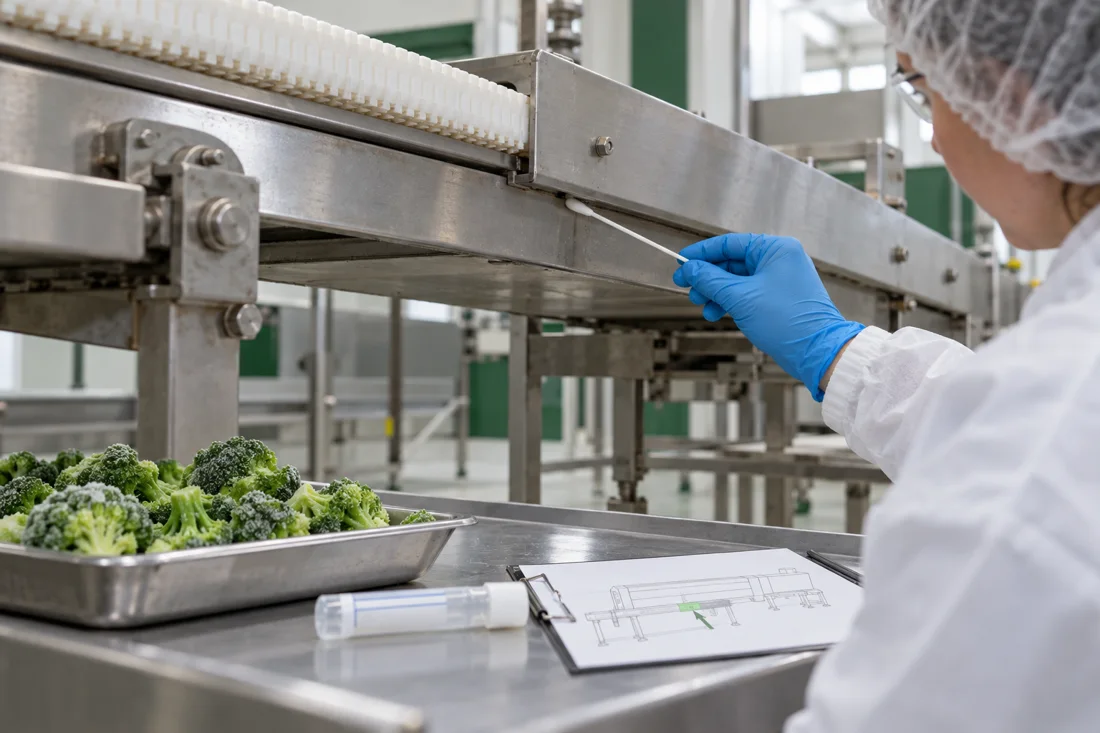
Reviewed 21 October 2026. Shipment requirements are checked for the actual product, route and filing date.
We help purchasing and quality teams turn a request for "microbiological control" into a scoped evidence request. The factory's responsible food-safety team owns the monitoring programme and product decisions. GreenLand connects the actual product and order to the available site, investigation and release records. The examples below illustrate a review method and contain no GreenLand laboratory results.
Map the exposed-food route before choosing swab sites
Begin with a process walk from incoming raw vegetables to the closed finished pack. Draw where food is exposed, where it is wet, where hands or tools touch it and where movement crosses a hygiene boundary. A photograph of a clean production room cannot establish these relationships. The drawing needs enough detail to distinguish a food-contact belt from its underside frame, the nearby floor drain and the wheels of a trolley entering the area.
For an illustrative broccoli line, the relevant sequence might include washing, cutting, blanching, cooling, freezing, conveying, inspection and packing. Confirm the actual sequence with the processing site. A belt following freezing can still contact exposed product, while a drain beside that belt can have an indirect transfer route through water, footwear, cleaning tools or maintenance activity. Sampling locations should follow the site's assessment of those routes. Assigning numbers to zones is useful only when their definitions remain visible.
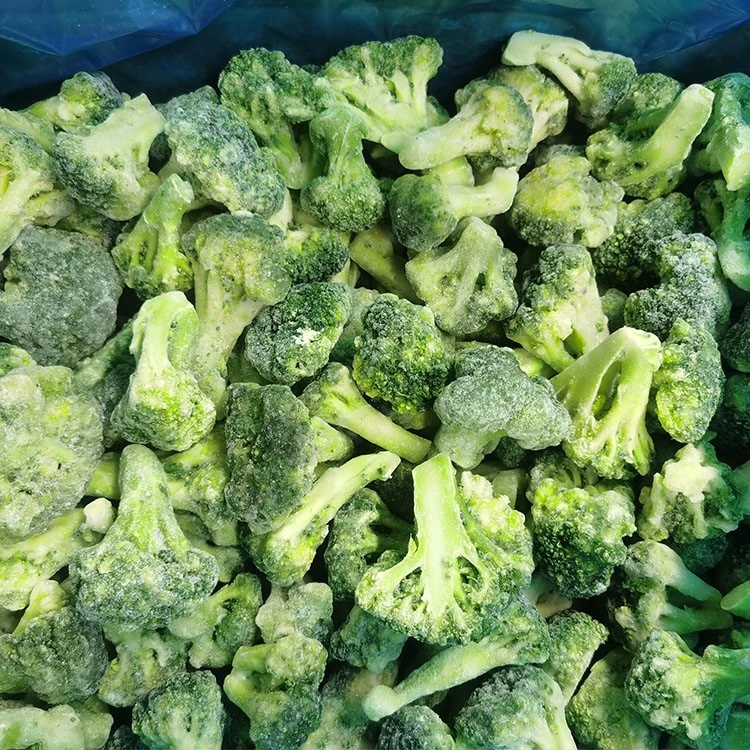
Original GreenLand product photograph: A second original view supports the discussion of pack identity and representative sample approval.. Product-form reference; not evidence from the DEMO order, sampling event or shipment.
Give every routine site a stable identifier and a specific physical description. "Packing room" is too broad. "Underside joint of conveyor P2, immediately before the bagging chute" allows another trained collector to find the same point. Record whether it contacts food directly, what adjacent activity could transfer contamination and whether access requires equipment disassembly. Attach a marked photograph or drawing to the controlled site list. The location reference belongs in the sampling record and laboratory submission.
Separate permanent sentinel sites from rotating or investigative sites. A stable group supports comparison over time; rotating sites explore places that a fixed list could miss. A maintenance intervention may justify targeted sampling outside either group. Keep those purposes identifiable in the dataset. Mixing all three into one monthly percentage can obscure why additional positives appeared after an investigation deliberately concentrated on a suspected niche.
The buyer can review the logic without receiving a complete proprietary factory blueprint. A redacted line sketch, site descriptions and movement arrows can establish the relationship between the supplied product and the monitored area. Ask which products share the route, which activities occur during the production window and which physical barriers reduce transfer. Where washing, cooling or packing is outsourced, identify the separate site and its evidence owner. One plant's monitoring file does not describe another location.
An effective supplier conversation ends with an agreed boundary: the named processing and packing activities relevant to the order. That boundary helps the buyer interpret a certificate, audit report or monitoring summary alongside the actual product route. It also prevents a generally reassuring factory document from being treated as evidence for a newly subcontracted packing operation.
Choose organisms and sampling times for the question
Write the monitoring objective before selecting the assay. A programme targeting Listeria species uses a different analytical question from a product test specifically reporting Listeria monocytogenes. General hygiene indicators can support other investigations. An ATP measurement describes a cleaning indicator under its own procedure. The factory's hazard assessment should explain which targets it uses and how each result changes the response. Do not combine unlike targets under one heading called "pathogen testing".
Sampling time also defines the question. A check after cleaning assesses a particular cleaned condition. Sampling during production can investigate the operating environment as equipment, water and people interact. A sample following a repair can address a specific intervention. Record the production state in ordinary language and retain the collection time. "Morning sample" is insufficient when sanitation finished, a belt restarted and maintenance entered the area at different times that morning.
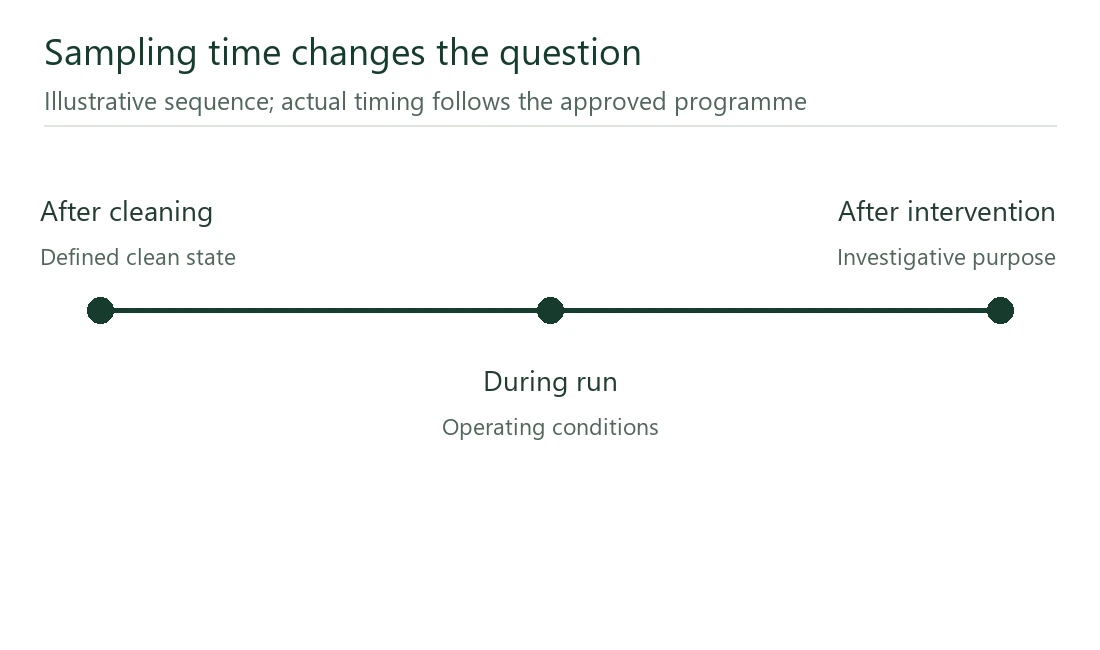
Monitoring sampling time. Illustrative method and DEMO data where shown. Swipe horizontally on a narrow screen to read the full illustration.
The FDA draft Listeria guidance discusses timing and site selection for ready-to-eat operations. It remains draft, nonbinding guidance. Use its discussion to frame technical questions within the actual operation rather than copying an example schedule into every frozen-vegetable contract. Canadian RTE policy likewise has its own categories and follow-up conditions. Those sources need their jurisdiction and intended-use scope attached.
Ask how the collection method handles residual sanitizer and hard-to-reach surfaces. The competent laboratory and factory should agree suitable collection materials, any neutralizer, transport conditions and time to analysis. Procurement should request that agreement rather than selecting a swab from a catalogue and assuming equivalence. A method suitable for one surface or organism may need further technical review when the factory changes its sanitizer or sampling device.
Set routine frequency and investigative escalation within the approved programme. A buyer may request a summary covering the production period relevant to its order, but that request does not automatically define how many swabs the factory must take. Record the rule's source: legislation, certification requirements, customer agreement or the site's risk assessment. When several customers request different schedules, the factory should explain how the combined programme meets the relevant obligations without losing site identity.
A practical review compares the planned schedule with the actual collection log. Look for missed visits, inaccessible points, cancelled production and substitutions. A rescheduled sample should show its new date and reason. Repeatedly missing the same difficult location deserves attention because the programme may be easiest to execute where it is least informative. The record should make that limitation visible to the approving quality team.
Keep the sample identity intact through the laboratory
The sample container and submission form should resolve to the same site and collection event. A useful identifier links the factory, line, location, date, time and purpose without exposing unnecessary customer information. Keep the laboratory accession number when it is assigned. This allows the reviewer to trace a result back through the original submission instead of relying on a spreadsheet row copied from an email attachment.
Use a collection log with the collector's identity, sampling device, defined area or surface description, target, production state and any deviation. Describe awkward geometry honestly. A small curved gasket cannot necessarily be sampled like a large flat panel. The laboratory or qualified programme owner should specify how the difference is handled. A nominal area printed on a form does not prove that the collector reached that area in practice.
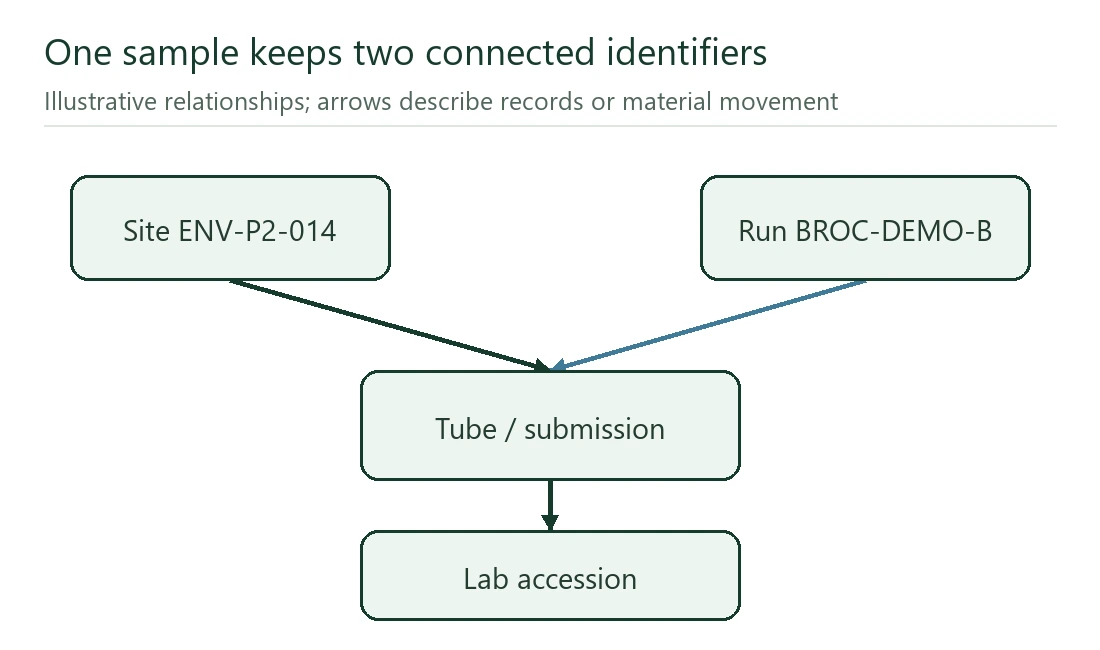
Monitoring custody identifiers. Illustrative method and DEMO data where shown. Swipe horizontally on a narrow screen to read the full illustration.
Record dispatch and receipt conditions when they affect method suitability. The submission needs the agreed transport requirements and the laboratory's acceptance or qualification of the received sample. If a package arrives late, warm, damaged or with conflicting identifiers, preserve that information. A report issued with a sample-condition qualification requires interpretation; quietly removing the qualification from the buyer's summary changes the evidence.
Environmental samples, retained product and shipment samples should remain distinct in the index. They can share a production-window reference while retaining their own sample types. A swab from a drain is not a sample of broccoli. A sealed pack from the freezer is not proof that a nearby drain is controlled. The relationship between these records is established through the investigation and hazard assessment, not through a common folder name.
For a DEMO record, ENV-P2-014 could identify one specific underside joint sampled during run BROC-DEMO-B. The laboratory might assign accession LAB-DEMO-082. The review file would preserve both identifiers, the collection event and the original report. These invented identifiers illustrate a linkage only. They make no statement about an organism being found or absent. Actual result fields remain dependent on the issued laboratory report.
The CFIA sampling procedures provide useful collection and identification context. For an order review, we would request the relevant submission record, original report and the factory's interpretation together. If the factory shares only a redacted extract, the extract should retain enough information for the responsible reviewer to establish site, method, production period and status. Redaction should protect confidentiality while preserving the meaning of the result.
Read trends with stable denominators and comparable methods
A trend chart needs its denominator. Two positive findings among forty routine samples and two among four targeted investigative samples describe different collection programmes. Reporting both as "two positives" hides that distinction. Reporting only percentages can also mislead when the number of samples changes sharply. Show the count tested, count positive, target organism, period and sampling purpose together.
Keep food-contact and non-food-contact results identifiable. Further groupings may help the site's investigation, such as line, room, recurring site, equipment type or shift. Select groupings that support a decision. A single whole-factory average can conceal repeated findings on one conveyor while many unrelated locations remain negative. Conversely, an increase in investigative positives may reflect better targeting rather than a newly established plant-wide trend.
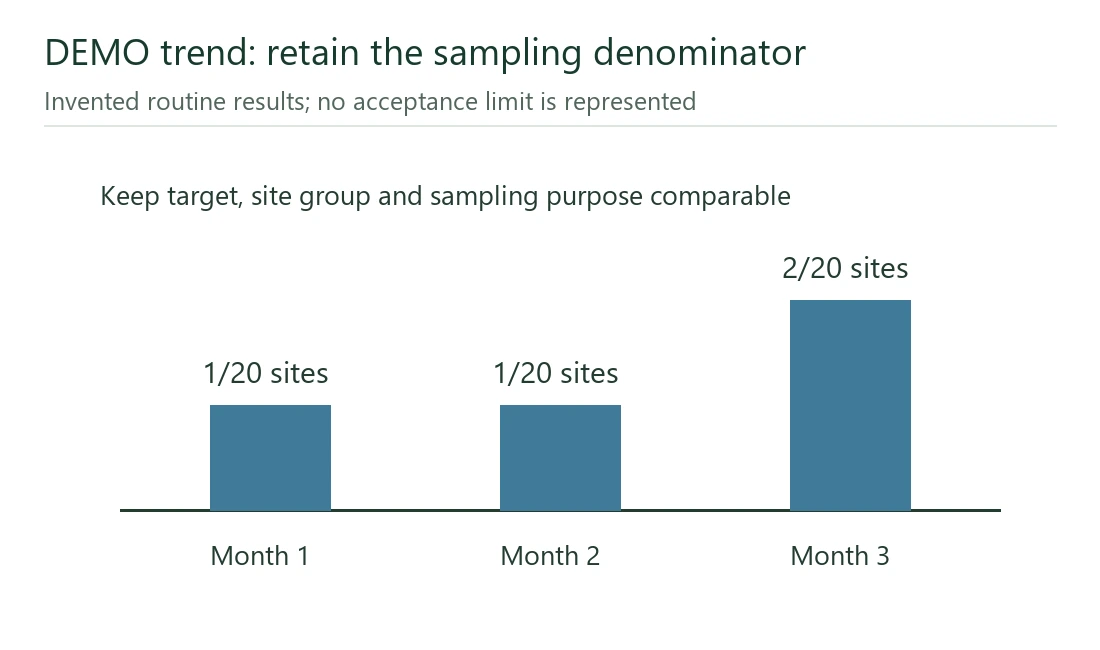
Monitoring trend denominators. Illustrative method and DEMO data where shown. Swipe horizontally on a narrow screen to read the full illustration.
An illustrative chart could show routine monthly counts of 1/20, 1/20 and 2/20. These DEMO numbers demonstrate a stable sampling denominator. They do not define an acceptable rate or an automatic action threshold. The programme owner must interpret location, timing, recurrence and transfer potential. A small number at a relevant food-contact point can require a different response from the same number at a remote site with no demonstrated route to exposed food.
Preserve method changes on the timeline. A new laboratory, assay, collection device, enrichment procedure or reporting convention may interrupt direct comparability. The laboratory should explain relevant differences. Do not erase the change by continuing a line graph without annotation. The same applies when a site is moved, renamed or sampled after disassembly for the first time. A location-code crosswalk helps maintain history while showing the revised physical boundary.
Review negatives critically as well. A long sequence of negative findings is useful only within the programme's ability to find relevant contamination. Ask whether the selected sites, timing and recovery method challenge the operation appropriately. This is a programme-design question for qualified technical staff. It is not a reason to manufacture positives or to treat a negative result as suspicious by itself.
Set a review interval and identify the person who examines the trend. The report should show what changed because of that review: a location added, a transfer route corrected, a collection time revised or a persistent pattern escalated. A chart filed without an interpretation does little for supplier approval. GreenLand can request a scoped summary for the actual factory and product route, with investigation references where relevant, rather than distributing a generic "all results satisfactory" statement.
Investigate a positive site through its transfer routes
Start by preserving the exact finding and its status. Record the organism or indicator reported, the method, site, collection state and whether the result is presumptive or confirmed under that method. The factory's written response should identify the people responsible for sanitation, engineering, production, laboratory communication and product assessment. Commercial staff need clear information about order status, while technical disposition remains with the designated authority.
Investigate how contamination could move from the site toward exposed food. Review water movement, splash, footwear, trolley wheels, cleaning tools, hands, compressed air and maintenance access where relevant. A drawing can make the proposed route easier to challenge. The investigation should explain observed evidence and reasonable hypotheses separately. Finding an organism near a drain does not establish every step of a transfer route without further assessment.
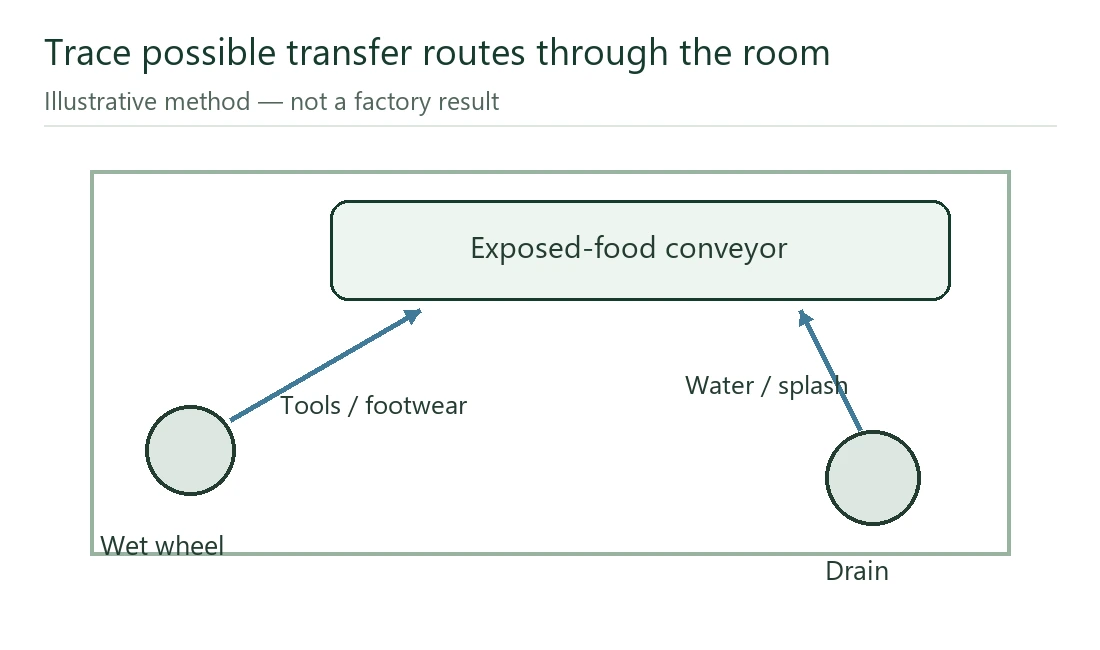
Monitoring transfer routes. Illustrative method and DEMO data where shown. Swipe horizontally on a narrow screen to read the full illustration.
Corrective action should address the suspected cause and verify its effectiveness. Cleaning a visible surface may leave an inaccessible joint, damaged seal or recurring water collection point unresolved. Where equipment disassembly is needed, trained staff should control the intervention and reassembly. Document the actual work, materials or parts changed, cleaning procedure, responsible person and verification. A photograph of a newly polished machine does not establish microbiological effectiveness.
Targeted follow-up sampling can explore neighbouring sites and the proposed route. Keep its purpose separate from routine trend data. The approved investigation should state the target, locations, timing and interpretation before results arrive. Additional sampling should answer whether a suspected niche or transfer route remains, with the limits of recovery and representativeness understood. Repeating one conveniently accessible swab until it is negative is a weak investigation design.
The CFIA Listeria control guidance describes different follow-up considerations for food-contact surfaces, other surfaces and food. Its Canadian RTE context matters. A frozen-vegetable supplier should connect the relevant principles to its actual product use and applicable programme, with qualified interpretation of product implications.
The buyer's useful outcome is a concise account of the affected route, corrective work, verification and remaining restrictions. Preserve unresolved hypotheses as unresolved. If the factory has not established whether an order was exposed, the shipment file should show the review as pending. A commercial deadline cannot supply the missing technical conclusion. That status allows the buyer to plan inventory without mistaking an ongoing investigation for a completed release.
Consider a DEMO event on a conveyor frame sampled midway through a broccoli run. The initial record identifies the exact underside joint, collection time, production state and laboratory reference. The investigator then asks whether the frame contacts packaging, whether water can splash upward and whether a maintenance tool moved from that frame to a food-contact part. These are questions to establish from observations and operating records. They are not conclusions supplied by the positive result alone.
The factory preserves the run schedule and lists the lots that used the conveyor during the relevant window. Engineering checks the joint and records any defect found. Sanitation records the corrective work, while the programme owner specifies follow-up locations and collection conditions. The product assessment records which information remains outstanding and whether any inventory restriction applies. The resulting file can support a qualified disposition without claiming that every carton was contaminated or that a later negative swab automatically clears earlier production.
This example also shows why response speed and investigation quality need separate measures. A factory can acknowledge a result promptly while still needing time to establish the affected boundary. Its first customer update should communicate confirmed facts, immediate controls and the next review time. Later updates add the technical conclusions and disposition reference. Rewriting an early uncertainty as a confident final statement would make the history harder to audit.
Decide product status and restart with responsible QA
An environmental finding and a finished-product disposition are related decisions with different evidence. The factory should identify production lines, time windows, raw-material batches, rework and finished lots potentially affected by the investigated route. Retain inventory and dispatch information. Define which stock is held, where it is stored and whether anything has already moved beyond the site's direct control.
Restart approval should identify the conditions the factory must meet under its programme. These may involve corrective work, sanitation verification, environmental results, process review or additional product assessment. The responsible food-safety team determines the applicable combination. Neither a clean-looking area nor an acceptable ATP reading independently supplies all the evidence needed for microbiological disposition.
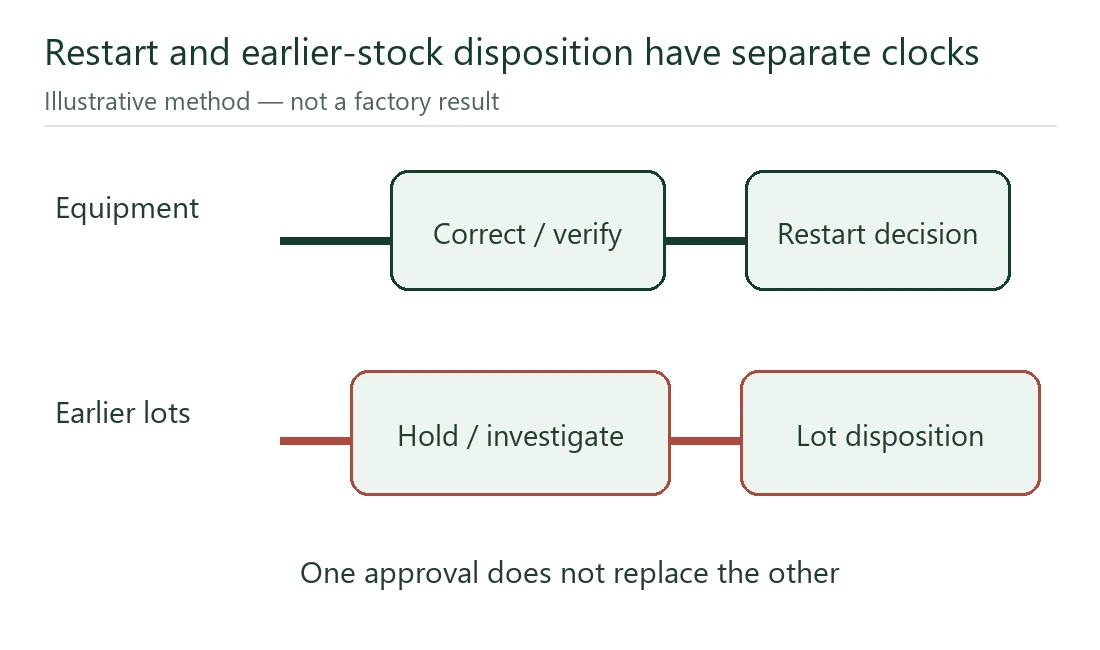
Monitoring restart and stock. Illustrative method and DEMO data where shown. Swipe horizontally on a narrow screen to read the full illustration.
The Health Canada control-measures policy demonstrates why follow-up depends on product category and finding type. Its specified sequences should remain attached to their policy context. A buyer should not turn one jurisdiction's example number of negative sampling days into a universal release condition for all frozen produce.
Keep restart of equipment, release of newly manufactured food and disposition of earlier held food as separate approvals where appropriate. They may occur at different times and require different records. A line can be technically ready for a controlled verification run while previous inventory remains on hold. Conversely, a lot decision does not automatically close the investigation into a recurring equipment niche.
When product has shipped, the importer and designated incident team need the affected-lot information promptly through the agreed communication route. Official restrictions require the responsible local party to track the authority's instructions and release status. The supplier provides traceability, process and investigation records. A customer email accepting delivery cannot itself remove a regulator's hold.
Request a scoped environmental-monitoring evidence pack
A useful order evidence pack identifies the actual processing and packing sites, product route, intended use and relevant production period. It includes the controlled programme summary, selected site map, sampling and laboratory references, trend interpretation and any applicable corrective-action or product-disposition record. The level shared can reflect confidentiality and customer requirements while retaining the information needed for a qualified assessment.
Before an order, tell us whether your quality team needs an audit extract, a monitoring summary for a defined period, original reports under controlled access or an investigation record for a specific event. We can coordinate the request with the actual factory. Agree the timing early, especially where a customer's approval must precede production or dispatch. The evidence request becomes part of the order handover rather than an unexplained demand after the container has loaded.

Original GreenLand product photograph: Original GreenLand product photograph showing the floret form used in this import example.. Product-form reference; not evidence from the DEMO order, sampling event or shipment.
For repeat orders, review changes in site, line, process, product use, sanitizer, method and monitoring design. Record whether the earlier supplier approval still covers the new arrangement. A current certificate can support the review, while the operating records establish what occurred within the period being assessed. The purchase specification and release plan should identify who accepts that evidence and what remains outstanding.
An evidence index can use one row for each requested item, with document owner, revision, covered site, covered production period, status and the reviewer who accepts it. A programme summary might be available for routine customer review while detailed sampling drawings remain under controlled access. An original report may be shareable after unrelated customer details are removed. State those access arrangements before approval so an attachment marked confidential does not become an unexplained missing item.
Review the index against the order rather than against the number of attachments. Five reports from an earlier season may provide history but leave the current packing route unaddressed. One concise current investigation extract may answer a specific question more effectively, provided the original evidence remains traceable and the qualified reviewer accepts its scope. Record that acceptance and any remaining condition. The customer then receives a usable explanation of the programme, its relevance to the supplied product and the limits of the shared record.
The practical standard is a reconstructable decision: which surface was sampled, what the result means, how the route was investigated and who approved the product's status. That record gives purchasing a usable answer and leaves food-safety judgment with the qualified people responsible for the operation.
Build your frozen vegetables order with GreenLand-food
GreenLand-food is a professional frozen vegetables supplier and manufacturer in China, providing factory-direct wholesale supply for importers, food manufacturers and foodservice programmes.
Send your product form, specification, packing, quantity, application, destination, private-label needs and requested documents. We will organise the product and order requirements with your purchasing and quality teams.