


Investigating Frozen Produce Quality Claims After Arrival
Oct 20, 2026
Leave a message

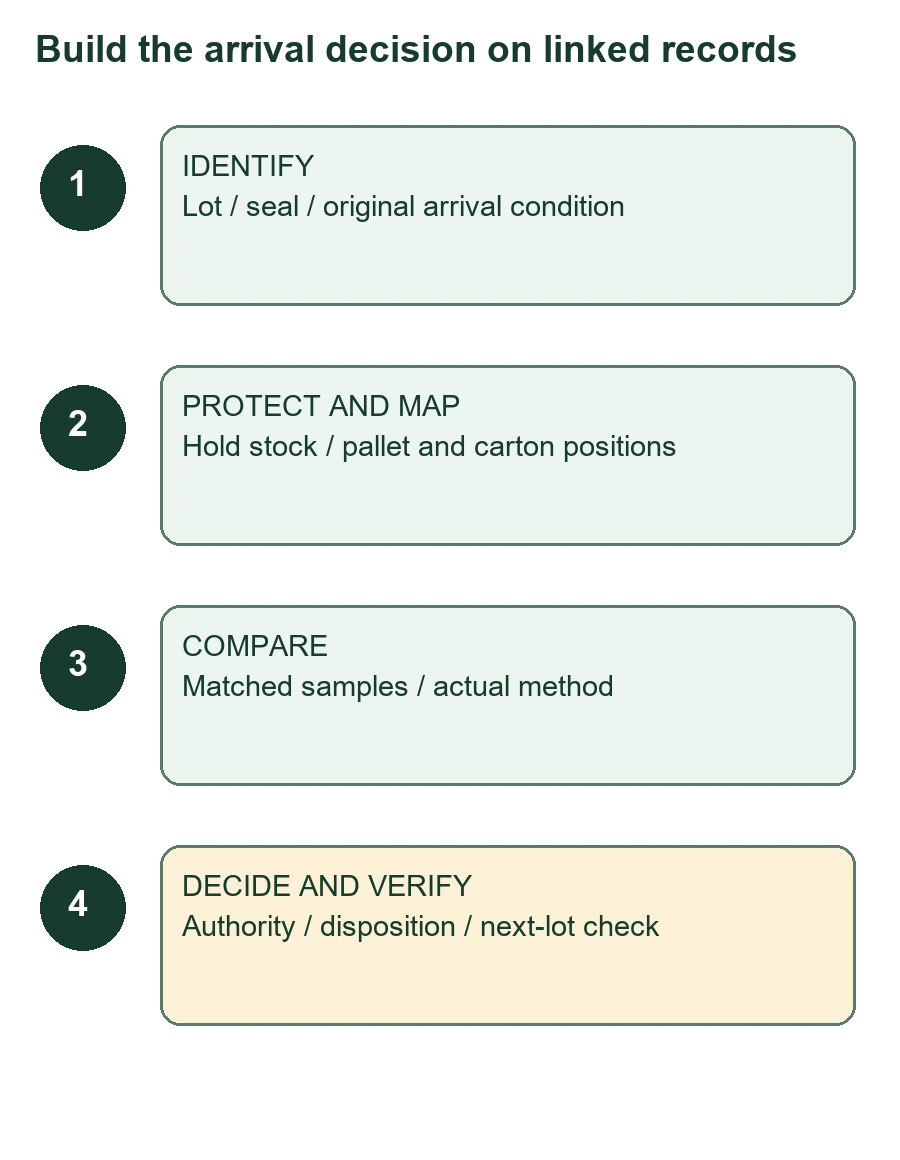
Protect and identify the stock, preserve its original arrival evidence, map the affected quantity, agree a matched sample method and assign the lawful decision. Investigate cause and compensation on that file; a favourable supplier retest or a discount cannot by itself release unsafe or officially held food.
Reviewed 20 October 2026. This guide covers Chinese-origin frozen vegetables, fruit and cultivated mushrooms in industrial packs. It explains an investigation method and clearly marked fictional calculations. Apply the actual destination requirements, contract, food-safety assessment and carriage terms to your consignment. Our existing quality-claims support page explains how to start the service conversation.
Protect the stock and record the first arrival finding
The receiving lead should open one incident number and record the container, seal, delivery document, product, production code, quantity, arrival time and first observer. Record local time and its UTC offset. Photograph the load before rearranging it: container identification, doors and seal, load layout, damaged and apparently sound cartons, labels and the product finding. Keep original files and metadata. A cropped image can help illustrate the complaint, but the original remains in the evidence folder with a caption identifying where and when it was taken.
Bring product into suitable frozen holding promptly while preserving its identity. Mark the provisional hold in the warehouse system and physically separate the relevant stock. Record quantities moved and new storage locations so mitigation does not erase the arrival layout. If there is suspected contamination, an official detention, a serious temperature failure or an unexplained safety result, involve the responsible quality professional and importer immediately. Do not taste suspect food, trial it in a production recipe or sell it to reduce storage cost while its status is unresolved.

IQF broccoli florets: confirm the visible-piece specification, fragment method and cooking use before sample approval.
Agree broccoli portions and receiving quality before ordering
For visible meal portions, compare floret dimensions, stem profile, loose fragments, cooking performance and industrial packing. We can organise a matched sample and order-specific inspection plan; use the same approved method at production and receipt.
Request Specifications & QuoteThe FDA transportation questions explain that, within the US rule's scope, an indication of potentially unsafe transportation conditions calls for preventing sale or distribution until a qualified determination. That scoped duty is different from a universal rejection temperature. Maritime carriage, the destination's food rules and a buyer's contract can create different obligations. The incident file should identify the applicable authority, the person making the food-safety decision and the written conditions needed before any stock moves.
Classify the initial report without prematurely classifying the cause. "Fragments exceed the signed mass limit under method version 3" is a testable quality allegation. "A carton is wet and warm at receipt" is an observation requiring a temperature and packaging investigation. "The whole container thawed at sea" is a causal conclusion that needs evidence. Record what the observer actually saw separately from the explanation proposed by purchasing, warehouse staff or the carrier. GreenLand uses that distinction when requesting the production and loading records.
Notify GreenLand with the incident number, invoice or order reference, batch codes, first photographs and the currently held quantity. The importer should separately notify the carrier, terminal, insurer or authority through the channels required for its shipment. Name an owner for each notice and record receipt. An acknowledgement confirms that a message arrived; it does not admit liability or clear the food. Do not wait for a fully quantified commercial claim before protecting the cargo or preserving time-sensitive evidence.
Product selection belongs earlier in the order, because it defines what is a defect. For visible broccoli portions, a buyer may need a narrow floret distribution and limited loose buds; a soup processor may accept a different fragment distribution. Use the actual product form, sample and application in the quotation. GreenLand can organise that sourcing comparison and record the cut, defect method, cooking use and pack before production. Those agreed conditions then become the receiving reference, rather than a new grade invented after delivery.
Read the temperature record without confusing targets and product readings
Request the logger's original export, device serial number, calibration or verification status, configured interval, start and stop times, time zone, placement photograph and any record of relocation. Keep the raw file read-only and perform calculations on a copy. Ask the operator for the reefer controller record, set point, supply and return air channels, alarm history, power interruptions, defrost events and relevant plug-in or transfer times. These are different measurements and events; do not merge them into a single "cargo temperature" column.
A set point is a target setting. Supply air, return air, a logger near a door, a between-pack reading and an intrusive product measurement describe different locations and responses. The AFFI/GCCA monitoring protocol makes that measurement distinction and records sensor position and movement. Its study design is useful for planning evidence; it does not authorise a warmer contractual limit or a universal safe period outside frozen storage. Use the full product and exposure history for the actual decision.

A temperature target cannot substitute for a product reading; retain the sensor location and method with each result.
Build a time line in one time basis. Retain the original local times, then add a converted UTC column with the conversion rule. Mark loading, gate-in, vessel departure, transhipment, discharge, inspection, collection and warehouse receipt from original records. A graph should identify missing data instead of drawing an invented line through a gap. Confirm the logger was actually activated before using a flat trace as proof of compliant transport. If a device was moved, identify the period before and after the move.
At receipt, a trained operator uses the agreed instrument and measurement method. Record instrument identity, its check, the carton and product location, time, reading, relevant uncertainty and whether the check was non-destructive or intrusive. An infrared surface reading is not a core reading through a sealed carton. If an intrusive check is needed, use a controlled hygienic procedure and treat punctured packs according to the receiving programme. Keep the inspected product protected from ambient warming during the examination.
For a fictional order whose contract requires product storage at −18°C or colder, a brief air logger rise to −12°C near an opened door is a reason to investigate timing and product measurements. It is neither proof that every piece reached −12°C nor automatic permission to accept it. Conversely, an apparently normal air trace cannot exclude a warm-loaded pallet or an unmonitored local problem. Describe the limits of each measurement and obtain a product-specific decision from the authorised quality professional.
GreenLand's dispatch file should specify the product-temperature requirement, unit and sign, loading checks, logger identity and location, carrier instructions and the responsible handover contact. TT Club's temperature-controlled cargo brief highlights communication, settings, equipment and airflow checks. We use those practical topics to structure the order discussion. Equipment alarms and operating alerts are investigation triggers; they do not replace the destination's food decision or the agreed product acceptance method.
Map the affected cartons before defining a whole-lot loss
Create a simple load map that identifies pallet numbers, rows, levels, carton codes and the door and refrigeration-unit ends. Add the logger positions and the observed finding. A leaking upper carton, crushed corner or cluster near a blocked airflow path should retain its spatial meaning. If the cargo has already been moved, reconstruct the original positions from loading photographs, warehouse records and the receiver's notes, and clearly identify any positions that cannot be recovered.
Keep three quantities separate: the shipment quantity, the quantity temporarily held while scope is uncertain, and the quantity demonstrated to have the defined nonconformity. A provisional whole-container hold may be appropriate while investigating an unidentified safety risk. It does not, by itself, prove the whole container's commercial value has been lost. Equally, two damaged cartons are not a sound reason to release the remainder where the same contamination or production cause could affect it. The quality lead records why the provisional boundary is wide or narrow.

Fictional positions show how location and affected quantity are recorded; they do not establish cause or a statistical acceptance plan.
Define the population before selecting samples. It might be one supplier production lot, a processing time window, all cartons sharing a packaging defect, or a spatial group exposed to a transport event. Preserve production and shipment boundaries separately: one container can hold several factory lots, while one factory lot may be shipped in several containers. GreenLand asks the processor for the lot genealogy, intake codes, production times and pallet allocation to identify related stock beyond the visibly affected positions.
For a fictional load of 20 pallets, each with 50 cartons of 10 kg, the total is 1,000 cartons or 10,000 kg. If two mapped pallets are initially affected, their physical stock is 100 cartons or 1,000 kg. This arithmetic only describes location and quantity. It does not establish a 10% defect rate in all units, an acceptable quality level or a statistically representative sample. If inspectors examine cartons from several positions, record exactly how they were selected and which inference that design can support.
Use a planned physical-quality sample across the relevant positions and production times, not only the worst photograph. Keep deliberately selected diagnostic samples separate from a probability-based acceptance sample. Fix the unit-carton, bag, piece or gram-and the selection method, sample size and decision rule before opening units where practicable. Existing inspection and sampling guidance helps prepare that conversation. Safety testing needs its own applicable units and plan; a physical-defect AQL does not become a microbial release rule.
The scope changes as evidence arrives. Record additions and removals, reasons, time and authorisation in a stock movement log. If a shared production or safety cause is found, extend the review to connected lots and customers through the importer's applicable traceability and withdrawal process. If an isolated crushed pallet is supported by the evidence, document the basis for evaluating unaffected stock separately. A salesperson should not narrow the boundary to reach a settlement before the quality lead has assessed the common-cause risk.
Agree the sample, preparation and laboratory comparison
A retained sample is useful only if it represents a known lot and its storage and custody are documented. GreenLand requests the processor's sealed retain identity, quantity, sampling date, product state and storage history. The receiver records the same details for its arrival sample. Where a joint inspection is possible, agree the inspector, laboratory, sample allocation and method with the parties before destructive work. Provide the independent examiner with the signed specification and original methods, not just a statement that the cargo is "poor quality."
Freeze the inspection instructions in a versioned sheet. Specify whether the quality examination is on frozen, tempered, thawed, drained, squeezed or cooked product. Record sample mass or count, thawing conditions, sieves, drainage time, cooking equipment and load, endpoint, holding period and reject definition. Two temperatures or two drainage periods can change water loss without any supplier fraud. If the customer's current application differs from the qualification trial, run both methods and name them rather than substituting the newer result into the old specification.

The offered cut-bean form needs its own sample identity, preparation and analytical matrix; do not interchange it with a seed-only sample.
For chemical or microbiological work, commission an appropriately scoped laboratory and identify the matrix, sampled part, target analytes, method, reporting limit and applicable criterion. Keep individual units distinct where the regulatory plan requires them. A composite physical-quality sample is not automatically an acceptable safety sample. Record transport conditions and custody from sampler to laboratory. Ask how the laboratory will report uncertain, out-of-range, damaged or thawed samples and which limitations will be attached to the result.
Before comparing two reports, check that they measured the same thing. For pesticide results, that includes the legal residue definition and components; for microbial results, the organism, unit, analytical portion and sample plan; for defects, the numerator and denominator. A non-detect with an unsuitable quantification limit does not resolve a lower legal limit. Different laboratories, sub-samples and methods can yield different results without showing which party caused the original finding. Use ILAC decision-rule guidance to frame the laboratory discussion while following the actual authority's required interpretation.
A supplier investigation test cannot independently overturn an official noncompliance result. Keep the official sampling record, laboratory result, notice and response deadline in the importer file and use the competent authority's actual review or disposition route. For a contractual quality dispute, agree any joint repeat test and its role in writing: confirmation, diagnostic investigation or an agreed arbitration test. Do not repeatedly sample until one result passes and discard the failures. Preserve every result and explain why any observation is excluded.
The paired file should travel back to production. GreenLand coordinates the relevant source, cleaning, cutting, treatment, sorting, freezing, packaging and dispatch records with the actual processor. Each response should name the lot and document version and answer a specific observation. A generic HACCP certificate or an unrelated COA cannot show whether the disputed pallet used the approved cut or passed its batch check. Where a required record is absent, keep that decision unresolved and assign its owner; do not replace it with a broader marketing statement.
Build a worked quality-dispute comparison without rewriting the contract
Consider a fictional broccoli order for visible meal portions. The signed method grades frozen product by an agreed sieve threshold and expresses loose fragments as fragment mass divided by total sampled product mass. A separate cooking trial measures accepted cooked drained florets against its own starting frozen mass. The contract includes a buyer-defined fragment limit, but this demonstration does not invent a legal percentage or claim a GreenLand lot met it. The approved sample, production check and arrival sample must use the same definitions.
In a fictional 1,000 g sample,70 g of defined fragments gives 7.0% by mass. If the remaining 930 g is cooked and gives 790 g of accepted drained florets, the cooking-stage yield is 790 ÷ 930 = 84.95%. Overall accepted output against the original sample is 790 ÷ 1,000 = 79.0%. Multiplying 0.93 by 0.8495 gives approximately 0.79. If a buyer instead counts every tiny bud as a separate piece, its piece-count percentage answers a different question and cannot be compared directly with this mass specification.

A matched comparison preserves original findings and explains their differences; it does not override an official result.
Now suppose the customer's arrival examination reports 11% fragments but used a larger sieve opening and included thawed material, while the dispatch record used the agreed frozen method. Repeat the authorised comparison on identified samples under the contract method and retain the original 11% finding as a separate observation. Do not declare it false or erase it. The difference may reveal a method mismatch, transport breakage, a production distribution problem or several factors. Record competing explanations and the evidence that would support or weaken each.
An approved sample may have come from a pilot run, an earlier crop or a hand-selected pack. Record that provenance during qualification and ask whether it reasonably represents the contracted production route. When GreenLand arranges the production comparison, the factory's sample selection should cover the relevant processing times and packs. A single attractive bowl photograph cannot prove consistency across a container. Keep the sample approval, mass data and batch checks together so the buyer can tell a production difference from an inspection difference.
Different ingredients need different comparisons. For spinach filling, fixed draining and squeezing matter; for mango puree, fibre and sieve loss matter; for shiitake soup, thickness, stem proportion and cooking water belong in the trial. Use the corresponding product guide and T08 application worksheet to define those operations. A cooked weight can include added water or sauce, so record additions and measure the ingredient output separately when comparing source performance. Do not interpret a higher wet weight as better quality without the application result.
Quality evidence supports a commercial decision only after the safety and legal gates are satisfied. If the product fails a visible-piece grade but is safe and lawfully suitable for a separately approved soup application, the authorised parties may evaluate regrading and its documentation. A different use can change labelling, customer approval and certification scope, so it requires an actual assessment. Suspected pathogens, illegal residues or an authority hold cannot be solved by offering the buyer a cheaper application or applying more severe cooking without permission.
| Fictional measurement | Numerator / denominator | Result and meaning |
|---|---|---|
| Defined fragment mass | 70 g / 1,000 g original frozen sample | 7.0% mass; not a piece-count rate |
| Cooking-stage accepted output | 790 g / 930 g graded cooking input | 84.95% under the agreed cooking/draining method |
| Overall accepted output | 790 g / 1,000 g original input | 79.0%; do not multiply displayed percentages as whole numbers |
Quantify the claim and separate disposition from compensation
Prepare a quantified file only for the bounded finding supported by the investigation. List product and lot, affected units and mass, invoice value basis, proposed treatment or loss, documented handling costs and any lawful salvage proceeds. Keep normal operating cost, incremental incident cost and speculative future loss on separate lines. A contract, insurance policy or carrier may treat them differently. The fact that an expense was incurred does not by itself show that another party owes it.
For a fictional calculation, assume 1,000 kg of goods has a supported lost value ofUSD 2.40/kg, or USD 2,400. Recorded incremental inspection, storage and lawful disposal costs are USD 180, USD 120 and USD 80. Actual lawful salvage receipts are USD 300. The arithmetic is 2,400 + 180 + 120 + 80 − 300 = USD 2,480. This is an itemised claimed-loss example, not an admission, a promised recovery or a general damages rule. Do not add the original purchase value again under a second line called replacement cost for the same goods.

The example illustrates arithmetic and cost boundaries; it is not a promised settlement or a statement that all expenses are recoverable.
Attach the records that justify each line and the quantity boundary. The Maersk cargo-claims guide illustrates a carrier's need for shipment documents, photographs, survey findings and a supported calculation. Your own carriage contract, mode, insurer and law govern notices and time limits. Have the responsible party verify them immediately. Do not copy a deadline from a guide for another service and assume GreenLand's commercial correspondence preserves the carrier claim.
Disposition and compensation are separate decisions. The importer and authorised food or quarantine authority determine any regulated correction, treatment, re-export or destruction. The warehouse carries out only the documented instructions applicable to its stock. GreenLand coordinates source records and the agreed supplier investigation; sales manages the commercial proposal after quality status is clear. Any surveyor reports observations within the commission. A survey report is not automatically a food-safety approval or a binding allocation of legal liability.
Mitigate loss while preserving evidence and complying with restrictions. Protect sound cargo, maintain the required cold holding, document reasonable handling and obtain authorisation before destructive treatment or disposal. If examination must proceed before all parties can attend, notify the relevant parties, record why delay would worsen loss and preserve samples and original photographs where lawful. Capture the stock movement and final receipts or destruction certificate. Do not retain suspect food solely to preserve a claim when the authority requires its disposal.
Close each claim line with the decision, decision-maker, date and supporting document. Record whether a settlement concerns quality only, the identified quantity and any reservations; use the actual agreed commercial terms. Keep rejected, withdrawn and destroyed stock out of saleable inventory. The final file should distinguish what was observed, what was established about cause, what remained uncertain, how stock was handled and which payment or replacement was agreed. Those distinctions make the next-order changes more useful than a vague note that the complaint was "resolved."
Put GreenLand source-to-delivery controls and corrective verification in the order
The best investigation preparation starts before quotation. Your purchasing team confirms product, destination, use, visible or processed application, pack and acceptance state. GreenLand coordinates a written specification with the actual processor and identifies which requirements are legal, certified or contractual. QA defines the source and production lot, method and sample basis, requested tests, photographic standards and the release owner. Unresolved product identity, intended use or certificate scope is a pre-production hold, not a note left for the arrival team.
At sourcing and intake, the procurement lead obtains actual crop or cultivation identity and treatment information needed for the risk and test plan. The processor records intake defects, rejects, lot codes and material movements. The production team records the agreed cleaning, repair, cut, thermal and cooling route, separation of unsuitable stock and the controls relevant to the product. A change of origin, factory, recipe, pack or use enters change control. GreenLand asks for the affected lots and the checks needed before the revised route is approved.

Document the responsible decision-maker and conditions for the actual stock, then verify the corrective action against the agreed method.
Before dispatch, the designated QA reviewer reconciles the physical inspection, applicable laboratory reports, record of deviations, labels, certification scope and commercial lot identities. The loading coordinator records container suitability, instructions, product and equipment checks, pallet map, seal and logger placements. The documents lead supplies a consistent invoice, packing list and required product or batch documents to the importer and authorised agent. Missing test coverage, a failed criterion or an unresolved regulated document prevents the affected lot from being treated as ready to load.
At arrival, your receiver uses T11 to record the untouched condition, stock map, original data and samples, while the importer monitors the actual clearance and official conditions. GreenLand's quality coordinator links that report to the dispatch and processor records. Decide the comparison method and affected-stock boundary before discussing a broad refund. Keep safety, legal, technical and commercial decisions assigned to their proper owners. T12 provides the change and affected-lot record when the investigation identifies a common production or sourcing issue.
Corrective action needs a testable explanation. If the finding is excessive fragments, examine raw maturity, handling, cutting, blanching, freezing, packing and transport distribution against the evidence; do not automatically blame freezing. Specify the change, responsible person, completion record and next-lot check. If a label or document mismatch caused the hold, fix its approval and version-control step. If sampling methods diverged, issue a common method and train the teams before the next comparison. Record which evidence will show the action worked.
Verification should check the next relevant lots using the same method and the intended customer application. Define the number of lots or trials and acceptance conditions with the responsible quality professional; there is no universal three-lot rule in this guide. Retain the results, including failures, and reopen the action if the criterion is not met. A short freeze–thaw stress test can examine a mechanism but cannot on its own prove shelf life or reconstruct the transport history of the disputed cargo.
Send your product form, destination, application and the main acceptance concern when requesting an order plan. We can then organise the appropriate source, sample comparison, specification, testing and document handovers. For an existing arrival report, include the order and lot references, held quantity and original observations first. That gives GreenLand and your team a shared starting file and lets each specialist act on a concrete question while the cargo remains under the appropriate control.
- Buyer and GreenLand lock the product, purpose, sample method and document responsibilities.
- Processor and designated QA record source, production, inspection, deviations and release evidence.
- Logistics and importer preserve loading identity, temperature evidence and actual clearance conditions.
- Receiver and quality lead record findings, bound the hold and commission the agreed investigation.
- Authorised parties determine lawful disposition and commercial handling; QA verifies the corrective action.
Use the existing order worksheets
Use T11 for the original arrival condition, stock map and sample custody. T12 records changes, related lots and authorised dispositions. T08 keeps the customer application trial on a repeatable basis.
Build your frozen food order with GreenLand-food
GreenLand-food is a professional frozen food supplier and manufacturer in China, providing factory-direct wholesale supply for importers, food manufacturers and foodservice programmes.
Send your product form, specification, packing, quantity, application, destination, private-label needs and requested documents. We will organise the product and order requirements with your purchasing and quality teams.