


Manufacturer Declarations for Frozen Produce: Signatories, Scope and Supporting Records
Oct 22, 2026
Leave a message

Research This Article & Topic with AI
Verify key claims, compare reliable sources, and explore GreenLand-food's practical frozen food knowledge.
Article details and research questions are prepared in the links. Sign-in or sending may be required.
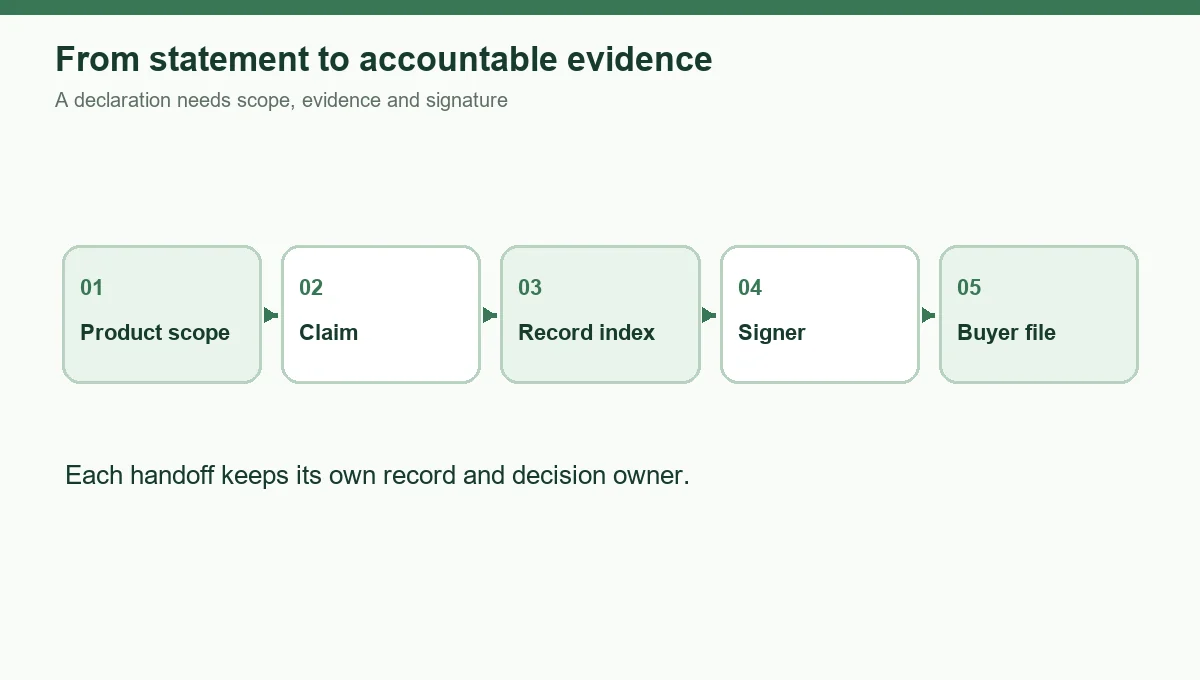
Reviewed 22 October 2026. Illustrative figures and DEMO IDs are not GreenLand lot results or customer limits.
Decide what the declaration can and cannot assert
A manufacturer declaration is a dated statement by an identified manufacturer about named products and a defined activity. It is useful only when the signer has authority, the claims fit the manufacturing site and product form, and the underlying records can be produced. A letter that says simply "all frozen vegetables comply with all markets" gives a purchasing team little to verify. The first buying question is what the letter is intended to support: a product specification, a customer quality file, a destination-specific import step, or a statement about a particular production control. Each purpose needs a different scope and evidence set.
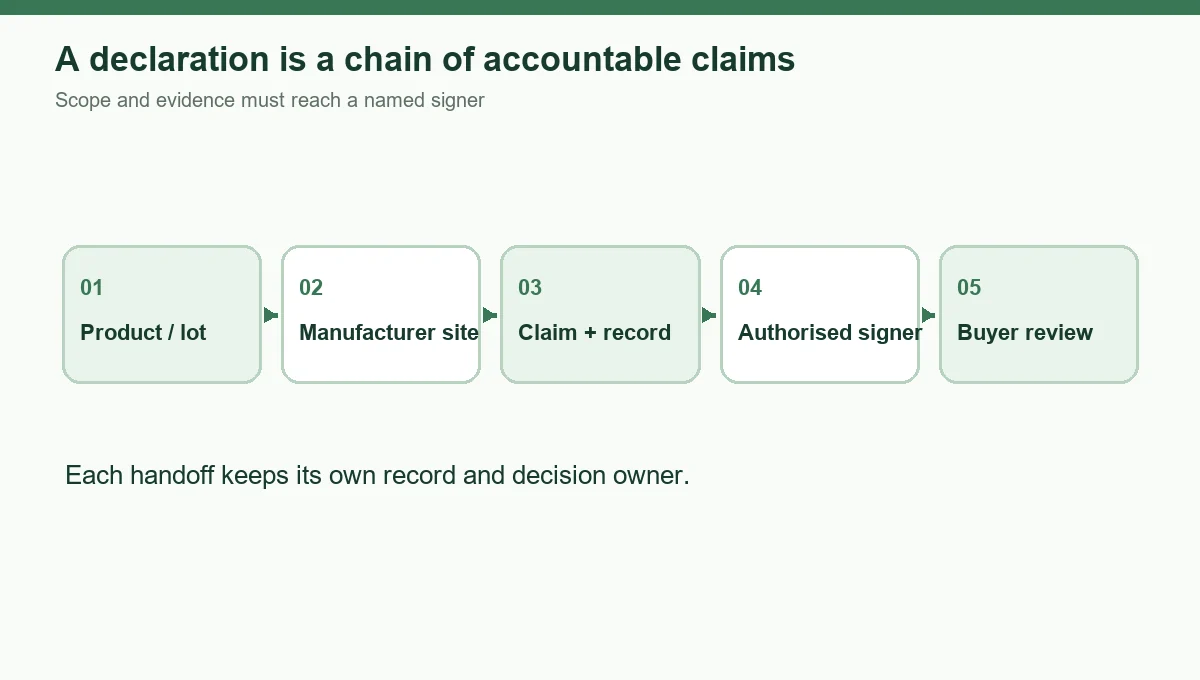
Illustrative method diagram; no actual lot, factory test or customer result is shown.
We help buyers separate the declaration from the supporting documents. A certificate can show that a management system or facility was assessed within a stated scope and validity period. A lot-specific certificate of analysis reports specified test results for a named sample. A product specification records agreed attributes and methods. A signed declaration ties selected statements to the manufacturer and effective product scope; it does not replace those other records. In the New Zealand ready-to-eat frozen-berry example, the regulator asks for a particular declaration alongside a recognised certificate. That example must not be copied into an unrelated market or into an industrial vegetable order as if its wording were universal.
Before drafting, list every proposed sentence as a testable claim. "Produced at Site A under revision 3 of the approved food-safety plan" can point to a site record, plan version and affected production dates. "Free of all hazards" cannot be established by a signature. "Manufactured for further processing" describes an intended use but says nothing by itself about whether a buyer may market the product as ready to eat. For each statement, identify the owner, record, date range and limit of inference. If a claim cannot be supported, narrow or remove it before anyone signs.
The decision is practical. Ask whether the buyer could select one carton and trace the statement back to that carton's product code, producing site and evidence period. If not, the letter may be visually complete yet operationally empty. Keep commercial promises, technical specifications and statutory wording in separate controlled places. This stops a broad sales phrase from becoming an accidental declaration about a process the named factory does not operate.
Identify the manufacturer, site and authorised signatory
The legal manufacturer, actual processing site, exporter and sales contact can be different entities. A buyer should see the registered company name and address, site address if different, plant or facility identifier where applicable, and an accountable contact for evidence requests. A trading company can coordinate documents, but its letterhead should not silently imply that it ran the blancher or freezer. Conversely, a factory declaration may be transmitted by a supplier representative without changing who authored the claim. Record those roles in a one-page authority chain before circulating a draft.
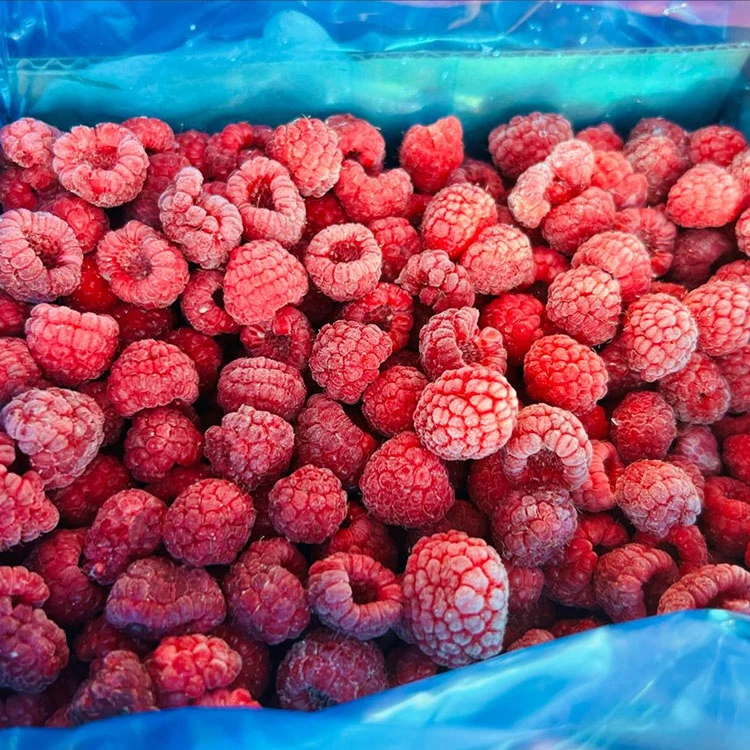
Current GreenLand product-gallery photograph showing the product form; this is not a record of this declaration, carton test or shelf-life study.
The signer needs a name, job title, business contact, signature method and issue date. Their authority should match the subject. A quality manager may be authorised to sign quality-system statements, while a commercial manager may only confirm order details. Authority can be documented in a delegation matrix or company procedure. When a regional office signs on behalf of multiple sites, check that the delegation covers each site and the exact product statement. A typed name alone is not evidence that the person reviewed current records. Ask who prepared, technically reviewed, approved and released the version, and keep those four steps visible even if one person occupies two roles.
A robust header includes a document ID and revision, issue date, language, named recipient or intended market where needed, and a superseded-version reference. It should also tell the reader whether a wet signature or authenticated electronic approval is expected by the recipient. Different importers and authorities may accept different formats. The New Zealand berry example shows signatory details on a destination-specific form; it is a model of disciplined attribution, not proof that every country requires the same fields. Confirm the current requirement with the importing party rather than copying an old file.
Try a simple challenge: ask the signer to identify the production line and record owners that support one statement in the letter. If the answer depends entirely on an external broker's summary, technical review has not reached the right person. Hold release until the site and signatory chain is clear. A declaration is strongest when someone with actual access to the controlled evidence can correct a scope mistake before it becomes part of an import dossier or a customer claim.
Define products, processes, destinations and effective scope
A frozen-produce range can contain IQF pieces, blocks, purees, blends and ready-to-eat or further-process forms. The declaration should name which forms it covers. Use a product-code table with botanical identity where relevant, cut or formulation, pack size, brand or private-label name, intended use, manufacturing site, process route, destination and effective dates. Avoid "all frozen fruit" if the site only processes two berry SKUs. If packaging differs, identify whether the letter covers each liner and carton configuration. The declared product description should agree with the current specification, artwork and invoice description.
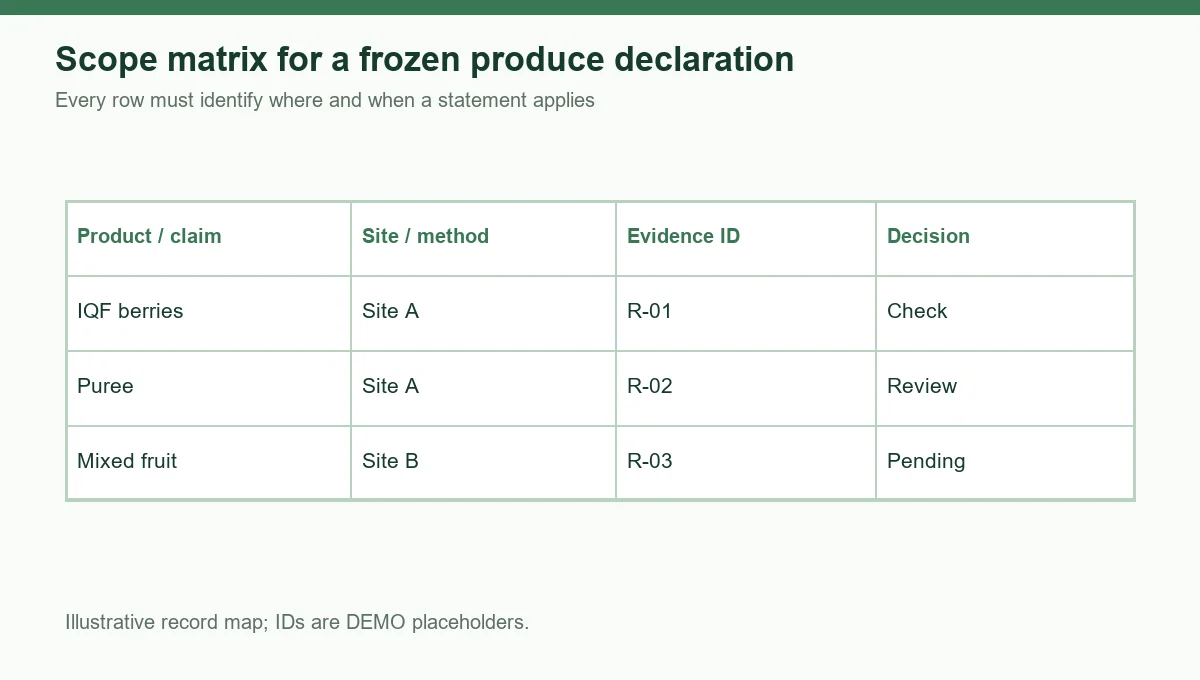
Illustrative method diagram; no actual lot, factory test or customer result is shown.
Scope also needs a negative boundary. Does it exclude products bought in and merely repacked? Does it exclude another plant's season, a new supplier of raw fruit, or a contract packer? A buyer cannot infer coverage from a familiar trade name. If the same brand includes both ready-to-eat and cook-before-use versions, the letter must distinguish them. In particular, statements about fresh-berry sourcing in the New Zealand example belong to that ready-to-eat frozen-berry clearance route. They are not automatically statements about blanched peas, coated fries or frozen mushrooms.
Build a matrix with rows for site and SKU, then columns for source material, process, pack, market and validity. The matrix should point to the specification revision and relevant product list rather than duplicate dozens of values inside prose. If a new private-label artwork is added, decide whether the existing statement already covers the physical product and whether the new brand name must be listed for its destination. If a processing step moves to another site, a new site-specific statement and evidence review may be needed even though the sales SKU stays unchanged.
We would ask a buyer to send the destination, receiving importer, product form and claimed use before a declaration is drafted. Those details determine which questions to bring to the manufacturing partner. They also prevent the document team from issuing a polished letter for a product the order cannot supply. The acceptance condition is a cross-check: every listed SKU must map to one current specification, an actual site and a signed evidence window. Any unmatched row remains pending rather than being hidden under a range heading.
Connect every statement to a controlled supporting record
A declaration should carry an evidence index, not a pile of unrelated attachments. For each statement, record the evidence ID, owner, source system, version, effective period and retrieval route. A claim about traceability might point to lot genealogy and mock-recall results; a claim about microbiological verification might point to the approved sampling plan and current results; a packaging statement might point to the relevant material specification and supplier declaration. A certificate page should be checked for scope and expiry, not merely filed as a colorful cover sheet.
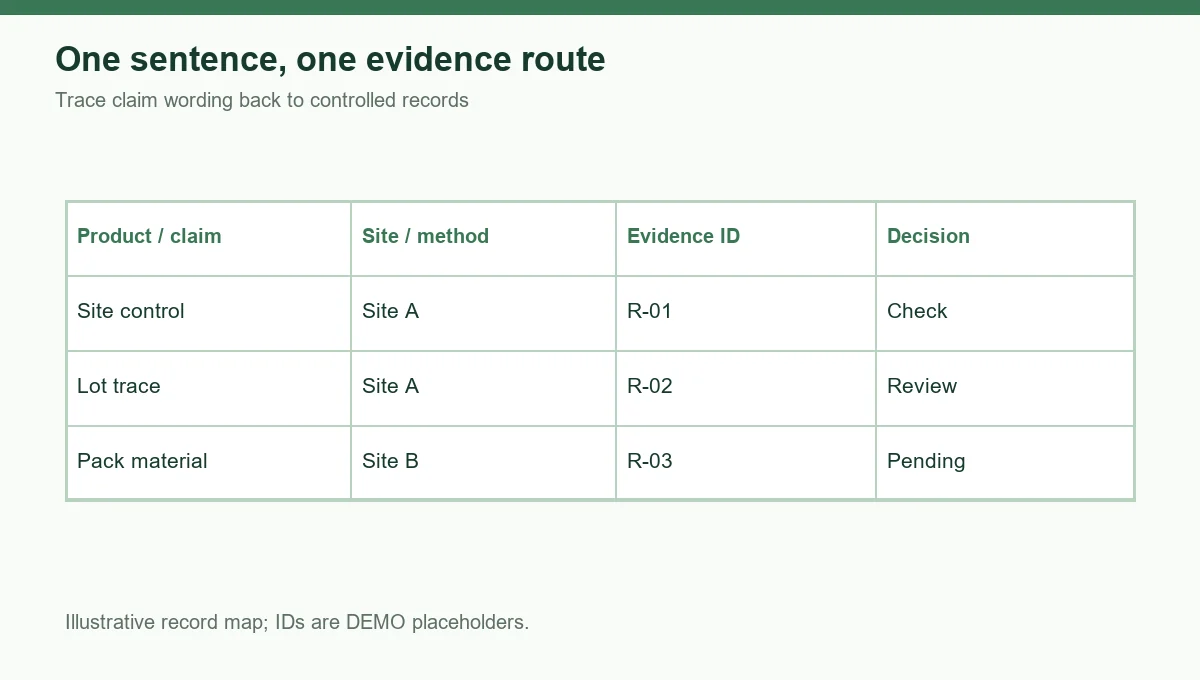
Illustrative method diagram; no actual lot, factory test or customer result is shown.
Start with one sampled finished lot. Link its product code and production date to incoming crop or ingredient lots, processing record, pack material lot, finished goods code, storage and shipment identifiers. Then reverse the path from one input lot to affected finished goods. Record whether the chain was obtained directly from controlled manufacturing records or transcribed by a broker. A declaration that refers to all lots in a season requires evidence that the relevant systems operated across that entire season. A single attractive retained sample cannot establish every claim in the letter.
The buyer can specify a response time for supporting records without claiming that every raw record travels with every shipment. Some records are confidential or contain other customers' information. Agree a redacted, secure route for inspection and define what summary can be supplied for routine orders. The site's quality owner should retain unredacted records under its control. If a recipient needs an authority-facing document, confirm the exact format and disclosure rules. A commercial contact should not replace unavailable records with an unsigned spreadsheet assembled after the event.
Evidence has a date dimension. A certificate may have been valid when the letter was issued but expired before a later shipment. A revised process may have taken effect after the test report cited. Mark the relation between the claim period and each record period. If evidence is missing, identify which sentence is unsupported and hold that sentence or the whole document according to risk. This claim-to-record mapping lets the next reviewer see exactly what changed when a site, grower, pack or test method changes.
An evidence index should include the method by which each record was checked, not just its filename. For a traceability claim, record the mock-trace date, selected start point, recovered forward and backward links, unresolved gaps and signoff. For a laboratory statement, preserve the sample collection basis, test method and laboratory identity beside the result. If a PDF is supplied through an online portal, save the portal retrieval date and exact document revision. These details matter because two files can have the same title while covering different plants or periods. The index is a reproducible route to evidence, not a substitute for an actual review of the evidence.
Separate supplier statements from importer and buyer duties
A manufacturer statement, an importer verification program and a buyer's product approval answer different questions. The manufacturer can speak to its own facility, production controls and records. An importer may have duties to evaluate foreign suppliers and keep verification evidence under the rules of the destination market. A buyer may impose additional specifications for color, cut, defects, intended use and customer labeling. One signed supplier letter does not transfer all those responsibilities to the signer. FDA's FSVP material, for example, describes an importer program with risk-based verification and approved-supplier procedures; it is not satisfied automatically by a generic "food safe" letter.
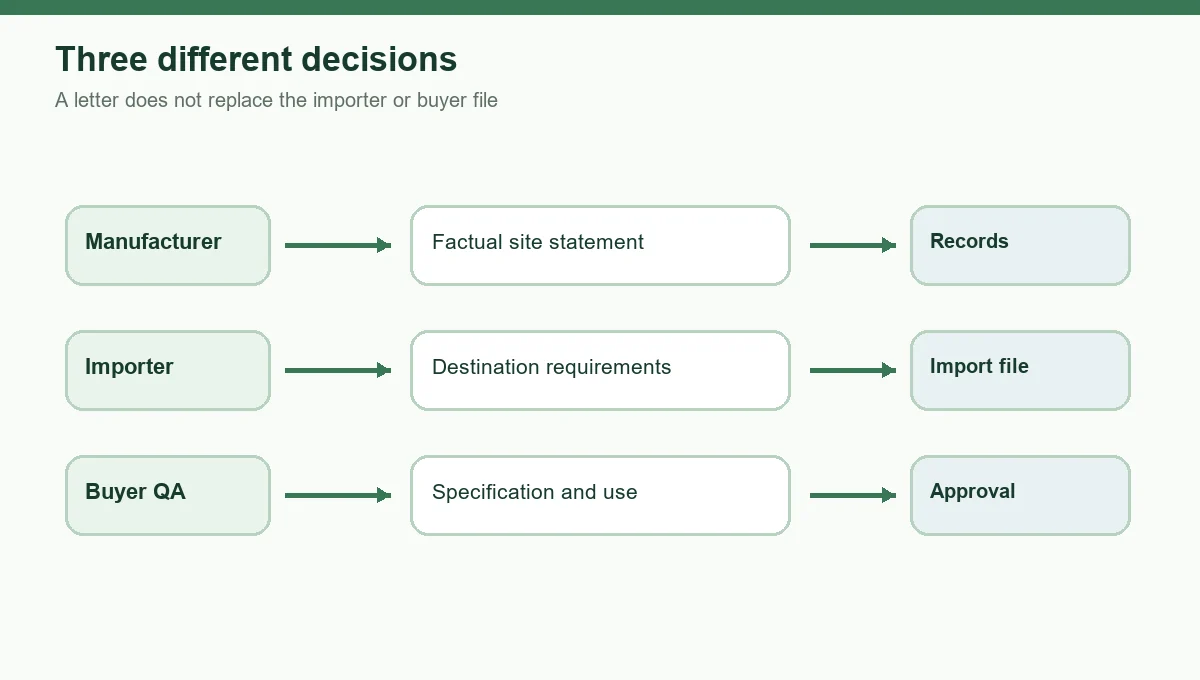
Illustrative method diagram; no actual lot, factory test or customer result is shown.
Separate the workflow into three decisions. First, does the manufacturing site agree that the factual statements about its products and process are accurate? Second, does the destination importer confirm the specific documentation and regulatory route it needs? Third, does the buyer's quality and application team approve the SKU under its own specification and use? The commercial team can coordinate timing and prices only after the scope is sound. Recording a "yes" in one column should not turn all other columns green. A rejected document can still accompany a perfectly acceptable physical sample, and a signed document cannot cure an off-spec lot.
Destination-specific requirements are especially sensitive. A New Zealand example for ready-to-eat frozen berries may require a manufacturer declaration and certificate in a particular clearance process. A U.S. importer may be governed by a different verification program. Another customer may request only a narrowly scoped manufacturing statement as a private contractual document. Write the document title and intended recipient accordingly. We would avoid embedding a list of global legal conclusions in the article or in the letter; requirements change and the buyer should confirm the current jurisdictional path with the responsible importer and qualified adviser.
For the physical shipment, join the declaration to the purchase order, specification, product code, batch list and shipping documents through consistent identifiers. Note which documents are standing site-level records, which are SKU-level, and which must be reissued per lot. If a buyer asks for "manufacturer declaration" without a template, send back a scope question before promising a form. That short exchange can prevent days of rework at clearance and avoid a misleading signature on a claim nobody intended to make.
Review a frozen-produce declaration as a buyer
A buyer review can be completed on a real document in a fixed order. Check the issuer and authority first, then site and product scope, then claims and supporting records, then validity and shipment fit. This is more reliable than starting with logos and certificates. Use a controlled checklist with a place for the actual document ID and reviewer, not a generic "documents okay" tick. Compare the products named in the letter against the current purchase order and product specification. If the order is for frozen raspberry puree, a declaration listing only whole IQF berries is a scope mismatch even if both carry the same brand.
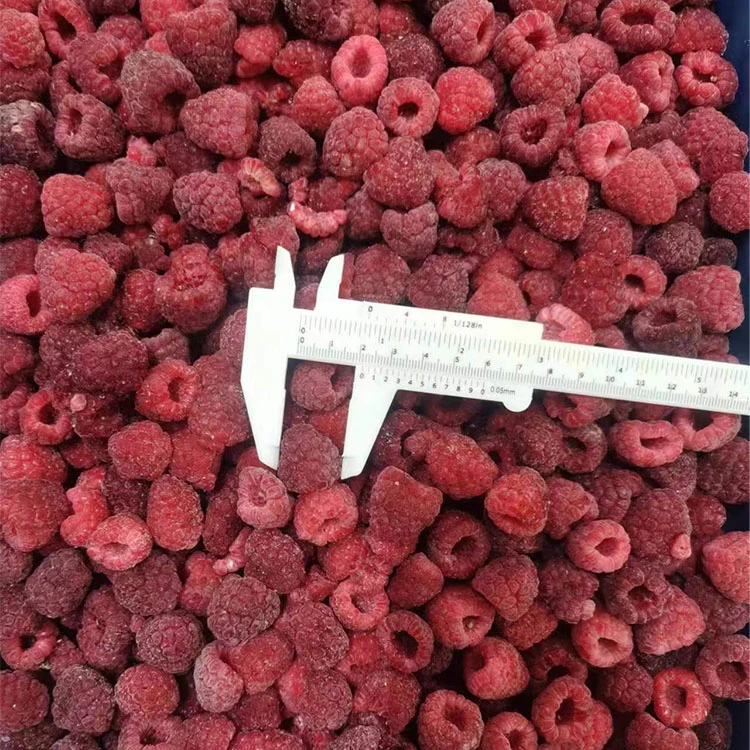
Current GreenLand product-gallery photograph showing the product form; this is not a record of this declaration, carton test or shelf-life study.
Read every statement literally. "Manufactured from berries supplied by audited growers" requires a defined grower and audit basis; "we maintain a traceability system" asks for a testable record trail; "suitable for ready-to-eat use" raises product and market-specific safety questions beyond appearance. Mark each as supported, needing clarification, or rejected. Put the record reference beside the claim so a second reviewer can reproduce the decision. An open question remains open; it must not be converted to pass just because shipment is near the port.
Check signature date against certificate validity and effective product list, then check the first and last production dates claimed. For standing annual letters, define a review or expiry trigger even if no statutory expiry appears on the page. A certificate renewed midseason may change its number or scope. The letter should be reviewed after that event; whether a new letter is required depends on the destination and buyer rule. Record what was checked, by whom and on which date rather than relying on memory during the next order.
Finally, test the review with one carton. Can the reviewer locate the lot in the manufacturing record and show that the right site, product form and pack were covered? Can the importer locate the specific records it needs without calling a different company? If either test fails, request a corrected version or supporting document before accepting the dossier. This is a controlled commercial handoff, not a claim that we independently certify a partner facility or a buyer's import eligibility.
Handle exceptions, expiry and evidence requests
An exception should be named, not buried in a revised PDF. Common triggers include an expired certificate, changed manufacturing site, product code omitted from the list, a mismatched brand, unavailable audit evidence, a new pack material, or a signer whose authority is unclear. Log the document ID, affected orders and lots, the exact statement in question, current evidence, owner and due date. Decide whether shipment can proceed under a narrower factual statement, needs a corrected form, or must pause pending technical review. Only the responsible buyer/importer can decide whether an alternate document satisfies its requirement.
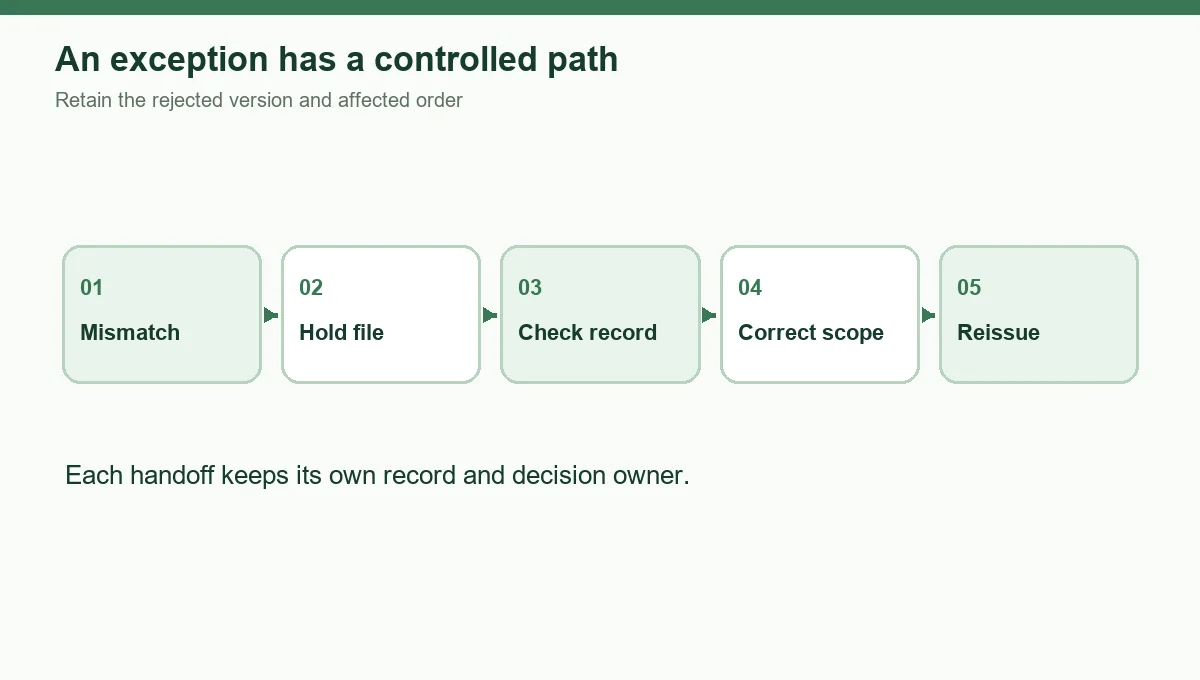
Illustrative method diagram; no actual lot, factory test or customer result is shown.
Keep the rejected version and the reason. Replacing a file in a shared folder under the same filename removes the audit trail. Issue a new revision, link it to the old one, and identify which shipments used each version. If an omission is discovered after dispatch, send the correction through the agreed controlled route, identify the affected consignment, and avoid silently dating a fresh declaration as though it existed earlier. A reviewer should be able to tell what was known and signed on the actual issue date.
Evidence requests also need a defined response. The buyer may ask for a current certificate, scope schedule, trace exercise or lot-specific COA. The manufacturer should identify which record owner will respond and whether a secure or redacted form is needed. Set an order-specific response clock if the delivery plan requires it, but do not promise a universal number of hours without agreement. Capture the request and supplied file hash or version so the team can later show exactly what was examined. Missing evidence is not fixed by a more confident sentence.
A concession has a narrow role. A buyer can choose an alternate commercial use for a physical product where safe and lawful, but it cannot waive a legal import requirement or retrospectively create manufacturer evidence. If the declaration's scope is wrong, correct it through a valid signer and date. If the underlying process did not meet the agreed specification, use the product deviation procedure, not document cosmetics. Separate these paths in the log so no one mistakes a signed correction for a release of an affected food lot.
Control changes and work a DEMO document trail
For a DEMO document trail, imagine a buyer requests IQF raspberries in a ten-kilogram industrial bag, made at Site A for further processing. The initial declaration lists whole berries and a retail pouch only. The physical fruit may still be suitable for the buyer's recipe, but the document does not cover this order. Record a scope exception, link the requested product code and pack revision, and ask the manufacturing quality owner whether the industrial bag uses the same controlled process and whether the letter's statements remain supported. The answer may require a revised product list, supporting pack record and a newly dated approval. These are illustrative document decisions, not GreenLand factory results.
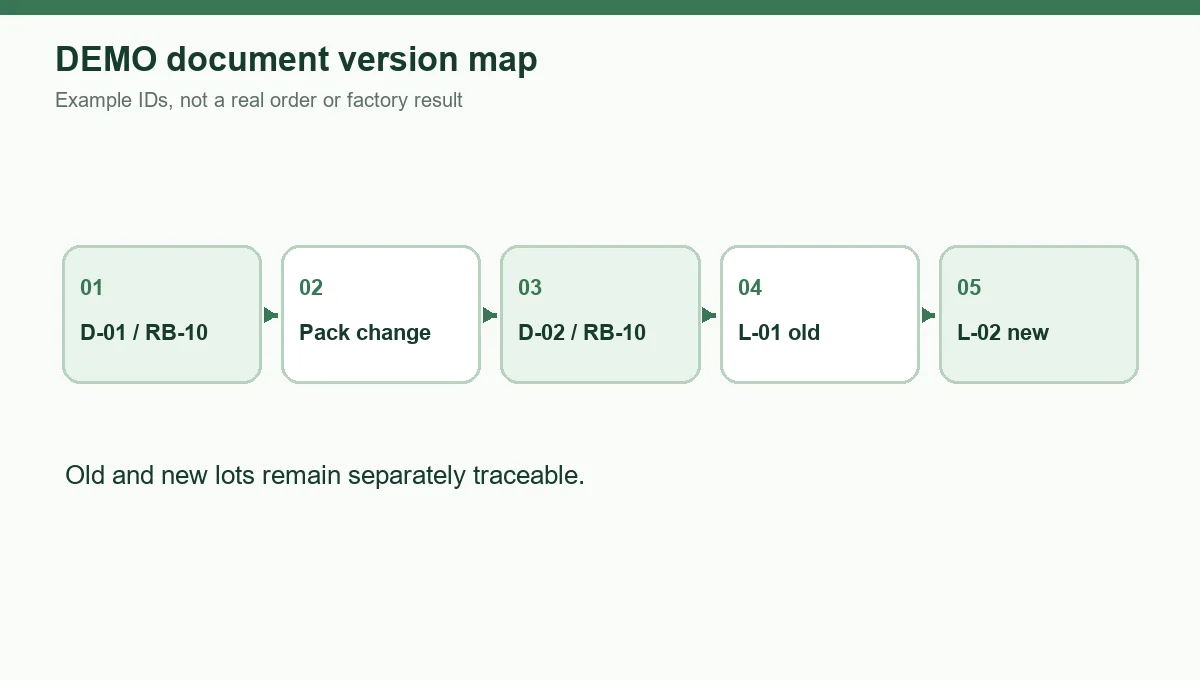
Illustrative method diagram; no actual lot, factory test or customer result is shown.
The DEMO ledger might hold declaration revision D-01, certificate reference C-07, site A, SKU RB-10, order O-100 and lots L-01 and L-02. If only L-01 was made before a pack change, the reviewer must not automatically apply D-01 to L-02. A revised document D-02 would state its effective date and affected codes. The buyer's QA owner checks the technical fit, the importer confirms its destination requirement, and purchasing verifies that the paperwork timing matches the shipment plan. The record records "pending" until each named role has signed its own decision.
This example also shows why count and cost fields belong in the record. Two declarations for the same order are not two production lots; do not double-count one shipment because an old form was superseded. If a redraft consumes a day, record it as a document delay rather than attributing it to manufacturing yield or freight. A simple status view can show one order, two lots, two document versions and one current approved scope. That is a meaningful dashboard because the denominators are explicit.
When we receive a buyer request, the practical input is the actual product form, pack, site if known, destination, intended use and required document wording. We can coordinate a draft with the manufacturing partner and arrange the supporting file, but final acceptance belongs to the named buyer and importer reviewers. Keep the approved PDF, underlying scope matrix, evidence index and exception log together. The next order then starts from a traceable version rather than an anonymous attachment in last season's email thread.
Build your frozen produce order with GreenLand-food
GreenLand-food is a professional frozen produce supplier and manufacturer in China, providing factory-direct wholesale supply for importers, food manufacturers and foodservice programmes. Ask us to scope frozen produce manufacturer declarations against the named product and order before any statement is approved.
Send your product form, specification, packing, quantity, application, destination, private-label needs and requested documents. We will organise the product and order requirements with your purchasing and quality teams.