


Importing China-Origin IQF Broccoli into the Philippines: Product and Permit Handover
Oct 22, 2026
Leave a message

Research This Article & Topic with AI
Verify key claims, compare reliable sources, and explore GreenLand-food's practical frozen food knowledge.
Article details and research questions are prepared in the links. Sign-in or sending may be required.
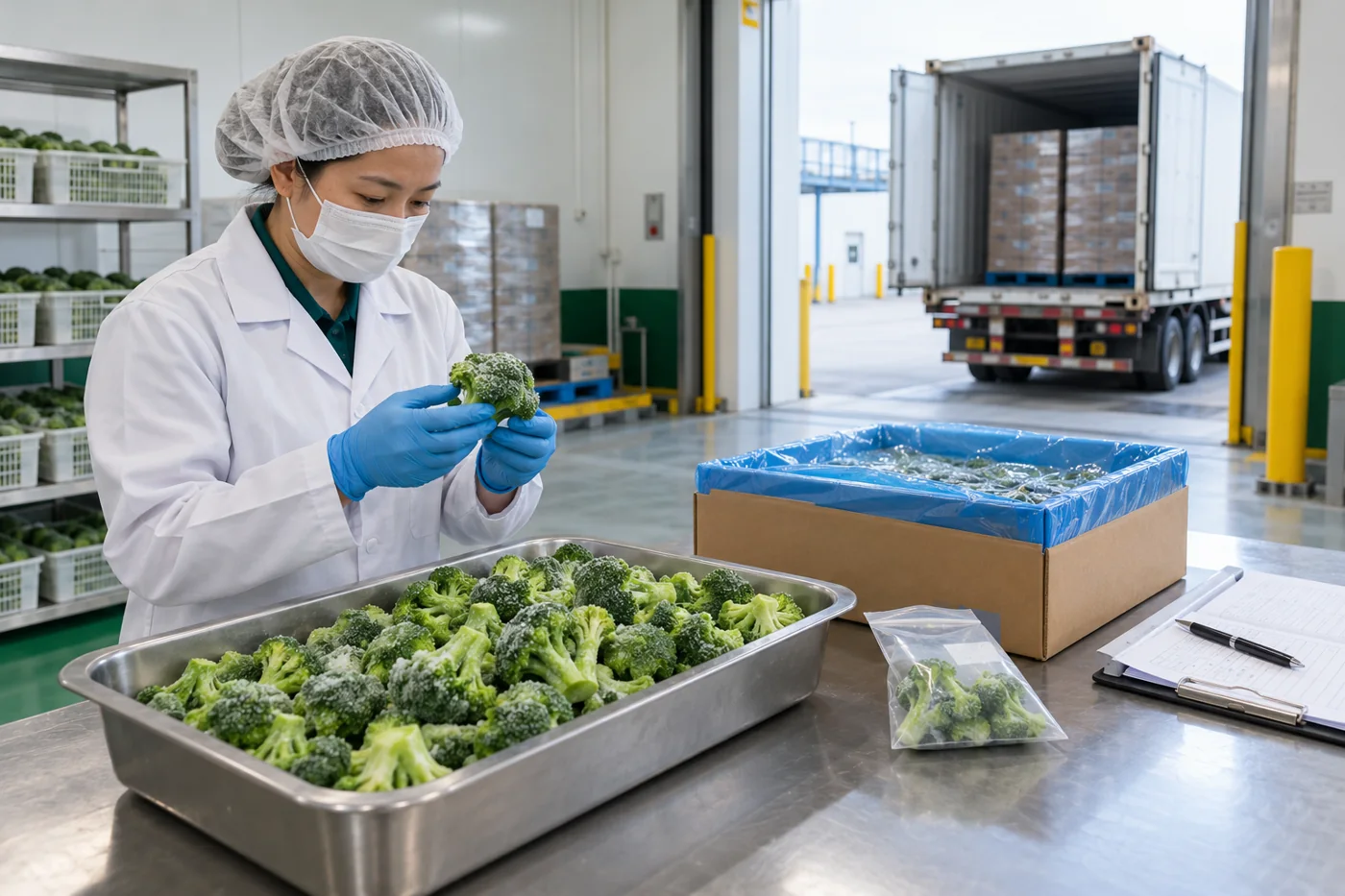
Reviewed 22 October 2026. Shipment requirements are checked for the actual product, route and filing date.
Define the broccoli and determine the Philippine regulatory responsibilities
Record the complete commercial food identity before choosing a permit. The example concerns Brassica oleracea var. italica florets grown and processed in China, with the actual trimming, blanching, cooling, freezing and packing sequence described by the factory. Confirm ingredients and relevant processing inputs, the saleable part, pack and cooking use. A description limited to frozen vegetables or HS0710 is too broad to establish the relevant commodity, process or analytical instruction.

Original broccoli photograph supports the product-identity discussion; the photograph is not a shipment inspection.
Plan the product and evidence together
Send the intended use, destination, pack and required records. We can prepare a specification and order evidence plan with your purchasing and quality teams.
Request Specifications & QuoteThe BPI National Plant Quarantine Services Division import guidance describes category-dependent plant clearance routes. A processed product can fall into different pest-risk categories according to what processing achieves. Category I involves a Plant Quarantine Service Certificate assessment, while the commercial route for relevant higher categories involves an SPSIC. The importer submits the actual commodity and treatment facts for the appropriate decision. Freezing alone is not a sufficient basis for assuming that a product belongs to Category I.
The Department of Agriculture's rules address plant and agricultural imports, while food-processing and marketing activities can also raise FDA questions. The local operator confirms the competent authority and requirements for the actual broccoli. Plain industrial florets and a seasoned prepared meal should not be treated as identical cases. If ingredients, processing or marketing change, supply the complete revised description for reassessment. The resulting written advice or permission is retained with the order instead of relying on a general statement that all frozen food follows one agency.
FDA's published processed-food classification annex is a useful classification reference within its own scope. It should not be used alone to infer that every frozen vegetable requires the same product registration or that a plant-health requirement disappears. We ask the importer to identify the actual filing and its legal basis, using the named product, process and intended sale. That prevents a product-category label from being mistaken for a completed authorization.
Customs classification is recorded separately. The broker checks the actual frozen-broccoli description against the applicable Philippine tariff and restrictions, including any details that change the code or treatment. The crop's pesticide or plant-risk classification can use different terminology and groupings. GreenLand provides the complete product and origin facts, while the responsible local parties resolve tariff or jurisdiction questions. One code does not establish all food, plant-health and commercial conditions for the order.
The first agreed result is a product identity and responsibility record. It names the importer, processor, packer, intended use, relevant authority route and unresolved questions. We use it to organize samples and supplier documents before commercial loading dates become fixed. The buyer can see which tasks belong to supplier qualification, which to a particular shipment and which to local registration, allowing each approval to be pursued by its proper applicant.
Establish the importer and commercial plant-clearance route
The Philippine customer establishes the legal business and customs standing needed for its import activity. The Bureau of Customs regulated-imports overview explains that applicable agency permits and clearances must be obtained for regulated goods. The customer also maintains its relevant customs accreditation and activation. Existing GreenLand guidance on CPRS explains that customs profile registration and food or plant permission are different elements of the import preparation.

Illustration: importer and supplier agree the product identity used for the application.
For the applicable commercial plant route, the NPQSD guidance identifies BPI importer registration before an SPSIC application and describes the electronic application channel. The importer checks its current license, account access and the exact commodity-origin eligibility. Its appointed local party applies with consistent supplier, product, quantity and transport information. A successful account login is useful operational access; the order file separately records the actual clearance or certificate and any conditions attached to it.
Commodity risk classification needs evidence of processing. The factory provides a factual flow identifying blanching, cooling, freezing and any subsequent handling, rather than an unverified assurance that all pests have been eliminated. The importer asks BPI how that treatment and product state affect the route. When an additional assessment or origin-product condition applies, arrange it before dispatch. A permission for a different vegetable, treatment or country cannot establish the eligibility of these Chinese florets.
If the accepted route is Category I, retain the actual evaluation and certificate outcome. If it requires an SPSIC, review the issued clearance against the order before scheduling loading. Record the importer, commodity, source, quantity, validity conditions and other relevant instructions. A general guide can explain those checks, but the issued document and current agency instruction control the actual shipment. The supplier needs the applicable conditions early enough to prepare the required official export documents lawfully.
Maintain a clear distinction between legal applicant and commercial coordinator. The importer or its authorized representative makes the Philippine filings. GreenLand gathers the manufacturing, product, sample and shipment information from the Chinese supply chain and responds to factual questions. The Chinese competent authority issues official certificates within its lawful remit. A supplier letter cannot substitute for a government certificate requested under an accepted import condition.
At quotation stage, agree the contacts, document-ready dates and dependencies. The regulatory contact tells the sales coordinator whether the route is established or remains under review. Logistics then plans booking and production around the actual permission status. Where a decision is pending, show the expected next action and owner rather than describing the order as cleared. This makes the commercial schedule more useful when several parties are preparing documents in parallel.
| Record or outcome | Responsible party | Order question |
|---|---|---|
| Customs accreditation/profile | Philippine importer and authorized customs parties | Is the importing business active for its actual activity? |
| BPI route and clearance/certificate | BPI and eligible local applicant | Which category, commodity-origin conditions and shipment permission apply? |
| Factory and laboratory file | Manufacturer, laboratory and GreenLand coordinator | Does the evidence describe the actual product, source and lot? |
| Arrival agency/customs outcomes | Competent agencies and importer | Which release or restriction remains effective? |
Prepare the product, laboratory and label dossier
Prepare the dossier around one controlled product specification. Include the actual manufacturer and site, botanical and commercial identity, growing and processing origin, full composition, processing flow, intended use, pack, storage conditions and shelf-life basis. The factory supplies the relevant technical facts. The importer identifies which of those facts must appear in an application, supporting document or local label, and in what form the authority will accept them.
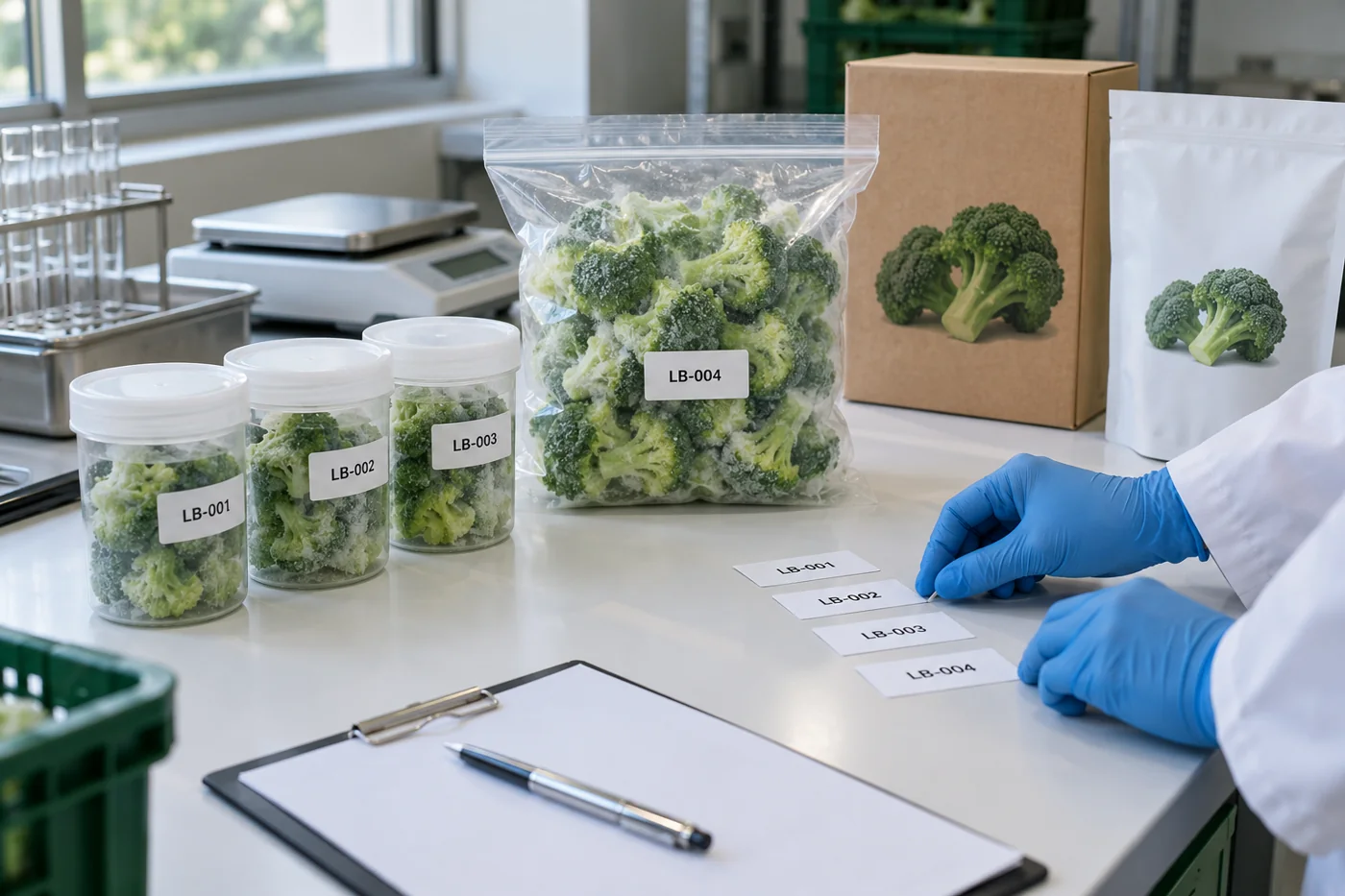
Illustration: identify each laboratory portion and connect it to the sample file.
Laboratory instructions follow the actual destination and crop requirements. Define pesticide targets and residue components, relevant contaminants and microbiological criteria according to the applicable Philippine rules, approval conditions and agreed customer specification. Keep each criterion's source and food scope visible. An EU-oriented multi-residue report can contribute useful analytical evidence, but its destination statement does not automatically establish conformity with every Philippine requirement for the actual food.
For fresh and minimally processed plant food within its scope, DA DC 12 of 2025 sets a sequence for pesticide MRLs: applicable Philippine standards or the relevant provisional FPA-based limit, then Codex, then ASEAN, and finally the LOQ of a valid analytical method. Contaminant limits have a separate sequence, including a BPI-evaluated provisional option before the final analytical fallback. Confirm the commodity and processing scope with the importer and BPI. An EU panel can inform the risk discussion, but it does not by itself establish the Philippine criterion. Record the named residue definition and the basis selected for each required result.
The Department of Agriculture maintains current circulars addressing agricultural import controls and regulatory-limit compliance. The importer and qualified reviewer check the applicable provisions, including any local standard and permitted sequence of reference limits. GreenLand supplies crop, source and process information for that assessment and commissions the confirmed scope. The laboratory checks that its methods and reporting limits can answer the named questions. Relevant analytical work is agreed before a representative finished-product sample is dispatched.
Preserve the report identity, sample state, lot, method, units, qualifiers and scope. Where the importer requires a report within a particular period, record the exact requirement and filing context. An older internal note referring to a six-month COA is not a universal rule for every Philippine broccoli shipment. The coordinator obtains the current instruction, while QA compares the original report with the supplier COA and the actual production being offered. Missing scope receives a documented response before release.
The label file reflects the accepted product and intended presentation. Confirm the product name, ingredients, responsible manufacturer and local importer information, origin where required, net quantity, lot identification, date marking, storage, directions and applicable allergen or other statements. The local reviewer confirms legal language and any industrial-pack provisions. We provide the approved manufacturing facts and retain an artwork revision, so product images, application information and the printed bag remain consistent.
Supporting claims receive their own review. A request for organic, religious certification, nutritional or other claims is matched to the exact product and evidence. Plain broccoli's composition does not establish permission to print a certification mark. The buyer states its accepted scheme and channel requirements; the factory, certifier and local reviewer answer their respective questions. The completed dossier identifies each document's issuer, scope, version and purpose instead of presenting every certificate as an interchangeable food-import approval.
Approve the broccoli specification and representative sample
Set the broccoli acceptance criteria before sample approval. Define floret size or distribution, stem allowance, colour, fines, broken material, free-flow condition and relevant defects with their sampling and measurement methods. The photographs on our frozen broccoli florets product page show the commercial form. The actual quotation and signed specification narrow that discussion to the grade, pack and application required for your order.
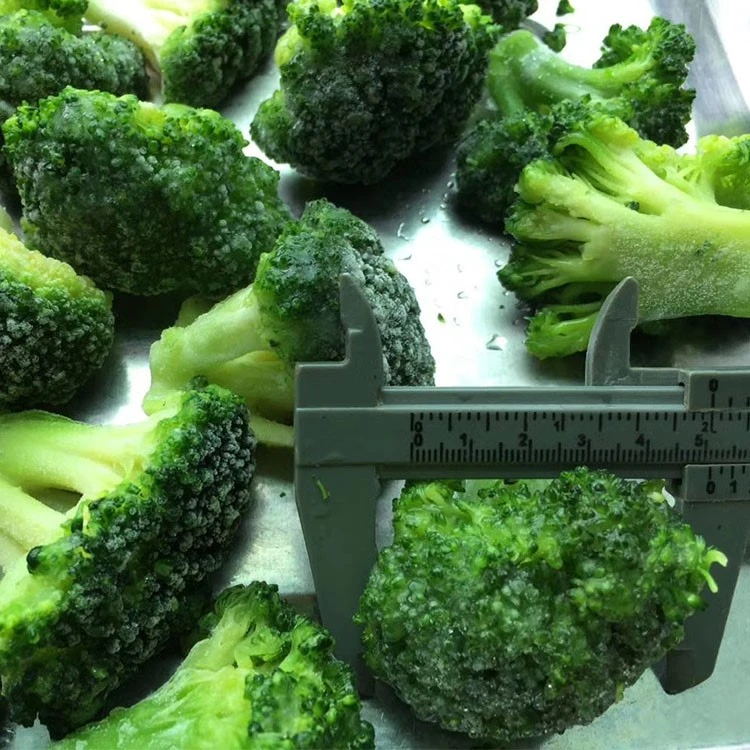
Original broccoli photograph supports the product-identity discussion; the photograph is not a shipment inspection.
Sampling represents a defined lot. QA identifies the relevant production window, carton range and pallet positions, then records how increments and sample units are selected. Allocate portions for physical review, laboratory work, cooking comparison and frozen retention as required. Record the sample codes, quantity, state, seal, sampler and transport conditions. A convenient bag from an unrecorded source can help an initial conversation, but it does not establish the conformity of an entire shipment.
Inspect the product in the states relevant to the decision. The frozen examination records floret distribution, visible ice, clumping, colour and packaging. A controlled preparation permits the agreed dimensional or defect assessment. A cooking trial then examines tenderness, stem bite, appearance, flavour and usable yield under the customer's application. The final-food operator validates its safe cooking process. Blanching and freezing should not be used to imply that every ingredient is ready for unheated consumption.
When a percentage is used, state what it measures. Broken-floret mass divided by prepared sample mass differs from a count of affected units. Oversize, undersize, stem and fines criteria also need clear definitions. The buyer and factory use the same sample state, size method and reference photographs for borderline defects. Attach the actual readings to the approval so later receiving staff can reproduce the comparison instead of interpreting an unsupported grade label.
The approved sample record includes the manufacturing source, product revision, sampling date, evaluation conditions, result and reviewer. It identifies which questions were answered: appearance, cooking performance, analytical scope or another specific requirement. Regulatory permission is recorded separately. If the buyer approves an attractive sample before the source or test file is complete, the order register retains the remaining dependencies. An individual sample approval should not be expanded into a claim that all subsequent lots have been tested or accepted.
For the first bulk run, compare representative finished product with the agreed standard and reference sample. Record any difference and its technical significance before dispatch. Keep retained product and the underlying batch information under defined conditions. GreenLand's coordinator connects the buyer's application decision with the factory's production and QA checks, so the supplier commitment can be reviewed against actual records rather than resting solely on a showroom photograph.
Coordinate Chinese documents with the Philippine shipment permission
Before an SPSIC-governed shipment, the importer sends the applicable permission and conditions to GreenLand's document coordinator. We compare the approved commodity, origin, supplier or manufacturer where specified, quantity, dates and relevant instructions with the final order. The issued clearance has its own shipment and validity scope. Do not substitute a general validity period taken from fresh produce or another commodity for the conditions on the broccoli's actual permission.
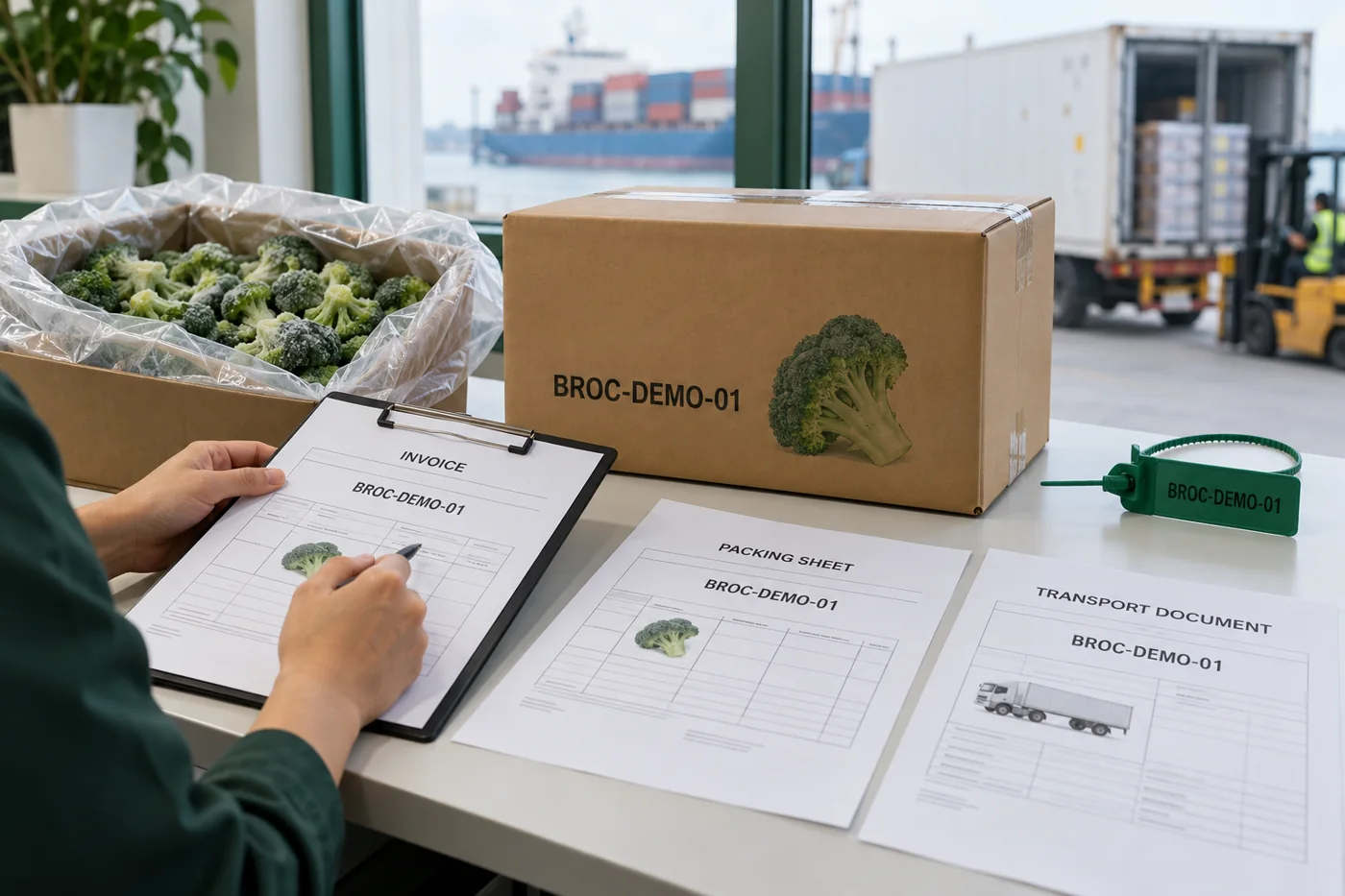
Illustration: reconcile the same demonstration reference across shipment records.
The current framework is DA DC 14 of 2025, read with its amendments, including DC 26 of 2026. DC 14 lists frozen and chilled fruit and vegetables among BPI-covered plant products. For an SPSIC shipment, issuance must precede embarkation and loading must meet the clearance's must-ship-out date; one clearance covers one shipment and is non-transferable. GreenLand gives the importer the proposed loading date and final quantity before booking is locked. The signed permission and current commodity conditions control the particular broccoli order, so a fresh-vegetable deadline or a rule for fish is not copied onto frozen florets.
The Department of Agriculture's current circular index includes DC14 of 2025 and its later amendments. The importer checks the current rules with the local agency before loading. The May 2026 amendment, DC26, changes specified commingling provisions with a particular clarification for BAI-regulated meat. It should not be used as a blanket authorization to combine every agricultural commodity in one shipment. Mixed-container proposals receive an explicit local review of the products and classifications involved.
Match the commercial and transport documents to the released packing plan. Check the invoice, packing list, case count, net and gross mass, consignee, origin, container and seal information as applicable. Confirm whether the actual route requires a phytosanitary or other official certificate and its exact additional statements. The competent Chinese authority receives accurate requirements and shipment facts; the supplier provides supporting production and consignment information rather than drafting an unofficial substitute certificate.
Quantity control starts at packing and weighing. A permission expressed in a stated quantity must be compared with the actual shipment using the same basis. Record the product, packaging and any relevant distinction between net and gross mass. The local importer resolves a proposed excess or revised quantity before shipment under the applicable instruction. An informal commercial tolerance in a purchase agreement cannot itself amend a government clearance.
Our shipment register shows the document version, issuer, recipient and handover date. If the broker asks for a corrected description or reference, the coordinator sends the revised facts to each responsible party and keeps the superseded set. Update affected applications or certificates through their proper issuer. The register also identifies any carrier or customs filing requirement outside the food and plant-health process, allowing the transport deadline to be tracked without confusing it with permit issuance.
The final dispatch review reconciles product approval, required laboratory work, packaging and artwork, supplier release and the applicable import conditions. QA records its own decision and the importer confirms the necessary local preparation. These actions support a lawful and well-documented shipment, while official entry decisions remain with the responsible Philippine authorities. Keep that distinction clear when discussing lead time: document preparation, permit processing, transport and border examination can each affect the schedule.
Track arrival inspection, cold storage and separate release decisions
Prepare arrival inspection before the vessel reaches port. NPQSD guidance describes advance application for inspection and the documents relevant to the applicable route. The importer or representative follows the current receiving-office instructions, supplies the clearance and official certificates where required, and coordinates the transport and customs records. GreenLand sends the finalized supplier file early enough for the importer to identify missing fields before the consignment is presented for examination.
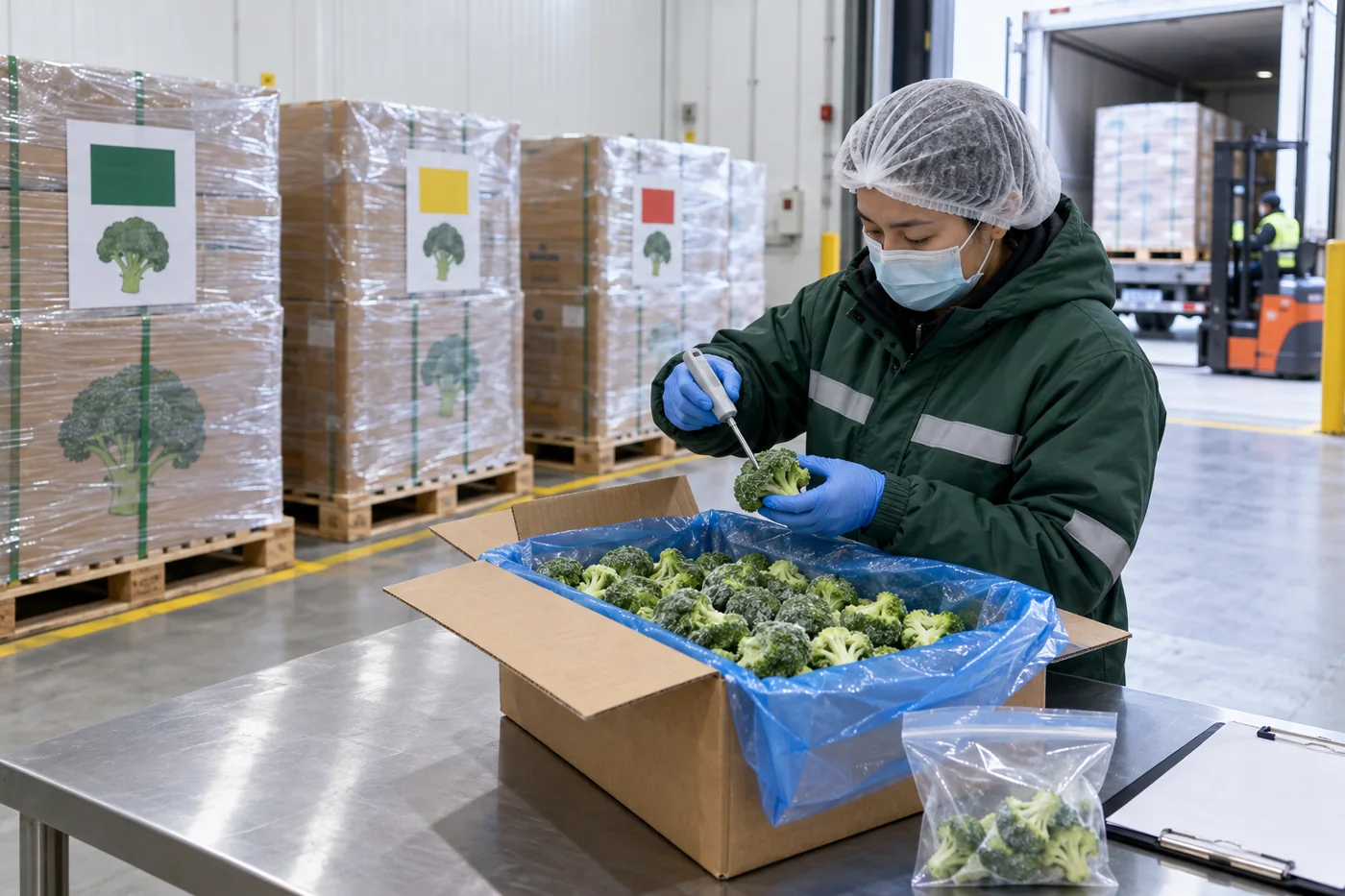
Illustration: arrival inspection preserves product, lot and temperature evidence.
The shipment may be subject to documentary, identity, physical or laboratory controls under the responsible authority's decision. Preserve official sample references, seal information and examination results. The receiving team keeps cartons and batches identifiable and follows any restriction on movement or use. If the authority permits transfer to an approved storage location while a decision is pending, the permitted transfer does not automatically authorize sale or processing. Record the stated conditions and who monitors them.
Cold storage is arranged for the actual food and port-to-warehouse sequence. The operator needs suitable frozen capacity, reliable unloading arrangements and a receiving plan that limits exposure. Record container and seal identity, transport-monitoring data and relevant product observations. The contractual storage target, equipment setpoint and measured product temperature describe different evidence. Compare them under the agreed method when investigating an excursion rather than treating a single display reading as the complete journey history.
Keep plant or food authority outcomes, customs release and commercial delivery separately visible. The customs broker handles its own declaration and clearance steps, while the agency responsible for food or plant controls addresses its permit and inspection conditions. The carrier or terminal also has a commercial release process. The order coordinator records the actual references and dates so staff can see whether a shipment is permitted to leave port, remains restricted or awaits another required action.
At warehouse receipt, the buyer compares representative stock with the signed specification and approved sample using the same preparation method. Photograph relevant pack and product findings, record carton selection and preserve a retained portion. A floret-size or cooking-yield dispute can require a commercial quality investigation even where official release has been granted. Conversely, a satisfactory visual review cannot authorize use of stock that remains under a regulatory hold.
When the importer receives a technical question, GreenLand coordinates a response from the actual processor, laboratory or document issuer. Send information tied to the questioned product and lot, including process, sample custody or packing history where relevant. Preserve the original authority request and the submitted answer. This allows the local representative to explain the shipment on its evidence and gives both purchasing teams a consistent record of what remains to be decided.
Manage a quantity change, missing document or adverse finding
A product or quantity change after permission needs review before it becomes a loading instruction. Record the request, affected product revision, original permission and proposed new facts. The importer determines whether a revised or new filing is required. GreenLand supplies updated manufacturing or packing information and traces the change through the specification, sample, laboratory and artwork files. Avoid allowing a commercially convenient substitution to create an undocumented difference between the goods and their entry papers.
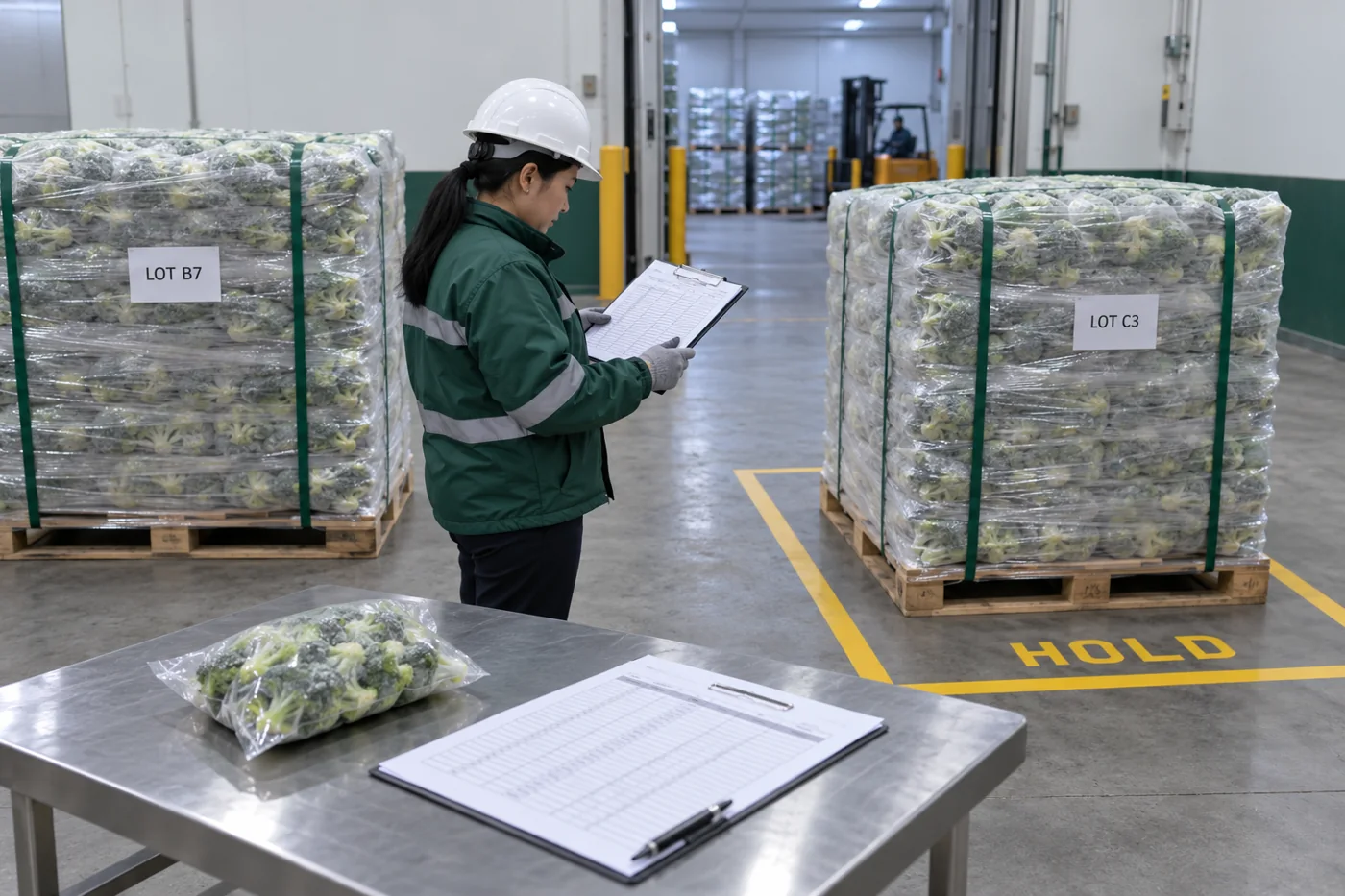
Illustration: keep changed and earlier lots separate while permissions and specifications are reviewed.
If the source factory changes, check supplier qualification and the applicable official and certification files. Identify whether the packer, process or growing source also changes. A similar-looking floret from another route may require new analytical, application or customer approval. The release owner records the scope of the hold and the evidence needed to close it. Product already made under the earlier route remains separately identified so the records can describe what each lot actually represents.
DEMO ONLY: a proposed shipment has 600 cartons of broccoli and 200 cartons of sweet-corn kernels, each carton nominally 10 kg. The product branches are 6,000 kg and 2,000 kg, totalling 8,000 kg. A permission or approved application describing only the broccoli branch cannot be assumed to describe the corn branch or the proposed combined consignment. Keep the actual product identities and national tariff decisions separate; changing the invoice description to mixed vegetables is not a correction for two single-ingredient SKUs.
The two scanned pages of DA DC 26, series 2026 amend the commingling provisions in sections 24(k) and 50(m) of DC 14, series 2025. The stated limitation for BAI-regulated meat is not a blanket mixed-container permission for plant products. Before adding the second SKU, the importer obtains the BPI and filing assessment for the actual arrangement, with the permission scope, quantities and required documents. Our loading team follows the resulting approved product map rather than making a regulatory inference from available container space.
A missing document is assigned to the correct issuer. The manufacturer supplies its factual statement; the laboratory resolves report identity or scope; the competent authority addresses its official certificate; the importer corrects the Philippine filing through its authorized channel. Preserve the original version and reason for correction. An email that a document is being prepared does not establish that the required record has been issued or accepted.
For an adverse result, protect and identify the affected stock, preserve the original report and notify the responsible importer and quality contacts. Confirm sample identity, method, units, reporting qualifier and applicable criterion before interpreting the finding. The competent authority determines any official restriction and permitted disposition. Additional testing remains connected to the original history, and any commercial claim is investigated with representative product, quantity and temperature evidence.
Use the arrival-quality investigation guide for the evidence sequence, and the pesticide testing guide when the unresolved question concerns analytical coverage. The actual order file keeps those methods connected to the broccoli batch, relevant Philippine requirement and named reviewer. A general article provides an organized approach; the completed records demonstrate how the approach was applied.
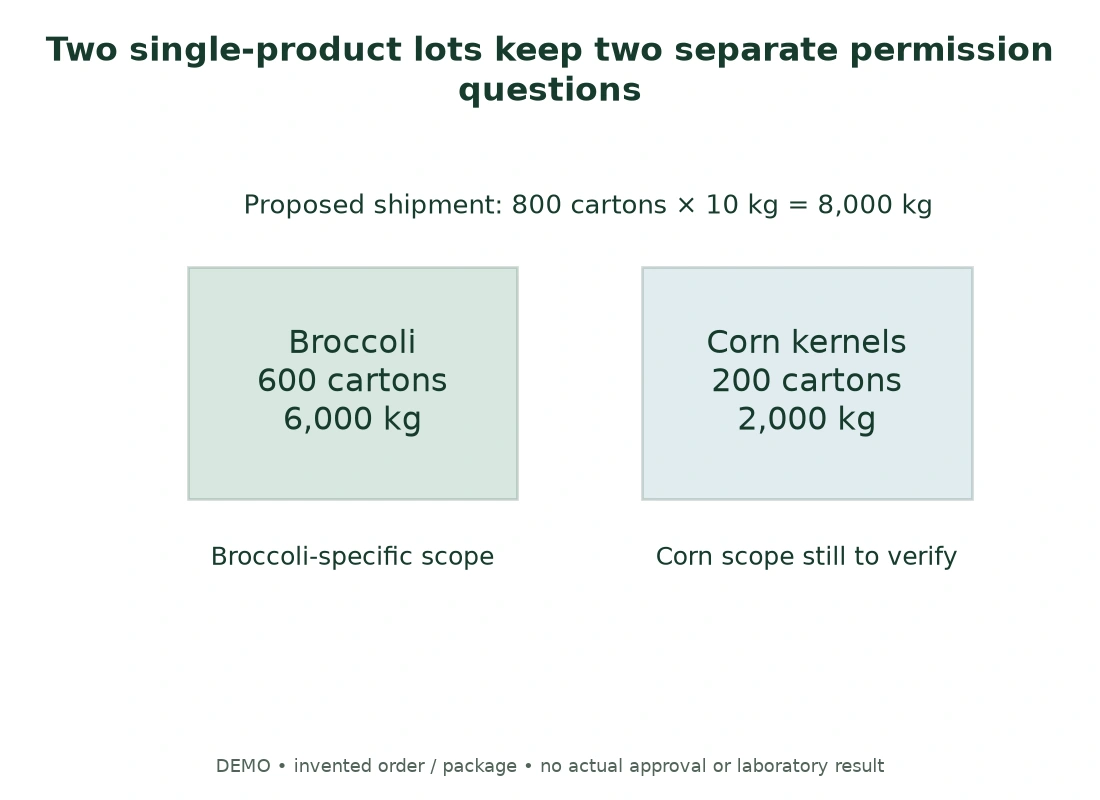
On narrow screens, scroll the figure to read every label.
DEMO proposed cargo: a broccoli-specific reference does not automatically cover the separate corn lot or establish a mixed-shipment permission.
Close the order with the accepted specification, current route and permissions, finished-batch and packaging records, required reports, shipment references and arrival outcomes. Record corrective actions and their verification when an issue has occurred. For your next inquiry, send the broccoli form, application, pack, quantity, destination port and importer's document requirements. We use those facts to prepare the supply and evidence plan with your purchasing and quality teams.
- Identify the changed or affected product and keep its stock controlled.
- Compare the actual facts with the permission, sample, laboratory and packing file.
- Obtain the responsible issuer or authority decision and retain the original history.
- Reconcile affected quantities and verify the corrective action before subsequent relevant supply.
Build your frozen broccoli order with GreenLand-food
GreenLand-food is a professional frozen broccoli supplier and manufacturer in China, providing factory-direct wholesale supply for importers, food manufacturers and foodservice programmes.
Send your product form, specification, packing, quantity, application, destination, private-label needs and requested documents. We will organise the product and order requirements with your purchasing and quality teams.