


Importing Frozen Sweet Corn into Qatar: Registration, Arabic Artwork and Shipment Records
Oct 22, 2026
Leave a message

Research This Article & Topic with AI
Verify key claims, compare reliable sources, and explore GreenLand-food's practical frozen food knowledge.
Article details and research questions are prepared in the links. Sign-in or sending may be required.
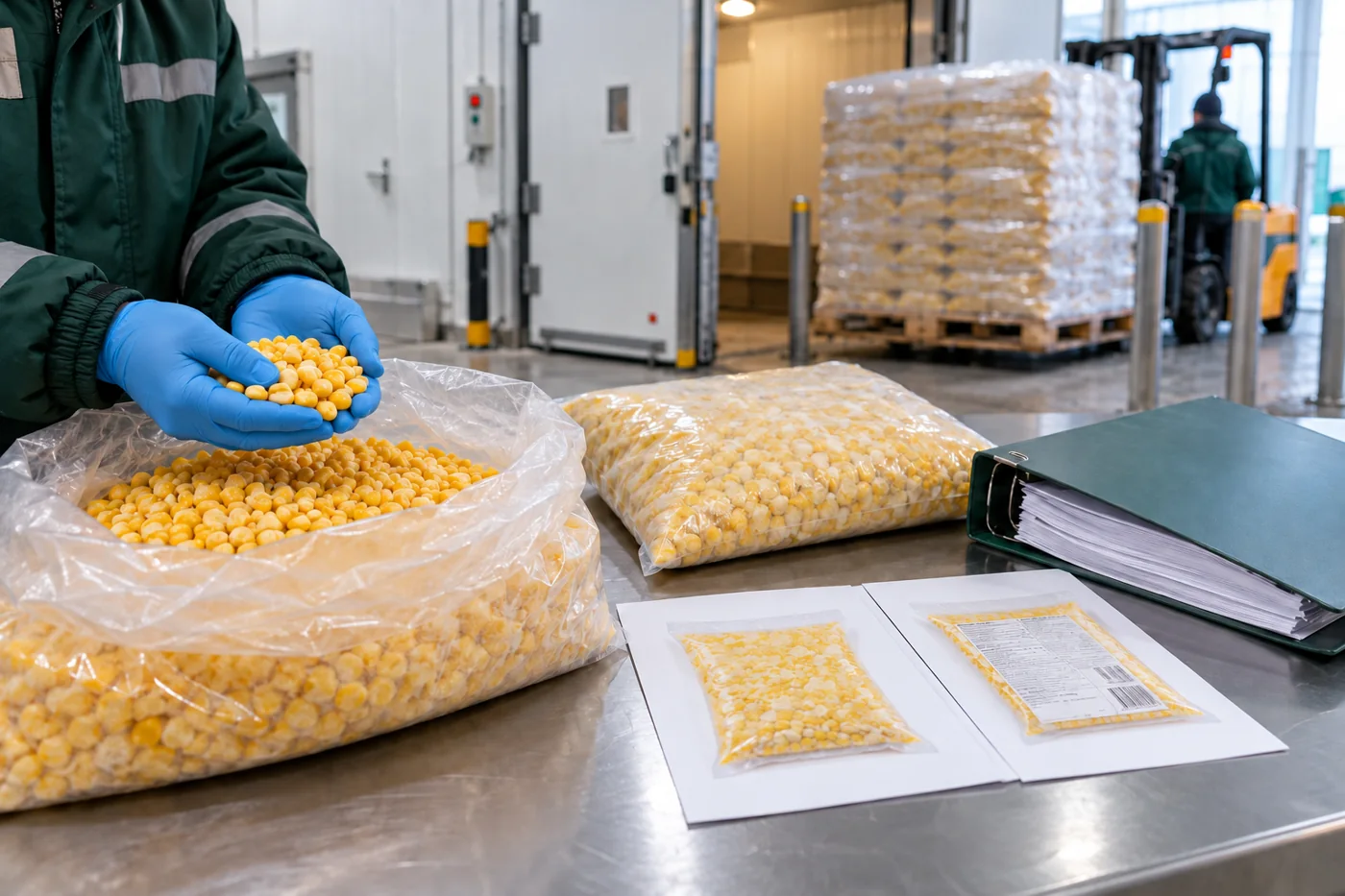
Reviewed 22 October 2026. Shipment requirements are checked for the actual product, route and filing date.
Define the corn and the Qatari importer before product registration
Write the purchase description before anyone uploads a registration image. In this example, the goods are kernels rather than corn on the cob; sweet corn rather than field corn; blanched and individually quick frozen rather than raw, canned or seasoned. The ingredient line should match the actual recipe. If the product is truly single-ingredient corn, neither an invented additive nor an unapproved seasoning belongs on the label. The industrial carton weight, any inner liner or bag, cooking instruction, storage instruction and intended user also belong in the specification. A foodservice kitchen that fully cooks kernels after opening has a different use pattern from a consumer retail bag; do not let one artwork stand for both without review.
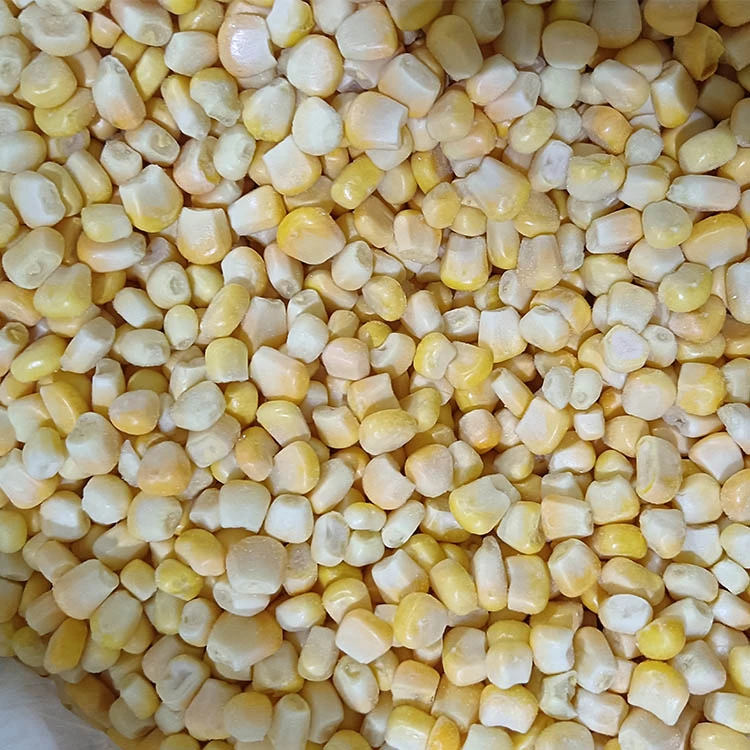
Original kernel photograph supports form comparison; it is not a result for the proposed Qatar order.
Plan the product and evidence together
Send the intended use, destination, pack and required records. We can prepare a specification and order evidence plan with your purchasing and quality teams.
Request Specifications & QuoteWe ask the buyer how the kernels will be used. A ready-meal manufacturer may need a narrow cut-size distribution so portions dose evenly; a central kitchen may put more weight on tenderness after a defined boil or stir-fry. We can compare sample lots against the same cooking time, portion mass and finished recipe, then agree which differences are acceptable. A raw Brix reading, a product photograph and a cooked sensory result answer different questions. The order should state which measures matter, the sampling basis and who decides a borderline result. That way the quoted grade has a test that can be repeated at receipt.
The Qatari company named as importer must be identified early. Sharek's establishment-registration service says the establishment is located in Qatar, has valid commercial registration and includes food trade in its registered activity. Its account opens electronic services such as food-product registration. We can provide manufacturer and product details for the file while the local importer controls its own credentials, application and authority correspondence.
Name the actual parties in the transaction: exporter, manufacturer or processing partner, importer of record, consignee, customs broker and the party taking the goods into frozen storage. They may not all be the same organization. Match each role to the purchase order, invoice and proposed transport documents before deposit or production. A sales agreement can say who pays freight and who bears a particular handling cost, but that commercial term does not transfer the importer's statutory registration work. If the destination, local importer or pack channel changes after sample approval, the order file needs a fresh review rather than a silent substitution.
Put the end-use decision into the first sample request. Ask for the buyer's normal cooking method, the desired texture after full cooking, acceptable broken-kernel share, target pack and opening pattern. An industrial 10 kg carton opened once in a factory behaves differently from many small foodservice bags opened repeatedly. A sample that arrives by air in a small insulated parcel can prove flavor and kernel form, but it does not prove how the final sea container, printed carton or port hold will perform. Record those remaining questions before calling the product commercially approved.
Register the food establishment and exact product in Wathiq
Keep company and product registration separate in the planning calendar. The Sharek food-product page says the food establishment must already have an active Wathiq account. Its stated product inputs include three product images, an image showing ingredients and supporting certificates depending on product type. The images need to show the information on the label clearly. A supplier's brochure photograph is therefore a weak substitute for the exact carton or bag artwork being registered. We can prepare legible front, back and ingredient-panel images tied to one artwork revision; the importer decides the correct local submission and confirms acceptance in Wathiq.
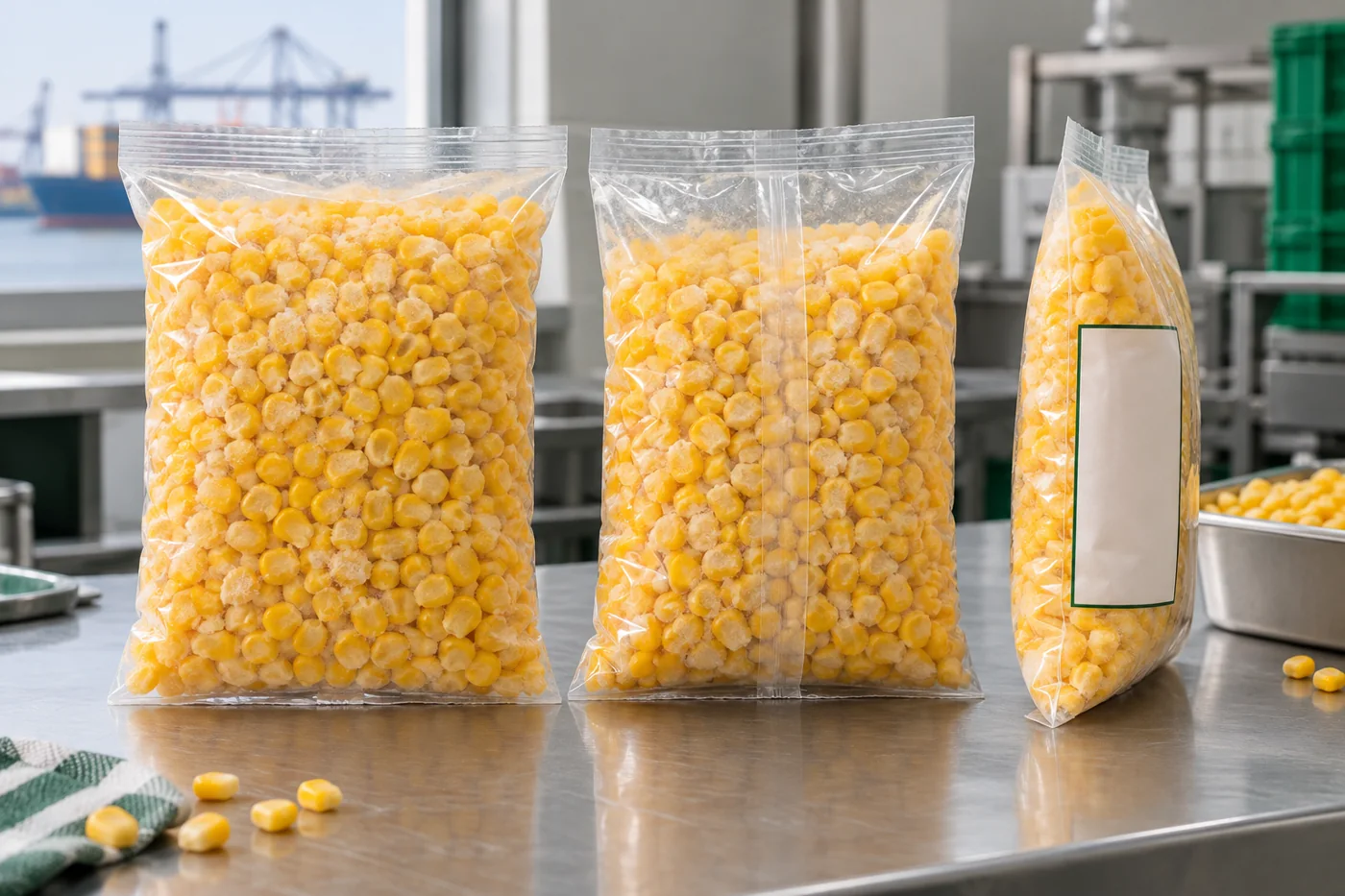
Illustration: prepare clear views of the actual pack format for product registration.
The official Wathiq user guide distinguishes creation and registration of a company account from registration and management of food products. It also describes import/export company and local-food-business routes. For the frozen corn order, ask the importer to show the relevant establishment status and the registered record for this exact product, not merely a screenshot proving that somebody can log in. Product name, brand, origin, ingredient, pack, label image and any applicable code should describe the shipment being purchased. Keep submitted and approved Wathiq records in distinct states, with the actual reference and decision date.
A useful pre-production reconciliation sheet has one row per field. Put the proposed English and Arabic product name, manufacturer, country of origin, ingredient statement, net weight, storage instruction, cooking instruction, pack image revision and registration reference side by side. Note who owns each field and where it will be printed. If the sample arrives in an unprinted plain bag but the commercial lot will use an Arabic-labelled industrial carton, the importer should review the final commercial artwork before registration or release. If the local registration uses a retail unit while the order ships only industrial cartons, pause and confirm whether the record actually covers that format.
Do not make the service page's estimated turnaround into a promised shipment date. The public page gives an estimated service time, but a specific application may require clarification, revised pictures or supporting documents. We set a commercial milestone: the importer confirms the usable establishment and product status before we commit a final artwork and production slot. For a new crop or changed pack, determine with the importer whether the existing product record can be updated or a separate record is required. Retain the accepted version in the order file so the next shipment starts from the actual approved identity.
Approve Arabic artwork, dates and the product specification
Artwork approval has to cover language and physical printing, not just a translated PDF. The U.S. International Trade Administration's Qatar labeling guide lists the product and brand names, production and expiry dates, country of origin, manufacturer name and address, metric net weight and ingredient list among food-label fields. It says labels may be Arabic or Arabic/English. Its statement that Arabic stickers can be accepted does not authorize adding production and expiry dates by sticker: the same guide says those dates must be printed on the original label or container by the manufacturer. We ask the importer to review the current destination rule and approve the actual carton or bag layout before it is printed.
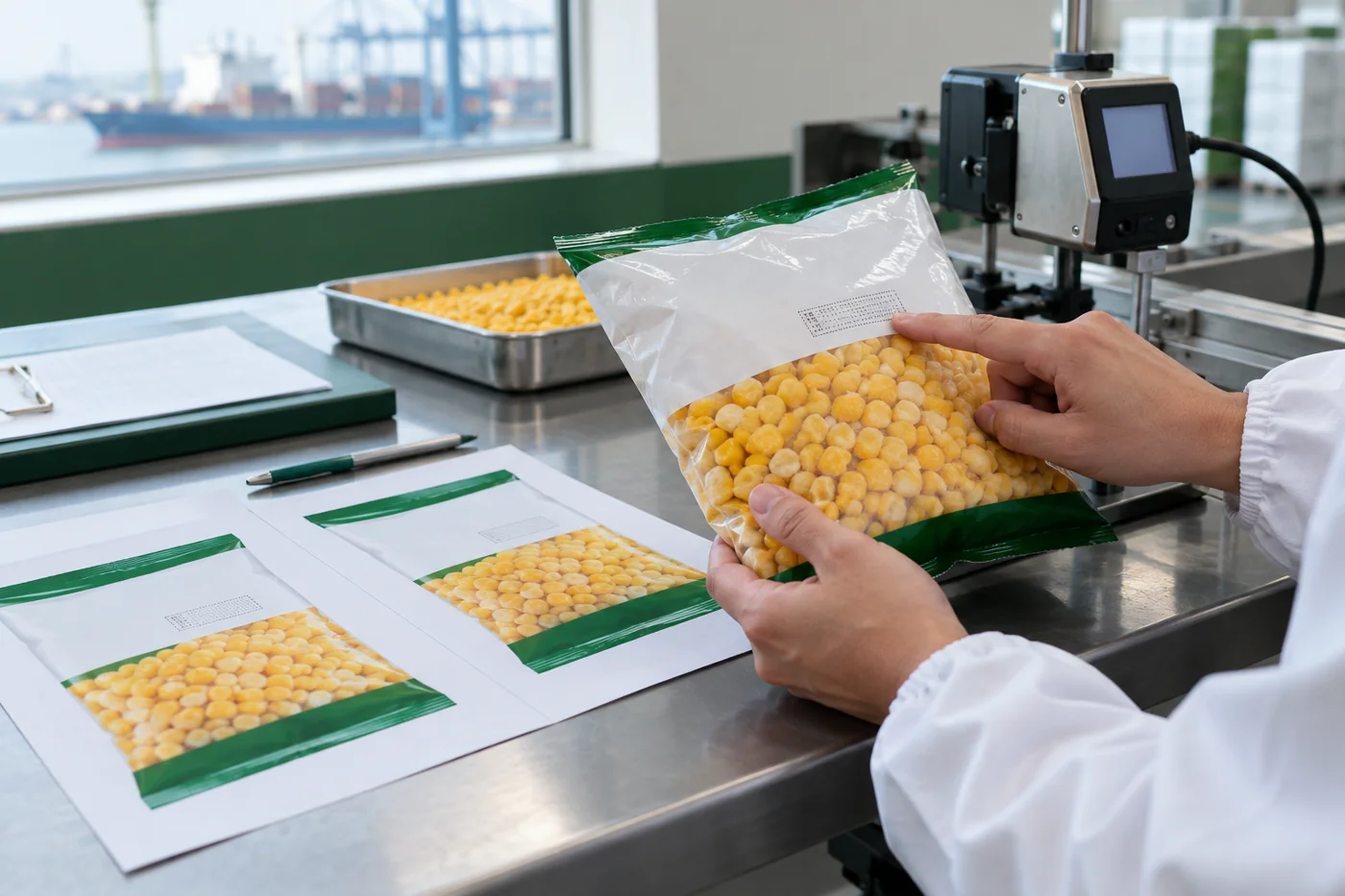
Illustration: compare the final pack with the approved artwork and permanent date-code area.
For one-ingredient corn, the wording should be plain and accurate. If blanching is part of the confirmed production route, describe the product accordingly; do not imply that blanching makes the kernels ready to eat. State that the product must be cooked thoroughly under the agreed use instruction. The storage statement should specify the frozen condition that the buyer can maintain through distribution. We check the Arabic and English versions for equivalent product form, ingredient, cooking and storage information. A mistranslated kernel-versus-cob name or an ingredient panel for a seasoned product could break the match with registration even when the picture looks right.
Dates need their own controlled proof. Agree the print location, legibility, date format, time-zone or calendar convention where relevant, and which production event starts shelf life. Review the first printed carton from the commercial run, not only an artwork mockup. The cited labeling guide also describes remaining-shelf-life expectations at destination; the importer should confirm the applicable standard and planned arrival margin for the exact corn category. Set shelf life from product validation and the actual pack, then record the accepted duration in the signed specification. Crop date, production date, best-before date, lot code and container number should each mean what the approved documents say they mean.
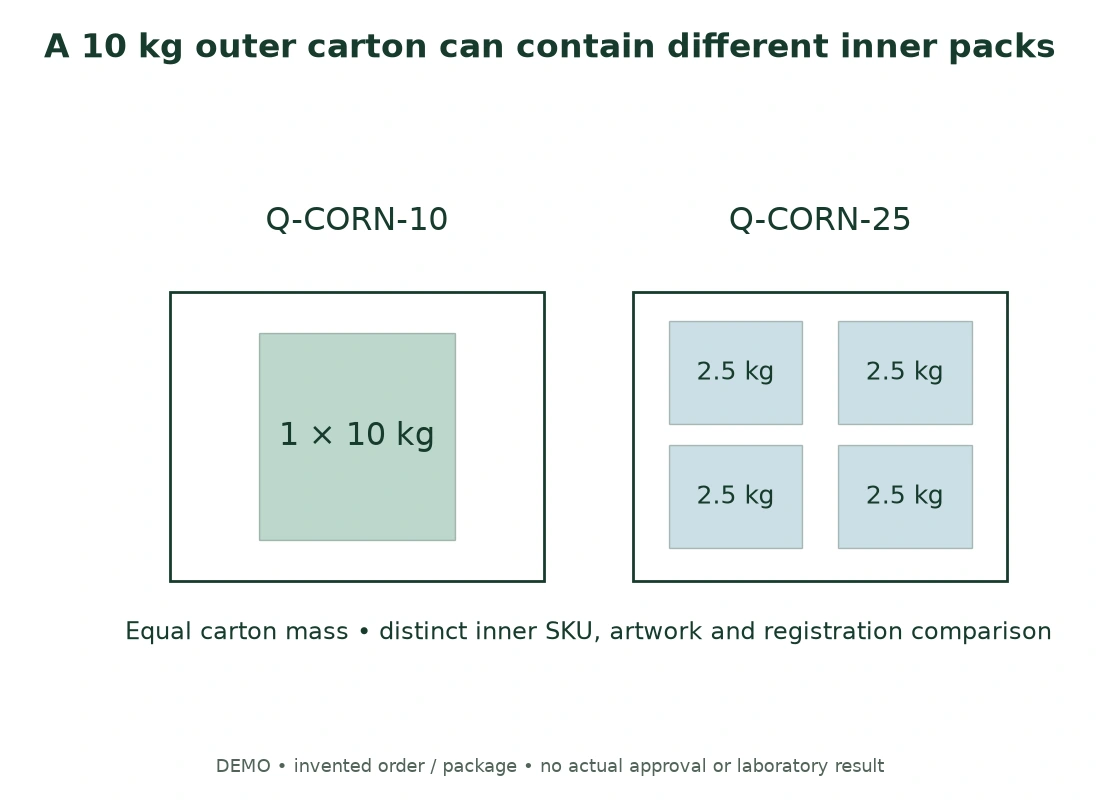
DEMO ONLY: compare two hypothetical 10 kg cartons. SKU Q-CORN-10 contains one 10 kg inner bag; SKU Q-CORN-25 contains four 2.5 kg inner bags. Both cartons total 10 kg, yet their inner labels, item codes and registered product images can differ. A file displaying the first SKU's bag cannot be assumed to cover the second merely because the invoice's outer net mass agrees. The importer reviews the exact registered product and pack arrangement, while our packaging coordinator retains the correct approved artwork and first-pack check.
The comparison sheet records the commercial SKU, inner-bag count, inner net mass, calculated carton net mass, label revision and the importer's product reference. An open cell remains visible until the responsible party provides the matching record. A change in the English brand spelling, Arabic product description, ingredient statement or date-code arrangement is also recorded independently. A numerical mass reconciliation is one check in that review; it cannot establish that all label or registration fields match.
On narrow screens, scroll the figure to read every label.
DEMO: 1 × 10 kg and 4 × 2.5 kg have equal outer mass but distinct inner-pack identities. The drawing is not approved artwork or a registered product.
The specification should travel with the artwork. It names sweet-corn kernel form, variety or sweet type where material, blanch status, defect classes, size basis, sweetness method if tested, cooking performance, physical foreign-material checks, pack and declared net weight. It should state whether the inspection sample is frozen, thawed or cooked, how many cartons contribute and how a failing carton is handled. We can prepare a buyer-specific reference sample and describe our supply and inspection responsibilities; the buyer approves limits and any required destination standard with its local technical team. Once signed, the same revision informs the carton image, purchase order and incoming inspection.
Prepare health, origin and shipment documents for the actual route
Start the document checklist with the importer's real shipment route and the current official service requirement. Sharek's imported-food inspection page lists a health certificate from official authorities or a certificate of conformity from an accredited body, an invoice, a customs declaration copy and a packing list if available. It conditions halal documentation on meat or animal-derived components. For the defined single-ingredient plant product, a meat slaughter certificate should not be put into the standard file by habit. The importer should confirm which health or conformity document the current route and product classification require; we can coordinate the applicable supplier-side evidence and confirm its issuing route before shipment.

Illustration: hand over the relevant origin, health and transport records for the same product.
A document should describe the same goods as the box. Reconcile manufacturer and exporter names, origin China, corn description, pack weight, carton count, production or lot codes, invoice number, container or seal reference and consignee across the invoice, packing list, transport document and any product-specific certificate. If the authority document is issued for a lot, do not use a prior lot's paper as a placeholder. A certificate can be authentic yet unusable when the pack description or origin differs from the actual shipment. Before finalizing the booking, we can give the importer a draft document set for field-by-field review and hold the shipment if a necessary correction cannot be made lawfully.
Country-of-origin evidence and commercial paperwork should be distinguished from a food health decision. An origin statement tells a different story from a laboratory result; the commercial invoice establishes sale details; the packing list identifies what was loaded. Depending on the trade arrangement and current customs instruction, the importer may need a particular origin certificate, invoice form, attestation or electronic filing. Ask the broker for the current required form and obtain the correct issuer or endorsement before the container departs. Then archive the issued version with the lot and invoice it supports.
The local declaration and the Ministry of Public Health food inspection are linked but distinct. Sharek says the inspection service is accessed after the customs broker organizes an import declaration through Al Nadeeb. That describes the gateway into food review; it does not mean that filing a customs entry releases the frozen corn for sale. Confirm who can view inspection status, who pays any storage or sampling charges under the contract, and who authorizes movement from the arrival facility. We provide traceable shipment and temperature information so the importer can answer an official query, while the authority and local applicant decide the actual clearance outcome.
Match laboratory, certificate and supplier controls to the order
A laboratory report is useful only when its sample, method and lot correspond to the order. Decide before production which microbiological, residue or other tests are actually required by the buyer, the destination product category and the current rule. Then specify the analyte, unit, sampling plan, laboratory method, acceptance criterion and timing of release. A clean photograph of frozen kernels says nothing about those results, and a result from one production date cannot be relabelled for another. We can coordinate a current certificate of analysis or other agreed evidence where the supply route supports it, and the issued record must identify the relevant lot.
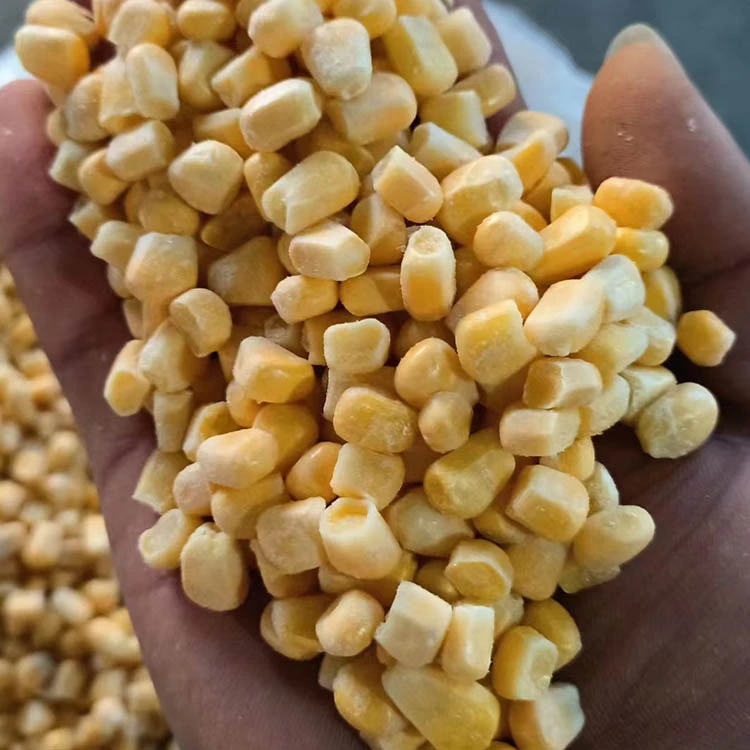
Original kernel photograph supports form comparison; it is not a result for the proposed Qatar order.
The supplier-control file should also explain the physical product. We record raw-material and process identity, blanch route where applicable, metal or other foreign-material controls in the actual plant, pack configuration and lot coding. The buyer may ask about site certifications or audit records, but those have to be current for the selected production partner and product route. A generic website logo, an expired certificate and an unrelated factory report do not prove this shipment. We state what can be supplied for review and what still needs confirmation before promising a document in the sales contract.
A provider guideline from Intertek describes a pre-shipment conformity service, product categories and inspection or testing routes. It identifies a specific mandatory certificate situation for certain fresh seafood movements, while saying that conformity certificates can support faster clearance for regulated food. That document alone does not establish that every sea shipment of blanched frozen corn from China must carry an Intertek CoC. We ask the importer and competent provider whether the exact product, origin and route fall in the currently applicable programme. If a CoC is required or commercially chosen, agree the request, test and inspection window early enough for the loading plan.
Keep conditional certificates out of the wrong product category. The official imported-food page calls for halal documents when meat or animal-derived components are involved. A genuinely single-ingredient corn SKU does not inherit slaughter requirements from a meat shipment; if the recipe, processing aid or cross-contact claim changes, reassess the evidence rather than assuming plant-only status forever. The same discipline applies to organic, non-GMO or allergen-free claims. We can discuss the requested claim and supporting route, but no artwork or order should carry it until the actual source and production evidence support it.
When comparing quotations, separate compulsory evidence from optional buyer assurance. The cost of a product-specific laboratory panel, an extra inspection, Arabic artwork development, a conformity-service request and retained samples may sit with different parties. Identify them in the commercial offer rather than concealing them inside a broad promise of compliance. If the importer asks for a specific certificate, request the issuing body, validity period and acceptance purpose in writing. We can then state whether the selected plant and lot can produce it, what lead time it adds and whether it must be issued before loading.
Coordinate the refrigerated load and food inspection
The cold chain is a measured handover, not a decorative phrase on an invoice. Before loading, agree the product's frozen target condition, carton and pallet configuration, container set point, pre-cooling responsibility, loading window and who retains the logger or reefer record. The agreed product specification should also say what receiving staff do with warm cartons, visible thaw/refreeze signs, wet packaging or damaged seals. We inspect the actual loaded lot and document the container and seal numbers. A container display at one moment cannot prove that every carton stayed frozen through a voyage, so retain the available history and connect it to the shipped lots.
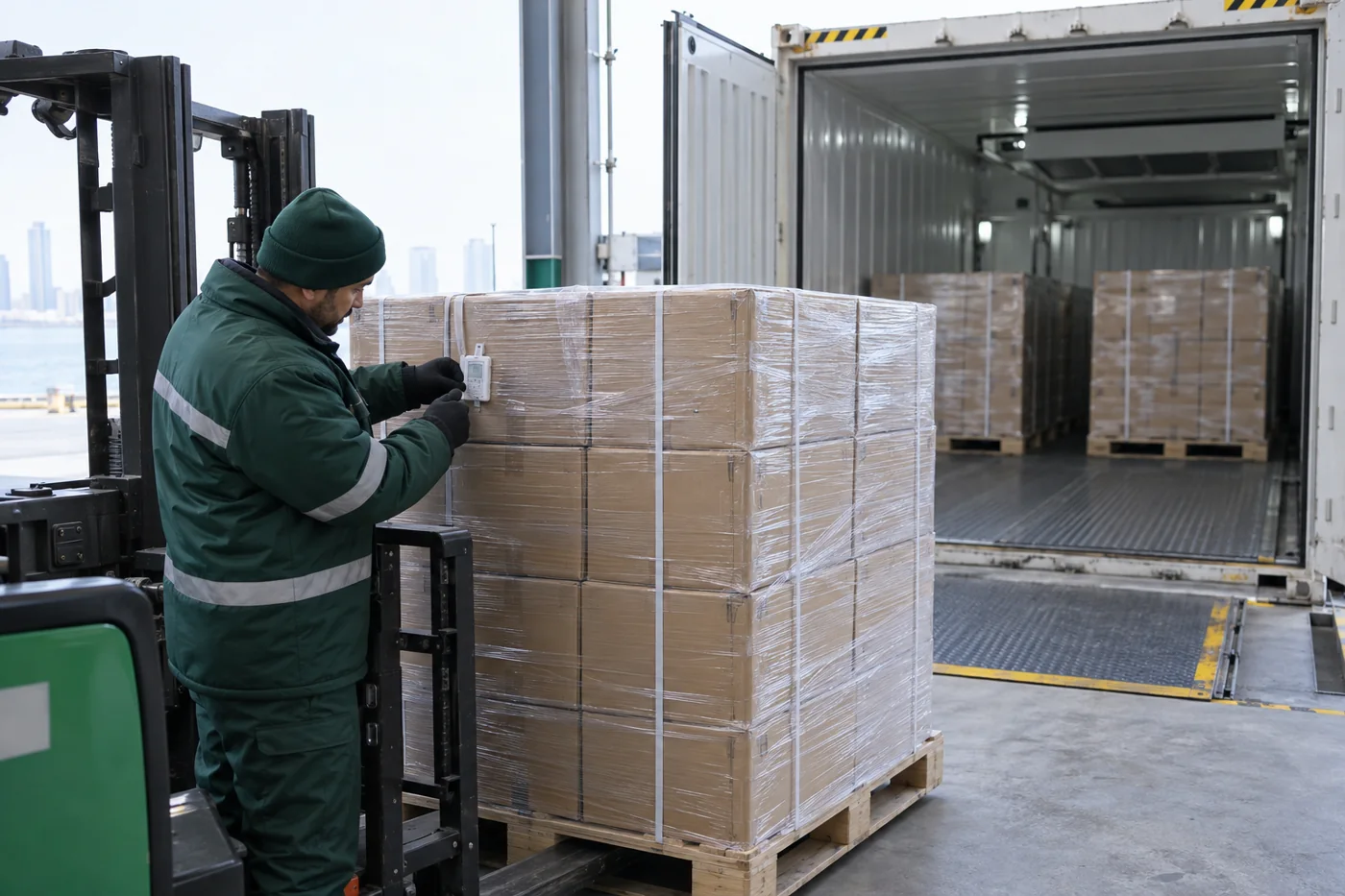
Illustration: verify loading and monitoring records for an industrial frozen-kernel shipment.
Loading details affect both quality and inspection. Airflow cannot work through blocked vents or against careless pallet placement. Cartons need adequate strength for the specified stack and moisture conditions, with lot codes readable when inspection samples are drawn. If a container carries several production lots or products, map pallet positions and carton counts to each lot; the packing list must make that map usable. We can provide the loader's count and supporting photos where appropriate, but we do not describe them as an authority release. The importer should know which cartons can be accessed for sampling without losing traceability in the frozen store.
At arrival, the broker's declaration starts the local workflow and the food authority may inspect or take laboratory samples, as Sharek explains. Sharek gives a longer estimated period when laboratory sampling occurs; it is a service estimate rather than a guaranteed arrival appointment. Build the purchase schedule around a plausible hold period and reserve temperature-controlled storage. Do not unload into ambient space merely to speed access. If a seal or carton condition differs from the shipping record, photograph and record it before moving goods, then ask the importer and its broker to coordinate with the relevant officials. The buyer should withhold commercial release while official or contractual checks are outstanding.
The importing team should compare arrival evidence with the signed order: product name and registration, origin, label revision, date print, net weight, carton count, lot codes, invoice, certificate references and frozen condition. A mismatch is not automatically a safety failure, but it is a reason to stop and identify which record is wrong before stock enters production. We can investigate the supplier-side source, send controlled corrections if lawful and provide lot-specific evidence. The local authority decides its inspection result, and customs clearance is a separate administrative outcome; neither should be inferred from an email saying the reefer has arrived.
Keep held stock controlled and close changes through the order file
Set a clear status for every carton after arrival: awaiting authority inspection, laboratory hold, buyer QA hold, released, rejected or another documented disposition. Keep held stock frozen and physically or systemically separated so it cannot be picked for a foodservice order by mistake. Record lot, pallet, quantity, location, reason and decision owner. If only one production lot is questioned, identify it precisely rather than freezing decisions for unrelated lots without cause. A controlled stock ledger lets the importer protect food quality while giving the supplier a focused investigation request.
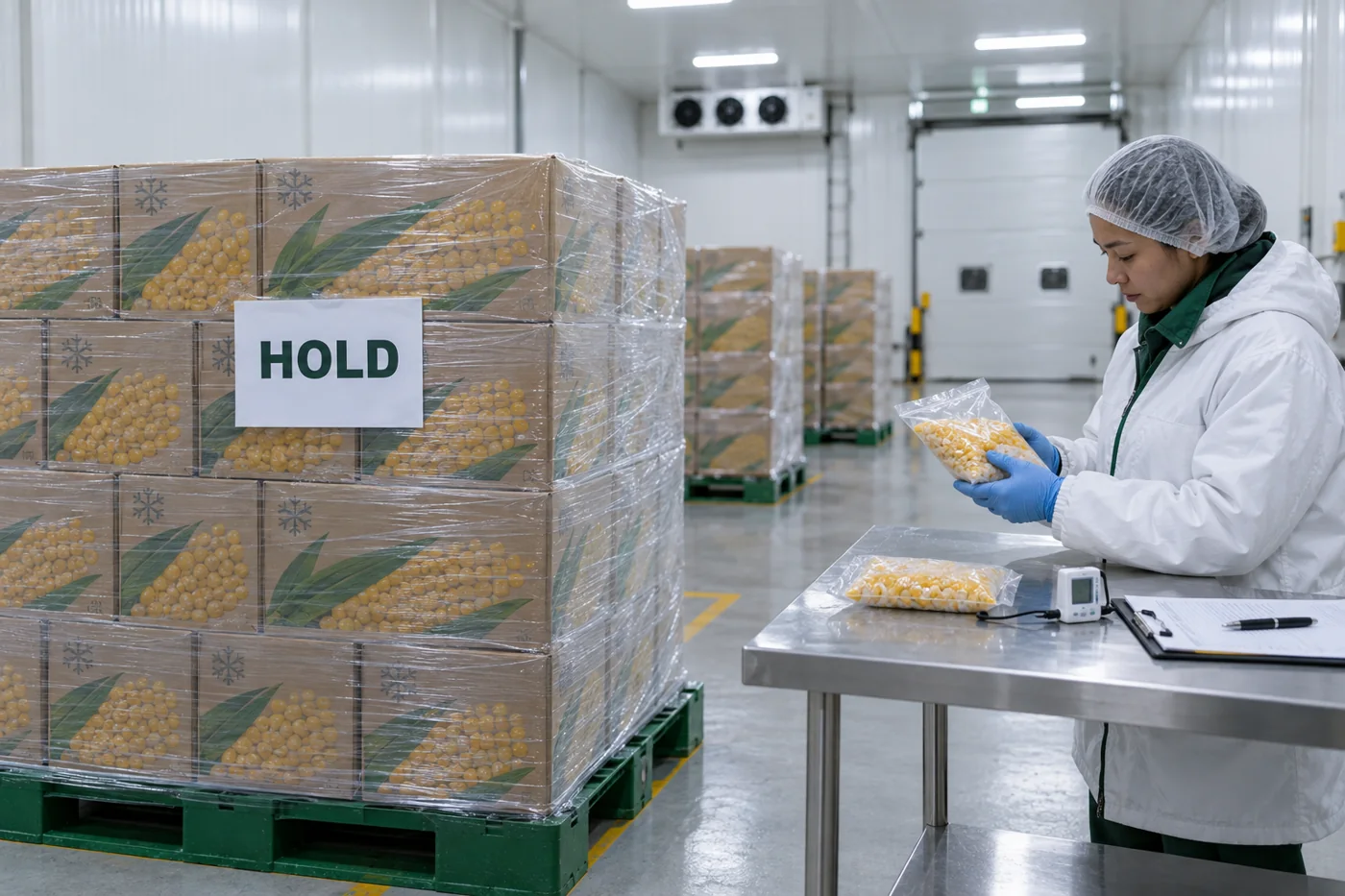
Illustration: controlled stock remains identified until the relevant restriction is resolved.
Where an official initial inspection reports non-compliance, use the actual local remedy rather than a casual request to 'check again.' Sharek's re-inspection service identifies an importer letter, producer or manufacturer explanation with scientific justification if available, and photographs of the non-compliant product. It lists a corrective-action period of 15 days. The importer should verify its live case deadline and submit through the authorized route. We can supply factual batch records and technical explanation, but we do not promise that re-inspection will reverse the first decision or authorize stock movement while the matter is pending.
Commercial changes need the same discipline before the next shipment. A new corn variety, kernel cut, blanch process, ingredient, factory, inner pack, carton weight, Arabic text, shelf-life print or importer can change an approved field. The purchasing team should identify the proposed change, affected sample and lot, evidence needed, registration impact and written buyer decision. If the old product record or label no longer fits, obtain the local review before printing or shipping. A supplier substitution cannot be hidden under the same generic description simply because the kernels still look yellow and frozen.
For repeat orders, keep one compact order file: signed product specification and artwork revision, Wathiq reference confirmed by the importer, approved reference sample, actual supplier documents, lot and carton map, container/temperature evidence, arrival inspection status, deviations and change approvals. Use it to compare the next lot against the first accepted one and to resolve a complaint without reconstructing the shipment from scattered emails. Send GreenLand-food the required kernel grade, industrial pack, annual or trial volume, destination, cooking application, Arabic artwork owner and local registration status. We can then discuss available supply and a realistic sample-to-order schedule against that exact purchasing brief.
A useful first-order closeout records which assumptions survived arrival. Did the printed dates match the approved artwork? Could inspectors reach the sampled cartons while maintaining frozen conditions? Did the receiving kitchen obtain the expected cooked yield and portion behavior? Record a measurable answer for each, along with the actual lot and document revisions. If the answer is no, define the correction before a repeat purchase order is accepted. That small feedback loop turns one successful customs and food-inspection event into a repeatable supply programme, without claiming that every later shipment is automatically cleared.
The current Qatar re-inspection service requests an importer letter and supporting producer information, with product photographs where relevant, within its stated corrective-action period. That procedural opportunity does not promise a favourable result. The supplier file should preserve the finding, relevant lot, actual scientific explanation and any authority decision, so stock status and customer communication remain consistent during review.
Build your frozen sweet corn order with GreenLand-food
GreenLand-food is a professional frozen sweet corn supplier and manufacturer in China, providing factory-direct wholesale supply for importers, food manufacturers and foodservice programmes.
Send your product form, specification, packing, quantity, application, destination, private-label needs and requested documents. We will organise the product and order requirements with your purchasing and quality teams.