


Importing China-Origin IQF Apricot Halves into Israel: Route and Evidence File
Oct 22, 2026
Leave a message

Research This Article & Topic with AI
Verify key claims, compare reliable sources, and explore GreenLand-food's practical frozen food knowledge.
Article details and research questions are prepared in the links. Sign-in or sending may be required.
Reviewed 22 October 2026. Shipment requirements are checked for the actual product, route and filing date.
Define the apricot product and confirm the Israeli import route
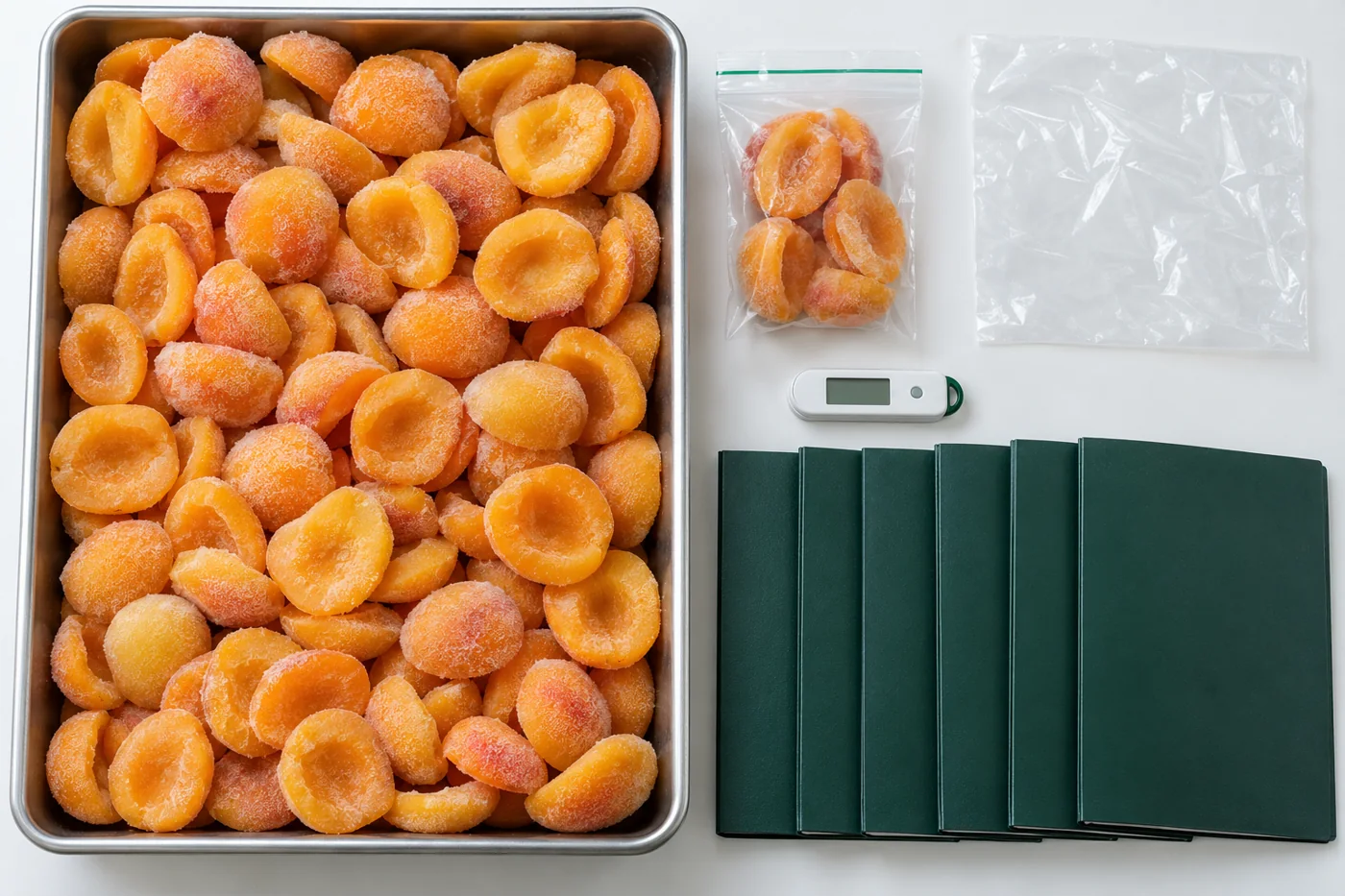
Start with the fruit that will actually enter Israel. Record Prunus armeniaca, China growing origin, processing country, pitted half form, ingredient composition, treatments, pack and intended use. Identify the actual processor and any separate freezer or packer. A sales description such as frozen yellow fruit leaves the importer and laboratory without enough information to classify the food or assess its requirements. A photograph supports the description, while the controlled specification establishes the accepted form and conditions.

Original apricot photograph illustrates the supplied form; no grade, lot test or import approval is inferred.
Plan the product and evidence together
Send the intended use, destination, pack and required records. We can prepare a specification and order evidence plan with your purchasing and quality teams.
Request Specifications & QuoteThe National Food Services import overview distinguishes regular and sensitive non-animal foods. Cold-controlled products require specific attention in the sensitive-food assessment. For this frozen ingredient, we plan the sensitive-food review unless the importer documents a different applicable classification or an accepted European-track arrangement. We send the actual process and storage description for that decision rather than treating every fruit product as regular food.
The standard sensitive-food route and the European route have different qualification and document requirements. A customer already registered as an importer is not automatically qualified for every route. Ask for the responsible importer's confirmation of the chosen procedure and any outstanding permission before production is allocated. A supplier declaration that a food meets selected EU limits does not itself determine the Israeli import route or satisfy all of its conditions.
Israel's adoption of European food provisions includes local adjustments and implementation dates. Keep the applicable Israeli adoption record with the order's legal schedule, alongside the underlying EU text when relevant. The January 2026 USDA FAIRS report is useful orientation to that transition, with its stated review date. An importer should resolve the actual provision with the responsible local authority when timing or scope affects the order.
Commercially, distinguish halves from dices, puree and fruit preparations containing sugar or other ingredients. A change in recipe, edible part or treatment may change the analytical matrix, label and approval file. A pack sold for a bakery filling also needs a different application discussion from fruit proposed for an unheated dairy preparation. We keep the intended use visible when reviewing the processing route and testing plan, so a later marketing request does not silently change the supplied food's safety assumptions.
The first usable result is a signed product identity and a recorded route decision. It names the importer, manufacturer, site, product revision, application and permission reference or pending question. Where a decision remains unresolved, the commercial schedule shows the dependency and owner. This allows raw-material and sample work to proceed with clear limits while preventing an unsupported assumption from becoming a shipment instruction.
Match the importer, manufacturer and pre-import document file
The local importer establishes its National Food Services registration and suitable storage arrangements. GreenLand supplies the factual manufacturing and product information needed for the selected application. We agree one technical contact at the processing site and one regulatory contact at the importer, then maintain a document register showing issuer, version, date, product and outstanding correction. This prevents commercial staff from forwarding several inconsistent specifications as if they formed a single approved file.
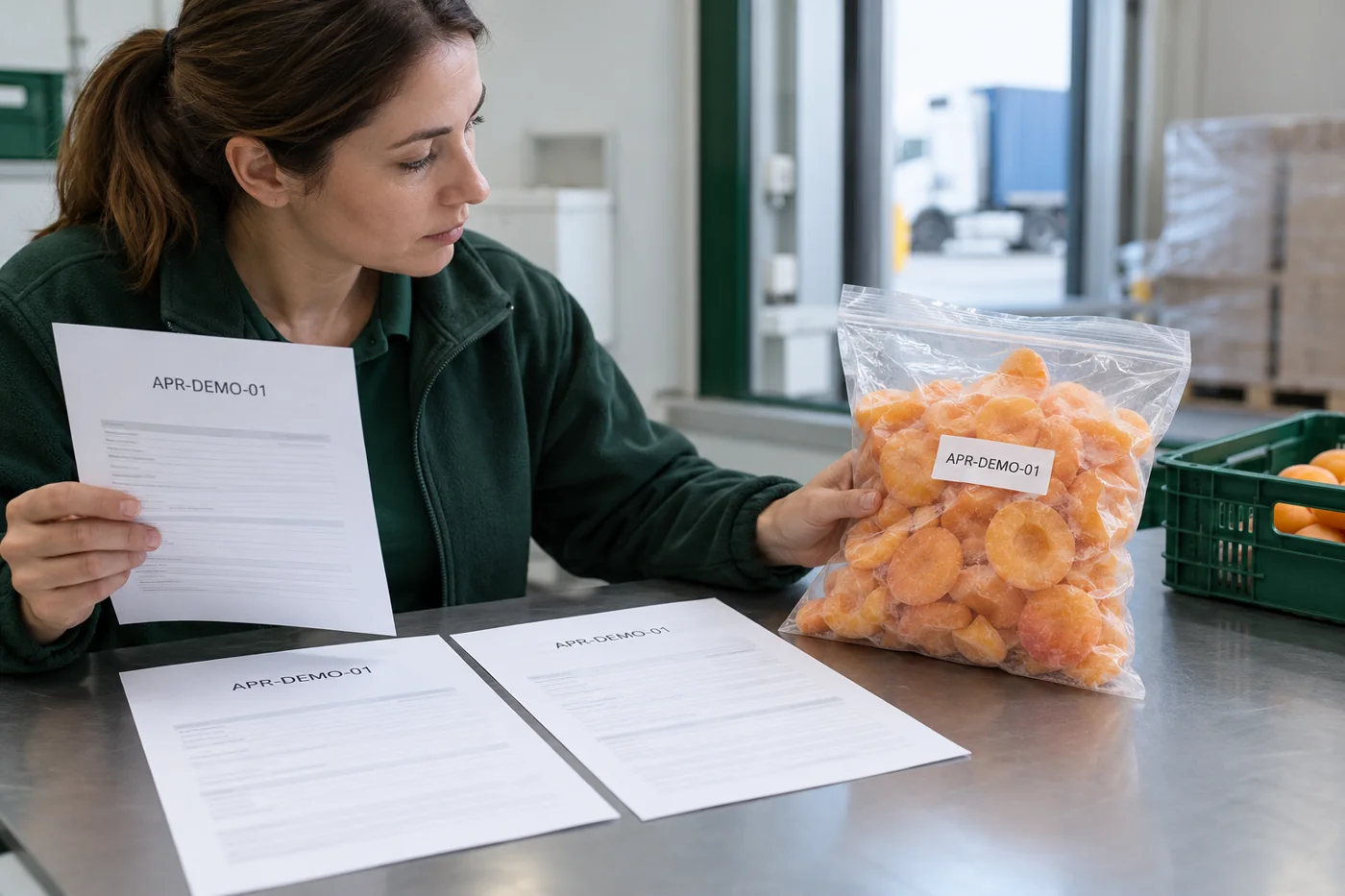
Illustration: compare the same manufacturer and product identity across the order file.
For a sensitive-food application, the official service instructions connect the permission to the particular importer, product, manufacturer and manufacturing site. They also describe document language, signatures and submission conditions. The importer checks the current procedure and submits through the designated portal. We prepare legible manufacturer documents using the actual legal name and address; the factory's technical contact confirms composition, process and code interpretation.
The technical file describes the fruit, complete ingredients and relevant processing inputs, product characteristics, shelf-life basis and frozen-storage conditions. When an aid or additive is used, its identity and purpose are supplied for assessment. A short single-ingredient sales line cannot replace that explanation. The importer determines the applicable disclosure and authorization requirements, supported by the manufacturer's factual statement and the appropriate evidence for the actual formulation.
Factory food-safety certificates are reviewed against the processing and packing operations behind the order. BRCGS or another accepted scheme can support supplier qualification when the customer requests it. We check the certificate holder, site, scope, status and dates, including outsourced handling. The order record identifies the requirement as a buyer qualification or scheme condition where that is its basis. A certificate for a different plant or activity cannot answer a gap in the proposed manufacturing route.
Assign every requested document to its lawful issuer. The manufacturer signs its composition and process statements; the laboratory issues its analytical report; a certifier decides its own scheme authorization; a competent authority issues any required official export certificate. GreenLand organises the requests and reconciles the resulting facts. We do not replace an unavailable official document with a similarly titled commercial letter. If the importer asks for a different format, establish the required issuer and content before requesting a revision.
Before the application is submitted, compare the manufacturer name, address, product name, brand, storage condition and specification revision across the file. Return discrepancies to their original issuer and preserve superseded versions. Retain the submitted set and the importer's receipt or decision, so a later request can be traced to what was actually filed. An application receipt records submission; the order coordinator separately records whether the necessary permission has been issued and whether its conditions cover the intended supply.
Commission the crop-specific laboratory and residue review
Agree the laboratory work before collecting the sample. We start with the exact apricot matrix, growing source, treatment history, destination requirements and customer's specification. Pesticide residues, contaminants and microbiological questions are separate parts of the plan. Each needs named targets, a relevant method, sample preparation and an applicable criterion. The importing authority may specify additional work; its request remains visible alongside the commercial programme.
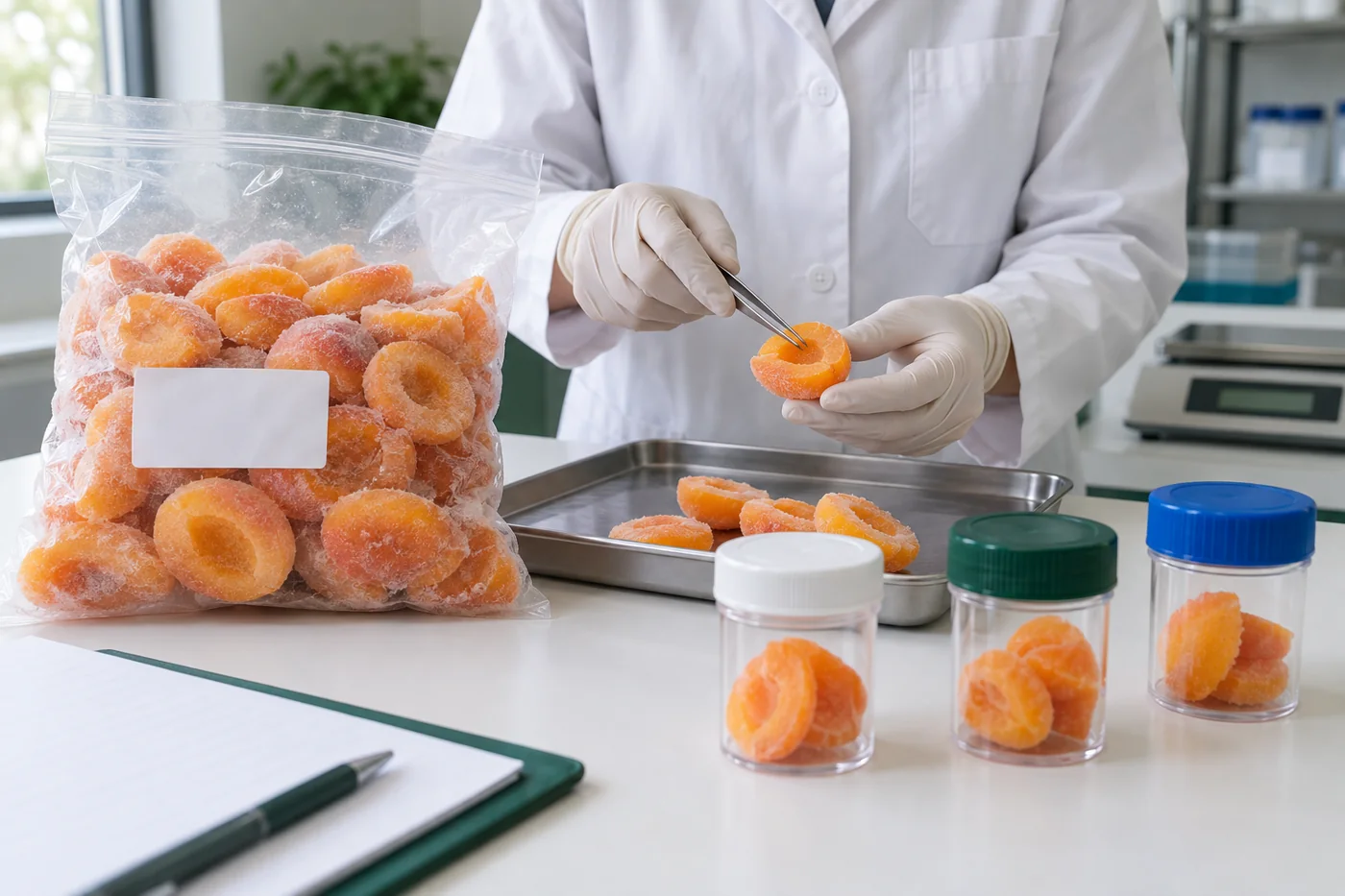
Illustration: separate identified test portions while preserving sample custody.
A screen advertised as 196 or 500 pesticides describes a laboratory service scope, not a universal legal approval. Compare the requested substances and residue components with the laboratory's current analyte list. Confirm whether relevant metabolites, isomers or compounds requiring separate methods are covered. Record the reporting limit for this matrix. Where the ordinary screen leaves a required target unresolved, commission the appropriate additional method before the batch is considered for release.
Results retain their original qualifier and unit. A report reading less than a stated reporting limit describes the method's reporting boundary; it should not be rewritten as a measured zero. It also cannot be interpreted correctly without the substance identity, unit, residue definition and applicable decision criterion. Our pesticide testing and COA guide explains the commissioning and review sequence in more detail. The batch file keeps the original report beside the supplier's summary COA.
Mercury requires careful source selection. Regulation (EU) 2018/73 amended mercury-compound residue provisions within the 396/2005 framework. An old reference to that amendment is not a complete current contaminant schedule. The reviewer checks the applicable commodity, current text, residue definition, reporting method and Israeli adoption conditions. Other metal questions are specified separately according to the relevant food category and destination rule. We do not infer one shared limit for every metal or every fruit product.
For microbiology, define the intended food use and relevant process evidence before choosing organisms and sampling units. Include the customer's downstream handling and any validated cooking step in the assessment. A single negative sample cannot demonstrate the absence of contamination throughout a container. The plan connects representative sampling, hygienic handling, prevention records and an appropriate release decision. Frozen storage preserves the product's state; the safety assessment still needs to address the actual hazards and use.
The sampler records the lot, carton positions, increments, sample mass, seal, time, temperature and delivery to the laboratory. Keep a sealed frozen retain under defined conditions. QA reviews report identity, scope, dates and qualifications against the agreed instruction. If the report covers a different harvest, factory or fruit form, it is returned for clarification. Original findings stay in the history when further testing is arranged, allowing the importer and authority to understand the complete sequence.
Arrange the accepted Kosher scope and Hebrew artwork
Kosher preparation begins with the customer's sales channel and accepted authority. Ask whether the requirement concerns an industrial ingredient, a retail pack, a particular brand or a seasonal claim. The official Israeli kashrut application service describes recognition and supporting information for imported products marketed as kosher. We coordinate the actual manufacturer and product information with the accepted certifier and the importer handling that route.
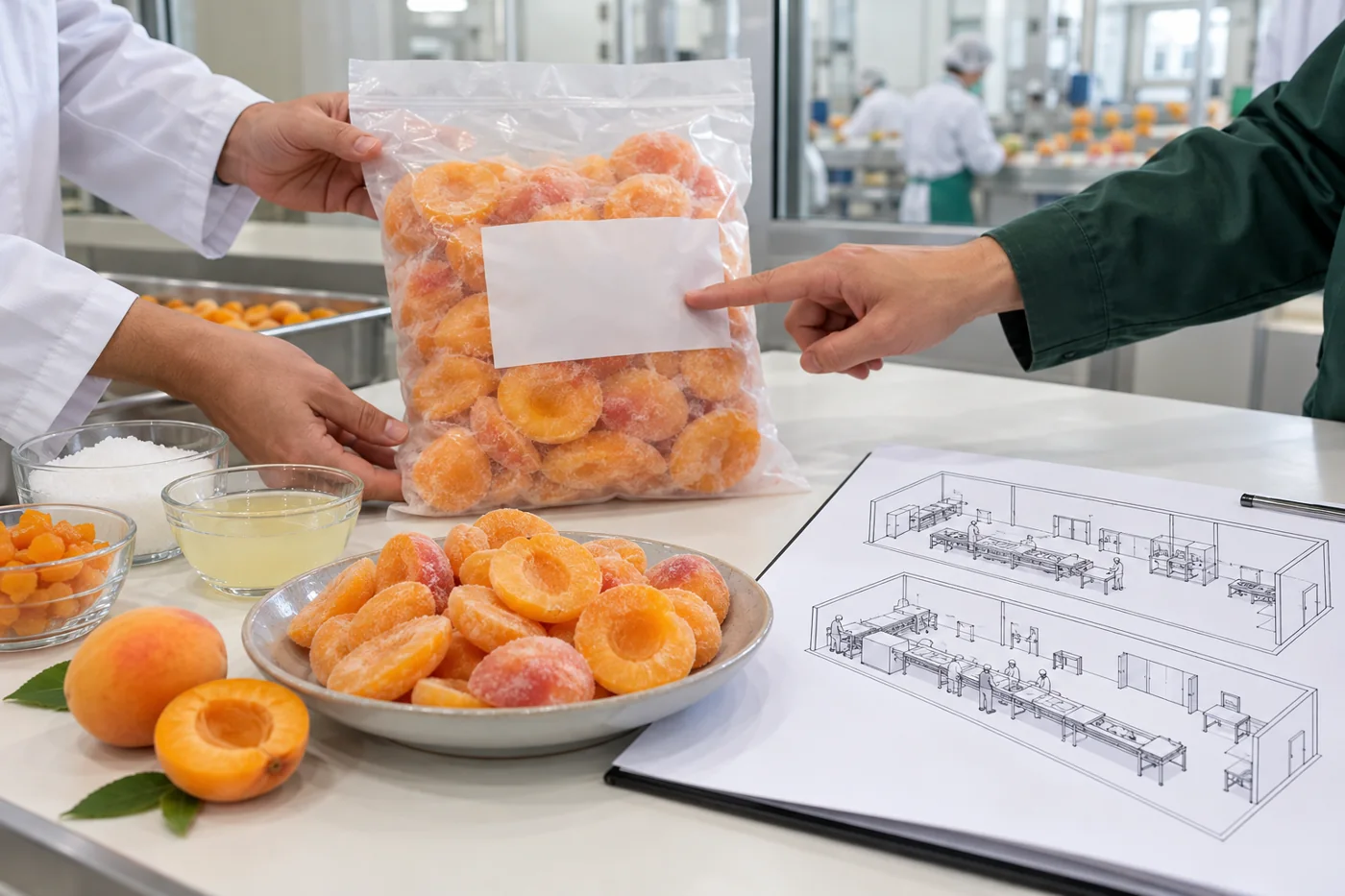
Illustration: review the packaging proof and actual production scope before a mark is authorized.
For plain fruit, the review can involve raw-material sources, insect concerns, process inputs, equipment, sanitation, shared operations and any separate packing site. Those subjects are assessed under the selected programme. A general description of Jewish dietary principles does not specify the supervision required for this production run. The certifier determines whether visits, production supervision, particular cleaning steps or other conditions apply; the factory schedules those requirements before the claimed production.
Keep the product and brand authorization with the order. A current site certificate may need an annex or product list to establish the relevant item. Private-label artwork needs the applicable permission for the buyer's brand and proposed mark. If the manufacturer, recipe or packer changes, reopen that scope before reconfirming the claim. Our Kosher frozen-produce guide develops the site, ingredient, equipment and artwork questions.
Hebrew artwork is reviewed against the actual food and the current Israeli requirements for its market presentation. The importer confirms the product name, ingredients, responsible parties, origin, net quantity, storage, use directions, date information and any applicable warnings. We supply the confirmed manufacturing facts and retain an approved artwork revision. A local label reviewer resolves required language and presentation; a translated sales description alone is insufficient for an approved production proof.
The artwork must also agree with the intended use. If the food has been assessed as an ingredient requiring further cooking, a request to present it for direct unheated consumption triggers technical review. Removing an instruction or adding a ready-to-use phrase cannot establish that the process supports that use. Similarly, a no-added-sugar or additive-related statement is checked against the complete formulation and applicable claim conditions before printing.
For the first packed run, the factory compares the physical pouch and carton with the approved proof, including lot and date legibility and any authorized certification mark. Line clearance removes superseded labels, and the packaging record identifies the material and artwork versions used. We keep photographs of the released pack as product-identification evidence. They help resolve a later registration or label question without implying that appearance alone proves chemical or religious compliance.
Connect packaging evidence and any European marketing documents
The inner liner is part of the order definition. Confirm its material code, supplier, thickness or construction where relevant, food-contact face, pack format and intended use. We obtain a matched declaration and supporting information from the packaging supply chain. The reviewer considers the actual apricot product, its acidity and composition, frozen-storage period and any later use in the pack. A declaration for a different film or a different temperature application leaves an unresolved packaging question.

Original apricot photograph illustrates the supplied form; no grade, lot test or import approval is inferred.
Chemical suitability and physical performance require different evidence. A food-contact statement addresses the relevant legal conditions; seal checks, handling trials and distribution observations address protection of the product. Apricot halves can be damaged by compression, abrasion or poorly supported handling even when the film's chemical file is adequate. We agree filling, closing, carton strength, pallet pattern and inspection methods for the actual pack instead of treating a single certificate as a complete packaging specification.
When the chosen Israeli route calls for European-market evidence, ask the importer to identify the precise condition and acceptable documents. A previous bill of lading can show a recorded transport movement. An origin certificate supports stated origin within its scope. A phytosanitary certificate addresses the certified plant-health statements. These documents do not all establish the same fact, and none should be relabelled as a comprehensive authorization for every future Israeli shipment.
The supplier file therefore separates existing factual evidence from a new declaration. We identify the product, manufacturer, production site and period covered by any previous European documents, then compare them with the proposed SKU. Commercially sensitive customer and price fields are handled through the agreed disclosure arrangement. If the required fact cannot be established from the available record, we ask the importer to resolve the acceptable route before relying on that document in the application.
The Chinese-origin customs file receives its own review. A route that uses European food provisions does not change where the apricots were grown or processed. The broker confirms the actual tariff classification and treatment using the complete product description. The Israeli import-documentation guide explains the importance of classification; its US-origin preference discussion should be read within that specific origin context. We provide the facts needed for the Chinese product's assessment.
For each document, record the requirement owner, issuer, SKU or lot, validity basis, recipient and unresolved point. This makes it possible to see whether a missing item blocks the application, a claimed certification, packaging approval or shipment release. Separate decisions remain linked to one order identity. The result is a usable evidence file in which each document has a defined purpose and the buyer can identify the action needed to close a particular gap.
| Document | Fact it can support | Additional question for the order |
|---|---|---|
| Laboratory report | Results for the identified sample and stated methods | Does scope and sampling represent this lot and required criteria? |
| Bill of lading | Recorded transport parties and movement | Does it identify the same product and relevant marketing evidence? |
| Origin certificate | Origin statements within its issued scope | Does it meet the importer and customs requirement? |
| Kosher authorization | Issuer-defined product, site and claim scope | Is the exact SKU, brand and production arrangement covered? |
Reconcile the shipment, cold chain and arrival release
Prepare the shipment register from the released product and packing information. Check invoice description, case count, net and gross mass, manufacturer, origin and lot details against the packing list and transport booking. The broker and importer confirm the documents required for the actual entry. Where an official health or phytosanitary certificate applies, the exporting authority receives accurate product and shipment facts before issuance. The requested document must reflect the accepted requirement and lawful issuing route.

Illustration: record loading condition and transport-monitoring identity.
Cold-chain preparation covers the product and the handling sequence. The order specification states the frozen-storage requirement and the factory's validated product conditions. Logistics confirms suitable storage, protected loading, the refrigerated container arrangement, pallet stability and monitoring. Record the container and seal numbers, product or loading observations, logger identity and placement, and the people receiving those records. A setpoint is an operating instruction; the quality review also considers actual product and transport evidence.
We set internal document-ready and sampling dates before commercial cutoffs, while keeping those preparation dates distinct from legal deadlines. The importer and carrier identify their own submission and booking requirements. If loading or sailing changes, the coordinator checks which shipment references, permissions or documents need updating. Sending the latest packing list once does not establish that every responsible party has received and accepted the revised information.
At arrival, the importer follows the food-shipment release procedure and any inspection or sampling instruction. The receiving team preserves the seal, carton, temperature and lot evidence before distributing stock. If movement to a controlled warehouse is permitted while a decision is pending, the goods retain their applicable restriction. Permission to move a shipment is assessed according to its stated terms before any commercial use is authorized.
Keep separate status entries for the food authority, Customs, carrier or terminal, and the buyer's receiving decision. Record the actual reference and date for each result. A supplier laboratory result can support the file, while the competent authority retains its own examination and release powers. We provide matching manufacturer, sample and transport records when the importer receives a question, so the response addresses the actual shipment rather than a generic brochure.
At delivery, the customer compares the accepted specification and sample with representative received stock under the agreed method. Record product state, carton selection, photographs and measured findings. The commercial comparison may concern size, colour, breakage or application performance even after regulatory release. Those observations are handled through the agreed quality process, with the original records retained so transport, product and analytical issues can be investigated on their respective evidence.
The official shipment-release service distinguishes an approved declaration that is not selected for sampling from a shipment referred for additional inspection or laboratory work. It also describes conditional movement under stated conditions while marketing remains prohibited pending satisfactory results. We therefore keep three separate status fields: location, food-authority decision and permission to market. A truck movement or warehouse receipt must not be transcribed as unrestricted product release.
Resolve a missing result, source change or official hold
A missing analyte is an unresolved test scope, even where the remainder of a large panel reports satisfactory results. QA identifies the affected lot and required additional work, obtains the laboratory's method and sample instruction, and informs the importer of the hold reason. A later report is linked to the original finding and sampling history. The release owner reviews the complete evidence and the applicable authority instruction before changing the status.
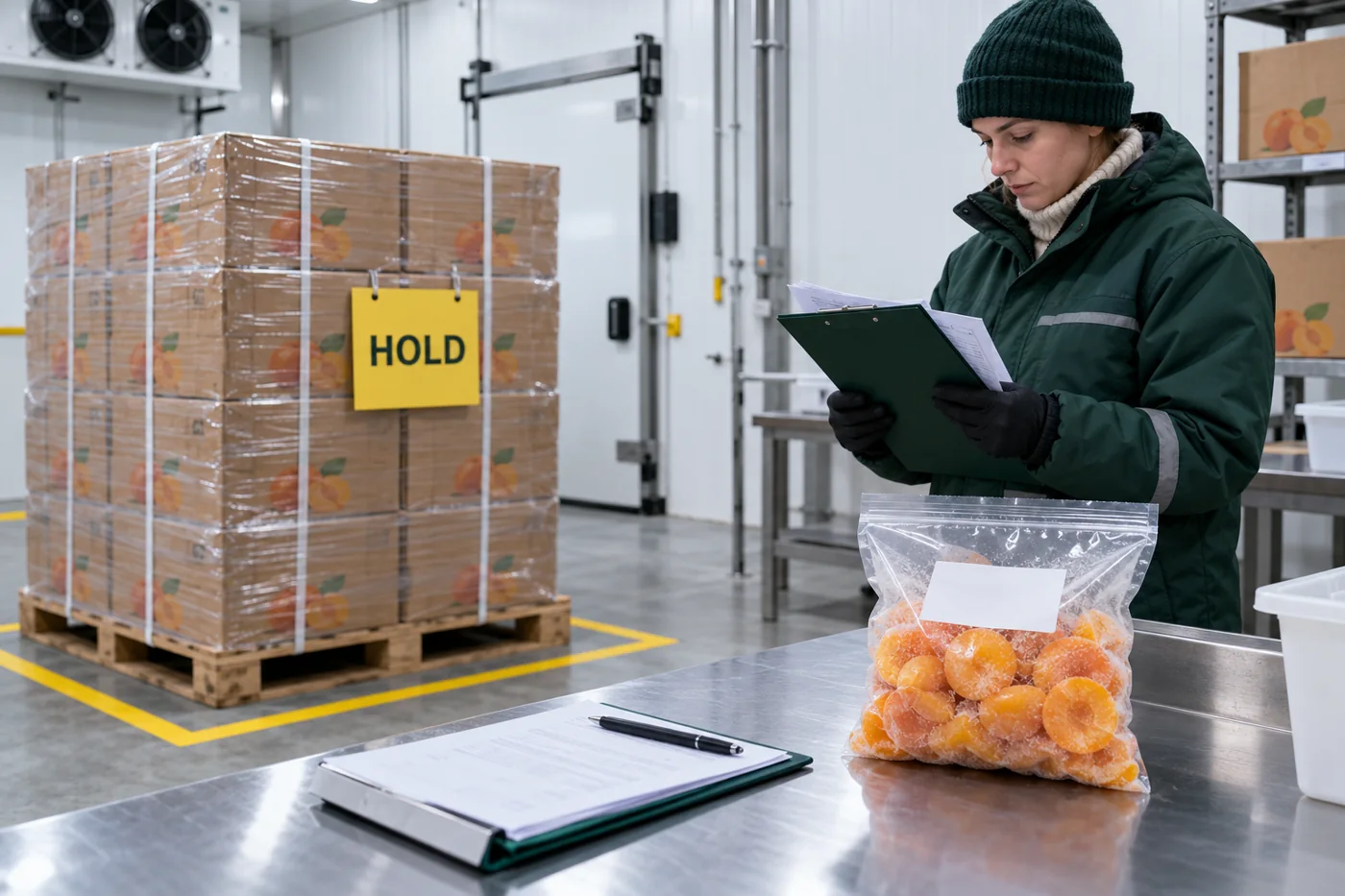
Illustration: maintain lot segregation while the responsible parties investigate a hold.
An unexpected numerical result needs a similarly controlled review. Confirm the exact chemical identity, result text, unit, reporting boundary, sample portion and applicable criterion. Resolve a mistranslation or transcription issue against the original issuer's report. We do not infer a particular pesticide from an ambiguous translated name. For a near-limit result, the qualified reviewer considers the applicable decision rule and measurement information rather than converting every detection into the same legal conclusion.
DEMO ONLY: a proposed container contains ten pallets, each with eighty 10 kg cartons, totalling 8,000 kg. Pallets 1-4 are recorded as finished lot A and pallets 5-10 as lot B. A laboratory report is linked only to lot A. Its represented stock is therefore 4 × 80 × 10 = 3,200 kg; the remaining 4,800 kg has no demonstrated connection to that report. These invented numbers explain traceability, not a sample-count recommendation or a GreenLand shipment result. The reviewer must establish the actual lot boundary and evidence needed for both populations.
The customer handover retains the original report, sample-to-lot link, pallet map and outstanding question for lot B. If a separate report is required, commission it under the agreed instruction and preserve its identity. Do not change the lot wording on lot A's report to make the arithmetic balance. The responsible importer also retains any official notice and marketing restriction; a private document review does not lift that instruction. Source, factory or treatment changes return to the same route and evidence review before another shipment is approved.
If the factory or formula changes after approval, compare the revised facts with the permission, certificate, laboratory and artwork files. Identify production already completed and materials already purchased. The importer confirms any required new filing, while the certifier addresses its own scope. New production remains identified under the revised source until the relevant decisions are complete. The previous approval remains attached to the product and route it actually described.
An official hold is managed through the importer and the competent authority. Preserve the notification, laboratory references, sample identity, affected quantities and permitted storage or movement conditions. GreenLand coordinates the source-side investigation and requested documents. Retesting, treatment, return or destruction follows the authorized process for the particular finding; commercial agreement between seller and buyer does not itself cancel a regulatory restriction.
When a quality complaint accompanies the hold, preserve both evidence streams. Photographs and counts can quantify damaged bags or discoloured fruit, while laboratory or authority documents explain an analytical restriction. Avoid estimating a whole-container loss from one convenient bag. Agree representative comparison, retained samples, quantity mapping and any independent examination. The arrival-quality investigation guide provides the broader evidence sequence.
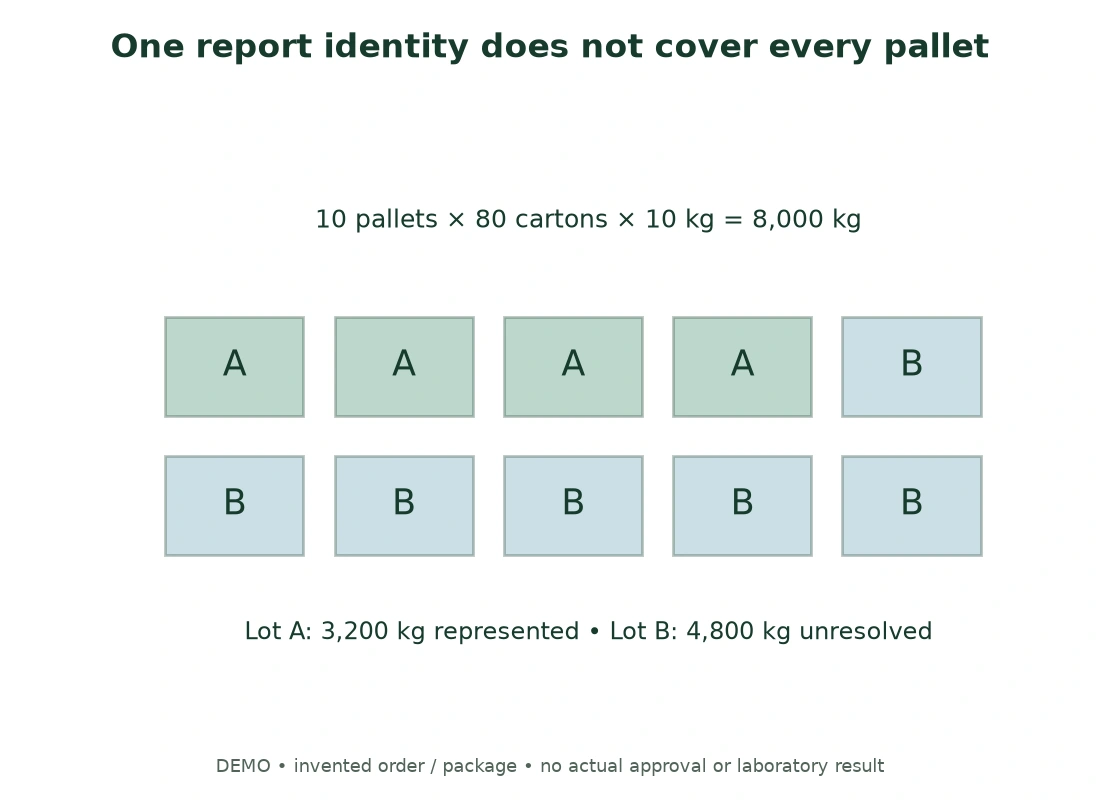
On narrow screens, scroll the figure to read every label.
DEMO traceability map: four lot-A pallets match the report identity; six lot-B pallets remain unrepresented. The drawing prescribes no sampling number.
Close the incident with a recorded decision, affected stock reconciliation and corrective action appropriate to the cause. Assign an owner and a verification method for the next relevant production. This may mean a revised source review, an additional analytical target, a corrected document field or a packaging change. The useful outcome for your next purchase is a traceable requirement and control that can be checked before shipment, supported by the responsible party's actual record.
- Identify and control the affected lot; preserve original results and authority instructions.
- Assign the missing technical, documentary or regulatory question to its responsible reviewer.
- Obtain matched evidence or authorized disposition and record the outcome.
- Reconcile the stock and verify the corrective action for subsequent relevant production.
Build your frozen apricot halves order with GreenLand-food
GreenLand-food is a professional frozen apricot halves supplier and manufacturer in China, providing factory-direct wholesale supply for importers, food manufacturers and foodservice programmes.
Send your product form, specification, packing, quantity, application, destination, private-label needs and requested documents. We will organise the product and order requirements with your purchasing and quality teams.