


Are Water Chestnuts Nuts?
Sep 09, 2026
Leave a message
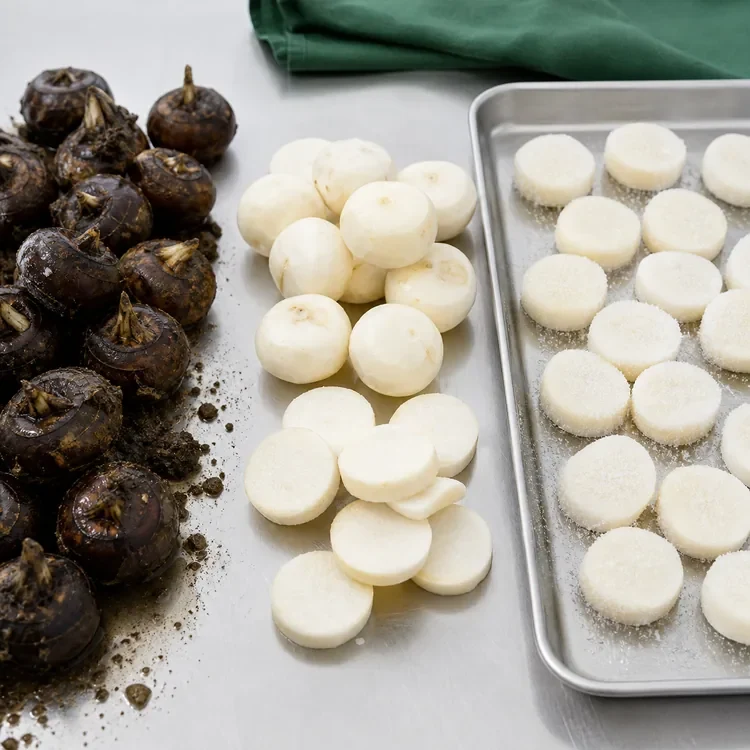
For someone managing an allergy, the useful next step is to check the exact ingredient, the complete recipe and the product's allergen information against their own medical advice. For a food business, the same distinction matters in purchasing: a specification for water chestnut slices should identify the vegetable accurately, while allergen controls need their own documented assessment. At GreenLand-food, we keep these questions separate when discussing frozen water chestnut supply, so a correct product name does not become an unsupported safety claim.
Water chestnuts are edible corms of an aquatic plant
The common Chinese water chestnut is Eleocharis dulcis. Kew's botanical record places it in Cyperaceae, the sedge family. Above the soil, the plant produces slender upright stems associated with wet growing conditions. The food develops below, where a swollen stem structure stores reserves. That structure is called a corm. Once its dark outer covering is removed, the pale flesh can be cut into the familiar round slices or small dice used in prepared dishes. Kew's Eleocharis dulcis record provides the botanical identification behind this description.
For the field-to-corm sequence behind that identity, see how Chinese water chestnuts grow.
Calling a water chestnut an aquatic vegetable is therefore a practical food description, rather than a claim that it is a fruit from a nut tree. A cut corm has firm white flesh throughout. It does not contain a separate nut kernel inside a hard chestnut shell. This matters when a buyer receives an unfamiliar sample: a brown exterior and the word chestnut are not enough to establish the ingredient. The peeled interior, product name and supplier documentation should tell the same story.

Water chestnuts develop as corms beneath an aquatic sedge. Botanical illustration.
The common name also needs care across languages and markets. A translated ingredient description may be shortened to chestnut even when the original product is a water chestnut. A dish name may omit the word water altogether. Where the identity affects an allergy decision or a commercial specification, ask for the full ingredient name rather than relying on a menu abbreviation. For our frozen vegetable discussions, specifying Chinese water chestnut, Eleocharis dulcis, removes an ambiguity that an English nickname can leave unresolved.
The corm's role as a storage organ helps explain its dense, crisp eating quality, although growing conditions and processing still affect the finished product. In a mixed dish, small pieces can provide a noticeable bite without adding a strong roasted-nut flavor. That culinary function is one reason the vegetable appears in fillings and stir-fries. It is also why substituting an actual chestnut would change both the ingredient identity and the texture, even if a purchasing system treats the names as similar.
Botanical classification is useful evidence, but it has a defined job. It tells us what plant an ingredient comes from. It does not reveal every substance in a sauce, every shared piece of equipment in a factory, or an individual's history of reactions. Those questions require other information. A clear explanation should establish the plant first and then move to the product and person, without turning the classification into a universal statement that water chestnuts are safe for everyone.
Water chestnuts and sweet chestnuts are different foods
Sweet chestnuts are the edible nuts of Castanea trees. They have a shell and an inner skin surrounding a kernel, and their cooked texture is generally soft and starchy. Water chestnuts are corms of a sedge and are commonly chosen for a crisp vegetable bite. The two foods therefore differ in plant source, edible structure and kitchen behavior. Their shared English name is the beginning of the confusion, rather than evidence that one is a variety of the other.
A whole-product comparison makes the distinction easier to remember. A water chestnut typically has a dark, rounded outer surface that is peeled away to expose white flesh. A sweet chestnut has a glossy shell with a characteristic pale attachment area and often a pointed end. Appearance alone is less helpful after chopping or blending, however. In a white filling or a dark sauce, either ingredient may be hard to recognize. The ingredient list remains more reliable than guessing from a photograph.
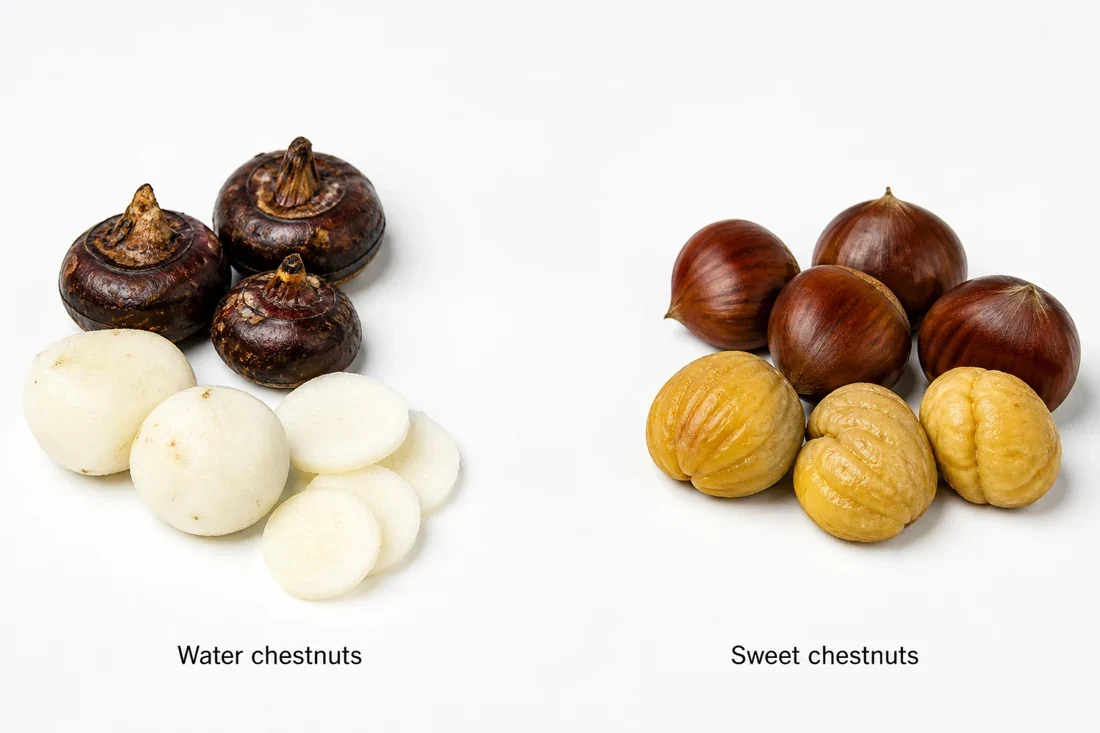
Water chestnut corms and sweet chestnut kernels are different foods.
| Food | Edible structure | Identity consequence |
|---|---|---|
| Water chestnut | Corm of Eleocharis dulcis | Aquatic sedge vegetable; not a tree nut. |
| Sweet chestnut | Kernel from Castanea trees | Different plant and food; not a water chestnut substitute. |
| Prepared dish | Several possible ingredients | Assess the complete recipe and relevant handling information. |
Their uses also differ. Water chestnut slices can retain a distinct crunch within a stir-fry, while chopped pieces provide texture in dumpling or meat fillings. Cooked sweet chestnuts can be mashed into puree, broken into stuffing, or served whole in a seasonal side dish. A recipe that calls for one should not silently receive the other. Even outside allergy management, such a substitution changes the sweetness, moisture behavior, bite and likely preparation method of the finished food.
An allergy resource may use a legal or practical grouping of nuts that is narrower than a botanical definition. That can make a sentence about chestnuts seem inconsistent with a plant reference. For this article, sweet chestnut describes the Castanea food, and water chestnut describes Eleocharis dulcis. We do not infer a destination market's labeling requirements from either common name. A manufacturer still needs to apply the rules relevant to its product and market using the correct ingredient identity.
Food Allergy Canada's March 2026 response to this exact naming concern explains that water chestnuts are unrelated to tree nuts while directing individual dietary decisions back to an allergist. That is a useful separation for both households and food businesses. The naming distinction can be answered confidently; a person's permission to eat a food should not be supplied by a general article. Food Allergy Canada: water chestnuts and tree nut allergy discusses the issue in that clinical context.
What the distinction means for tree nut allergy
Having a tree nut allergy does not make water chestnut a tree nut. The American Academy of Allergy, Asthma & Immunology includes water chestnuts among foods whose names can be misleading in this discussion. This supports correcting an ingredient misunderstanding. It does not support printing a blanket safe-for-nut-allergy statement on every water chestnut product, because a plain vegetable, a seasoned mixture and a restaurant dish can have very different ingredient and preparation histories. AAAAI's tree nut allergy guidance is intended to inform that broader assessment.
Individual allergy history remains relevant even when foods are botanically unrelated. A person can react to more than one food for reasons that a common-name comparison cannot resolve. If water chestnuts have previously been associated with symptoms, the fact that they are vegetables is not a reason to dismiss that experience. The appropriate next step is discussion with a qualified clinician who can interpret the history. This article is not a basis for testing a suspected food at home.

Ingredient identity, product composition and individual allergy advice answer separate questions.
View larger diagramFor someone with an existing allergy management plan, follow that plan when considering unfamiliar foods or responding to a reaction. A restaurant server, purchasing manager or general food article cannot replace the advice behind it. If a potentially serious reaction occurs, use the person's emergency plan and seek urgent medical help. The practical point is narrow: correcting the plant identity should help people ask better questions, without weakening precautions they have been instructed to take for their own situation.
Families may find it useful to separate two questions when speaking with an allergist. The first is whether plain water chestnut is relevant to the diagnosed allergy. The second is what product labeling and preparation precautions are appropriate for the person's circumstances. Keeping the questions distinct avoids a familiar misunderstanding in which an answer about the vegetable is treated as approval for any dish containing it. A stir-fry with water chestnuts can still contain other ingredients that matter to that person.
Food businesses should use equally precise language with customers. Saying that the ingredient is an aquatic vegetable answers a factual identity question. Saying that a particular meal is suitable for a particular allergy requires reliable recipe and handling information, together with the business's established process for responding to allergy requests. If staff cannot confirm an ingredient or preparation detail, they should say so clearly. Guessing from the name, color or appearance of the vegetable does not fill a gap in the records.
Read the complete ingredient list for the product
A pack of plain frozen water chestnut slices and a prepared stir-fry mix are different products, even when the front labels feature the same vegetable. The mix may contain sauce, seasoning, oils or other vegetables. A canned product may include a packing liquid. A filling can contain several ingredients that are not visible after chopping. Start with the full label on the actual pack and check the ingredient information for each component used in the finished dish.
The phrase plain water chestnuts should still be checked against the written specification. Ask whether the product consists only of the named vegetable or contains other declared ingredients. Where relevant, obtain the processing description and current allergen information for that exact item. A photograph of white slices cannot establish whether an ingredient has been added. Nor can a category page establish the formulation of every pack size, brand or customer-specific version that a supplier may discuss.
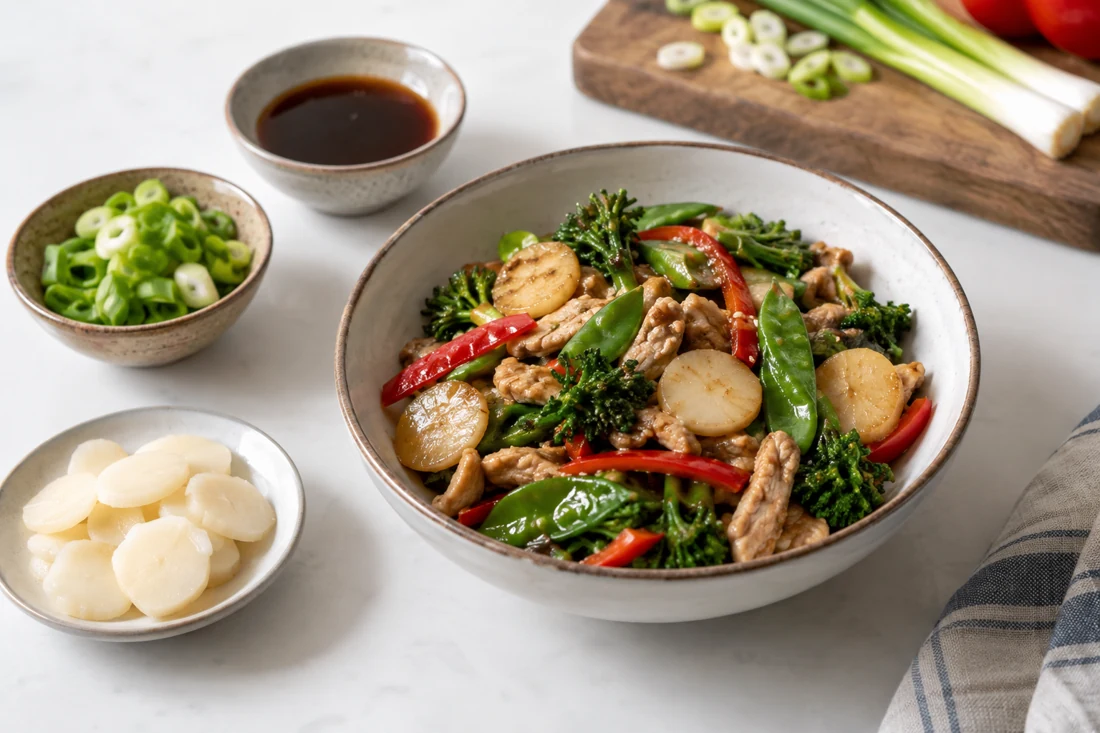
Review the complete dish, including sauces and garnishes. Illustration.
Read new purchases even when the product looks familiar. Packaging, recipes and suppliers can change, and a previous pack is not the current pack. In a kitchen, retain enough identification to connect the ingredient with its original label or delivery record after it is moved into a working container. A tub marked only vegetables is difficult to investigate later. The most useful label is one that helps staff identify the food, the relevant lot and the source information without relying on memory.
Precautionary statements and allergen declarations also need to be interpreted within the person's medical advice and the relevant market's labeling framework. The absence of an obvious nut word on the front of a bag does not answer every cross-contact question. Equally, a common name containing chestnut should not be treated as proof of a tree nut ingredient. Anaphylaxis UK's discussion of foods with nuts in their names helps explain why names alone are an unreliable shortcut. Anaphylaxis UK: misleading nut names covers this wider naming issue.
For a purchasing team, the practical output is a complete ingredient record that can be used by the people writing recipes, labels and customer responses. Keep the exact product description, approved specification and current supplier declaration together. If a substitution is proposed, review the new item before treating it as equivalent. A change from plain slices to a seasoned vegetable mixture may look minor on an order, but it creates a different ingredient assessment for the finished food.
Consider preparation and manufacturing cross-contact
Cross-contact concerns how an allergen might unintentionally reach a food through handling or production. It is a different question from the botanical identity of water chestnuts. A vegetable remains a vegetable when it passes through a shared preparation area, but the handling history can still matter to someone with an allergy. This is why a correct explanation of the word chestnut should be followed by product-specific information when the question concerns an actual meal or packaged ingredient.
At home or in a foodservice kitchen, the relevant details include the other ingredients being prepared, the utensils and work surfaces used, and the procedures followed for an allergy request. A shared serving spoon or an unrecorded sauce can undermine an otherwise accurate description of the main vegetable. Staff need access to the complete recipe and an established way to communicate uncertainty.
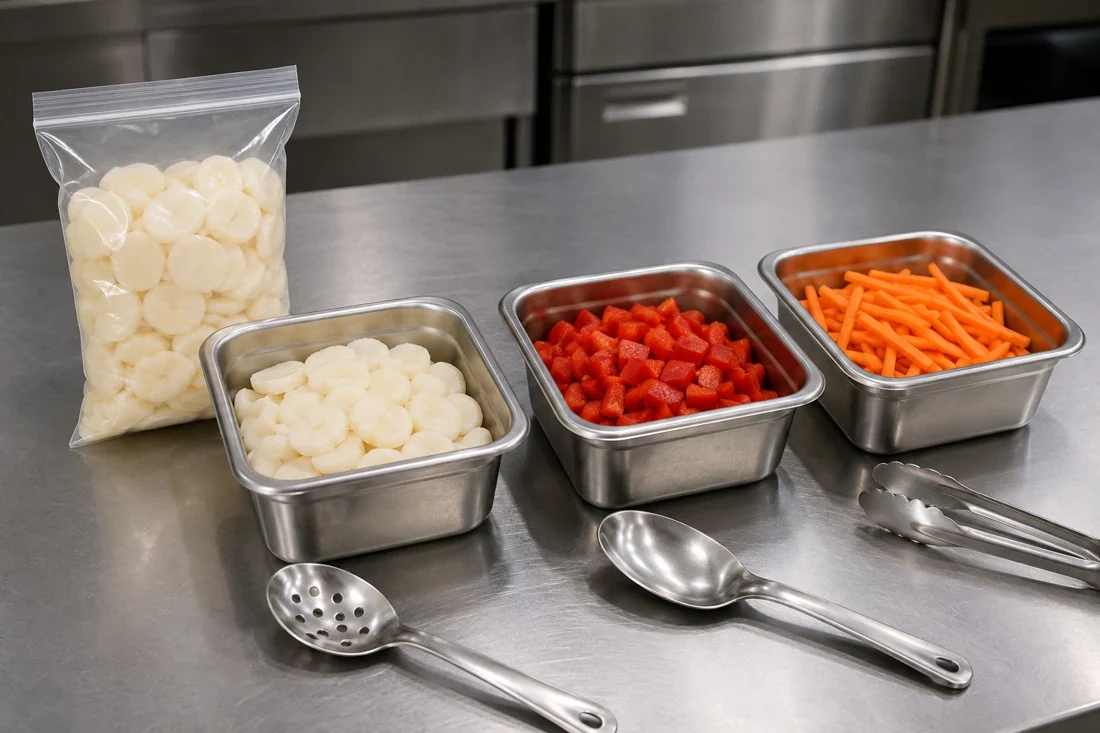
Separate ingredient containers and utensils illustrate preparation organization; actual controls require confirmation.
At a manufacturing site, useful questions concern the actual product and production arrangement. Ask for the current allergen declaration, the basis of any stated claim, and the applicable controls where other allergenic materials are handled. A general company statement may not identify the line, item or pack under review. Buyers should check that the declaration matches the product they intend to purchase and is current enough for their approval process, rather than collecting a document simply because its title sounds relevant.
The wording of a claim matters. Nut-free is broader than a botanical explanation and should not be inferred from the ingredient being a corm. Neither a frozen state nor an attractive clean pack establishes that claim. If a buyer requires a particular allergen-related statement, it needs a defined meaning and supporting evidence appropriate to the destination market and product. We would review that requirement with the product documentation before agreeing what can accurately appear in a quotation or specification.
Restaurant dishes add another layer because ingredients can be combined immediately before service. Ask about the complete preparation, including garnishes and sauces, through the restaurant's normal allergy procedure. A server who identifies the white crunchy pieces correctly has answered only one part of the question. For a person with a diagnosed allergy, the decision should follow their own advice and the information the business can actually confirm. An uncertain answer should remain uncertain rather than being converted into reassurance by the vegetable's name.
Identify whole, sliced and diced water chestnuts
Whole peeled corms, slices and dice offer different eating and manufacturing functions. Whole pieces make the ingredient visible and provide a substantial bite. Slices distribute a flat, crisp shape through stir-fries and mixed vegetables. Dice spread texture through fillings and chopped preparations. These formats share a botanical identity, but they are not interchangeable specifications. A filling developed with small dice may become difficult to portion when the same weight is supplied as large slices or whole corms.
Size should describe the cut that matters to the recipe. For slices, diameter and thickness affect appearance, bite and how pieces mix with other ingredients. For dice, edge size and the proportion of irregular pieces may be more useful. A sample should show the expected range rather than only the best-looking pieces placed on top. Our frozen water chestnut slices information provides a starting point for discussing these formats; the agreed order specification controls the actual supply.

Frozen water chestnut slices with pale circular cut faces. Confirm whether the ingredient is supplied whole, sliced or diced.
Processing state also belongs in the description. A frozen vegetable may have received blanching or another pretreatment without being a ready-to-eat food. Ask for the intended preparation instructions and whether the product requires further cooking. Do not infer readiness from whiteness, softness after thawing, or the word frozen. The processing description helps a kitchen choose an appropriate method and helps a manufacturer assess the ingredient as part of its finished product, while allergen questions remain a separate review.
Texture should be evaluated in the intended dish. A plain thawed slice may feel different from a slice that has passed through a sauce cook, filling cook or final reheating step. Compare samples using the same recipe and handling conditions so that a difference in the method is not mistaken for a difference in the vegetable. Record whether the pieces stay distinct, whether excessive breakage occurs and whether the finished bite suits the application. These observations concern performance, not allergy safety.
The product name used in a purchasing system should carry through to production records. Water chestnut slices should not become chestnut pieces on an internal recipe simply to save space. A shortened name can create confusion for staff, label reviewers and customers. Retaining the full identity costs little and prevents the botanical distinction from being lost between procurement and the kitchen. Where scientific identification is needed for approval, keep Eleocharis dulcis in the specification alongside the familiar commercial name.
Confirm ingredient and allergen information with the supplier
Begin a supplier discussion with the intended product and use: whole, sliced or diced water chestnuts; plain or formulated; bulk ingredient or retail pack; and the destination market. Then describe the information needed for your own approval process. This allows the supplier to connect the request to a specific item instead of replying about water chestnuts in general. An importer purchasing plain frozen slices and a manufacturer buying a seasoned filling component need different supporting details, even though the vegetable name is shared.
The core documents should answer several concrete questions. What is the ingredient identity and full composition? What processing state is supplied? Which lot and facility information supports traceability? What current allergen declaration applies to the item? If the buyer requests an additional claim, what evidence supports that wording? Each answer should refer to the product under discussion. A broad catalog, an unrelated certificate or a general statement about vegetables cannot substitute for an item-specific explanation of composition and handling.

Peeled whole water chestnuts with pale corm flesh. Product appearance must be supported by the required ingredient and allergen documentation.
We supply frozen water chestnut formats for B2B ingredient and packing requirements and can review cut, pack and processing questions against the proposed order. Our frozen water chestnut range is the place to start with product options. When allergen information is needed, include the exact requirement with the inquiry so it can be checked alongside the specification. We do not turn the fact that water chestnuts are vegetables into a blanket promise about every customer's dietary circumstances.
For sample approval, keep identity, performance and documentation as distinct checks. Confirm that the sample is the named ingredient, test the cut and texture in the intended application, and review the relevant declarations separately. A good cooking result does not validate an allergen statement. A complete declaration does not demonstrate that a slice will retain the bite a filling needs. Treating these as separate checks produces a clearer approval record and makes later changes easier to assess.
The answer to the original question is therefore precise: water chestnuts are aquatic vegetables, not tree nuts. The next decision depends on the actual product and the person or business using it. Clear ingredient names, complete recipe information and current supplier documents help that decision. For an individual with an allergy, their clinician's advice remains the guide; for a manufacturer or foodservice buyer, the approved specification and handling procedures turn the botanical explanation into information staff can use accurately.
Discuss frozen water chestnut supply with GreenLand-food
GreenLand-food is a professional frozen water chestnut supplier and manufacturer in China, providing factory-direct wholesale supply for importers, food manufacturers, foodservice distributors and private-label programs.
Share the water chestnut cut, processing state, packing and volume, with the product-specific ingredient or allergen information your approval requires.