


Mixed Berry Nutrition: Why Blend Ratios and Serving Weights Matter
Oct 19, 2026
Leave a message

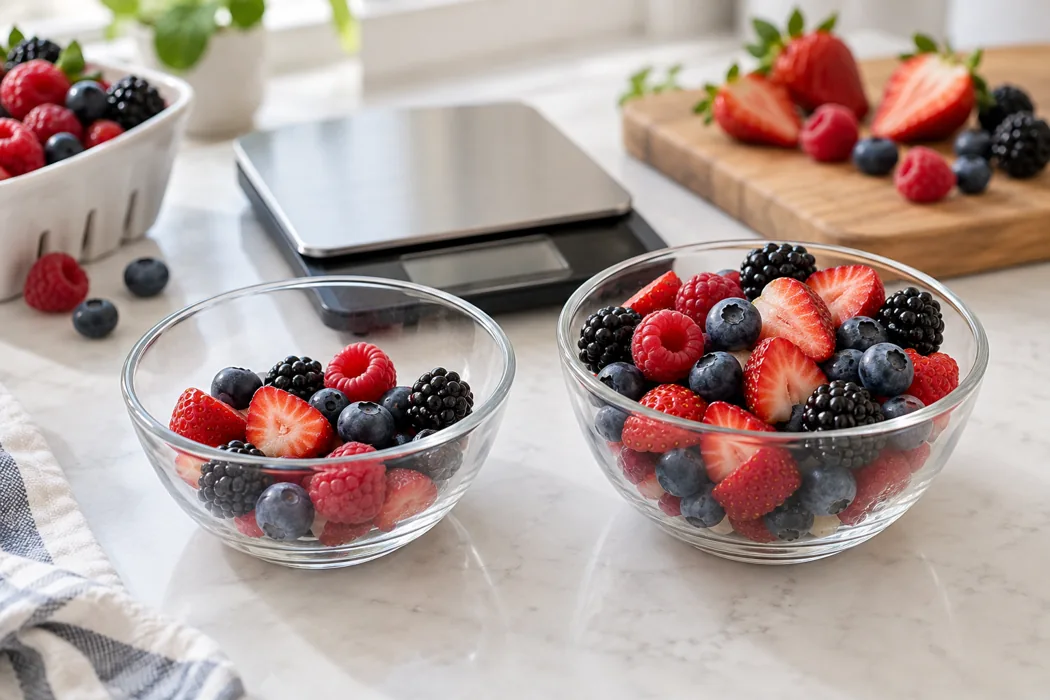
For a manufacturer or private-label buyer, the formula is the starting point of the nutrition file. A change in component ratios can change the calculated profile, while draining juice or adding yogurt creates another food with another basis. We recommend keeping the approved composition, nutrient sources, serving weight and label review together. This article explains that relationship without assigning a universal calorie or nutrient number to every mixed berry product.
Identify the blend behind the nutrition number
The name "mixed berries" describes a group of products rather than one fixed food. Some blends combine strawberries, blueberries, raspberries and blackberries. Others contain only three berries or include currants. Even when two packs list the same four fruits, they may use different proportions. A nutrition estimate that omits the formula can therefore be useful as a rough reference but cannot define the exact contents of a purchased lot.
The ingredient statement is the first document to read. It identifies the components and may reveal sugar, syrup or another addition. It does not always disclose every percentage. Where ratios are commercially important, request the approved formula separately. For private-label development, the nutrition specialist needs enough composition information to select appropriate data and evaluate the final declaration.
A current brand label illustrates how specific the figures are. Wyman's Triple Berry lists wild blueberries, blackberries and raspberries, with a declared serving of 140 grams. Its published panel gives 80 calories and 7 grams of dietary fiber for that serving. Those are that product's declared figures; they are not a universal panel for strawberry-containing mixes or a specification for GreenLand supply.

Raspberries, blackberries and small dark berries in a GreenLand-food product photograph; the image does not specify an order formula.
The product form also matters. Plain frozen whole berries, sweetened fruit, a drained preparation and a refined puree are different inputs for a nutrition calculation. Selecting a database entry solely because its name contains "berry" can conceal differences in water content, sugar addition or retained solids. Match the entry to the food that is actually being weighed and consumed.
Maturity, variety, growing conditions and processing can introduce natural variation within a component. A calculated average can be appropriate for development while still carrying uncertainty. A laboratory result describes the tested sample under its method; it is not a promise that every individual berry has the same composition. Avoid displaying more decimal places than the input evidence can reasonably support.
Our mixed berry product information can support a discussion of the component mix and available form. For a nutrition-sensitive program, send the destination, proposed formula and whether the figures are needed for development, a finished label or a particular claim. Those uses require different levels of review and supporting evidence.
The visible appearance of a blend is a poor way to estimate its nutrient profile. Large strawberry pieces may occupy much of a photograph while small dark berries contribute considerable mass between them. A darker color also does not establish a quantified antioxidant value. Identify and weigh the ingredients before drawing conclusions from color, apparent abundance or a promotional image.
Calculate a blend on one weight basis
For a simple fruit-only mixture, a useful development calculation multiplies each component's nutrient value per 100 grams by its fraction of the total mass, then adds the contributions. The same method can be applied separately to energy, carbohydrate, fiber or another nutrient when the source data are appropriate. All component fractions must use the same basis and total one, equivalent to 100 percent.
Consider a deliberately hypothetical example with two components. Suppose component A has 40 units of a nutrient per 100 grams and component B has 60 units. A blend containing 75 percent A and 25 percent B would calculate as 0.75 multiplied by 40, plus 0.25 multiplied by 60, giving 45 units per 100 grams. The units could represent a chosen nutrient, but these invented inputs are arithmetic examples rather than berry composition data.
Changing the ratio changes the result even though the ingredient names remain identical. A 25 percent A and 75 percent B blend gives 55 units per 100 grams using the same hypothetical inputs. The difference follows directly from the larger contribution of B. In a real four-berry formula, repeat the calculation with four matched component records and preserve the source of every value.
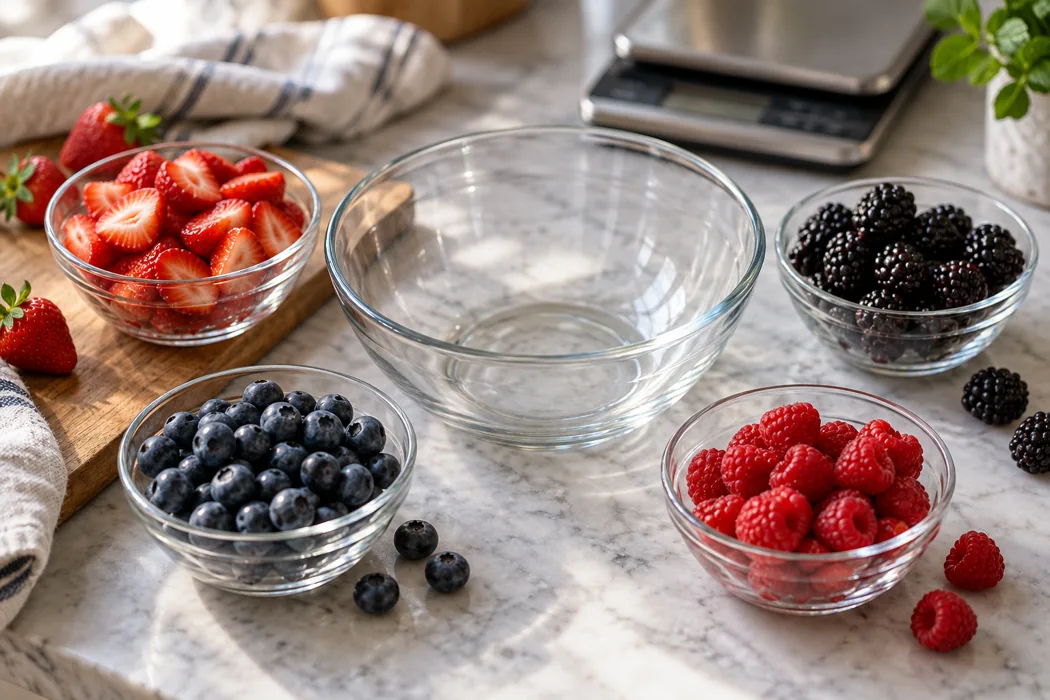
A blend calculation starts with the weight and nutrient data of each component.
| Illustrative blend | Component A | Component B | Calculated units per 100 g |
|---|---|---|---|
| A-dominant | 75% | 25% | 45 |
| Equal mass | 50% | 50% | 50 |
| B-dominant | 25% | 75% | 55 |
These calculations assume that the components are combined without a change that alters the mass basis or nutrient distribution. Heating with evaporation, draining, sieving and adding other ingredients can require a revised calculation. If the finished product loses water during cooking, dividing the original nutrient total by the original batch weight would describe a different concentration from the cooked yield.
Use consistent definitions across the component data. A nutrient value for a sweetened frozen strawberry product should not be used for an unsweetened component without justification. Nor should an entry for drained solids be combined casually with values for undrained fruit. Where only imperfect reference data exist, document the limitation and decide whether better supplier data or analysis is needed before the figure is used commercially.
The USDA FoodData Central documentation explains that its data types have different origins. Foundation Foods emphasize analytical information and variability, Branded Foods draw on product labels, and SR Legacy contains historical values assembled through several methods. A branded entry can be useful for that branded product, while a generic ingredient estimate needs a suitable underlying record. The database name alone does not make every entry interchangeable.
Retain unrounded working values through the calculation and apply the destination's required presentation rules at the appropriate stage. Repeatedly rounding each contribution can move the final result, especially with small quantities. Keep the calculation file understandable: formula version, component mass, data identifier, nutrient basis, units and any processing adjustment should be traceable by someone reviewing the work later.
Translate serving weights without false precision
Once the composition is expressed per 100 grams, scaling it to a weighed portion is straightforward. Multiply the per-100-gram value by the serving mass divided by 100. A hypothetical blend containing 50 units per 100 grams would supply 75 units in a 150 gram portion and 40 units in an 80 gram portion. The example demonstrates scaling; it does not set a recommended portion or a nutrition claim.
Serving size on a label and the amount placed in a bowl serve different purposes. The FDA's explanation of the Nutrition Facts label states that serving size reflects amounts typically consumed and is not a recommendation of how much to eat. A person's portion can be larger or smaller. Read both the household measure and its accompanying gram weight before applying the panel.
Volume becomes less reliable when the mixture contains unlike pieces. Whole blueberries can fill spaces between strawberry halves; a scoop containing large pieces can have more air gaps than one containing small fragments. A heap above the rim adds further uncertainty. A cup measure can be convenient in a recipe, but the gram weight is the more useful basis for comparing products or repeating commercial portions.
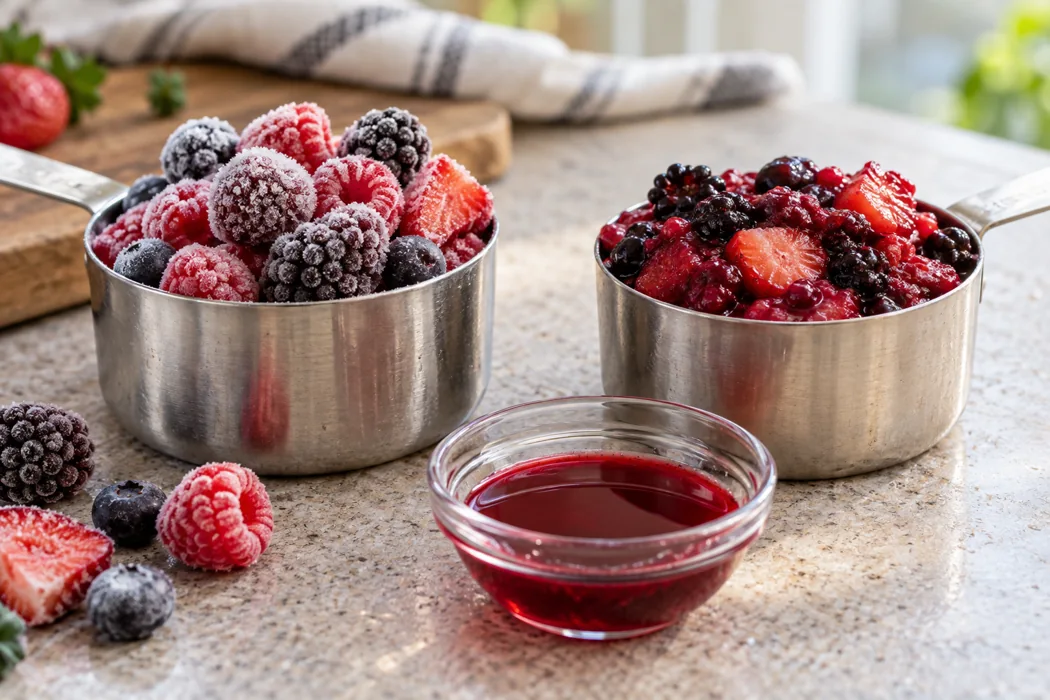
Whole frozen berries and softened fruit occupy a cup differently.
Thawing changes the occupied volume as tissue softens and fruit settles. A cup filled with frozen pieces may look much smaller after thawing, although the total contents have not disappeared if all fruit and juice remain in the container. Treating the smaller thawed volume as a smaller amount of food would misread the physical change. Weigh the full portion when a dependable comparison is needed.
Portioning from a mixed bag can also change the local component ratio. A single scoop might contain more large strawberry pieces, while smaller berries collect elsewhere. For everyday approximate tracking, the package average may be adequate for the user's purpose. For a commercial declared portion or a controlled trial, assess whether the dispensing method creates enough variation to matter and whether preportioned packs or a different cut would improve consistency.
A practical kitchen check can reveal the size of the issue. Weigh several ordinary scoops separately using the same utensil and handling method. Record the spread rather than only the average. This is a proposed portion-control exercise, not a test performed for this article. If the spread is unacceptable for the operation, adjust the portioning method and repeat the check with the actual ingredient.
Compare labels on equal masses before ranking them. A product that appears to have fewer calories per serving may simply declare a smaller serving. Likewise, a higher fiber number can reflect a larger portion rather than a stronger concentration. Use the per-100-gram figure where available, or convert the declared serving values cautiously, remembering that label rounding limits the precision of the result.
Account for sugar, juice and drained fruit
"No added sugar" and "no sugar" describe different concepts. Berries naturally contain sugars, while added sugars depend on the formulation and the applicable labeling definitions. A fruit-only blend can therefore show total sugars while having no added sugars. Check the ingredient statement and the current destination rules before making a claim; the absence of a visible sugar coating does not establish the formulation.
Sweetened components can be easy to overlook when a mixture is assembled from purchased ingredients. A berry preparation may include syrup or another sweetening ingredient even if no sugar is added during the final blending step. Review the composition of each input, including compound ingredients, so that the calculation and label reflect the complete recipe.
The same attention applies to juice or puree used as a carrier. A mix of intact berries with added fruit juice is not identical to plain berries in their naturally released juice. The added ingredient contributes mass and nutrients, and it may affect the claim review. State the formulation clearly instead of using a broad fruit-only description that conceals the difference.
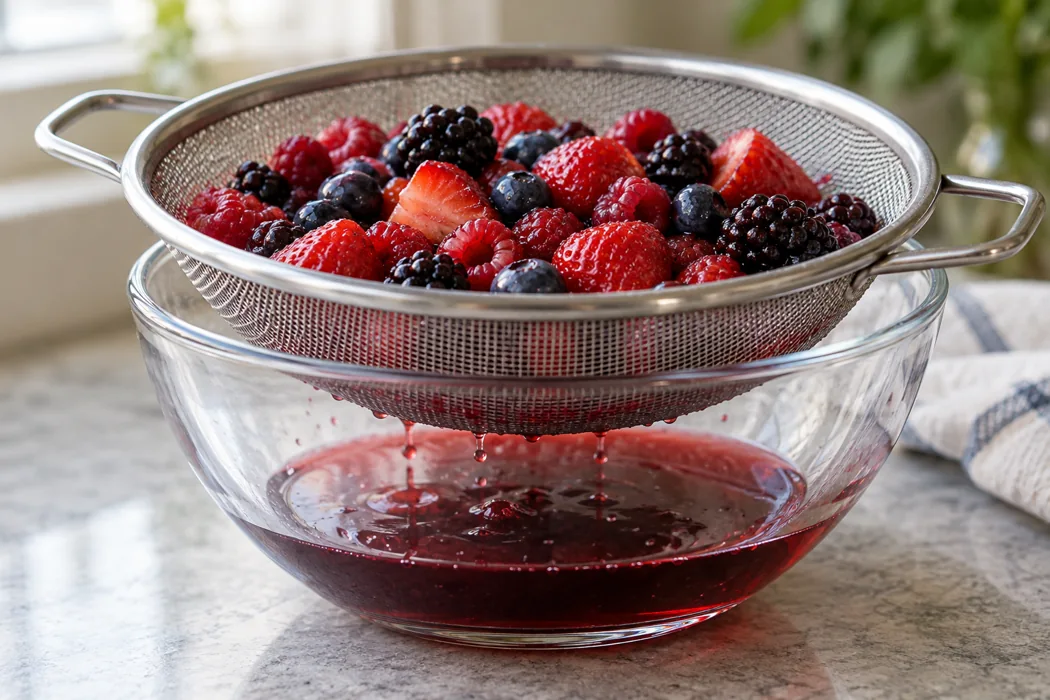
Draining changes the fruit-and-juice portion used in the final food.
Draining creates a new measurement question. Thawed berry juice contains dissolved material as well as water, so discarding it does not remove a known percentage of every nutrient equally. A 15 percent loss of total mass does not justify reducing all nutrients by 15 percent. Nor can the remaining solids automatically be assigned the original per-100-gram composition. A useful calculation needs evidence appropriate to the drained product or a justified processing model.
If the juice is retained in a smoothie or sauce, include it in the ingredient mass and finished yield. If it is discarded before topping a yogurt cup, describe that preparation consistently in the recipe and nutrition work. Switching between retained and drained fruit while keeping one unchanged ingredient weight can make portion comparisons misleading.
Water changes during heating need similar care. A simmered berry sauce can become more concentrated as moisture evaporates. Adding sugar, starch or another fruit changes the total composition further. Record both the inputs and the actual finished yield used in the calculation. A recipe's initial weight does not necessarily equal the amount packed into jars or cups.
Blending whole fruit reduces particle size but does not by itself imply that all fiber has been removed. Sieving or straining, however, removes a fraction of the material and can change the composition. For a refined beverage base, record the retained and discarded fractions and use data suited to the process. The nutritional description of a whole-berry blend should not be copied unchanged onto a filtered product.
Read nutrient changes with the right evidence
Frozen berries can be useful fruit ingredients, but an exact comparison with fresh fruit needs a defined comparison. The variety, harvest maturity, storage history, preparation and nutrient measured can all influence the result. "Fresh" can describe fruit eaten soon after harvest or fruit held through distribution. "Frozen" can describe different processes and storage conditions. A general claim of complete equality overlooks those variables.
Different nutrients also behave differently. Mineral content, dietary fiber and vitamin measurements do not respond identically to preparation and storage. A statement about one vitamin cannot be expanded automatically to every nutrient. For a product-specific claim, use evidence that matches the food, relevant conditions and the claim wording rather than a broad statement about frozen fruit.
The existing GreenLand-food strawberry nutrition article discusses why product form, added sugar and storage history matter for that component. A mixed blend adds the ratio question: even perfectly matched data for each strawberry sample would not tell the reader how much strawberry is present in the final mixture.
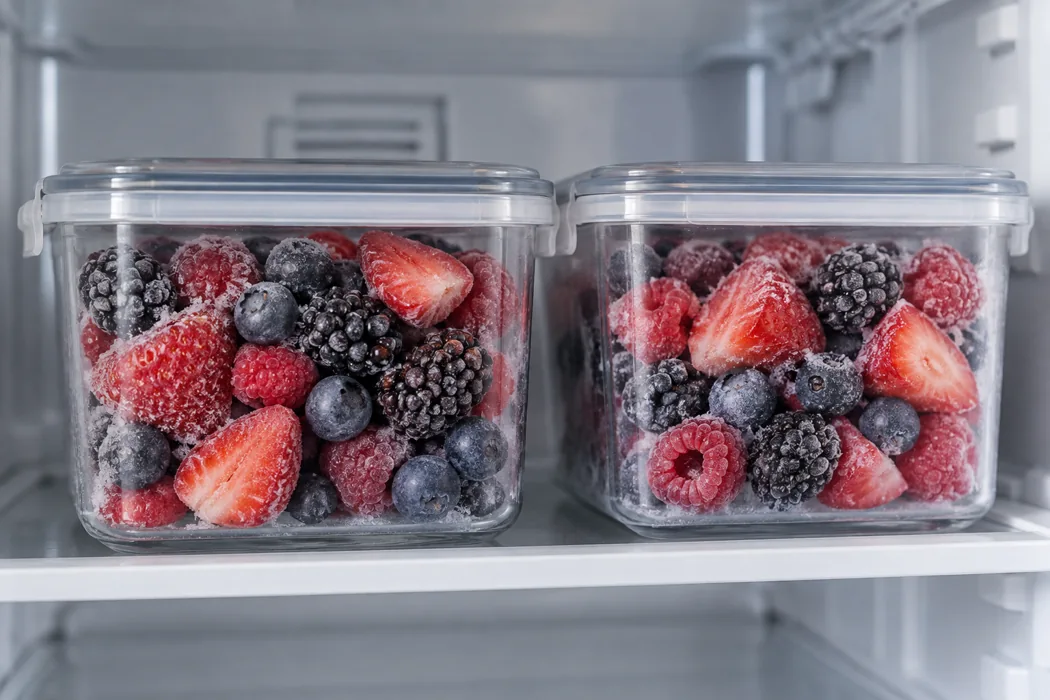
Pack integrity and storage history belong beside the composition record.
Color is useful for quality evaluation but cannot replace chemical measurement. A dark purple blend may contain more visibly pigmented fruit, yet the photograph does not quantify individual compounds or establish a health outcome. Avoid converting an appealing color into an antioxidant ranking or a disease-related promise. Where a specific compound matters to the product brief, agree an appropriate analytical method and evidence.
Research on fruit composition often reports values under carefully described laboratory conditions. Check whether the samples were raw, frozen, freeze-dried, extracted or otherwise processed before comparing the reported units. Values on a dry-weight basis can look much higher than values per 100 grams of the food as eaten because water has been excluded. The denominator needs to travel with the number.
An analysis report also needs context. Ask which lot was sampled, how the sample was prepared, which method was used and whether the result represents a composite or an individual unit. Analytical uncertainty and normal lot variation should inform the interpretation. A single result near a claim threshold may not provide a comfortable basis for a long-running commercial claim.
For procurement, the practical response is to control the variables that can be specified and document those that remain variable. Confirm composition, additions, food form, storage instructions and the data basis. If a finished claim requires a tighter assurance than reference data can provide, discuss representative analysis and ongoing verification with the responsible technical team before approving artwork.
Build a nutrition file for a commercial product
A useful nutrition file begins with the version of the formula actually intended for sale. Identify every component, its proportion, processing state and any additions. Connect that formula to the product specification and intended preparation. The reviewer should be able to tell whether the figures concern frozen contents as sold, drained fruit, a cooked preparation or a finished food containing several ingredients.
Next, preserve the source of each input value. Supplier analytical data, an appropriate public database entry and a branded product label have different strengths and limits. Record identifiers, dates, units and any assumptions rather than keeping only the final totals. This makes later updates possible without reconstructing the calculation from memory.
The FDA's guide to developing nutrition-labeling databases discusses manufacturer responsibility, product characterization, sampling and the use of ingredient data. It is a historical methodological guide, so current label requirements must be checked separately. Its useful lesson for buyers is that a defensible declaration depends on a documented basis and an appropriate view of product variation.

Mixed berries including visible strawberry pieces on a metal sorting surface in a GreenLand-food product photograph.
Decide who owns the final declaration. The ingredient supplier may provide composition and supporting information, while the brand owner or responsible manufacturer approves the final label for the destination. A supplier's ingredient panel does not automatically cover the customer's added milk, sweetener, portion size or preparation losses. Assigning responsibility early prevents an incomplete ingredient estimate from being treated as finished-label approval.
Claims deserve a separate review from the ordinary nutrient table. A phrase about fiber, sugar or a vitamin may have specific conditions, calculation bases and presentation requirements. A buyer should establish those requirements for the intended market before setting a formulation target. Leave a reasonable margin for variation where appropriate rather than designing a claim around a single favorable measurement.
For laboratory work, agree the purpose before sampling. Development screening, confirmation of a calculated profile and substantiation of a claim may call for different plans. The selected samples should represent the product and variation relevant to that purpose. An attractive sample selected for photography is rarely a sound basis for an entire annual nutrition program.
We can use the frozen fruit sourcing discussion to connect product form, packing and documentation requests with the buyer's application. State whether the project needs fruit-only ingredient data, a private-label pack declaration or information for a prepared recipe. That distinction helps identify which records belong with the ingredient and which must be generated for the final food.
Keep nutrition values aligned with formula changes
A blend revision should trigger a review of the nutrition file even when the front-of-pack name remains unchanged. Increasing blueberry, replacing raspberry with another berry or moving from whole fruit to refined puree can affect the data basis. The team should assess the change before using the old panel on new production, rather than waiting for a visible difference in the printed numbers.
Keep formula and artwork versions connected. A temporary sourcing substitution may require a temporary specification, updated ingredient information or other label review. Define the approval route and identify the affected lots. When the original blend returns, ensure the correct records and packaging return with it.
Serving changes can be just as consequential as composition changes. A cafe that increases the berry dose from one weighed portion to another has changed the nutrient contribution even if the blend itself is identical. A retail brand changing pack format may need to review the number of servings and presentation. The nutrient total for a container and the nutrient concentration per 100 grams should remain logically consistent.
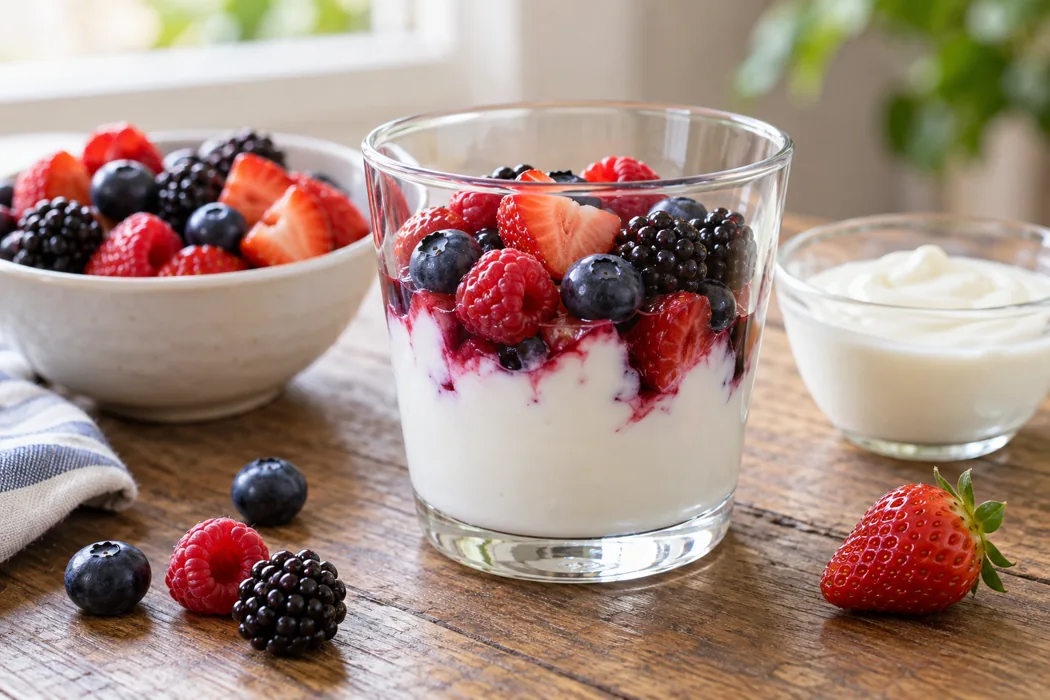
Nutrition for a prepared yogurt cup includes both the berries and the dairy base.
Prepared foods need a complete recipe calculation. A yogurt cup includes the yogurt and any toppings; a smoothie includes its liquid, fruit, body ingredients and sweeteners. The mixed berries' contribution can be calculated separately, but it is only one part of the finished product. Keep the final yield and actual serving mass with the recipe so the numbers describe what customers receive.
Review unexpected results before concluding that the fruit has changed. A scoop may be heavier, juice may be discarded, a sweetened yogurt may replace plain yogurt, or a database entry may use a different food form. Comparing these details can explain a difference without attributing it immediately to the supplier's berry lot.
For repeat supply, maintain a simple change log that identifies the formula, data source updates, analytical results and approved declarations. The log should explain why a value was revised and which products or lots it affects. This is particularly useful when several markets use different label formats or claim conditions.
The most useful nutrition statement is one the buyer can trace back to the actual blend and portion. Confirm the ingredients, use a common weight basis, preserve the calculation assumptions and review changes before the figures reach packaging. A carefully documented estimate is more informative than a precise-looking number detached from the product it is supposed to describe.
Source frozen mixed berries with GreenLand-food
GreenLand-food is a professional frozen mixed berries supplier and manufacturer in China, providing factory-direct wholesale supply for importers, food manufacturers, foodservice distributors and private-label programs.
Send your berry components and ratios, required form, specification, packing, quantity, application, destination, private-label needs and requested documents so we can review the supply requirements.