


Making Haskap Jam and Jelly from Frozen Berries
Oct 19, 2026
Leave a message

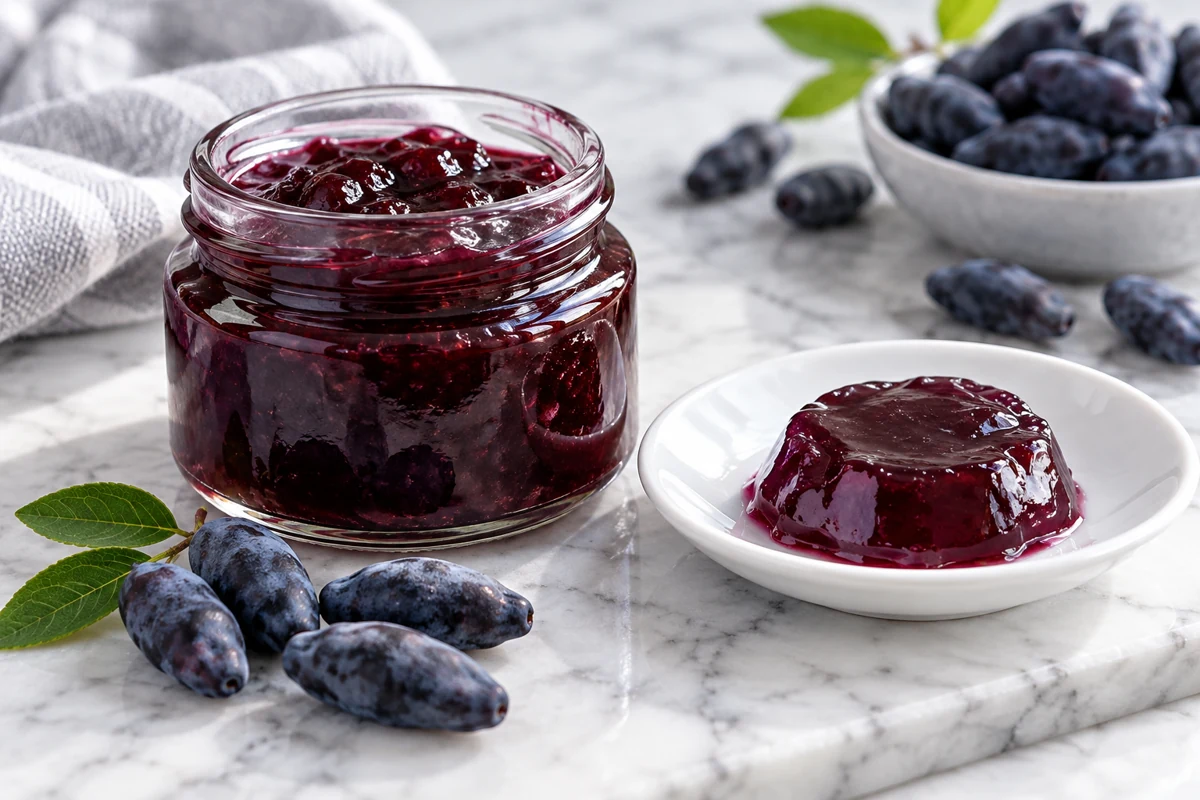
The practical starting point is an unsweetened, identified food ingredient and a clear target: a soft breakfast spread, a firmer jelly, a bakery filling or a fruit preparation for further processing. Each can require a different balance of fruit, sugar, acid and gelling ingredients. We recommend evaluating the cooled product before agreeing on a purchasing specification. A recipe that performs well with one fresh crop may behave differently with a frozen lot, especially when thaw juice is discarded, sugar is changed or the batch is enlarged.
Decide whether you need jam or clear jelly
Jam retains crushed or chopped fruit, so its texture includes the contribution of skins, pulp and small seeds. Jelly begins with extracted juice and is evaluated partly by clarity and the character of its gel. Cooking a pulpy haskap mixture for longer can make it thicker, but it does not turn that mixture into a clear jelly. This difference is useful when choosing both the raw material and the processing steps. A customer expecting a smooth translucent spread may reject a well-made jam because the product concept was never agreed.
Haskap's soft fruit structure can be helpful in a jam because it breaks down readily during preparation. That does not mean every lot produces the same particle size or gel without added pectin. Ripeness, fruit condition and processing all influence the mixture. Decide how much recognizable fruit you want in the cooled product and whether the seeds and skins are acceptable in the intended serving. A spread tasted alone on a spoon can feel different on bread, inside a pastry or alongside a cultured dairy food.
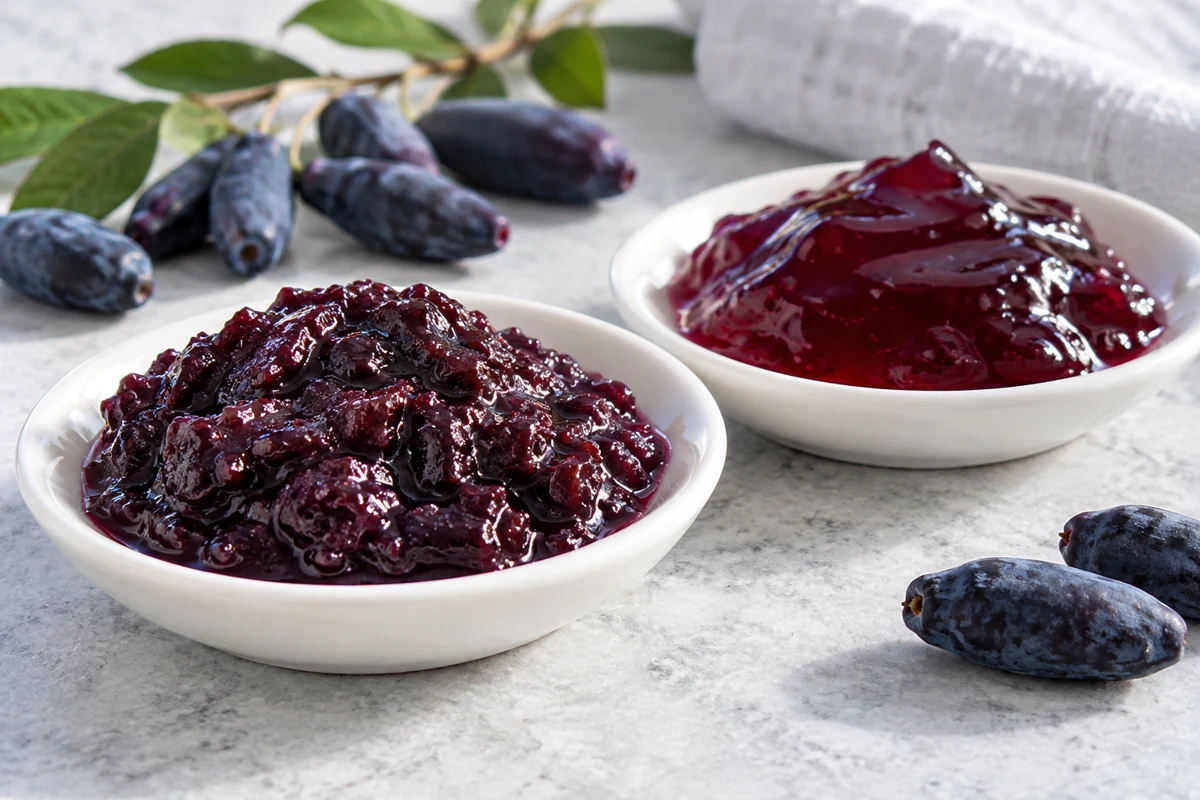
A pulpy spread and a clearer gel illustrate two distinct product targets. Illustrative image.
For jelly, the juice extraction step becomes part of the ingredient specification. Clarified or gently strained juice gives a different appearance from a puree pressed through a coarse sieve. Both can be useful, but they should have different names and formula records. If the buyer wants an opaque smooth fruit spread, there may be no reason to remove as much material as a clear jelly requires. Defining appearance early avoids paying for additional fruit and processing simply to achieve a clarity the customer does not value.
The National Center for Home Food Preservation distinguishes these product types by how the fruit is prepared and how the final spread behaves. Its descriptions provide a sound starting point for the terminology. Commercial naming and composition requirements can also depend on the destination market, so the finished label needs its own review. A product sold as a fruit spread, jam, jelly or reduced-sugar preserve should not acquire its name merely because it looks similar to a photograph online.
Before making a trial, write a short target description in ordinary language. For example, a developer may want a spoonable dark fruit spread with fine pulp and a bright tart finish, or a smooth jelly that holds on toast without becoming rubbery. These are development targets, not results from a performed test. They give the team a shared reference when judging the sample and prevent the discussion from collapsing into whether one person prefers a firmer or sweeter product. The storage route should be included in the same brief from the beginning.
| Route | Useful target | Decision to record |
|---|---|---|
| Jam | Crushed fruit with pulp | Prepared fruit and retained juice |
| Jelly | Extracted and strained juice | Measured liquid after extraction |
| Fruit preparation | Application-specific texture | Formula, process and intended storage |
Measure thawed fruit and retain its released juice
Use a defined quantity of frozen fruit and thaw it under controlled refrigeration in a clean covered container. Keep the original lot identity with the trial record. Haskap may release substantial colored juice as its flesh softens, and that liquid belongs to the original ingredient. If the formula assumes the entire fruit mass is used, discarding the liquid changes the water, flavor and color entering the pan. An operator should not make that decision by habit while another operator keeps everything.
For jam, the simplest reproducible basis is often the combined thawed fruit and retained juice, prepared as the selected formula specifies. If the process intentionally drains the berries, weigh the drained fruit and the liquid separately. The recipe then needs to say which quantity is used and whether any of the liquid is returned. A drained kilogram and a kilogram measured before drainage are not interchangeable. Their difference can affect yield, concentration, sweetness and the amount of gelling ingredient needed.
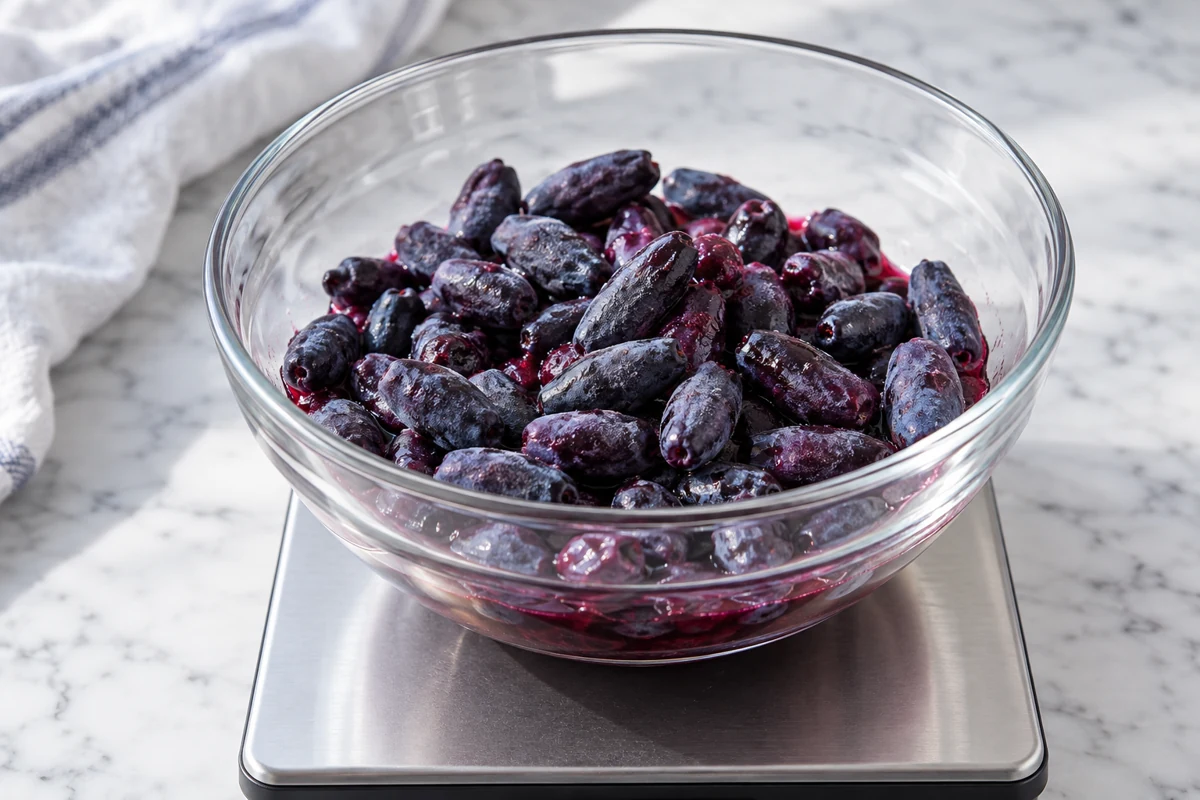
Weigh the prepared fruit and account for its released juice. Illustrative image.
For jelly, measure the juice after the agreed extraction and straining method. The frozen fruit purchase weight remains useful for cost and extraction yield, but it does not replace the juice quantity in the jelly formula. Record water added during extraction, if the validated method calls for it, and any material retained by the filter. This makes the yield calculation transparent. A higher collected volume may simply reflect more added water or more pulp passing through the cloth rather than a better fruit lot.
Weighing is particularly useful for commercial trials because cups of whole elongated berries contain variable empty space. Even crushed fruit can be measured differently depending on how it is packed into a cup. Use the measurement method required by a tested home recipe when following that recipe; for development work, agree on a consistent mass-based record. Note the preparation state at weighing. This small detail becomes important when trials are repeated by another person or transferred from a kitchen to a larger kettle.
Check the ingredient declaration before adding sugar. Frozen berries may be plain, sweetened or supplied as a preparation with other ingredients. The added sugar in an incoming ingredient contributes to the finished formula and cannot be ignored when judging sweetness or gelling behavior. Wisconsin Extension's preservation guidance emphasizes accurate measured quantities and refrigerator thawing for frozen fruit used in spreads. That principle is useful here, while a fruit-specific tested recipe and its permitted substitutions still govern home canning. General frozen-fruit advice does not validate replacing another berry with haskap in an ambient-storage recipe.
Build the gel around the actual fruit and pectin
Fruit, pectin, acidity and sugar work together in traditional jellied products. Haskap recipes often emphasize the fruit's natural tartness and ability to thicken, but these observations cannot guarantee the same set across varieties, ripeness levels and frozen lots. A product that gels well in one small batch may be softer in the next. Start with the intended spread texture and the chosen gelling system, then use the actual fruit to evaluate whether the combination gives a repeatable result.
Commercial pectin products have different instructions and are not automatically interchangeable. Regular powdered pectin, liquid pectin and products designed for reduced-sugar preparations can require different ingredient ratios and addition sequences. Follow the manufacturer's directions and the relevant tested recipe. Replacing one type with another by spoonful can produce a poor set even if the total amount seems similar. In a commercial formulation, obtain the ingredient's technical information and confirm that its recommended use matches the fruit preparation, heat treatment and target storage conditions.
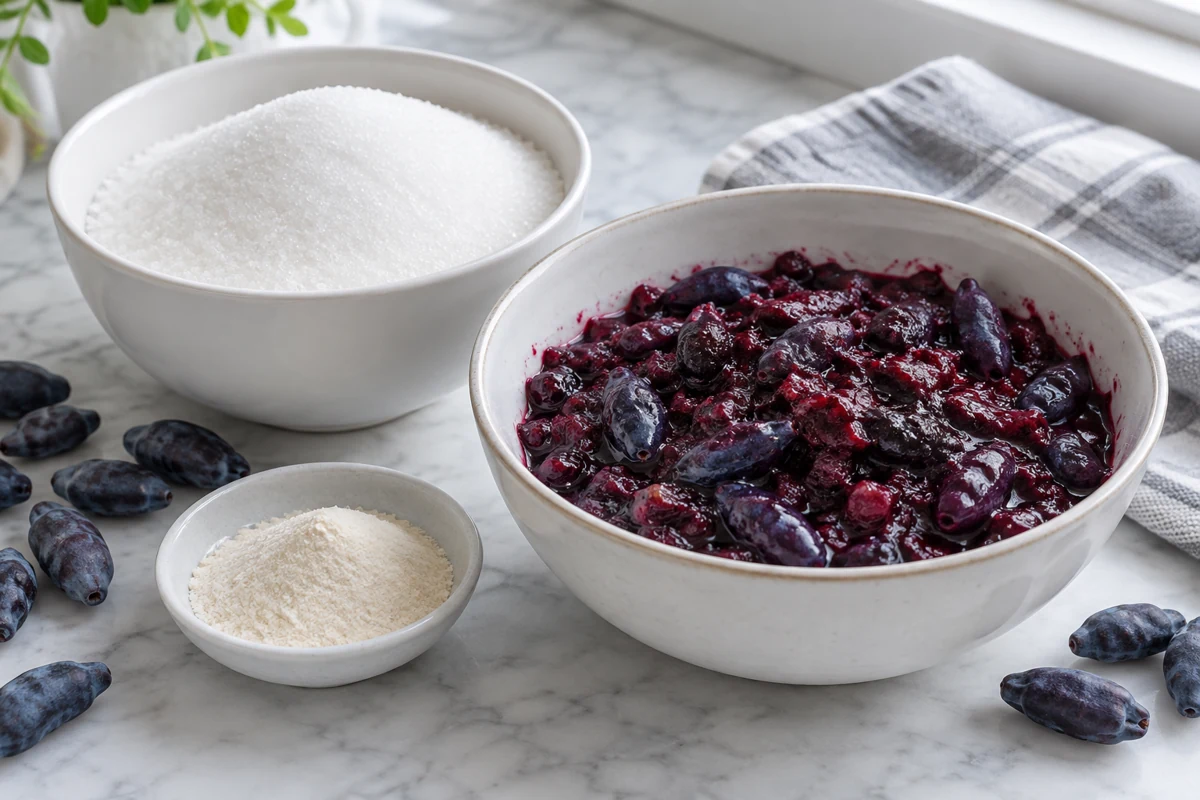
Fruit, sugar and gelling ingredients must belong to a compatible formula. Illustrative image.
Reducing sugar changes more than sweetness. It can change the gel system, water availability, yield and storage behavior. A low-sugar product needs a formula designed for that purpose. Do not remove a large part of the sugar from a conventional preservation recipe and assume that extra cooking or extra pectin restores every function. Similarly, honey, syrups and high-intensity sweeteners contribute different amounts of water and solids. Their use needs to be considered within a compatible formulation rather than treated as equal-volume replacements.
Taste and pH are also different kinds of information. Haskap can taste sharply tart, yet taste cannot establish the pH of the finished mixture or its suitability for a particular preservation method. Sugar can soften the perception of acidity without removing the acid. Other ingredients may change the final balance. Where pH or soluble solids are part of a commercial specification, use the agreed measurement method on a representative prepared sample. The result should be connected to the exact batch and formula, not quoted as a fixed value for the species.
The National Center for Home Food Preservation advises using the proper ratio of fruit, pectin, acid and sugar and following directions for the specific pectin. For buyers, the practical extension is to separate incoming fruit variation from formula changes. Keep the same recipe while comparing fruit lots, then adjust the formulation in a distinct controlled trial if necessary. Changing the sugar, pectin and berry loading simultaneously may produce a pleasant spread, but it leaves the team unable to explain which change mattered or how to reproduce it on the next order.
Cook jam for its cooled spread and fruit character
Choose a pan or kettle suitable for the approved batch size and heating method. The amount of exposed surface, the depth of the mixture and the effectiveness of stirring all influence evaporation and the risk of scorching. Doubling ingredients in the same small saucepan can change the cooking behavior substantially. A larger batch therefore needs its own process assessment. The important endpoint is the product achieved under the selected method, with the necessary safety controls, rather than a cooking time borrowed from an unrelated recipe.
Bring the prepared fruit through the chosen formulation steps in their required order. Stir sufficiently to distribute ingredients and avoid localized burning while preserving the intended amount of fruit texture. A coarse jam and a nearly smooth spread need different mechanical treatment. Record whether the fruit was hand-crushed, blended or broken down only during cooking. These methods expose different amounts of skin and pulp, and a change of blender or mixing speed can alter the finished texture even when the ingredient weights remain the same.
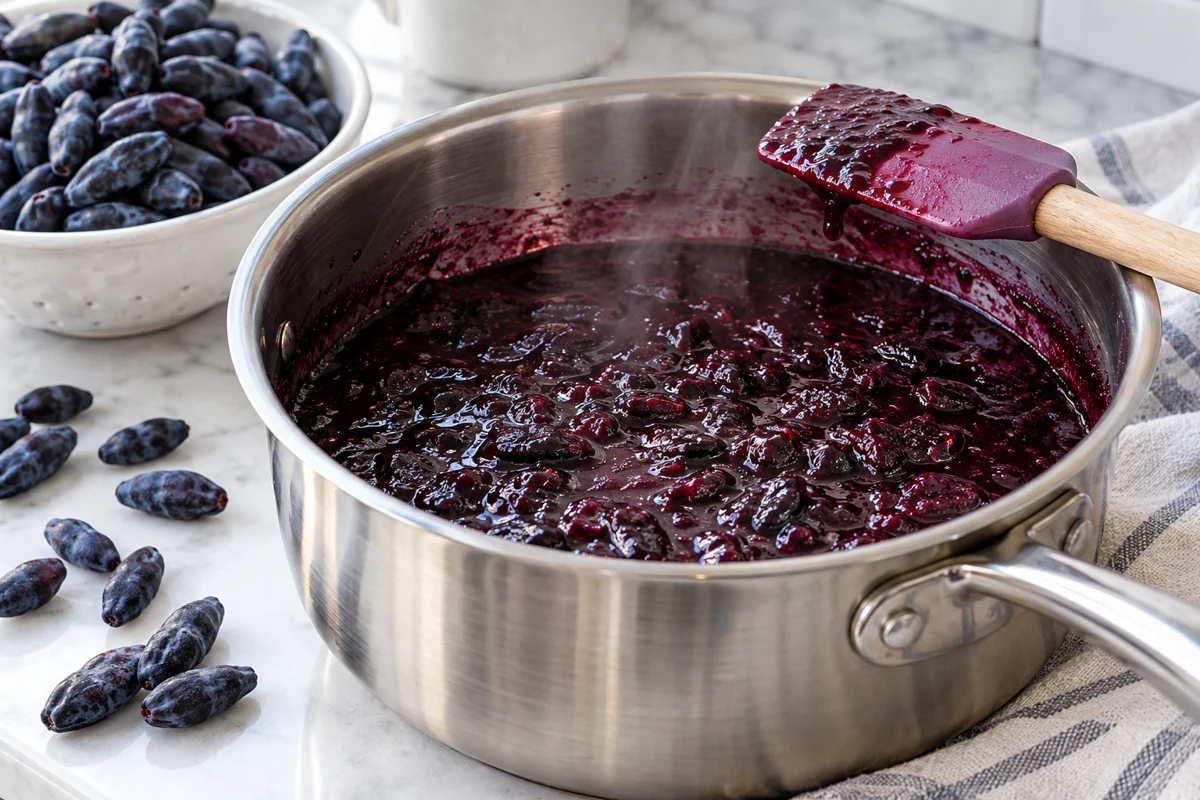
A saucepan illustrates the cooking stage, not a validated time-temperature process. Illustrative image.
Observe the jam after cooling under the specified conditions. Hot fruit mixtures flow more easily, and a cooled set develops differently according to the gelling system. A hot spoonful alone is a weak basis for approving spreadability. Use the relevant recipe's set assessment for home preparation. In commercial development, define a consistent cooling and holding period before evaluating flow, spoon release, fruit distribution and any visible liquid separation. The assessment should reflect the temperature at which the customer will actually use the product.
Flavor should be judged in a realistic serving. A highly concentrated spoonful can seem exciting while a thick layer on bread becomes tiring or overly sweet. A bakery may need enough tartness to remain noticeable beside pastry and icing, whereas a breakfast spread may be eaten with unsweetened bread or yogurt. Compare the whole serving and note the portion size. Avoid describing every stronger or darker sample as better: concentration can change balance, yield and the cost of each finished serving.
Haskap's color gives another reason to control the cooking process rather than extending it without a clear objective. The berry's anthocyanins respond to processing conditions, but a darker appearance is not a direct measurement of retained pigment or nutritional value. Concentration, light, container depth and the surrounding food all affect what the eye sees. Keep a retained sample and consistent photographs for practical comparisons. If a technical color target is needed, agree on a measurement procedure and evaluate it independently of the sensory description.
Strain jelly juice before setting the formula
Jelly begins with a decision about extraction. The method should release the fruit's juice while meeting the selected recipe or process requirements. Frozen haskap's softened structure may make extraction convenient, but the result still depends on thawing, heating, water addition and mechanical pressure. Record those steps. A supplier's whole-berry sample can be evaluated for juice use, yet the extraction yield belongs to the tested method and cannot be treated as a guaranteed property of all frozen haskap.
A jelly bag or suitable filter separates the juice from much of the fruit material. Support it securely above a clean collecting vessel and allow the method's required drainage. Pressing can move additional pulp into the juice and reduce clarity. Whether that is acceptable depends on the target. If clear jelly is the goal, do not rescue a low yield by pressing harder without recording the change. The resulting ingredient may now require different clarification and may no longer match the approved visual standard.
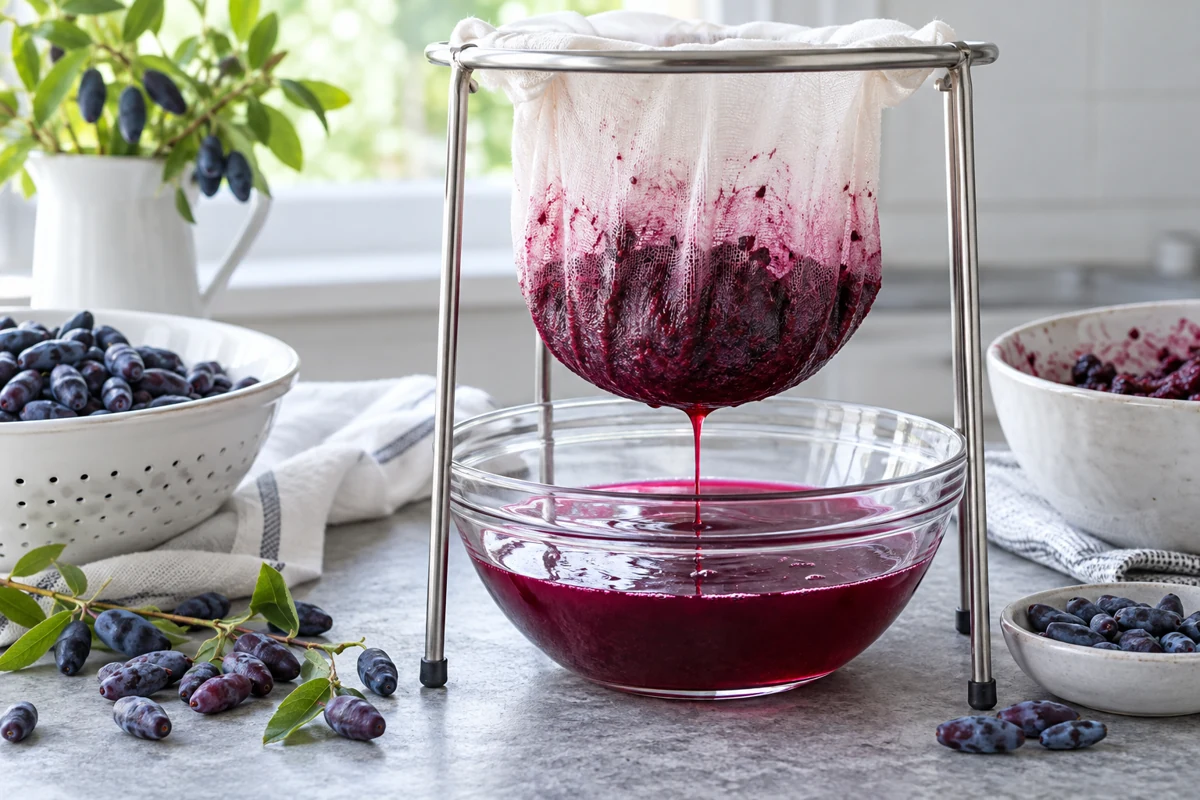
A supported straining bag lets juice separate from the fruit solids. Illustrative image.
Judge clarity in a consistent layer and container. Deeply colored haskap juice can look nearly opaque in a thick glass while allowing light through a shallow layer. A photograph against a bright window can therefore exaggerate apparent clarity compared with a normal serving. Review a practical quantity on the actual plate or spread surface. Any numerical turbidity or filtration requirement should be agreed separately. A decorative photograph should never be used as the sole evidence for a measurable clarity claim.
After straining, measure the juice and use the corresponding jelly formulation. Do not add the pectin and sugar calculated for the original whole-fruit mass unless that is what the selected formulation explicitly requires. The discarded pulp changes the ingredient composition and final yield. Keep an extraction record that connects purchased fruit, juice recovered and finished jelly. This is especially useful for commercial costing because a cheaper fruit lot may produce less acceptable juice under the same process.
The strained solids may have a separate use in development, but any reuse needs its own quality and safety assessment. Their age, temperature history and handling remain relevant. Avoid treating them as an automatically ready ingredient for an uncooked dessert. When a production line makes both jam and jelly, keep the two material flows and records clear enough that a pulpy return does not accidentally enter a clear-jelly batch. The point is to preserve the product definition chosen at the start and the traceability needed to investigate a later texture or appearance complaint.
Choose chilled, frozen or validated shelf-stable storage
Storage is a design decision made before the trial, because it affects formulation, processing, packaging and instructions. A refrigerated experimental spread, a freezer jam and a shelf-stable retail jar do not have the same requirements. A lid that seals as the product cools demonstrates a physical closure, not a complete preservation process. Likewise, a good gel and a sharp flavor do not establish that spoilage organisms or pathogens have been controlled under the intended storage conditions.
For home shelf-stable preservation, use a current tested recipe from a reliable preservation authority that covers the fruit and permitted substitutions, and follow its container, ingredient and processing directions. A blueberry recipe is not automatically a tested haskap recipe. The haskap recipe pages reviewed for this guide contain varying claims about acidity, pectin and processing, so they are useful as culinary ideas rather than validation. If an appropriate tested method is unavailable, choose a properly handled refrigerated or frozen preparation instead of inventing a canning schedule.
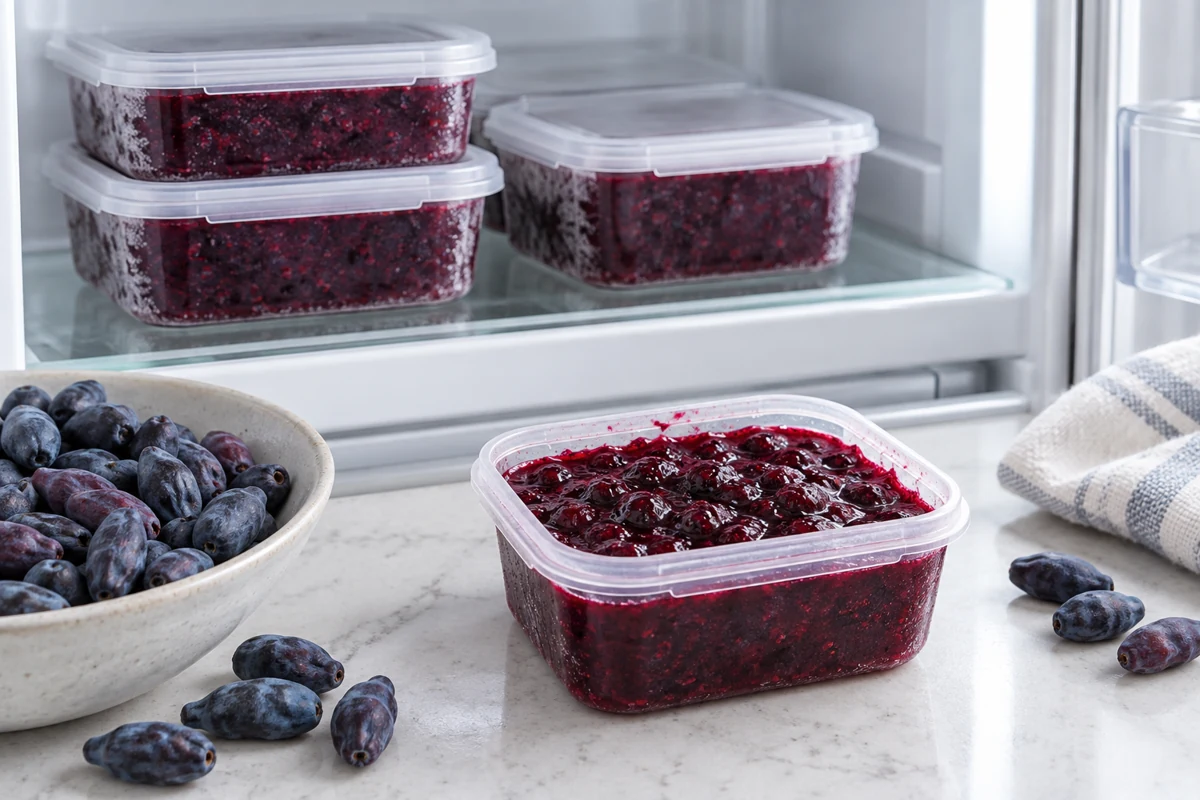
Chilled containers illustrate the storage route; shelf life needs its own validation. Illustrative image.
Commercial ambient storage requires a process assessed for the exact product and pack by the responsible qualified personnel. The review may need to consider formulation, acidity, water activity where relevant, heating, filling, container closure and the expected distribution conditions. Changing a jar size, reducing sugar or adding another fruit can change that assessment. Keep commercial validation distinct from a successful kitchen batch. A pleasant taste and several weeks without visible spoilage are not substitutes for a suitable process and shelf-life program.
For chilled or frozen products, use packaging appropriate to those conditions and follow the validated handling and storage instructions. Cooling, portion size, hygienic filling and the period after opening all matter. Freezing does not sanitize the fruit or the finished spread. The FDA's berry guidance makes clear that freezing generally does not inactivate viruses introduced along the supply chain. The safety plan must therefore address the ingredient and process, including any no-cook route, rather than relying on the freezer as a kill step.
Label development samples clearly with the actual storage requirement and batch information. This prevents a chilled trial jar from being mistaken for an approved ambient product. During commercial development, retain the formulation version and processing record with the sample so later observations can be interpreted correctly. If a product separates, ferments, develops mold or otherwise falls outside its requirements, the responsible team should investigate and make a disposition decision. Do not taste questionable material to decide whether a preservation failure is acceptable.
A repeatable application review
- Define jam, jelly or fruit preparation and the intended storage route.
- Thaw and prepare the fruit; extract juice if making jelly.
- Measure the ingredient on the basis required by the compatible formula.
- Follow the applicable process, cool appropriately and evaluate the final set.
Buy frozen haskap for a consistent preserve
Begin the supply specification with verified ingredient identity and the intended preparation. The common name haskap should be supported by the records needed for the buyer's market and labeling. A photo of dark oblong berries shows appearance and bulk form, but does not independently prove species, cultivar or treatment. We recommend confirming the identity documentation before a sample becomes the basis of a label claim or a long-term purchasing contract. Keep any unresolved point explicit in the approval record.
For jam, useful incoming attributes include flavor, maturity direction, added-ingredient status, foreign-material controls and the condition of the fruit after the agreed thaw. Whole-berry appearance may be less critical than in a decorative dessert, but excessive damage can still affect handling and consistency. For jelly, the useful comparison includes juice extraction under the intended method, the character of the strained juice and the finished gel. Do not pay for an appearance grade that brings no value to the process while overlooking the attributes that drive usable yield.

Existing GreenLand product-page photograph: visible bulk berry form only. Confirm botanical identity, lot specification and suitability for the intended process separately.
Agree on representative sample preparation before comparing offers. The same thaw method, fruit mass, extraction procedure and formula should be applied to each candidate lot. Keep records of juice recovered, finished product obtained and sensory observations at the intended use temperature. These are proposed approval measurements, not claimed results from GreenLand-food trials. They help purchasing teams connect price per kilogram with the amount and character of finished preserve produced by their own process.
Packing and supply timing should support the production schedule. Confirm inner-pack size, lot marking, carton condition, storage requirements, order quantity and expected lead time for the actual project. A pack that requires a long thaw may not suit a small daily preserve run. A frequently opened bulk bag may be less convenient than portions aligned with the kettle load. Where private-label supply is needed, discuss the ingredient name, language, destination and required documents before artwork or shipment arrangements are finalized.
Send GreenLand-food the target spread type, expected storage route and the formula or acceptance criteria you can share. We can use those details to focus the frozen-ingredient discussion and identify what needs confirmation. Fruit supply, formulation development and preservation validation each have a defined role in a successful preserve. An agreed sample and clear records let the buyer assess whether the supplied berries support the intended jam or jelly, without turning a general product description into an unsupported promise about gel strength, shelf life or finished-food safety.
Related reading
Can You Make Jam from Frozen Fruit?
Compare fruit-and-juice measurement with the broader jam, freezer and shelf-stable distinctions.
How to Ensure Frozen Fruit Quality: From Field to Your Warehouse
Connect the application trial to incoming lot records, packaging and a defined acceptance method.
Source frozen haskap berries with GreenLand-food
GreenLand-food is a professional frozen haskap berries supplier and manufacturer in China, providing factory-direct wholesale supply for importers, food manufacturers, foodservice distributors, and private-label programs.
Send the intended preparation, fruit form, packing, quantity and destination. Confirm the botanical identity, agreed specification, microbiological route and documents for the actual SKU before approval.