


Haskap vs Blueberries: Flavor, Shape and Recipe Substitution
Oct 19, 2026
Leave a message

What changes when haskap replaces blueberries
| Recipe attribute | Haskap trial focus | Blueberry reference |
|---|---|---|
| Form | Often elongated; verify identity and size | Usually round; define cultivated or wild type |
| Flavor | Assess tartness at the recipe addition | Retain accepted lot and recipe reference |
| Texture | Check skin breakdown and released juice | Measure under the same handling method |
| Color | Evaluate in the final food matrix | Compare at the same stage and serving condition |
The first change is ingredient identity. Haskap is associated with Lonicera caerulea, while blueberries belong to Vaccinium species. They are different fruits even when their dusty blue surfaces look similar. Confirm the scientific identity and accepted market name in the supplier records before formulating or changing an ingredient declaration. Common names can be broad, particularly for unfamiliar berries. An image or translated product title is insufficient to approve the identity of a commercial lot.
The culinary comparison then concerns the actual form being purchased. Whole frozen haskap should be compared with whole frozen blueberries when that is the proposed replacement. A drained thawed berry, a puree and a sweetened preparation introduce other changes at the same time. If the recipe currently uses blueberry juice or a formulated filling, replacing it with whole haskap is a reformulation project rather than a simple fruit swap. Establish the ingredient composition and process status before interpreting flavor or cost differences.

Original blueberry product photograph; recipe suitability requires a representative lot trial.
University sources describe haskap flavor through familiar berry comparisons while also recognizing cultivar variation. The Wisconsin crop profile discusses its thin skin and food applications. Such descriptions help a development team anticipate questions, but they do not establish the sweetness or firmness of a shipment. A ripe, well-handled haskap lot and a different cultivar may give noticeably different results. The same applies to blueberries selected for size, variety, origin and intended use.
A proposed comparison should therefore record the existing blueberry ingredient as carefully as the candidate haskap. Keep a sample of the accepted blueberry lot, its specification and the standard recipe. Record whether fruit enters the process frozen or thawed, whether released juice is retained, and how much fruit is added by mass. The accepted product provides a practical reference for the customer experience. Without it, a team may approve a pleasant haskap product without understanding whether it still meets the original product brief.
The main adjustments usually concern flavor balance, liquid management, the visibility of fruit pieces and color distribution. Some products will welcome those differences and can be presented as a new haskap version. Others need to remain close to an established blueberry format. Decide that commercial aim early. It determines whether the trial asks for a distinctive new flavor or for performance within an existing appearance and texture range, and it prevents unnecessary attempts to make two different fruits indistinguishable.
A useful comparison also separates consumer expectation from technical feasibility. A bakery may be able to produce an excellent haskap muffin while its customers expect the familiar blueberry appearance and flavor. Product naming, menu description and packaging imagery should follow the chosen concept. Technical approval and commercial positioning need to be discussed together before a replacement becomes routine.
Compare shape and fruit structure on real samples
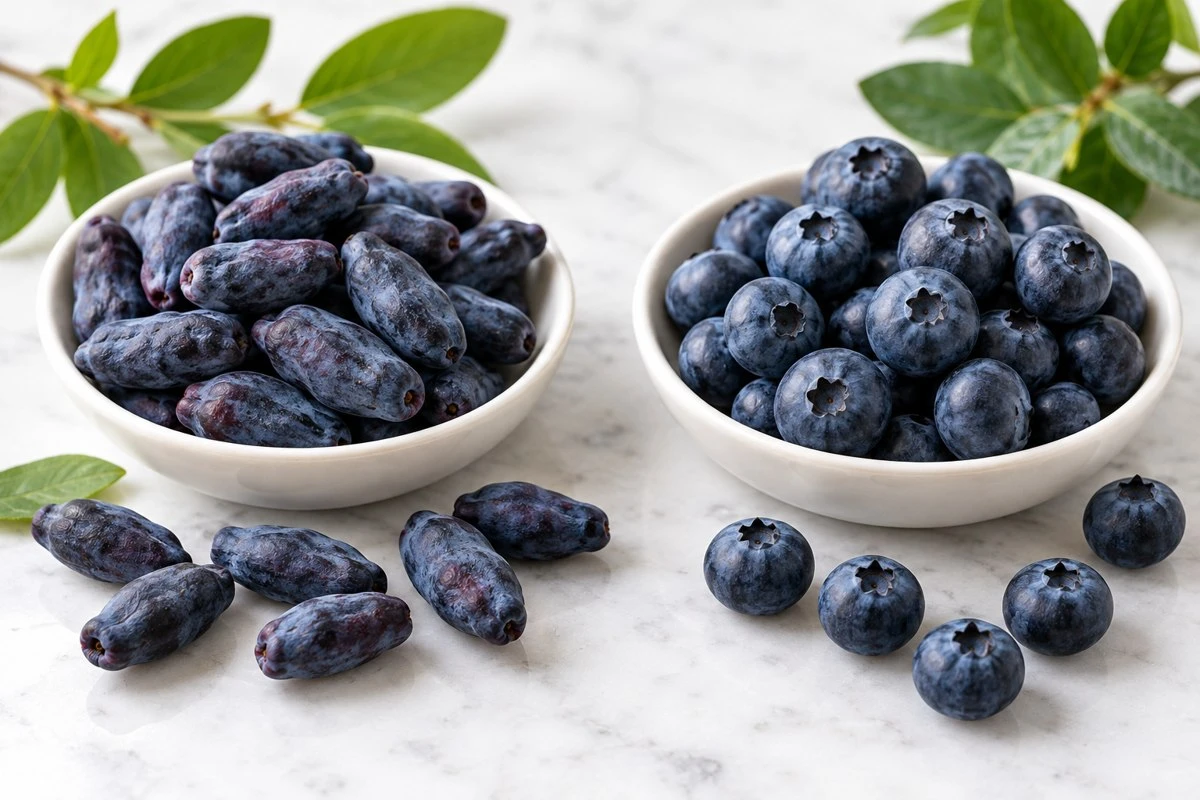
Haskap often has an irregular oval or elongated cylindrical form, whereas blueberries are generally round with a recognizable calyx end. Haskap shape also varies among cultivars and breeding material. The University of Saskatchewan breeding report documents considerable variation. A buyer should use shape to describe the sampled material, not to authenticate species or infer a cultivar. Botanical identity still needs its own evidence.
Shape matters operationally because fruit must pass through portioning, mixing and filling equipment. Long berries can distribute differently from round berries in a scoop or dosing opening. Equal cup volumes may contain different fruit masses because of packing spaces and size distribution. For a controlled recipe trial, weigh the fruit and record its form. If production doses by volume, test that actual dosing method later and measure the resulting portion variation rather than assuming the equal-mass bench comparison solves it.

Original supplied-product photograph. The visible form does not establish species or lot acceptance.
Inspect the frozen fruit and, where relevant, a separately thawed portion. Note whole fruit, splits, crushed material and released liquid. Thin skins may soften or break down during preparation, affecting whether the finished food contains distinct pieces. A blueberry ingredient can also vary in skin behavior and firmness, so avoid treating every blueberry as one fixed reference. Compare the actual accepted ingredient with the proposed alternative using the same handling procedure and observation stage.
The original photo on GreenLand's haskap sourcing page shows dark elongated frozen fruit in a carton liner; the commercial identity on that page remains subject to source-record confirmation. Our IQF blueberry page provides the corresponding blueberry sourcing context. These are starting points for sample and specification discussions. Product photographs cannot establish the texture, species or performance of a future shipment.
For an appearance-sensitive product, decide which fruit characteristics remain visible after preparation. A smooth sauce may remove most of the importance of initial shape, while a topping or inclusion-rich muffin can make it central. Agree a sample preparation and retain photographs of representative finished portions. This allows purchasing to discuss a relevant size or whole-fruit requirement instead of copying a blueberry size range into a haskap specification that describes a different shape and handling behavior.
For products sold by piece count, compare the number and distribution of fruit pieces per serving as well as their mass. A few larger elongated berries can create a different bite from many smaller round berries. Define the desired eating experience and test representative portions. A weight specification alone may not describe that experience adequately.
Taste the berries at the recipe dilution
Haskap is often described as tart and complex, with flavor associations that include blueberry, raspberry or currant. These are sensory descriptions rather than a fixed chemical profile. Cultivar, maturity and processing can change the balance. Blueberries also range from mild and sweet to more pronounced and tart. Taste the approved, safely prepared samples in the intended food so that the comparison reflects the fruit contribution the customer will experience.
A spoonful of concentrated fruit can exaggerate a difference that becomes subtle after dilution. Conversely, a modest change can be important in a lightly flavored dairy product. Prepare the existing blueberry formula and a candidate haskap version with the same fruit mass and other ingredients for the first comparison. Use coded portions where practical. Ask the team to record sweetness, tartness, berry character, aftertaste and overall fit separately. This is more informative than a single preference score without explanation.
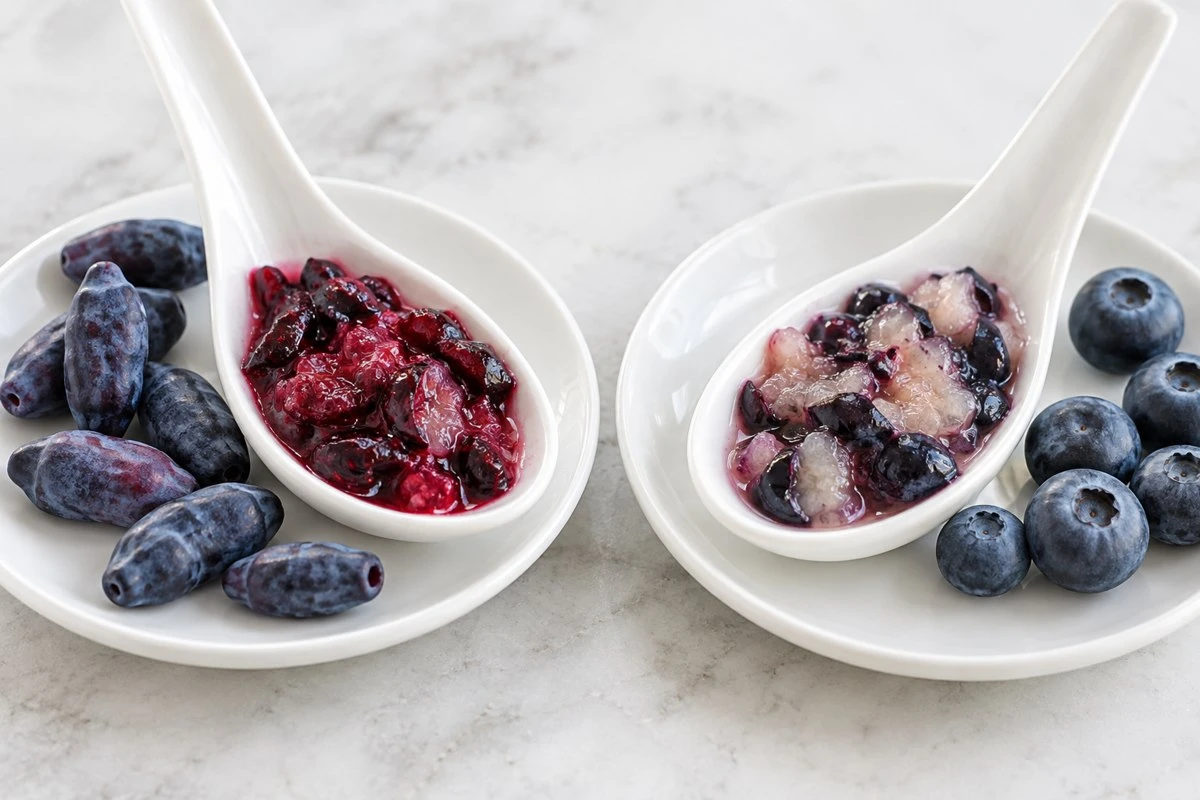
Illustrative haskap blueberry flavor tasting.
If the candidate needs adjustment, change one formulation variable at a time and record its mass. Additional sugar may balance tartness while also changing solids, viscosity and the character of the final food. Acid adjustment can affect both flavor and color, and sometimes texture or the established preservation process. Keep the product-development and safety requirements connected. A recipe should not be adjusted solely to imitate a tasting impression without checking the consequences in the actual product.
The Saskatchewan juice-blending investigation found that the perception of haskap depended on the other juices used. Its informal results are not a commercial sensory specification, but they support evaluating the complete recipe. A strong citrus component can change the balance differently from a mild base. For purchasing, that means a generic claim of intense flavor is less useful than a reference sample tested at the intended addition and serving condition.
Agree whether the final product is meant to preserve the familiar blueberry flavor profile or introduce haskap as a distinct ingredient. For a new haskap product, a different but acceptable balance can be the intended result. For an existing line, the development team may need a narrower sensory range and clearer label review. Document the approved recipe and sample so that the next lot is judged against the same aim, rather than against each evaluator's memory of what either berry should taste like.
Serving temperature can influence the tasting comparison, especially for frozen desserts and chilled beverages. Prepare both versions in the same way and assess them at the intended service stage. If the product is commonly consumed after warming or partial melting, include that condition in the development brief. Record the observation so future trials repeat it.
Adjust juice management in fillings and sauces
A fruit replacement can change the liquid released during thawing, mixing and cooking. That liquid carries flavor and color as well as water. Decide whether the recipe retains it, removes it or uses it in a separate component. Keep that decision consistent during comparisons. Draining haskap while using blueberries with all their juice creates a different ingredient balance from an equal-mass whole-fruit substitution, even if the starting weights were identical.
For a filling, assess the product after the intended cooling and holding stage. A hot mixture can look thick enough while behaving differently when sliced or served later. Observe free liquid, fruit-piece integrity, coating of the pieces and the way the filling holds its shape. Use the same batch size, vessel and cooking endpoint for the initial comparison. Record final mass so that differences caused by evaporation are visible rather than attributed entirely to the berry.
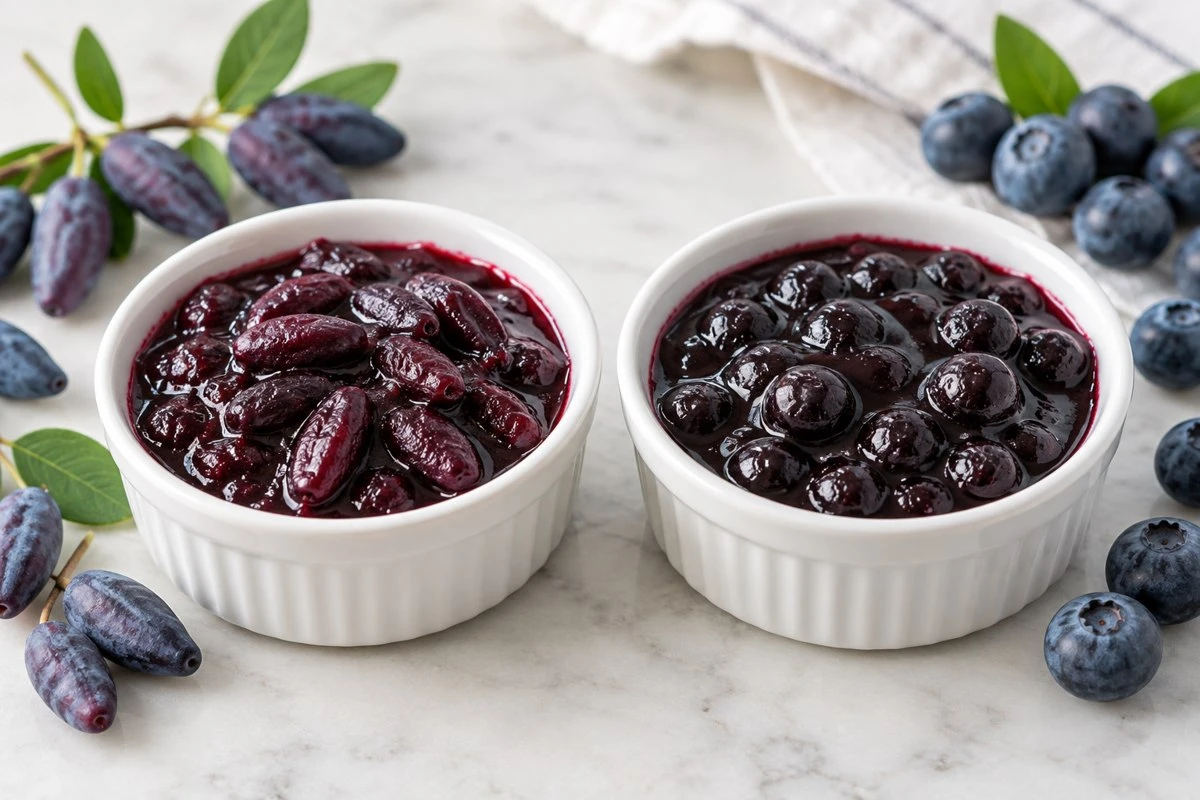
Illustrative haskap blueberry filling textures.
If a thickener is used, review its interaction with the revised recipe through an appropriate formulation trial. Fruit acidity, solids, heating and mixing can all be relevant to texture. Avoid an automatic instruction to add a fixed extra spoonful of starch whenever haskap replaces blueberries. The amount needed depends on the starting recipe, the measured liquid contribution and the required eating quality. Excess thickening can mask fruit character or create an unwanted texture even when it stops visible leakage.
A smooth sauce has a different endpoint from a filling with recognizable fruit. It may benefit from the way soft berry tissue disperses, while still needing control of seeds, skin fragments and settling. Compare the chosen straining or blending method as part of the recipe. If the production line uses a specific pump or nozzle, include a representative transfer check. Bench texture judged with a spoon does not necessarily predict reliable dosing through the commercial equipment.
Record recovery on a declared basis when cost matters. The price per kilogram of frozen fruit is only one input; usable filling or sauce yield depends on the recipe, any removed liquid or solids and the accepted finished consistency. Use measured trial output to compare alternatives, and keep added water and sugar separate in the calculation. A lower-cost ingredient can require more processing or produce less acceptable output, while a higher-cost fruit can create a distinct product that supports a different commercial brief.
Keep removed material in the trial record even when it is discarded in production. The mass of juice or solids separated from each fruit helps explain changes in flavor, color and usable output. If the business plans to use that material elsewhere, evaluate the proposed secondary use separately, with its own safety and product requirements.
Fold frozen berries into batter with a controlled trial
Bakery trials should reproduce the way fruit enters the actual batter. If the established blueberry recipe uses frozen fruit, start the haskap comparison in the same state. Thawing one fruit in advance changes its juice distribution and temperature contribution. Record fruit mass, batter mass, mixing sequence, mixing time and the interval before depositing. These details can affect color streaking and the distribution of pieces, so they belong in the trial record alongside the recipe itself.
Observe how the fruit survives mixing. Delicate skins or split berries can release color into the batter, while larger pieces may create a different appearance when the muffin is cut. Gentle folding can reduce avoidable breakage, but the method must remain compatible with production. A careful hand-folded bench sample is insufficient if the factory uses a different mixer and deposit system. A later production-representative trial should check whether the approved appearance survives the actual handling route.
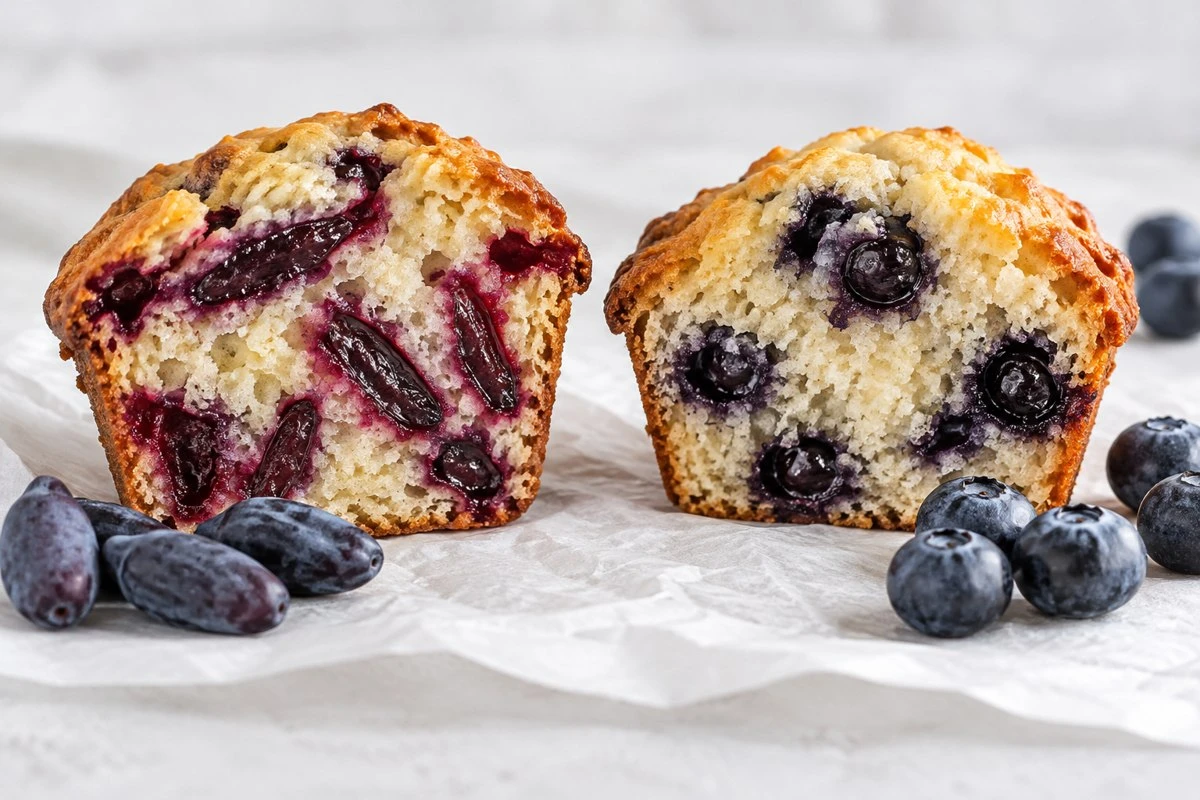
Illustrative haskap blueberry muffin crumb.
Portion weight and fruit distribution need separate attention. Two muffins can have the same total mass while containing different numbers or masses of fruit pieces. Long haskap berries and round blueberries may distribute differently as the batter is scooped or deposited. Examine several finished portions from appropriate positions in the trial, and record the sampling approach. A single attractive cut muffin can be useful for discussion but does not establish consistent inclusion distribution across a batch.
Evaluate after the agreed bake and cooling procedure. Look at crumb around the fruit, wet pockets, fruit shape, color spread and eating texture. Keep leavening and other ingredients fixed in the initial fruit comparison; changing them at the same time makes interpretation difficult. If the recipe is later adjusted, record the new formulation as a distinct trial. A color shift near berries should be investigated in the context of the batter and process rather than treated automatically as evidence of poor incoming fruit.
Consumer recipe pages often encourage direct substitution, and they can be helpful for identifying familiar applications. They do not validate a commercial bake, packaging life or frozen-distribution system. Use the bench trial to identify a promising formulation, then confirm it through the buyer's normal production and shelf-life development process. The approved specification should state the fruit form and handling conditions that gave the accepted result, so that a later change in thawing or mixing does not silently invalidate the comparison.
After the initial bake, inspect the product in its intended package and distribution format. A muffin sold fresh, one held chilled and one frozen for later service need different development work. The fruit substitution can interact with moisture movement over time. Follow the buyer's established validation process instead of assuming the first cooling-stage result covers every route.
Assess color and texture in dairy and drinks
Haskap can give a vivid purple or red-purple contribution to foods, but its appearance depends on the recipe. A translucent drink, an opaque yogurt and a fruit layer in a dessert show color differently. Blueberries also vary in pigment distribution and the color released during preparation. Compare the complete products under consistent lighting and in the intended serving vessel. A dark berry concentrate should not be treated as proof that the final food will look stronger or more attractive.
For a dairy or plant-based preparation, decide whether the fruit is blended uniformly, swirled or layered. A smooth blend can be judged for overall color, texture and flavor. A swirl additionally needs assessment of boundary movement and bleeding into the surrounding base. Use the same mixing intensity and storage stage for both fruits. If the haskap version is stirred more thoroughly, a more uniform purple appearance may reflect the preparation rather than a difference in the ingredient's coloring strength.
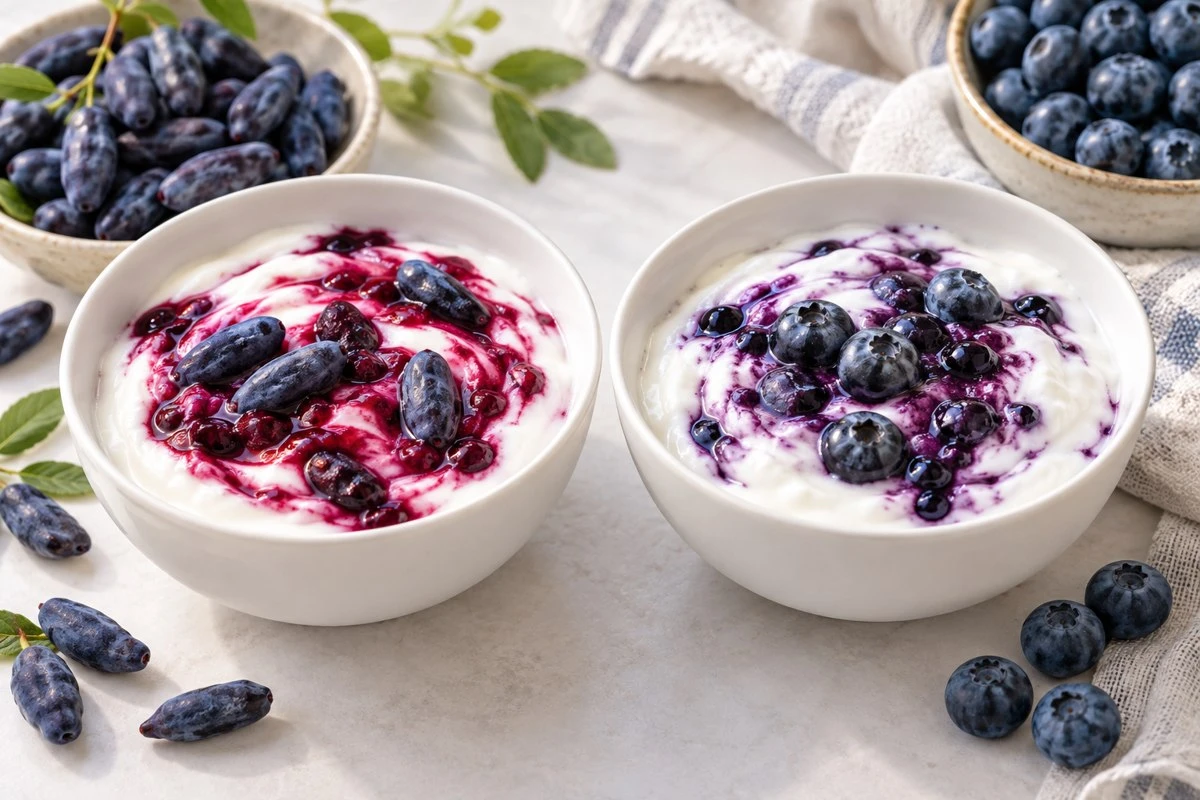
Illustrative haskap blueberry yogurt trial.
In drinks, define the fruit addition, serving dilution and clarity target. A puree carries solids that may settle or float, while extracted juice has a different texture and processing history. Compare like forms where possible, or describe the extraction change as part of the reformulation. Taste alongside the visual check. A drink can become strongly colored before its berry flavor reaches the intended balance, especially when other ingredients contribute their own flavor or opacity.
Avoid using visible color as a nutritional ranking. A darker sample is not a reliable measurement of anthocyanin content or evidence of a health advantage. If a compositional claim is required, it needs appropriate analysis and review for the actual product and destination. For most recipe substitution work, the immediate questions are whether the drink or dairy food has the desired appearance, flavor and stability under its established process. Keep those practical decisions distinct from unsupported marketing comparisons between the fruits.
Storage and serving conditions should match the commercial brief. A fruit preparation may separate, change color or diffuse differently after holding, and the packaging can influence what the customer sees. Follow a justified evaluation plan alongside the required safety and shelf-life work. An unchanged appearance cannot establish safety. Record the accepted recipe, pack and handling instructions so that purchasing knows the approval applies to a specific product system, rather than to every possible food made with the same frozen berries.
If the fruit is part of a blend, define the replacement fraction and test the complete blend. A small haskap addition among several fruits may behave differently from a full blueberry replacement. Keep the other fruit lots and proportions stable during the comparison. This makes the observed change easier to connect to the ingredient under evaluation.
Approve the replacement with purchasing and production
A successful substitution has a technical record and a commercial decision. The technical record identifies the fruit, sample lot, recipe, preparation, evaluation method and accepted result. The commercial decision describes the product positioning, ingredient wording, cost and supply requirements. These records should agree before a routine order is placed. A pleasant development sample can still leave unresolved questions about species, lot representation, packing or the consistency of future deliveries.
Compare specifications on attributes that matter to the product. For a whole-fruit bakery ingredient, size distribution, whole-fruit condition and released juice may be significant. For a strained beverage base, extraction behavior, flavor and solids management may matter more. Keep identity, foreign-material and safety requirements in either case. Do not copy every blueberry requirement into a haskap specification without checking whether its definition makes sense for an elongated fruit with different handling and recipe behavior.
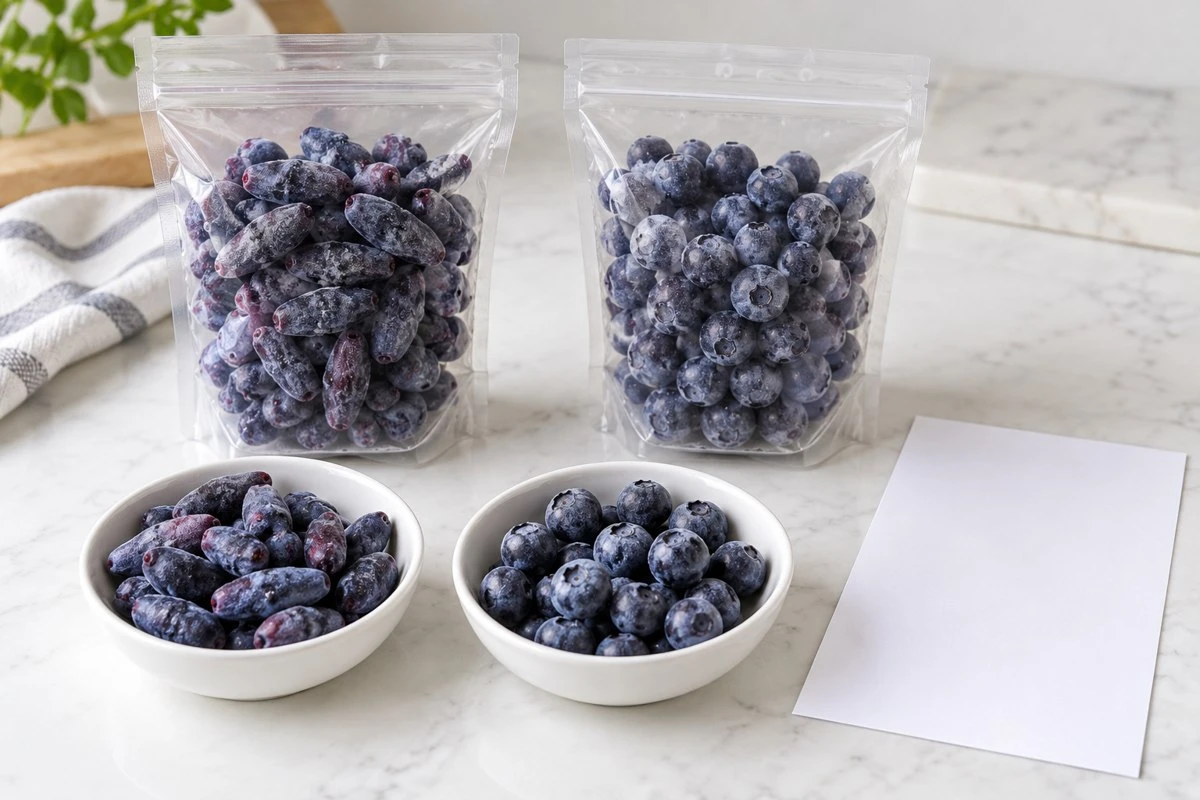
Illustrative haskap blueberry frozen sample packs.
Confirm the offered pack and the receiving operation. Pack size, liner, closure and frozen form affect thawing, portioning and transfer. A development sample supplied in a small pouch may behave differently from a bulk carton. Ask how commercial lots will be identified and how the approved sample relates to them. Agree the documents and analyses needed for the destination and intended use, and keep any pending identity confirmation visible before ingredient or private-label artwork is approved.
We can use the buyer's recipe brief to organize a frozen-fruit sourcing discussion, including the requested form, quantity, packing and application. For the current haskap offer, source records must confirm the berry identity before a firm haskap specification is approved. For blueberries, specify the intended type and form rather than relying on the broad word blueberry. A precise inquiry helps connect the right sample with the process the buyer actually uses and avoids comparing offers that describe different materials.
Retain an approved reference and agree how future differences will be handled. Define the retest method, the observations required with a complaint and who can authorize a formulation change or alternative use. If the final product intentionally becomes a haskap version, preserve its own recipe and acceptance record. That gives purchasing and production a repeatable basis for supply: the chosen fruit delivers the agreed food, and any later change can be assessed against documented performance rather than a general promise that berries are interchangeable.
Continue reading about berry preparation
Extend the trial into cake-layer holding, fruit distribution and moisture control.
Compare thawing routes against the blueberry ingredient's intended application.
See how a berry syrup is checked in coffee, dairy and plant-based drinks.
Discuss frozen fruit with GreenLand-food
GreenLand-food is a frozen fruit supplier and manufacturer in China, offering factory-direct wholesale supply. For frozen haskap berries, the offered lot's identity and accepted market name require confirmation before specification approval.
Send your required product form, specification, packing, quantity, application, destination, private-label needs and requested documents so we can define the sample and sourcing discussion.