


How to Blanch Cauliflower
Sep 08, 2026
Leave a message
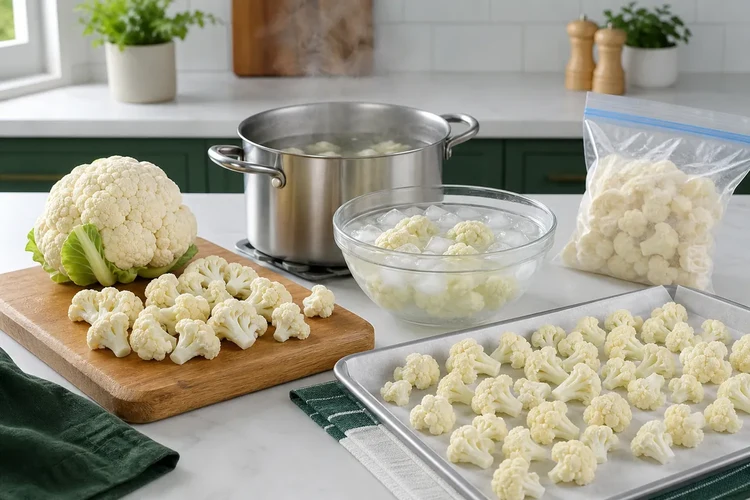
Blanching for a dish can have a different endpoint. A chef may want cauliflower partly softened before roasting or adding it to a sauce, while preservation blanching is intended to control enzyme activity before storage. Establish that purpose before choosing a time.
Decide whether you are preparing for freezing or finishing a dish
The word blanching covers a brief heat treatment followed, in many preparations, by rapid cooling. Its purpose determines how the result should be judged. For home freezing, the treatment is part of a tested preservation method. For immediate cooking, it may simply reduce the finishing time or produce a preferred texture. A crisp-tender sample does not by itself prove that the preservation treatment was sufficient.
Fresh vegetables contain enzymes that remain active after harvest. Freezing slows these reactions but does not necessarily stop them completely. A suitable blanching treatment reduces activity that can otherwise contribute to undesirable changes during storage. The National Center for Home Food Preservation explains that underblanching can be worse for quality than omitting the step, while excessive blanching can reduce flavour, colour, vitamins and minerals.
That does not mean the longest possible blanch gives the best frozen cauliflower. Heat also softens the vegetable. A head cut into delicate florets has a limited ability to withstand prolonged treatment and later cooking. The objective is an appropriate treatment for the specified piece size and method, followed by prompt cooling. Both inadequate treatment and excessive softening can produce a disappointing result.
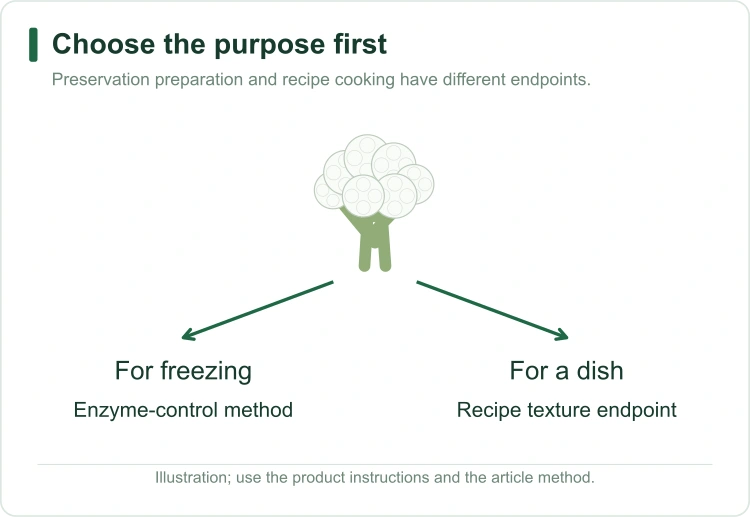
The purpose determines the method. Preservation guidance provides a defined preparation sequence, while a recipe may call for a different texture before its final cooking stage.
For a dish served immediately, think about the remaining cooking. Cauliflower going into a long bake should not be brought to the same softness as cauliflower that will receive only a brief final toss in a pan. Test the full recipe, including the core of the largest piece. A culinary blanching time is therefore a recipe parameter rather than a universal preservation instruction.
In a commercial frozen product, ask what the supplied blanching condition means. The description may refer to a product prepared for further cooking, and it does not automatically establish ready-to-eat status. The label, process validation and agreed specification should define intended use. A customer requiring use without a later cooking step needs that requirement addressed explicitly.
This article concentrates on blanching preparation, timing, cooling and assessment. Packaging and long-term freezer management follow their own requirements. Keeping those decisions distinct helps identify the source of a problem: a poorly timed heat treatment requires a different correction from a damaged pack or an unsuitable final cooking method.
Prepare even florets and a blanching station
Begin with sound, compact cauliflower. Remove the leaves and divide the head into pieces of a similar size, retaining only the sound stem needed for the intended floret. The NCHFP method specifies pieces about one inch across. Large stem sections and very small fragments should be separated rather than forced through one household batch and expected to behave identically.
Width across the curd is useful, but stem thickness also matters. A floret with a broad white head and a thin stalk heats differently from a piece dominated by a thick core. Cut oversized stem sections more evenly or use them in another preparation. Consistent cutting improves the chance that the largest piece receives sufficient treatment without turning the smallest pieces soft.
Wash the cauliflower under running water and use clean utensils, a clean basket and a clean cooling container. Washing helps remove soil and debris; it does not make contaminated produce sterile. The FDA's produce guidance advises against using soap, detergent or commercial produce washes. Keep the washed cauliflower separate from raw animal-food preparation and from used cleaning cloths.

A caliper beside a cauliflower floret makes the cut-size question visible. For the home method described here, prepare the cited approximately one-inch pieces; a commercial product photograph does not establish the blanching time for another size or process.
Set up cooling before heating the first batch. Once the blanching time is complete, searching for ice or clearing a sink adds uncontrolled cooking time. Have a sufficiently large bowl or container of cold water ready, with ice if needed to keep it cold. A clean colander or draining basket should also be available so the cauliflower does not remain soaking after cooling.
A pot needs enough water and heat capacity for the amount of cauliflower added. NCHFP's general home water-blanching guidance uses a gallon of water per pound of prepared vegetables. The practical check is whether the water returns to boiling promptly. If the pot is overloaded, a nominal three-minute treatment can include an unpredictable period of lower-temperature heating.
Make several manageable batches when necessary. Keep the unprocessed cauliflower cool while waiting and avoid piling the finished pieces into a warm, deep container. Organising the workstation in the order of washing, cutting, heating, cooling and draining reduces handling and makes the sequence easier to repeat. A timer should be clearly visible, and the person running the batch should know exactly when it starts.
Start the timer when the water returns to the boil
For the specified cauliflower pieces, the NCHFP cauliflower instructions call for a three-minute water blanch. The page includes salt in its stated blanching water, at four teaspoons per gallon. Follow the complete chosen method rather than taking the time from one source and changing the piece size or equipment based on another.
- Bring the prepared blanching water to a vigorous boil.
- Lower the even-sized cauliflower pieces into the water, preferably in a basket that allows good circulation.
- Cover as directed and allow the water to return to boiling.
- Start the three-minute timer when boiling resumes.
- Remove the batch promptly when the timer finishes and transfer it to cooling water.
The recovery period is a useful process check. NCHFP says the water should return to boiling within one minute; a longer recovery indicates too much vegetable for the amount of boiling water. Reduce the next batch or use suitable equipment with more capacity. Do not compensate by guessing an extra minute and then treat that improvised schedule as a validated method.
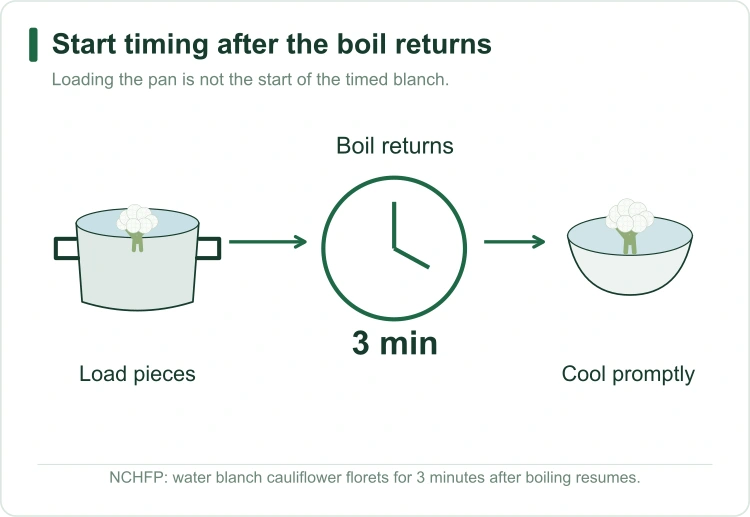
The three-minute interval begins after the water returns to the boil. Loading time and slow heat recovery should not be silently counted as the prescribed blanch.
The cauliflower should be surrounded by the heating medium. Tightly packed pieces, a basket that is too small or florets projecting above the water can give uneven exposure. Stir or move the basket only as the method and equipment allow, keeping the operation controlled and avoiding burns. The aim is uniform contact rather than vigorous agitation that breaks the curd.
Record the start correctly when several batches are running. A timer begun at the moment the vegetables enter the pot can expire before the required period at boiling has elapsed. Conversely, leaving a finished basket in the hot water while another task is completed adds unrecorded heat exposure. Either mistake makes it difficult to compare results.
Elevation also matters for home preservation because water boils at a lower temperature at higher altitude. Use the altitude adjustment from the applicable extension or preservation guidance rather than assuming a sea-level method works everywhere. This article's three-minute reference is a standard starting method for the specified pieces, not an instruction to ignore local elevation guidance.
Timing is a control, while texture is an observation. A floret may still feel reasonably firm after the required treatment. Do not extend the blanch simply because you expect a fully cooked eating texture at this stage. Final cooking will add further heat, and the preservation method is not designed to produce a ready-to-serve side dish.
Cool promptly and remove surface water
Cooling stops the cauliflower from continuing to soften after removal from the blancher. The curd and stem contain heat that keeps moving through the piece even when it is no longer in boiling water. A tray left on the counter cools much less predictably than a correctly prepared cold-water bath, especially when the pieces are piled together.
Transfer the batch promptly into clean cold or ice water. Give the water room to circulate around the florets, and keep it cold as successive batches enter. A small bowl that becomes lukewarm after the first basket cannot provide the same cooling conditions for the next. Renew the water or ice as necessary and follow the chosen preservation procedure.
Check the larger stem portions as well as the outer curd. The surface can feel cold while the centre remains warm. The purpose is to remove the residual heat promptly without leaving the cauliflower in water longer than necessary. Prolonged soaking after cooling introduces another variable into texture and surface moisture.
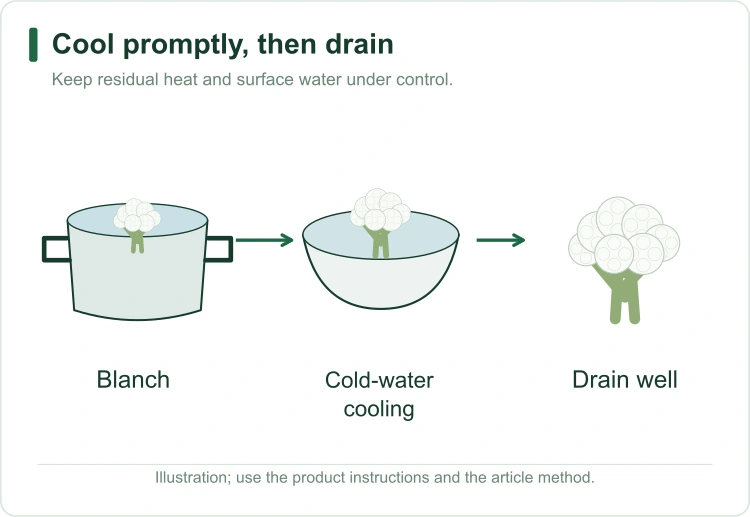
Prompt cooling limits continued softening after the timed stage. Draining then removes surface water before the next preparation or freezing step in the selected method.
Drain the cooled pieces thoroughly. Water trapped between curd branches can collect in the final pack or freeze around adjacent pieces. A free-flowing appearance depends partly on that surface-water management, although draining alone does not reproduce an industrial IQF process. Avoid squeezing the florets; it can crush the curd and release more liquid from the tissue.
Use a clean draining surface and protect the cooled cauliflower from recontamination. A towel used to wipe the counter or dry hands is unsuitable for direct contact with prepared vegetables. Cooling water, baskets and draining trays are part of the food-contact process, so their condition matters as much as the original washing step.
For a commercial operation, cooling and dewatering need their own defined controls. Water quality, residence time, product depth and the method of removing surface moisture should fit the line and product. A purchase sample that carries excess water may require a process discussion, but it should be assessed against the agreed product and test method before a cause is assigned.
The useful endpoint is a cooled, drained piece with the intended blanching condition. From there, move into the planned next stage promptly, whether that is freezing or a controlled kitchen preparation. Leaving the batch waiting in a warm room adds time that the blanching timer does not capture.
Recognise underblanching and excessive softening
Underblanching can leave enough enzyme activity to contribute to quality deterioration during storage. The resulting off flavour or colour change may develop gradually. A good appearance immediately after cooling is therefore not proof that the treatment was adequate. The method, piece dimensions and process records provide more reliable evidence than a quick visual check alone.
Overblanching is often easier to notice at once. The curd can become fragile, stems can lose resistance and small fragments may break away during draining. Later freezing, transport and final cooking can make that weakness more apparent. A product that looks intact in a frozen photograph may still collapse under the intended cooking procedure.
| Observation | Possible explanation to investigate | Useful comparison |
|---|---|---|
| Uneven firmness within a batch | Mixed sizes or uneven heat contact | Small versus large pieces from the same batch |
| Excessive breakage after cooking | Excessive heat exposure, fragile raw material or handling | Approved sample prepared with the same method |
| Strong quality change during storage | Inadequate enzyme control or storage-related factors | Process records and samples of known history |
| Heavy surface ice or clumping | Moisture removal, packing or temperature history | Product specification and receiving records |
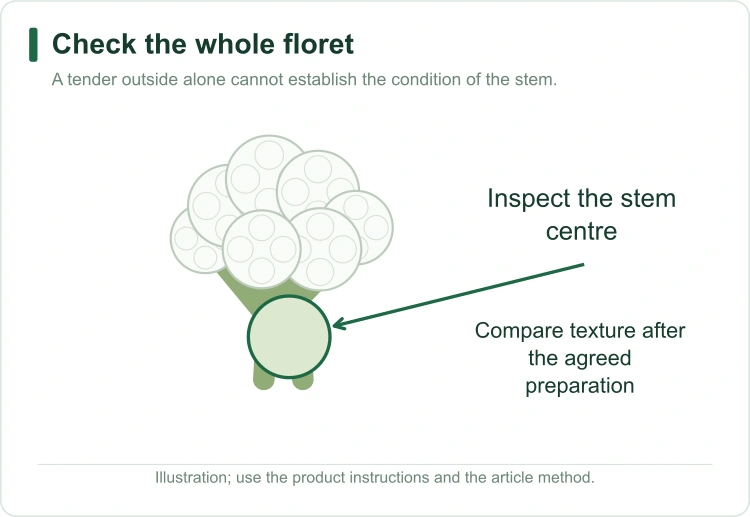
The outside and the stem centre can give different impressions. A controlled sample check should assess the part most likely to remain firm or heat unevenly.
These are investigation routes, not diagnoses from appearance. Several causes can produce similar results. A cauliflower sample may be soft because it was overblanched, because it was overcooked in the test kitchen or because the raw material was unsuitable. Compare one variable at a time and retain the preparation details.
For a kitchen, use a simple trial log: cut size, batch weight, water quantity, time to regain boiling, timed blanch, cooling method and final recipe. The record is short enough to repeat but detailed enough to reveal a change. If all later batches are softer, check whether the heating or cooling conditions changed as the work progressed.
For a factory, enzyme-control assessment can include process validation and appropriate analytical checks. The choice of test and its acceptance limits belongs to the product's technical programme. A buyer should not invent an enzyme-test limit from a general article or assume that a single negative result proves every safety characteristic of the lot.
We assess the delivered cauliflower against agreed colour, structure and cooking performance, with the relevant product and process information available for review. When a sample fails, describe the observable problem precisely. "The florets broke into small fragments after the stated cooking method" gives the supplier a clearer investigation point than "the blanching is wrong."
Keep water, steam and factory processes distinct
Water and steam transfer heat differently. A basket submerged in boiling water receives contact around the pieces, while steaming depends on the movement and condensation of steam around the product. Loading depth, lid fit and equipment design affect that contact. A three-minute water treatment should not automatically become a three-minute steam treatment.
University of Minnesota Extension lists five minutes for steam blanching one-inch cauliflower florets alongside the three-minute water entry. Other preservation guidance may recommend water blanching as the principal method for cauliflower. Choose one complete, applicable method and follow it. Do not average different recommendations or create a hybrid schedule because the equipment seems similar.
Microwaving is another different heating process. A microwave can cook cauliflower successfully for a meal, but that does not establish it as an equivalent preservation blanch. Uneven energy distribution and variable loading can make enzyme control difficult to confirm. NCHFP does not recommend microwave blanching for home freezing. Use a supported preservation method when storage quality is the objective.
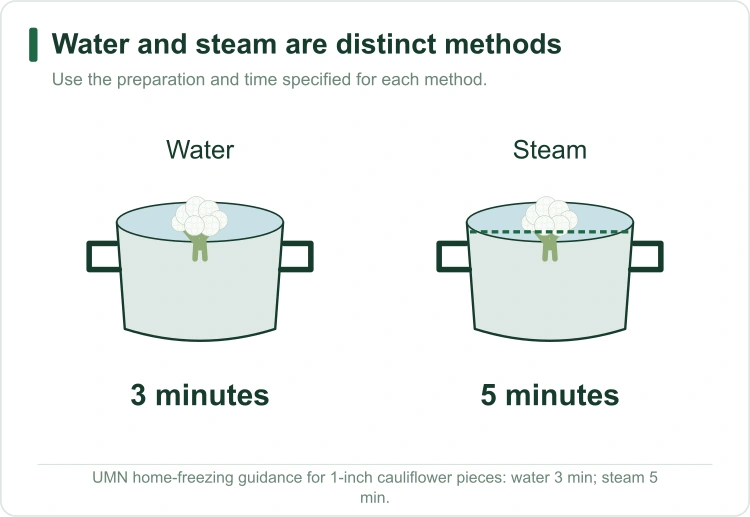
Water and steam have different reference times in the cited guidance. Changing the heat-transfer method requires its own instructions rather than reusing the water-blanching timer.
The term blanching also appears in cauliflower growing. There it can mean shielding the developing curd from light, often with leaves, to maintain a desired white appearance. That horticultural practice is separate from heating cut cauliflower in a kitchen or factory. It has no cooking timer and does not prepare the vegetable for frozen storage.
An industrial blancher may use continuous water, steam or another validated system. Product moves through under controlled conditions, and the equipment may process much larger quantities than a household pot. The operating schedule must account for the actual piece geometry, product flow and subsequent cooling. A home method provides background understanding rather than a commercial operating specification.
For purchasing, confirm the product's pretreatment and intended use without demanding a generic setting that may be inappropriate for the supplier's equipment. Technical teams can exchange the process evidence required for approval. The receiving specification should describe the condition the buyer needs and the agreed criteria used to assess it.
A change in cut size, product loading or final application may require a new review. A schedule previously used for small florets should not be assumed suitable for thick stem sections or intact steaks. The relevant question is whether the actual product and process have been evaluated together.
Translate blanching quality into a cauliflower purchase specification
Start with the final application. A visible vegetable side may need florets that remain intact and tender after reheating. A puree line may accept a softer structure but require consistent colour and flavour. Riced cauliflower needs particle and moisture controls that differ from whole florets. The blanching requirement should support those results.
The GreenLand-food frozen cauliflower range includes several forms for cooked use. We confirm form, size, stem ratio, blanching condition and packing against the order requirements. A product name alone does not establish the exact pretreatment or application performance, so provide the intended preparation method when requesting a sample.
Use a representative sample and follow the proposed cooking instructions. Assess the product immediately after cooking and after any realistic hold or reheat. Record curd integrity, stem tenderness, natural colour, flavour and the amount of free liquid. When yield is measured, define the draining procedure and whether the result includes cooking liquid.
Agree the acceptance basis before comparing suppliers. One sample may have a higher proportion of stem or smaller fragments, affecting both texture and water release. Another may be supplied at a different blanching level. Those differences need to be visible in the comparison rather than hidden under the same "IQF cauliflower" label.

Frozen cauliflower florets in a lined bulk pack show the product form a buyer receives. Agree the floret-size range, stem proportion and acceptable fragments, then assess texture after the intended cooking method rather than relying on a photograph alone.
Packing, lot identification and cold-chain records support the quality assessment. Confirm storage instructions, shipment condition, remaining shelf life and any required inspection or product documents. The wider frozen vegetable programme can help buyers coordinate related cuts and blends, but each component still needs its own confirmed specification.
Send the sample cooking method and the problem it needs to solve with the commercial enquiry. We can then review the available product form, sample plan, quantity, packing and destination requirements. A clear account of the desired cooked cauliflower gives the technical and purchasing teams a practical basis for agreement.
Keep the approved sample findings beside the signed specification. When a later batch behaves differently, repeat the same preparation before deciding what changed. That routine connects blanching control with the result the customer actually uses and makes quality discussions more precise.
Confirm the cauliflower preparation you need
GreenLand-food is a professional frozen cauliflower supplier and manufacturer in China, providing factory-direct wholesale supply for importers, food manufacturers, foodservice distributors and private-label programmes.
Send the required cut, application, pack format, volume and destination. If blanching affects your recipe's texture, include the cooking method and sample acceptance criteria. We will review the product information and documents relevant to the proposed supply, with processing details confirmed for the actual item.
Use the product range and downloadable catalogue to review the wider selection, then send the specification and order details that matter to your application.