


Japan AFR, NACCS and Food Import Notification Handover
Oct 20, 2026
Leave a message

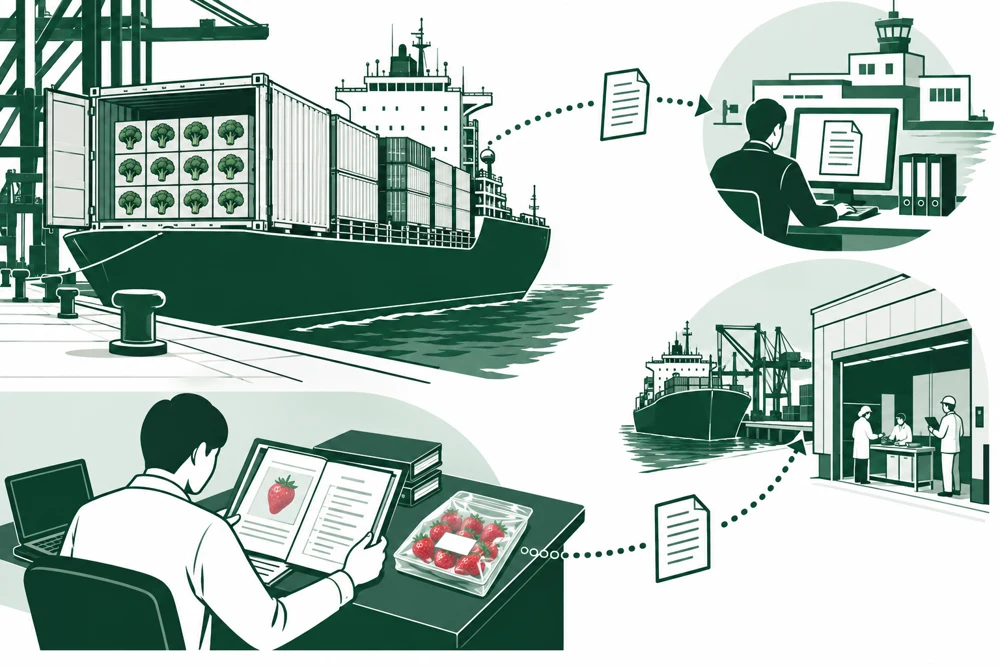
Reviewed 20 October 2026. Shipment requirements are checked for the actual product, route and filing date.
Separate the three procedures and name their owners
AFR is a customs security filing for maritime container cargo intended to enter a Japanese port. The Japan Customs AFR overview says the shipping company or NVOCC must submit the cargo information electronically, ordinarily no later than 24 hours before departure from the foreign port of loading. A shipping company reports at ocean master bill level; an NVOCC reports its house-bill cargo information when that layer exists. NACCS is the electronic system used for these records. It also supports many other trade and port procedures, so a generic statement that a shipment "is in NACCS" is too imprecise to prove AFR compliance.
Food import notification is a different obligation. Japan's Ministry of Health, Labour and Welfare explains that a notification to a quarantine station is submitted each time food is imported for sale or commercial use. The station reviews the submitted information and may require inspection. The customs import declaration and permission are further steps. A carrier can obtain a normal AFR processing result even when the importer has not completed the food notification; conversely, food documents in progress do not repair a late or rejected AFR message. The parties should maintain separate status lines rather than one "Japan clearance" tick.
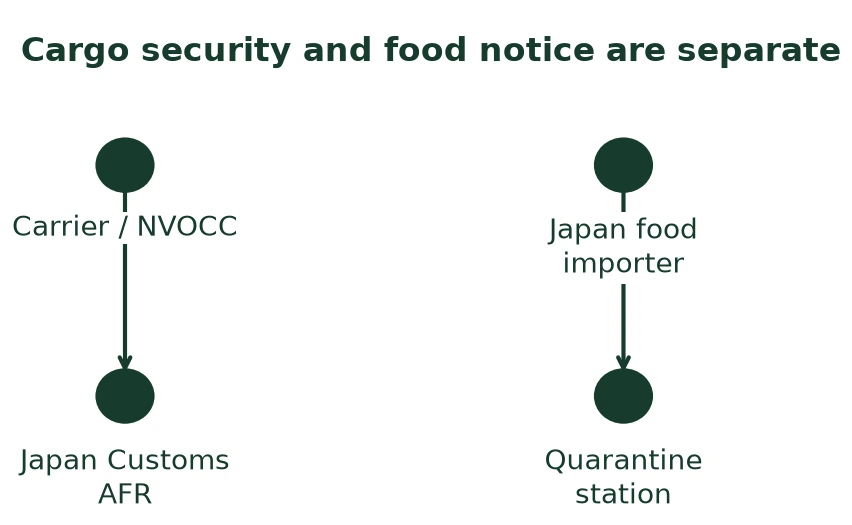
The same source facts may support both files, while their regulated owners and decisions remain distinct.
At contract stage the buyer should identify the Japanese importer, customs broker, ocean carrier, forwarder or NVOCC, and the party that actually submits the food notification. For a direct full-container load without an NVOCC house bill, the master-level structure may be simpler. For a consolidated shipment, the house-level filer may be a different company from the carrier. Ask the nominated logistics provider to confirm the bill structure and its NACCS reporter identity. GreenLand-food prepares product and commercial records; the responsible filer decides the message and monitors Japan Customs responses.
Write the ownership map beside the timetable. One row covers product and factory facts, another the booking and master bill, another the house bill, another AFR receipt and risk response, and another food notification, inspection and customs permission. Include a named contact and substitute for each. A title such as "export department" is not enough when the vessel sails after working hours. The buyer should know which person can ask the carrier to stop loading, correct a house description, or provide a fresh ingredient specification to the quarantine station.
The purpose of this division is traceability during change. Suppose the buyer changes the Japanese consignee after a draft bill is issued. GreenLand-food can revise the commercial instruction only after the buyer approves the correct legal party. The carrier and NVOCC then assess their transmitted cargo records; the importer assesses its food and customs forms. A revised invoice in the supplier's files is an input to these checks, not evidence that each regulated filing has changed. Retain the change request and the messages that close it.
Match master bill, house bill and frozen-product identity
The Japan Customs AFR summary identifies master-level cargo data from the shipping company and house-level data from the NVOCC. For a buyer, the connecting fields include the vessel and voyage, load and discharge ports, master and house bill numbers, container number, cargo description, parties and package information. The exact NACCS message fields are defined in Japan Customs and NACCS instructions, but the supplier can make the source packet coherent before a filer keys or transmits it. Do not equate a purchase-order number with the ocean bill or a house bill with the carrier's master bill.
A good product description says what is actually in the container. "IQF chopped spinach, blanched, unseasoned, packed in 10 kg bags inside cartons" is more useful than "frozen food" or a brand name alone. If a retail pack contains seasoning, sauce or another ingredient, name it. The description on the draft bill should match the commercial invoice and packing list in substance, while preserving the nomenclature required by the filer. Japan Customs warns that inappropriate or vague descriptions hinder its risk analysis. The exporter should disclose a product change promptly instead of waiting for a customs question at arrival.
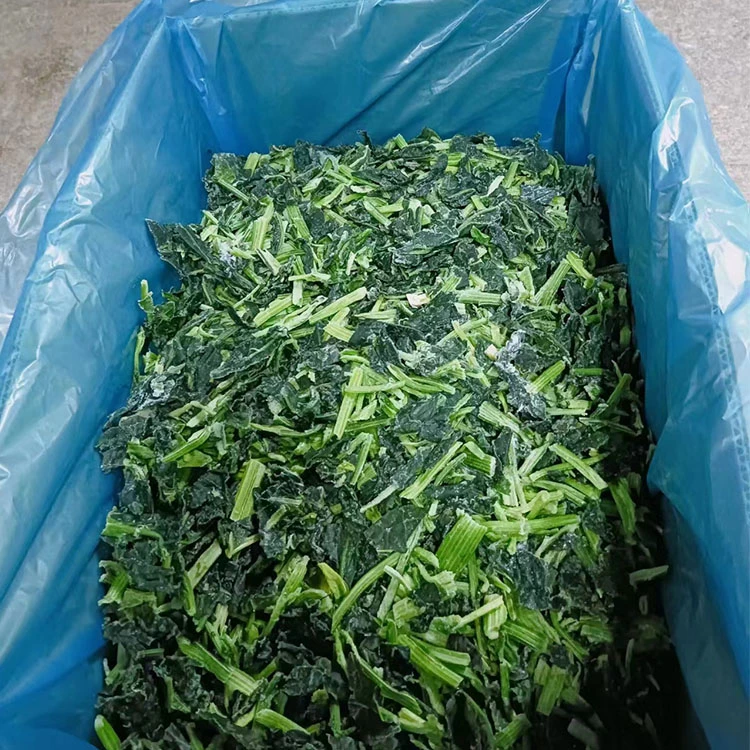
IQF chopped spinach: identify the actual form, packing and intended use in the shipment file. Product photograph; not evidence of a filing result.
IQF chopped spinach for your import programme
Tell us your destination, intended use, cut or grade, packing, quantity and preferred shipment window. We can coordinate the proposed source, sample specification and origin documents with your importer and appointed filing team. The actual lot, factory and required documents are agreed before dispatch.
View product and supply details
Request Specifications & QuoteRecord net and gross weights, number and type of packages, pallet count if relevant, country of origin as supported by production records, shipper, consignee, notify party, container and seal. Check whether a pallet is counted as a package in the booking instruction; inconsistent units can make the master and house data appear irreconcilable. For a container with multiple lots, keep a lot-to-carton mapping that allows an inspection or recall to locate the affected cartons. The AFR cargo report may not carry every quality detail, but the importer must be able to bridge its food notification and batch documents to the same physical cargo.
GreenLand-food's shipment sheet can have three linked panels. The commercial panel covers product, pack, quantity, price and agreed parties. The transport panel covers vessel, voyage, ports, bills, container, seal and cut-offs. The quality panel covers factory, production dates, lots, product specification, ingredient status and temperature instruction. Only fields relevant to an AFR message go to the carrier or NVOCC, but all panels share stable shipment and lot references. This prevents a temperature logger number from being mistaken for a customs identifier or a revised lot list from being detached from the final bill.
Review the buyer's preferred IQF chopped spinach or other actual product form at quotation. A product page illustrates the available form; a purchase specification and sampled batch define the order. The parties should confirm chop size, blanch status, pack, intended use and requested tests early enough to avoid a late change in the cargo description. A photo of frozen spinach establishes neither a Japanese legal standard nor the status of a particular lot. Those decisions belong in the buyer's market and food-compliance plan.
Work backwards from the vessel's departure
The principal AFR deadline is easy to misstate. The Japan Customs rule says cargo information must be filed, in principle, no later than 24 hours before the vessel departs the foreign loading port. It is a departure-based clock, not a universal 24 hours before arrival rule and not a 24 hours before a container reaches the terminal rule. Japan also has separate pre-arrival reports for vessels and cargo; their clocks must not be conflated with this pre-departure AFR. Put the expected departure in local port time, its time zone, the filing cut-off and the responsible filer on the booking sheet.
Japan Customs describes a temporary relaxed deadline for specified short-distance routes from certain neighboring ports to certain Japanese ports. The official summary says that qualifying cargo may be filed by vessel departure. This is a route-specific provision. A China-origin frozen food shipment is not automatically eligible merely because China is a neighboring country; the actual loading and Japanese destination ports and current designated route must be confirmed by the carrier or NVOCC. We plan to the ordinary 24-hour rule unless the filer documents that the specific route qualifies.
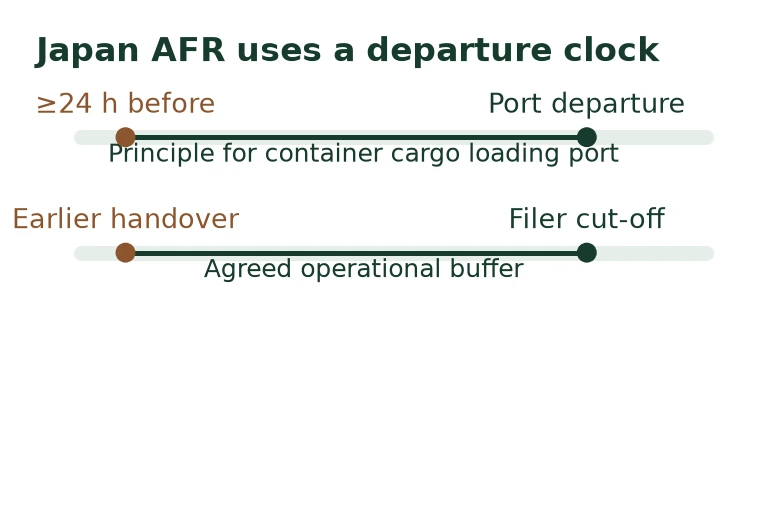
Confirm any geographical or route exception. The principal AFR event is vessel departure, unlike US ISF loading.
The shipping company's internal deadline can be earlier than the legal filing time. It needs time to receive and validate the shipper's description, submit the master record and respond to errors. An NVOCC also needs its house-bill data aligned with the carrier's voyage and master bill. For a Friday departure, a Wednesday or Thursday supplier cut-off may be the practical limit. The order coordinator should obtain the real booking deadlines, then schedule invoice, packing and bill-instruction approval before them. A signed final invoice sent exactly at the statutory minute may reach the filer too late.
The shipper should signal what is still provisional. Product name, number of cartons and buyer identity can often be approved before loading. Container and seal become final after stuffing. If there is a discrepancy, send an explicit revision stating old value, new value, affected bills and reason. Do not circulate several attachments with identical filenames and no version date. The carrier and NVOCC determine whether and how to amend their NACCS messages. A supplier's email "please update" does not prove an accepted revised AFR record.
Risk analysis creates another reason to file accurately and early. Japan Customs may send advance notices concerning higher-risk cargo before loading. Missing, false or late information can lead to intervention and, under the law, penalties. The supplier should avoid promising a sailing or final delivery until the filing parties report acceptable status. If Customs instructs that the cargo not be loaded, the carrier and NVOCC follow that instruction; the exporter holds the goods and records the affected lot and container. Operational urgency does not convert an unaccepted filing into a valid one.
Check NACCS acknowledgements and react to risk codes
The NACCS AFR guidance describes master-bill advance cargo registration and house-bill advance cargo registration. NACCS checks input conditions and reports completion or error to the filer. The importer should ask the appointed carrier and NVOCC for the relevant reference, submission time and processing outcome. A draft screen, a booking confirmation or a PDF bill cannot stand in for that result. If the message failed, identify the specific field and re-submit through the authorised filer.
The seventh-generation NACCS is now in operation; NACCS Center's history records its start, and its 2026 reporting compares processing after the October 2025 changeover. An operator should use its current system manual, message mapping and service-provider instructions for the actual filing date. An older AFR explanatory PDF remains useful for the legal roles and logic, but a screen path or legacy field code should not be copied into a 2026 work instruction without verification. We therefore ask the carrier and NVOCC to return current-system receipts and to identify which procedure produced each response. This avoids confusing a successfully created draft in a service provider's interface with a message processed by the live NACCS environment.
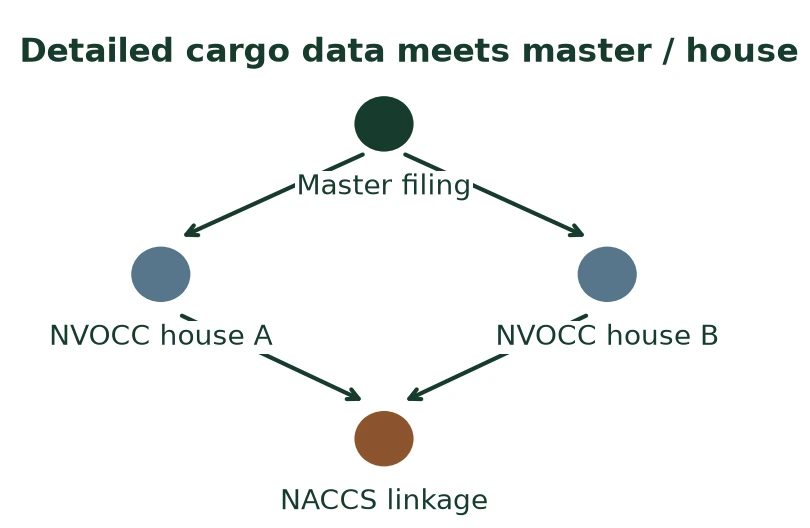
The filing records must preserve commercial party and bill relationships at the proper level.
Risk notices require interpretation by the filing party. Japan Customs and NACCS guidance identify codes and procedures for advance notices, requests for correction, and cases that can suspend loading or discharge. The exact code should be read in its current official context rather than translated casually in a supplier email. For example, a request to add or correct information is a task with a deadline and an accountable filer; a notice affecting loading or unloading is a movement control. Copying the code into a shipment tracker without taking the prescribed action does not resolve it.
The Japan Customs/NACCS AFR guidance distinguishes DNL, a do-not-load notice for the affected cargo, from HLD, a request for further or revised information. DNU can suspend discharge after departure, including where an unresolved HLD has not been cleared by the required point. SPD can be issued for overdue filing and may require an application for cargo-discharge permission before unloading. The carrier or NVOCC reads the actual notice and current procedure, confirms whether it has been cancelled, and obtains any required Customs permission. A supplier should record the code and affected bill but should never translate it into an unconditional promise to load or unload.
Japan Customs also warns about discrepancies between master and house information. The shipping company and NVOCC should cooperate to resolve them so risk analysis can proceed. If the house bill uses a different port, bill relationship or package total, first establish the true shipping facts from the booking and load file. Then have the relevant filer correct its own NACCS record. Keep a dated record of both old and new values, the Customs notice and the completion message. A supplier should not ask one party to change a true record merely to make it match the other's erroneous entry.
Correction rights can change with the stage of the voyage. The NACCS guidance describes restrictions after particular registration and departure-time events, and the possibility of Customs-directed correction. This makes a late "simple typo" potentially harder to fix than the commercial team expects. The carrier or NVOCC must consult its current NACCS procedure and Japan Customs notice, especially if a loading or discharge control applies. We can provide a corrected invoice, factory load report or written product explanation, but the filer remains responsible for the electronic correction and its receipt.
In the official operational flow, a master record is registered through AMR and a house record through AHR. Corrections normally use their prescribed update procedures before actual departure-time registration (ATD); after ATD, the guidance limits correction to circumstances such as a relevant Customs advance notice. These codes identify system events, not a route for GreenLand-food to self-file. The shipping company or NVOCC should use its live seventh-generation NACCS instructions when carrying out an amendment in 2026. If SPD or another notice controls discharge, the party seeking discharge follows the Customs permission process before unloading, even when the commercial documents look complete.
Japan Customs' AFR appendices also identify BLL for associating registered bill numbers and DNC for applying for cargo-discharge permission. The carrier and NVOCC should use BLL where their actual bill relationship calls for it and compare discrepancy output after ATD or manifest submission. DNC is an application, not permission by itself: the party seeking discharge must retain the Customs decision. Ask the filer for the affected master or house bill, event time, accepted response or error, and any subsequent cancellation or permission. Keep these separate from the Japanese importer's food-notification and customs-release evidence.
The forwarder should tell the Japanese buyer what the response actually authorises and who is still holding the cargo. A NACCS message that accepted corrected data does not, by itself, cancel DNL or DNU. Where the notice concerns a house bill, the master-bill carrier must also know whether its loading or discharge plan is affected. GreenLand-food can correct source facts and preserve them in the shipment packet, but only the authorised filer and Customs can close the electronic and movement-control steps.
If the network or NACCS system itself is unavailable, Japan Customs publishes a specific contingency instruction linked from its AFR page. The filing party should follow the current official notice rather than borrow an old manual workaround. Preserve outage time, affected messages, official direction, communication with the buyer and final acceptance. While the paperwork is open, the logistics team protects reefer power, tracks the container's actual location and updates the delivery plan. A cold-chain hold and a cargo-reporting hold can occur together; each needs its own evidence to close.
| NACCS event or Customs notice | Responsible action | Result the buyer should request |
|---|---|---|
| AMR / AHR | Carrier files master data; NVOCC files house data. | Accepted response for the correct bill and voyage, or an error followed by corrected acceptance. |
| ATD / BLL | Carrier records departure; relevant filer reconciles and associates registered bill numbers where required. | Departure and bill-association responses plus resolution of any discrepancy output. |
| DNL | Carrier and NVOCC stop the affected loading plan and follow Japan Customs' notice. | Customs cancellation or other explicit official disposition before any claim that loading can proceed. |
| HLD | Named filer adds or corrects the requested master or house information. | Corrected accepted filing and Customs notice status, not just a resubmitted draft. |
| DNU | Carrier and NVOCC hold discharge of the affected cargo and contact Customs. | Cancellation or express Customs disposition before discharge resumes. |
| SPD / DNC | Responsible party addresses late or missing filing and applies for discharge permission through DNC when required. | Accepted filing plus the separate Customs discharge-permission result. |
Hand over to the food importer and quarantine station
Japan's food notification starts from the imported food itself. The importer needs the product's composition, production method, manufacturer, country, intended use and other facts required for its notification and any prior consultation. The MHLW imported-food explanation shows the quarantine station reviewing notifications and conducting inspections as needed. If an inspection order applies, food cannot be released on the basis of a carrier's AFR acceptance. The Japanese importer should confirm the current food standards and testing requirements for the exact spinach or other vegetable before shipping.
For frozen spinach, distinguish raw leafy material from blanched IQF chopped spinach, and disclose any ingredients or treatments. The importer may need manufacturing-process information, pesticide or microbiological reports, packaging specifications or origin records to answer a quarantine-station question. We can prepare current lot and process documents that correspond to the commercial invoice. A generic annual certificate or a previous buyer's food notification is not proof that the new product and lot meet the buyer's current requirements. If the product changes, alert the importer so it can reassess the notification content.
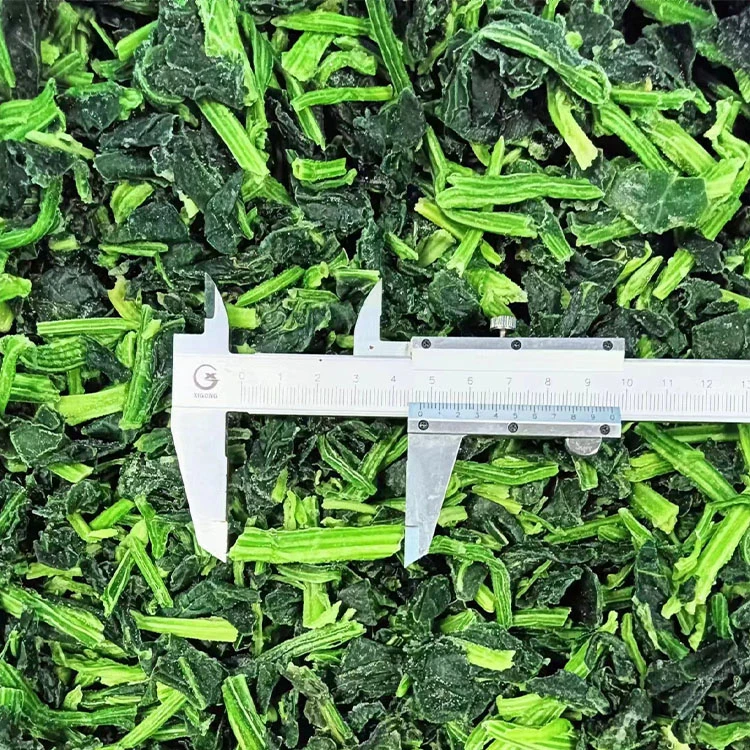
IQF chopped spinach: identify the actual form, packing and intended use in the shipment file. Product photograph; not evidence of a filing result.
The MHLW FY2026 imported-food monitoring plan shows that imported-food oversight is active and risk-based. It should not be turned into a prediction that a particular reefer will be sampled or cleared. The importer receives the actual station's decision for its consignment. During a hold, the buyer and warehouse maintain product temperature and restrict distribution. GreenLand-food can provide traceability, laboratory scope and manufacturing answers, while the importer coordinates any official sample, inspection instruction or corrective response.
Food notification, plant quarantine where applicable, customs declaration and cargo discharge are separate decisions. The broader Japan import guide helps the buyer organise those requirements. In this article, the handover point is concrete: the Japanese importer receives a final invoice, packing list, bill numbers, product specification and batch mapping that correspond to the cargo reported by the carrier and NVOCC. If a revised house bill changes a consignee or quantity, the importer checks whether its food and customs records require amendment too.
Ask the buyer to return a release path rather than one unqualified "cleared" message. The sequence may include AFR processing, vessel arrival, food notification acceptance or inspection outcome, customs permission and physical warehouse release. The importer or broker can identify which stage is pending and who owns it. The supplier need not gain access to the importer's NACCS account to support this process. A shared shipment reference, exact document version and disciplined question log are enough to answer most product-specific requests without disclosing unrelated account data.
Work through a frozen-spinach shipment and its exceptions
Consider a proposed full-container order of blanched IQF chopped spinach for a Japanese food processor. GreenLand-food and the buyer agree the cut, pack, quantity, labeling, destination and test documents. The buyer nominates a carrier and an NVOCC that issues a house bill. The carrier confirms its master bill and vessel schedule; the NVOCC confirms its house bill and NACCS reporting role. The Japanese importer names the person responsible for food notification and its customs broker. This division is written into the order file before the production lot is released for loading.
The supplier then sends a controlled packet: product and process description, invoice, packing list, carton and pallet totals, production lots, shipment marks and draft bill instruction. After stuffing, it adds container and seal, final weights and load record. A second person compares the commercial and transport documents. The carrier and NVOCC file their respective AFR data by the route's applicable deadline, using the in-principle 24-hour pre-departure rule unless a documented exception applies. Each returns an accepted processing result with its bill and voyage reference.

A cargo-security response does not issue the food import notification certificate.
Suppose the NVOCC receives a discrepancy because its house record lists a different discharge port from the carrier's master record. The shipping coordinator checks the booking and buyer instruction. If the house record is wrong, the NVOCC corrects it and retains the NACCS completion message; if the carrier's booking changed, both filing parties review their records. GreenLand-food updates its internal shipment sheet and invoice only if those documents also contain an incorrect port. No one changes a true physical fact merely to make electronic records agree. The importer checks whether its food notification and customs plan use the affected port.
Suppose instead that Japan Customs issues a notice that prevents loading or requires correction. The carrier and NVOCC follow the notice and hold the cargo at origin as directed. The supplier identifies the reefer and affected production lots, maintains the agreed temperature and informs the buyer of the revised sailing risk. The filing party supplies the exact Customs disposition before the container is released to load. If the notice reaches the parties after departure and affects discharge, the Japanese importer and carrier coordinate the required permission. A carrier tracking page that says "arrived" cannot override a discharge suspension.
At destination, the importer submits the food notification with matching product and batch evidence. If the quarantine station orders inspection, the cold store holds the goods until the official outcome permits the next step. Customs permission and physical pickup follow their own confirmations. The complete record connects product lot, container, master and house bills, AFR receipts, food notification and disposition. For the next order, the team can reuse the responsibility map and document template, while checking the current law, route, product and official notices again. The operational gain is fewer uncertain handoffs when a frozen container is already moving.
Close the shipment file with receipts the next buyer can use
The first shipment should produce a reusable control sheet, but the next buyer still needs an order-specific review. Archive the approved product description, the invoice and packing-list version used for AFR, booking and final bills, carrier and NVOCC message references, processing results, any risk notices, amendment history, and the importer's food and customs outcomes. Index them by order, container and production lot. This lets a purchasing team investigate a later quality complaint without searching unrelated email threads or relying on a freight platform's summary status. A document link should open the actual dated file, not just a label that says "approved."
An exception log is most useful when it records cause and closure. For each rejected AFR field, discrepancy notice or food-document question, write the issuing authority or system, affected bill or lot, the exact problem, the owner, the deadline and the revised receipt. Keep the original transmission and document version. If the issue came from a supplier description, correct the controlled product master so the next order starts with an accurate phrase. If it came from a carrier transshipment or NVOCC bill relationship, update the transport instruction and require a new check at booking. The lessons should change the appropriate source document rather than become a vague note to "pay more attention."
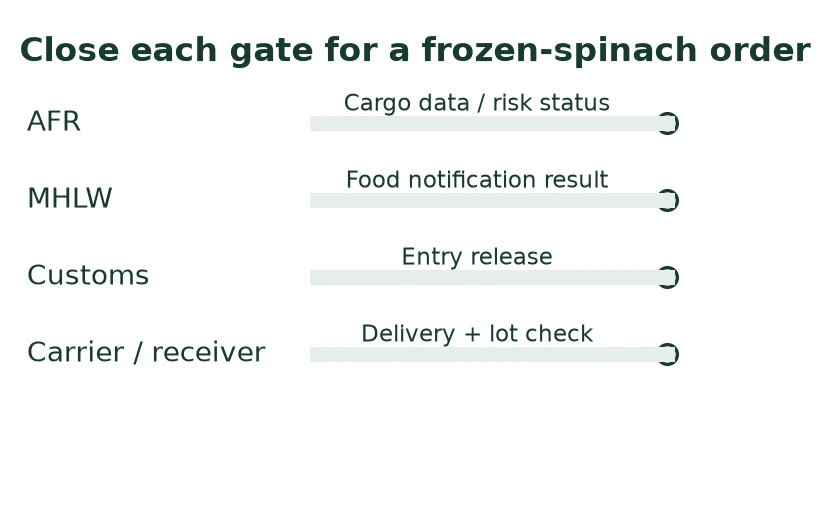
Keep each result and any restriction with the actual lot and transport reference.
Measure handover timing by events that matter. Record when final product data reached the carrier and NVOCC, when their messages were accepted, when the vessel departed, when the importer lodged food notification, and when official and physical release occurred. A delay between data-ready and acceptance points to a document or filing problem; a delay after food inspection points to a different control. These intervals do not prove a party's legal fault, but they help a buyer plan realistic lead time and reefer storage for the next order. Record local time zones and source receipts so two clocks can be compared correctly.
At quotation, the buyer can send destination port, intended importer, selected carrier or NVOCC, product form, cut, pack, quantity, desired documents and delivery date. GreenLand-food can respond with a proposed production and document schedule for its factory-direct wholesale frozen-food supply. The importer and appointed filing parties then confirm current Japanese AFR, food and customs steps for that exact route and product. This preserves a clean division of responsibility while giving every participant the same shipment identity and the evidence needed to release a frozen container safely.
Use the existing order worksheets
Use T10 to assign each field or document to its provider, reviewer, due time and returned reference. T12 records changed source, product or transport facts; T11 preserves arrival evidence. Keep the legal deadline separate from the agreed earlier handover.
Build your frozen food order with GreenLand-food
GreenLand-food is a professional frozen food supplier and manufacturer in China, providing factory-direct wholesale supply for importers, food manufacturers and foodservice programmes.
Send your product form, specification, packing, quantity, application, destination, private-label needs and requested documents. We will organise the product and order requirements with your purchasing and quality teams.