


Planning Pesticide Tests and Reviewing COAs for Frozen Produce
Oct 20, 2026
Leave a message

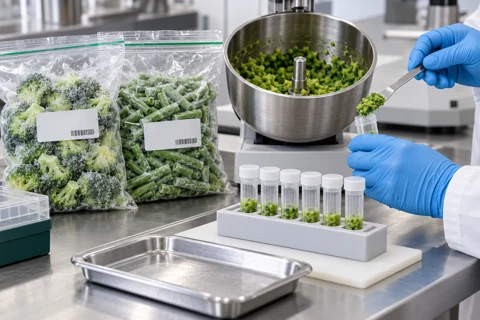
Use it when requesting a new quotation, changing a destination, adding a crop source or reviewing a report with missing analytes. It also explains when GreenLand's quality coordinator should keep a lot on hold and what additional evidence resolves the question. Regulatory framework reviewed 20 October 2026; the actual order schedule must reflect the law applicable to its relevant production and market dates.
Define the food and the destination before requesting tests
Begin with a product identity that a laboratory, importer and production team can all recognise. Record the botanical or accepted commodity name, edible part, origin, growing source, cut, ingredients, treatment, packing and intended use. Plain blanched green-bean cuts and a seasoned mixed vegetable blend require different descriptions. A commercial label such as 'Asian vegetables' is too broad to select a legal commodity or prepare a reproducible sample.
Keep the agricultural commodity classification separate from the customs tariff. HS0710 helps organise trade statistics and customs research, while a pesticide database may divide foods by botanical family, edible portion or a specifically named commodity. The tariff does not prove that a tolerance for another member of a crop group applies. GreenLand's order coordinator records both identities and sends classification questions to the importer's responsible regulatory contact before the testing request is approved.

Match the actual crop and form before selecting the test scope.
Choose the crop and form for your testing plan
Soups, foodservice sides and prepared-food production. Confirm cut or size, preparation, intended cooking use and industrial packaging with the order.
Request Specifications & QuoteThe sample state matters. State whether the report concerns raw incoming produce, frozen finished product or a preparation made for consumption. Describe trimming, peeling, blanching, cooling, draining and any added ingredients. Do not create an assumed processing factor by dividing an arbitrary raw result by an expected reduction percentage. Where processing affects the legal assessment, retain the matched evidence, residue definition and reviewer's reasoning with the specification.
For an order sold into several markets, create one controlled product identity and separate destination columns. Record each legal source and application date, alongside any tighter contractual requirement. A retailer's prohibited-substance policy or lower reporting target can affect purchasing even where the law permits a residue. Keep the customer condition visible as a contract term; describing it as a government limit gives the buyer the wrong explanation and may cause unnecessary rejection elsewhere.
We connect that identity to a real supply discussion. For broccoli, confirm floret or chopped form, stem allowance and cooking use; for strawberries, confirm whole or cut fruit and subsequent heating or other use. The agreed sampling and laboratory plan follows those choices. Buyers can review our corresponding product detail pages and send the destination, quantity, packaging and required documents with the quotation request. A product photograph identifies the offered form; it does not certify the chemical status of a shipment.
Turn crop and process risks into a named analyte list
Build the proposed panel from crop-protection records, approved suppliers, growing locations, seasonal pest pressure, previous findings and current official monitoring. Add relevant packing or processing exposures. Record the basis beside each substance rather than listing every chemical without a reason. A new field group, unexpected detection or change in water treatment can trigger review before the next lot is received. A clean report from last season cannot establish the status of a new harvest.
The legal residue definition tells us what must be measured and combined. It may refer to a parent compound, specified metabolites, isomers or a sum expressed as another compound. Enforcement and dietary risk-assessment definitions can differ. The FAO explanation of residue definitions is a useful starting point; the actual destination provision decides the components for the order. Copying only the common pesticide name can leave a required component untested.

Fictional components A–E show a coverage gap; this is not a legal pesticide list.
Send the laboratory a component-by-component mapping request. For every legal definition, ask which compounds are included, which methods measure them, the matrix-specific reporting limits and how the final sum is calculated. If molecular-mass conversion is required, preserve the prescribed expression and calculation. A report of one parent compound cannot be silently relabelled as the complete regulated sum. An unsupported sum remains an unresolved analytical scope issue, even if its measured component is low.
A broad GC-MS/MS and LC-MS/MS screen can cover many relevant compounds efficiently, but it has a finite list. Particular polar compounds, fumigants or compound groups can require different preparation or selective methods. Ask the laboratory about the named substances and frozen matrix. Do not order extra methods simply because their names sound comprehensive; commission them where the risk review or specification identifies a need. Record exclusions explicitly so purchasing understands what the panel does and does not establish.
Use the existing T07 pesticide research and laboratory coverage workbook to keep these two lists distinct: requirements researched and analyses commissioned. In a demonstration with five required components, a screen covering four leaves one analytical gap. That is80% component coverage for that illustrative list, not80%food safety or80%compliance. The missing fifth component may be decisive. GreenLand's quality coordinator closes it through an appropriate additional method, a documented applicability conclusion or a justified change to the order plan before release.
Compare EU, US and Japanese legal decision routes
In the EU, use the current food commodity, pesticide entry, residue definition, notes and applicable date under Regulation 396/2005. The framework includes a0.01 mg/kg default where its legal conditions apply, with specified exceptions and substance-specific entries. It is not a universal test specification for every compound. The Commission MRL questions and answers explains the framework and changes in application dates. Preserve the actual entry used, rather than a screenshot of an undated summary.
The United States uses EPA tolerances and exemptions for the chemical and commodity. EPA's tolerance explanation leads to the relevant legal provisions. There is no general permission to use0.01 mg/kg for every pesticide without a tolerance. FDA distinguishes detections above a tolerance from a confirmed, quantified residue in a commodity without the required tolerance or exemption. Any processed-food assessment also needs its applicable legal basis; a simple 'US pass' copied from an EU report is inadequate.

Whole green beans: record the edible portion, preparation and destination for the analytical instruction.
Japan's positive-list framework includes specific standards, substances subject to special non-detection requirements, exempt substances and a0.01 ppm uniform standard where applicable. The CAA residue portal provides the current standards and methods route; its positive-list introduction explains the structure. Check the current substance and food classification before applying the uniform value. A Japanese 'not detected' provision must be interpreted through its specified method and conditions.
For mass fractions in these examples,1 mg/kg equals1 ppm and1000 µg/kg. Therefore0.01 mg/kg equals10 µg/kg. Units should be normalised before comparison, while retaining the original report. A numerical difference caused by a unit conversion must not become a false nonconformity. Conversely, a report in a different sample basis-such as a dry-weight value-cannot be converted to a wet-product requirement without the necessary measured moisture information and an appropriate assessment.
Each destination column needs an accountable reviewer. The laboratory confirms what its method measures; the importer's regulatory lead confirms local legal applicability; GreenLand coordinates the specification, source information and lot records. If the order is redirected, repeat the destination review rather than renaming the old COA. Legal acceptance in one market does not establish acceptance in the second. Country import guides explain separate filing and border procedures; a private residue report does not replace an official inspection or release.
| Destination | Record before laboratory instruction | Decision that remains separate |
|---|---|---|
| EU | Commodity code, current entry and notes, legal definition, applicable date and processed-state reasoning | Official control decision and any stricter buyer acceptance |
| United States | Exact EPA chemical/commodity tolerance or exemption; relevant processed-food rule | FDA entry assessment, FSVP responsibilities and customs release |
| Japan | Food classification, specific/ND/exempt/uniform branch and method | Food import notification, ordered inspection and customs permission |
Continue with the local filing routes: Germany · United States · Japan.
Commission the laboratory and sampling plan
Define a commercial lot before defining a sample quantity. Record farm or approved raw-material group, harvest and production dates, factory, line, product code and quantity. Identify how cartons, pallets and container positions relate to that lot. If a container combines several production batches, decide explicitly which are assessed separately. Combining unrelated lots into one composite can dilute a problem and leave the individual batches without interpretable evidence.
The written sampling plan should specify selection across the lot, primary increments, aggregate sample, laboratory quantity, retained quantity, containers, seals and custody. The correct plan depends on the commodity, sample purpose and applicable scheme. A few pieces from a convenient top carton do not become representative because they are photographed. Keep safety sampling separate from appearance inspection: an AQL plan for visible defects is not automatically a pesticide sampling method or an official enforcement procedure.

A proposed sampling arrangement; the lot-specific plan defines increments and quantities.
Name the sampler and record date, location, selection method, bag codes and the lot-to-sample bridge. Use clean, suitable tools and containers. Confirm with the laboratory how frozen samples should be packed and transported and whether thawing is permissible for its validated preparation. Record condition at dispatch and receipt. Damaged seals, uncertain temperatures or a product state inconsistent with the instruction require a documented suitability decision, not a silent replacement of the sample description.
Laboratory qualification includes more than an accreditation logo. Check the actual site, matrix, method and analyte scope, the accreditation body's current schedule and any flexible-scope arrangements. Ask how non-accredited or subcontracted work will appear on the report. Obtain the laboratory's confirmation of matrix suitability, analyte-specific LOQs, sample quantity, reporting format, turnaround and handling of ambiguous findings before sending the sample. A quotation that only gives a panel count is not enough for purchase approval.
GreenLand's coordinator prepares the instruction with the importer and quality reviewer; a trained assigned sampler executes the agreed collection; the laboratory acknowledges receipt and condition. The shipment file retains the instruction, scope acceptance and custody record. Quality releases the analytical request only when the methods can answer the specification. If the nominated laboratory cannot cover a required component, arrange a qualified complementary method or another laboratory before the shipping timetable creates pressure to accept incomplete results.
A raw-material surveillance sample and a finished-lot release sample also need different labels. In surveillance, the programme may compare suppliers or detect a previously unconsidered compound over a season. In release work, the sampling record identifies the goods whose disposition will be decided. Keep the purposes explicit when budgeting frequency and laboratory costs. If one annual survey sample is used to claim every container was tested, the document describes a level of control that never occurred. The quality plan should explain which evidence supports each lot, which checks are periodic verification and what new finding changes that frequency. A buyer can then judge the programme and request a different arrangement before approving price and lead time.
Read the COA against the original report
A supplier COA can summarise a batch, while the original laboratory report records what happened to the submitted sample. Keep both when they serve different jobs. Reconcile product, factory and lot identifiers, sample receipt and analysis dates, report number, method, units and actual result. When a laboratory uses its own internal sample code, retain the signed link to the commercial lot. Similar product names and nearby dates are not an adequate identity bridge.

Demonstration: a reporting boundary above the target leaves an unresolved concentration range.
Read the meaning of every qualifier. 'ND', 'less than' and 'below quantification' are not necessarily equivalent. Ask for the reporting definition and relevant LOD or LOQ for each analyte. An untested compound must appear as outside scope, not as zero. A detected amount below a quantification limit may need a different statement from an identified, quantified concentration. Preserve the laboratory's original wording while the reviewer explains its implications for the order.
Consider a demonstration target of0.010 mg/kg; this is a teaching value, not a limit assigned to any named crop or pesticide. A result reported as less than0.005 mg/kg has a reporting boundary below that target. A result less than0.020 mg/kg leaves concentrations between0.010 and0.020 unresolved. The second report cannot demonstrate that the result is below the target simply because it prints a less-than sign. Request an appropriate lower-limit method or keep the affected criterion unresolved.
Check whether all components needed for a regulated sum are available and how non-quantified components are handled under the relevant method and rule. Do not add detection limits mechanically to invent a result, or treat every missing component as zero. Ask the laboratory for its calculation and uncertainty statement where relevant. The Commission's SANTE 11312/2021 v2026 guidance provides detailed analytical quality and reporting guidance; it does not replace the shipment's correct legal commodity entry.
Use T04 COA review for the report-to-specification reconciliation and T05 laboratory-scope matching for competence records. Record each line as answered, not applicable with a reason, or unresolved with an owner. GreenLand retains the original report and controlled COA version, so a revised summary cannot conceal an earlier detection or analytical limitation. If the report has been amended, preserve the amendment reason, previous version and authorised new version before updating the buyer's batch file.
Use the existing buyer worksheets
Fill the order and lot identity first. Keep the original report or trial record beside the worksheet; record unresolved questions with an owner before approving release.
Work through missing scope and near-limit results
Separate an analytical question from a legal or contractual decision. An unexpectedly high result may require confirmation of identity, method performance, sample integrity and the applicable rule. A missing analyte is a scope gap even when all reported results are low. A wrong lot code is an identity gap even when the method is sound. Name the exact issue so the follow-up work can answer it. Reordering a broad screen without a hypothesis can waste time and obscure the original evidence.

The interval describes a measurement; legal and contractual decisions need their applicable rule.
Measurement uncertainty needs a stated decision rule. EU SANTE guidance describes an enforcement interpretation using the result and expanded uncertainty, including its conditions for a harmonised uncertainty. This must not become a universal commercial allowance or be copied to US and Japanese decisions. The importer and responsible reviewer should agree how laboratory statements and contractual limits are assessed. A result above an agreed purchasing target is not automatically acceptable because a convenient subtraction would bring it below that target.
For a separate fictional example, suppose an agreed value is0.010 mg/kg, a result is0.012 mg/kg and expanded uncertainty is0.003 mg/kg. The interval spans0.009–0.015 mg/kg. The arithmetic describes measurement; it does not decide lawful sale, official enforcement or contractual acceptance. The reviewer records the governing rule, how rounding is applied and what the uncertainty refers to. Keep unrounded values available when the authorised calculation requires them.
A justified retest starts with an agreed question. Examples include confirmatory analysis of an identified compound, a missing method on a properly retained sample, or investigation of sample handling. Preserve custody and the first result. Do not select a new favourable carton to erase a previous failure. Where the result points to field use or cross-contamination, investigate the linked raw-material and production scope as well. Confirmed non-compliant material must not be diluted into another lot to lower the measured concentration.
GreenLand's quality coordinator places the affected goods in an identifiable hold status, traces linked inputs and assigns the evidence request. The laboratory resolves method questions; the importer's regulatory lead addresses local interpretation; the authorised quality decision-maker approves disposition. Release requires the agreed evidence and recorded review. Rework, redirection, return or destruction needs a lawful approved route and complete traceability. Sales may coordinate timing and customer communication, but a shipment deadline does not substitute for quality approval.
Carry the decision from raw materials to shipment
Chemical control begins before the finished sample exists. Procurement confirms the approved source and obtains available crop-protection, harvest and traceability information required by the programme. Quality reviews changes and previous findings before accepting the raw-material route. A finished-product test can support verification; it cannot reconstruct missing field controls or guarantee that an unsuitable source will become suitable after washing. The purchasing decision should therefore precede a commitment to a particular shipping slot.
During processing, the factory keeps raw-material links and records the actual treatment route. If a new source, aid, ingredient, line or water programme changes the chemical risk or product definition, reopen the scope review. Keep the frozen batch segregated and identified through packing. GreenLand coordinates the approved specification and instructions with the matched facility, while the assigned factory quality team retains production and deviation records. The required evidence is defined for the actual order rather than inferred from general website claims.

An explanatory document-review scene linking the retained sample and shipment identity.
Before shipment, reconcile the released quantity and batch codes with the COA, packing list, invoice, label and transport documents. Confirm that any regulatory or buyer documents identify the correct facility and product. Send the importer the agreed report package at the specified pre-arrival point so its filing or verification team can review it in time. Customs clearance, food-authority release and the carrier's delivery order are separate events governed by the destination route. Our testing file supports that route without claiming to grant release.
A demonstration order might contain one plain blanched green-bean SKU from one approved production lot. The buyer confirms destination, cooking use and specification revision; GreenLand confirms the matched source and coordinates the laboratory request; the sampler seals and identifies the sample; quality reconciles all required components and documents disposition. If the buyer adds a second market after testing, the order returns to the market-column review. Any missing method, different legal definition or unsuitable reporting limit is resolved before the extra destination is approved.
At arrival, retain the lot identity and follow the agreed receiving checks. Where official or customer results differ, compare sampling purpose, lot positions, specimen state, method, analytes, units and reporting limits before drawing a conclusion. Preserve the original evidence and involve the competent local party for regulatory issues. Feed confirmed findings into the next source and test-scope review. Send us your product, destination, quantity, intended application and existing buyer panel: we can organise the specification, laboratory-scope discussion and batch-document handover around those concrete requirements.
- Buyer approves product identity, destination columns and specification revision before the laboratory request is placed.
- Quality signs the named method and LOQ mapping; the sampler records increments, seals and the lot-to-sample link.
- The laboratory issues its authorised report; quality reconciles T04 and attaches any missing-scope investigation.
- The designated approver records the lot disposition and quantity; document staff reconcile the released codes before shipping.
- The importer receives the agreed evidence package and completes its local verification and filing steps.
Build your frozen food order with GreenLand-food
GreenLand-food is a professional frozen food supplier and manufacturer in China, providing factory-direct wholesale supply for importers, food manufacturers and foodservice programmes.
Send your product form, specification, packing, quantity, application, destination, private-label needs and requested documents. We will organise the product and order requirements with your purchasing and quality teams.