


Canada ACI, eManifest and House Bills for Frozen Food
Oct 20, 2026
Leave a message

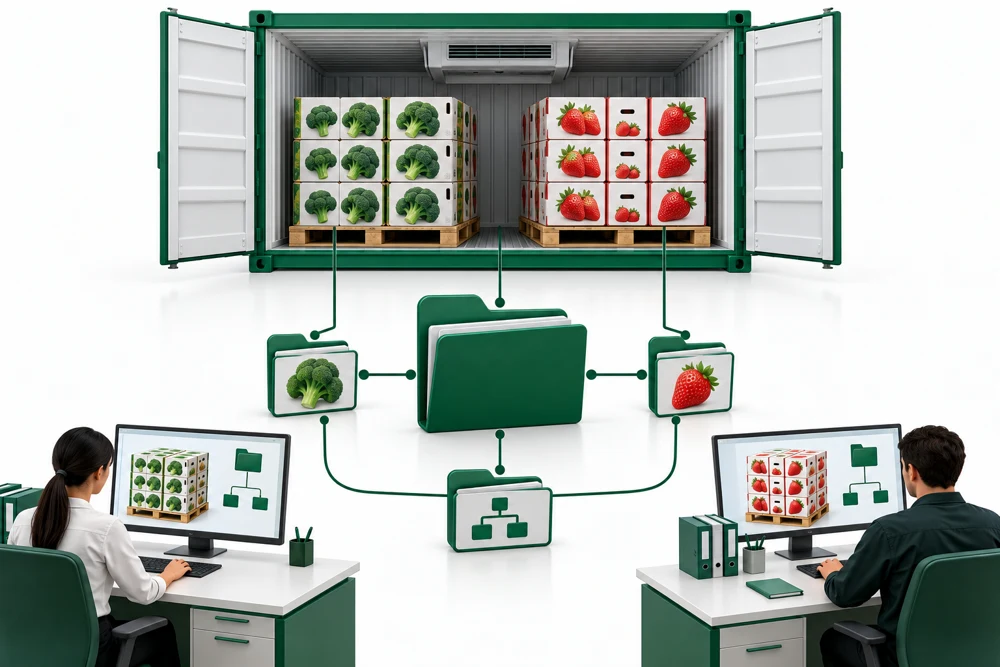
Reviewed 20 October 2026. Shipment requirements are checked for the actual product, route and filing date.
Assign the roles before anyone starts a filing
Start the booking with a four-party responsibility map. The marine carrier controls the vessel movement and its marine cargo and conveyance transmissions. A freight forwarder that issues house bills for a consolidation controls the applicable secondary house-bill data and the close message that connects it to the higher cargo record. The Canadian importer and its broker handle the customs release request and later accounting through the mechanisms applicable to that order. GreenLand-food supplies shipment facts and documents as the exporter or seller under the contract; it should not present a sent email as proof that CBSA accepted a filing.
The distinction matters because each party sees a different slice of the same cargo. A carrier may know the master bill, container, voyage and primary cargo control number. The forwarder knows the individual house-bill parties, shipment descriptions and consolidation relationship. The importer knows the intended product, tariff assessment, Canadian business details and release arrangements. If a buyer simply asks the seller to "send the manifest," the request hides which record and which accountable filer are missing. Name the deliverable instead: for example, a forwarder-accepted house bill with its cargo control number, or a carrier-confirmed marine cargo report tied to the booked voyage.
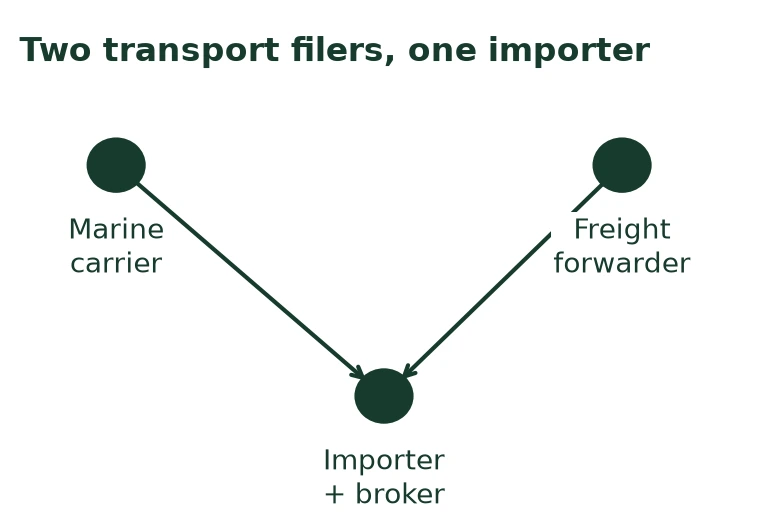
Carrier and forwarder reporting feed the importer handover; neither replaces the separate release request.
The CBSA client-type requirements distinguish reporting duties and prescribe mode-specific timeframes. They also explain that ACI does not replace a marine vessel's separate pre-arrival notification process. For our purchase-order file, we therefore list the actual marine carrier, booking agent, consolidator, forwarder, Canadian customs broker and importer of record. We record who will receive CBSA acknowledgements and who can correct a reject. If a subcontractor files through a service provider, the responsible carrier or forwarder still needs visibility into the transmitted data and status.
Agree the information cut-off before the factory release date. Carrier and forwarder data deadlines may arrive before the final commercial document pack is signed. A practical timetable names the supplier's data-ready date, the forwarder's internal cut-off, the carrier's cut-off, vessel departure, expected first Canadian port and the importer's broker deadline. It also specifies which facts may still change and who must be told. A freight booking confirmation by itself does not establish that the house bill was lodged or linked; retain the actual transmission and acceptance evidence from the filing party.
For a mixed purchase of frozen broccoli and cauliflower, we ask the buyer to confirm whether a single consignee and one commercial shipment will travel under one house bill or whether its forwarder will split the booking. This is an operational question, not a decision inferred from carton count. A split affects identifiers and may change how the importer matches a release request to cargo. It also affects labels, pallet lists and sampling files. Resolve it before the carrier's data record is finalized, then keep the approved mapping in the order file so an amended invoice cannot quietly change the reporting structure.
Build the master-to-house identity chain
Every reporting layer needs an identifier that can be traced to the physical reefer. A marine carrier's primary cargo control number identifies its reported cargo. A forwarder's house bill is an initial record of an individual shipment and is identified by its own cargo control number (CCN). The CBSA freight-forwarder FAQ describes a close message, identified by a close message number (CMN), as the record linking house bills. Keep master bill, primary CCN, house bill, house CCN and CMN in separate columns; none is a general synonym for "B/L number."
On a consolidated cargo report, the carrier signals that supplementary or house information is expected. The forwarder then provides the appropriate lower-level reports and close data. If an intermediary co-loader creates another consolidation layer, document that relationship with the relevant parties instead of assuming the lowest house bill links directly to the carrier. The responsible forwarder must check the relationship shown in CBSA notices. GreenLand-food's export file should carry the bill numbers the transport parties confirm, but the company should not invent a CCN from the printed bill or infer completion from a PDF draft.

Frozen broccoli florets: identify the actual form, packing and intended use in the shipment file. Product photograph; not evidence of a filing result.
Frozen broccoli florets for your import programme
Tell us your destination, intended use, cut or grade, packing, quantity and preferred shipment window. We can coordinate the proposed source, sample specification and origin documents with your importer and appointed filing team. The actual lot, factory and required documents are agreed before dispatch.
View product and supply details
Request Specifications & QuoteThe CBSA Chapter 8 eManifest requirements specify the sequence more tightly: each house bill must be in Accepted status before it is referenced in a close message, and the previous CCN must also be accepted. A close message that quotes an absent, rejected or wrongly associated CCN will be rejected. For a chain with more than one freight forwarder, each level links its lower house bills to the previous cargo control document it actually received. The exporter can help reconcile numbers, but the forwarder must own that electronic relationship and retain the CBSA acceptance response.
A useful bridge table has one line per commercial shipment and records purchase-order reference, factory lot, pallet range, container, seal, master bill, house bill, primary CCN, house CCN, CMN, exporter, consignee and importer. The table is a coordination record; it is not a CBSA form. Give each version a date and owner. When a booking moves to another vessel, preserve the old voyage and bill references in the change history so the forwarder can determine which electronic report needs amendment or cancellation. Deleting the previous value makes it harder to explain a "document not on file" response.
Descriptions must permit identification of the cargo. "Frozen food" or "vegetables" may be too vague at the level where the agency expects the underlying item. A better handover states, for example, "IQF frozen broccoli florets, unseasoned, packed in 10 kg poly-lined cartons," with the declared carton count and net/gross weights. The exact wording should reflect the agreed product and documents. CBSA guidance through its freight-forwarder rules determines the required fields; the carrier or forwarder validates the electronic description. A commercial SKU title or marketing phrase should not replace the commodity description.
CBSA's freight-forwarder memorandum D3-3-1 says the forwarder needs a valid CBSA-issued carrier code; that code is part of the house CCN. A forwarder filing a consolidated house bill also needs the appropriate bonded status under the Chapter 8 rules. A seller should therefore ask who the actual authorised forwarder is, especially when a broker, overseas agent and co-loader all appear on emails. Commercial authority to arrange transport does not automatically identify the legal CBSA filer. Have the buyer or lead forwarder name the company that will transmit each level and return its receipt.
Use the bridge to catch identity errors before filing. Compare the shipper name against the commercial invoice, the consignee against the bill instruction, the container and seal against the packing and load records, and package totals against the pallet list. Record whether "cartons" and "pallets" are both shown, so a count of twenty pallets is not accidentally sent as twenty cartons. If the reefer carries two production lots, the shipping report may still describe one commercial consignment, while the batch file must retain both lot-to-carton mappings. The buyer needs both views for a recall or border examination.
Calculate the marine clocks from route and origin
Canadian marine reporting has several clocks. The timing depends on cargo type, where it was loaded, whether a pre-load rule applies, and the voyage to Canada. The CBSA marine memorandum D3-5-1 is the primary operational text. The CBSA summary by client type gives a broad marine window of 24 to 96 hours and directs readers to that memorandum for the specific case. Do not turn the broad range into one deadline for every frozen-food reefer.
For this ordinary containerised China-load reefer, the carrier must transmit the cargo information at least 24 hours before loading onto the vessel for Canada, subject to the precise category and routing in D3-5-1. A later material change to pre-load cargo data can restart that clock. The carrier decides the applicable update and loading status; a corrected PDF does not itself update an electronic cargo record. Containerised cargo loaded in the United States has a separate pre-arrival branch. Do not treat a US transshipment as establishing that branch without having the carrier check where the cargo was actually loaded and the applicable reporting leg.
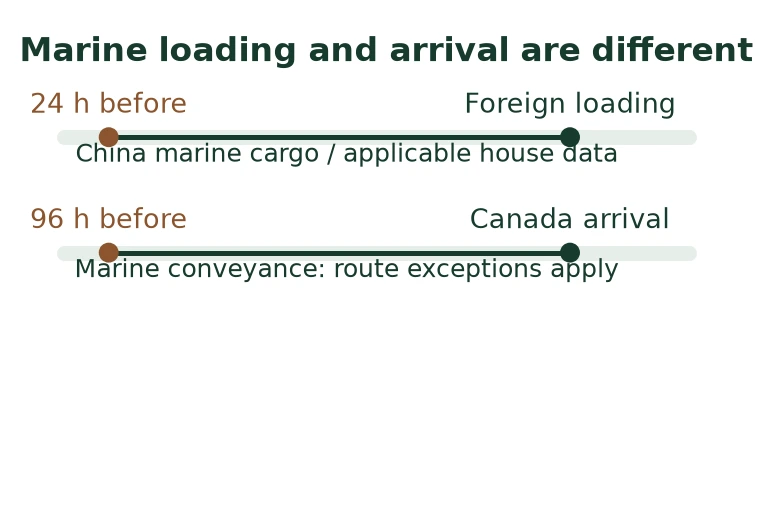
Use the exact CBSA route and voyage exceptions. Cargo, conveyance and house records do not share one universal deadline.
Pre-arrival reporting is a different clock, tied to vessel arrival rather than loading. Cargo loaded in the United States has distinct CBSA marine timing, including a 24-hour pre-arrival provision for containerized, bulk and break-bulk cargo described in the memorandum. The vessel's conveyance information has its own rule. For a short voyage whose duration is less than the stated pre-arrival period, D3-5-1 says the information must be transmitted before the vessel departs for Canada. The buyer's transport team should verify the current port pair and category with its carrier; a China-to-Vancouver shipping example cannot be copied onto a coastal feeder movement without reconsidering the clock. For marine conveyance reporting, the normal period is 96 hours before arrival at the first Canadian port, or before departure for a voyage shorter than 96 hours. The carrier keeps that conveyance receipt separate from cargo pre-load acceptance and from its PAN.
An operational schedule should show local time zones and the event used for each deadline. Write "vessel departure from named foreign loading port" or "arrival at first Canadian port," along with the carrier's booking cut-off. Avoid one ambiguous "ETA 24 hours" field. If a transshipment changes the first Canadian port or the ocean leg, the carrier should revisit the deadline and reporting reference. The exporter should send changed route facts as soon as known, but the transport parties decide the required amended transmission. The arrival estimate on an invoice is not a substitute for the carrier's voyage record.
The practical control is to freeze stable data early without pretending the whole shipment is immutable. We can confirm product identity, carton configuration, expected gross weight and parties while the lot is still being packed; then send final container and seal details after stuffing. Each message should say which data are final and which remain provisional. The carrier or forwarder should return a dated acknowledgement that ties the accepted record to the intended voyage and cargo identifier. If the carrier's data cut-off is earlier than factory stuffing, agree the update method at booking rather than discovering the conflict when the terminal closes.
| China-origin ordinary ocean example | Filer and timing event | Evidence and exception |
|---|---|---|
| Container cargo and applicable house-bill data | Carrier/forwarder: at least 24 hours before foreign loading for the non-US containerised branch. | Accepted cargo and applicable house/close linkage; changes may restart the pre-load clock. |
| Vessel conveyance data | Carrier: normally 96 hours before arrival at first Canadian port; for voyages shorter than 96 hours, before departure. | Accepted conveyance record; distinct from the ship master/agent separate PAN. |
| US-loaded cargo / bulk / breakbulk / short voyage | Check D3-5-1 and D3-3-1 category with the responsible filer. | Do not reuse the China deep-sea example as a universal deadline. |
Hand over the frozen-food facts the filers actually need
A shipment-data sheet should begin with the product, not with a generic customs code. For IQF broccoli florets, include the botanical/common identity used in the sales contract, frozen and unseasoned state, cut, consumer or bulk pack, carton configuration, country of origin as supported by the production records, net and gross weights, package count and shipping marks. If a blend includes sauce or another ingredient, disclose it instead of reusing the plain-vegetable description. The filer can then align the electronic cargo text with the invoice and packing list while the importer separately validates the tariff and food requirements.
Add physical transport references: refrigerated container number, seal number, booking and voyage, load port, Canadian discharge port, intended final delivery, and any planned transshipment. The temperature setpoint and logger details belong in the quality and transport file. They may be useful to an insurance or cold-chain claim, but they are not proof of ACI acceptance. A properly filed cargo report also does not prove that the reefer maintained the specified temperature. Keep the manifest and cold-chain evidence connected by container and lot, with distinct acceptance criteria.
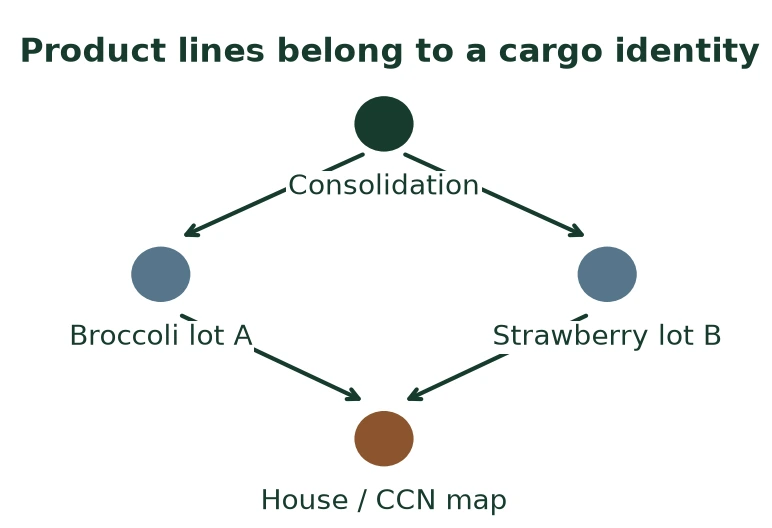
Keep the product, package and weight totals attached to their actual house and higher-level cargo records.
Ask the forwarder to return its precise bill instruction template. Shipper, consignee and notify party can differ among the commercial invoice, master bill and house bill for legitimate contract reasons. The difference must be intentional, documented and acceptable to the relevant filer and broker. If the importer of record is a separate affiliate, do not quietly insert its name as the bill consignee. Resolve naming with the buyer and the appointed broker before transmission. The controlled document set should show the reason for any expected difference so a reviewer does not mistake it for a data-entry error.
We can prepare a reconciled packet: approved invoice, packing list, lot-to-carton schedule, loading record, product specification and bill instructions. The buyer can request additional food records under its Canadian import plan. These files must be current for the shipped lot. A certificate for a previous production date or a stock photo does not verify the cartons in this reefer. If our specification changes after quotation, we update the invoice description and communicate the change to the forwarder before it affects ACI. A single controlled version should be designated for cargo reporting.
The importer can use the Canadian country guide for its food licence, preventive control, CFIA and CARM responsibilities. This shipping article does not prescribe a tariff or promise release. We instead ask the importer to confirm that its broker has the product and shipment identifiers needed to connect the release request to the carrier or house cargo record. If the importer and forwarder each hold a different CCN, the discrepancy should be investigated before arrival. A release request matched to the wrong cargo control number can remain unresolved even when its commercial invoice is accurate.
Read acceptance, linkage, arrival and release as separate receipts
An electronic submission has stages. A portal or EDI system may accept the syntax of a trade document, return a reject, or later show that its relationship to another cargo record is incomplete. The freight forwarder's FAQ explains the house bill and close message types; the carrier's and forwarder's technical message guides govern the particular statuses. Ask for the message or status that proves the record in question was accepted. A screenshot of data typed into a portal before submission is not an acknowledgement.
For a consolidation, the forwarder should confirm that the house bill is on file, its CCN is correct, the close message links the expected lower-level bills, and any outstanding "document not on file" notice is resolved. The carrier should confirm its primary cargo report and conveyance relationship. Those checks require cooperation: the carrier can have an accepted primary record while the house close is still missing. Likewise, a house bill can be accepted but tied to an obsolete primary CCN. Both parties should exchange the exact identifiers rather than search by consignee name alone.

Whole frozen strawberries: identify the actual form, packing and intended use in the shipment file. Product photograph; not evidence of a filing result.
Arrival is another event. The carrier reports or certifies conveyance arrival under the applicable marine process. The importer or broker then needs the correct release path and any food-agency permissions. Customs release, deconsolidation and physical pickup are not identical. A frozen container may need examination, warehouse movement or a CFIA decision after marine arrival. The buyer should not schedule a retailer delivery from a simple "vessel arrived" message; its broker and warehouse need to confirm the actual release and availability for pickup, while logistics maintains the reefer's power and monitoring.
The shipment file should contain a dated receipt ladder: supplier data approved, carrier cargo accepted, forwarder house accepted, close linkage complete, vessel arrival reported, broker release request status, agency hold or examination outcome, customs release, and terminal/warehouse handoff. Some steps will not apply to a non-consolidated move. Mark "not applicable" with a reason rather than filling the cell with a generic green tick. The importer can share the relevant status back to GreenLand-food without exposing unrelated account data. This gives the supplier enough information to answer document questions and support a trace-back.
The status labels have precise meanings in the CBSA Chapter 8 requirements. Accepted confirms business-rule validation of the trade document; a consolidated house bill can still be Not Matched while its close relationship is missing. Matched can indicate a lower level remains incomplete, while Cargo Complete and Document Package Complete reflect different states of the lower bills and any related pre-arrival release. A Reported status follows processing at the first port of arrival. The buyer's forwarder should provide the status history for the relevant CCN, not translate all these stages into one unqualified word "cleared."
If the CBSA sends a risk or examination notice, the filing party and importer follow its instructions. An ACI acceptance means data entered the system; it does not confer permission to discharge, release or sell food. The correct response is to retain the notice, identify the affected cargo and lot, hold any dependent movement, and obtain the responsible agency or broker's written disposition. GreenLand-food can provide specification and origin records if requested. It should not diagnose a hold from a tracking app's generic delay code or assure the buyer that the issue will clear automatically.
Correct a reject or changed document without losing traceability
Rejections should be treated as work items with an owner and deadline. Record the rejected message type, reference number, code, text, time received and exact field to be corrected. The carrier corrects its primary cargo or conveyance data; the forwarder corrects its house or close data. A supplier can correct the factual source document, but cannot make an electronic filing on another party's behalf merely by emailing a revised invoice. The filer should return the new acceptance and explain whether a linked party must update its reference.
Suppose the final carton count is 1,240 but the forwarder's house bill shows 1,204. First check the load record and invoice to establish the true physical quantity. Then ask the forwarder whether its transmitted house report, close relationship and the carrier's cargo description or totals need amendment under the current stage of the voyage. The importer and broker should check their release request. Retain the original and corrected values and the CBSA response. A corrected packing list alone leaves the electronic mismatch in place.
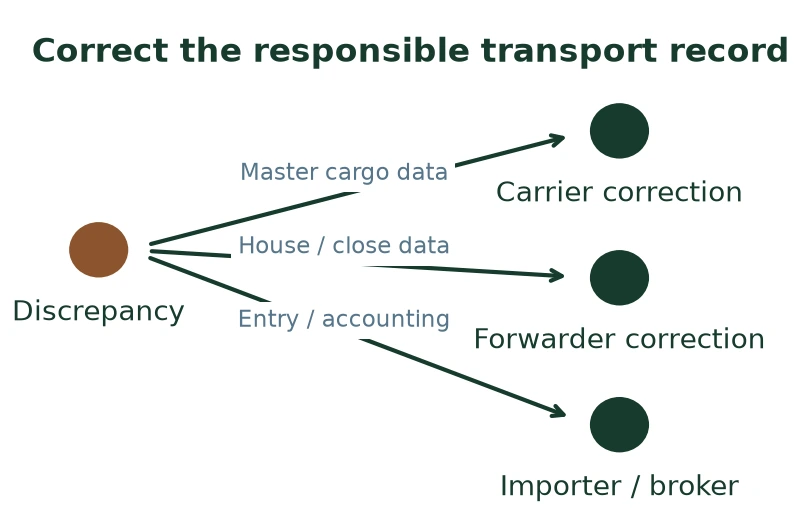
Send the before-and-after values to the actor authorised to change that record.
Some corrections near loading can affect the pre-load period. The marine memorandum says certain electronic changes restart the 24-hour clock. This is why the shipping coordinator should flag changes to shipper, consignee, bill structure, descriptions and cargo references before authorizing a late-document revision. The carrier determines whether the particular change is significant under its reporting rule and whether the load must wait. A salesperson should not promise a sailing while the filing party is still resolving a pre-load status.
Changes after arrival use different procedures. CBSA identifies a post-arrival manual amendment route for certain cargo, house-bill and conveyance data, including form BSF673 in its reporting resources. The appointed filer should check the current applicable method and submit the required evidence; it should not re-send an old pre-arrival message and assume it overwrote the legal record. Store the reason, affected CBSA identifier, supporting bill and revised receipt. The importer should confirm whether its own declaration or release request needs amendment as a consequence.
For retention, D3-3-1 requires freight forwarders to keep the source records used for electronic house-bill, close-message and supplementary submissions for three complete calendar years plus the current year of transmission. That is the forwarder's legal retention duty; GreenLand-food's sales and quality records may follow different contractual or legal periods. Ask the forwarder to preserve the bills, source instructions and status history so a later discrepancy can be explained from the exact records used. An exporter-side copy helps coordination but should not be represented as the forwarder's complete regulated archive.
For service disruptions, use the CBSA published outage and contingency instructions through the filing party. Do not substitute an unverified email address or a screenshot. The incident log should show when the problem began, whether it affected a portal, EDI provider or local data, the official direction relied upon and the eventual acceptance. Operationally, protect the cold chain while the paperwork is corrected: confirm reefer power, temperature monitoring, container location and any demurrage exposure with the buyer and carrier. Record the costs and decisions in the shipment file rather than hiding a delayed release in a revised ETA.
Apply the controls to a consolidated IQF vegetable shipment
Consider a proposed China-origin ocean reefer containing bulk IQF broccoli florets and cauliflower florets for one Canadian processor. The buyer has nominated a forwarder that will issue a house bill within a larger consolidation; a marine carrier issues the master bill. Before production release, GreenLand-food and the buyer agree separate product lines, carton pack, lot identification, labeling, net/gross weights, port pair and reefer conditions. These are commercial and quality inputs. The forwarder identifies the house-bill structure and the carrier identifies the master/primary reporting structure. The importer confirms its broker and Canadian food-import responsibilities.
At booking, the parties create the identity bridge with placeholders only for identifiers that genuinely do not yet exist. Once the carrier issues booking and bill references, the forwarder fills its house details, CCN and close plan. The supplier sends descriptive cargo text for each vegetable and a reconciled invoice/packing list. When the container is stuffed, the loading supervisor records carton totals, pallet positions, container and seal; the shipping coordinator updates the controlled packet. A second person compares the final totals and names against the draft bill instruction before the forwarder and carrier cut-offs.
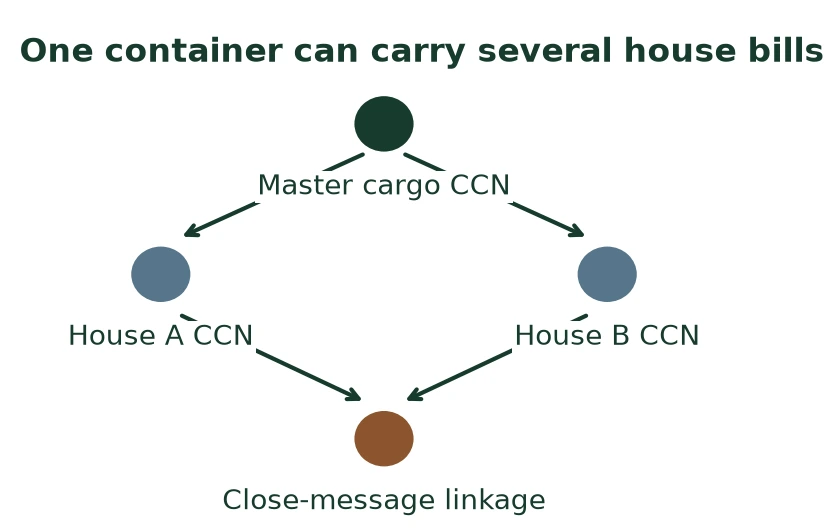
A shared container number does not merge separate house bills or establish accepted linkage.
The carrier evaluates the China-origin marine pre-load rule and sends its cargo report within the required period. The forwarder sends applicable house-bill and close data by its marine deadline. The shipping coordinator asks both for actual accepted-status evidence and checks that the house CCN and primary CCN match the intended relationship. If the status shows a missing document, the forwarder and carrier resolve it before departure. A supplier packet marked "sent" cannot close this gate. The importer receives the identifiers for its broker's release planning.
If the cauliflower lot is replaced because of a packing defect, the supplier amends the batch schedule, invoice and packing list, then tells the buyer, forwarder and carrier immediately. The filing parties determine whether electronic data need changes and whether a pre-load clock restarts. Quality separately approves the replacement lot; a changed cargo record does not approve product quality. On arrival, the importer coordinates customs and CFIA requirements and the warehouse confirms physical release, available reefer power and seal condition. The completed record keeps both the original and revised lot mapping so an inspection sample can be traced to actual cartons.
Before a quote is accepted, ask for the product form and cut, destination, quantity, carton and pallet configuration, packaging, delivery term, expected sailing, and the buyer's appointed Canadian filer and broker. We can then align a realistic production and document timetable with the parties who control the ACI messages. GreenLand-food supplies frozen vegetables, fruits and mushrooms as a China-based supplier and manufacturer for factory-direct wholesale orders. The operative promise is a clear, current product and shipment record that the authorised carrier, forwarder and importer can use to meet their own filing and release obligations.
- Buyer names carrier, forwarder, broker and importer and confirms the actual consolidation structure.
- GreenLand prepares product, pack, source and load facts, keeping package units and revisions explicit.
- Carrier and forwarder file their respective cargo, house and close records by the applicable clock and return acceptance and linkage evidence.
- Importer and broker complete release/food requirements; logistics confirms physical availability and frozen handling.
Use the existing order worksheets
Use T10 to assign each field or document to its provider, reviewer, due time and returned reference. T12 records changed source, product or transport facts; T11 preserves arrival evidence. Keep the legal deadline separate from the agreed earlier handover.
Build your frozen food order with GreenLand-food
GreenLand-food is a professional frozen food supplier and manufacturer in China, providing factory-direct wholesale supply for importers, food manufacturers and foodservice programmes.
Send your product form, specification, packing, quantity, application, destination, private-label needs and requested documents. We will organise the product and order requirements with your purchasing and quality teams.