


Mixed Berry Pie Filling from Frozen Berries: Juice and Thickening
Oct 19, 2026
Leave a message

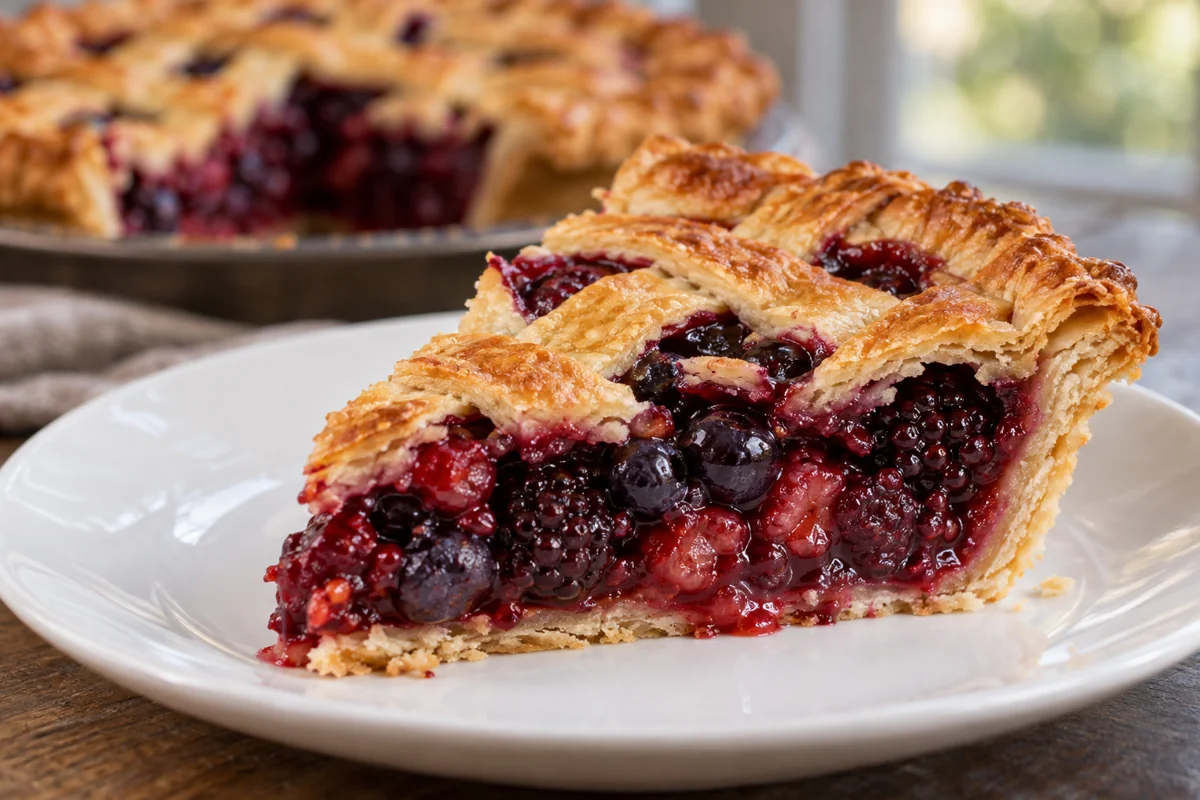
For a bakery, the useful question is how the same pie behaves when the berry lot changes. A mix rich in fragile raspberries can become a soft, continuous filling; a blend with more intact blueberries can leave more recognizable fruit. Strawberry pieces add another size and moisture variable. We recommend defining the intended slice first, then choosing the frozen fruit specification and a trial that reproduces the actual pan, filling depth, baking sequence and service conditions.
Choose the berry blend for the slice you want
The words mixed berries describe a category of ingredients rather than a fixed pastry formula. Read the ingredient list and, for a commercial order, agree the component proportions by weight. A photograph can show which fruits are present, but it cannot establish their percentages. The proposed blend should also identify whether strawberries are whole, sliced or diced and whether raspberries are whole fruit, broken fruit or a specified combination.
Those details change the mouthful. A small blueberry may remain visible within a cooked filling even when its skin has softened. A raspberry breaks into many small drupelets and can give body to the surrounding sauce. Blackberry seeds remain a sensory consideration after the fruit softens. Large strawberry pieces can dominate an individual slice and leave a different cutting surface from a blend of smaller berries. Choose these effects deliberately, with the finished pie in mind.

Raspberries, blackberries and blueberries in a mixed berry sample. Confirm component ratios and cuts for the order.
A requirement for visible fruit does not automatically mean every berry must begin perfectly whole. Some broken raspberries can suit a filling that should surround intact blueberry pieces. Conversely, paying for whole fruit offers little benefit if the process deliberately blends everything into a smooth preparation. State the desired amount and size of recognizable pieces after cooking, as well as the raw appearance, so purchasing and pastry development are evaluating the same outcome.
Sweetened fruit needs its own calculation. Added sugar in the incoming pack belongs in the total formula, along with sugar added at the kettle or mixing bowl. A substitute pack that contains syrup changes more than sweetness: it also brings liquid and changes the basis on which fruit is weighed. An unsweetened IQF blend is often easier to compare in development because the fruit and added sweetener can be recorded separately. Confirm the declaration for the actual product rather than inferring it from frost or color.
The King Arthur pie-thickener guide distinguishes berries by their juice and natural pectin behavior. That is a useful reason to revisit a formula when the blend changes. Its quantities are guidance within particular recipe assumptions; combining several fruits does not create a universal dose that can be read from a single row. Use a suitable recipe as the starting point, then document the mixed blend actually tested.
Before committing to a purchase, compare the blend in a plain cooked sample as well as in pastry. The plain sample makes seed texture, acidity and cooked aroma easier to notice; the pie shows how those properties work with fat, sugar and crust. Record both observations. An attractive frozen photograph is useful for identity, while the application sample supplies the evidence needed for a bakery decision.
Account for every portion of released juice
Frozen fruit can release substantial colored liquid as it thaws and cooks. That liquid contains fruit flavor and soluble components; it is not simply unwanted water. The first decision is whether the recipe uses all of it, drains a defined amount, or reduces a separated portion before returning it. Each route can produce a useful filling, but they create different ingredient balances and should not be mixed casually within the same trial.
For a thaw-and-drain route, record the starting fruit weight, thaw conditions, drainage time and the weight of liquid collected. Use the same sieve and handling method when comparing lots. Pressing the fruit changes the result because it removes more liquid and breaks delicate pieces. A sample left draining while another task is completed will also differ from one removed promptly. The word drained needs an operational definition if the number will influence price or formulation.
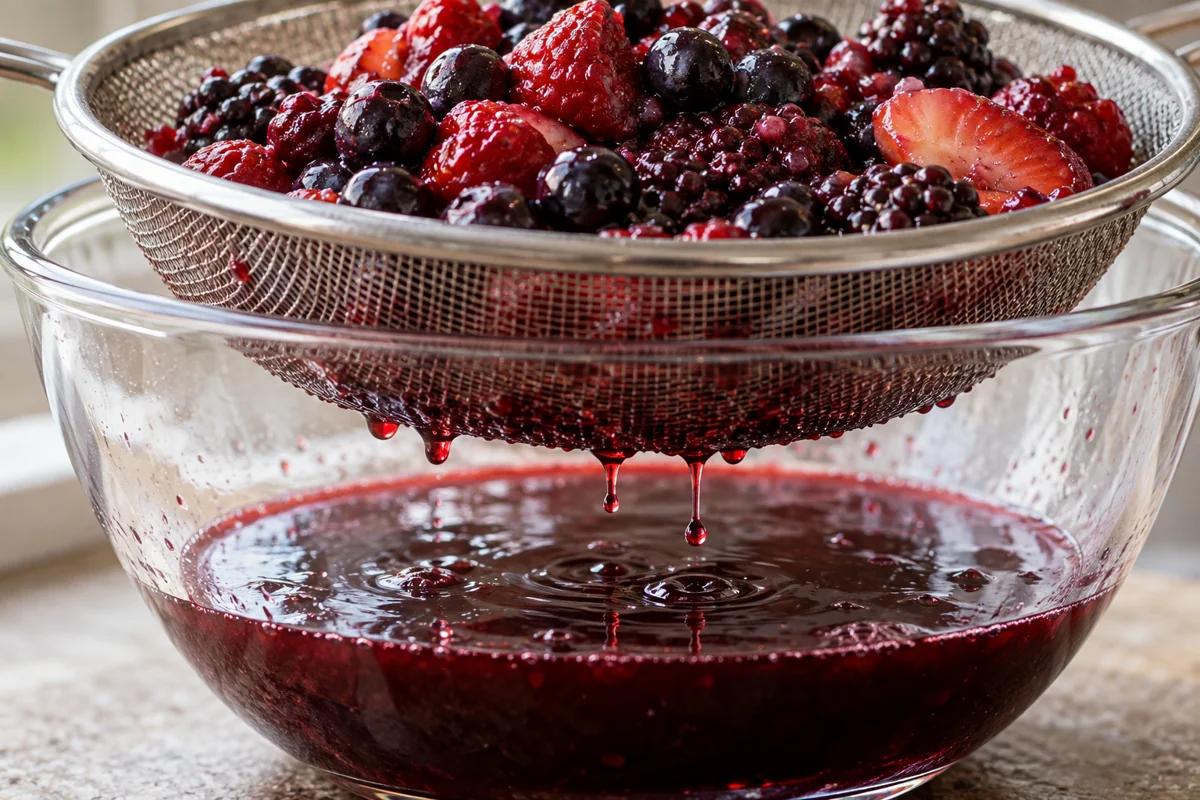
Released berry juice collected below a strainer.
Suppose a development sample starts with 1,000 grams of frozen berries and a chosen method separates 160 grams of juice. The remaining fruit weighs approximately 840 grams before other losses. These are illustrative numbers, not an expected yield. Adding a formula quantity of starch to 840 grams of drained fruit creates a different filling from adding it to the original fruit plus all 160 grams of juice. Record which basis the recipe uses before comparing results or scaling the batch.
Reducing the collected juice can preserve more berry flavor than discarding it, while removing some water through evaporation. Record the weight before reduction and after reduction, then the amount returned to the fruit. A darker syrup is not by itself a measured endpoint. Excessive reduction may produce a cooked flavor or a sticky filling, so the final pie still needs sensory assessment. If the juice is used elsewhere, give it its own handling plan rather than leaving an untracked by-product on the bench.
The thawed-fruit approach shown in King Arthur's mixed berry pie is one practical recipe route. Other formulas begin with frozen berries and manage their liquid during cooking. Choose a complete method whose assumptions fit your operation. Changing from frozen addition to a long thaw while keeping every other instruction unchanged can alter the amount of free liquid present when the filling enters the crust.
For production purchasing, ask for a sample that represents the proposed pack and lot. A small hand-selected bowl may contain fewer fragments or a different berry balance than material drawn from a large bag. Take portions from several positions under an agreed sampling method. If the observed juice release changes, first check the measurement method, component ratio and handling history before changing the thickener. That sequence helps avoid correcting a process difference with an unnecessary formulation change.
Match the thickener to the filling process
A thickener needs to work through mixing, baking, cooling and any later frozen storage. Begin with the ingredient named in the selected recipe. All-purpose flour, cornstarch, tapioca products and modified starch products differ in concentration, hydration behavior and finished appearance. Similar looking white powders are not interchangeable measures, and different products sold under a broad starch description can require different handling.
Cornstarch is familiar in cooked berry fillings. A smooth slurry can help distribute it through liquid, while some recipes disperse starch with the sugar before combining it with fruit. Follow the route appropriate to the recipe and starch. Adding a mound of dry starch directly into a hot, wet filling can create unevenly hydrated lumps. More stirring may then break the fruit without correcting the centers of those lumps. Good distribution starts before the thickening stage.
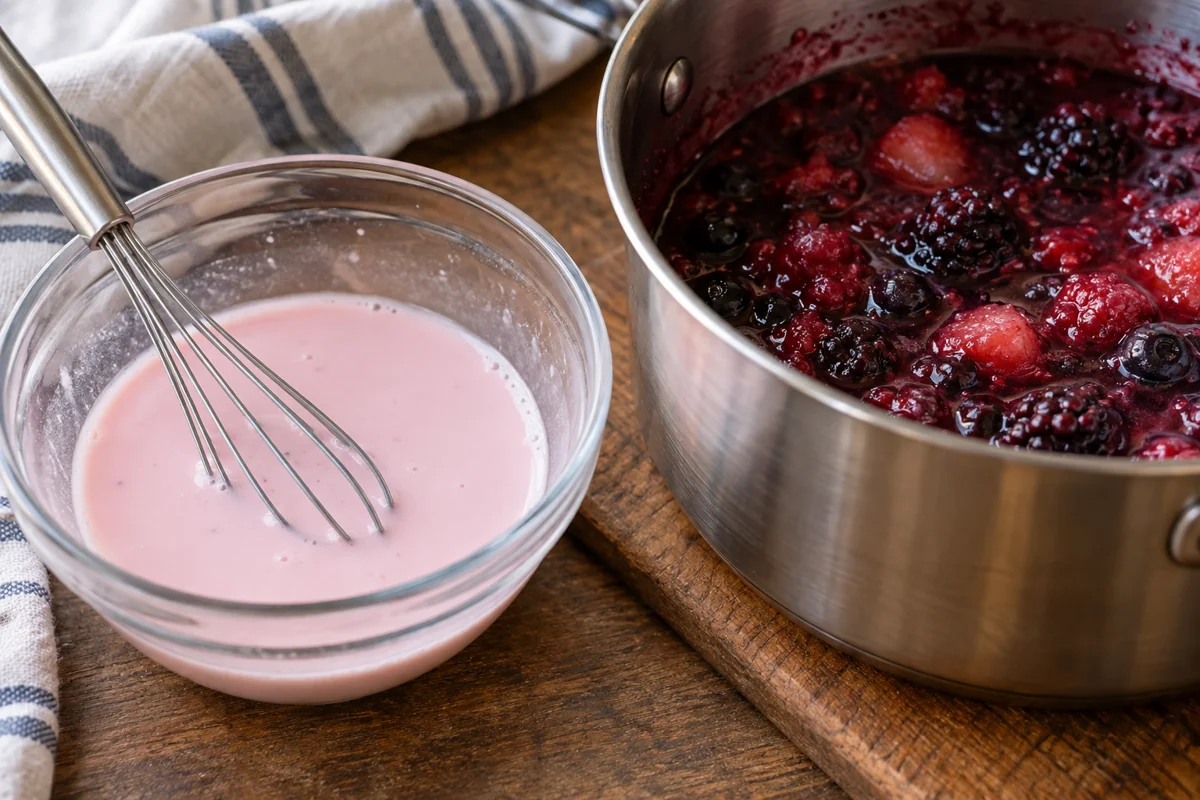
Smooth starch slurry beside mixed berry filling.
Flour can give a softer, more opaque result and contributes components beyond starch. Quick-cooking tapioca has its own preparation requirements and can leave a perceptible texture. An instant modified starch and a cook-up modified starch should be identified by their exact product descriptions. If a supplier proposes a replacement, request the application directions and compare it in the complete pie. A viscosity claim in water does not establish its behavior in acidic berry filling under your baking conditions.
| Thickening choice | Useful question | Trial observation |
|---|---|---|
| Recipe-specified cornstarch | Was it evenly dispersed and cooked as directed? | Lumps, cooled slice structure and mouthfeel |
| Flour-based filling | Does the opaque texture suit the pie style? | Flavor and softness after cooling |
| Quick-cooking tapioca | Was its specified hydration step followed? | Granule perception and filling texture |
| Application-specific modified starch | Is the exact grade suitable for the process? | Performance through baking and any freeze-thaw cycle |
The comparison is a way to organize a trial, not a substitution table. Keep the fruit, sugar, liquid balance and filling depth constant when assessing one thickener change. If the test simultaneously removes juice, reduces sugar and increases starch, a firmer slice will not reveal which change caused the improvement. An initial screening can be simple, but the final choice should be repeated in the intended recipe and service sequence.
Avoid judging success only by firmness. A very stiff filling may cut neatly yet feel pasty, hide berry flavor or pull away from the pastry. A softer filling may suit a plated dessert served with a spoon. Define a target that includes slice shape, fruit visibility, juiciness and eating quality. For a product sold chilled, examine the chilled slice; for a warm service pie, evaluate the defined reheated portion. The same starch system may look acceptable in one condition and disappointing in another.
Choose a raw-filled or pre-cooked route
In a raw-filled route, the fruit and thickener mixture develops its final structure during baking. This can preserve a less processed fruit character, but the pastry and filling have to reach their intended condition together. Frozen centers, filling depth and oven loading all affect that relationship. Use a recipe designed for the fruit state and pan size. A larger or deeper pie needs more than an assumption that the familiar bake time will still work.
A pre-cooked route lets the baker observe juice release and thickening before the filling enters the crust. It can be useful where the blend varies or a dense filling is difficult to heat evenly in pastry. The extra handling also introduces opportunities for fruit breakdown, evaporation and temperature variation at filling. Record the cooked filling weight and its condition when deposited. A batch that sits uncovered while another batch is used immediately may no longer be equivalent.

Pre-cooked mixed berry filling with retained berry pieces.
Sally's triple berry pie uses a pre-cooked filling and reserves some berries to add later for texture. This is evidence for that recipe's method, rather than proof that every mixed berry pie requires pre-cooking. If a similar strategy is used in development, specify which berries are reserved, their weight and the stage at which they enter the process. The finished filling must still follow the full cooking and handling method.
A practical development sequence is:
- Fix the berry blend, ingredient weights, pan dimensions and intended service condition using a suitable base recipe.
- Prepare one reference batch exactly as written, recording fruit state, liquid handling and filling weight.
- Change only the proposed process variable, such as the defined pre-cook route, while documenting any unavoidable evaporation difference.
- Bake with the same oven load and record the filling observations as well as crust appearance.
- Cool and evaluate both pies at the same defined point, then repeat the preferred method before approving it.
This is a proposed comparison, not a record of completed GreenLand trials. It gives a bakery a manageable way to separate the effect of the fruit from the effect of the method. At production scale, the same principle applies even though the equipment changes. A wide saucepan loses water differently from a deep vessel. Heating rate, agitation and exposed surface area can change the cooked filling weight and the amount of recognizable fruit remaining.
Keep intermediate handling explicit. A cooked filling prepared in advance requires an appropriate cooling and storage procedure within the operation's food-safety plan. Quality observations such as gloss, thickness and aroma do not validate that procedure. The supplier's raw berry instructions and the bakery's finished-product process have separate roles. Resolve both before using a development result as a production instruction.
Read the filling as well as the crust
Pastry color is easy to see, so it often becomes the signal to remove a pie from the oven. The filling is less visible and can lag behind the crust, especially in a deep pie or one loaded with frozen fruit. Look through the vents or lattice at the center as well as around the edge. Follow the recipe's filling cues and baking conditions; a browned rim does not prove that the middle has reached the intended state.
The Kansas State Extension fruit-pie guidance highlights bubbling in the center as a practical cooking observation. It is useful for understanding why edge activity alone can mislead. It is not a universal microbiological validation or a replacement for a commercial process specification. If temperature is part of the bakery's controlled method, define the probe location and use the relevant validated procedure rather than borrowing a number from an unrelated pie.
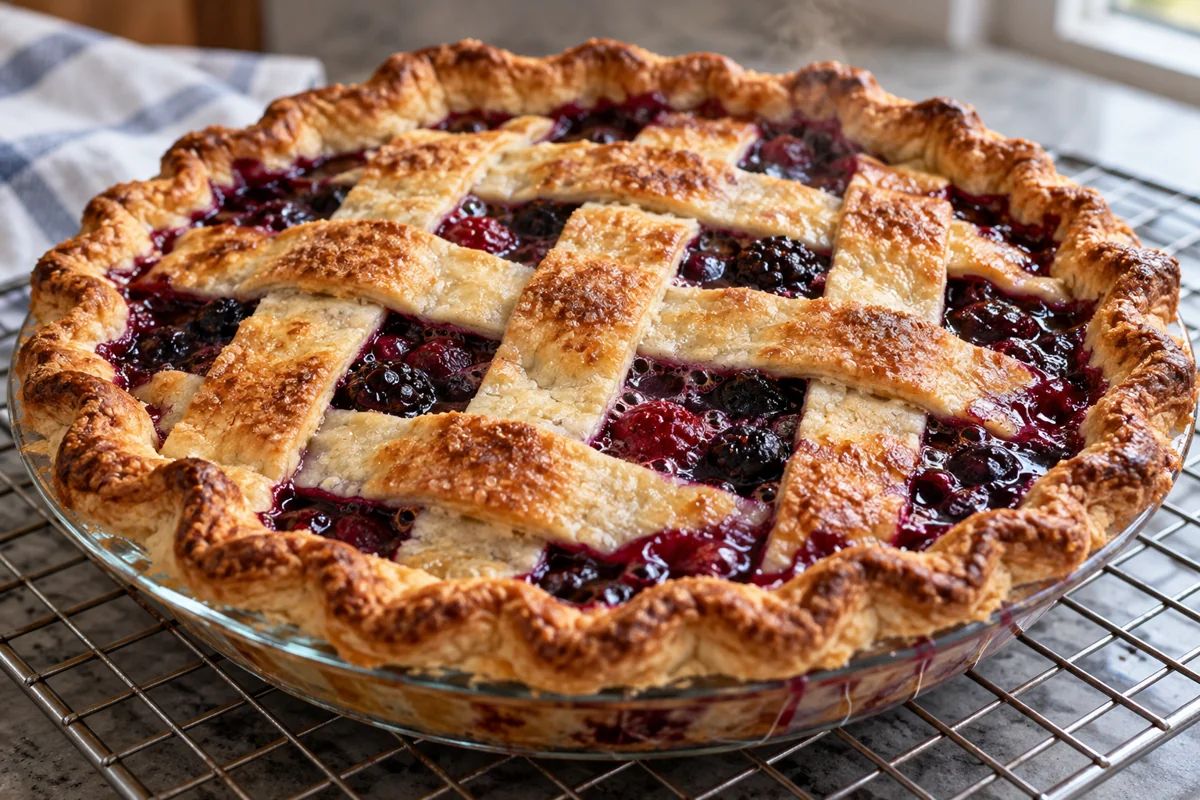
Berry filling bubbling through the center of a baked lattice pie.
When the crust darkens before the filling is ready, investigate oven conditions, pan position, crust protection and the selected recipe. Adding more thickener to the next batch may make the cooled filling firmer while leaving the underlying heating mismatch unresolved. Likewise, making a shallower pie can alter the result without saying anything about the berry quality. Keep the geometry and load visible in the trial record so a successful result can be reproduced.
The top crust influences evaporation. An open lattice exposes more filling than a nearly closed top with a few small vents. A crumb topping creates another surface and absorbs some moisture. These formats should be evaluated as separate products, even when they share the same berry blend. A formula approved in a lattice pie may require development before it is used in a sealed turnover or a small tart shell.
Observe the base after cooling and cutting. Its underside can reveal whether the pastry baked as intended, while the upper surface shows contact with the fruit. A wet layer at that interface may reflect liquid migration, insufficient base baking, filling condition at assembly or extended holding. Describe the location and appearance rather than recording only soggy. That detail makes the next trial more focused and helps distinguish pastry handling from fruit formulation.
A bakery comparing multiple lots should also control oven loading. A single pie baked in an otherwise empty oven is not directly comparable with a full production load. Record the number of pans, spacing and loading sequence for the application trial. These details may seem distant from a berry purchase, but they determine whether the approved sample result is a meaningful predictor of the actual finished product.
Evaluate the cooled slice and its holding behavior
The hot filling is still changing as the pie cools. Cutting immediately can release liquid and collapse a slice that would hold together later. Set a defined cooling and evaluation schedule appropriate to the product and handling plan, then apply it consistently. If a bakery sells chilled slices, use that condition for the main assessment. A photograph taken while a pie is hot answers a different question from the slice a customer receives.
Begin with the cut face. Look at the distribution of whole berries and fragments, the thickness of the surrounding sauce and the way the filling meets the bottom crust. Place a defined slice on the same type of plate for each comparison. After an agreed interval, note any liquid around the base and whether the slice has spread. An image with consistent lighting and scale can make these differences easier to discuss with the supplier and pastry team.
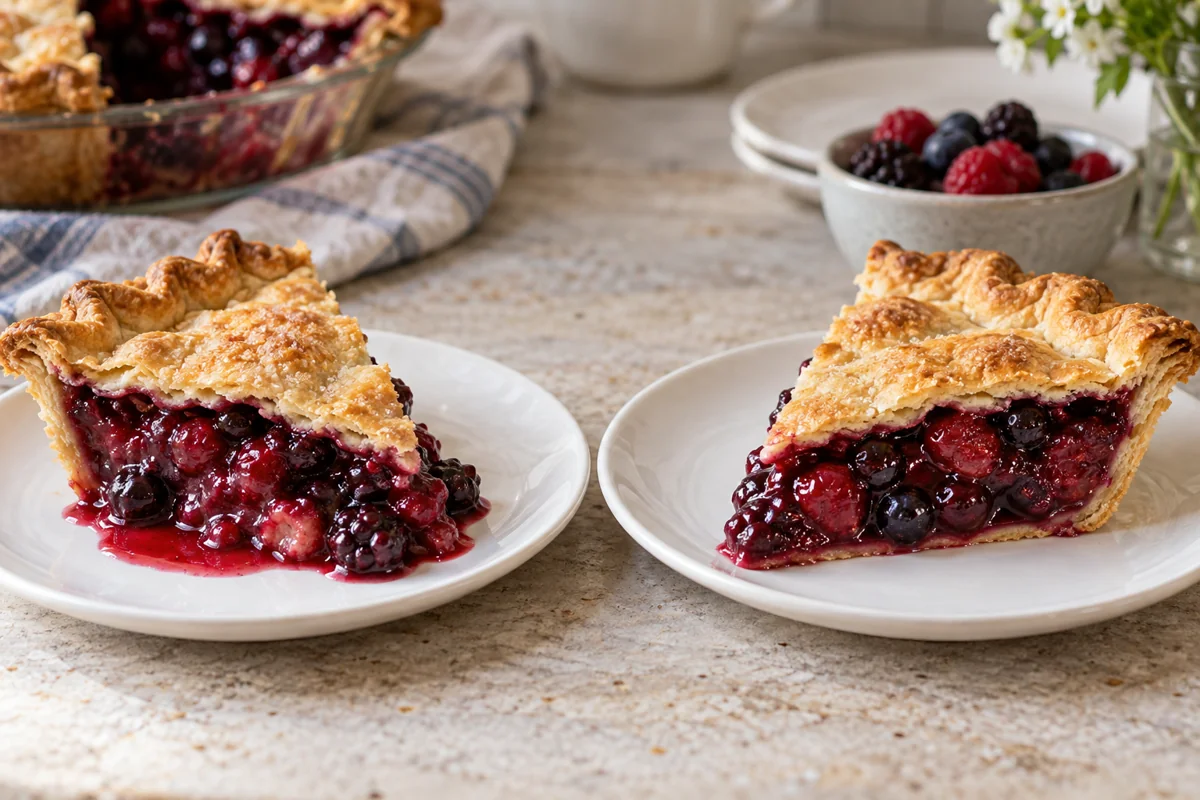
Two pie slices showing different levels of released liquid.
The amount of free liquid should be interpreted alongside mouthfeel. A completely dry plate is not automatically the best result if the filling is heavy or gummy. The target might allow a small amount of berry juice while requiring the slice to remain presentable. Write that preference before comparing samples. Otherwise, one reviewer may reward firmness while another rewards juiciness, and their scores will seem inconsistent even though they are evaluating different goals.
Holding can reveal changes that are absent at the first cut. Assess the product at the points relevant to the sale: after cooling, after the intended chilled hold, and after any planned reheating. If the business freezes finished pies, include the actual freezing, storage and thawing sequence in development. One successful fresh bake does not establish performance through a later freeze-thaw cycle. The thickener supplier's application information can help select candidates, while the finished-product trial supplies the evidence.
Use a small defect vocabulary that describes observable conditions. Separate loose liquid, uneven thickening, broken fruit, excessive stiffness, wet base and flavor changes. These can have different causes and need different corrective work. A catch-all score such as poor quality hides the information that would make a supplier discussion useful. Keep a reference sample or agreed photographs where practical, together with the exact preparation record.
The frozen-versus-fresh baking comparison from King Arthur reinforces the importance of the application rather than a broad claim that one fruit state always performs better. For mixed berry pie, the commercially useful approval is the complete combination of blend, formula, process and service condition. Reopen that approval when one of those elements changes materially.
Specify berries against an agreed bakery trial
The purchase specification should make it possible to recreate the approved filling. Name the berry components, their agreed proportions, product forms and relevant size limits. Include the acceptable level of broken fruit where it affects texture. Define added-sugar status and any permitted substitutions. A supplier should not have to infer whether a different strawberry cut or an altered raspberry proportion will be acceptable in the buyer's pie.
Sampling should reflect the commercial pack. A bakery using part of a large bag at a time needs to know whether components remain reasonably distributed through that bag. A processor emptying whole bags may have a different concern. State the portion size used in the approval trial and how the sample is drawn. The same overall blend can produce different individual pies if small berries settle and larger pieces remain near the top during handling.

Mixed berries with strawberry pieces on a sorting surface. Confirm component ratios and cuts for the order.
Discuss packing in terms of the operation. Confirm inner-pack weight, carton format, storage instructions and how opened packs will be managed. Agree the expected order quantity, destination and delivery timing early enough to assess available stock and crop transitions. A new crop or replacement component may justify a fresh application sample even when the product name remains the same. Treat continuity as an agreed specification and review process, rather than a promise that fruit never varies.
Documents should answer the buyer's actual requirements. Confirm ingredient identity, traceability, declared storage conditions, applicable microbiological criteria and the requested lot documentation. If a thaw-drip limit or fruit-piece recovery criterion is important, define the method and acceptance basis. Do not compare numbers generated by different sample preparation or drainage procedures as if they were equivalent. A commercial certificate and a pastry performance trial provide different kinds of evidence.
For a quote, we ask buyers to connect the frozen mixed berry specification with the intended pie: pan size, fruit load, whole-piece expectation, thickener system, frozen or thawed addition, and the point of sale. Those inputs help us discuss the appropriate raw fruit and sample scope. Final formula approval and the bakery's process validation remain with the team producing the finished pie.
Keep the approval record short enough to use. It should identify the accepted sample lot, exact blend and cut, trial formula revision, liquid-handling method, bake conditions and cooled-slice criteria. Add who can authorize a substitution and what change requires another trial. That record gives purchasing a practical reference when a later lot looks different, and gives the pastry team a way to explain whether the difference matters to the product it actually sells.
Related reading
Strawberry Pie Filling with Frozen Strawberries
Compare a strawberry-only filling with the mixed-berry juice and slice decisions here.
Can You Bake With Frozen Strawberries? Pie, Cake & Muffin Tips
See how strawberry cut and thaw state change other baked applications.
IQF vs Block Frozen Strawberries: Buyer's Guide
Review the raw-fruit format before choosing how a bakery will weigh and handle it.
Source frozen mixed berries with GreenLand-food
GreenLand-food is a professional frozen mixed berries supplier and manufacturer in China, providing factory-direct wholesale supply for importers, food manufacturers and foodservice buyers.
Send the berry components, product form, specification, packing, quantity, application, destination, private-label needs and requested documents so we can discuss an appropriate supply brief and sample.