


Making Smoothies with Frozen Mixed Berries: Blend Ratio and Texture
Oct 19, 2026
Leave a message

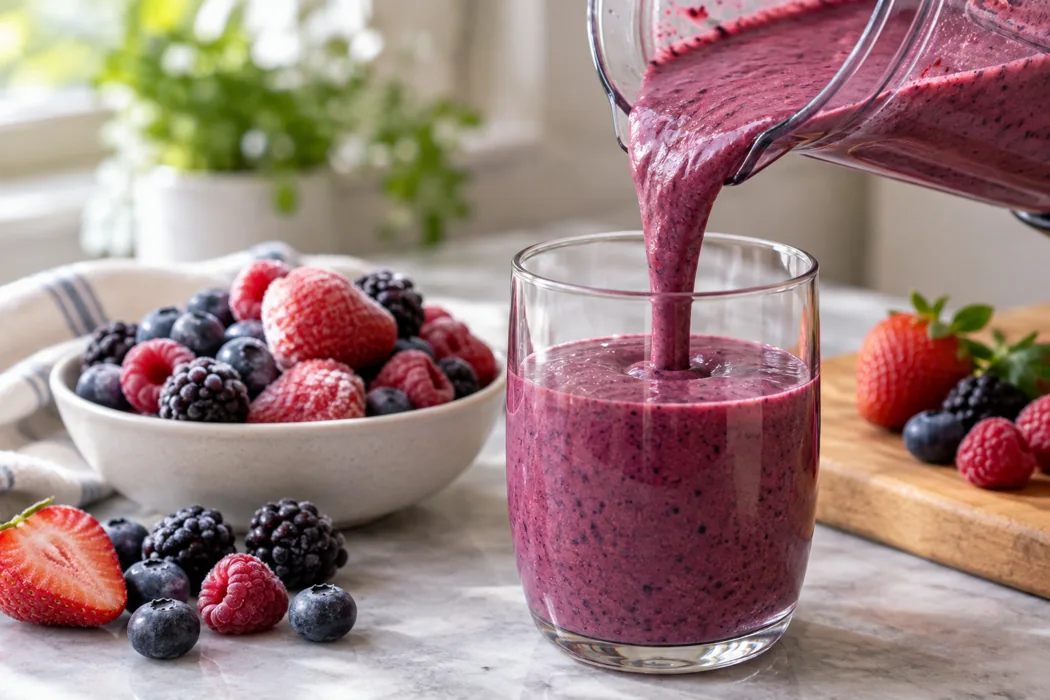
There is no single fruit-to-liquid ratio that works for every berry blend and machine. Large strawberry pieces, a high proportion of seedy berries, different starting temperatures and thick plant drinks can all change the result. First confirm that the berries are suitable for the intended cold use, then define whether the target is a drink through a straw or a spoonable bowl. The trial method below helps buyers and foodservice teams turn that target into a useful ingredient specification.
Separate the berry ratio from the liquid ratio
The blend composition determines the fruit character before the blender is switched on. Strawberry, blueberry, raspberry and blackberry contribute different aromas, colors, structures and seed characteristics. Two bags carrying the same broad mixed-berry name may therefore produce different drinks even when the same total fruit weight and milk quantity are used.
Write the internal berry formula as percentages by mass when that information is available. For example, a development brief could propose a strawberry-led blend and compare it with a blend containing more dark berries. The percentages should be agreed through tasting and performance trials; an illustrative formula is not evidence of a standard commercial recipe. Keep the component forms in the record as well as their proportions.
The second ratio concerns the whole drink. State the berry mass, added liquid and any banana, yogurt, puree or other ingredients. A formula described only as "two parts fruit to one part liquid" can hide a large quantity of yogurt or frozen banana, both of which affect the final body. Include every ingredient in the trial sheet so that a later operator can reproduce the same mixture.

Raspberries, blackberries and small dark berries in a GreenLand-food product photograph; the image does not specify an order formula.
Liquid identity matters as much as its amount. Water, juice, dairy milk and plant drinks have different flavor and composition. A thick oat drink is not necessarily equivalent to a lighter almond drink at the same volume. Sweetened yogurt and juice can also change the perceived berry balance. Use the same ingredient versions when comparing fruit lots, then evaluate substitutions separately.
Temperature creates another variable. A fully frozen fruit dose brings a different amount of ice into the blender from the same fruit after partial thawing. The water is still present, but its physical state has changed. A drink made with softened berries can therefore flow differently without any change in the weighed formula. Record the starting state and handle it consistently.
The GreenLand-food mixed berry product page is a useful route for discussing the component list and form. When requesting a sample, describe the intended beverage, blender type and whether the fruit will be used through an approved ready-to-eat route or a prepared base. Those details help make the sample test relevant to the finished drink.
Keep the first comparison simple. If fruit ratio, milk, sweetener and blend time all change together, the team cannot identify which adjustment improved the drink. A controlled trial changes one main variable at a time while holding the others steady. This approach creates practical knowledge about the particular blend instead of producing a collection of recipes that cannot be compared.
Use weight to build a repeatable starting formula
Weight is useful because berry pieces occupy volume unevenly. One cup of strawberry pieces does not have to weigh the same as one cup of blueberries, and a scoop from a mixed bag may contain a different combination each time. Even Vitamix's triple berry recipe lists different gram weights for equal cup measures of its three berries. That recipe is designed for its stated equipment; the broader lesson is to preserve the actual mass in a repeatable formulation.
A proposed bench trial could begin with 200 grams of approved mixed berries, 120 grams of a chosen liquid and 60 grams of plain yogurt. Treat this as a development starting point, not a universally tested recipe or a production specification. The blender's permitted load, ingredient instructions and desired serving style may require another starting point. Confirm that the machine can process the quantity safely before running the trial.
Weigh each ingredient into the trial record and note its condition. Identify the yogurt type, the liquid and whether any banana is fresh or frozen. A ripe fresh banana can add body and sweetness without contributing the same ice fraction as a frozen banana. Leaving that distinction out can explain why two operators obtain different textures from an apparently identical recipe.
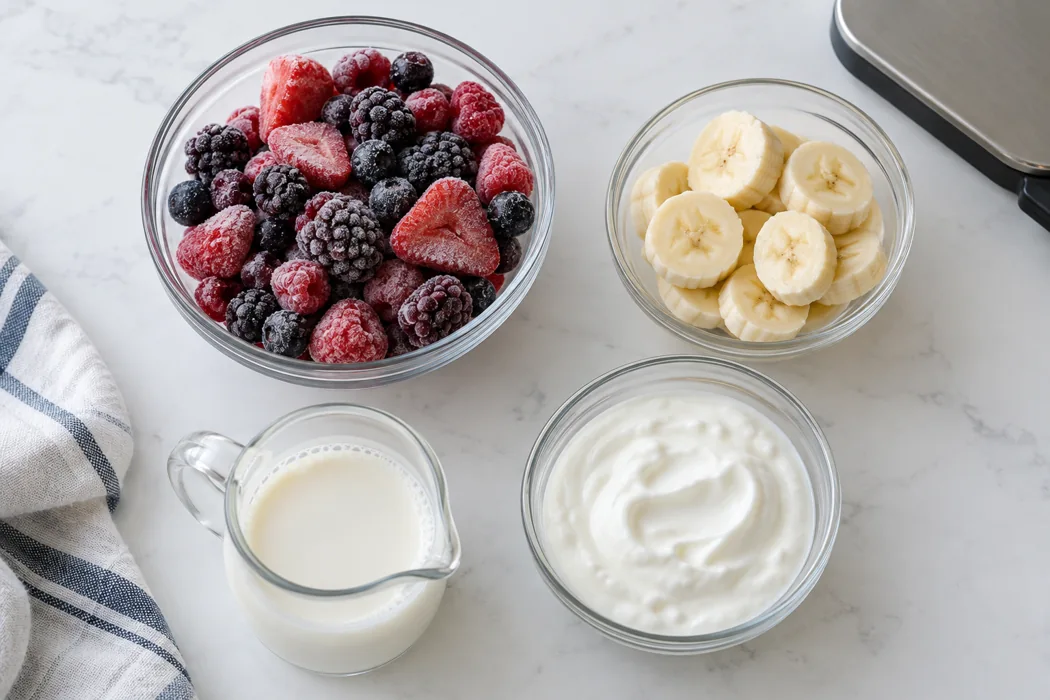
Weighed fruit, liquid and body ingredients make a repeatable smoothie trial.
Use a small set of deliberate variants. Hold berry and yogurt weights constant while adjusting the liquid in modest measured steps. The following figures are illustrative trial designs, with no claim that the outcomes have been tested.
| Trial | Mixed berries | Liquid | Plain yogurt | Question being tested |
|---|---|---|---|---|
| A | 200 g | 100 g | 60 g | Can the equipment circulate a thicker starting mix? |
| B | 200 g | 120 g | 60 g | Does the drink flow at the intended service texture? |
| C | 200 g | 140 g | 60 g | Does easier pouring dilute the desired fruit character? |
The comparison should include both texture and flavor. More liquid can solve circulation while weakening the berry impression. A thicker drink can appear attractive yet be awkward to serve through the chosen straw. Select the result that fits the product promise and service conditions, rather than assuming the thickest sample is best.
Record the total prepared mass and recoverable yield. Some smoothie remains on the jar and blades, and an aerated drink can occupy more apparent volume without containing more ingredient mass. If the business sells by cup size, assess both filling consistency and actual yield. Multiplying a recipe's stated servings without measuring the result can distort cost and nutrition calculations.
Once a preferred small formula is found, repeat it before scaling. Use the same ingredient state, jar, load and cycle to see whether the result is dependable. A single attractive glass is a development observation. Repeated trials with representative berry lots provide a stronger basis for deciding whether the formulation is suitable for routine service.
Choose fruit form and frozen condition for the blender
The blender needs to move ingredients into the cutting zone. A loose mix of suitable pieces can circulate differently from a compact frozen block. Large strawberry halves can bridge above a narrow blade area, while small fragments may move readily but contribute more exposed surface and loose fines. Match piece size and free-flowing condition to the actual equipment.
Follow the manufacturer's loading instructions for the particular machine. The appropriate sequence can differ between a conventional upright jar, an inverted personal cup and an immersion blender. Advice copied from another design may place the liquid away from the active blade area. Keep the equipment's minimum and maximum fill requirements in the procedure as well.
Do not force a stalled machine to continue. Stop it before checking or redistributing ingredients, and use only accessories and methods approved by the manufacturer. A tamper is appropriate only where the blender is designed for it. Improvised utensils inside a running jar introduce a separate hazard and do not solve the underlying formulation problem.
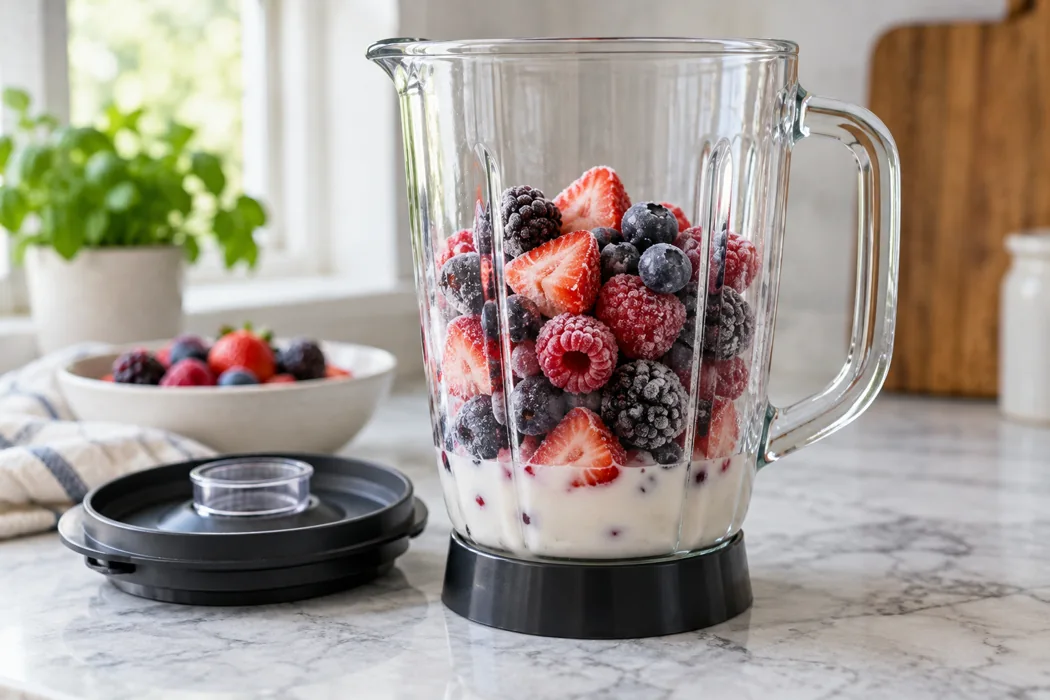
Loose pieces and appropriate loading help the blender draw fruit toward the blade.
If the fruit does not circulate, first identify whether the cause is the load, piece size, a trapped air pocket or insufficient mobile liquid. A measured small addition of liquid can help test the last possibility, but record it. An operator who adds an unmeasured splash every time gradually changes the formula and makes the supplier's ingredient performance difficult to assess.
Clumping should be addressed at receiving and storage as well as at the blender. A hard fused mass may signal handling history that deserves investigation against the specification. Breaking it aggressively can produce fine fragments and still leave oversized pieces. Agree the accepted frozen condition and the response to an unsuitable pack rather than relying on staff to improvise each time.
Whole, cut and puree forms each offer a different operating route. Cut strawberries may dose more evenly in a berry mix. A prepared puree can simplify dispersion but changes pack access, thawing, seed specification and the amount of ice in the drink. Compare the forms through the actual process, including labor and recovered yield, before selecting one only on price per kilogram.
The existing frozen strawberry smoothie guide discusses single-fruit size and blending behavior. A mixed-berry program adds component segregation: small berries and fragments may distribute differently from large strawberry pieces during storage and scooping. Test the dispensing method as part of the beverage system so each drink receives a representative fruit portion.
Adjust thickness without losing berry character
Begin with a clear texture target. A drinkable smoothie should move through the chosen serving format without excessive effort. A smoothie bowl can hold a spooned surface and toppings, but the machine must still be able to process it within its intended use. These are different products and should have separate approved formulas if both are sold.
When a drink is too thin, review the cause before adding more frozen material. The fruit may have warmed, the liquid dose may be high, or the yogurt may differ from the approved type. Extra fruit can increase thickness while also changing portion size, cost and flavor. Correct the source of the variation where possible, then evaluate any deliberate recipe revision.
Additional ice changes more than temperature. As it melts, it contributes water without berry solids or flavor. It may be useful in a specifically designed drink, but it should be weighed and included in the formula. Using ice as an unrecorded correction can produce an initially thick drink that becomes weak during service.
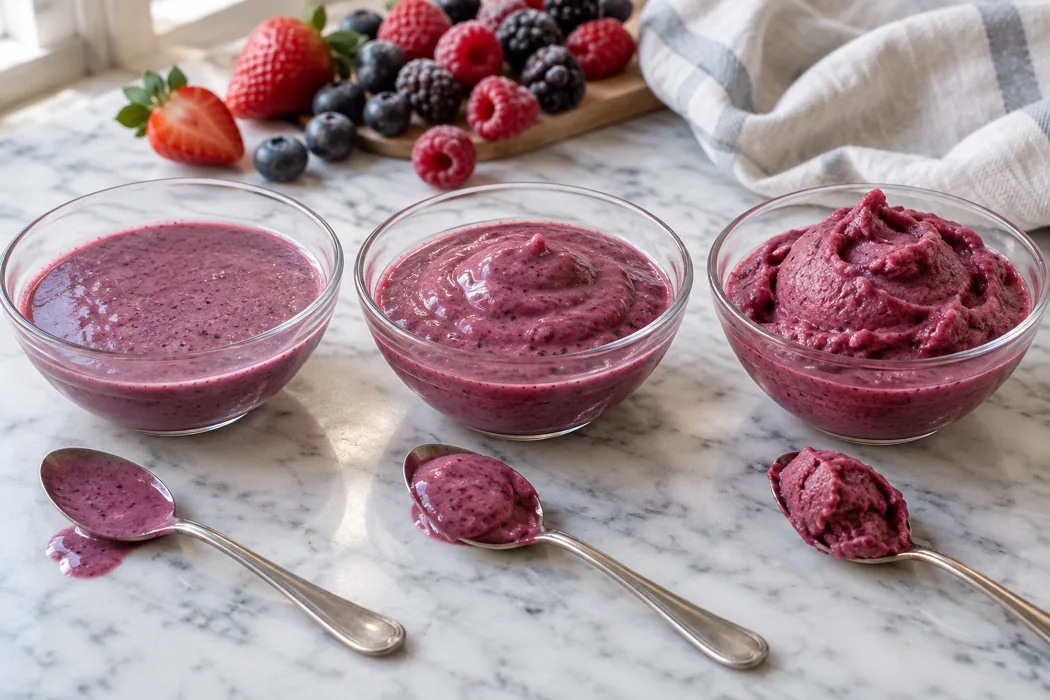
A drinkable smoothie and a spoonable bowl need different texture targets.
Banana and yogurt contribute body through their own composition and structure. They also change flavor. Increasing banana can soften perceived tartness but move the drink away from its intended berry character. A stronger yogurt flavor can compete with delicate fruit aroma. Choose the amount through tasting at the intended serving temperature, rather than treating either ingredient as a neutral thickener.
Powders, oats, seeds and other additions deserve their own trials. They can absorb liquid, contribute particles or change the texture over time. A drink that pours well immediately after blending may thicken later as an ingredient hydrates. Keep any such addition in the complete recipe and assess the realistic time between preparation and consumption.
Sweetness and acidity should be judged together with dilution. More liquid may reduce both the intensity of tartness and the overall berry flavor. Adding sweetener may balance taste but does not restore fruit aroma lost through excessive dilution. Taste the approved fruit blend first through the intended safe route, then make the smallest deliberate recipe change that achieves the product target.
For commercial development, use a repeatable observation such as a defined pour test, a consistent spoon assessment or an appropriate instrumental measurement. Describe the method and sample temperature. A label such as "creamy" is useful sensory language, but it is too broad to explain why one lot passes and another fails. Keep a reference sample or clear agreed description where practical.
Control seeds, foam and separation
Berry seeds and skin fragments can remain perceptible after blending. Their presence depends on the component mix, fruit form, equipment and process. A longer blend may reduce some particle perception, but it cannot be assumed to eliminate all seeds. Approve the mouthfeel through the actual machine and serving format, especially for customers who expect a very smooth drink.
Changing the ratio of raspberry or blackberry can change seed perception even if the drink's color remains attractive. A blend selected for visible whole-fruit use may therefore differ from the preferred beverage blend. Specify the final texture requirement and test it, rather than treating a premium whole-fruit grade as a guarantee of smoothness.
Straining is an option for some beverage bases, but it removes material and adds a processing step. Use a defined screen and record the recovered mass. A fine screen can improve smoothness while reducing yield, and the discarded fraction affects the composition of what remains. Compare cost on usable finished base, not only the purchased fruit weight.
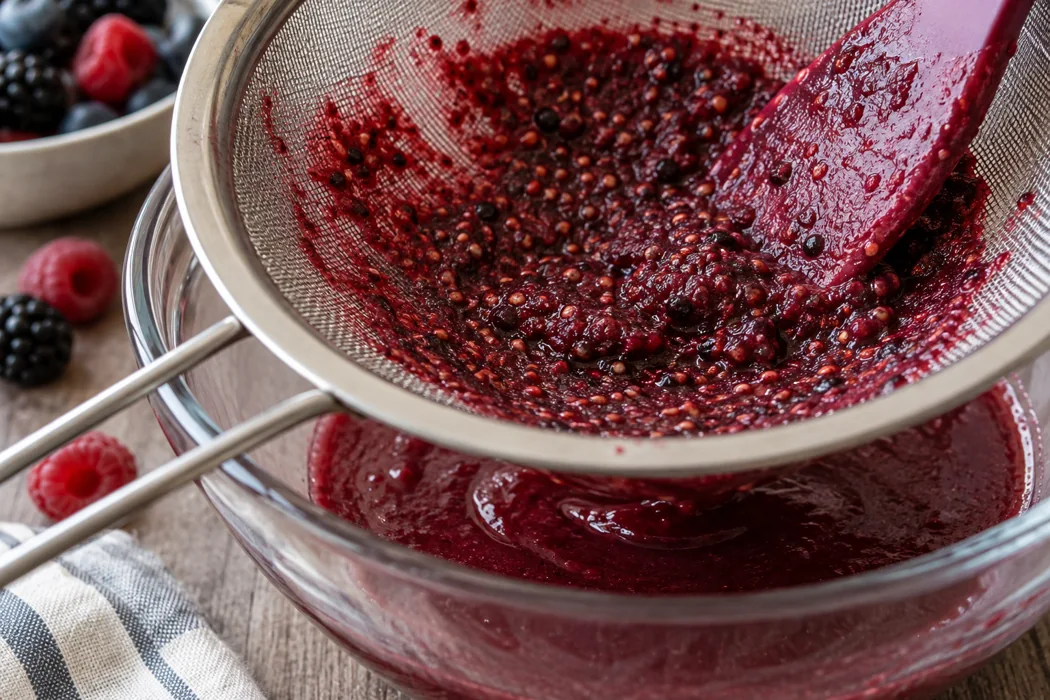
Removing seeds changes both mouthfeel and recoverable yield.
Foam can complicate portioning. Air incorporated during blending may increase the apparent volume and produce a lighter top layer. A cup filled immediately can settle differently from one filled after a short wait. Keep the fill procedure and assessment point consistent so that apparent volume is not mistaken for additional product.
Blending time can also affect temperature and texture. Continuing well beyond the point needed for circulation and particle reduction can warm the mixture and change the amount of remaining ice. The useful cycle is the one that produces the approved result within the equipment's limits. Record its conditions rather than assuming that longer is always better.
Separation should be assessed at the expected service interval. A smoothie can look uniform when poured and develop a liquid layer later. The extent depends on the complete formula, temperature, particle distribution and handling. A photograph taken immediately after blending cannot establish stability for delivery or extended holding.
Use a simple comparison trial to distinguish causes. Prepare the same formula with controlled ingredients, fill identical containers and inspect at defined times under the approved holding conditions. Record any layer formation, foam change and sensory difference. This is a proposed method, not a test performed here. If the intended service requires longer stability, the formulation and process need development for that requirement rather than an unsupported promise that all mixed berry smoothies remain uniform.
Match the safety route to a cold drink
A smoothie often has no cooking step after the berries enter the jar. The ingredient must therefore be suitable for that intended use under the relevant supplier approval and food-safety plan. IQF describes a freezing approach; it does not establish a validated treatment that makes every berry product ready to eat.
Follow the actual product's preparation instructions and applicable local advice. The Food Safety Authority of Ireland recommends boiling imported frozen berries for one minute before consumption. That advice has a specific scope. A business operating under such guidance should plan the appropriate treatment and subsequent handling rather than assuming blending or partial thawing achieves the same result.
Where a cooked berry base is used, it needs controlled cooling and protected storage before entering a cold drink. Its texture and water distribution will differ from intact frozen fruit. Develop the smoothie formula around that prepared ingredient and its approved handling route; do not simply substitute it by volume and expect an identical frozen texture.

Mixed berries including visible strawberry pieces on a metal sorting surface in a GreenLand-food product photograph.
Cleaning and sanitation remain part of the beverage process. Fruit can contact scoops, lids, jar seals, blades and work surfaces. A visibly clean jar does not by itself demonstrate that the required sanitation procedure was followed. Use the operation's established methods and attention to equipment parts that retain residues.
Milk, yogurt, nuts and plant drinks introduce their own storage and allergen considerations. Changing the liquid can affect both the recipe and the information provided to customers. Keep utensils, ingredient identification and cleaning procedures aligned with the menu's allergen controls. A berry-only supplier specification cannot cover the complete cafe beverage.
Prepare close to service where the operation allows, and hold the finished drink according to the applicable validated procedure. The frozen shelf life of the unopened berry bag does not apply to a blended drink containing dairy or other ingredients. Temperature, time and handling history need to be controlled for the finished food.
For sourcing, request the relevant intended-use statement, traceability and supporting product records. Confirm which site and product the documents cover. Sensory approval and a pleasing smoothie texture are important quality decisions, but neither can replace supplier qualification or the safety assessment. We recommend resolving those requirements before using the sample in an uncooked consumer product.
Approve a blend that works through service
An approval trial should reproduce the real service sequence as closely as practical. Include frozen storage, opening the bag, portioning, loading the jar, blending, pouring and the expected interval before consumption. A result achieved by carefully arranging one laboratory sample may not survive a busy service period with repeated scooping and varying ingredient temperatures.
Measure the portioning variation. Weigh several ordinary berry doses prepared by the intended method and inspect whether their component balance changes. A scoop can collect small berries differently from large pieces. If that affects flavor or texture, consider a revised cut, dispensing practice or preportioned pack, then test the change rather than assuming it will solve the issue.
Include the serving vessel in the approval. A narrow straw, wide straw, spoon and open cup ask different things of the same drink. The beverage can pass a pour check yet leave recognizable particles that obstruct a narrow opening. Compare the intended lid and utensil under normal use, and keep the customer's drinking experience beside the technical viscosity or particle observations.

Texture should be assessed at the service interval as well as immediately after blending.
For delivery programs, the journey becomes part of the quality trial. Record the container, insulation, expected delay and approved holding conditions, then assess the drink at the end of that interval. A fresh cafe pour and a delivered smoothie may require different formulations or service promises. The trial should establish what the actual operation can maintain; it should not extend a short bench observation into an unsupported shelf-life statement.
Scale the process with care. A larger jar changes circulation, load and the interaction between ingredients and blades. Multiplying every ingredient by ten does not prove that the same cycle will work for a tenfold batch. Follow the equipment's limits and validate the scaled formula, prepared yield and service performance in that machine.
Use a small set of acceptance points that matter to the beverage. These may include component identity and ratio, fruit size, clumping, color, sensory balance, seed feel, finished yield and texture at service. Each point should have a practical method or reference. Avoid a long list of tight limits that the receiving team cannot assess reliably.
Compare supplier samples on equal conditions. Use the same fruit mass, liquid, other ingredients, machine and preparation sequence. If a sample needs more liquid to circulate, record the correction and assess the resulting drink. That additional liquid can change the cost per serving and fruit intensity, making the operational difference commercially relevant.
Keep formula changes separate from lot acceptance. If a new crop requires a deliberate recipe adjustment, approve and record it. Otherwise an operator may gradually compensate for differences until the purchased blend no longer supports the original product promise. A clear feedback record helps identify whether the ingredient specification or the beverage formula should change.
The GreenLand-food frozen fruit solutions discussion can connect blend selection with packing and application needs. Send the berry components, preferred ratios, fruit form, target drink texture, equipment, portion size and destination. We can use that brief to focus the supply conversation on a blend your team can test and repeat through its actual service process.
Source frozen mixed berries with GreenLand-food
GreenLand-food is a professional frozen mixed berries supplier and manufacturer in China, providing factory-direct wholesale supply for importers, food manufacturers, foodservice distributors and private-label programs.
Send your berry components and ratios, required form, specification, packing, quantity, application, destination, private-label needs and requested documents so we can review the supply requirements.