


Thawing Frozen Mixed Berries for Different Food Uses
Oct 19, 2026
Leave a message

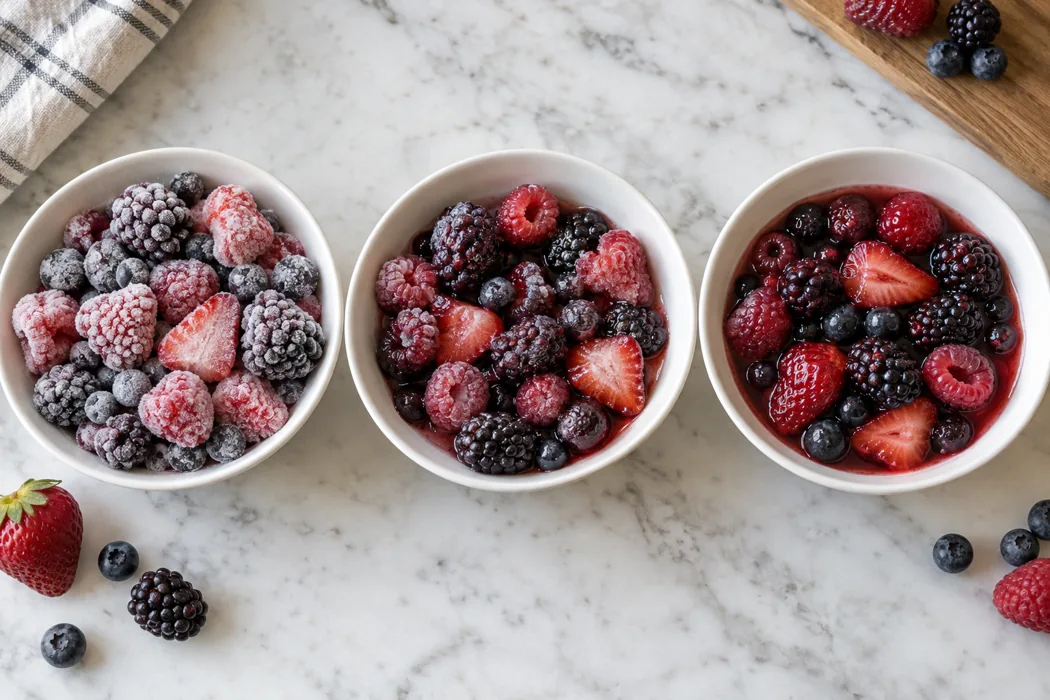
First check the product's intended use and preparation instructions. Freezing does not establish that berries are ready to eat, and thawing does not provide a pathogen-control treatment. Once that safety route is clear, choose the physical endpoint that suits the recipe: frozen, partly softened or fully thawed. For commercial use, record the portion, container, temperature conditions and juice treatment so that a later lot can be assessed in the same way.
Choose the thawed state from the final food
The desired endpoint is a functional condition rather than a universal number of minutes. Frozen berries remain firm enough for separate dosing and can provide chilling in an appropriate smoothie process. Partly thawed fruit may be easier to divide or incorporate while retaining some structure. Fully thawed fruit releases more visible liquid and may be easier to puree or distribute over a dessert. Each state has advantages when it matches the application.
Mixed berries make a fixed clock time less reliable because the components differ in size and structure. A small blueberry, a hollow raspberry and a large strawberry half will not necessarily soften at the same rate. The outside of the strawberry can look glossy while its center remains firm. Assess the largest relevant pieces as well as the smaller fruit, and describe the condition required by the next operation.
Pack size and depth affect the result. A thin layer in a shallow container behaves differently from a dense mass in a deep bag. Air circulation, starting temperature, contact with the container and the amount of product all influence the progression. A household instruction for a small bowl should not be multiplied directly into a thaw time for a commercial carton.

Mixed berries including visible strawberry pieces on a metal sorting surface in a GreenLand-food product photograph.
Define the desired appearance realistically. Frozen berries often become softer after thawing, and some juice release is normal. A topping that demands the firmness of freshly picked fruit may need a different ingredient or a revised presentation. Approval should examine the actual thawed blend, rather than relying on an image of firm frozen pieces.
| Final use | Useful trial starting state | What to observe |
|---|---|---|
| Suitable muffin or cake batter | Frozen small pieces | Mixing distribution, cold spots and baked moisture |
| Chilled visible topping | Refrigerated thaw to the chosen endpoint | Shape, surface juice and color bleed |
| Cooked sauce or compote | Frozen or partly loosened fruit | Heating uniformity, retained juice and final concentration |
| Cold blended drink | Approved ready-to-eat route or safely prepared base | Blender circulation, temperature and dilution |
These are trial directions, not universal preparation instructions. A particular product label, validated recipe or food-safety procedure can require a different route. Keep the safety requirement in place even where a colder or firmer state would appear convenient for texture.
The GreenLand-food mixed berry range provides a starting point for discussing component forms. Tell us whether the product will be visible, folded into batter, heated into a preparation or blended. That information helps focus the sample review on the state your operation actually needs.
Check intended use before choosing a method
Frozen fruit is a preserved ingredient, but freezing is not sterilization. The University of Minnesota's fruit-freezing guidance notes that freezing does not kill bacteria that may be present. A bright color, clean flavor or well-separated IQF appearance cannot demonstrate microbiological safety. Treat those observations as quality information and use the approved safety controls for the intended food.
Read the package directions and obtain clarification where the commercial specification does not identify intended use. A product supplied for further cooking should enter a suitable cooking process. A cold smoothie or chilled topping may have no later heat step, making the approved supplier and product route particularly important. Do not infer ready-to-eat status from the words "washed," "IQF" or "premium."
Destination advice can also affect preparation. The Food Safety Authority of Ireland advises boiling imported frozen berries for one minute before consumption. That is specific national advice addressing viral risks and should be understood in its stated scope. A gentle thaw or a brief rinse is not the same treatment. Commercial businesses should follow their applicable requirements and validated procedures.
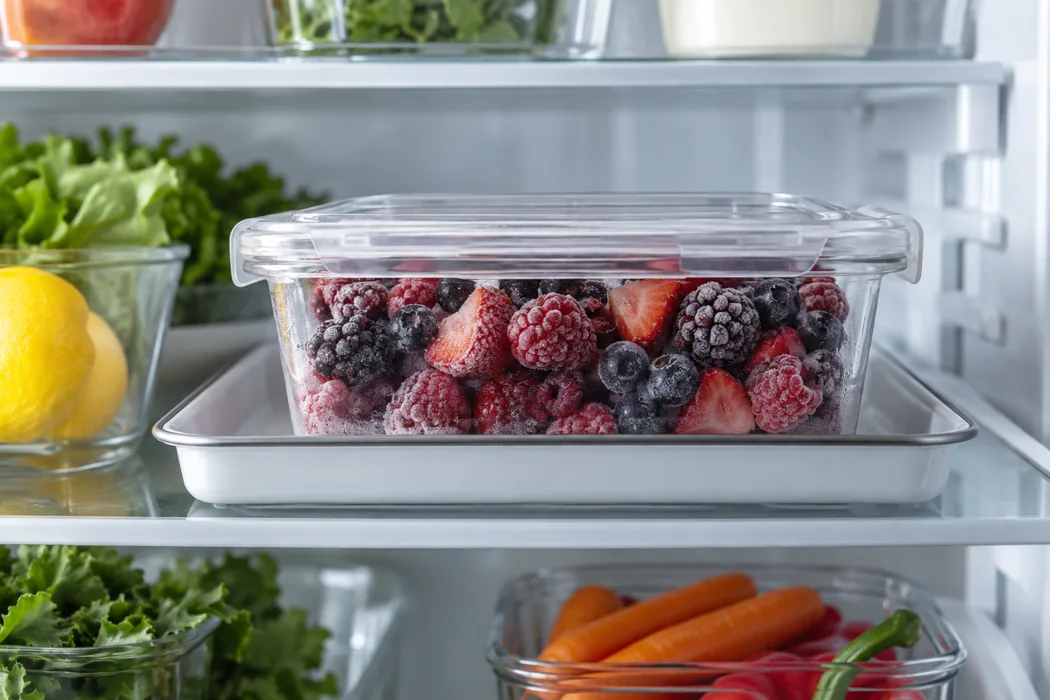
A covered shallow container contains juice during refrigerated thawing.
Refrigerated thawing is a practical way to control warming while fruit softens. Use a clean food-grade container, protect the berries from contamination and contain leaking juice. Place the container where raw foods cannot drip onto it. The refrigerator setting, actual product temperature and the operation's time limits belong in the handling procedure; one generic thaw duration cannot replace those controls.
Countertop thawing can leave the outside warmer while the center is still frozen, especially in a large mass. A microwave can create uneven heating and partly cooked areas. These methods may also damage the texture sought for visible fruit. Where rapid preparation is necessary, use a method suitable for the recipe, equipment and validated safety plan rather than improvising a long ambient hold.
Keep utensils and work surfaces clean, and avoid returning handled fruit to the original unopened-stock system. A portion that has been thawed or prepared carries a different handling history from the sealed frozen ingredient. Identify it clearly and use the applicable storage and use instructions. A freezer shelf-life statement does not describe the safe holding life of a thawed topping or mixed dairy dessert.
If the product must be cooked before use in a cold food, plan the subsequent cooling and protected handling as part of the process. Cooking, cooling and storage each affect both safety and texture. A cooked berry base may be useful in a smoothie, but it will behave differently from intact frozen fruit and needs its own recipe balance and approved handling route.
Thaw gently for toppings and visible fruit
For a topping, begin with the appearance and portion you intend to serve. A cheesecake garnish may need recognizable pieces with little loose juice, while a breakfast bowl may welcome a spoonful of fruit and its juice. Approve the final presentation before deciding that all released liquid should be removed. Drainage is a formulation choice as well as a handling step.
A shallow covered container lets you observe the fruit without a deep pile pressing on the lower pieces. Keep the portion manageable and avoid repeated stirring while the berries soften. Delicate raspberries can break under handling that leaves blueberries intact. Lift or fold gently when movement is needed, using tools and contact surfaces that suit the food.
If the recipe requires draining, use a clean sieve or perforated insert over a collecting container under the approved temperature conditions. Describe the drain time, sample mass and whether pressure is applied. Squeezing the fruit extracts additional juice and changes its structure, so it should not be treated as equivalent to passive drainage. Keep the method consistent during sample approval and routine preparation.
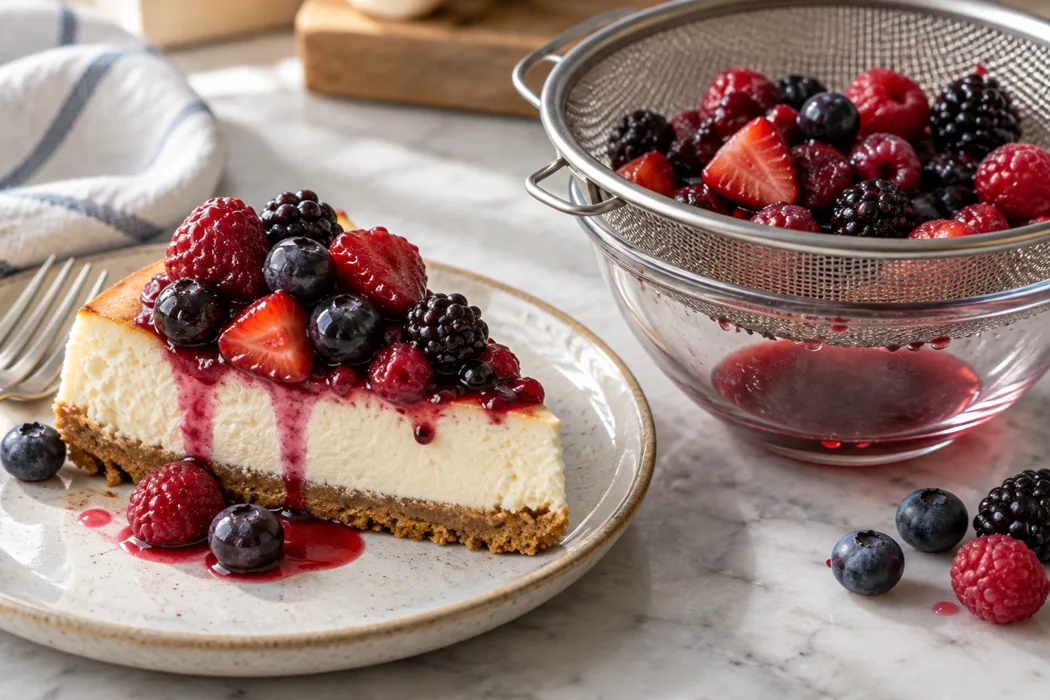
Topping trials should include juice release and visible-fruit condition.
Color release can be as important as the amount of liquid. Dark berry juice may spread into a pale cream or yogurt before the fruit looks visibly collapsed. Check the assembled dessert at the expected service interval, not only immediately after topping. A layer that looks tidy at preparation may develop a wider colored halo during holding.
Size and component ratio affect the serving experience. A large strawberry half can dominate a small dessert while several tiny blueberries disappear into the cream. Smaller specified cuts may distribute more evenly, but additional cut surfaces can also release juice. The appropriate choice comes from a trial that uses the actual blend and portion.
Frozen fruit cannot always reproduce the look of fresh fruit arranged individually by hand. If the customer expects a neat premium garnish, consider whether the blend is suited to that role or whether a selected component and different preparation would be more appropriate. Avoid masking an unsuitable ingredient with excessive draining that reduces yield and leaves the fruit less flavorful.
Record usable topping yield after the chosen handling method. The purchase weight, drained fruit weight and amount served can differ. That difference affects both cost per portion and recipe calculations. A supplier comparison is more informative when both samples are prepared identically and the buyer records the saleable topping obtained from the same initial fruit mass.
Use frozen fruit deliberately in baking
Many suitable batters can accept small frozen berry pieces directly. Keeping fruit firm during incorporation can limit immediate smearing and help preserve visible pieces. The University of Minnesota's blueberry guidance recommends adding frozen blueberries without thawing for baking to reduce juice and color leakage. That advice concerns blueberries; a mixed blend introduces larger pieces and other fruit structures that still need recipe testing.
The batter must be able to accommodate the cold ingredient and the moisture it releases during baking. A formula developed with fresh fruit may need adjustment when the same nominal quantity of frozen fruit is used. Do not assume that coating the berries in flour resolves every moisture or distribution problem. The base batter, fruit size, dose and baking process work together.
Fold the fruit in with only the handling needed to distribute it. Excess mixing can break softer pieces and streak the batter, particularly as the fruit warms. Keep the ingredient frozen until the planned addition stage and avoid leaving a bowl beside a warm mixer while other work proceeds. Portion the amount needed rather than repeatedly warming the whole supply bag.
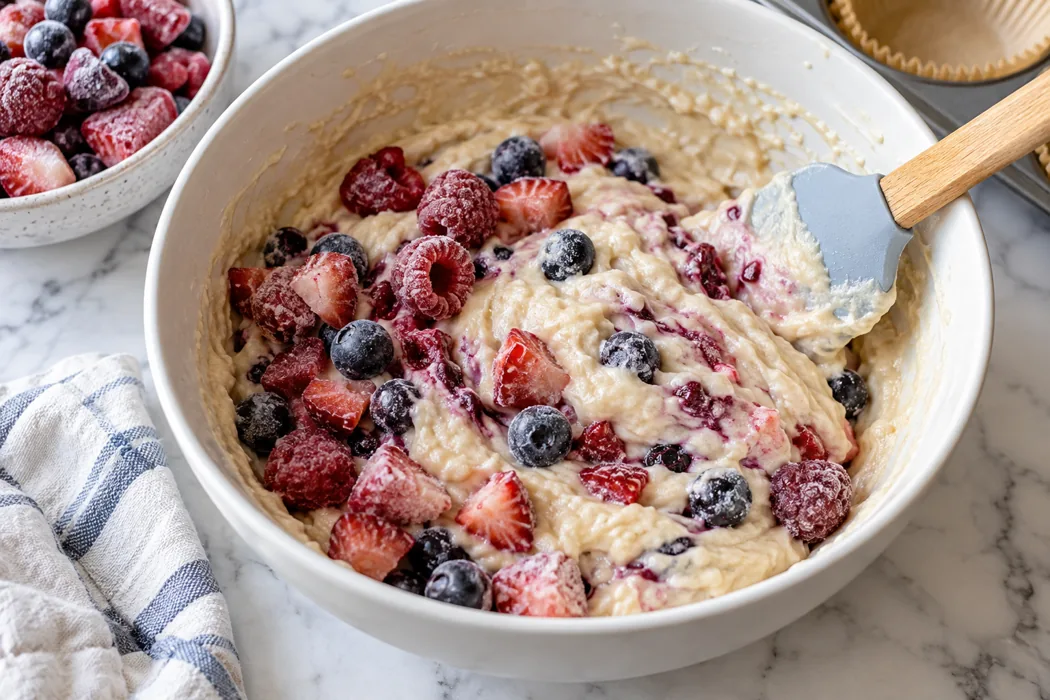
Small frozen berry pieces can be folded into suitable batter during a controlled recipe trial.
Large strawberry pieces can create localized wet areas and cool the surrounding batter more than small dice. This can affect the appearance and consistency of a muffin or cake portion. Compare relevant cuts in the actual pan size and recipe. A successful small laboratory bake is useful development evidence, but production loading and oven conditions still need confirmation.
Evaluate the baked interior as well as the top surface. A product can brown attractively while the crumb around large fruit remains wet or the center has not reached the recipe's required endpoint. Use the operation's validated cooking criteria and quality checks. Extra minutes chosen by appearance alone are not a substitute for a properly established process.
Pies, cobblers and fillings differ from aerated batters. They may be designed to collect substantial fruit juice in a thickened matrix. In those foods, thawing and measuring the liquid can be a deliberate part of the recipe, or the formulation may be designed for fruit added from frozen. Follow a suitable recipe and evaluate the finished set, rather than applying one muffin rule to every baked product.
For commercial approval, keep fruit dose, component ratio, cut size, batter temperature, pan fill and process conditions in the trial record. Photograph the cut product at a consistent time after baking, and record any drainage or fruit loss before mixing. This makes it easier to determine whether a later difference comes from the blend, the preparation or the baking process.
Manage juice for sauces and fruit preparations
A sauce can often use the liquid released during thawing as part of the recipe. Keeping that juice retains flavor and dissolved material that would otherwise be discarded. The pan may receive frozen fruit, partly loosened fruit or a controlled thawed portion, depending on the equipment and process. Define that starting state so the heating and concentration steps are repeatable.
Start with a manageable quantity and provide the heat transfer and agitation required by the approved recipe. A large frozen block behaves differently from loose pieces. The outside can heat while the center remains frozen, and excessive agitation can destroy fruit pieces before the batch reaches its intended endpoint. Equipment, batch depth and piece size need to be considered together.
Decide how much fruit structure the sauce should retain. A compote may benefit from recognizable pieces, while a smooth preparation may be blended or refined. The whole-fruit grade that matters for a topping can have less value in a fully pureed sauce, although identity, defects, sensory quality and safety requirements still apply. Choose the ingredient form for the process rather than paying for an appearance that will be deliberately removed.
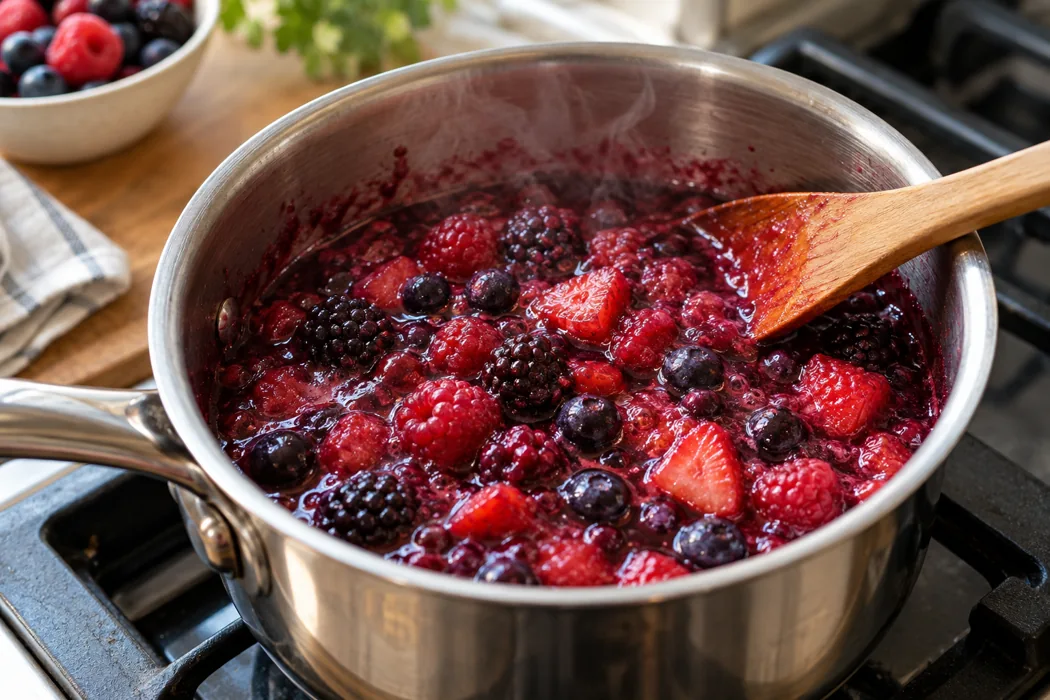
A cooked sauce can use released berry juice as part of its formulation.
Concentration changes during cooking. Evaporation reduces water and can make the remaining preparation taste stronger or sweeter even without adding sugar. Record finished yield when comparing blends. Two samples cooked for the same clock time may lose different amounts of water if the heat, pan or starting state differs, so equal time alone does not establish equal treatment.
If a thickener is used, follow the formulation and processing requirements appropriate to it. Berry ratio, acidity, sugar concentration and available liquid can affect the final texture. A trial with one blend does not establish that another will give the same set. Check the preparation at the actual serving temperature and after the intended holding period.
Straining introduces another yield decision. Removing seeds and coarse material may improve smoothness but discards part of the fruit. Use a defined screen and handling method, and record the recovered puree or sauce mass. A coarse sieve and a fine sieve can produce different mouthfeel and yield even from the same batch.
Oregon State University's berry preservation guidance describes dry-frozen berries as useful for pies, cobblers, syrups and spreads. Those application ideas do not replace a validated commercial preservation process. If the finished sauce is intended for shelf-stable packing or extended chilled distribution, its safety and shelf life require assessment for the complete formulation, process and package.
Measure thaw performance across mixed components
A useful thaw trial begins with a known sample and a defined question. For a topping, the question may be how much intact fruit remains after a particular refrigerated preparation. For a sauce, it may be whether the blend releases liquid consistently enough for the recipe. Avoid collecting numbers before deciding which result would affect acceptance.
Keep a distinction between liquid that was already loose in the bag and liquid collected after the controlled thaw. Surface ice, adhering fragments and previously released juice can make the starting condition different between samples. Photograph and describe the unopened or newly opened sample before preparing it. If a sample arrives partly softened, it may still provide information about arrival condition, but it is a poor substitute for the specified frozen starting state in a comparative trial.
Choose an assessment point that corresponds to use. A topping may be checked immediately after draining and again after contact with the dessert base. A sauce input may be assessed after gentle loosening, with the main acceptance judgment made after cooking. Testing each at an arbitrary common endpoint can create a ranking that has little relevance to the final food. Explain that application relationship beside the result so future reviewers understand what the trial established.

Raspberries, blackberries and small dark berries in a GreenLand-food product photograph; the image does not specify an order formula.
Record the initial mass, component specification, package condition and starting frozen state. Use the same container geometry and fruit depth for comparisons. Keep the temperature conditions and endpoint consistent, and note whether the sample is stirred, separated or drained. These details help explain a result that otherwise looks like an unexplained lot difference.
If juice release is measured, define the collection method. Passive drainage through a specified mesh for a stated period differs from pressing the fruit or leaving it overnight. Report the collected liquid relative to the stated starting mass, and describe any fruit fragments that pass through. A percentage without those details can look precise while representing a different test from the supplier's.
Inspect the individual components alongside the overall blend. Blueberries may retain recognizable shape while raspberries fragment and strawberry pieces soften. An acceptable average can hide the loss of the component that matters most to the finished presentation. Where practical, record component-specific observations in addition to total drained mass or overall sensory judgment.
Assess aroma, color and texture at the appropriate preparation stage. A sample should be evaluated under safe conditions and in line with its intended use. Sensory review does not establish microbiological safety, but it can reveal quality differences relevant to a recipe. Keep that distinction clear in the report.
Repeatability matters more than a complicated-looking method. A small operation may use a simple controlled trial with a scale, suitable containers and clear observations. A larger processor may require an instrumented method and a formal sampling plan. In either case, the method should be feasible at both sample approval and routine receiving.
Use the results to make a specific purchasing decision. The remedy for excess loose liquid might involve fruit form, component ratio, handling or recipe changes. A universal rejection rule based only on one drip percentage may overlook the application. Agree the limit and method that actually protect the finished food, then retain the approved sample and records as appropriate.
Write a repeatable handling specification
The handling specification should connect the frozen ingredient to the next process. State the intended use, pack size, portion mass, preparation container and required endpoint. Include the applicable temperature controls, protection from contamination and use limits under the operation's food-safety plan. The person preparing the fruit should not need to interpret an informal instruction such as "thaw until ready."
Describe what happens to the juice. "Retain all contents," "drain by the agreed method" and "use a measured portion of juice in the recipe" lead to different results. Carry that choice into the recipe, yield calculation and nutrition work. If the practice changes, review the effects before assuming the same specification still applies.
For a kitchen serving several foods, separate the preparation routes. A batch assigned to a cooked sauce can have a different physical endpoint from a topping batch, while the safety requirements remain tied to each product and process. Use clear identification so that fruit prepared for further cooking is not accidentally diverted into an uncooked dessert.
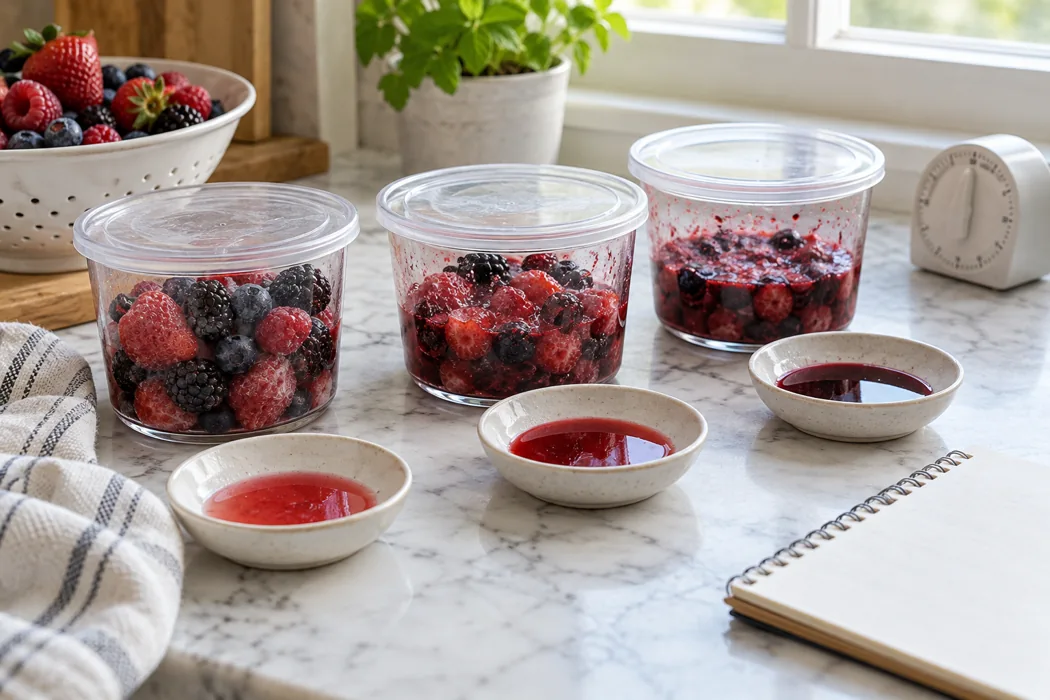
A repeatable thaw trial records the same sample mass, container and endpoint.
The package should fit the operation's actual demand. Repeatedly opening a large bag for small portions can expose the remaining fruit to handling and warming. Smaller bags may simplify control but add cost and packaging. Compare options using labor, usable yield, storage and service requirements rather than package price alone.
Train staff to recognize a change that needs investigation. A hard fused mass, unusual leakage, damaged packaging or a portion with markedly different component distribution may deserve a check against the approved specification. Record the lot and handling history before attempting to correct the product by warming, breaking or mixing it into another batch.
When a customer reports poor thaw performance, obtain the preparation details with the sample evidence. Container depth, starting mass, time, temperature, stirring and draining can all influence the result. A supplier and buyer are more likely to resolve the issue when both are comparing the same method. The GreenLand-food receiving and sampling guide provides related background on keeping the lot and observations connected.
We help buyers frame the ingredient request around the final food: visible fruit, baked inclusion, sauce or beverage base. Send the component mix, cut requirements, preparation route and the quality result you need to maintain. An agreed thaw method makes sample approval more useful and gives repeat orders a clear basis for comparison.
Source frozen mixed berries with GreenLand-food
GreenLand-food is a professional frozen mixed berries supplier and manufacturer in China, providing factory-direct wholesale supply for importers, food manufacturers, foodservice distributors and private-label programs.
Send your berry components and ratios, required form, specification, packing, quantity, application, destination, private-label needs and requested documents so we can review the supply requirements.