


Red Currant Jam vs Jelly: Fruit, Juice and Setting
Oct 19, 2026
Leave a message

For a buyer developing a spread from frozen redcurrants, the useful decision comes before the cooking time. Choose whether the finished product needs visible fruit, smooth pulp or clear juice, then establish the required cooled consistency. A soft breakfast spread, a pastry layer and a jelly served beside roast meat may need different textures even when they begin with the same berry lot.
We supply loose frozen redcurrants as an ingredient. The development approach below helps connect that ingredient to extraction, setting and application checks. It does not provide a new canning recipe. A home preserve intended for room-temperature storage must follow a tested recipe and its full processing directions; a commercial packaged spread needs validation for its own formula, process and container.
What fruit and juice leave in the finished spread
The distinction starts with the fruit fraction that enters the pan. A seeded jam uses crushed berries with their skins and seeds. Cooking breaks down the delicate redcurrant flesh, so a finished jam can contain small fragments rather than many intact berries. A seedless jam passes the softened fruit through an appropriate sieve or food mill. The retained seeds and coarse skins are removed, while fine pulp continues into the spread. Jelly starts with juice separated from that material and therefore has a different visual and textural target.
Names alone do not fully describe a commercial sample. A supplier or recipe author may use "jam" for a smooth, screened preparation, while another uses it for a distinctly seeded product. Ask to see the spread on a white plate, in a clear sample container and on the food where it will be used. Those views reveal suspended pulp, seed fragments and transparency more clearly than a front label. A spoonful can look bright red and still carry enough fine solids to appear cloudy when spread thinly.
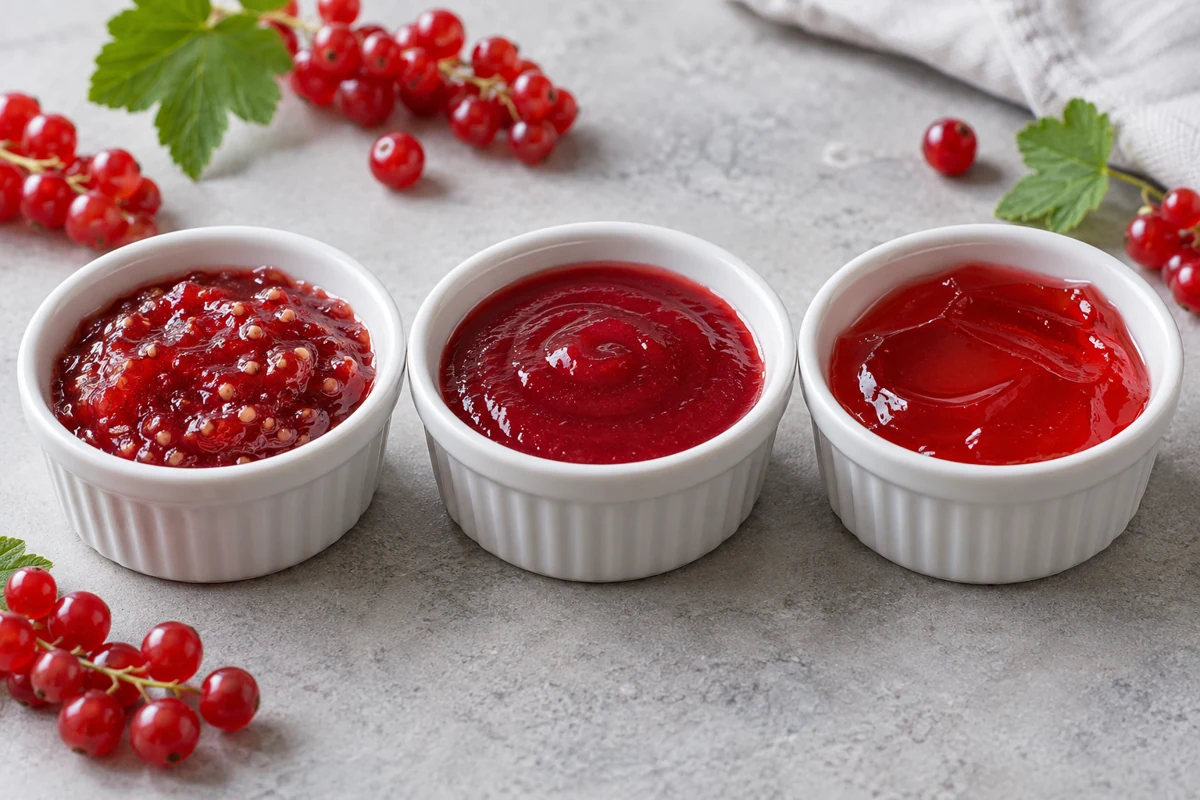
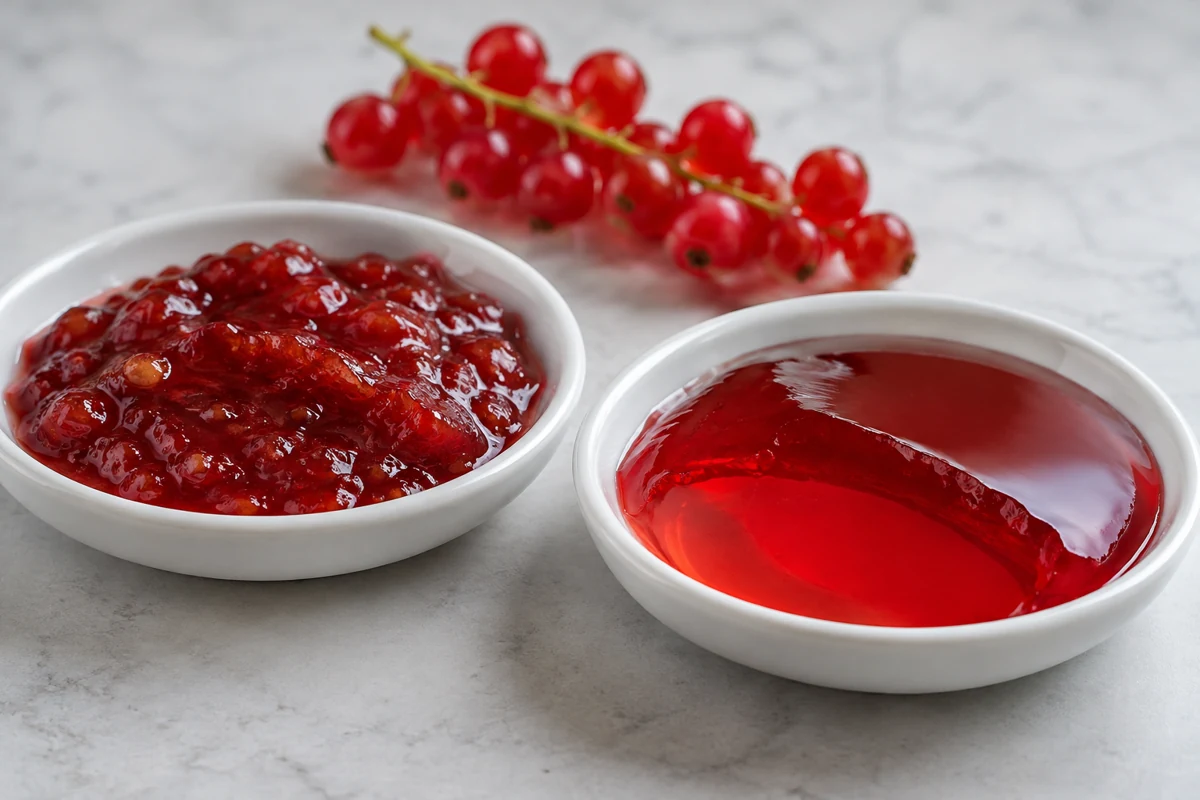
Seed removal can leave a pulpy spread; clear jelly uses a different juice base. Illustrative textures.
Seeds are a sensory specification rather than a minor technicality. Redcurrants contain small seeds that may be acceptable in a rustic breakfast preserve but distracting in a smooth pastry filling. A coarse screen removes larger material while allowing more pulp through; finer finishing changes both mouthfeel and recovery. Define whether "seedless" means no whole seeds under the agreed inspection or a more demanding particle standard. Neither a photograph nor a single tasting spoon can establish the condition of an entire production lot.
Clear jelly is useful when light transmission and a clean finish matter. It can suit a glossy glaze, a condiment or a sandwich where obvious fruit particles would interrupt the intended appearance. Pulpy jam brings a fuller fruit texture, although more retained fruit is not automatically better for every use. A filling that tears a delicate biscuit when spread, or leaks after a cake is sliced, has missed its application requirement regardless of how appealing it looks in its jar.
For development, compare the same attributes across the three routes: retained fruit material, transparency, recovery, spreadability and the actual application. Keep the fruit source and evaluation conditions consistent. Otherwise a difference attributed to "jam versus jelly" may really come from different sugar levels, a different pectin system or a different cooling period. The finished spread should meet the texture and handling requirements of its intended application.
| Spread | Retained fruit | Useful application question |
|---|---|---|
| Seeded jam | Pulp, skins and seeds | Is visible fruit and seed texture acceptable? |
| Seedless pulpy spread | Pulp after coarse residue removal | Does the smooth fruit body suit the filling? |
| Clear jelly | Strained juice set into a gel | Does the cooled gel spread or cut as required? |
Choose frozen fruit for the intended texture
Loose frozen redcurrants can feed either a jam or a jelly process. Their condition matters differently in each. A visible-fruit jam may justify tighter limits on broken berries because some berry identity is meant to remain after cooking. A clear jelly process will deliberately extract and separate the fruit, so intact appearance alone is a weak purchasing criterion. It still requires sound raw material with controlled stems, leaf fragments, foreign matter and handling history. Screening later does not excuse an undefined incoming grade.
The current GreenLand-food redcurrant product page describes loose berries and a separately agreed processing grade with a broken-berry allowance. For a jam trial, specify which of those starting conditions is being evaluated. Ask whether the supplied sample represents packed fruit after normal handling, since a carefully selected handful may overstate whole-berry retention. Take samples from more than one part of the pack and keep them identifiable through the test.
Frosted loose redcurrant berries on a white inspection plate. GreenLand-food product photograph.
Thaw liquid needs an explicit destination. If the recipe or development method uses the fruit and its released juice, retain both and include them in the recorded input. Draining the fruit without recording that loss changes the proportions of fruit solids, acid and water reaching the pan. If draining is intentional, define the temperature, time and draining method so the result can be repeated. A kilogram of drained berries is a different starting quantity from a kilogram of frozen fruit plus its thaw liquid.
Inspect surface frost and loose ice separately from the fruit. Some visible frost on frozen berries is expected; a mass of loose ice or a fused block deserves a handling review against the order specification. Do not assign the same meaning to every clump. Temperature records, packaging condition and the position of damaged berries help interpret what happened. For formulation work, record any removed loose ice and the fruit mass actually used so dilution does not remain hidden inside the trial.
Maturity also affects the setting discussion. Currants are associated with useful natural pectin and acidity, but that reputation is not a batch guarantee. The National Center for Home Food Preservation advises using added pectin with commercially frozen fruit in its home-preserving guidance because such fruit is generally fully ripe. A commercial developer should select and validate the pectin system for the actual material. A "no added pectin" concept needs evidence from repeated representative lots, rather than an assumption attached to the fruit name.
Choose clarity before extracting the juice
Decide how much cloud is acceptable before choosing how forcefully to press the berries. Gentle dripping through a suitable jelly bag can produce a visually clearer juice than pushing softened pulp through a mesh. The latter method may recover more liquid and fine fruit solids, but it also changes the material being evaluated. If the brief is a clear jelly, additional cloudy recovery may have little value. If the brief is a seedless pulpy jam, retaining that fine fruit material may be exactly the objective.
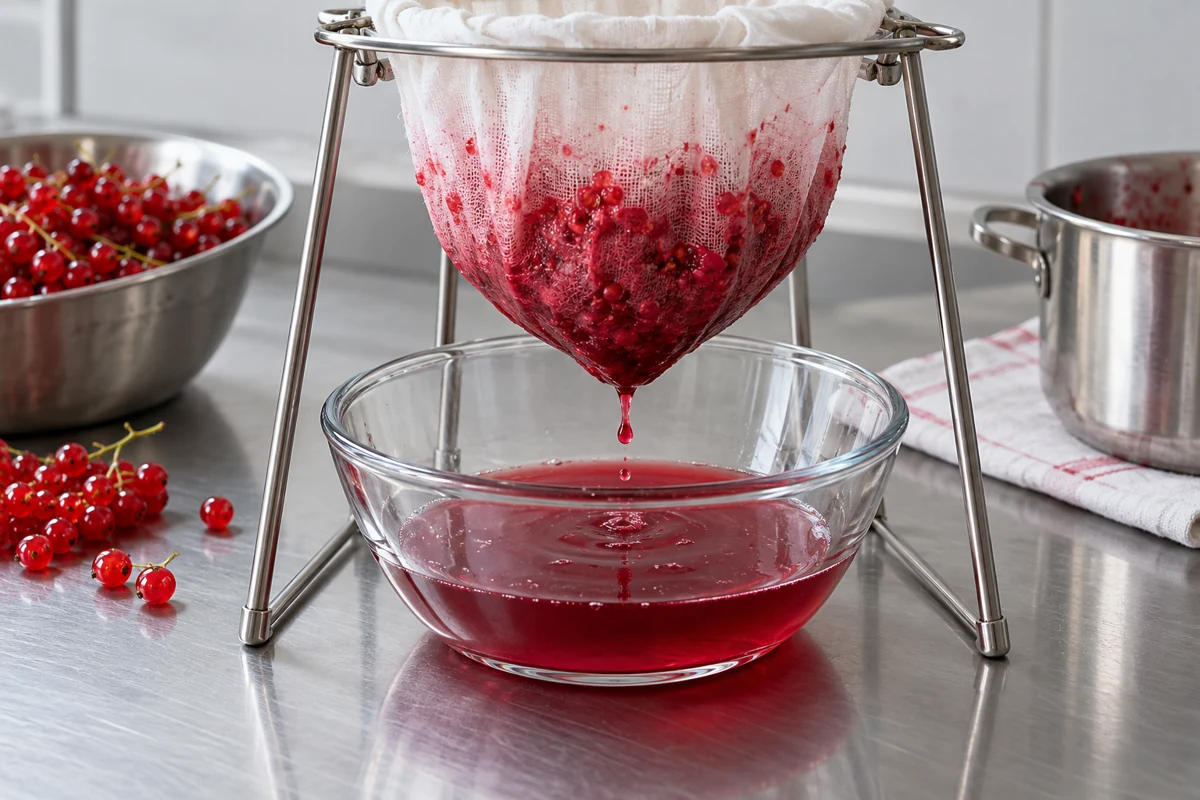
Gravity drainage illustrates a clarity-first extraction route.
The University of Alaska Fairbanks currant guide describes juice extraction separately from puree preparation and advises against pressing the jelly bag when clear juice is wanted. That separation is helpful for development. Label the streams in the worksheet as extracted juice, screened pulp and retained material, with a stated method for each. Calling every red liquid "juice" makes it difficult to explain why two batches finish with different body or transparency.
Weigh the material at useful points. Record the incoming fruit, added extraction water, recovered juice or pulp and the wet material remaining on the screen. These quantities do not by themselves prove extraction efficiency, because the retained fraction also contains water and useful dissolved material. They do reveal where mass went. A recovery figure becomes meaningful only alongside its water addition, finishing method and quality endpoint. Diluting the extraction can increase collected liquid while lowering fruit concentration.
Compare recovery on a consistent basis. One practical development comparison uses the same fruit mass, the same added water and the same intended clarity, then changes only the finishing method. If pressing is tested, record pressure or the reproducible operating procedure rather than an instruction such as "press well." Hand pressure varies widely. At larger scale, screen loading, residence time and cleaning frequency also influence the result, so a small kitchen sieve cannot predict continuous throughput unaided.
Inspect the recovered stream after it cools and stands for the planned observation period. Fine suspended pulp may become more obvious in a clear container or settle at the bottom. Foam can make a sample appear cloudier than its liquid phase, so compare samples after equivalent settling and handling. Use the same container depth and lighting for photographs; a deep red liquid in a thick layer can seem opaque even when a thin layer transmits light well.
Separate the fruit finishing decision from the later gel decision. A clear, weakly set jelly and a cloudy, firmly set jelly present different problems. The first may need a formulation or process investigation; the second may need a review of extraction and suspended material. Reboiling cannot reliably remove pulp that was pressed into the juice, and finer screening cannot by itself establish the correct pectin balance.
How pectin, sugar and acid determine the set
Pectin helps form the structure that holds liquid in a jelly or jam. Its behavior depends on the type used, the formulation and the process. A conventional sugar-dependent pectin system requires an appropriate balance of soluble solids and acid. Other pectin systems are designed for reduced-sugar products and may have different requirements, including calcium control. Choose a named system with the manufacturer's directions or an established tested recipe; "add pectin" is not a complete instruction.
Powdered and liquid home-preserving pectins cannot simply be exchanged by equal volume or weight. Their recipes can differ in ingredient proportions and order of addition. The NCHFP guidance explicitly keeps those forms separate. For commercial development, the same discipline extends to supplier grade, gel strength, preparation and dosing method. A change of pectin supplier or product code is a formulation change to evaluate, even when the label ingredient remains pectin.
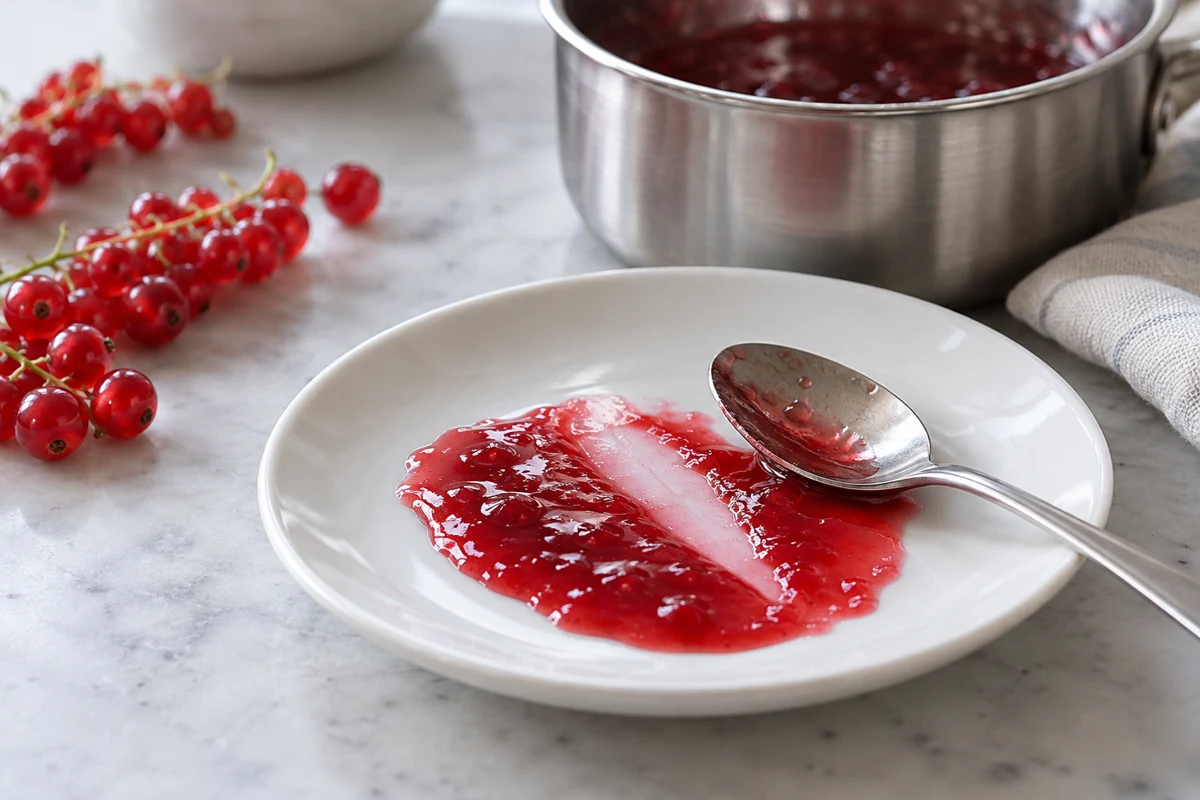
A cooled sample reveals a different consistency from hot liquid. Illustrative set check.
Sugar has several jobs. It contributes sweetness and soluble solids and participates in the setting conditions of conventional preserves. Cutting it to make a sharply tart fruit taste less sweet can therefore change the texture as well as the flavor. Develop a lower-sugar spread using a system intended for that purpose. Adding extra cooking time to compensate may concentrate the fruit and alter its flavor before producing the desired texture. A satisfactory spoon test also does not settle its preservation requirements.
Acidity should be considered through both measurement and taste. pH and titratable acidity describe different aspects of the acid system; neither alone predicts whether a person will prefer the spread. Taste the actual sweetened, processed preparation at the intended serving temperature. If acid adjustment is needed, record the ingredient, amount and point of addition. Repeated additions made by taste without a mass record can leave a good sample that cannot be reproduced or evaluated properly by the safety team.
Keep evaporation visible in the trial record. The same kettle time can produce different final concentrations when batch size, pan shape, heat input or stirring changes. Record starting and finishing mass and the chosen endpoint measurements. A refractometer can help describe soluble solids when used with an appropriate sample and method, but its reading is not a complete gel specification. Temperature, pulp content and instrument practice need consistency, and the finished spread still needs a texture assessment.
Judge the set after a defined cooling period. Hot jam can appear fluid and develop substantial body later; a chilled sample can feel firmer than the spread at room service. Use the same sample size, container and evaluation temperature for comparisons. If a sample is too firm, too loose or releases liquid, investigate the recorded ingredients and process before deciding on a repair. Commercial rework needs its own approved instructions, while home reworking should follow established guidance for the exact preserve type.
Compare the cooled spread in its real application
A spoonful in a jar is only the beginning of application approval. For a breakfast preserve, spread a measured amount on the bread or toast used in service and assess how readily it moves without tearing the surface. Observe whether seeds interrupt the bite and whether the flavor remains pleasantly tart at the normal portion. A jelly that looks elegant in a sample cup may slide off warm toast if the intended eating conditions were overlooked.
For pastry, define whether the preparation will be baked again or applied after baking. A jam layer between finished biscuits faces compression and moisture migration, while a filling entering an oven faces heating and a different water-loss pattern. Test the appropriate route. A preserve that sets well overnight in a jar is not automatically bake-stable. Nor does a thick filling necessarily remain in place under the pressure of depositing, sandwiching or slicing.
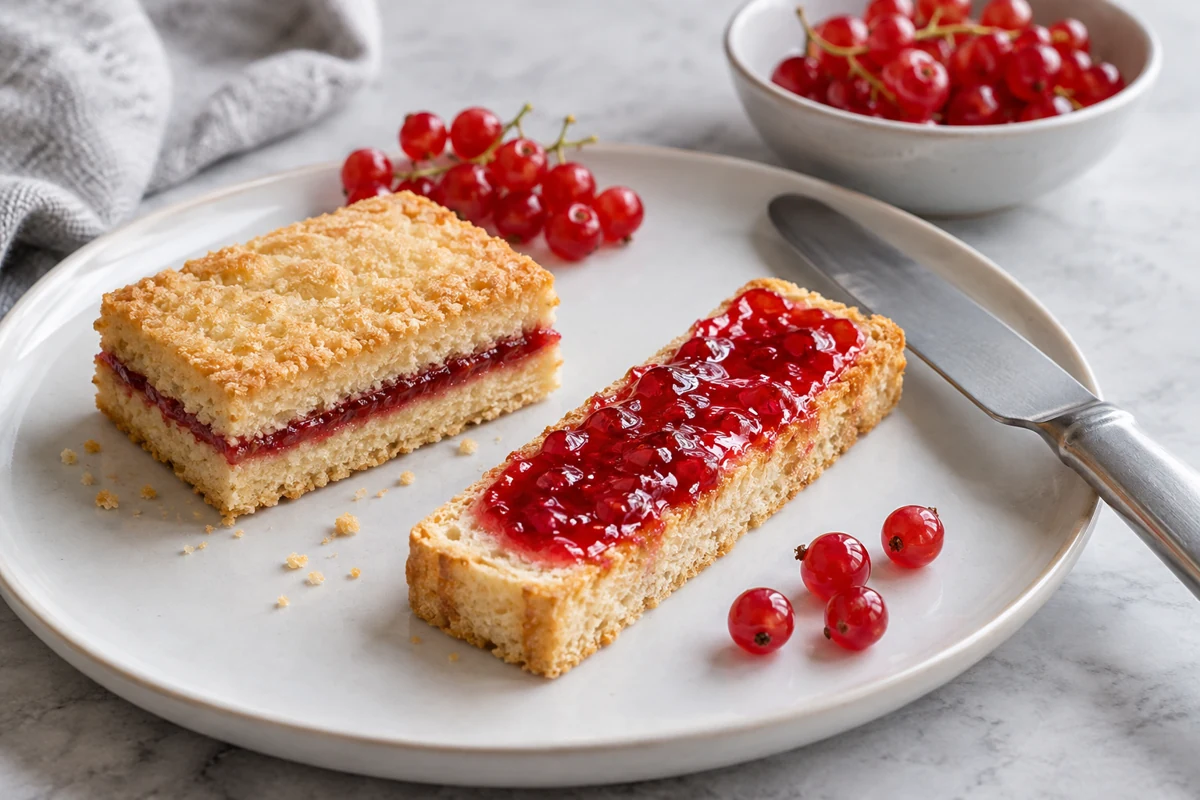
Pastry filling and table spread need their own application checks. Illustrative food samples.
Use a small, documented comparison instead of adjusting every variable simultaneously. For example, compare a seeded jam, a screened pulpy jam and a clear jelly at the same intended portion in one finished food. Establish each preparation through its own suitable formulation, then describe the differences in eating texture, appearance and practical handling. If the question is specifically about one processing variable, make a second comparison that keeps formulation constant and changes only that variable.
Watch for failures after the food has stood. Liquid may collect at an interface, a biscuit may soften, or a cut layer may creep outward. Record the storage and service conditions, packaging and observation time. These quality observations guide development but do not assign a safe shelf life. The appropriate microbiological and process controls must be established independently. Sensory panels should receive samples released for evaluation under the business's food-safety procedures.
The economics should use accepted output. Suppose, purely as a costing illustration, one fruit route recovers 0.70 kg of acceptable screened material from 1 kg of purchased fruit, while another recovers 0.55 kg meeting a stricter clarity requirement. Divide the fruit purchase cost by those actual accepted quantities when comparing ingredient contribution. Then add water, sugar, pectin, labor, energy, packaging and losses on their correct bases. These figures are examples, not redcurrant yield standards or GreenLand performance claims.
Do not compare final jam kilograms without accounting for formulation. A product containing more added sugar can deliver more finished mass per kilogram of berries while serving a different market brief. Fruit content, flavor intensity, portion size and the accepted legal product description all matter. Purchasing should see both the ingredient recovery and the cost per approved finished unit, together with the recipe version that produced them.
Keep preservation instructions tied to a tested recipe
A spread can form a beautiful gel and still lack a suitable preservation process. Gel formation is a physical quality result. Shelf stability depends on the finished food and the complete controls applied to it, including formulation, acidity, water activity where relevant, heating, filling, container and closure. Treat a new development sample as a trial with defined handling, rather than assuming the traditional reputation of jam makes it suitable for ambient storage.
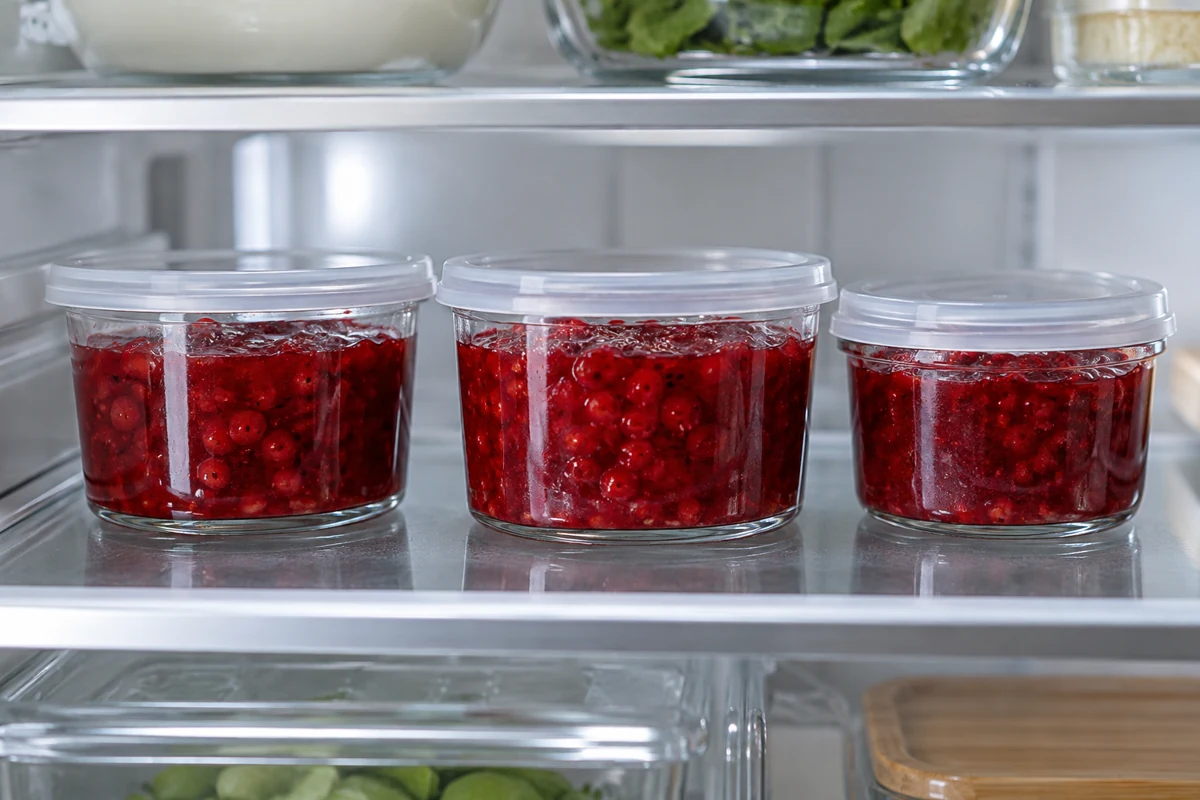
Covered development samples illustrate chilled handling; no storage period is established by the scene.
For home canning, use a current tested recipe from a reliable preserving authority and follow its ingredients, jar size, headspace, preparation and processing instructions, including altitude adjustments where specified. The UAF currant publication includes specific redcurrant jelly formulations using liquid or powdered pectin. Those are complete recipes with their own conditions. Their processing directions should not be attached to a different ratio of fruit and sugar, a different pectin product or a savory sauce developed from the same berries.
The same care applies when reading informal recipes online. "Pour into a clean jar," a lid pulling down, or turning a jar upside down does not independently demonstrate an adequate process. A published refrigerator period also belongs to the author's stated recipe and handling conditions. This article therefore gives no universal number of months for redcurrant jam or jelly. Keep the storage instructions attached to the validated recipe or approved commercial product specification.
A commercial manufacturer should involve its food-safety and process specialists while the concept is still being designed. A reduced-sugar spread, a new package size or a new filling route may change the validation work needed. Record whether the product is to be refrigerated, frozen or stored at room temperature, and identify the distribution conditions before the shelf-life study begins. The package used in that study should represent the intended commercial container and closure.
Frozen berries also need a defined intended use. Freezing is not a universal microbial elimination step. Obtain the ingredient's handling directions and agreed microbiological information, then establish the downstream controls for the actual process. A short visual simmer used to demonstrate softening cannot stand in for a validated treatment. Keep utensils, contact surfaces and containers hygienic, and handle trial material under the site's approved cooling and storage procedures.
Quality testing continues alongside safety validation. Track color, flavor, spreadability, liquid separation and any change in the container over the planned study. A product can remain within a safety control while losing the bright tartness or clean gel the customer approved. The commercial shelf-life decision must therefore satisfy both the safety requirements and the promised eating quality. Retain the trial formula, ingredient lot and process record so later results remain interpretable.
Buy against recovered fruit and agreed acceptance
An effective redcurrant specification begins with the chosen preserve route. For seeded jam, describe the desired visible fruit and permitted broken-berry condition. For screened jam or jelly, give more weight to sound-fruit recovery, stem control, extraction behavior and the relevant chemical measurements. State how those attributes will be sampled and evaluated. A general "premium" grade offers little protection if the buyer and supplier are measuring different properties.
We can discuss the frozen ingredient form, packing and representative sample against the intended application. Send the planned use as well as the product name: clear jelly juice, smooth fruit preparation or visible-fruit jam. If a processing grade with more broken berries is acceptable, give that allowance separately from stems and foreign material. Broken edible fruit and non-fruit material should never be merged into one tolerance simply because both may remain on a screen.
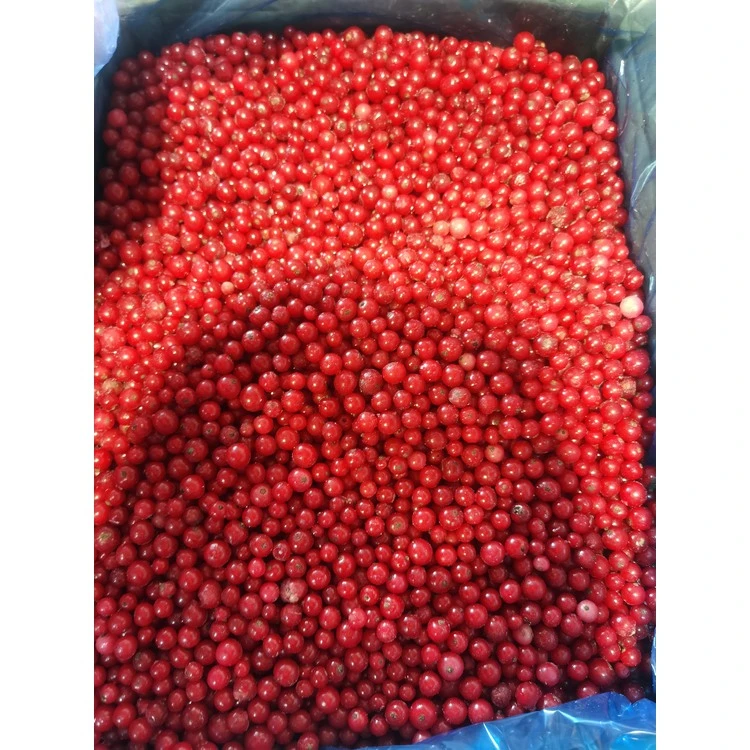
Loose frozen redcurrants in a blue-lined carton. GreenLand-food product photograph.
Agree the practical order details before the first repeat shipment. Net weight, liner closure, carton handling, pallet arrangement and storage conditions affect how the berries reach the kettle. A large economical pack may be inconvenient if the operation can safely handle only part of it at a time. Consider the batch size and cold-storage workflow when selecting the pack. MOQ, crop availability, lead time, loading port and trade terms need current confirmation for the selected program.
Connect the approved sample to the documents. The ingredient declaration should identify any added sugar or other relevant component. Requested analysis should state the analyte, method, represented lot and acceptance basis; a generic report is not proof of every shipment's performance. Specify destination-related residue or microbiological requirements with the appropriate specialists. Where traceability is needed, keep the ingredient lot, production batch and final packed spread linked in the manufacturer's own records.
For repeat orders, retain an agreed reference and a short application method that reproduces the sensitive parts of the trial. If clarity was the main limitation, keep the extraction and viewing conditions. If pastry leakage drove the decision, retain the same pastry, portion and observation method. Rechecking the relevant endpoint is more useful than repeating a long list of measurements that never influenced acceptance.
The final purchasing question is whether the offered fruit consistently produces the approved spread at an acceptable recovered cost. A clear answer requires the berry specification, processing method and finished-food test to stay connected. Once those are agreed, the distinction between jam and jelly becomes a practical order decision: which fruit fraction is required, which texture must survive the intended use, and which evidence releases each lot for that purpose.
Continue reading about fruit applications
Review fruit-and-juice measurement and the distinction between development batches and tested preservation recipes.
Compare a different berry through clear-juice extraction and jelly setting, with its own fruit and process requirements.
Follow raspberry seed removal and puree recovery as a separate example of preparing a smooth fruit base.
Source frozen redcurrants with GreenLand-food
GreenLand-food is a professional frozen redcurrants supplier and manufacturer in China, providing factory-direct wholesale supply for importers, food manufacturers, foodservice distributors, and private-label programs.
Send the product form, specification, packing, quantity, application, destination, private-label needs, and requested documents.