


Sea Buckthorn Creaming or Oxidation? Test the Right Change
Oct 09, 2026
Leave a message

Research This Article & Topic with AI
Verify key claims, compare reliable sources, and explore GreenLand-food's practical frozen food knowledge.
Article details and research questions are prepared in the links. Sign-in or sending may be required.
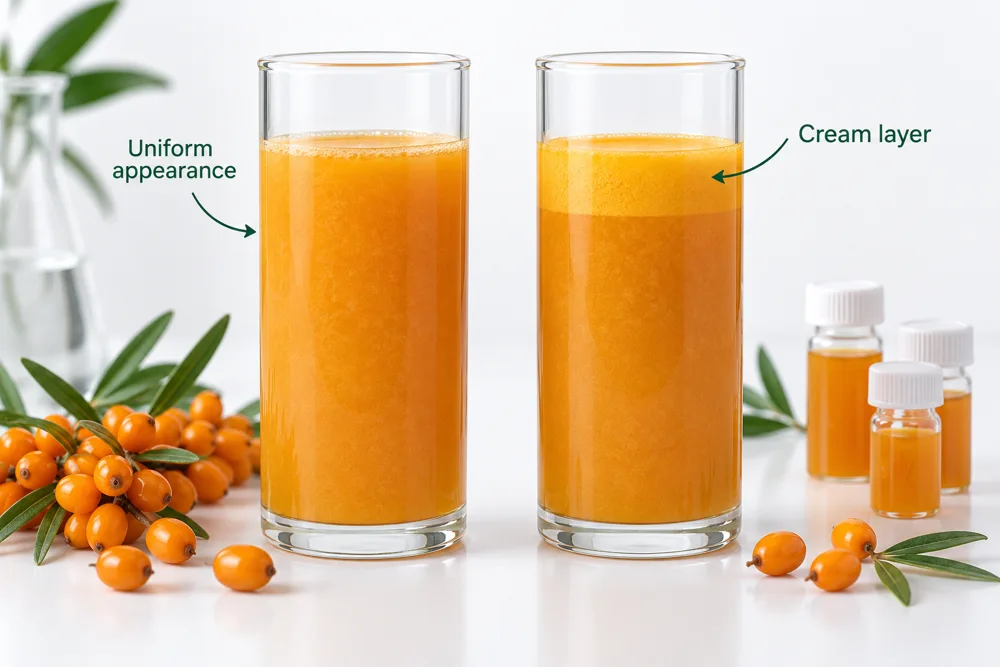
Describe the observed change before assigning a cause
Begin with a neutral description that another person could reproduce. Record where the visible layer sits, its approximate extent, the appearance of the lower liquid and whether sediment is present. Note the vessel, fill height, elapsed time, temperature and light exposure. A photograph taken before shaking can preserve the distribution that prompted the complaint. This record describes what was observed without prematurely assigning a chemical mechanism to the picture.
Record odor separately. Explain whether the observation was made at opening, after mixing, after heating or in the finished application. If trained sensory assessment is available, retain its method and comparison sample. A word such as rancid in an informal email does not identify the responsible compound or establish its source. Equally, the absence of an obvious odor does not replace a chemical test when the purchase question concerns oxidative change during storage.
A layer, odor and marker result can be compared on their evidentiary scope. Layering concerns the distribution of material in the vessel. Odor concerns sensory perception under the conditions of assessment. A validated chemical assay concerns its measured analyte or response in the sampled matrix. The comparison table below helps a complaint team avoid using one type of evidence to fill gaps in another. It also explains why the same sample may require more than one investigation.
| Evidence | Question addressed | What remains unproven |
|---|---|---|
| Layer formation | Where material is distributed | Chemical oxidation, safety and commercial shelf life |
| Odor change | Sensory difference under defined assessment | Compound identity and complete chemical cause |
| Validated oxidation marker | Specified chemical response in the sampled matrix | Every pathway and every finished-product claim |
Identify what the sample actually contains. Whole frozen berries, a crushed berry preparation, clarified juice, a beverage containing pulp and an extracted oil have different structures and sampling problems. If oil droplets or suspended pulp can redistribute, a small aliquot taken from one depth may differ from the overall formulation. Write the preparation and sampling procedure alongside the observation so that a later analytical result can be connected to the same measured object.

Whole sea-buckthorn berries are the supplied ingredient; oil models and beverage trials require separate interpretation.
Preserve an unopened comparator when available and record how it was stored. Comparing a complaint sample left open on a bench with a newly opened retained sample introduces differences beyond the original supply lot. An appropriate comparison may include the initial formulation, a retained ingredient sample and a matched finished-product sample. The laboratory should help choose the relevant comparator and handling conditions. Avoid collecting whichever sample is easiest and calling it a baseline without describing its history.
Food safety remains a separate question. A visible layer does not establish microbiological suitability, and a low response in an oxidation assay does not release a product from other applicable controls. If the complaint includes abnormal package condition, temperature abuse or a relevant hazard concern, the responsible quality team should follow its established investigation. The analytical distinction developed here concerns physical separation and oxidative chemistry; it does not provide a safety decision from appearance.
For purchasing, distinguish the ingredient specification from the finished-recipe expectation. The buyer may accept whole frozen berries while expecting a beverage prepared from them to remain visually uniform for a defined period. That expectation depends on the recipe and process as well as on the ingredient. Agree what form is supplied and which product is being evaluated. The real berry photograph identifies the commodity; it does not establish the stability of a later beverage or an extracted oil.
A useful complaint statement therefore contains a product identity, a handling history and a set of observations. For example, an illustrative formulation team reports an upper orange layer after a defined holding period and a separate change in aroma after opening. This is a reconstructed example, not a verified GreenLand customer case. The next request is for matched samples and suitable tests, so the team can investigate distribution and chemistry on evidence appropriate to each question.
Keep physical separation in its own evidence branch
Sea-buckthorn preparations can contain both lipid material and suspended fruit solids. Their physical distribution can change with formulation and handling. Existing work on turbid juice discusses colloidal instability and the practical effects of processing. For the detailed explanation of creaming, settling, droplet size and treatment history, use the relevant GreenLand article linked below. Here the task is to establish what physical evidence can and cannot contribute to a chemical complaint. Why Sea Buckthorn Juice Separates.
Creaming describes a redistribution of dispersed material through the continuous phase. The conceptual cylinder diagram retains the same number of droplets while changing where they are concentrated. It gives the reader a visible way to understand a layer without implying a change in the chemical identity of those droplets. Real formulations can have more complicated behavior, including suspended solids and several concurrent changes, so the picture is an explanatory relationship rather than a microstructural diagnosis of your product.
Record whether gentle mixing redistributes the layer and what happens during subsequent holding. This observation can inform the physical investigation, but remixing is not an oxidation assay. A dispersed appearance after mixing cannot establish that the lipid composition is unchanged, and persistent separation cannot identify a particular oxidation product. Keep the observation in the physical record and let the laboratory investigate chemical change through a suitable independently defined sample and analytical method.
Formulation history determines what a physical comparison means. Describe berry form, pulp fraction, dilution, added ingredients, emulsifier or stabilizer, mixing equipment, pressure or other processing settings, and relevant thermal treatment. Include the order in which ingredients were combined. A comparison between two jars with different recipes or processing histories cannot isolate the effect of the supplied berries. The development team needs that context before proposing a formulation change or making a claim about ingredient consistency.

The same conceptual droplets occupy different positions after physical redistribution.
Handling history belongs beside the recipe. Document thawing, holding, heating, cooling and any repeated temperature transitions. Explain whether the observed sample was the ingredient, a pilot preparation or a production batch. If different teams prepared samples, compare their written methods. Small differences in dilution or mixing can change the physical system being examined. An investigation becomes more efficient when the team first establishes that it is comparing the intended formulations under comparable conditions.
A 2020 primary sea-buckthorn oil-emulsion study assessed droplet properties and creaming under an accelerated centrifuge test, while also examining chemical responses during storage. It reported that accelerated physical behavior and visible room-temperature behavior needed their own context. This supports the separation of test questions; it does not provide a shortcut for predicting your beverage's commercial stability from a centrifuge result. Use the cited full article to understand the tested model and its endpoints. Primary sea-buckthorn emulsion study.
Sampling a separated vessel requires an explicit decision. A homogenized whole-vessel sample asks about the composition or response of the overall product. A sample from the cream layer asks about material concentrated there. A sample from the lower liquid asks another question. These approaches can all be useful if their purpose is defined, but their results cannot be compared as equivalent aliquots. Record sampling depth, remixing and preparation so that interpretation follows the material actually analyzed.
We supply frozen sea buckthorn for applications whose processing requirements should be discussed before ordering. When a buyer expects a specific finished-product appearance, we ask for the recipe context and trial conditions rather than assigning an oxidation cause to a photograph. Product form, maturity expectations, packing and quantity identify the supply requirement. The physical trial then evaluates the formulation under its own defined conditions, leaving the chemical branch available whenever its evidence is needed.
What the oil-emulsion study measured chemically
The original study central to this topic investigated extracted plant oils in an oil-in-water emulsion model. Tudor and colleagues compared sea buckthorn, blackcurrant, linseed and olive oils under induced thermal oxidation. The publisher-supplied study record describes probe ultrasonication, AAPH-induced exposure and three monitored marker types: TBARS, hexanal and conjugated dienes. That combination makes the analytical point clear: the researchers investigated chemistry with several chemical responses rather than diagnosing it from a visible layer.
The accessible record is the primary-study abstract supplied to FAO AGRIS; the journal's direct route was blocked during this review. It identifies the model and reported marker families, but it does not provide every method detail needed to reproduce the experiment. We therefore use it to explain the questions those measurements address. We do not import a protocol, an acceptance threshold or a commercial shelf-life claim from information that was not available for inspection. Publisher-supplied 2025 study record.

Conceptual oil droplets and interfaces identify a separate chemical testing question.
Conjugated dienes represent a structural feature monitored during lipid oxidation. In an appropriate method, their measurement can help follow an early chemical change in susceptible lipid systems. The response depends on the oil, preparation and analytical procedure. A value reported per unit of extracted oil cannot be treated as equivalent to a value reported per unit of whole beverage. Ask how the laboratory defines the analyte basis before interpreting the magnitude or comparing two reports.
TBARS stands for thiobarbituric acid reactive substances. The name itself describes an assay response rather than a complete inventory of all oxidation products. A method may report the response against a malondialdehyde calibration or another stated basis, but the laboratory must explain how the result is obtained in the intended matrix. The purchasing implication is to request the method, units, specificity and validation evidence before using a TBARS number to decide a complaint.
Hexanal is a volatile compound that can be investigated as a secondary oxidation marker in a suitable lipid system. Its measured amount depends on the analytical procedure and sample handling, including headspace conditions. A chemical identification or trend can support a defined oxidation question, while an odor description alone cannot quantify hexanal. Likewise, a hexanal result does not describe every possible pathway or every component responsible for the sensory character of a sea-buckthorn beverage.
The pathway diagram below separates a monitored early structural response from measured secondary responses. It deliberately provides no fixed conversion between conjugated dienes, TBARS and hexanal. The three are not interchangeable scales and cannot be added into a universal stability score. A laboratory can select complementary measurements for a defined investigation and explain the relationship expected in that particular system. That interpretation is stronger when repeated samples show a coherent time course under controlled conditions.

The monitored marker families address different parts of the oxidation investigation; arrows show conceptual relationships.
The model boundaries are commercially consequential. Extracted oils dispersed into a laboratory emulsion differ from intact frozen berries and from a finished recipe containing fruit solids, sugars, acids and other ingredients. Induced thermal exposure differs from normal frozen distribution or a beverage's intended storage. An oil comparison can generate hypotheses about chemical stability. It cannot establish the shelf life of the whole ingredient, the finished product or every sea-buckthorn formulation a buyer might prepare.
Other primary emulsion research uses peroxide or acid values, while syrup research examines chemical fingerprints under particular processing conditions. Those studies broaden the available analytical approaches; they do not authorize replacing the requested three-marker question with an unrelated number. When discussing a report, identify which chemical response was measured, why it was selected and what inference its validated method supports. The result should remain tied to its original sample matrix, exposure conditions and reporting basis. Review frozen sea buckthorn supply.
Choose a matrix-suitable oxidation question
Choose the question before choosing the assay. A team asking whether lipid oxidation increased during storage needs a matched baseline and a suitable marker strategy. A team asking what caused a new odor may need a different investigation that includes volatile analysis and sensory comparison. A team asking whether two oil preparations differ under accelerated exposure needs a clearly defined experimental model. Each objective determines what to sample, which method to validate and what a result can resolve.
The qualified laboratory should confirm suitability for the actual berry or beverage matrix. Supply the full relevant ingredient list, expected lipid content, acidity, color, suspended solids and preparation history. Explain whether the sample will be homogenized, separated or extracted before analysis. Ask whether the laboratory has evaluated interference, recovery and precision for that type of sample. A method valid in a transparent oil extract may need additional work before its response is interpretable in strongly colored fruit material.
A matrix blank and a spiked preparation can help evaluate a specific analytical concern when the method design supports them. A blank examines background response under the procedure; a known addition can help assess recovery or another performance characteristic. The laboratory decides suitable controls and how to interpret them. The diagram illustrates that comparison conceptually. It does not prescribe a universal spike level or promise that a single recovery check resolves all potential interferences in the finished recipe.
Ask about specificity in direct language: what else in this formulation could contribute to the reported response, and how is that contribution evaluated? For optical measurements, color or other absorbing compounds may require suitable preparation and correction. For volatile analysis, separation, identification, calibration and sample handling matter. The answer should be part of the method explanation, not an assumption made because the report uses a familiar assay name. Specificity determines how confidently a result supports a chemical conclusion.

Schematic matrix and spike comparisons illustrate method evaluation in a colored formulation.
Require the reporting basis to travel with the number. Results per kilogram of oil, per kilogram of emulsion and per volume of beverage answer different quantitative questions. A change in dilution or lipid concentration can change a reported value even when other chemistry is comparable. Retain units, extraction basis, preparation method and relevant detection or quantification limits. If two laboratories report different bases, resolve that difference before comparing their values or presenting a percentage change to purchasing.
A time course can be more informative than a lone endpoint when the investigation concerns storage change. Use matched samples under defined conditions and state how sampling affects the package, headspace or exposure. Decide whether containers are opened repeatedly or separate units are taken at each interval. Describe temperature and light conditions without calling them equivalent to commercial storage unless that relationship has been established. The experimental plan should preserve the question it is meant to answer.
An illustrative formulation team asks GreenLand whether an orange cream layer means its beverage has oxidized. The professional response is to define the measured preparation and its intended use, retain the physical observations, and request matrix-suitable chemical evidence. This example is reconstructed for explanation and does not represent a verified historical customer complaint. A layer can initiate investigation; the conclusion about oxidative change must come from the appropriate observations, controls and validated analytical results.
To assess that application with us, send the intended use, the reports or trial conditions being compared, and the basis for each result. Include physical layer distribution, the lipid-containing matrix, oxidation-marker specificity and formulation history. State how samples were drawn and whether they were mixed first. These details help connect the frozen ingredient to the finished-product trial. They also allow the laboratory to identify missing information before the team spends time comparing numbers that describe different samples.
Resolve the complaint with separate conclusions
Resolve the complaint with conclusions that match the evidence. The physical branch may establish that dispersed material redistributed under the documented conditions. The chemical branch may establish a change in a validated marker relative to a suitable comparator. If the assay is unsuitable, the sample history is uncertain or no comparator exists, describe the chemical conclusion as unresolved. Clear reporting prevents a visually persuasive photograph from becoming a chemical finding through repeated retelling.
The four-state diagram shows why physical and chemical change should be considered independently. A formulation may show a layer with no demonstrated marker increase, a marker change without visible layering, both changes or neither demonstrated change. These are analytical possibilities, not four measured results from a GreenLand trial. Their purpose is to help the team ask which evidence it actually possesses and which next investigation would reduce the remaining uncertainty.

Physical and chemical evidence can change independently; the quadrants are conceptual states.
An absence of demonstrated change also needs careful wording. It can mean the selected test found no meaningful difference under its conditions; it does not establish that every oxidation pathway has been excluded. A result below the method's quantification limit needs the laboratory's interpretation, especially when the question concerns a small increase from baseline. The report should make the relevant measurement capability visible so the buyer does not confuse limited analytical sensitivity with universal chemical stability.
Separate corrective actions by their intended effect. A formulation or homogenization change may address visible distribution. A change in oxygen exposure, light protection or process handling may be investigated for chemical stability. Each proposed action needs validation in the finished product, and improvements in one branch should be checked for their effects on the other. A more uniform appearance is useful when appearance is the target; chemical performance still requires its own evidence. Batch and document traceability.
Retain the lot identity and sampling chain when sharing reports. Product code, carton batch, preparation date, recipe version and laboratory sample identifier should connect the ingredient to the tested formulation. That connection becomes especially useful when several pilot recipes use the same frozen berry lot. The traceability page explains how product records support shipment review. It provides the documentary route for the inquiry while the laboratory supplies the analytical interpretation of the particular sample.
Shelf-life decisions require a program appropriate to the product and intended distribution. An accelerated oil-model experiment does not establish the commercial shelf life of whole frozen sea buckthorn or of a beverage. Define the finished product, package, storage conditions and relevant acceptance criteria, then evaluate them through a suitable plan. Chemical markers may contribute to that plan, alongside other required quality or safety evidence. The responsible team should state which part of the claim each study actually supports.

Whole sea-buckthorn berries are the supplied ingredient; oil models and beverage trials require separate interpretation.
For a supply discussion, describe the delivered berry form, packing, quantity, application and destination together with the requested documents. If the buyer needs a trial sample, agree the preparation and evaluation objective before comparing it with a production recipe. The second real berry photograph shows the source ingredient state, reinforcing the distance between whole fruit and an extracted-oil model. This distinction helps keep both product selection and analytical interpretation specific enough to act on.
A useful final report gives the physical observation, the chemical result and the unresolved questions in separate sentences, each linked to its method and sample. It then assigns the next action to the formulation, quality or laboratory team responsible for that question. GreenLand-food can help align the supplied product and documents with your application review. Accurate complaint resolution begins with the measured material and ends with conclusions that the available evidence can support.
Source Frozen Sea Buckthorn with GreenLand-food
GreenLand-food manufactures frozen sea buckthorn in China. We fill factory-direct wholesale orders for importers, food manufacturers, foodservice distributors and private-label programs.
Send the product form, specification, packing, quantity, application, destination, private-label needs and requested documents, together with the analytical question and trial conditions.