


Why Garlic Turns Green: A Color-Reaction Guide for Frozen Garlic Users
Sep 28, 2026
Leave a message


The practical question is often why a frozen garlic lot seems pale when opened yet develops a blue-green cast in one sauce and stays pale in another. We would compare the same lot as a clove, a controlled mince and the actual sauce before assigning the cause to freezing or to the supplier. Cut size, time between cutting and heating, acid addition, temperature and the surrounding ingredients all affect the observation. An application may also reject a visually unusual but otherwise conforming ingredient because the finished product has a strict color standard. The disposition should therefore record two separate decisions: whether the material meets its safety and quality release rules, and whether the color meets the agreed recipe appearance.
Why cutting can trigger blue-green color
An intact garlic clove keeps many reactive constituents in different compartments. Cutting, pressing and pureeing disrupt that organization. Alliinase can then act on sulfur-containing precursors, producing reactive thiosulfinates that take part in the chemistry behind garlic aroma and, under suitable conditions, color development. The words matter because a simplified story about a single compound can lead a processor to expect a universal remedy. Garlic contains more than one precursor, and the balance changes with raw material and processing history.
In an original study of unheated garlic puree, Yamazaki and colleagues isolated two thiosulfinates with direct color-developing activity: 2-propenyl E-1-propenethiosulfinate and (E/Z)-1-propenyl 2-propenethiosulfinate. In their assay these compounds reacted with glycine to yield a blue-green color similar to the observed puree discoloration. The study supports a plausible biochemical route for processed garlic. It does not prove that every green batch followed precisely the same route, and it did not test a GreenLand commercial lot. For plant decisions, the useful lesson is that pigment can form from normal garlic constituents after tissue damage, while the actual cause of a given observation still needs evidence.
Color appearance depends on both the amount of colored material and the medium around it. A small proportion of tinted particles can look vivid in a white garlic paste, less obvious in a red tomato base, and different again in an opaque cream sauce. Blue and yellow colored products may combine visually into a green impression. A photograph taken under warm warehouse lighting can also look unlike the same sample under a neutral inspection lamp. Before comparing batches, agree where and when the sample will be viewed. Otherwise the team may call a lighting change a product change.
Acid is relevant, but it should not be treated as an on-off switch. The timing of acid exposure, the strength and composition of the sauce, and the time the cut garlic spends before heat treatment can change the result. A frozen peeled clove, a diced piece and a fine puree present different exposed surface areas and different histories of disruption. Some commercial forms may be blanched when specified; a buyer must confirm the actual product specification instead of assuming every frozen garlic form has the same enzyme activity. Studies of garlic greening have explored storage and heat treatments, but a processing plant should not adopt an untested treatment from a consumer recipe as a reliable prevention measure.

An illustrative comparison keeps the visible color change within clean cut tissue.
The green central shoot sometimes found in an aging clove is another visible condition. It has a distinct structure inside the clove and can be separated during inspection; it is not the diffuse blue-green pigment that appears across cut tissue. Similarly, the green leaves sold as young green garlic are a different ingredient. Those distinctions sound elementary, yet a receiving complaint that only says "garlic is green" can send the investigation down the wrong path. Describe where the color sits, whether it appeared before or after cutting, and whether the surface is smooth, dry, wet or fuzzy.
Our working interpretation should remain proportional to the observation. A uniform tint in a clean minced sample after an acid step is compatible with a color reaction. A patch on an uncut clove before production has a different history. Neither statement establishes microbial status. An ingredient can have a normal pigment reaction and still fail a microbial or foreign-material limit; a pale lot can fail those limits too. Keep color investigation within the quality system rather than turning the photograph into a safety certificate.
The reopened consumer results commonly move from a pigment explanation straight to reassurance that a home-cooked dish can be eaten. That shortcut does not fit a commercial receiving decision. A supplier lot, a production batch and a finished sauce can each have a different acceptance criterion and different records. The pigment mechanism helps formulate a testable hypothesis; it cannot replace a documented check of pack integrity, odor, foreign matter, storage history and the agreed release limits. If the only evidence is a photograph of green mince, keep the conclusion at "appearance observed" until the comparison and quality review are complete.
What changes between the clove and the finished sauce
The first comparison is the supplied form. A frozen peeled clove retains most of its structure until the user chops it. Frozen crushed garlic, minced garlic and portioned puree have already undergone tissue disruption before the sauce maker opens the pack. The commercial terms are not interchangeable: crushed pieces, small dice and paste differ in particle size, fines, dispersion and dosing behavior. GreenLand's frozen garlic range includes whole cloves and cut or crushed forms, but the actual cut size, blanching status, ingredient declaration and pack format belong in the order specification. The product page is a starting point for discussion, not a substitute for the agreed lot document.

Frozen peeled garlic cloves in a clear pack show the supplied whole-clove form.
At receiving, photograph the unopened pack and a representative sample. Note whether cloves are separated or clustered, whether the pack is intact, and whether visible discoloration is already present. For a clove product, cut a few representative cloves and record the interior. For a cut product, examine both the particle surface and the interior of larger pieces. Do this under stable lighting before the sample is mixed with sauce. The evidence establishes a useful time boundary: if color appears only after the garlic enters the recipe, the formula sequence deserves close attention; if color is already present at opening, handling and source records deserve earlier attention.
The next comparison is the degree of cutting. Take one identified lot and divide it into equal portions. Leave one portion as intact cloves, prepare a second as the defined mince, and prepare a third as a fine puree, keeping the same thawing and holding conditions where the product permits that comparison. The exercise does not isolate every chemical variable, because particle size also changes the rate of warming and mixing. It does show whether appearance follows the amount of tissue disruption. Where the supplied form is already minced or pureed, do not pretend it can be restored to an intact clove control; use a comparable clove lot only as context and label it accordingly.
Then examine the actual formula. A white garlic sauce exposes small color shifts; a tomato sauce can mask them; oil and water phases can place the particles in different visual backgrounds. Vinegar, citrus juice, tomato, fermented ingredients and other acidic components may enter before or after the garlic. A sauce heated immediately after garlic addition has a different history from a cold blend held for several hours. Record the order rather than reporting only the final ingredient list. Two formulations with identical ingredients can produce different garlic color if the process sequence differs.
Frozen history matters as well, but a green result should not be blamed on freezing by itself. Ask when the garlic was cut relative to freezing, how the frozen material was packed, whether the lot remained at the agreed frozen condition, and how the sample was thawed for the trial. A partially thawed block may give uneven dosing; thaw drip may carry soluble compounds into a sauce; prolonged holding after thaw can introduce both quality and safety questions. These are reasons to document handling, not claims that a particular freezing step caused the pigment. The related GreenLand article on what freezing changes in garlic covers the broader storage and texture question.

Different matrices make the same color easier or harder to see; this is an illustrative setup.
For sauce development, compare appearance at the point that matters commercially. A processor may inspect the kettle, the filled pack, and a representative product after the specified storage interval. Color that is invisible at filling may become visible later; conversely, a transient tint may change during processing. The acceptance rule should identify the matrix, time, lighting, package and reference sample. "No green garlic" is too vague if the team has never agreed whether it refers to incoming ingredient, cut sample or finished sauce. Pair the visual rule with normal product specifications for flavor, particle size and microbiological release rather than expecting one color line to control all quality dimensions.
When a green observation needs a hold
A smooth blue-green tint within recently cut garlic can fit the pigment explanation. Fuzzy or powdery growth on the surface, a wet collapsed clove, spreading brown decay, a leaking or damaged pack, or an odor outside the approved garlic profile calls for a hold and qualified inspection. These conditions have different possible causes and cannot be cleared from a screen image. The distinction is especially important when a sauce developer receives only a phone photo from a production shift. Camera color balance, compression and lighting conceal texture, which is often more informative than hue.
If the observation is uncertain, identify and segregate the affected lot and any work in process that may contain it under the plant's established hold procedure. Preserve the original pack, labels and lot code. Retain representative samples under the required conditions. Record the quantity used, the production time window, the finished batch IDs and any other garlic lots on the line. This creates a clear boundary for investigation and prevents an informal color judgment from becoming an undocumented release decision. The hold can be lifted only through the site's authorized quality process, with evidence appropriate to the suspected issue.
Visual pigment is not a test for pathogens or spoilage organisms. The ingredient may need the normal certificate of analysis, supplier specifications, receiving checks and any verification tests required by the product and destination market. A color reaction also does not prove that a sauce's acidification, heat process, cold chain or shelf life is adequate. Those controls belong to the finished product's validated process. If the recipe is a cold sauce, a raw garlic preparation or a low-oxygen pack, the site should apply the relevant qualified food safety review; a benign-looking green shade cannot answer those process questions. We avoid a general "safe to eat" verdict because the commercial lot and finished food are not characterized by the color alone.

An open pack shows the actual pale clove surfaces available for receiving inspection.
The location and chronology of color can still narrow the investigation. A color that emerges evenly after mincing and acid addition across replicated portions points toward a formulation interaction. A rough isolated patch that was visible on unprocessed cloves directs attention to incoming condition. A green sprout in the center of an otherwise firm clove should be described as a sprout. A mixed pattern may require more than one explanation. Rather than forcing every sample into a single cause, document each finding and its occurrence rate within a representative sample. If the defect is sporadic, sample selection becomes critical; photographing only the most dramatic clove exaggerates prevalence.
The plant also needs an application decision apart from safety release. A visually unusual garlic particle may be acceptable in a dark cooked sauce but unacceptable in a pale aioli or private-label dip, even when it meets ingredient and microbial specifications. The buyer and supplier should agree the appearance criterion and the reference method before a dispute arises. A signed sample, controlled photograph or defined color range may be useful, depending on the product. If the finished sauce does not meet the customer's expected appearance, reformulation or a different garlic form may be considered after testing. Do not change acid, heat or holding solely to hide color without assessing the finished product process.
Record the disposition in plain terms: what was held, what evidence was reviewed, which authorized person made the decision, and which lots or batches it covers. This is more useful than a note saying "green garlic harmless" or "supplier issue." A root-cause investigation may remain open after a batch disposition; the record should say so. Keeping the two tracks separate protects both parties: the supplier can address incoming ingredient facts, and the processor can investigate its recipe sequence without prematurely assigning responsibility.
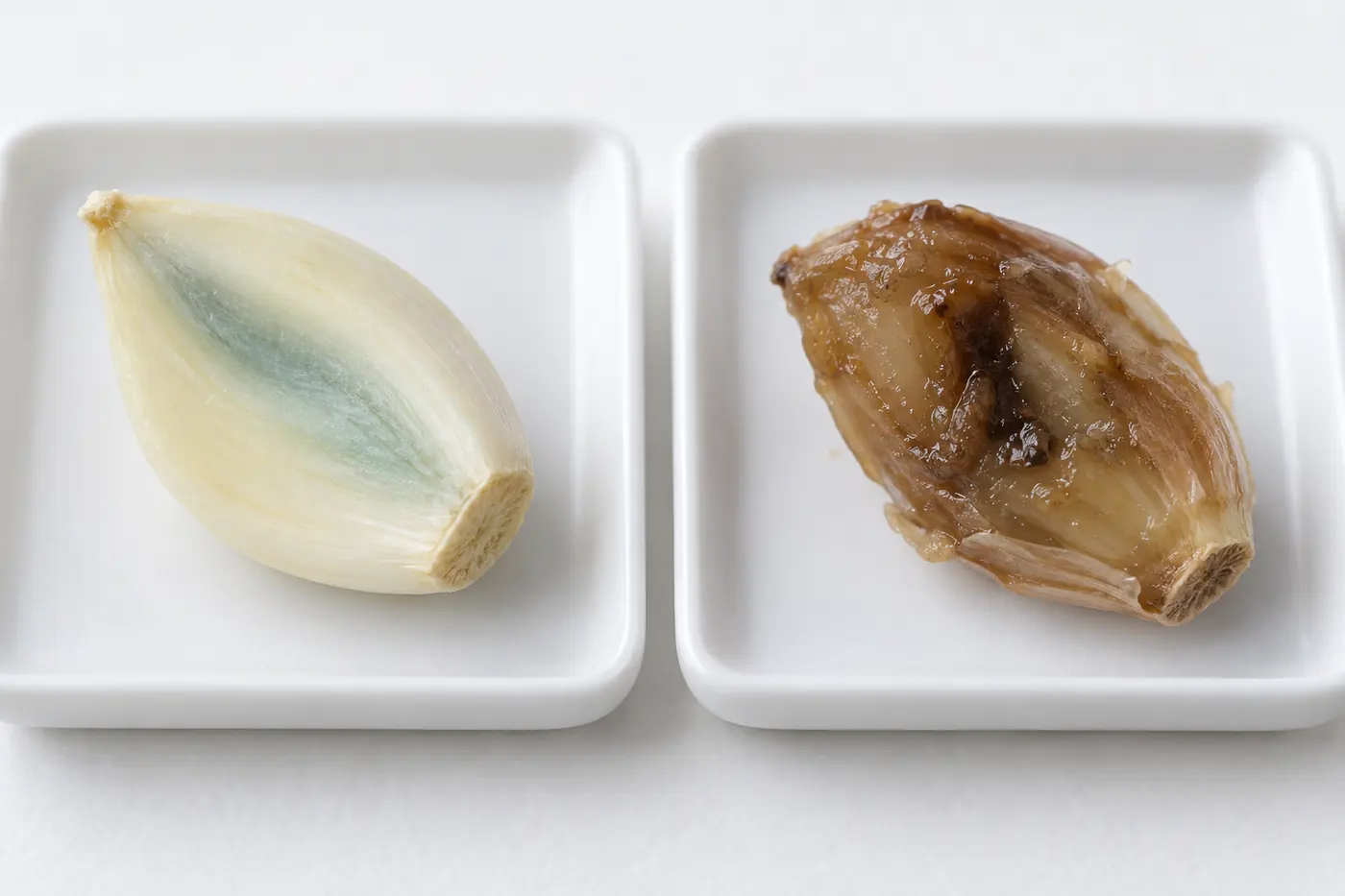
A smooth internal tint and a visibly damaged wet clove require different investigations; neither photograph proves safety.
Run a controlled color trial
A useful trial begins with one question. If the question is whether an acid addition is associated with greening, hold the garlic lot, cut size, sample mass, mixing time and observation schedule constant while changing the acid step. If the question is whether mince reacts differently from cloves, hold the recipe and addition order constant while changing the garlic form. Changing lot, cut, formula and heating together can produce a striking result but no reliable explanation. Keep a simple record that another operator can repeat on the same equipment or bench.
Start with representative material from an identified production lot. Record the frozen form, pack condition and the route used to bring the sample into the trial. Weigh equal garlic portions on a stated basis; do not compare a frozen block containing surface frost with an already drained mince as if their garlic solids were equal. Use the actual sauce recipe for the application arm, and prepare a no-acid garlic control where that comparison is technically appropriate. A no-acid control is a diagnostic reference, not a proposed commercial product. If the sauce contains several acidic ingredients, test the practical addition order first; deeper factor trials can follow if the result warrants them.
Make a photograph schedule before opening the packs: before cutting or mixing, immediately after preparation, after acid addition, after any heat step, at filling, and at the relevant defined hold points. The exact intervals should match the process and expected emergence of color; an arbitrary universal schedule would miss some systems. Use the same neutral background, fixed camera distance and stable light source. Include a neutral reference in each frame if the site's method allows it. Name files by lot, formulation version, sample ID and observation time. That discipline makes small differences easier to review and prevents a later photo from being mistaken for the incoming ingredient state.
The sensory and physical record should accompany the images. Note whether the color is in the garlic particle, the surrounding liquid or both; whether it is smooth or surface growth; how much of the sample shows it; and whether texture and odor differ from the approved reference. Record pH where it is relevant to the formula, but do not use pH alone as a predictor of greening or a release result. Heating should be logged as actual product time and temperature rather than "cooked" or "uncooked." If the trial is run at bench scale, note the limitations before extrapolating to kettle mixing, filling and commercial hold conditions.

Keep the observation setup consistent before comparing formula changes.
A comparison table can keep the decision visible without inventing a pass result. The rows below are trial arms, not observed GreenLand performance. Fill in the empty outcome fields after testing the actual lot and recipe.
| Trial arm | Initial state to photograph | Process order to record | Appearance points | Disposition evidence |
|---|---|---|---|---|
| Intact clove from identified lot | Frozen and cut interior | Thaw route, cut time | Opening, cut, timed hold | Incoming condition and lot specification |
| Defined mince, no-acid control | Particle size and pale reference | Cut, mix and hold | Immediate and fixed timed views | Mechanism comparison only; not a saleable recipe |
| Actual sauce with garlic | Garlic before addition and sauce base | Acid, garlic and heat sequence | Mix, fill and specified hold | Finished appearance criterion plus normal release checks |
Run at least enough independent preparations to see whether the result repeats rather than relying on one spoonful. If a difference appears, repeat with the same lot before changing supplier lot. A later cross-lot comparison can help assess raw-material variation, but it needs the same recipe, sample mass, timing and inspection method. Record negative observations too. A no-color result under one trial condition does not prove the ingredient cannot green under another process history. A positive color result does not establish that a lot fails food safety requirements. The outcome should lead to a specific next action: approve appearance, adjust a process after validation, request a different garlic form, or keep the lot on hold pending investigation.
An anti-greening treatment should be judged against its tradeoffs. Heat treatment can affect pungency and texture; changing acid timing can affect flavor and the validated safety process; changing a garlic form can alter dispersion and dosing. The right question is whether an allowed, documented process gives the intended sauce result while preserving all other requirements. There is no responsible guarantee that a named treatment will prevent every green outcome in every garlic lot and matrix. Test it under the actual application conditions before writing it into a specification.
Write a useful supplier investigation
The first supplier message should let both teams locate the material and reproduce the observation. Provide the exact lot code, product form and cut size, pack type, date received, quantity received, storage and handling record, and whether green was visible before opening, after cutting or only after sauce mixing. Include clear photographs of the original pack and each observation point, with one normal reference sample where possible. State the recipe version, acid ingredients, order of addition, heat step and hold conditions. A message that says only "garlic turned green" cannot distinguish an incoming appearance defect from a sauce reaction.

Frozen garlic cubes are a distinct portion format; confirm unit size and composition in the order.
Ask the supplier for documents that answer the actual issue: the agreed specification and appearance tolerance, lot traceability, production form, any specified blanching or other processing step, and the applicable quality records. Do not assume a public product-page description is the batch specification. GreenLand-food can discuss peeled cloves, diced or crushed garlic and portioned forms through its frozen garlic range, with order details confirmed for the buyer. A sauce developer should identify which form was actually delivered before comparing it with a different product. The crushed garlic product page explains why coarse crushed pieces, mince, dice and paste require distinct particle and packing terms.
The supplier can then check whether the complaint matches retained samples or other records from the identified lot. A processor should share enough application detail to make the comparison meaningful while protecting confidential formula information under its normal commercial arrangement. If only the finished sauce changes color, send a practical, controlled description of the acid and heat sequence instead of assuming the ingredient arrived green. If the incoming pack itself shows abnormal growth, damage or odor, prioritize the physical condition and food safety investigation. The response should state what was inspected, the sample basis and which findings are observations rather than hypotheses.
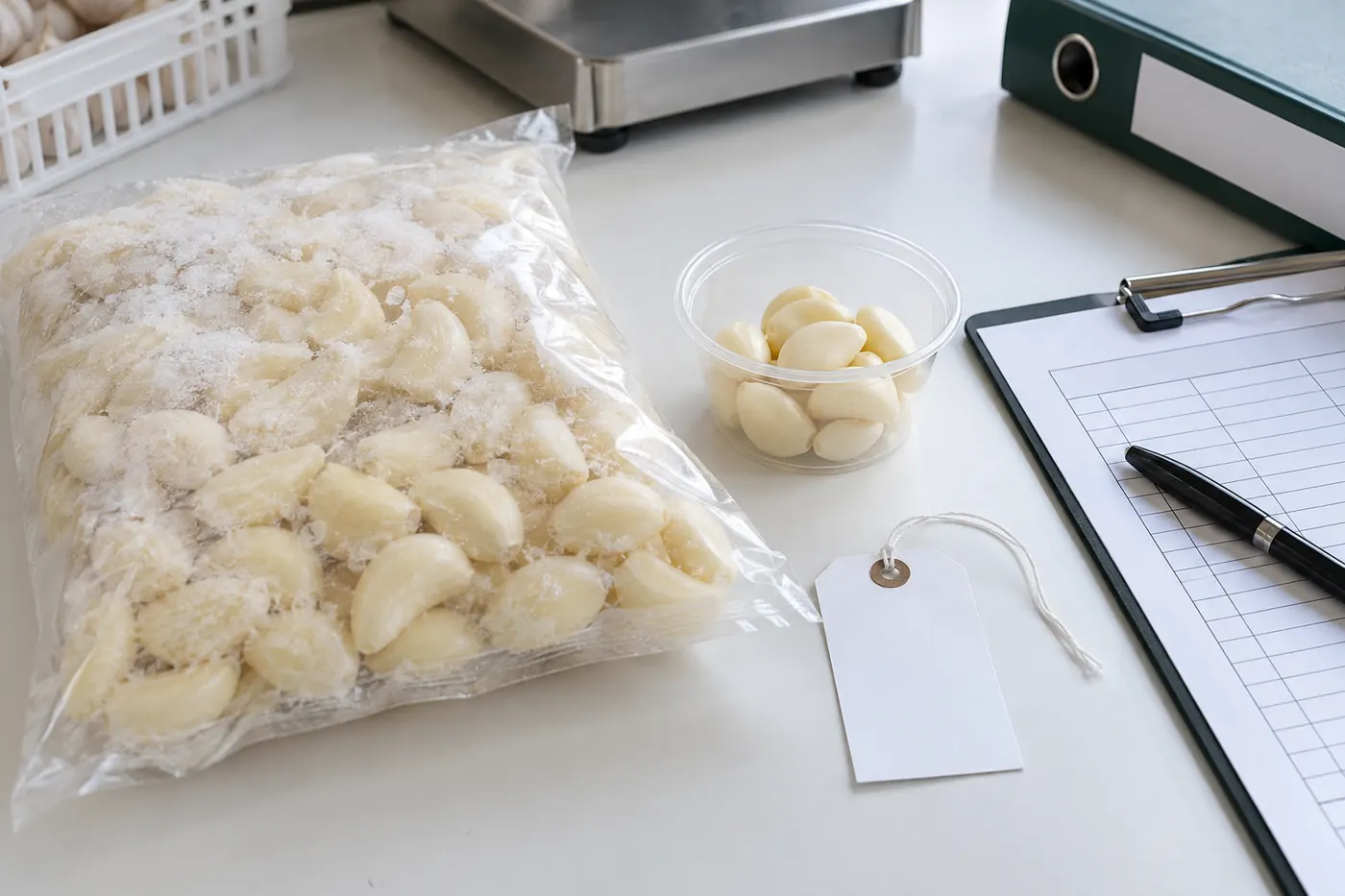
A supplier question needs the pack, sample and process record tied to one lot.
Agree two acceptance lines. One covers the incoming frozen garlic: form, size, color and defect tolerance, packing integrity, labeling, cold-chain condition, traceability and any required test results or documents. The other covers the finished application: visible garlic color in the actual sauce at specified times, flavor, dispersion and consumer-facing appearance. These lines may overlap, but they are not interchangeable. A supplier cannot certify how a confidential sauce will look under an undisclosed process, and a processor cannot use an acceptable incoming photograph as proof of a finished product result. A pilot sample under the actual formulation is the bridge.
Commercial details belong in the same communication when a replacement or alternate form is being considered. State the expected monthly or order quantity, the pack size that fits the line, the dosing format, destination market, requested documents and any private-label needs. If a different cut or a specified blanched form is proposed, request its actual specification, availability, lead time and sample route. Confirm whether a trial quantity can be supplied before changing the production schedule. A cut-size switch that solves appearance may change the rate at which garlic flavor enters the sauce; evaluate both results. Keep the comparison within the same lot where possible, and document when that is impossible.
A good investigation ends with a bounded finding. It may conclude that the color arose only after a defined recipe step, that an incoming defect was confirmed, or that more evidence is needed. It should identify the lots covered, the corrective action, and the method for the next trial or shipment. We help purchasing and QA teams frame frozen garlic requirements around form, specification, packing, quantity and application; we cannot infer an individual lot's safety or promise a color outcome from a general article. When the appearance requirement is tight, make it explicit early enough for both the supplier and sauce plant to test against it before commercial release.
Source Frozen Garlic with GreenLand-food
GreenLand-food is a professional frozen garlic supplier and manufacturer in China, providing factory-direct wholesale supply for sauce makers, importers, foodservice distributors and private-label programs.
Send the required garlic form, specification, packing, quantity, application, destination, private-label needs and requested documents. We can discuss a relevant sample and the appearance criterion before the order is confirmed.