Freeze Kiwi Slices
video

Freeze Kiwi Slices

We supply IQF Frozen Kiwi Slices made from selected kiwifruit, peeled, sliced, individually quick frozen and packed for smoothie manufacturers, beverage chains, yogurt and dessert producers, foodservice distributors, frozen fruit blend factories and retail private label programs. We confirm variety, Brix, ripeness, slice diameter, thickness, green or golden flesh, seed distribution, broken ratio, edge browning, drip loss, IQF separation, packing and food-safety documents before quotation. Kiwi slices, dices, chunks and halves are recorded as separate forms so the buyer receives the correct specification. Slices, Dices, Chunks & Halves Diameter & Thickness Control Brix, Ripeness & Browning Control Bulk, Retail & Private Label

Description

Technical Parameters

IQF FROZEN FRUIT SUPPLY

IQF Frozen Kiwi Slices for Smoothies, Dessert, Yogurt and Fruit Blends

We supply IQF Frozen Kiwi Slices made from selected kiwifruit, peeled, sliced, individually quick frozen and packed for smoothie manufacturers, beverage chains, yogurt and dessert producers, foodservice distributors, frozen fruit blend factories and retail private label programs.

We confirm variety, Brix, ripeness, slice diameter, thickness, green or golden flesh, seed distribution, broken ratio, edge browning, drip loss, IQF separation, packing and food-safety documents before quotation. Kiwi slices, dices, chunks and halves are recorded as separate forms so the buyer receives the correct specification.

Slices, Dices, Chunks & Halves Diameter & Thickness Control Brix, Ripeness & Browning Control Bulk, Retail & Private Label
IQF frozen kiwi slices supplier

Kiwi slice appearance provides evidence for diameter, thickness, flesh color, seed distribution and frozen separation.

Can Kiwi Slices Be Frozen?

Yes. For commercial supply, the important question is not simply whether kiwi can be frozen, but whether the fruit is selected at suitable maturity, peeled and cut to a controlled specification, frozen quickly, inspected and kept under a stable frozen chain.

IQF kiwi slices are best used from frozen or semi-thawed. Full thawing may produce a softer texture and some juice release because freezing changes the fruit cell structure. They are therefore better matched to smoothies, yogurt toppings, desserts, frozen fruit cups, beverage applications and fruit blends than to premium fresh-fruit platters requiring fresh-slice firmness.

Key Quality Points for Frozen Kiwi Slices

We connect each application risk to a control point and an order result that the purchasing or QA team can evaluate.

Buyer Concern Product Risk GreenLand-food Control Buyer Result
Brix and ripeness Underripe fruit is too sour; overripe fruit becomes soft Confirm variety, maturity, firmness and Brix by crop or agreed batch test Application-matched flavor and texture target
Slice thickness Thin slices break; thick slices alter portioning and thawing Confirm 5-8, 6-8 or 8-10 mm range and inspect cut tolerance Repeatable slice specification
Diameter variation Mixed sizes reduce retail and dessert presentation Sort fruit size and confirm slice diameter range More consistent visual appearance
Browning or dull color Slow handling or unsuitable fruit reduces value Control freshness, peeling, slicing exposure, freezing speed and final sorting Agreed green or golden color standard
Broken slices Rough handling and packing damage premium forms Control slicing, IQF handling, final inspection and pack protection Defined broken-ratio tolerance
Drip loss and softness Overripe fruit or full thawing releases excess juice Confirm maturity, freezing, cold chain and intended application Realistic use and thawing expectation
Clumps or surface ice Poor separation makes dosing difficult Manage IQF freezing, packing and -18 C frozen storage Free-flowing product condition
Peel or foreign material Incomplete trimming or inspection causes claims Wash, peel, trim, visually inspect and apply metal detection Clear defect and foreign-material control

Available Forms: Slices, Dices, Chunks and Halves

Slices and dices must not share one size description. We quote each form against its own dimensions, appearance tolerance and application.

Form Reference Specification Best For Buyer Note
IQF Kiwi Slices Diameter 30-60 or 40-70 mm; thickness 5-8, 6-8 or 8-10 mm Smoothie bowls, toppings, fruit cups and retail packs Slice integrity and visual appearance matter
IQF Kiwi Dices 10x10, 12x12 or 15x15 mm Yogurt, ice cream, bakery filling and fruit blends Uniform cubes support portion control
IQF Kiwi Chunks 20-25 mm irregular pieces or customized Smoothies, beverage bases and industrial processing Useful when perfect visual shape is not essential
IQF Kiwi Halves Half-cut peeled fruit Foodservice, reprocessing and larger-format use Requires suitable maturity and fruit shape
Kiwi Puree Separate processed product when available Beverage, sauce, ice cream and bakery Separate specification and quotation required
IQF frozen kiwi dices for yogurt and fruit blends

Product photos help distinguish slice, dice and chunk forms before sample and quotation approval.

Green Kiwi vs Golden Kiwi

Green and golden kiwi should not be mixed under one color specification unless the buyer accepts variation. We confirm variety, flesh color, Brix, acidity and crop availability before quotation.

Type Appearance Flavor Profile Procurement Match
Green Kiwi Green flesh with natural black edible seeds Sweet-acid and refreshing Classic fruit blends, smoothies, yogurt and desserts
Golden Kiwi Yellow to golden flesh Generally sweeter and less acidic by variety and maturity Premium desserts, retail packs and beverage toppings

Core B2B Specification

The table provides quotation references. Final variety, Brix, dimensions, defects, packing, loading and documents follow crop availability, approved sample, destination market and order agreement.

Product Name IQF Frozen Kiwi Slices / Frozen Kiwi Fruit Slices
Botanical Name Actinidia deliciosa or Actinidia chinensis according to variety
Varieties Green kiwi or golden kiwi according to crop and buyer requirement
Main Form Peeled kiwi slices
Other Forms Dices, chunks and halves; puree quoted separately when available
Slice Size Diameter 30-60 or 40-70 mm; thickness 5-8, 6-8 or 8-10 mm; customized by confirmation
Dice / Chunk Size Dices 10x10, 12x12 or 15x15 mm; chunks 20-25 mm or customized
Processing Washing, peeling, trimming, slicing or dicing, IQF freezing, inspection, metal detection and packing
Color Natural green or golden flesh with black edible seeds; abnormal browning controlled
Brix Reference around 10-14 degrees, depending on variety, maturity and crop; final standard by agreement
Texture Separate when frozen; tender when semi-thawed; full thawing may cause softening and juice release
Defect Control Mould, decay, bruising, underripe or overripe fruit, abnormal brown pieces, peel residue, breakage and clumps by agreed tolerance
Bulk Packing 1 x 10 kg carton
Foodservice / Retail 4 x 2.5 kg, 10 x 1 kg, or 300 g, 400 g, 500 g and 1 kg retail packs
MOQ Normally one 20' RF or 40' RH; mixed frozen fruit loading can be discussed
Loading Reference About 22-24 MT per 40' RH depending on packing; 20' RF by carton and order plan
Shelf Life / Storage 24 months at -18 C or below under continuous frozen storage
Supply Period Year-round planning based on crop and frozen stock availability
Lead Time Normally 15-21 days after order and deposit confirmation, subject to stock and packing
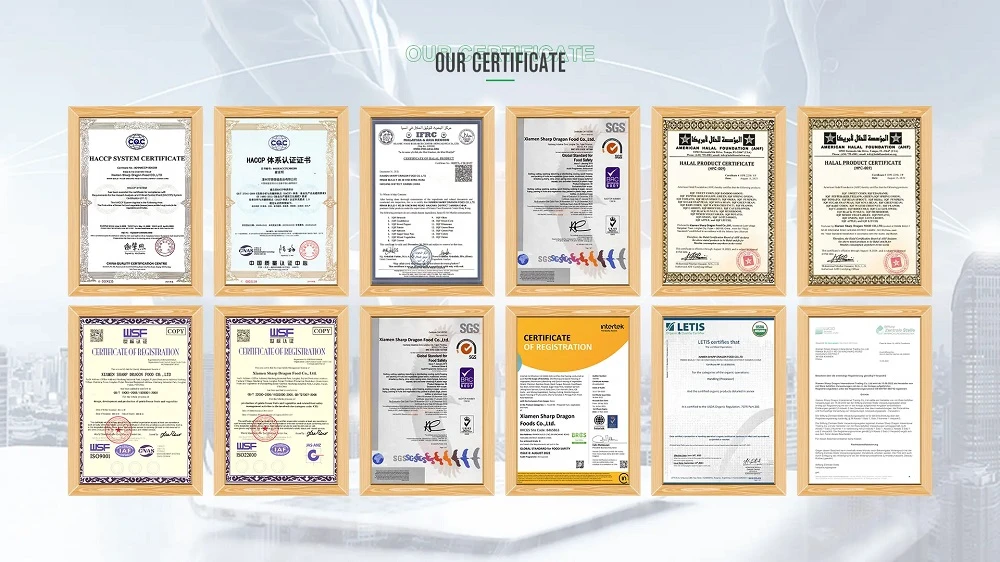
Certificates BRC, HACCP, ISO, KOSHER, HALAL, FDA registration or ECO CERT evidence according to factory and order availability
Documents Specification, COA, invoice, packing list, bill of lading, origin, health documents, certificate copies and loading photos by order

Product Video

Kiwi slices. We confirm the final cut, processing method and packing against your order specification.

Watch on YouTube

Important Application Note: Frozen Kiwi Is Not Always a Fresh-Slice Replacement

Frozen kiwi slices work well in frozen and semi-thawed applications. When fully thawed, they may soften and release juice, so they should not automatically be specified as a direct replacement for firm fresh kiwi decoration.

For visual toppings or fruit cups, buyers should test thawing time, slice integrity, drip loss and service temperature. For blending, fillings and frozen desserts, controlled pieces or dices may provide better handling than premium whole slices.

Applications & Quality Requirements

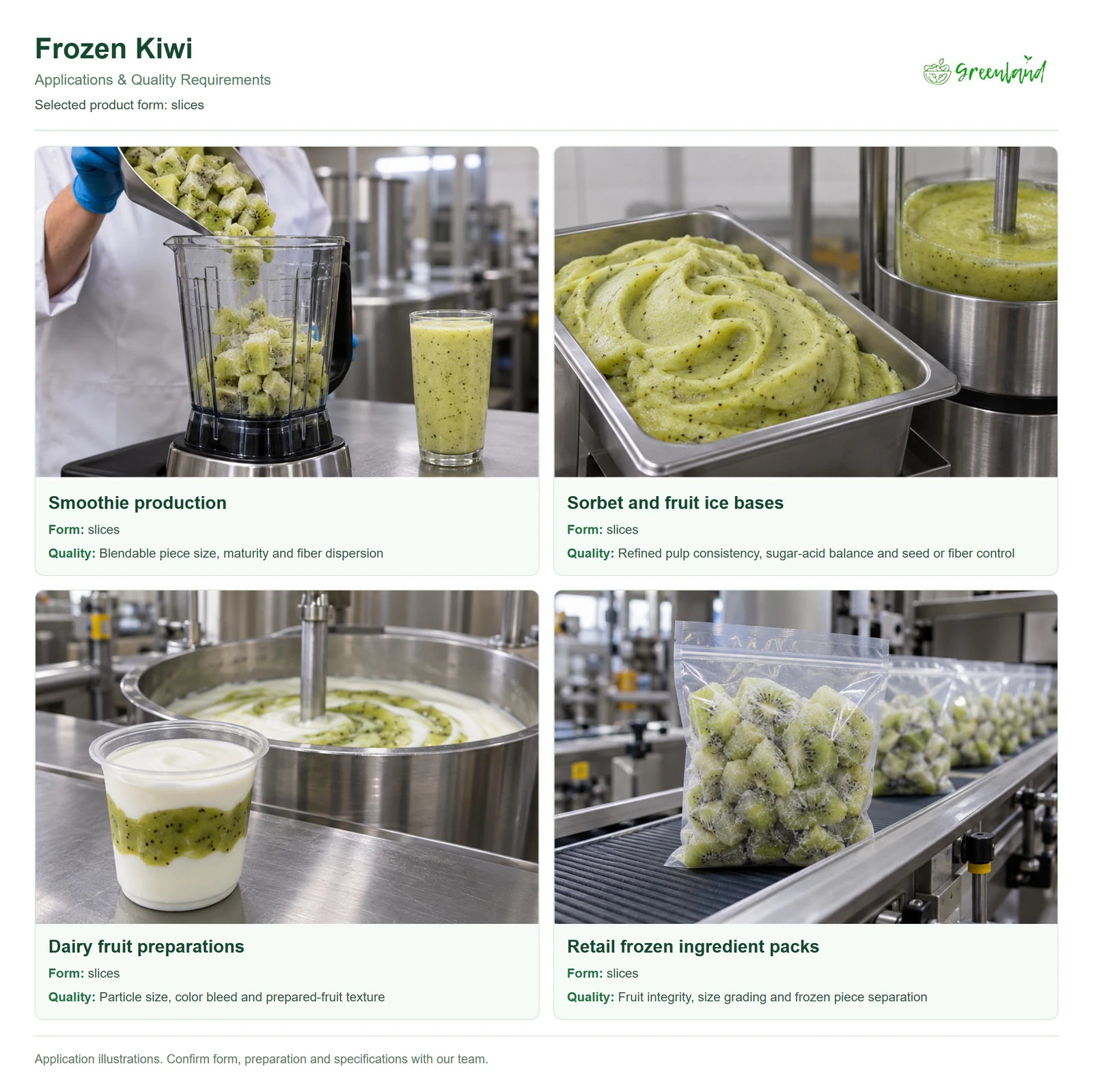
We match Freeze Kiwi Slices to your processing or packing line. Product form to confirm: Slices. Tell us the intended use and target texture so we can review the relevant size, grade, preparation and packing requirements before quotation.

Freeze Kiwi Slices applications and quality requirements: Smoothie production, Sorbet and fruit ice bases, Dairy fruit preparations, Retail frozen ingredient packs
Application illustrations. Product form, preparation and suitability follow the confirmed specification. Open the overview to inspect the image.
Smoothie production application illustration for Frozen Kiwi

Smoothie production

For: Beverage factories and foodservice commissaries

Form: slices

We review slices for your smoothie production programme. Confirm blendable piece size, maturity and fiber dispersion. Confirm intended-use safety specification; blending and thawing do not provide pathogen reduction.

Sorbet and fruit ice bases application illustration for Frozen Kiwi

Sorbet and fruit ice bases

For: Frozen dessert manufacturers

Form: slices

We review slices for your sorbet and fruit ice bases programme. Confirm refined pulp consistency, sugar-acid balance and seed or fiber control. Remove inedible parts, pulp/refine and validate dessert base preparation and final freezing behavior.

Dairy fruit preparations application illustration for Frozen Kiwi

Dairy fruit preparations

For: Fruit preparation and dairy purchasing teams

Form: slices

We review slices for your dairy fruit preparations programme. Confirm particle size, color bleed and prepared-fruit texture. Prepare and validate the fruit component before dairy addition; check acidity, enzyme activity and microbiological suitability. Kiwi protease compatibility requires treatment trials.

Retail frozen ingredient packs application illustration for Frozen Kiwi

Retail frozen ingredient packs

For: Retail packers and private label purchasing teams

Form: slices

We review slices for your retail frozen ingredient packs programme. Confirm fruit integrity, size grading and frozen piece separation. Confirm consumer intended use and preparation instructions; no automatic thaw-and-eat positioning. Label the confirmed consumer preparation method and expected handling; do not imply unvalidated thaw-and-eat suitability.

Match the Application with the Purchasing Specification

ApplicationSelected formQuality points to confirm
Smoothie productionslicesblendable piece size, maturity and fiber dispersion
Sorbet and fruit ice basesslicesrefined pulp consistency, sugar-acid balance and seed or fiber control
Dairy fruit preparationsslicesparticle size, color bleed and prepared-fruit texture
Retail frozen ingredient packsslicesfruit integrity, size grading and frozen piece separation

Quality, Packing & Export Support

We connect the agreed product specification with packing, lot identity, applicable quality documents and frozen delivery planning. Review our quality control system, traceability support and factory audit and inspection support with your sourcing requirements.

Send us the product, required form, final application, key quality requirements, packing, quantity and destination market. We will review the supply programme and confirm the order specification with your team.

Discuss Your Application & Specification

Kiwi Enzyme Note for Dairy and Gelatin Applications

Kiwifruit naturally contains actinidin, a proteolytic enzyme. In some dairy, gelatin or protein-based formulations, kiwi may affect texture or gel formation. For yogurt toppings, dairy desserts, jelly products and protein desserts, we recommend application testing before bulk use.

Heat treatment or formulation adjustment may be required depending on the final recipe and process. The food manufacturer should validate compatibility under its own production conditions.

IQF Frozen Kiwi Slices Processing Flow

We prepare Freeze Kiwi Slices to the agreed product form, pretreatment, grade and packing specification. The diagram shows a typical production process; we confirm preparation and step order for your order.

IQF Kiwi Cuts Production Process; twelve typical production and handling stages, with captioned site references and clearly marked process illustrations.
Typical process flow. Final processing and step order follow the confirmed specification. Site photos show the captioned subjects and may illustrate a representative form; process illustrations show typical operations. Storage and loading photos are generic frozen-food references.

Production and handling stages

  1. Raw Material InspectionWe check identity, condition and the agreed raw-material criteria.
  2. Initial SortingWe remove visible defects and unsuitable material.
  3. WashingWe follow the confirmed cleaning and water-control route.
  4. Peeling & CuttingWe prepare the agreed cut form and remove the specified inedible parts.
  5. Size & Form GradingWe match size and form to the approved specification.
  6. DrainingWe remove excess surface water before freezing.
  7. IQF FreezingWe quick freeze prepared pieces and review separation.
  8. Frozen Product InspectionWe review the agreed defects, form, separation and frozen condition.
  9. Weighing, Packing & Metal ControlWe check net weight, pack integrity and agreed metal controls.
  10. Batch Review & ReleaseWe match lot identity and records to the agreed release checks.
  11. Frozen StorageWe maintain the agreed frozen-storage conditions and lot identity.
  12. Reefer LoadingWe review cartons, lot records and refrigerated shipment arrangements.

IQF Frozen Kiwi Slices Processing Flow

1. Receiving & Inspection We check variety, maturity, Brix or firmness when required, color, mould, bruising and decay.
2. Washing We clean the fruit before peeling and cutting.
3. Peeling & Trimming We remove skin, hard ends and defective tissue.
4. Slicing / Dicing We control diameter, thickness or cube size according to the approved form.
5. Visual Sorting We remove abnormal brown, damaged, underripe or overripe pieces.
6. IQF Freezing We quick freeze pieces to support separation and reduce clumping.
7. Final Inspection We check breakage, browning, peel residue, clumps and visible foreign material.
8. Metal Detection We apply metal detection before final packing.
9. Packing & Coding We check weight, seal, label, carton marks and batch code.
10. Frozen Storage & Loading We store at -18 C or below before reefer-container shipment.
frozen kiwi processing and packing line

Processing-line evidence supports evaluation of fruit handling, IQF freezing, inspection and export packing.

Quality Control and Food Safety

Raw Fruit Control
We confirm variety, maturity, color, firmness and visible defects and remove mouldy, rotten or seriously bruised fruit.
Cut Quality
We inspect diameter, thickness, dice size, edge integrity, seed distribution, peel residue and breakage.
Color & Browning
We limit processing exposure before freezing and remove abnormal brown or dull pieces.
IQF & Cold Chain
We manage quick freezing, free-flowing condition, frozen storage and reefer loading.
Foreign Material
We combine washing, sorting, visual inspection, metal detection and carton coding.
Testing & Documents
We coordinate COA, microbiology, residue and heavy-metal reports by market and order requirement.

Final microbiological, pesticide residue and heavy metal limits follow destination-market regulations and the buyer's approved specification; we do not present one test table as a universal global standard.

frozen kiwi halves and chunks for food processing

Larger kiwi forms provide evidence for maturity, flesh color and suitability for reprocessing or foodservice use.

Applications for Smoothies, Desserts, Yogurt and Fruit Blends

Smoothies & Beverages
Slices or chunks matched to blending, fruit tea toppings, smoothie bowls and beverage bases.
Yogurt & Dairy
Dices or topping pieces with application testing for enzyme-sensitive formulations.
Dessert & Ice Cream
Slices, dices or chunks selected for sorbet, popsicles, inclusions and frozen toppings.
Bakery & Pastry
Dices and pieces for filling or topping where thawing behavior has been tested.
Retail Fruit Packs
Free-flowing pieces, consumer pack weight, private-label artwork and mixed-fruit formulas.
Foodservice & Catering
Foodservice packs for hotel breakfast, buffet topping and frozen fruit preparation.

Packaging and Private Label Options

We match the pack with industrial handling, foodservice distribution or retail positioning. Before production, we review inner bag, carton strength, label language, barcode, batch number, dates, storage instruction, origin, importer information, nutrition panel when required and private-label artwork.

Packing Type Common Format Suitable Buyer
Bulk Carton 1 x 10 kg / carton Fruit blend factories, beverage processors and repackers
Foodservice Pack 4 x 2.5 kg or 10 x 1 kg Hotels, catering, smoothie shops and distributors
Retail Pack 300 g, 400 g, 500 g or 1 kg Retail chains, private label and frozen fruit brands
Mixed Fruit Pack Kiwi with mango, pineapple, strawberry or berries Smoothie packs, retail blends and foodservice
bulk frozen kiwi slices and mixed fruit packing

Product and packing photos help confirm form, frozen condition, net-weight plan and private-label presentation.

Certificates, Documents and Batch Traceability

Certificate availability is confirmed for the selected factory, product and market. We connect raw material, production, packing, frozen storage and shipment information through the finished-product batch code.

Factory Evidence
BRC, HACCP, ISO, KOSHER, HALAL, FDA registration or ECO CERT evidence according to applicable factory status.
Quality Files
Specification, COA, microbiological, pesticide residue and heavy metal reports by requirement.
Shipment Documents
Invoice, packing list, bill of lading, certificate of origin and health documents by destination market.
Pre-Shipment Evidence
Product, packing, carton-mark, batch and loading photos according to order agreement.
frozen kiwi supplier certificates and export documents

Certificate images indicate document capability; current validity and product scope must be checked before order confirmation.

Export, Cold Chain and Loading Information

We ship frozen kiwi by reefer container and maintain -18 C or below through storage and loading. Stable temperature reduces clumping, ice-crystal growth, color deterioration, package deformation and broken slices.

Storage -18 C or below
Shipment Reefer container by sea
MOQ Normally one 20' RF or 40' RH, subject to item and packing
40' RH Reference About 22-24 MT depending on packing
Mixed Loading Kiwi with mango, pineapple, strawberry, blueberry, raspberry or mixed fruit by plan
Loading Proof Product, carton, batch and loading photos by request
IQF frozen kiwi bulk supply and cold chain

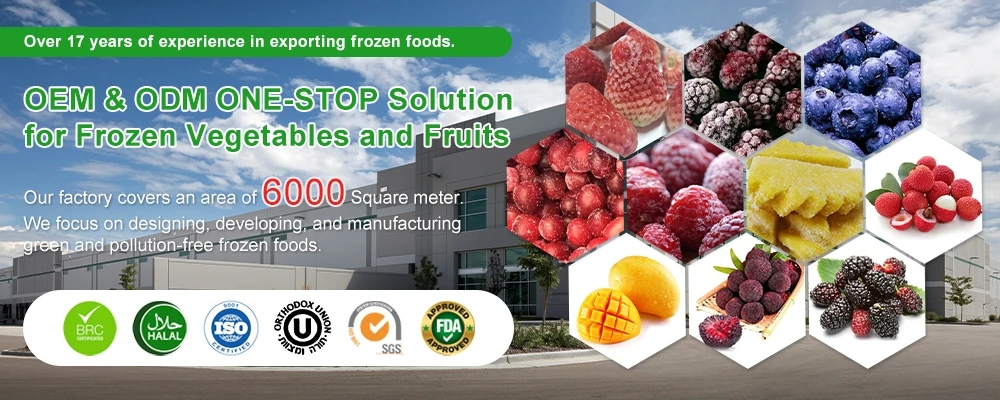
Frozen fruit supply evidence supports stock, mixed-container and reefer shipment planning.

Why Buyers Work with GreenLand-food for Frozen Kiwi

Product-Specific Understanding
We define Brix, ripeness, diameter, thickness, browning, breakage, drip loss and IQF separation.
Correct Form Matching
We separate slices, dices, chunks, halves and puree specifications according to application.
Practical Application Guidance
We explain thawing behavior and enzyme considerations instead of promising fresh-fruit texture.
Packing & Document Coordination
We review private label, QA files, batch records and cold-chain loading before shipment.
frozen kiwi export customers and buyer service

Buyer-service evidence covers specification, application, private-label, document and shipment coordination.

FAQ for Frozen Kiwi Buyers

Can kiwi slices be frozen?

Yes. IQF processing helps commercial kiwi slices remain separate and easier to portion for frozen-fruit applications.

Are frozen kiwi slices the same as fresh slices after thawing?

No. Full thawing may soften the fruit and release juice. Frozen or semi-thawed applications are usually a better match.

What frozen kiwi slice sizes can you supply?

References include 30-60 or 40-70 mm diameter and 5-8, 6-8 or 8-10 mm thickness.

Do you supply frozen kiwi dices?

Yes. Common dice references are 10x10, 12x12 and 15x15 mm, subject to production confirmation.

Can you supply green kiwi or golden kiwi?

Both can be discussed according to crop availability. Variety, color, Brix and application should be confirmed separately.

What is the normal Brix?

A reference around 10-14 degrees may be discussed, but the final value depends on variety, maturity and crop.

Are the kiwi slices peeled?

The standard slice form is normally peeled. Final processing and peel-residue tolerance follow the order specification.

How do you control browning and broken slices?

We control fruit freshness, maturity, peeling, cutting exposure, IQF freezing, sorting, handling, packing and cold-chain storage.

Can frozen kiwi be used in yogurt or gelatin products?

Yes, but application testing is important because natural actinidin may affect some dairy, gelatin or protein formulations.

What packaging formats are available?

References include 10 kg bulk cartons, 4 x 2.5 kg, 10 x 1 kg and 300 g, 400 g, 500 g or 1 kg retail packs.

Can you arrange private label packaging?

Yes. We review artwork, barcode, label language, dates, origin, storage instructions and importer information.

Can frozen kiwi be mixed with other frozen fruit?

Mixed loading or mixed-fruit packing can be discussed by stock, MOQ, carton size and production plan.

What documents can you provide?

We prepare specification, COA, commercial and shipment documents, certificate evidence and test reports by market and order.

What should I provide for quotation?

Send the form, variety, diameter, thickness or dice size, Brix target, packing, quantity, port, application and document needs.


Send an Inquiry for IQF Frozen Kiwi Slices

Send us the required kiwi form, variety, slice diameter, thickness, Brix target, broken ratio, packing, destination market, quantity, application and document needs. We will check current stock, crop planning, loading plan and quotation.

Hot Tags: freeze kiwi slices, China freeze kiwi slices manufacturers, suppliers, factory, freeze kiwi slices, freeze kiwi whole, iqf kiwi

Technical specification · reference schedule

Frozen Kiwi Slices

We review the selected form, grade, process and packing against the technical schedule below. Published and TDS values are specification references for order review. External benchmarks apply only within their stated scope. Acceptance is governed by the signed SKU specification; the identified lot COA reports actual measured results.

Form: Slices Product category: Frozen Kiwi

01 / Physical & Sensory

ParameterSpecification / referenceVerification & order basis
Diameter30–60 / 40–70 mmTDS referenceFrozen sample; caliper or cut gauge. Selected form and grade must match this TDS reference. Applies to: IQF slices.
Thickness5–8 / 6–8 / 8–10 mmTDS referenceFrozen sample; caliper or cut gauge. Selected form and grade must match this TDS reference. Applies to: IQF slices.
Dimensions - IQF Kiwi SlicesDiameter 30-60 or 40-70 mm; thickness 5-8, 6-8 or 8-10 mmPublished referenceConfirm method, representative sample and acceptance basis in the signed specification.
Dimensions - IQF Kiwi Chunks20-25 mm irregular pieces or customizedPublished referenceConfirm method, representative sample and acceptance basis in the signed specification.
Botanical NameActinidia deliciosa or Actinidia chinensis according to varietyPublished referenceCheck raw-material identity and variety/source declaration against the ordered programme.
Main FormPeeled kiwi slicesPublished referenceConfirm method, representative sample and acceptance basis in the signed specification.
Other FormsDices, chunks and halves; puree quoted separately when availablePublished referenceConfirm method, representative sample and acceptance basis in the signed specification.
Slice SizeDiameter 30-60 or 40-70 mm; thickness 5-8, 6-8 or 8-10 mm; customized by confirmationPublished referenceMeasure a defined frozen sample with caliper or size gauge; report distribution and tolerance.
ColorNatural green or golden flesh with black edible seeds; abnormal browning controlledPublished referenceCompare with the approved sensory reference using the stated frozen/thawed/prepared condition.
TextureSeparate when frozen; tender when semi-thawed; full thawing may cause softening and juice releasePublished referenceCompare with the approved sensory reference using the stated frozen/thawed/prepared condition.
Thickness & intact-cut inspectionMeasure thickness separately from fruit/cap/root diameter or piece length; classify broken cuts and end pieces.Use a thickness gauge/caliper and separate mass or count for intact and broken fractions.

02 / Physicochemical & Residue Controls

ParameterSpecification / referenceVerification & order basis
BrixReference around 10-14 degrees, depending on variety, maturity and crop; final standard by agreementPublished referenceMeasure representative prepared sample with a temperature-compensated refractometer.
Thaw yield / drip lossFor a drip-sensitive grade, define thawing conditions, draining apparatus and duration before setting a numerical target.Record initial sample mass and drained liquid mass; drip loss (%) = 100 × drained liquid mass / initial sample mass.
Pesticide residue scheduleNamed active ingredients and commodity-specific limits are selected for the destination market. EU sourceLink farm spray history, laboratory LOQ and batch result to the destination MRL. EU database is one market reference; apply the actual destination rule.
Lead, cadmium and other contaminantsApply the limit for the exact commodity and processed form in the destination market. EU sourceState analyte, preparation basis, method, LOQ and lot result. Do not transfer a fresh-commodity limit to a processed form without the required assessment.

03 / Microbiological Criteria

ParameterSpecification / referenceVerification & order basis
Hygiene-indicator panelSelect aerobic count and relevant Enterobacteriaceae, coliform or E. coli indicators for the declared process and intended use. CodexReport each quantitative result in CFU/g, method/reporting limit, sample plan and lot identity.
Pathogen acceptance programmeDefine Salmonella and Listeria criteria when applicable to the destination, ready-to-eat status and buyer programme. CodexState analytical portion, sample-unit plan, method and detected/not-detected reporting; identify the treatment and release basis.
Yeast & mould enumerationSelect separate yeast and mould criteria for the ordered grade and process; assess storage stability with the applicable product data. CodexReport yeast and mould separately in CFU/g using validated matrix-specific methods.
Acceptance scheduleSelect the test panel and limits by intended use (ready-to-eat or further processing), product form and destination. EU sourceState organism, analytical method, sample mass and n/c plan; report actual lot results. A universal APC, coliform, Salmonella or Listeria limit is not assigned to every frozen product.

04 / Freezing & Cold Chain

ParameterSpecification / referenceVerification & order basis
Frozen storage and transport≤−18 °CTDS referenceProduct core check and logger record. Selected form and grade must match this TDS reference. Applies to: Frozen Kiwi frozen formats.
Shelf Life / Storage24 months at -18 C or below under continuous frozen storagePublished referenceVerify unopened-pack validation, declared storage condition and production/best-before coding.
Storage-18 C or belowPublished referenceConfirm method, representative sample and acceptance basis in the signed specification.
Separation & loose-ice assessmentKeep inherent moisture, loose ice and permanently frozen clusters as separate inspection categories.Weigh separated loose ice and welded clusters against initial sample mass; distinguish natural paired pieces or blocks.
Product thermal centre−18°C or colder after freezing and thermal stabilization; maintain the agreed frozen distribution condition.External reference CodexProbe the thickest representative pack and retain storage/transport temperature records. Codex quick-frozen reference; selected product form and route must be frozen.
Frozen condition at dispatchHard frozen, correctly sealed and coded, without thaw/refreeze evidence or excessive loose ice. CodexCheck pack integrity, free-flow or block condition as declared, carton condition and loading temperature.

05 / Pack Size & Shelf Life

ParameterSpecification / referenceVerification & order basis
Bulk Packing1 × 10 kg cartonPublished referenceCheck approved pack drawing, calibrated scale and production records.
9. Packing & CodingWe check weight, seal, label, carton marks and batch code.Published referenceCheck approved pack drawing, calibrated scale and production records.
Declared net contentsVerify each selected pack format against the artwork and applicable quantity-control rule. CodexCalibrated checkweigher or scale; defined sample and tare.
Shelf-life basisThe labelled period applies only to its validated pack and continuous stated storage condition. CodexReview stability study or approved shelf-life file and production-date code.

06 / Process Controls

ParameterSpecification / referenceVerification & order basis
ProcessingWashing, peeling, trimming, slicing or dicing, IQF freezing, inspection, metal detection and packingPublished referenceCheck the approved product flow, line settings and identified production record; validate numerical critical limits within the site HACCP plan.
Raw-material preparation checksDeclare peeled state, cultivar and whole/sliced form; control cutting damage and maturity.Verify the selected product flow and the relevant trimming, sorting and pretreatment record.
Declared routeWashing, peeling, trimming, slicing or dicing, IQF freezing, inspection, metal detection and packingVerify approved process flow, line record and finished-product identity. Page-described route; numerical set-points require the approved line SOP.
CCP designationUse the site-approved HACCP plan to identify true CCPs and their validated critical limits. CodexCheck hazard analysis, monitoring, deviation and corrective-action records. A quality-control step is not automatically a CCP.

07 / Ingredients, Additives & Allergens

ParameterSpecification / referenceVerification & order basis
Added glaze / coating declarationDeclare any intentionally added water glaze, syrup, oil or coating and the measurement basis; loose ice is assessed separately.Verify formula/addition records; agree a deglazing or coating test and net-content basis where applicable.
Ingredient statementkiwi as the main raw material; exact ingredient and additive declaration pending selected SKUCompare approved formula, product label and supplier bill of materials. Published product statement; verify final commercial formula.
Additive useDeclare any colour-protection agent, acidulant or other additive by ingredient and maximum permitted use for the target market. NHC standardCheck approved formula, actual addition record and market-specific additive category. GB 2760-2024 applies to China; export rules are checked separately.
Allergen and cross-contact assessmentDeclare inherent allergens and assess shared-line cross-contact from the actual facility schedule. FDAReview line matrix, cleaning validation and buyer label approval. Do not claim a shared-line allergen or allergen-free status without facility evidence.

08 / Defects & Foreign Matter

ParameterSpecification / referenceVerification & order basis
Defect ControlMould, decay, bruising, underripe or overripe fruit, abnormal brown pieces, peel residue, breakage and clumps by agreed tolerancePublished referenceInspect a defined representative sample; record count or mass basis and disposition.
Intrinsic defect classificationPeel where peeled, hard core, brown tissue, soft pieces and irregular slices.Record each defect class separately by count or mass; state sample size, denominator and combined-limit rules.
Hazardous foreign matterNo foreign matter detected in the defined inspection sample; reject and investigate any finding.External reference CodexDefine visual-inspection sample size and detector challenge in the signed quality schedule. "None detected" is a sampling statement, not an absolute guarantee of zero particles.

09 / Packaging Materials & Label

ParameterSpecification / referenceVerification & order basis
Food-contact packSpecify inner-contact material and obtain the applicable food-contact compliance declaration. NHC standardReview film structure, supplier DoC, migration evidence and actual intended conditions. GB 4806 series is China-specific; EU export also checks Regulations 1935/2004 and 10/2011.
Carton and seal integrityDefine carton stacking strength, bag seal and puncture resistance for the confirmed net weight and pallet plan. EU sourceInspect pack drawing, compression/seal test and shipment configuration.
Label verificationMatch product name, ingredient/allergen statement, net weight, lot/date, shelf life and storage instruction to the destination artwork. CodexApprove artwork against the signed specification and destination rules.

10 / Detection & Traceability

ParameterSpecification / referenceVerification & order basis
8. Metal DetectionWe apply metal detection before final packing.Published referenceChallenge the actual packed product on the selected line with validated test pieces.
Foreign-body detectorValidate Fe, non-Fe and stainless-steel challenge pieces for the actual product, aperture, pack and line; record the proven sensitivity. CodexChallenge at defined start, changeover, interval and end points; retain rejection records. Do not copy generic detector sizes into a plant capability claim.
Lot traceabilityLink input source lot, processing run, packaging code, test records, frozen storage and shipment to one finished lot. CodexTrace one sample lot forward and backward in a recorded mock recall. Recall speed is stated only when the site has a validated target and record.
Order approval: Confirm the selected form and grade, ingredient formula, intended use, destination market, packing, sampling plan and test panel. The signed specification controls acceptance; the identified lot COA reports actual results.

Send Inquiry