Gloved workers sorting whole frozen strawberries on a metal table
Whole and halved frozen strawberries showing pale cut surfaces
1/
Frozen Sliced Strawberries
We supply unsweetened IQF frozen sliced strawberries for bakery plants, dairy and dessert manufacturers, fruit-preparation processors, foodservice distributors, importers and private-label programmes. We quote against a measurable cut specification rather than the product name alone: nominal thickness, thickness tolerance, recognisable-slice ratio, broken-piece limit, Brix, pH, defect grade, packaging, test panel and shipment plan are written into the order standard.
Frozen Sliced Strawberries with Defined Thickness, Grade and Batch COA
We supply unsweetened IQF frozen sliced strawberries for bakery plants, dairy and dessert manufacturers, fruit-preparation processors, foodservice distributors, importers and private-label programmes. We quote against a measurable cut specification rather than the product name alone: nominal thickness, thickness tolerance, recognisable-slice ratio, broken-piece limit, Brix, pH, defect grade, packaging, test panel and shipment plan are written into the order standard.
The photographed comparison separates whole fruit, halves, round slices, dice, bits and puree. Our sliced quotations identify one cut form and one dimensional standard; these forms are not interchangeable.
The buyer is purchasing cut performance, not only frozen fruit
We compare slice thickness, breakage allowance, frozen separation and shipment documents before we quote the grade. Send the intended application and pack so we can record those choices in one specification.
Our standard nominal thicknesses are 6 mm, 8 mm and 10 mm. Project ranges of 5–7 mm, 7–9 mm or 8–10 mm can be quoted when the buyer prefers a range instead of a nominal target. We keep whole berries, halves, dice and crumbles outside a sliced lot unless the contract explicitly permits them as a measured tolerance.
Fast RFQ: send thickness, Grade A or Grade B, recognisable-slice ratio, fine-piece limit, pack, annual volume, destination port, final application and required laboratory panel.
Frozen sliced strawberry supply summary
Procurement item
Standard supply direction
Order decision
Product
Unsweetened IQF frozen strawberry slices
No syrup and no added sugar unless a separate formula is ordered.
Cut
6 mm, 8 mm or 10 mm nominal
5–7, 7–9 and 8–10 mm project ranges are available.
Grade
Grade A or Grade B
Grade determines colour, slice integrity, defects and price.
Soluble solids
7–11 °Bx
A tighter minimum can be ordered for fruit preparation.
Acidity direction
pH 3.0–4.0
The batch COA shows the tested value when included.
Bulk packing
10 kg PE liner in export carton
5 kg foodservice and 1 kg retail packs can be quoted.
Storage / shelf life
−18°C or below / 24 months
Unopened product under continuous frozen storage.
Commercial starting point
Planning reference: 10 MT standard bulk pack MOQ; confirm for the selected thickness, grade, pack and load.
Planning reference: printed retail packaging may start from 15 MT per artwork; confirm film, carton and load plan.
A sliced lot must still look like slices
For our sliced-strawberry offer, a recognisable slice is a strawberry cross-section retained after cutting and freezing, under the definition and inspection method agreed with your team. We measure slice thickness separately from the by-weight recognisable-slice and fine-piece fractions. A pack dominated by dice or crumbles does not meet a slice-grade order merely because its label says sliced.
For visible Grade A applications, our commercial starting point is at least 85% recognisable slices by weight and no more than 5% pieces below 5 mm. For processing Grade B, the starting points are at least 75% recognisable slices and no more than 8% below 5 mm. The signed specification and approved frozen sample govern the order.
Actual bulk frozen strawberry pieces with round cut faces visible through a clear liner. This is a product-form reference, not a promise of the final carton presentation or a substitute for the approved sample.
Measurable slice geometry and physical acceptance
We recommend writing every cut requirement as a testable property. "Approximately sliced" creates disagreement at receiving; a nominal thickness, tolerance band, sampling mass and weight-based acceptance rule give the buyer and supplier the same inspection language. The following table is our detailed commercial starting point for quotations. A buyer may select the Grade A column, the Grade B column or a project-specific combination.
Physical item
Grade A starting limit
Grade B starting limit
Inspection basis
Thickness conformity
≥90% within nominal ±2 mm
≥85% within nominal ±2 mm
Measure representative thawed pieces without compression.
Recognisable slices
≥85% by weight
≥75% by weight
Intact or substantially intact strawberry cross-sections.
Fines below 5 mm
≤5% by weight
≤8% by weight
Separate using the agreed screen or manual measurement.
Clumps
≤2% by weight
≤4% by weight
Pieces not separable by gentle hand pressure while frozen.
Loose ice
≤1.0% by weight
≤2.0% by weight
Free ice separated from the frozen sample.
White / underripe tissue
≤3% by weight
≤5% by weight
Excludes the natural pale central core agreed in the reference sample.
Dark / oxidised pieces
≤2% by weight
≤4% by weight
Abnormal brown or dark tissue, not normal varietal red.
Calyx, stems, mould and decay
Absent
Absent
Visual inspection of the representative sample.
Extraneous vegetable matter
Absent
Absent
Leaves, field material and non-strawberry plant matter.
Whole IQF strawberries in a lined bulk carton with a caliper. The image supports raw-material size review before slicing; it is not presented as a photograph of finished slices.
Raw material determines the finished cross-section
We receive ripe, sound, stemmed strawberries by identified lot and inspect colour, maturity, visible damage, decay, off-odour and foreign material. Whole-fruit diameter affects the number and diameter of usable slices. A small berry cut at 10 mm will produce fewer complete cross-sections than a larger berry, while a thin 6 mm cut normally gives more pieces but increases breakage risk.
Our normal whole-fruit size references are 15–25 mm and 25–35 mm, subject to crop and variety. American No. 13, Sweet Charlie, Honey and buyer-approved equivalents may be used according to availability and the approved specification. We match the raw fruit to your required slice diameter. If the specification allows equivalent varieties, we'll agree the available options with you before confirming the order.
Applications & Quality Requirements
We match Frozen Sliced Strawberries to your processing or packing line. Product form to confirm: Slices. Tell us the intended use and target texture so we can review the relevant size, grade, preparation and packing requirements before quotation.
Application illustrations. Product form, preparation and suitability follow the confirmed specification. Open the overview to inspect the image.
Jam & Fruit Spreads
For: Preserve and fruit preparation manufacturers
Form: slices
We review slices for your jam & fruit spreads programme. Confirm Brix-acidity balance, seed or stem control and cooked gel behavior. Pulp or size-reduce as required; validate cooking, gel formulation and filling controls.
Dairy fruit preparations
For: Fruit preparation and dairy purchasing teams
Form: slices
We review slices for your dairy fruit preparations programme. Confirm particle size, color bleed and prepared-fruit texture. Prepare and validate the fruit component before dairy addition; check acidity, enzyme activity and microbiological suitability.
Bakery fillings
For: Bakery ingredient purchasing teams
Form: slices
We review slices for your bakery fillings programme. Confirm slice thickness, broken-piece tolerance and bake moisture release. Cook or formulate the filling and validate bake performance; freezing is not a kill step.
Ice Cream Inclusions
For: Ice cream ingredient procurement teams
Form: slices
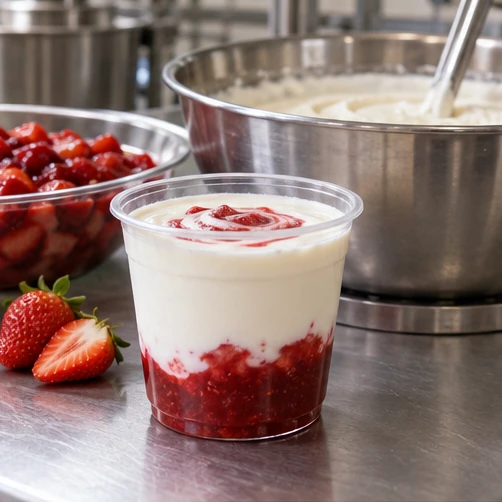
We review slices for your ice cream inclusions programme. Confirm inclusion size, freeze texture and ripple consistency. Validate fruit preparation, freezing texture and safe addition stage; raw frozen fruit is not ready-to-eat by default.
Match the Application with the Purchasing Specification
Application
Selected form
Quality points to confirm
Jam & Fruit Spreads
slices
Brix-acidity balance, seed or stem control and cooked gel behavior
Dairy fruit preparations
slices
particle size, color bleed and prepared-fruit texture
Bakery fillings
slices
slice thickness, broken-piece tolerance and bake moisture release
Ice Cream Inclusions
slices
inclusion size, freeze texture and ripple consistency
Tell us the target slice thickness and diameter and how the slices will be used. We'll check the available grades and agree the thickness range, breakage criteria and pack for your order.
The values below are specification limits or commercial ranges, not pre-filled batch results. The COA reports the actual result measured for the released production lot. Where the buyer needs a tighter value, we place it in the signed specification before production and price the raw-material selection and testing programme accordingly.
Item
Specification direction
Method / commercial note
Ingredients
100% strawberries
Unsweetened and without syrup; additives only under a separate formula.
Origin
China
Crop source and producing facility are linked to the order record.
Processing
Hulled, washed, sliced, drained, IQF frozen, sorted and packed
No blanching is stated for ordinary IQF strawberry slices.
Appearance
Natural red to dark red strawberry cross-sections
Natural pale central tissue is assessed against the approved sample.
Flavour and odour
Characteristic ripe strawberry; no off-flavour or off-odour
Assessed after controlled thawing.
Brix
7–11 °Bx
Refractometer reading on homogenised thawed representative material.
pH
3.0–4.0
Measured on homogenised thawed representative material.
Foreign material
Absent
Visual sorting plus agreed foreign-material controls.
Allergen statement
Strawberry is not one of the major declarable allergens in common US/EU lists
Facility cross-contact statement is supplied for the named production site.
GMO direction
Non-GMO raw material
Statement wording follows the destination and customer file.
Storage
−18°C or below
Avoid thawing and refreezing; maintain the frozen chain.
Processing controls for clean cuts and free flow
We prepare Frozen Sliced Strawberries to the agreed product form, pretreatment, grade and packing specification. The diagram shows a typical production process; we confirm preparation and step order for your order.
Typical process flow. Cold-storage and loading photos are general frozen-food references. We confirm the process and step order for your product against the agreed specification.
Production and handling stages
Raw Material InspectionWe check identity, condition and the agreed raw-material criteria.
Initial SortingWe remove visible defects and unsuitable material.
WashingWe follow the confirmed cleaning and water-control route.
Hulling & CuttingWe prepare the agreed cut form and remove the specified inedible parts.
Size & Form GradingWe match size and form to the approved specification.
DrainingWe remove excess surface water before freezing.
IQF FreezingWe quick freeze prepared pieces and review separation.
Frozen Product InspectionWe review the agreed defects, form, separation and frozen condition.
Weighing, Packing & Metal ControlWe check net weight, pack integrity and agreed metal controls.
Batch Review & ReleaseWe match lot identity and records to the agreed release checks.
Frozen StorageWe maintain the agreed frozen-storage conditions and lot identity.
Reefer LoadingWe review cartons, lot records and refrigerated shipment arrangements.
Actual strawberries in a stainless-steel washing stage. This supports the raw-material cleaning process; the picture does not claim to show a sliced-product-only line.
Processing controls for clean cuts and free flow
We receive and lot-code the fruit, inspect it, remove calyx and unsuitable berries, wash with controlled water, drain, slice to the selected setting, remove excessive fragments, IQF freeze, sort in the frozen state, inspect, weigh, seal and transfer the cartons to frozen storage. Cutting blades, feed rate and berry firmness influence the finished geometry, so the line setting is tied to the approved sample rather than copied from another strawberry form.
Drainage before freezing reduces surface ice. Rapid individual freezing helps the pieces remain separable, but the finished pack still requires temperature control and protection from compression. At packing, we check free-flow condition, clumps, loose ice, colour, visible defects, net weight, liner seal, carton condition, label data and lot code.
Production flow and traceable release
Each production lot connects the incoming fruit record, processing date, line and shift record, in-process checks, packing material, finished-product inspection, laboratory results and storage location. The carton code is the operational link used when the importer receives the shipment and matches it to the COA and packing list.
We retain the agreed specification as the release standard. If the order is for 8 mm Grade A slices, the inspection is performed against the 8 mm programme and its listed tolerances-not against a general whole-strawberry specification. This separation prevents the most common documentation error on cut-fruit orders: a COA that identifies strawberries but never identifies the actual product form.
The strawberry process visual covers receiving, stemming, washing, draining, freezing, sorting, weighing, bag sealing and cold storage. The final cut setting remains product-specific.
Batch COA: limits and actual results kept separate
We provide the COA for the identified released lot. It states product name and cut, lot number, production date, best-before date, packaging, storage condition and the agreed test panel. The "Specification" column contains the acceptance limit. The "Actual Result" column contains the value measured for that production batch. We do not repeat a specification range in the actual-result column.
COA item
Commercial specification limit
How the batch is reported
Purpose
Brix
7–11 °Bx
One tested value, for example 8.6 °Bx
Soluble-solids reference for flavour and formulation.
pH
3.0–4.0
One tested value, for example 3.46
Useful for dairy, sauce and fruit-preparation systems.
Total plate count
≤100,000 CFU/g
Actual CFU/g
General microbiological load.
Yeast
≤1,000 CFU/g
Actual CFU/g
Spoilage control.
Mould
≤1,000 CFU/g
Actual CFU/g
Spoilage control.
Coliforms
<100 CFU/g
Actual CFU/g or below reporting limit
Hygiene indicator.
E. coli
<10 CFU/g
Actual CFU/g or below reporting limit
Hygiene indicator.
Salmonella
Absent in 25 g
Absent / detected
Pathogen criterion.
Listeria monocytogenes
Absent in 25 g when ordered
Absent / detected
Buyer or destination programme.
Lead (Pb)
≤0.10 mg/kg for the stated EU-oriented reference
Actual mg/kg or
Heavy-metal panel.
Cadmium (Cd)
≤0.030 mg/kg for the stated EU-oriented reference
Actual mg/kg or
Heavy-metal panel.
Pesticide-residue programme: we build the analyte list around the destination MRL schedule and buyer programme. For EU-oriented work, a 0.01 mg/kg default reporting/acceptance reference may apply where the regulation does not set a different product-specific MRL. The laboratory report identifies the tested lot, analytes, methods, LOQs and actual results. We describe the measured panel and batch results without making absolute residue claims.
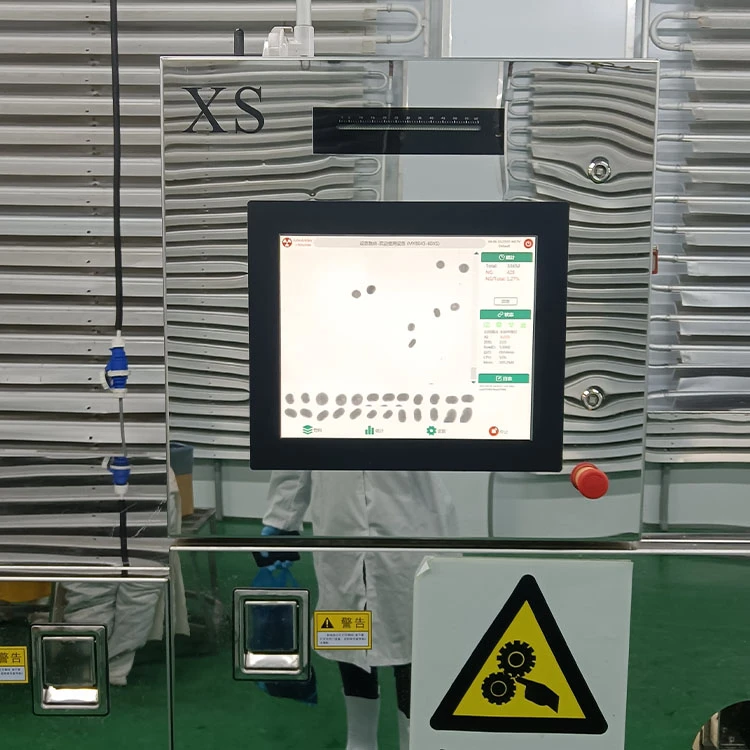
General frozen-fruit optical sorting equipment and its control screen. The image supports sorting capability; it is not identified as a dedicated strawberry-slice line or a record from the shipped batch.
Inspection plan: frozen first, then controlled thaw
We begin with the frozen sample because free flow, loose ice, clumps, pack condition and visible breakage can be altered by thawing. A representative sample is weighed, the frozen defects are separated and the results are calculated on the basis written in the specification. Thickness checks are made after pieces have softened enough to measure without cracking or compression.
For a controlled thaw test, we record sample weight, time and temperature. A practical factory or buyer protocol is 12–18 hours at 2–5°C in a covered container, followed by a two-minute drain on the agreed mesh. Drip loss is calculated as drained liquid divided by the original frozen sample weight. For visible Grade A projects, ≤20% drip loss is a useful starting limit; for processing Grade B, ≤25% can be used. The approved method and product application always accompany the limit because time, temperature and mesh change the result.
Application trials before a volume order
Trial frozen slices for drip loss, color bleed and application performance. Confirm sample form and quantity, fees and freight, destination and trial purpose before dispatch. Review sample evaluation. Record the approved sample identity, evaluation method and acceptance result with the order file.
One laboratory number cannot predict every finished product. We recommend an application trial using the exact thickness and grade under consideration. For bakery topping, record piece coverage per tray, breakage during depositing, colour after heating and liquid migration into the dough. For dairy and dessert inclusion, record frozen dosing, thawed slice visibility, serum release and distribution through the base. For fruit preparation, record Brix, pH, particle retention after mixing and pumpability.
6 mm slices
A useful starting point for broad topping coverage, layered desserts and faster thaw response. The thinner cut requires closer breakage control.
8 mm slices
A balanced industrial option for bakery, dairy, dessert and foodservice applications where both visibility and handling matter.
10 mm slices
A thicker piece for applications that prioritise fruit identity and bite. Larger berries normally give the best complete cross-sections.
Dice or crumbles
Choose these separate products when uniform small particles or easy pumping is more important than a visible slice profile.
Packing, private label and loading quantities
Confirm commercial terms for this order
We confirm payment terms, trade basis and lead time in the quotation and order agreement after reviewing the product grade, quantity, packing, destination and required documents. Please send your target shipment window; the schedule is confirmed against the actual production and loading plan. We confirm payment method, invoice currency, due date or payment milestones, and documents required for each payment stage in the signed quotation and order agreement.
We use a food-grade inner liner and export carton for bulk supply. The standard industrial pack is 10 kg net; 5 kg foodservice packs and 1 kg retail bags can be developed. A private-label project includes artwork, barcode, legal product name, ingredients, allergen statement, country of origin, nutrition panel where required, storage instruction, date format, lot code, net weight, importer information and outer-carton marks.
Commercial item
Working figure
Planning note
MOQ, standard 10 kg bulk
10 MT planning reference; confirm by order.
One agreed thickness, grade and pack.
MOQ, printed retail pack
15 MT per artwork planning reference; confirm by order.
Depends on film printing and carton minimums.
20-foot reefer
About 10–12 MT net
Final load follows carton dimensions and pallet choice.
40-foot high-cube reefer
About 20–24 MT net
Floor-loaded and palletised quantities differ.
Normal lead time
15–25 days planning reference only; confirm the production and shipment window for this order.
After specification, payment and packaging approval; crop and vessel space apply.
Loading port / terms
Qingdao, Shanghai or contracted China port; FOB, CFR or CIF
The quotation identifies the actual port, Incoterm and planned net load.
General company and facility certificate display. It supports document review only; it is not a strawberry batch COA, a pesticide report or proof that every certificate covers every facility and product.
Documents organised by purpose
Match sliced-strawberry lot COA and packing marks to the accepted cut form. Review document verification. For any requested certificate, confirm the supplying factory or holder, covered product, validity period and destination-market relevance; a certificate image is not a lot result.
We separate corporate and facility certificates from product and shipment records. The document pack can include the signed product specification, batch COA, microbiological report, pesticide-residue report, heavy-metal report, allergen statement, GMO statement, country-of-origin document, health certificate, phytosanitary document where applicable, commercial invoice, packing list, bill of lading and traceability information.
Certificate applicability depends on the producing facility, certification scope and order. Organic supply requires the named organic standard, certified chain and transaction documents; it is never implied by an ordinary strawberry photograph. A private-label importer should list its exact document names in the RFQ so that the quotation includes testing and certification costs.
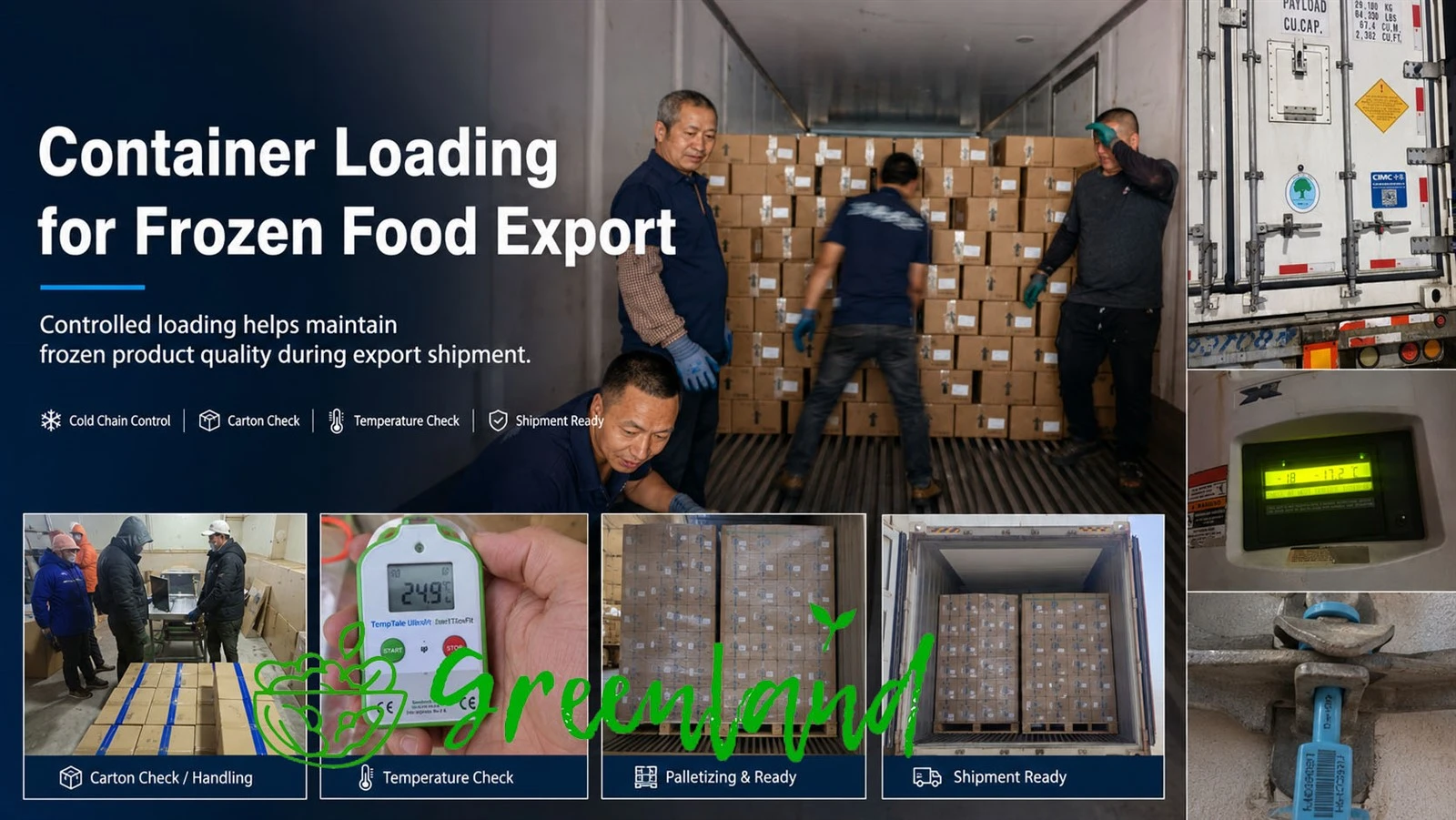
We store and ship frozen sliced strawberries at −18°C or below. Before loading, we check carton condition, lot marks, planned quantity, container cleanliness, odour, reefer set point, loading arrangement and seal information. The loading record and shipment documents identify the commercial consignment; the batch COA identifies the product lot.
Temperature abuse can create clumps, loose ice and texture damage even when the fruit originally left the line in acceptable condition. We therefore coordinate cold-store release, loading time and reefer operation, and we state the frozen-storage instruction on the label and documents. The product should not be thawed and refrozen during distribution.
If the slices arrive clumped, damaged, outside the agreed thickness or with abnormal thaw drip, retain carton and lot labels, affected quantity, receiving temperature, unopened-pack and sample photographs, and a representative frozen sample where practical. Start an arrival quality review so we can compare the result with the approved slice specification, sample and lot records, then document the response.
General frozen-food container loading, carton handling and temperature checks. The cartons are not identified as a specific strawberry-slice shipment.
Frozen Sliced Strawberries FAQ
1. What thicknesses of frozen sliced strawberries do you supply?
We supply 6 mm, 8 mm and 10 mm nominal slices. We can also quote 5–7 mm, 7–9 mm or 8–10 mm project ranges. The order states whether acceptance uses a nominal thickness with tolerance or a defined range.
2. How do you distinguish slices from broken pieces or dice?
We use a recognisable-slice ratio and a fine-piece threshold. Our Grade A starting point is at least 85% recognisable slices by weight with pieces below 5 mm limited to 5% by weight.
3. What is the difference between Grade A and Grade B?
Grade A uses tighter limits for recognisable slices, fines, clumps, loose ice, underripe tissue and dark pieces. Grade B is suitable for processing applications that can accept more fragments. The table on this page gives numerical starting limits for both.
4. Are the frozen strawberry slices unsweetened?
Yes. Our standard product is 100% strawberries without syrup or added sugar. Sweetened or formulated fruit is quoted as a separate product with its own ingredient declaration and process.
5. What Brix and pH specifications are available?
Our normal commercial direction is 7–11 °Bx and pH 3.0–4.0. We can quote a tighter Brix minimum for a defined application. The batch COA reports the actual tested values when they are included in the agreed panel.
6. How do you measure slice thickness?
We soften representative frozen pieces enough to measure without cracking or compression, then measure the cut face with a calibrated gauge. Our starting conformity limit is 90% within nominal ±2 mm for Grade A and 85% for Grade B.
7. Can drip loss be included in the specification?
Yes. We can use a controlled thaw of 12–18 hours at 2–5°C followed by a two-minute drain on an agreed mesh. A useful starting limit is ≤20% for visible Grade A applications and ≤25% for processing Grade B.
8. What microbiological limits do you use?
The standard commercial panel can use total plate count ≤100,000 CFU/g, yeast ≤1,000 CFU/g, mould ≤1,000 CFU/g, coliforms <100 CFU/g, E. coli <10 CFU/g and Salmonella absent in 25 g. Listeria monocytogenes absent in 25 g can be added.
9. Can you provide pesticide-residue and heavy-metal reports?
Yes. We arrange the agreed analyte panel for the destination and provide actual lot results and LOQs. For the EU-oriented reference on this page, Pb is limited to 0.10 mg/kg and Cd to 0.030 mg/kg; the applicable order standard remains controlling.
10. What bulk and retail packs are available?
The standard industrial pack is a 10 kg food-grade PE liner in an export carton. We also quote 5 kg foodservice packs, 1 kg retail bags and buyer-approved private-label sizes.
11. What are the MOQ, lead time and reefer quantities?
For planning, 10 MT bulk and 15 MT per printed retail artwork are starting references; MOQ and lead time, including the 15–25 day planning range, are confirmed for the selected slice grade, packaging, quantity, destination, tests, crop availability and vessel plan. A 20-foot reefer may carry about 10–12 MT and a 40-foot high-cube reefer about 20–24 MT, subject to the approved pack and pallet plan.
12. What is the shelf life of IQF strawberry slices?
The standard shelf life is 24 months for unopened product held continuously at −18°C or below. Repeated thawing and refreezing can damage texture and free-flow condition and is not part of the shelf-life basis.
13. Can you produce private-label frozen sliced strawberries?
Yes. We coordinate bag and carton artwork, barcode, language, declarations, lot and date coding, outer marks and destination documents. Printed-film and carton minimums determine the final MOQ and timing.
14. What information gives the most accurate quotation?
Send nominal thickness or range, grade, recognisable-slice and fine-piece limits, Brix, pH, pack, quantity, destination, Incoterm, application, test panel, certificate list, private-label requirements and requested shipment date.
Build your frozen sliced strawberry specification
Send the target thickness, Grade A or Grade B, recognisable-slice ratio, fine-piece and drip-loss limits, pack, quantity, destination port, application, private-label scope, laboratory panel and required shipment date. We will quote the defined product, batch document set and loading plan.
We review the selected form, grade, process and packing against the technical schedule below. Published and TDS values are specification references for order review. External benchmarks apply only within their stated scope. Acceptance is governed by the signed SKU specification; the identified lot COA reports actual measured results.
Form: SlicesProduct category: Frozen Strawberry
01 / Physical & Sensory
Parameter
Specification / reference
Verification & order basis
Thickness
6 / 8 / 10 mm nominalTDS reference
Frozen sample; caliper or cut gauge. Selected form and grade must match this TDS reference. Applies to: IQF slices.
Cut
6 mm, 8 mm or 10 mm nominalPublished reference
Measure a defined frozen sample with caliper or size gauge; report distribution and tolerance.
Grade
Grade A or Grade BPublished reference
Confirm method, representative sample and acceptance basis in the signed specification.
Thickness conformity - Grade A starting limit
≥90% within nominal ±2 mmPublished reference
Measure representative thawed pieces without compression. Programme: Grade A starting limit.
Thickness conformity - Grade B starting limit
≥85% within nominal ±2 mmPublished reference
Measure representative thawed pieces without compression. Programme: Grade B starting limit.
Origin - Specification direction
ChinaPublished reference
Crop source and producing facility are linked to the order record. Programme: Specification direction.
Appearance - Specification direction
Natural red to dark red strawberry cross-sectionsPublished reference
Natural pale central tissue is assessed against the approved sample. Programme: Specification direction.
Flavour and odour - Specification direction
Characteristic ripe strawberry; no off-flavour or off-odourPublished reference
Assessed after controlled thawing. Programme: Specification direction.
Thickness & intact-cut inspection
Measure thickness separately from fruit/cap/root diameter or piece length; classify broken cuts and end pieces.
Measure nominal slice thickness with a suitable caliper or gauge. For recognisable-slice and broken-piece percentages stated by weight, sort the agreed categories, weigh each and divide by the initial representative sample mass; record sample size and definitions.
Sensory acceptance
Characteristic colour, flavour and texture for the declared product; no abnormal odour or visibly deteriorated material.External referenceCodex
Compare an identified frozen sample with the approved grade and defect schedule. External technical reference; confirm SKU and market applicability.
02 / Physicochemical & Residue Controls
Parameter
Specification / reference
Verification & order basis
Soluble solids
7–11 °BxPublished reference
Measure representative prepared sample with a temperature-compensated refractometer.
pH
pH 3.0–4.0Published reference
Use calibrated pH meter or titration on the stated sample preparation.
Brix - Specification direction
7–11 °BxPublished reference
Refractometer reading on homogenised thawed representative material. Programme: Specification direction.
pH - Specification direction
3.0–4.0Published reference
Measured on homogenised thawed representative material. Programme: Specification direction.
Thaw yield / drip loss
For a drip-sensitive grade, define thawing conditions, draining apparatus and duration before setting a numerical target.
Record initial sample mass and drained liquid mass; drip loss (%) = 100 × drained liquid mass / initial sample mass.
Pesticide residue schedule
Named active ingredients and commodity-specific limits are selected for the destination market. EU source
Link farm spray history, laboratory LOQ and batch result to the destination MRL. EU database is one market reference; apply the actual destination rule.
Lead, cadmium and other contaminants
Apply the limit for the exact commodity and processed form in the destination market. EU source
State analyte, preparation basis, method, LOQ and lot result. Do not transfer a fresh-commodity limit to a processed form without the required assessment.
03 / Microbiological Criteria
Parameter
Specification / reference
Verification & order basis
Hygiene-indicator panel
Select aerobic count and relevant Enterobacteriaceae, coliform or E. coli indicators for the declared process and intended use. Codex
Report each quantitative result in CFU/g, method/reporting limit, sample plan and lot identity.
Pathogen acceptance programme
Define Salmonella and Listeria criteria when applicable to the destination, ready-to-eat status and buyer programme. Codex
State analytical portion, sample-unit plan, method and detected/not-detected reporting; identify the treatment and release basis.
Enteric-virus risk programme
For a direct-consumption berry programme, assess hepatitis A and norovirus controls and any buyer-required verification. FDA
Use an appropriate validated method and sampling plan; support testing with farm, worker and water hygiene controls. FDA prevention guidance is a risk-control reference; it does not assign a universal numerical batch limit.
Acceptance schedule
Select the test panel and limits by intended use (ready-to-eat or further processing), product form and destination. EU source
State organism, analytical method, sample mass and n/c plan; report actual lot results. A universal APC, coliform, Salmonella or Listeria limit is not assigned to every frozen product.
04 / Freezing & Cold Chain
Parameter
Specification / reference
Verification & order basis
Frozen storage and transport
≤−18 °CTDS reference
Product core check and logger record. Selected form and grade must match this TDS reference. Applies to: Frozen Strawberry frozen formats.
Storage / shelf life
−18°C or below / 24 monthsPublished reference
Verify unopened-pack validation, declared storage condition and production/best-before coding.
Storage - Specification direction
−18°C or belowPublished reference
Avoid thawing and refreezing; maintain the frozen chain. Programme: Specification direction.
Separation & loose-ice assessment
Keep inherent moisture, loose ice and permanently frozen clusters as separate inspection categories.
Weigh separated loose ice and welded clusters against initial sample mass; distinguish natural paired pieces or blocks.
Product thermal centre
−18°C or colder after freezing and thermal stabilization; maintain the agreed frozen distribution condition.External referenceCodex
Probe the thickest representative pack and retain storage/transport temperature records. Codex quick-frozen reference; selected product form and route must be frozen.
Frozen condition at dispatch
Hard frozen, correctly sealed and coded, without thaw/refreeze evidence or excessive loose ice. Codex
Check pack integrity, free-flow or block condition as declared, carton condition and loading temperature.
05 / Pack Size & Shelf Life
Parameter
Specification / reference
Verification & order basis
Bulk packing
10 kg PE liner in export cartonPublished reference
Check approved pack drawing, calibrated scale and production records.
Declared net contents
Verify each selected pack format against the artwork and applicable quantity-control rule. Codex
Calibrated checkweigher or scale; defined sample and tare.
Shelf-life basis
The labelled period applies only to its validated pack and continuous stated storage condition. Codex
Review stability study or approved shelf-life file and production-date code.
06 / Process Controls
Parameter
Specification / reference
Verification & order basis
Processing - Specification direction
Hulled, washed, sliced, drained, IQF frozen, sorted and packedPublished reference
No blanching is stated for ordinary IQF strawberry slices. Programme: Specification direction.
Raw-material preparation checks
Separate unsweetened IQF, syrup-packed fruit, puree and freeze-dried styles; hull before the declared processing route.
Verify the selected product flow and the relevant trimming, sorting and pretreatment record.
Declared route
Hulled, washed, sliced, drained, IQF frozen, sorted and packed
Verify approved process flow, line record and finished-product identity. Page-described route; numerical set-points require the approved line SOP.
CCP designation
Use the site-approved HACCP plan to identify true CCPs and their validated critical limits. Codex
Check hazard analysis, monitoring, deviation and corrective-action records. A quality-control step is not automatically a CCP.
07 / Ingredients, Additives & Allergens
Parameter
Specification / reference
Verification & order basis
Ingredients - Specification direction
100% strawberriesPublished reference
Unsweetened and without syrup; additives only under a separate formula. Programme: Specification direction.
Allergen statement - Specification direction
Strawberry is not one of the major declarable allergens in common US/EU listsPublished reference
Facility cross-contact statement is supplied for the named production site. Programme: Specification direction.
GMO direction - Specification direction
Non-GMO raw materialPublished reference
Statement wording follows the destination and customer file. Programme: Specification direction.
Added glaze / coating declaration
Declare any intentionally added water glaze, syrup, oil or coating and the measurement basis; loose ice is assessed separately.
Verify formula/addition records; agree a deglazing or coating test and net-content basis where applicable.
Ingredient statement
100% strawberriesTechnical control
Compare approved formula, product label and supplier bill of materials. Published product statement; verify final commercial formula.
Additive use
Declare any colour-protection agent, acidulant or other additive by ingredient and maximum permitted use for the target market. NHC standard
Check approved formula, actual addition record and market-specific additive category. GB 2760-2024 applies to China; export rules are checked separately.
Allergen and cross-contact assessment
Declare inherent allergens and assess shared-line cross-contact from the actual facility schedule. FDA
Review line matrix, cleaning validation and buyer label approval. Do not claim a shared-line allergen or allergen-free status without facility evidence.
08 / Defects & Foreign Matter
Parameter
Specification / reference
Verification & order basis
Clumps - Grade A starting limit
≤2% by weightPublished reference
Pieces not separable by gentle hand pressure while frozen. Programme: Grade A starting limit.
Clumps - Grade B starting limit
≤4% by weightPublished reference
Pieces not separable by gentle hand pressure while frozen. Programme: Grade B starting limit.
Loose ice - Grade A starting limit
≤1.0% by weightPublished reference
Free ice separated from the frozen sample. Programme: Grade A starting limit.
Loose ice - Grade B starting limit
≤2.0% by weightPublished reference
Free ice separated from the frozen sample. Programme: Grade B starting limit.
Calyx, stems, mould and decay - Grade A starting limit
AbsentPublished reference
Visual inspection of the representative sample. Programme: Grade A starting limit.
Calyx, stems, mould and decay - Grade B starting limit
AbsentPublished reference
Visual inspection of the representative sample. Programme: Grade B starting limit.
Extraneous vegetable matter - Grade A starting limit
AbsentPublished reference
Leaves, field material and non-strawberry plant matter. Programme: Grade A starting limit.
Extraneous vegetable matter - Grade B starting limit
AbsentPublished reference
Leaves, field material and non-strawberry plant matter. Programme: Grade B starting limit.
Foreign material - Specification direction
AbsentPublished reference
Visual sorting plus agreed foreign-material controls. Programme: Specification direction.
Stalks or stalk parts: Codex reference tolerance
≤3 stalks or parts each >3 mm in one dimension count per 500 g drained fruitExternal referenceCodex
Thaw until practically free of ice crystals; drain on a 3 mesh/cm (8 mesh/inch) screen for two minutes; assess 500 g drained fruit. Recover specified plant material from drained syrup; wash off post-freezing dry sugar before draining whole berries. Codex reference for quick-frozen Fragaria grandiflora L. or Fragaria vesca L. offered for direct consumption. Puree, freeze-dried fruit and products intended for further industrial processing are excluded.
Thaw until practically free of ice crystals; drain on a 3 mesh/cm (8 mesh/inch) screen for two minutes; assess 500 g drained fruit. Recover specified plant material from drained syrup; wash off post-freezing dry sugar before draining whole berries. Codex reference for quick-frozen Fragaria grandiflora L. or Fragaria vesca L. offered for direct consumption. Puree, freeze-dried fruit and products intended for further industrial processing are excluded.
Thaw until practically free of ice crystals; drain on a 3 mesh/cm (8 mesh/inch) screen for two minutes; assess 500 g drained fruit. Recover specified plant material from drained syrup; wash off post-freezing dry sugar before draining whole berries. Codex reference for quick-frozen Fragaria grandiflora L. or Fragaria vesca L. offered for direct consumption. Puree, freeze-dried fruit and products intended for further industrial processing are excluded.
Intrinsic defect classification
Calyx/stem, white immature tissue, mould, damaged fruit and excessive broken pieces.
Record each defect class separately by count or mass; state sample size, denominator and combined-limit rules.
Hazardous foreign matter
No foreign matter detected in the defined inspection sample; reject and investigate any finding.External referenceCodex
Define visual-inspection sample size and detector challenge in the signed quality schedule. "None detected" is a sampling statement, not an absolute guarantee of zero particles.
09 / Packaging Materials & Label
Parameter
Specification / reference
Verification & order basis
Food-contact pack
Specify inner-contact material and obtain the applicable food-contact compliance declaration. NHC standard
Review film structure, supplier DoC, migration evidence and actual intended conditions. GB 4806 series is China-specific; EU export also checks Regulations 1935/2004 and 10/2011.
Carton and seal integrity
Define carton stacking strength, bag seal and puncture resistance for the confirmed net weight and pallet plan. EU source
Inspect pack drawing, compression/seal test and shipment configuration.
Label verification
Match product name, ingredient/allergen statement, net weight, lot/date, shelf life and storage instruction to the destination artwork. Codex
Approve artwork against the signed specification and destination rules.
10 / Detection & Traceability
Parameter
Specification / reference
Verification & order basis
Foreign-body detector
Validate Fe, non-Fe and stainless-steel challenge pieces for the actual product, aperture, pack and line; record the proven sensitivity. Codex
Challenge at defined start, changeover, interval and end points; retain rejection records. Do not copy generic detector sizes into a plant capability claim.
Lot traceability
Link input source lot, processing run, packaging code, test records, frozen storage and shipment to one finished lot. Codex
Trace one sample lot forward and backward in a recorded mock recall. Recall speed is stated only when the site has a validated target and record.
Order approval: Confirm the selected form and grade, ingredient formula, intended use, destination market, packing, sampling plan and test panel. The signed specification controls acceptance; the identified lot COA reports actual results.