



Frozen Strawberry Package
Description
Technical Parameters
IQF strawberry • bulk, foodservice and retail packaging • private label
Frozen Strawberry Package Programs Built Around a Verifiable Specification
We supply packaged IQF frozen strawberries for importers, frozen-fruit distributors, industrial processors, foodservice programs, repackers and private-label brands. Whole, halves, slices, dices and processing-grade pieces are quoted as separate products because the fruit grade, fill behavior, film, case count and inspection method are different.
Our standard starting product is 100% strawberry with no added sugar, color or preservative. We connect the approved fruit specification, food-contact packaging, artwork version, production lot, COA, carton label and reefer shipment so purchasing and QA teams can evaluate one controlled supply program.

Actual IQF whole fruit view for frozen-state inspection of color, separation, frost and visible condition.
Choose the Package by Sales Channel and Acceptance Need
Pack weight is only the first decision. The sales channel also determines the fruit grade, inner-bag count, film, artwork, carton strength, testing scope and loading method. We define these fields together so the packaged product is comparable at quotation and inspectable at receipt.
Fruit form, size, Brix, defect limits, 10 kg liner construction, net weight, COA and full-container cost.
1 kg or 2.5 kg inner bags, case count, handling size, seal integrity, readable lot code and carton strength.
Printed pouch, artwork, legal copy, barcode, net quantity, shelf presentation, case packing and print-run MOQ.
Lot-specific results, residue plan, heavy metals, traceability, packaging declaration and shipment records.
Package Selection Map
| Channel | Standard configurations | Primary package | Controls that change cost |
|---|---|---|---|
| Industrial bulk | 1 × 10 kg, 1 × 20 lb, 1 × 20 kg or 1 × 40 lb | PE liner in export carton | Liner gauge, carton grade, pallet/floor load and testing panel |
| Foodservice | 2 × 5 kg, 4 × 2.5 kg, 5 × 2 kg or 10 × 1 kg | Sealed inner bags in a 10 kg case | Bag count, film, seal, label, code and kitchen handling |
| Retail metric | 20 × 500 g, 25 × 400 g, 10 × 750 g or 10 × 1 kg | Printed or neutral frozen pouch | Artwork, print colors, zipper, bag shape, barcode and case count |
| Retail imperial | 12 or 20 × 1 lb; 12 × 2 lb; 6 × 2.5 lb | Printed pouch or pressure-sensitive label | US customary declaration, nutrition artwork and case cube |
| Industrial tote | Approximately 500-550 kg octabin | Heavy liner in octagonal bulk bin | Fruit form, bridging risk, liner closure, pallet and unloading method |
The 10 kg master-case target can be reached by different inner-pack counts. Each configuration receives its own bill of packaging materials, net-weight plan and carton mark.
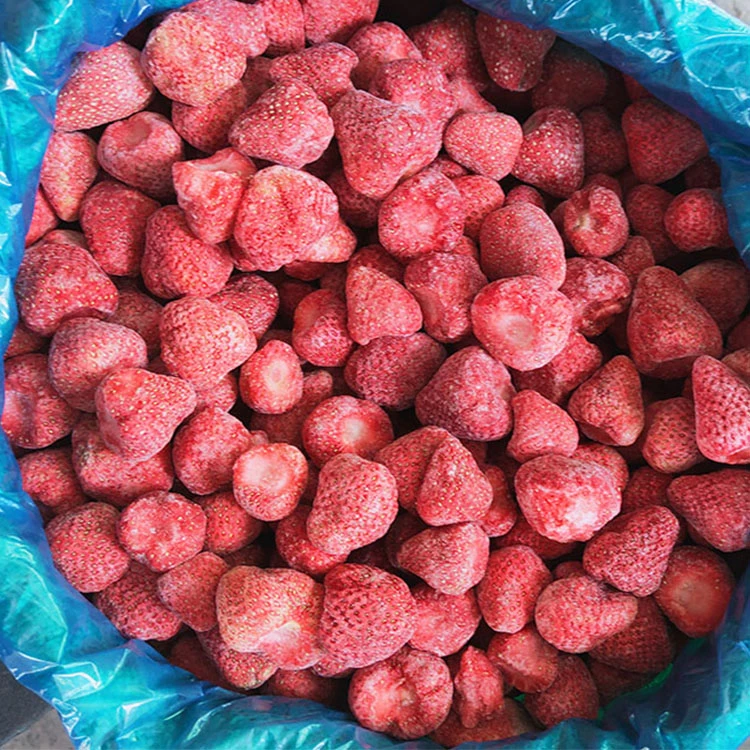
Actual bulk packing view: the fruit, liner coverage and frozen separation remain visible before final closure.
Fruit Forms and Sizes Available Inside the Package
We supply AM13, Honey, Sweet Charlie, Red Face, 99# and other crop-available varieties from China. Variety supports crop planning, but the finished pack is accepted against its measurable form, size, maturity, color and defect specification.
| Form | Available specification | Typical package direction |
|---|---|---|
| Whole calibrated | 15-25 mm, 25-35 mm or a signed 10 mm band | Retail, foodservice and visible-fruit uses |
| Whole uncalibrated | 15 mm minimum commercial basis; natural mixed size | Beverage, jam, puree and industrial processing |
| Large whole | 35 mm+; upper-size and uniformity rule stated in the order | Premium display or selected foodservice |
| Halves / quarters | Longitudinal half or quarter; intact-cut percentage stated | Bakery, dairy and dessert inclusions |
| Slices | 5-7 mm or 8-10 mm thickness | Toppings, bakery, fruit preparation |
| Dice | 10 × 10 × 10, 12 × 12 × 12 or 15 × 15 × 15 mm | Yogurt, beverage, bakery filling and sauce |
| Pieces / crumble | Contracted particle distribution and fines limit | Puree, jam and blended manufacturing |
Detailed IQF Strawberry Starting Specification
This is our quotation basis for unsweetened Grade A IQF whole strawberries. The signed order can select tighter fruit, chemistry or package limits, while processing-grade fruit and cut products use their own defect definitions.
| Parameter | Commercial release limit | How the pack is assessed |
|---|---|---|
| Product / ingredient | IQF strawberry; 100% strawberry; no added sugar, color or preservative | Ingredient declaration and production record |
| Origin / crop | China; main crop April-May; crop year stated by lot | Raw-material lot and finished-lot link |
| Whole size | 15-25 mm, 25-35 mm, 35 mm+ or uncalibrated; selected basis on label/specification | Maximum diameter by caliper; count distribution |
| Brix | 7-11°Bx natural range; standard minimum 7.0°Bx; 7.5°Bx minimum program available | Refractometer at 20°C on representative homogenized sample |
| pH | 3.0-4.0 | Calibrated pH meter on homogenized sample |
| Sensory | Characteristic red to deep red, strawberry flavor and odor; no fermented, musty or foreign note | Frozen and controlled-thaw inspection |
| Frozen condition | Free-flowing IQF; no solid block; clumps ≤2.0% m/m for Grade A starting basis | Frozen sample separation and defect weighing |
| Added glaze | None for the standard product | Ingredient/process record and frozen visual check |
| Foreign material | None detected in the examined sample | Documented visual inspection; hazardous foreign material is critical |
| Storage / shelf life | Continuously frozen at ≤−18°C; 24 months unopened from production | Cold-store, date-code and shipment records |
Codex-Based Whole-Strawberry Size and Defect Reference
For a 500 g drained-fruit sample, Codex CXS 52-1981 provides specific reference tolerances. We can use this basis or a tighter signed customer grade. This prevents words such as "premium" or "good quality" from replacing measurable acceptance limits.
| Inspection item | Reference tolerance | Definition / counting rule |
|---|---|---|
| Sized-pack uniformity | Largest minus smallest maximum diameter ≤10 mm; maximum 10% by number outside | Measured on whole fruit by maximum diameter |
| Fruit below 15 mm | Maximum 5% by number | Applies to whole Fragaria grandiflora whether sized or unsized |
| Stalks / stalk parts >3 mm | Maximum 3 by number | Per 500 g drained-fruit sample |
| Calyces | Maximum 3 cm² | Combined area in the sample |
| Other extraneous vegetable material | Maximum 3 cm² | Combined area in the sample |
| Completely uncolored whole berries | Maximum 1 by number | At least 75% of outer surface lacks characteristic color |
| Partially uncolored whole berries | Maximum 5% m/m | 25-75% of outer surface lacks characteristic color |
| Disintegrated whole berries | Maximum 5% m/m | Broken, crushed or smashed fruit |
| Blemished | Maximum 5% m/m | Visible pest, pathological or physical injury |
| Misshapen whole berries | Maximum 2% m/m | Abnormal development or hard parts in the flesh |
| Dissimilar varieties | Maximum 6% m/m | Fruit visibly inconsistent with declared varietal characteristics |
| Mineral impurities | Maximum 0.1% m/m | Sand and similar mineral material on whole-product basis |
Processing Flow Connects Fruit Quality to Package Integrity
- Raw-material release: variety/crop identity, ripeness, color, decay, mold, field contamination and transport damage.
- Hulling and washing: removal of stalks, calyces, soil and loose plant matter; potable-process-water controls are recorded.
- Draining and cutting: surface water is reduced before freezing; slices, dice and halves use a separate cut check.
- IQF freezing: the thermal center reaches −18°C after stabilization and the product is maintained in frozen condition.
- Frozen sorting and detection: size, color, broken fruit, clumps, foreign material and detector records are reviewed.
- Weighing, sealing and coding: the approved film, net weight, seal, lot/date code, case count and carton mark are checked before cold storage.

Product-specific process overview showing the route from raw strawberries to sealed bags and cartons in cold storage.
Bulk Liner and Export Carton Specification
Our standard 10 kg starting construction is one food-contact PE liner inside a moisture-resistant five-ply export carton. The packaging is designed to protect quality, reduce dehydration and prevent contamination or foreign odor during frozen storage and transport.
| Component | Standard starting construction | Release check |
|---|---|---|
| Bulk inner liner | Virgin food-contact LDPE/LLDPE, 0.07 mm (70 µm); natural or blue; 10 kg nominal fill | Material identity, declaration of compliance, dimensions, gauge and cleanliness |
| Liner alternatives | 0.06 mm for standard smooth product; 0.08 mm for higher puncture/handling demand | Approved packaging specification and trial-packed case |
| Closure | Continuous heat seal, minimum 8 mm seal band; no burn-through, trapped fruit or open channel | Visual and manual seal-integrity check |
| Master carton | Five-ply moisture-resistant corrugated board; 44 ECT (approximately 7.7 kN/m) starting basis for palletized export | Board certificate, case dimensions, closure and stack trial |
| 10 kg reference case | 400 × 280 × 200 mm; 10.0 kg net; approximately 10.5 kg gross | Packing drawing and actual gross-weight record |
| Carton closure | Pressure-sensitive tape over main flaps; no staples or wire closures | Tape adhesion, flap closure and no sharp metal |
| Net-weight control | Declared net 10.00 kg; filling target 10.03-10.08 kg; lot average not below declared net quantity | Verified scale, start/middle/end records and final checkweigh |
| Pallet options | 1200 × 1000 mm or 1200 × 800 mm; clean four-way pallet; corner boards and stretch wrap | Cartons/layer, layers/pallet, overhang, total height and treatment marks |
The reference carton is a firm quotation starting point, not a hidden variable. If the selected fruit form, retail inner bags, destination pallet or carrier payload requires another case, the revised dimensions and calculated carton count are stated in the offer.
Ask for the 10 kg Packaging Drawing
Actual weight check near 10.03 kg illustrates a controlled fill target; the shipment record carries the released lot data.
Retail and Foodservice Film Options
A retail pouch is a food-contact component and a legal label, not only an image. We release the film structure, bag dimensions, seal width, artwork version, code area, declared quantity and master-case arrangement together.
Clear or white mono-PE, 70 µm, heat sealed; 1 kg, 2 kg, 2.5 kg or 5 kg.
Reference PET 12 µm / PE 70 µm laminate, total 82 µm; reverse printed and heat sealed.
Mono-PE 80 µm starting construction; artwork, seal and frozen-drop trial required.
Press-to-close zipper above the product seal; tear notch and usable opening zone shown on the dieline.
Frozen-film approval includes low-temperature flexing, filled-bag drop, seal integrity, print rub, code legibility and freezer storage. Packaging declarations are matched to the intended destination and frozen-storage condition.
Private-Label Artwork and Label Release
We use a controlled artwork workflow so the printed pouch, case label and commercial documents identify the same product. Retail packs also include the keeping and thawing information required for the destination market.
| Artwork field | Release content | Control point |
|---|---|---|
| Legal product name | IQF Frozen Strawberries; form stated as whole, halves, slices or diced | Name matches product specification |
| Ingredient / claims | Strawberries 100%; unsweetened statement only for the no-added-sugar product | No unsupported organic, nutrition or certification claim |
| Quantity | Net weight in the required metric and/or US customary format | Font size, placement and pack-weight record |
| Dates / lot | Production date, best-before date, lot code and code legend | Reserved print area and scan/readability test |
| Storage / handling | Keep frozen at −18°C or below; do not refreeze after thawing | Required language and legibility |
| Responsible business | Manufacturer/packer/exporter and importer details as required | Name, address and market role |
| Commercial codes | Buyer item number, EAN/UPC/GTIN, case barcode, carton number and shipping mark | Barcode proof and master-data match |
| Nutrition / market copy | Customer-approved panel, serving basis, language, recycling and disposal symbols | Market-specific legal review before print release |
Release sequence: buyer brief → dieline and copy → digital proof → barcode verification → signed color/artwork proof → packaging-material receipt inspection → first packed sample → mass production.
Packaging Inspection Plan
Weak seals, underweight bags, the wrong artwork and crushed cartons create receiving failures even when the fruit meets specification. We therefore release packing as part of the finished product.
- Incoming material: supplier batch, food-contact declaration, film structure/gauge, printed version, dimensions, carton grade and visible cleanliness.
- Line start: correct product, bag/case combination, print orientation, lot/date code, seal temperature and first packed sample.
- In-process: net weight at production start, middle and end; seal continuity; fruit trapped in seal; bag puncture; code readability and case count.
- Finished case: correct label, net/gross weight, tape closure, no moisture collapse, no pallet overhang and no mixed artwork versions.
- Release: retained packaging sample, packed-product photographs, quantity record, lot allocation and signed packing inspection.

Actual export cartons demonstrate closure, label position and frozen-storage stacking; readable lot labels identify the released shipment.

Actual strawberry washing equipment supports removal of field soil and loose plant matter before draining and freezing.
Food Safety and Chemical Compliance Baseline
The destination standard and customer specification govern release. For EU-oriented programs, we use concrete contaminant limits that apply to strawberries on a wet-weight basis after washing and separating the edible part.
| Control | EU-oriented baseline | Report |
|---|---|---|
| Lead (Pb) | ≤0.10 mg/kg | Lot or scheduled third-party heavy-metal report |
| Cadmium (Cd) | ≤0.030 mg/kg | Lot or scheduled third-party heavy-metal report |
| Pesticide residues | Each analyte ≤destination MRL; EU default 0.01 mg/kg where no specific MRL applies | Multi-residue report listing analytes, LOQ, result and MRL |
| GMO | Strawberry ingredient not genetically modified | Product declaration |
| Irradiation | Not irradiated for the standard program | Process declaration |
Microbiological Release and Lot COA Structure
The following panel is the standard finished-product starting basis. A destination, application or customer standard can require tighter limits or additional organisms. The COA identifies the production lot and places the contractual limit beside the measured Actual Result; numerical Actual Results are issued only for the tested lot.
| Parameter | Release limit | Reference method | COA result format |
|---|---|---|---|
| Aerobic plate count | <100,000 cfu/g | ISO 4833-1 | Measured cfu/g |
| Coliforms | <100 cfu/g | ISO 4832 | Measured cfu/g |
| Escherichia coli | <10 cfu/g | ISO 16649-2 | Measured cfu/g or below reporting limit |
| Yeasts | <1,000 cfu/g | ISO 21527-1 | Measured cfu/g |
| Molds | <1,000 cfu/g | ISO 21527-1 | Measured cfu/g |
| Salmonella spp. | Not detected in 25 g | ISO 6579-1 | Detected / not detected |
| Listeria monocytogenes | Not detected in 25 g | ISO 11290-1 | Detected / not detected |
Product, form/size, pack, product code, PO, lot, production date, best-before date, sample date and laboratory/reference.
Parameter, specification, Actual Result, unit and test method for Brix, pH, physical defects, microbiology and contracted chemistry.
Pass/release conclusion, authorized reviewer, issue date and report revision connected to the production lot.

Actual caliper inspection makes the contracted whole-fruit band verifiable by maximum diameter.
Traceability and Document Package
We connect raw fruit and packaging materials to the finished case and shipment. A lot code identifies the producing facility, production date, line/shift and finished-product batch. The trace record links receiving, washing, freezing, grading, packing-material batch, cold-store location, COA, container and seal.
Product specification, approved sample, packing drawing, film structure, artwork proof, carton mark and certificate scope.
COA, microbiology, physical inspection, packaging inspection, pesticide/heavy-metal reports when contracted and retained sample.
Commercial invoice, packing list, certificate of origin, health certificate, bill of lading, loading record and temperature evidence.
HACCP, BRCGS, ISO, Kosher, Halal, organic or customer-audit files are supplied only when the producing facility, product and route are inside the relevant current scope. Certificate names are not used as a substitute for the batch COA.
Application-to-Package Matching
| Buyer use | Recommended fruit direction | Recommended package | Critical release items |
|---|---|---|---|
| Retail frozen fruit | Grade A calibrated whole | 400 g, 500 g, 750 g, 1 lb or 1 kg printed pouch | Appearance, free flow, size, seal, net quantity and artwork |
| Foodservice / bakery | 25-35 mm whole, halves or slices | 4 × 2.5 kg or 10 × 1 kg | Intact fruit/cuts, thaw behavior, handling size and code |
| Yogurt / dairy preparation | 10, 12 or 15 mm dice | 2 × 5 kg or 4 × 2.5 kg | Particle distribution, fines, Brix, pH and micro |
| Beverage / smoothie | Uncalibrated whole or pieces | 1 × 10 kg or 1 × 20 kg liner carton | Brix, color, usable yield, clumps and stem material |
| Jam / puree / sauce | Defined processing-grade pieces | 10 kg carton or octabin | Decay exclusion, Brix, pH, stem/calyx and extractable yield |
MOQ, Lead Time, Loading and Trade Terms
| Commercial field | Standard quotation basis | Included decision detail |
|---|---|---|
| Standard bulk MOQ | 10 metric tons for one product and specification | Fruit form, grade, size, pack and test panel fixed |
| Printed private label | 15 metric tons per SKU/artwork starting basis | Film print run, artwork and balance-material ownership stated |
| Mixed frozen load | 3-5 metric tons per compatible SKU | Same port, temperature, document route and shipment week |
| 20 ft reefer | Approximately 10-12 metric tons | Final cartons follow case dimensions, pallets and route payload |
| 40 ft high-cube reefer | Approximately 23-25 metric tons floor loaded; 20-23 metric tons palletized | Final loading plan states cartons, pallets, net weight and airflow |
| Bulk lead time | 15-18 days after order, specification and neutral packing release | Ex-stock availability, tests and sailing date considered |
| Printed-pack lead time | 25-35 days after final signed artwork and deposit | Printing, material cure, incoming inspection and production included |
| Trade / loading port | FOB, CFR/CNF or CIF; Qingdao or contracted China port | Destination, Incoterm, insurance and documents stated in offer |
Cold Chain, Loading and Receiving Inspection
We store finished packs at −18°C or below and load into a clean, odor-free reefer set to maintain frozen transport. Dispatch records identify container, seal, loading date, cartons, pallets or floor-loaded pattern, product lots and temperature evidence.
At receipt, record the container and seal before unloading; examine temperature evidence, pallet/carton condition, bag seals, codes and lot allocation. Inspect fruit while frozen for separation, surface ice, clumps, broken pieces, color and size, then run the agreed controlled-thaw assessment.
For a claim, retain unopened cases from the affected lot, readable label photographs, package/seal photographs, sample weights, defect separation and laboratory chain of custody. The signed specification and sample method remain the comparison basis.

General frozen-fruit loading evidence; the product labels, batch file and loading record identify the actual strawberry shipment.
Complete RFQ Format for a Comparable Quote
A price becomes comparable only when fruit, package, tests and delivery basis are fixed. Send one line containing:
Example: IQF whole strawberry, Grade A, AM13/Honey crop direction, 25-35 mm, minimum 7.5°Bx, Codex defect basis with clumps ≤2%, 20 × 500 g printed PET12/PE70 pouches in 10 kg cases, 15 MT, EU market, Pb ≤0.10 mg/kg, Cd ≤0.030 mg/kg, EU pesticide MRL panel, lot COA, FOB Qingdao, shipment in [month].
Frequently Asked Questions
1. What does a Frozen Strawberry Package quotation include?
It includes the fruit form, variety/crop direction, size, grade, Brix, defect limits, inner packaging, master case, net weight, testing, MOQ, lead time, loading and trade basis.
2. What bulk frozen strawberry packages are available?
Standard options include 1 × 10 kg, 1 × 20 lb, 1 × 20 kg and 1 × 40 lb PE-lined cartons, plus an approximately 500-550 kg octabin program.
3. Which retail pack weights can you supply?
We quote 400 g, 500 g, 750 g, 1 kg, 1 lb, 2 lb and 2.5 lb bags in a master-case configuration matched to the sales channel.
4. Can you produce private-label frozen strawberry bags?
Yes. The program covers dieline, film structure, artwork proof, legal copy, barcode, date/lot code, bag seal, case packing and retained print sample.
5. What packaging film do you use?
Bulk uses a 70 µm food-contact PE liner as the standard start. Foodservice uses 70 µm mono-PE. Printed retail starts with PET12/PE70 (82 µm total) or an 80 µm mono-PE option.
6. What whole strawberry sizes are available?
We supply 15-25 mm, 25-35 mm, 35 mm+ and uncalibrated whole fruit. A Codex-style sized pack uses a maximum 10 mm difference between the largest and smallest berry.
7. What cut forms can be packed?
Halves, quarters, 5-7 mm or 8-10 mm slices, and 10, 12 or 15 mm dice can be packed under separate cut-integrity and fines limits.
8. Is sugar added to the strawberries?
No. The standard product is 100% strawberry without added sugar, syrup, color or preservative. Sweetened fruit is a separate formulation and label.
9. What Brix is available?
The natural commercial range is 7-11°Bx. Our standard minimum is 7.0°Bx, and a 7.5°Bx minimum program is available by crop plan.
10. Do you provide a lot-specific COA?
Yes. The COA identifies the lot and reports Actual Results for the contracted Brix, pH, physical, microbiological and chemical fields, with units and methods.
11. What are the residue and heavy-metal limits?
Each pesticide follows the destination MRL; the EU default is 0.01 mg/kg where no specific MRL applies. The EU-oriented strawberry baseline is Pb ≤0.10 mg/kg and Cd ≤0.030 mg/kg.
12. What is the MOQ?
Standard bulk starts from 10 metric tons. A printed private-label SKU starts from 15 metric tons, while compatible mixed loads start from 3-5 metric tons per SKU.
13. What is the production lead time?
Neutral bulk packing normally takes 15-18 days after release. Printed private-label packing normally takes 25-35 days after signed artwork and deposit.
14. How much fits in a reefer container?
A 20 ft reefer plans approximately 10-12 MT. A 40 ft high-cube reefer plans 23-25 MT floor loaded or 20-23 MT palletized, subject to the approved case and legal payload.
15. What storage and shelf life apply?
Keep the unopened product continuously frozen at −18°C or below. The standard shelf life is 24 months from production; thawed product must not be refrozen.
Plan Your Frozen Fruit Purchase
Review our frozen-food supply resources, then send the fruit form, size, Brix, grade, packaging, quantity, destination, artwork and document requirements for a package-specific offer.
Build Your Frozen Strawberry Package Specification
Send the fruit form, size, Brix, grade, 10 kg bulk/foodservice/retail configuration, film, artwork, quantity, destination, shipment month and document list. We will return the product specification, packaging basis, MOQ, lead time, container plan and quotation.
Hot Tags: frozen strawberry package, China frozen strawberry package manufacturers, suppliers, factory, frozen fruit sorbet, frozen fruit crepes, frozen fruit butters, frozen jackfruits, frozen fruit dairy free snacks, frozen breadfruits


