We supply pre-fried, quick-frozen potato fries with defined cut size, length distribution, color, solids, oil level and finish performance. Each order is built around a written product specification, an approved reference sample and batch-linked release records.
7×7 to 14×14 mm
Straight or Crinkle Cut Coated or Uncoated
24-Month Frozen Shelf Life
Potato Fries Frozen for Foodservice, Wholesale and Private Label
We supply pre-fried, quick-frozen potato fries with defined cut size, length distribution, color, solids, oil level and finish performance. Each order is built around a written product specification, an approved reference sample and batch-linked release records.
7×7 to 14×14 mmStraight or Crinkle CutCoated or Uncoated24-Month Frozen Shelf Life
A Frozen Fry Program Built Around the Finished Portion
Frozen fries are not purchased by cut size alone. A 9×9 mm strip can perform very differently when raw-potato solids, reducing sugar, blanching, par-fry conditions, oil type, frozen color, length distribution and final preparation are not controlled together. We therefore define both the frozen product and the result after a standard finish test.
Our standard offer covers straight-cut fries in 7×7 mm and 9×9 mm. We also prepare 6×6, 10×10, 12×12 and 14×14 mm programs, crinkle cuts, skin-on styles, clear-coated products and uncoated products. Each style remains a separate SKU with its own ingredient statement, color target, length grade, finish instruction and carton declaration.
We supply importers, foodservice distributors, restaurant groups, central kitchens, industrial meal producers and retail private-label programs. The commercial file states product identity, country of origin, production site, pack format, destination label language, oil system, shelf life, test plan, loading quantity and document set before production is scheduled.
Loose frozen straight-cut fries showing piece separation, pale frozen color and the general visual condition evaluated at intake.
Foodservice Consistency
Defined fry color, length grade, oil level and finish protocol support repeatable portions across restaurant, catering and quick-service operations.
Importer Risk Control
The signed specification separates legal limits, order limits and batch test results so that release decisions are traceable and unambiguous.
Private-Label Execution
Retail bag size, foodservice pouch, carton marks, barcode, date code, language and artwork approval are controlled as order-specific packaging data.
Export Cold Chain
Frozen storage, product-temperature checks, reefer inspection, container and seal records support delivery at −18°C or below.
Applications & Quality Requirements
We match Potato Fries Frozen to your processing or packing line. Product form to confirm: Potato strips; prefried state as declared. Tell us the intended use and target texture so we can review the relevant size, grade, preparation and packing requirements before quotation.
Application illustrations. Product form, preparation and suitability follow the confirmed specification. Open the overview to inspect the image.
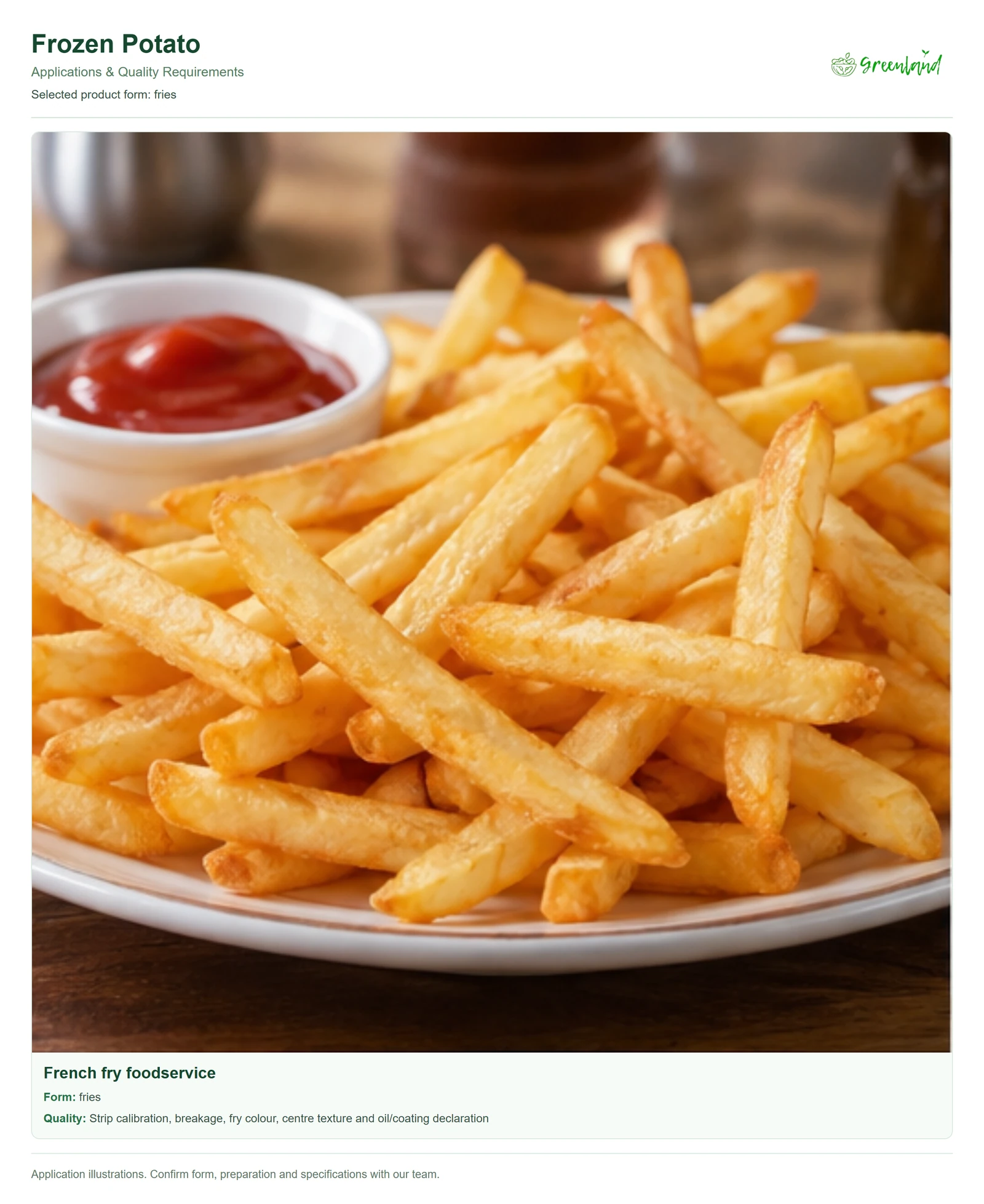
French fry foodservice
For: Foodservice distributors and central-kitchen buyers
Form: fries
We review fries for your french fry foodservice programme. Confirm strip calibration, breakage, fry colour, centre texture and oil/coating declaration. Use the declared fry-strip programme; confirm raw/blanched versus prefried status, oil/coating and final cooking. Larger plain potato pieces are not received fries. Your team prepares the required cut or refined component before this application.
Match the Application with the Purchasing Specification
Application
Selected form
Quality points to confirm
French fry foodservice
fries
strip calibration, breakage, fry colour, centre texture and oil/coating declaration
Send us the product, required form, final application, key quality requirements, packing, quantity and destination market. We will review the supply programme and confirm the order specification with your team.
Product Configuration and Orderable Specifications
The following matrix gives concrete options for quotation. The selected combination is written as one SKU; coated and uncoated fries, different oils, different cuts or different length grades are not mixed under one product code.
Item
Standard Offer
Extended Program
How It Is Written in the Order
Product
Pre-fried quick-frozen potato strips
Foodservice or retail recipe
Not raw; not ready-to-eat
Cut
7×7 mm; 9×9 mm
6×6, 10×10, 12×12, 14×14 mm
Nominal cross-section and tolerance
Shape
Straight cut
Crinkle cut
One style per SKU
Surface
Uncoated, skin-off
Clear coated; skin-on
Ingredient and allergen statement follows recipe
Oil
Palm oil
Sunflower or other approved vegetable oil
Oil source named on label and specification
Frozen color
00–0 reference range
Approved physical reference
Color system and viewing conditions stated
Finished fry color
USDA 1–2 equivalent
Customer reference standard
Measured after the stated finish test
Shelf life
24 months
Destination-specific program
Stored continuously at −18°C or below
Origin
China
Approved production site
Site and origin appear in the shipment file
Product Video
Straight-cut potato fries. We confirm the final cut, processing method and packing against your order specification.
Cross-section determines cooking speed, crust-to-center ratio and portion appearance. Length distribution determines plate coverage, perceived value and the amount of short pieces left in a basket or pouch. We record both. A caliper check verifies the nominal width and thickness, while a weighed or counted length analysis separates long pieces, usable mid-length pieces and short pieces.
Standard Foodservice Length Grade: pieces below 30 mm ≤5%; pieces at or above 50 mm ≥55%; pieces at or above 75 mm ≥8%.
Long-Cut Foodservice Grade: pieces below 25 mm ≤5%; pieces at or above 50 mm ≥60%; pieces at or above 75 mm ≥20%.
The long-cut grade improves visual coverage but uses a tighter raw-potato and process selection. It is quoted separately. For strip styles from 5 to 16 mm, our baseline also follows the Codex concept that a small piece is shorter than 25 mm, with sorting limits written by weight or count in the signed test method. This prevents one party from counting short pieces while the other weighs them.
A caliper checks cross-section; a separate length analysis controls the share of long, medium and short fries.
Contract Specification: Physical and Chemical Targets
The table below separates a usable order limit from the measurement that appears on the batch COA. It is a detailed standard program, not a claim that every style has the same result. A coated 7×7 mm fry and an uncoated 14×14 mm fry have different oil uptake and finish behavior, so each is released against its own SKU specification.
Parameter
Standard Order Limit
Enhanced Option
Release Record
Moisture
≤76.0%
70.0–74.0%
Batch result, %
Finished-product dry matter
≥24.0%
28.0–30.0%
Batch result, %
Total fat/oil
3.0–6.0%
≤5.0%
Batch result, %
Free fatty acids in extracted fat
≤1.5%
≤1.0% or ≤0.5%
Batch result, % as oleic acid
Frozen color
00–0
Approved reference
Pass and reference ID
Fried color
USDA 1–2 equivalent
Customer color card
Result after 175°C, 3–4 minute test
Product core temperature
≤−18°C after thermal stabilization
Shipment program ≤−18°C
Cold-store and loading records
The 76% moisture ceiling and 1.5% free-fatty-acid ceiling align with the international Codex standard for quick-frozen French fried potatoes. The tighter columns are available as purchasing targets and carry their own price, raw-material selection and test plan.
Frozen-color comparison is one release check. The order file identifies the agreed card or physical reference and viewing method.
Color, Reducing Sugar and Finish Performance
Dark finished fries can result from excess reducing sugar, raw-potato maturity, storage conditions or an unsuitable time-and-temperature combination. We manage this risk through raw-potato intake, blanching control, frozen-color comparison and a documented finish test. The specification does not treat a pale frozen strip as proof of acceptable cooked color; both stages are assessed.
Our standard bench test uses 175°C oil for 3–4 minutes. The final instruction is written for the selected cut, coating and appliance type. Test load, oil condition, product starting temperature and drain time are held constant when comparing production lots. Results cover external color, crispness, internal mealiness, oiliness, limp pieces, hollow pieces and off-flavor.
Reducing sugar can be included in the raw-material or process-control plan with a crop-appropriate limit; finished fry color remains the decisive release result. This avoids using one sugar number across varieties and storage seasons when the actual commercial requirement is a consistent golden portion.
Defect Allowances That Can Be Inspected
Vague phrases such as "good quality" do not create an enforceable fry grade. We use named defects, size thresholds, sample weight and maximum counts. For 5–16 mm strip styles, the Codex baseline uses a 1 kg sample and distinguishes minor defects from 3 to under 7 mm, major defects from 7 to under 12 mm and serious defects at 12 mm or larger. The baseline maximums are 7 serious units, 21 serious plus major units, and 60 total serious plus major plus minor units per 1 kg sample.
A tighter Grade A order program can state: black spots 3–6 mm ≤18/kg; black spots over 6–10 mm ≤10/kg; black spots over 10 mm ≤1/kg; sugar ends ≤5/kg; slivers ≤12% by mass; small pieces plus scrap ≤6% by mass; total sorting defects ≤12% by mass; and frying defects ≤0.5% by mass. Grade names alone are not used without the numerical schedule.
Additional visual checks cover peel, green tissue, bruising, hollow pieces, misshapen strips, clusters, excessive ice, foreign vegetable matter and foreign material. The accepted sample and inspection method define borderline appearance. This enables a receiving team to repeat the same check rather than relying on subjective wording.
Process Flow from Potato Intake to Frozen Pack
We prepare Potato Fries Frozen to the agreed product form, pretreatment, grade and packing specification. The diagram shows a typical production process; we confirm preparation and step order for your order.
Typical process flow. Final processing and step order follow the confirmed specification. Site photos show the captioned subjects and may illustrate a representative form; process illustrations show typical operations. Storage and loading photos are generic frozen-food references.
Production and handling stages
Raw Material InspectionWe check identity, condition and the agreed raw-material criteria.
Initial SortingWe remove visible defects and unsuitable material.
WashingWe follow the confirmed cleaning and water-control route.
Peeling, Cutting & GradingWe prepare and grade potato strips to the approved cut.
Blanching & Surface DryingWe follow the confirmed blanching, cooling and drying program.
Par-Frying & Oil DrainingWe follow the approved oil and pre-fry program, then remove excess oil.
IQF FreezingWe quick freeze prepared pieces and review separation.
Frozen Product InspectionWe review the agreed defects, form, separation and frozen condition.
Weighing, Packing & Metal ControlWe check net weight, pack integrity and agreed metal controls.
Batch Review & ReleaseWe match lot identity and records to the agreed release checks.
Frozen StorageWe maintain the agreed frozen-storage conditions and lot identity.
Reefer LoadingWe review cartons, lot records and refrigerated shipment arrangements.
Process Flow from Potato Intake to Frozen Pack
Raw-potato intake: variety, maturity, soundness, size, solids, reducing-sugar behavior, green areas and major defects are checked by lot.
Washing and preparation: soil and loose foreign matter are removed; potatoes are peeled or retained skin-on according to the SKU.
Cutting and grading: strips are cut to the nominal cross-section, then short, thin, misshapen and defective pieces are controlled.
Blanching and surface treatment: time and temperature support enzyme control, color management and finish consistency. Dextrose and processing aids appear in the declared recipe when used.
Drying and par-frying: surface moisture, oil temperature and residence time are managed to form the pre-fried structure without completing final cooking.
Quick freezing: product is rapidly frozen, stabilized at a thermal center of −18°C or colder and maintained as free-flowing pieces.
Final inspection and packing: visual grade, bag seal, code, label, carton, metal-detection check and finished weight enter the lot record.
Frozen release and dispatch: released cartons remain at −18°C or below before reefer loading.
The image shows potato washing and preparation scenes, including potatoes and cut strips. Lot records connect these operations to the selected production run.
Manual fry sorting shown as a product-specific visual control for misshapen, short or visibly defective strips.
Ingredient, Oil, Coating and Allergen Declaration
Uncoated standard recipe: potatoes and vegetable oil, with dextrose and an approved color-control agent only when included in the agreed formula. Coated recipe: potatoes, vegetable oil and a declared clear coating system. A coating may improve holding time and delivery performance, but it changes ingredient, allergen, oil-uptake and preparation data; it is never substituted for an uncoated SKU.
We state the vegetable-oil source, processing-aid declaration, additive name or INS/E-number where required, allergen status and genetically modified ingredient status according to the destination label rules. For EU consumer products, industrial trans fat in the final food is controlled to no more than 2 g per 100 g of fat, excluding naturally occurring animal trans fat.
Shared-line allergens are assessed at the selected site. The allergen statement comes from the actual recipe and line assessment, not from the product name. Buyers receive the composition, nutrition panel data set when ordered, packaging declaration and label review inputs for the destination market.
Quick Freezing and Loose-Piece Control
The par-fried strips enter quick-freezing equipment after controlled cooling. Airflow, belt load, product depth and residence time are managed to remove heat rapidly and support piece separation. After thermal stabilization, the product center is at −18°C or colder. The lot then remains under frozen storage.
Loose pieces matter to foodservice operators because compact blocks create uneven portions and variable finishing. We inspect for free-flowing condition, clusters, excess surface frost, bag damage and evidence of thaw-refreeze exposure. The receiving specification can include a maximum cluster allowance and a defined hand-separation test.
The adjacent image shows general GreenLand-food quick-freezing equipment. It demonstrates frozen-food process capability and is not described as a potato-only line or as evidence for a specific shipment. Batch evidence comes from the corresponding production, temperature and release records.
General quick-freezing equipment supporting rapid temperature reduction and loose-piece handling; not a potato-batch record.
Choose the Fry by Service Model, Not by Size Alone
One product rarely serves every channel equally well. We translate the operating condition into a measurable configuration, then price that configuration as one SKU. The following starting profiles help procurement teams compare meaningful alternatives without relying on broad labels such as "restaurant grade."
Quick-Service Dine-In
Starting profile: 7×7 or 9×9 mm straight cut, uncoated, standard or long-cut grade, finished color USDA 1–2 equivalent.
The release test emphasizes fast cooking, crisp exterior, mealy center, low limp-piece rate and consistent portion color immediately after draining. Basket load and fryer recovery are included in the test setup because an overloaded fryer can make a suitable product appear oily or soft.
Delivery and Extended Hold
Starting profile: 9×9 or 10×10 mm, clear coated, long-cut grade, dedicated holding test at 5, 10 and 15 minutes.
The assessment records crispness loss, surface toughness, internal moisture, carton condensation and breakage after the stated hold. The coating recipe and allergen declaration remain visible in the commercial specification and destination label data.
Catering and Central Kitchen
Starting profile: 10×10, 12×12 or 14×14 mm, straight or crinkle cut, 4×2.5 kg foodservice pack.
Thicker cuts offer a higher soft-center ratio and can tolerate batch preparation, but they require a longer finish. We state the exact instruction, usable yield, color range and hold observation for the selected equipment rather than applying a thin-cut instruction to every SKU.
Retail Private Label
Starting profile: 7×7 to 12×12 mm, 400 g to 2 kg printed bag, destination-language instructions.
Retail development covers fryer, oven and air-fryer directions as separate trials when required. Net-weight control, barcode, nutrition data, ingredient sequence, allergen statement, date coding, recycling marks and carton identification enter the artwork file before printing.
Raw Potato and Crop-Season Control
Long, uniform fries begin with suitable processing potatoes. Intake records cover variety or approved variety group, harvest and storage lot, maturity, tuber size, soundness, green tissue, sprouting, bruising, internal defects and behavior during a controlled fry test. Raw potatoes with unsuitable shape or excessive defects increase short pieces even when the cutter is correctly set.
Solids affect yield, texture and oil uptake. Reducing sugars affect finished color. Both can change during storage, so we do not treat one crop-season reading as a permanent result. The production lot uses current intake and process data, followed by the frozen-product and finish tests specified for that SKU.
If a crop transition changes color, solids, length yield or finish time, the commercial response is recorded as a controlled product review. The approved product identity and numerical order limits remain the acceptance basis; a raw-material change does not authorize a darker color, higher short-piece rate or different oil system.
Reference Sample and Receiving Inspection
The approved reference sample supports appearance, cut and finish discussion, while the written specification remains the contract control. The sample label records SKU, cut, recipe, production date, storage condition and reference status. Color cards, photographs and cooked samples are used only with their stated preparation and lighting conditions.
At receiving, a practical check begins with carton and bag condition, label, lot code, temperature and signs of thawing. A representative frozen sample is then assessed for cut, length distribution, color, clusters, ice, foreign matter and visible defects. A separate standard finish test covers color, texture, oiliness and off-flavor.
When a result falls outside the written limit, the lot and test evidence are isolated for review. Photographs, sample identity, method, equipment, time and temperature prevent a complaint from being reduced to an unsupported phrase. Retained samples and lot traceability support a focused investigation.
Microbiological, Contaminant and Foreign-Material Plan
Frozen potato fries require final cooking, but the supply program still uses measurable hygiene and food-safety criteria. The destination, intended use and selected site determine the final sampling frequency and method. The following order limits provide a complete starting point for an export specification.
Test
Proposed Limit
Reporting Principle
Total plate count
≤100,000 CFU/g
Numerical batch result
Enterobacteriaceae
≤1,000 CFU/g
Numerical batch result
Escherichia coli
≤100 CFU/g
Numerical batch result
Coagulase-positive Staphylococci
≤500 CFU/g
Numerical batch result when included
Yeast and mould
≤1,000 CFU/g
Numerical batch result
Salmonella
Absent in 25 g
Detected / not detected
Listeria monocytogenes
Absent in 25 g when required by the program
Detected / not detected
Lead
≤0.10 mg/kg wet weight for EU peeled-potato basis
Actual laboratory result
Cadmium
≤0.10 mg/kg wet weight for EU peeled-potato basis
Actual laboratory result
Pesticide residues
Comply with destination MRLs
Multi-residue report for the ordered program
Metal detector challenge
Fe 2.0 mm; non-Fe 2.5 mm; stainless steel 3.0 mm starting program
Final validated sensitivity by product and pack
Legal limits vary by destination and product classification. The signed specification lists the applicable regulation and test method. We do not describe a limit as the production result: the batch COA reports the value measured for the released lot.
Finished-Fry Testing and Acrylamide Management
Acrylamide forms during high-temperature finishing; therefore a frozen strip cannot be assigned one meaningful acrylamide value without the preparation method. For programs supplying the EU market, we use the 500 µg/kg benchmark level for ready-to-eat French fries as the reference for a prepared-product assessment. This benchmark is a process-performance reference, not a universal frozen-product acceptance result.
The test record states appliance, oil type, oil age, product load, time, temperature, drain time and finished color. The reported laboratory result belongs to that preparation protocol. Raw-potato sugar management, blanching, par-fry control, finish instructions and avoidance of excessive browning work together to control risk.
Our sensory check also records crisp exterior, tender or mealy interior, absence of excessive oiliness, absence of internal separation, percentage of limp pieces and hold-time observations. A delivery-focused coated fry can use 5-, 10- and 15-minute hold readings, while an uncoated dine-in fry can use an immediate-service target.
Finished appearance is evaluated after a documented time-and-temperature test, not inferred from the frozen color alone.
Batch COA: Specification Limit and Actual Result
A COA is issued for the corresponding production batch. "Actual Result" means the value measured or observation recorded for that batch; it is not copied from the specification column. The COA header includes product name, SKU, batch number, production date, best-before date, pack format, quantity, site and release date.
COA Parameter
Specification Limit
Actual Result Field
Method / Record
Appearance and free-flowing condition
Conforming, no thaw-refreeze evidence
Pass / observation
Visual lot inspection
Nominal cut
Example: 9×9 mm
Measured range
Caliper check
Length distribution
Selected standard or long-cut grade
Actual percentages
1 kg sample
Moisture / dry matter
≤76.0% / ≥24.0%
Actual %
Declared analytical method
Total fat and FFA
SKU limit
Actual %
Extracted-fat analysis
Frozen and fried color
Agreed reference range
Observed result
Reference card and finish protocol
Defect counts
Contract schedule
Actual units/kg or %
1 kg inspection
Microbiological tests
Organism-specific limit
Actual CFU/g or absent/25 g
Specified laboratory method
Metal-detector verification
Validated sensitivity
Pass and check time
Line challenge record
Technical File, Site Documents and Change Control
The technical file is matched to the selected production site and SKU. It can include the signed product specification, ingredient statement, allergen statement, nutrition data, process flow, HACCP summary, packaging specification, shelf-life statement, microbiological plan, contaminant plan, destination-compliance declarations, certificate copies within their current scope and a sample COA layout.
For the shipment, we provide the batch-linked records named in the order: COA, packing list, invoice, origin documentation, health documentation where applicable, container and seal data and requested loading evidence. A general site certificate does not replace a batch COA, and a batch COA does not replace destination registration or import documentation.
Recipe, oil source, processing site, cut, coating, supplier of a functional ingredient, primary pack, shelf life and critical label data are controlled fields. A material change enters a documented review before it reaches a purchase order. This is especially important for private label because a technically small recipe change can alter the ingredient sequence, allergen declaration, nutrition panel or cooking instruction.
Current facility certification may include HACCP, BRCGS, Kosher or other market-specific systems at the chosen site. Copies show the legal entity, address, product scope, issuing body and validity period. We describe only the certificate that applies to the selected site and active order program.
Packaging Programs
Foodservice: 4×2.5 kg/carton and 1×10 kg/carton.
Retail: 20×400 g/carton, 500 g, 750 g, 1 kg and 2 kg bags.
Inner pack: food-contact frozen-grade film, plain or printed, with controlled net weight and heat seal.
Outer carton: export corrugated carton with product name, cut, net weight, batch, production date, best-before date, storage instruction, origin and handling marks.
Artwork data include dieline, print colors, barcode, nutrition panel, ingredient and allergen statement, legal name, cooking instruction and recycling marks. Print approval and first-pack review are recorded before volume packing.
Commercial and Loading Data
MOQ: 10 metric tons per SKU and pack design.
40 ft reefer: approximately 22–25 metric tons, determined by carton size, pallet use and legal payload.
Lead time: 20–30 days after order, specification and artwork data enter the production schedule.
Trade terms: FOB, CFR and CIF.
Loading ports: Qingdao or Tianjin according to the selected approved production site.
Samples: cut, recipe, color and finish-performance samples can be arranged before the first commercial order.
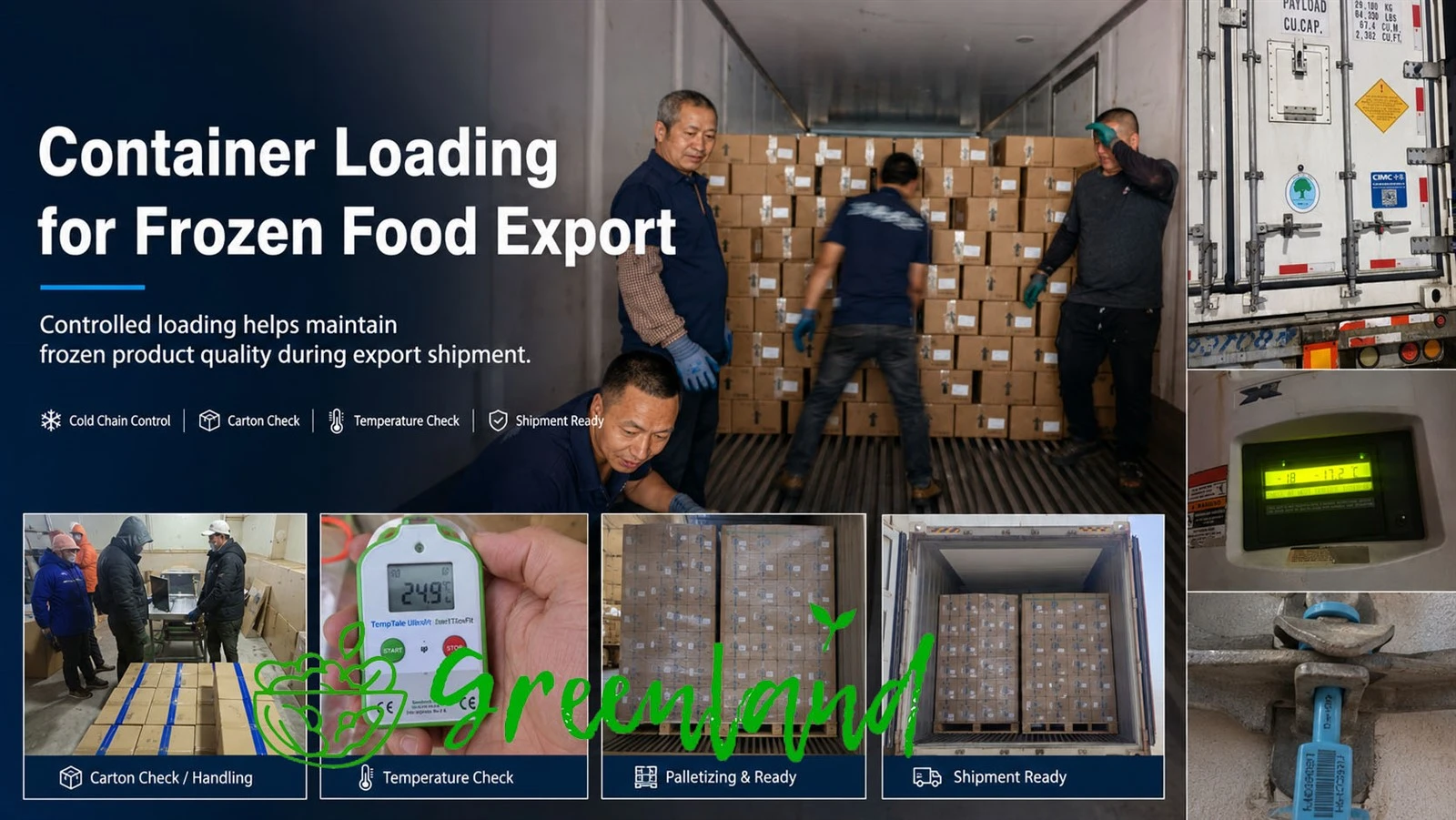
General frozen-food loading evidence showing carton handling, temperature checks and reefer preparation; the visible cartons are not identified as a specific potato-fries batch.
Cold Storage, Reefer Loading and Traceability
Released product is stored at −18°C or below. Before loading, we record container cleanliness, odor, floor and wall condition, door seal, drainage, pre-cooling status and reefer set point. Carton condition, product temperature, quantity, pallet pattern where used, container number and seal number enter the shipment file.
Each finished lot traces to raw-potato intake lot, oil lot, ingredient lot, production date, line and time window, blanching and par-fry records, quick-freezing record, inspection result, metal-detector checks, pack-material lot, cold-store location and loaded container. A temperature logger is added when the purchase program requires continuous transit data.
The shipment document set can include commercial invoice, packing list, bill of lading data, certificate of origin, health or phytosanitary documents where applicable, batch COA, production records requested by the customer and current selected-site certificates within their valid scope.
What We Need for a Complete Frozen Fries Quotation
Send the destination country, cut size, straight or crinkle style, coated or uncoated recipe, skin-on or skin-off preference, oil type, length grade, finished color target, hold-time requirement, pack format, private-label language, annual volume, first-shipment date and discharge port. We return a product configuration, commercial offer, sample route and proposed specification table.
For tenders or chain accounts, include the existing specification, cooking equipment, basket load, target serving time and receiving test. We can align the product assessment with that operating condition and state every measurable difference in the offer.
Potato Fries Frozen FAQ for Importers and Foodservice Buyers
1. Are your potato fries frozen raw or pre-fried?
We supply pre-fried, quick-frozen potato strips. They require final cooking before service and are not described as raw potatoes or ready-to-eat food. The oil type, par-fry recipe and final preparation instruction are written for each SKU.
2. Which frozen French fry cut sizes can you supply?
Our core sizes are 7×7 mm and 9×9 mm. Programs are also available in 6×6, 10×10, 12×12 and 14×14 mm. The nominal cross-section, measurement tolerance and length distribution appear as separate specification lines.
3. Can I order straight-cut, crinkle-cut or skin-on frozen fries?
Yes. We offer straight and crinkle cuts, with skin-off as the standard and skin-on as a separate program. Shape, skin level and visual defect tolerance are defined for the selected SKU so that another style is not substituted.
4. What is the difference between coated and uncoated frozen fries?
Uncoated fries use a simpler surface and suit immediate service. A clear coating can improve crispness retention for delivery, buffet or longer hold. Coating ingredients, allergens, oil uptake, finish time and sensory targets are stated as a separate recipe.
5. What length grade is available for bulk frozen fries?
The standard foodservice grade uses <30 mm ≤5%, ≥50 mm ≥55% and ≥75 mm ≥8%. The long-cut grade uses <25 mm ≤5%, ≥50 mm ≥60% and ≥75 mm ≥20%. The quotation names the method as weight or count and uses one method at receiving.
6. Which oil can be used for the pre-fried potato fries?
Palm oil is the standard option. Sunflower oil or another approved vegetable oil can be quoted for a dedicated recipe. The oil is named in the ingredient statement and specification; total fat and free fatty acids are controlled numerically.
7. How do you control frozen and fried color?
We combine raw-potato selection, sugar behavior, blanching control, frozen-color comparison and a standard finish test. A typical program uses frozen color 00–0 and fried color USDA 1–2 equivalent after 175°C for 3–4 minutes.
8. What are the moisture, dry-matter and oil limits?
The standard finished-product limits are moisture ≤76%, dry matter ≥24% and total fat 3–6%. An enhanced program can use 28–30% dry matter and total fat ≤5%. Free fatty acids are ≤1.5%, with ≤1.0% or ≤0.5% available as tighter order limits.
9. Do you provide a batch COA for frozen potato fries?
Yes. The batch COA identifies the lot and reports actual measured results for the agreed physical, chemical and microbiological items. Specification limits and actual results occupy different columns. The COA does not present a template limit as the batch result.
10. Can acrylamide be included in the testing program?
Yes. Because acrylamide forms during final high-temperature cooking, the result is tied to a documented preparation protocol. For EU programs, the ready-to-eat French-fries benchmark of 500 µg/kg can be used as the process-performance reference.
11. What microbiological limits can be written into the order?
A complete program can use total plate count ≤100,000 CFU/g, Enterobacteriaceae ≤1,000 CFU/g, E. coli ≤100 CFU/g, yeast and mould ≤1,000 CFU/g, Salmonella absent in 25 g and Listeria monocytogenes absent in 25 g when required.
12. Which foodservice and private-label pack sizes are available?
Foodservice formats include 4×2.5 kg and 1×10 kg cartons. Retail formats include 20×400 g plus 500 g, 750 g, 1 kg and 2 kg bags. Plain and printed film, carton marks, barcode and destination-language artwork are available.
13. What are the MOQ, lead time and reefer loading quantity?
MOQ is 10 metric tons per SKU and pack design. Standard lead time is 20–30 days. A 40 ft reefer carries approximately 22–25 metric tons depending on carton dimensions, pallet use and legal payload. We quote FOB, CFR or CIF.
14. What is the shelf life and storage temperature?
Standard shelf life is 24 months under continuous storage at −18°C or below. The product is not refrozen after thawing. Cold-store, loading temperature, reefer set point, container and seal records support the shipment file.
15. What information should I send to receive an exact quotation?
Send destination, cut, shape, coating, skin, oil, length grade, finish color, hold time, pack, artwork language, order volume, delivery window and discharge port. We then issue one product configuration with exact specification and commercial terms.
Build Your Potato Fries Frozen Specification
Tell us the cut, length grade, oil, coating, fried color, hold time, pack and destination. We will prepare a detailed product offer, sample path and batch-control plan for your foodservice or private-label program.
We review the selected form, grade, process and packing against the technical schedule below. Published and TDS values are specification references for order review. External benchmarks apply only within their stated scope. Acceptance is governed by the signed SKU specification; the identified lot COA reports actual measured results.
Form: Potato strips; prefried state as declaredProduct category: Frozen Potato
01 / Physical & Sensory
Parameter
Specification / reference
Verification & order basis
Cut
7 × 7 mm; 9 × 9 mmPublished reference
Measure a defined frozen sample with caliper or size gauge; report distribution and tolerance.
Shape
Straight cutPublished reference
Confirm method, representative sample and acceptance basis in the signed specification.
Frozen color
00–0 reference rangePublished reference
Compare with the approved sensory reference using the stated frozen/thawed/prepared condition.
Finished fry color
USDA 1–2 equivalentPublished reference
Compare with the approved sensory reference using the stated frozen/thawed/prepared condition.
Origin
ChinaPublished reference
Reconcile source declaration, intake lot and shipment documents.
Frozen color - Standard Order Limit
00–0Published reference
Compare with the approved sensory reference using the stated frozen/thawed/prepared condition. Programme: Standard Order Limit.
Frozen color - Enhanced Option
Approved referencePublished reference
Compare with the approved sensory reference using the stated frozen/thawed/prepared condition. Programme: Enhanced Option.
Frozen color - Release Record
Pass and reference IDPublished reference
Compare with the approved sensory reference using the stated frozen/thawed/prepared condition. Programme: Release Record.
Fried color - Standard Order Limit
USDA 1–2 equivalentPublished reference
Compare with the approved sensory reference using the stated frozen/thawed/prepared condition. Programme: Standard Order Limit.
Fried color - Enhanced Option
Customer color cardPublished reference
Compare with the approved sensory reference using the stated frozen/thawed/prepared condition. Programme: Enhanced Option.
Fried color - Release Record
Result after 175°C, 3–4 minute testPublished reference
Compare with the approved sensory reference using the stated frozen/thawed/prepared condition. Programme: Release Record.
Measure cross-sectional dimensions in the frozen condition. Only selected quick-frozen French-fried potato strips cut on all four sides, with confirmed frying or precooking route. Applies to straight or crinkle cut; raw, cube, chunk and ball SKUs are excluded. Confirm route on ambiguous pages. The cited Codex standard excludes products indicated for further industrial processing.
Cross-section & length distribution
Report cross-section, length fractions and short/sliver material separately for the selected strip grade.
Gauge both cross-section axes and sort a representative frozen sample by the agreed length bands.
Sensory acceptance
Characteristic colour, flavour and texture for the declared product; no abnormal odour or visibly deteriorated material.External referenceCodex
Compare an identified frozen sample with the approved grade and defect schedule. External technical reference; confirm SKU and market applicability.
02 / Physicochemical & Residue Controls
Parameter
Specification / reference
Verification & order basis
Moisture - Standard Order Limit
≤76.0%Published reference
Report validated laboratory method, sample basis and lot result. Programme: Standard Order Limit.
Moisture - Enhanced Option
70.0–74.0%Published reference
Report validated laboratory method, sample basis and lot result. Programme: Enhanced Option.
Moisture - Release Record
Batch result, %Published reference
Report validated laboratory method, sample basis and lot result. Programme: Release Record.
Finished-product dry matter - Standard Order Limit
≥24.0%Published reference
Use a validated analytical method for this matrix; report sample basis, unit, preparation and lot result. Programme: Standard Order Limit.
Finished-product dry matter - Enhanced Option
28.0–30.0%Published reference
Use a validated analytical method for this matrix; report sample basis, unit, preparation and lot result. Programme: Enhanced Option.
Finished-product dry matter - Release Record
Batch result, %Published reference
Use a validated analytical method for this matrix; report sample basis, unit, preparation and lot result. Programme: Release Record.
Free fatty acids in extracted fat - Standard Order Limit
≤1.5%Published reference
Use a validated analytical method for this matrix; report sample basis, unit, preparation and lot result. Programme: Standard Order Limit.
Free fatty acids in extracted fat - Enhanced Option
≤1.0% or ≤0.5%Published reference
Use a validated analytical method for this matrix; report sample basis, unit, preparation and lot result. Programme: Enhanced Option.
Free fatty acids in extracted fat - Release Record
Batch result, % as oleic acidPublished reference
Use a validated analytical method for this matrix; report sample basis, unit, preparation and lot result. Programme: Release Record.
Lead
≤0.10 mg/kg wet weight for EU peeled-potato basisPublished reference
Use a validated analytical method for this matrix; report sample basis, unit, preparation and lot result. Published commercial target; verify current destination limits, edible-part basis and any processing factor before approval.
Cadmium
≤0.10 mg/kg wet weight for EU peeled-potato basisPublished reference
Use a validated analytical method for this matrix; report sample basis, unit, preparation and lot result. Published commercial target; verify current destination limits, edible-part basis and any processing factor before approval.
Pesticide residues
Comply with destination MRLsPublished reference
Use a validated analytical method for this matrix; report sample basis, unit, preparation and lot result.
Codex reference: moisture for shoestring, medium and thick-cut strips
Whole-product moisture by relevant CXS 234-1999 method; extra-large and other styles have a separate 78% m/m maximum. Only selected fried or precooked quick-frozen French-fried potato strips classified as shoestring, medium or thick cut (4–16 mm). Raw strips and other cuts are outside this reference. Confirm route and size. The cited Codex standard excludes products indicated for further industrial processing.
Acrylamide programme scope
Apply destination mitigation and monitoring requirements to the relevant potato product and finishing state. EU source
Use a stated preparation protocol and validated laboratory method; a ready-to-eat benchmark is not a frozen-batch limit.
Pesticide residue schedule
Named active ingredients and commodity-specific limits are selected for the destination market. EU source
Link farm spray history, laboratory LOQ and batch result to the destination MRL. EU database is one market reference; apply the actual destination rule.
Lead, cadmium and other contaminants
Apply the limit for the exact commodity and processed form in the destination market. EU source
State analyte, preparation basis, method, LOQ and lot result. Do not transfer a fresh-commodity limit to a processed form without the required assessment.
03 / Microbiological Criteria
Parameter
Specification / reference
Verification & order basis
Total plate count
≤100,000 CFU/gPublished reference
Report the named organism, analytical method, sample mass, sampling plan and lot result; use CFU/g for enumeration and a stated mass for detection.
Enterobacteriaceae
≤1,000 CFU/gPublished reference
Report the named organism, analytical method, sample mass, sampling plan and lot result; use CFU/g for enumeration and a stated mass for detection.
Escherichia coli
≤100 CFU/gPublished reference
Report the named organism, analytical method, sample mass, sampling plan and lot result; use CFU/g for enumeration and a stated mass for detection.
Coagulase-positive Staphylococci
≤500 CFU/gPublished reference
Report the named organism, analytical method, sample mass, sampling plan and lot result; use CFU/g for enumeration and a stated mass for detection.
Yeast and mould
≤1,000 CFU/gPublished reference
Report the named organism, analytical method, sample mass, sampling plan and lot result; use CFU/g for enumeration and a stated mass for detection.
Salmonella
Absent in 25 gPublished reference
Report the named organism, analytical method, sample mass, sampling plan and lot result; use CFU/g for enumeration and a stated mass for detection.
Listeria monocytogenes
Absent in 25 g when required by the programPublished reference
Report the named organism, analytical method, sample mass, sampling plan and lot result; use CFU/g for enumeration and a stated mass for detection.
Acceptance schedule
Select the test panel and limits by intended use (ready-to-eat or further processing), product form and destination. EU source
State organism, analytical method, sample mass and n/c plan; report actual lot results. A universal APC, coliform, Salmonella or Listeria limit is not assigned to every frozen product.
04 / Freezing & Cold Chain
Parameter
Specification / reference
Verification & order basis
Product core temperature - Standard Order Limit
≤−18°C after thermal stabilizationPublished reference
Probe the product thermal centre after stabilization; retain cold-chain records. Programme: Standard Order Limit.
Product core temperature - Enhanced Option
Shipment program ≤−18°CPublished reference
Probe the product thermal centre after stabilization; retain cold-chain records. Programme: Enhanced Option.
Product core temperature - Release Record
Cold-store and loading recordsPublished reference
Probe the product thermal centre after stabilization; retain cold-chain records. Programme: Release Record.
Separation & loose-ice assessment
Keep inherent moisture, loose ice and permanently frozen clusters as separate inspection categories.
Weigh separated loose ice and welded clusters against initial sample mass; distinguish natural paired pieces or blocks.
Product thermal centre
−18°C or colder after freezing and thermal stabilization; maintain the agreed frozen distribution condition.External referenceCodex
Probe the thickest representative pack and retain storage/transport temperature records. Codex quick-frozen reference; selected product form and route must be frozen.
Frozen condition at dispatch
Hard frozen, correctly sealed and coded, without thaw/refreeze evidence or excessive loose ice. Codex
Check pack integrity, free-flow or block condition as declared, carton condition and loading temperature.
05 / Pack Size & Shelf Life
Parameter
Specification / reference
Verification & order basis
Shelf life
24 monthsPublished reference
Verify unopened-pack validation, declared storage condition and production/best-before coding.
Declared net contents
Verify each selected pack format against the artwork and applicable quantity-control rule. Codex
Calibrated checkweigher or scale; defined sample and tare.
Shelf-life basis
The labelled period applies only to its validated pack and continuous stated storage condition. Codex
Review stability study or approved shelf-life file and production-date code.
06 / Process Controls
Parameter
Specification / reference
Verification & order basis
Raw-material preparation checks
Distinguish raw/cooked whole-cut potato from prefried or formed potato; formula and route govern release.
Verify the selected product flow and the relevant trimming, sorting and pretreatment record.
Fry-process consistency
Link potato reducing sugars/solids, blanching, pre-fry profile and processing-oil condition to the declared recipe and finish-colour target. Codex
Record product-specific line settings and oil-condition checks; use one defined final-fry colour protocol.
CCP designation
Use the site-approved HACCP plan to identify true CCPs and their validated critical limits. Codex
Check hazard analysis, monitoring, deviation and corrective-action records. A quality-control step is not automatically a CCP.
07 / Ingredients, Additives & Allergens
Parameter
Specification / reference
Verification & order basis
Added glaze / coating declaration
Declare any intentionally added water glaze, syrup, oil or coating and the measurement basis; loose ice is assessed separately.
Verify formula/addition records; agree a deglazing or coating test and net-content basis where applicable.
Ingredient statement
List every ingredient and its declared role for the selected SKU; verify any added sugar, oil, coating, seasoning or glazing medium.
Approved formula and supplier declarations.
Additive use
Declare any colour-protection agent, acidulant or other additive by ingredient and maximum permitted use for the target market. NHC standard
Check approved formula, actual addition record and market-specific additive category. GB 2760-2024 applies to China; export rules are checked separately.
Allergen and cross-contact assessment
Declare inherent allergens and assess shared-line cross-contact from the actual facility schedule. FDA
Review line matrix, cleaning validation and buyer label approval. Do not claim a shared-line allergen or allergen-free status without facility evidence.
08 / Defects & Foreign Matter
Parameter
Specification / reference
Verification & order basis
Codex reference: external defects for 4–16 mm strip cross-section
serious ≤7; serious + major ≤21; serious + major + minor ≤60 affected units / 1 kgExternal referenceCodex
1 kg sample; use external-defect definitions in §2.2.2. Only qualifying quick-frozen French-fried strips whose confirmed cross-section is 4–16 mm; do not transfer these counts to strips >16 mm or other shapes. The cited Codex standard excludes products indicated for further industrial processing.
Codex reference: small pieces and scraps, combined
1 kg sample; small pieces are <25 mm long; scraps are irregular potato material outside the fries shape. Only qualifying quick-frozen French-fried potato strips, after frying or precooking. Confirm commercial strip SKU and route. The cited Codex standard excludes products indicated for further industrial processing.
Intrinsic defect classification
Green tissue, sprouts, eyes, bruises, dark ends, slivers and irregular pieces.
Record each defect class separately by count or mass; state sample size, denominator and combined-limit rules.
Hazardous foreign matter
No foreign matter detected in the defined inspection sample; reject and investigate any finding.External referenceCodex
Define visual-inspection sample size and detector challenge in the signed quality schedule. "None detected" is a sampling statement, not an absolute guarantee of zero particles.
09 / Packaging Materials & Label
Parameter
Specification / reference
Verification & order basis
Food-contact pack
Specify inner-contact material and obtain the applicable food-contact compliance declaration. NHC standard
Review film structure, supplier DoC, migration evidence and actual intended conditions. GB 4806 series is China-specific; EU export also checks Regulations 1935/2004 and 10/2011.
Carton and seal integrity
Define carton stacking strength, bag seal and puncture resistance for the confirmed net weight and pallet plan. EU source
Inspect pack drawing, compression/seal test and shipment configuration.
Label verification
Match product name, ingredient/allergen statement, net weight, lot/date, shelf life and storage instruction to the destination artwork. Codex
Approve artwork against the signed specification and destination rules.
10 / Detection & Traceability
Parameter
Specification / reference
Verification & order basis
Metal detector challenge
Fe 2.0 mm; non-Fe 2.5 mm; stainless steel 3.0 mm starting programPublished reference
Challenge the actual packed product on the selected line with validated test pieces. Published challenge-piece reference; actual line sensitivity requires validation with the selected product and pack.
Foreign-body detector
Validate Fe, non-Fe and stainless-steel challenge pieces for the actual product, aperture, pack and line; record the proven sensitivity. Codex
Challenge at defined start, changeover, interval and end points; retain rejection records. Do not copy generic detector sizes into a plant capability claim.
Lot traceability
Link input source lot, processing run, packaging code, test records, frozen storage and shipment to one finished lot. Codex
Trace one sample lot forward and backward in a recorded mock recall. Recall speed is stated only when the site has a validated target and record.
Order approval: Confirm the selected form and grade, ingredient formula, intended use, destination market, packing, sampling plan and test panel. The signed specification controls acceptance; the identified lot COA reports actual results.