Freezing Raw Pumpkin
video

Freezing Raw Pumpkin

We supply 100% pumpkin as peeled IQF dice, cubes, chunks and slices for importers, distributors, foodservice programs, ready-meal factories, soup and sauce processors, frozen vegetable brands and private-label projects. For commercial orders, freezing raw pumpkin means an unblanched, individually quick-frozen ingredient prepared for further heat processing. It is not a ready-to-eat product and it is different from household freezer instructions. We also supply blanched, steamed and puree-style routes for applications that need a shorter cooking step or a smoother texture.

Description

Technical Parameters

Commercial IQF Pumpkin Supply

Freezing Raw Pumpkin for Bulk Orders: IQF Cubes, Chunks, Slices and Processing Formats

We supply 100% pumpkin as peeled IQF dice, cubes, chunks and slices for importers, distributors, foodservice programs, ready-meal factories, soup and sauce processors, frozen vegetable brands and private-label projects.

For commercial orders, freezing raw pumpkin means an unblanched, individually quick-frozen ingredient prepared for further heat processing. It is not a ready-to-eat product. Blanched, steamed and puree programs are listed as separate RFQ routes because they are not interchangeable with raw-style IQF pumpkin.

freezing-raw-pumpkin-iqf-hero

Product illustration for cut-form discussion. Shipment appearance is assessed against the signed specification and batch sample.

Core Sizes6×6, 10×10, 15×15 and 20×20 mm dice
Main Packing1×10 kg, 2×5 kg, 4×2.5 kg and retail bags
RFQ Load Reference10 MT for 20-foot; 22–25 MT for 40-foot planning
RFQ Lead-Time Reference15–45 days by crop, packing and artwork schedule
Cold Chain-18°C or below; 24-month shelf life
Batch FilesSpecification, COA, test reports and traceability

Procurement Risks and Our Control Points

Pumpkin price alone does not show how the ingredient will perform. We write the cut size, process route, defect limits, packing, testing and cold-chain conditions into the quotation specification so your purchasing and QA teams can compare like with like.

Buyer Concern Order Risk GreenLand-food Control Released Result
Wrong piece size Uneven cooking, filler loss or poor visual identity We specify nominal cut and measurable in-size range; 10 mm dice use 8–12 mm as the reference in-size band. Size distribution and out-size result recorded in inspection.
Watery or soft texture High drip, weak shape after reheating We identify the requested unblanched, blanched or steamed route and do not compare them as the same SKU. Route, appearance, frozen texture and thawed texture stated in the product specification.
Peel, fibers or blemishes Visible defects and customer complaints We inspect trimming, peel residue, overripe pieces, discoloration and extraneous vegetable matter. Defect counts or weight percentages released against the selected grade.
Clumping and excess frost Poor portioning and inaccurate dosing We control draining, IQF separation, frozen handling and bag sealing. Free-flowing condition and clump limit included in the release check.
Unclear food-safety status QA rejection or unsuitable end use We state whether the lot is unblanched or heat-treated and provide a route-specific microbiological panel. COA reports TPC, coliforms, E. coli, yeast, mould, Salmonella and Listeria.
Wrong label or weak carton Customs delay, leakage or repacking cost We review net weight, liner, carton strength, language, barcode, lot code and carton marks before production. Approved artwork, packing specification, check-weight record and packing photos.
Temperature fluctuation Ice build-up, dehydration or damaged texture We store and load at -18°C or below and use reefer shipment planning. Frozen loading record, temperature check and shipment documents.

Pumpkin Forms, Sizes and Processing Routes

Fine Dice

6×6 mm for filling, puree preparation, sauce bases and fine industrial blends.

Standard Dice

10×10 mm and 15×15 mm for soups, ready meals, vegetable mixes and foodservice.

Large Cubes

20×20 mm for visible pieces, roasting lines, curries, meal kits and premium side dishes.

Chunks

20–40 mm or 30–60 mm for long-cook soups, foodservice, mash and further cutting.

Slices and Wedges

Lengths 20–40, 40–70 or 40–90 mm; thickness 7–10 or 10–20 mm; with or without skin.

Related Puree RFQ

Smooth frozen puree is handled as a separate sourcing specification covering Brix, pH, consistency and industrial pack format.

freezing-raw-pumpkin-size-comparison

Illustrative size comparison from fine dice to large cubes. The contract specification uses measured millimetre limits, not visual estimation.

Close view of free-flowing IQF pumpkin dice for size and color assessment

Original pumpkin product photo for color, nominal cut and free-flowing-condition review.

Processing Route Options

Unblanched / raw-style IQF: washed, peeled, seeded, cut and individually quick frozen. Intended for further heat treatment; commercial cooking reference is a core product temperature of at least 75°C for 30 seconds.

Blanched IQF RFQ route: specify enzyme inactivation, cooling, draining and freezing when color control or a shorter downstream cooking step is required.

Steamed frozen RFQ route: specify the target cooking degree and finished application as a separate order program.

Puree RFQ route: specify Brix, pH, viscosity or consistency and industrial pack format; do not treat it as the same SKU as IQF pieces.

Application Matching by Cut and Process

freezing-raw-pumpkin-industrial-applications

Application illustration. We match cut, heat-treatment route and packing to the finished product process.

Ready meals and meal kits
Use 15×15 or 20×20 mm pieces when visible identity must remain after mixing, freezing, distribution and reheating.
Soup, sauce and puree processors
Use 6×6 or 10×10 mm dice for faster thermal processing, or puree when piece identity is not required.
Foodservice and HORECA
Use 20×20 mm cubes, 20–40 mm chunks or slices with 1 kg, 2.5 kg or 10 kg handling formats.
Retail frozen vegetables
Use 10×10 or 20×20 mm free-flowing pieces in 400 g, 500 g or 1 kg bags with private-label artwork and barcode control.
Industrial repacking and vegetable blends
Use tighter size distribution, controlled clumping, bulk PE-lined cartons and mixed-container planning.

Applications & Quality Requirements

We match Freezing Raw Pumpkin to your processing or packing line. Product form to confirm: Raw/unblanched pumpkin pieces; cut selected by order. Tell us the intended use and target texture so we can review the relevant size, grade, preparation and packing requirements before quotation.

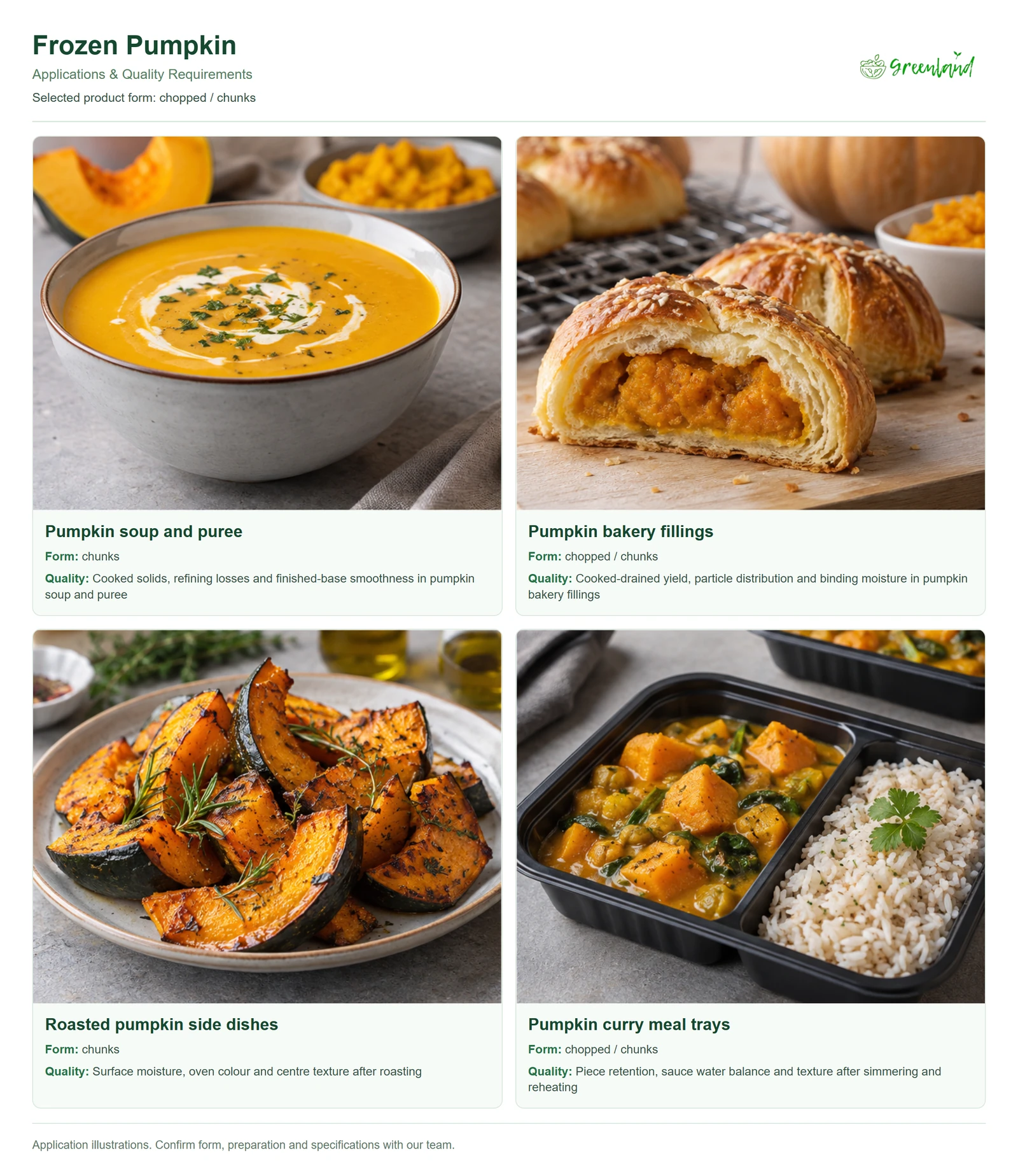
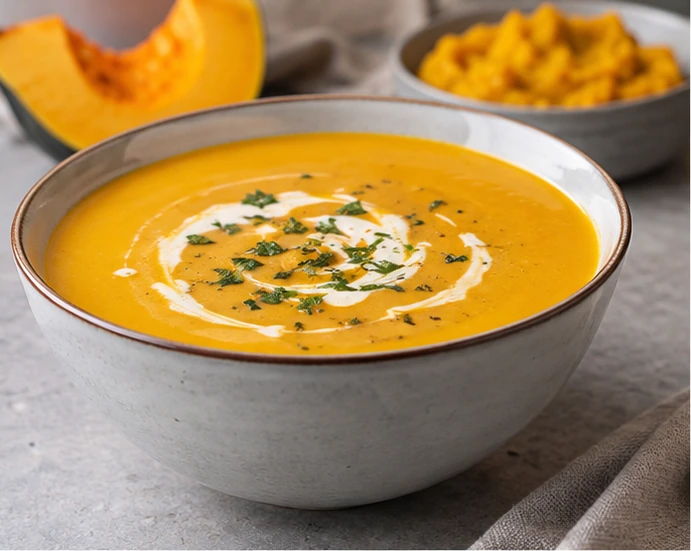
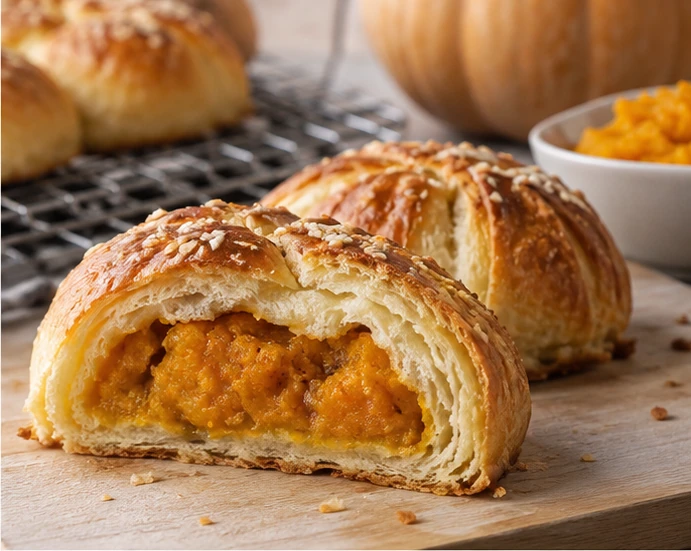
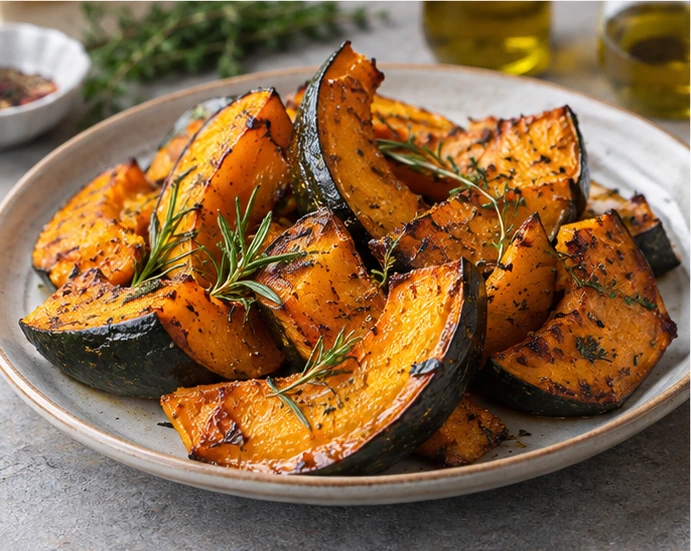
Freezing Raw Pumpkin applications and quality requirements: Pumpkin soup and puree, Pumpkin bakery fillings, Roasted pumpkin side dishes, Pumpkin curry meal trays
Application illustrations. Product form, preparation and suitability follow the confirmed specification. Open the overview to inspect the image.
Pumpkin soup and puree application illustration for Frozen Pumpkin

Pumpkin soup and puree

For: Ingredient buyers at food-processing plants

Form: chunks

We review chunks for your pumpkin soup and puree programme. Confirm cooked solids, refining losses and finished-base smoothness in pumpkin soup and puree. Larger declared inputs require controlled tempering, trimming and cutting, or cooking and blending as appropriate, before they meet the ideal form; assess preparation yield and discard losses.

Pumpkin bakery fillings application illustration for Frozen Pumpkin

Pumpkin bakery fillings

For: Prepared-food and bakery ingredient buyers

Form: chopped, chunks

We review chopped, chunks for your pumpkin bakery fillings programme. Confirm cooked-drained yield, particle distribution and binding moisture in pumpkin bakery fillings. Larger declared inputs require controlled tempering, trimming and cutting, or cooking and blending as appropriate, before they meet the ideal form; assess preparation yield and discard losses. Trial the cooking and drainage step, usable ingredient yield, particle distribution and moisture balance in the finished filling or dough. Your team prepares the required cut or refined component before this application.

Roasted pumpkin side dishes application illustration for Frozen Pumpkin

Roasted pumpkin side dishes

For: Ready-meal and vegetable-blend buyers

Form: chunks

We review chunks for your roasted pumpkin side dishes programme. Confirm surface moisture, oven colour and centre texture after roasting. Larger declared inputs require controlled tempering, trimming and cutting, or cooking and blending as appropriate, before they meet the ideal form; assess preparation yield and discard losses.

Pumpkin curry meal trays application illustration for Frozen Pumpkin

Pumpkin curry meal trays

For: Ready-meal and vegetable-blend buyers

Form: chopped, chunks

We review chopped, chunks for your pumpkin curry meal trays programme. Confirm piece retention, sauce water balance and texture after simmering and reheating. Larger declared inputs require controlled tempering, trimming and cutting, or cooking and blending as appropriate, before they meet the ideal form; assess preparation yield and discard losses. Your team prepares the required cut or refined component before this application.

Match the Application with the Purchasing Specification

ApplicationSelected formQuality points to confirm
Pumpkin soup and pureechunkscooked solids, refining losses and finished-base smoothness in pumpkin soup and puree
Pumpkin bakery fillingschopped, chunkscooked-drained yield, particle distribution and binding moisture in pumpkin bakery fillings
Roasted pumpkin side disheschunkssurface moisture, oven colour and centre texture after roasting
Pumpkin curry meal trayschopped, chunkspiece retention, sauce water balance and texture after simmering and reheating

Quality, Packing & Export Support

We connect the agreed product specification with packing, lot identity, applicable quality documents and frozen delivery planning. Review our quality control system, traceability support and factory audit and inspection support with your sourcing requirements.

Send us the product, required form, final application, key quality requirements, packing, quantity and destination market. We will review the supply programme and confirm the order specification with your team.

Discuss Your Application & Specification

Detailed Commercial Specification

This table separates the original GreenLand offer facts from technical and competitor-derived planning benchmarks. Exact benchmark numbers stay visible for RFQ preparation, while the signed order line identifies the GreenLand SKU, supplying site and applicable limits.

Product Name IQF Frozen Pumpkin / IQF Pumpkin Dice / Frozen Pumpkin Cubes and Chunks
Market Term Freezing Raw Pumpkin for unblanched commercial IQF pieces; not ready to eat
Ingredient 100% pumpkin; no added color, flavor or preservative in the standard product
Botanical Group Cucurbita species; Miben and Ebisu/kabocha type are commercial cultivar references to name in an RFQ when variety matters
Origin Fujian, China; the product specification and shipment file state the contracted origin and crop lot
Grade Grade A commercial frozen ingredient; tighter defect limits available as a premium contract grade
Processing Main product: unblanched IQF pieces. Blanched IQF, steamed frozen and puree are separate RFQ routes and must appear as separate order lines.
Dice / Cube Sizes 6×6, 10×10, 15×15 and 20×20 mm
Chunk Sizes 20–40 mm or 30–60 mm
Slice / Wedge Sizes Length 20–40, 40–70 or 40–90 mm; thickness 7–10 or 10–20 mm; with or without skin
10 mm In-Size Reference 8–12 mm measured dimension band
Color Natural yellow, yellow-orange to deep orange, uniform for the agreed variety and maturity grade
Appearance Clean, sound, free-flowing frozen pieces; slight surface frost is acceptable; no permanent mass or visible foreign material
Flavor and Odor Characteristic pumpkin flavor and odor after cooking; no foreign flavor or odor
Texture Firm when frozen; tender after correct thermal processing; unblanched product requires further cooking
Natural Soluble Solids Technical planning benchmark: 6–8°Bx for diced pumpkin; 8–14°Bx for puree programs depending on variety and concentration route
pH Technical planning benchmark: 4.8–6.5 for diced pumpkin; 4.5–6.5 for puree programs
Bulk Packing 1×10 kg, 2×5 kg, 4×2.5 kg or 1×20 kg food-grade PE bags in export cartons
Retail Packing 20×500 g, 25×400 g, 10×1 kg, 1 lb or 2 lb bags in cartons
RFQ Quantity Benchmark Planning reference: 10 MT for a 20-foot reefer or 22–25 MT for a full 40-foot reefer; the offer states the actual MOQ for the selected pack and mixed-load plan
Loading Capacity Reefer planning reference: approximately 22–25 MT per 40-foot container with no or limited pallet use; palletized loading reduces net payload
Crop / Processing Season Industry planning reference: September–December main processing window; shipment timing depends on the contracted crop lot and frozen inventory
Shelf Life 24 months from production when unopened and continuously stored at -18°C or below
Storage and Transport -18°C or below in frozen storage and reefer transport; protect from thawing and refreezing
Lead Time RFQ planning reference: 15–45 days; printed retail packing and peak-season production use the longer end of the range
Loading Port Xiamen is the working port reference for Fujian-origin planning; the commercial offer states the named loading port
Trade Terms FOB, CFR/CNF or CIF
Payment Terms Export RFQ reference: T/T or L/C at sight; the commercial offer states the selected term
Certificate / Scope Request HACCP, BRC, ISO, Kosher or Ecocert/organic-scope documents are listed by supplying site and current scope in the commercial offer; organic status applies only to a certified organic lot within that scope
Batch Documents Product specification, COA, microbiological report, pesticide-residue report, heavy-metal report, packing list, commercial invoice, certificate copies and traceability record
OEM / Private Label Bag weight, film, artwork, label language, barcode, nutrition panel, lot code, carton marks and pallet plan

Need a tighter defect limit, different cube size or lower microbiological target?
Send the end application, pack weight, annual volume and destination port; we will quote the matching grade rather than hiding the difference inside a generic product name.

Get a Specification-Based Quote

Product Video

Pumpkin product overview. We confirm the product form, processing method and packing for each order.

Watch on YouTube

Processing Flow and Defect Control

We prepare Freezing Raw Pumpkin to the agreed product form, pretreatment, grade and packing specification. The diagram shows a typical production process; we confirm preparation and step order for your order.

IQF Pumpkin Raw Cuts Production Process; twelve typical production and handling stages, with captioned site references and clearly marked process illustrations.
Typical process flow. Final processing and step order follow the confirmed specification. Site photos show the captioned subjects and may illustrate a representative form; process illustrations show typical operations. Storage and loading photos are generic frozen-food references.

Production and handling stages

  1. Raw Material InspectionWe check identity, condition and the agreed raw-material criteria.
  2. Initial SortingWe remove visible defects and unsuitable material.
  3. WashingWe follow the confirmed cleaning and water-control route.
  4. Peeling, Seed Removal & CuttingWe prepare the agreed product form and remove the specified inedible parts.
  5. Pretreatment by SpecificationWe follow the declared raw or heat-treated program.
  6. DrainingWe remove excess surface water before freezing.
  7. IQF FreezingWe quick freeze prepared pieces and review separation.
  8. Frozen Product InspectionWe review the agreed defects, form, separation and frozen condition.
  9. Weighing, Packing & Metal ControlWe check net weight, pack integrity and agreed metal controls.
  10. Batch Review & ReleaseWe match lot identity and records to the agreed release checks.
  11. Frozen StorageWe maintain the agreed frozen-storage conditions and lot identity.
  12. Reefer LoadingWe review cartons, lot records and refrigerated shipment arrangements.

Processing Flow and Defect Control

freezing-raw-pumpkin-process-route-comparison

Process illustration: the raw-style route proceeds from preparation to IQF freezing, while the blanched route adds heat treatment, cooling and draining before freezing.

Frozen pumpkin pieces undergoing manual sorting on a stainless inspection table

Original pumpkin image showing frozen piece separation and manual defect sorting.

1. Raw Material Receipt
Maturity, soundness, decay, soft spots, field damage and lot identity.
2. Washing
Surface soil, sand and loose field material removed before cutting.
3. Peeling and Seeding
Rind, seed cavity and stringy tissue removed to the selected peel tolerance.
4. Trimming
Discolored, damaged, overripe and pest-affected flesh removed.
5. Cutting
Dice, cube, chunk or slice formed to the declared nominal size.
6. Heat Route
No blanching for raw-style IQF, or controlled blanching/steaming for the selected route.
7. Cooling and Draining
Surface water reduced before freezing to limit heavy frost and clumps.
8. IQF Freezing
Individual pieces frozen for free-flowing commercial handling.
9. Frozen Sorting
Out-size, clumps, peel, blemishes, foreign material and color defects checked.
10. Weighing and Sealing
Net weight, liner condition, bag seal and carton condition recorded.
11. Metal Detection
Finished pack passes the sensitivity written into the packing specification.
12. Cold Storage and Loading
Lot code, carton count, -18°C condition and reefer loading record linked to shipment.

Reference Physical Defect Limits

These measurable limits give a practical starting point for a signed specification. A premium grade can use tighter values when the application needs a cleaner retail appearance or more accurate dosing.

10 mm Dice Reference

In-size band 8–12 mm
Color defects ≤10% by weight
Irregular dice ≤25% by weight
Permanent clumps ≤15% by weight
Skin residue ≤7% by weight
Pest/disease damage ≤3 pieces per 500 g
Plant-origin matter ≤0.05% by weight
Mineral matter ≤0.03% by weight
Foreign material None detected

20 mm Dice Reference

Reference range 10–30 mm around the 20 mm nominal cut
Undersize below 10 mm ≤20% by weight
Oversize above 30 mm ≤10% by weight
Clumps over 5 joined units ≤10% by weight
Minor + major blemishes ≤2% by weight
Overripe pieces ≤6% by weight
Pieces with peel ≤5% by weight
Extraneous vegetable matter ≤1 piece per 1,000 g
Foreign material None detected

COA Release Targets: Microbiology, Residues and Heavy Metals

The COA identifies the lot and reports the actual result next to the release limit. We use different microbiological targets for raw-style and heat-treated products because they are not the same risk profile.

Parameter Unblanched / Raw-Style IQF Blanched IQF Target COA Expression
Total plate count ≤500,000 CFU/g <100,000 CFU/g Actual count in CFU/g
Total coliforms ≤1,000 CFU/g <100 CFU/g Actual count in CFU/g
E. coli ≤100 CFU/g <10 CFU/g Actual count or below reporting limit
Yeast ≤1,000 CFU/g <1,000 CFU/g Actual count in CFU/g
Mould ≤1,000 CFU/g <1,000 CFU/g Actual count in CFU/g
Salmonella Absent in 25 g Absent in 25 g Detected / not detected
Listeria monocytogenes Absent in 25 g Absent in 25 g Detected / not detected
Peroxidase Not applicable Negative for a validated blanch route Positive / negative when included

EU-Oriented Heavy-Metal Limits

Lead: ≤0.050 mg/kg

Cadmium: ≤0.020 mg/kg

Wet-weight limits for the washed edible portion of fruiting vegetables under the EU contaminant framework.

Pesticide-Residue Release

Each tested active substance must be at or below the destination-market MRL. For the EU, the general default is 0.01 mg/kg when no specific MRL is set. The report lists the tested compounds, reporting limits and measured results.

Metal-Detector Sensitivity

500 g–1 kg packs: Fe 1.5–2.0 mm; Non-Fe 2.0–2.5 mm; SS316 2.5–3.0 mm.

2.5–10 kg packs: Fe 2.5–3.0 mm; Non-Fe 3.0–3.5 mm; SS316 3.5–4.0 mm.

Packaging, OEM and Private Label

freezing-raw-pumpkin-packaging-options

Packaging illustration. Final bags, cartons, print and pallet pattern follow the approved packing specification.

Bulk bag of frozen pumpkin cubes showing natural orange color and commercial piece condition

Original bulk PE-bag product view for frost, piece condition and pack discussion.

Bulk processing: 10 kg or 20 kg PE-lined carton for repacking, soup, sauce, puree and industrial plants.

Foodservice: 1 kg, 2.5 kg or 5 kg inner bags sized for portion control and back-of-house handling.

Retail: 400 g, 500 g, 1 lb, 1 kg or 2 lb pouches with buyer artwork, nutrition panel, barcode and local-language label.

Carton control: corrugated strength, food-grade liner, net weight, production/lot code, best-before date, carton mark and destination label.

Loading: use approximately 22–25 MT as a 40-foot reefer planning reference; the actual payload follows pack volume and pallet requirement.

What the Pumpkin COA and Shipment File Contain

Batch Identity

Product name, process route, nominal size, origin, production lot, production date, best-before date, pack format and released quantity.

Physical and Sensory

Color, appearance, odor, flavor after cooking, frozen texture, thawed texture, size distribution, clumps, peel, blemishes and foreign material.

Analytical and Safety

Brix, pH when specified, microbiology, pesticide residues, lead, cadmium, peroxidase for a blanched route and metal-detector release record.

Declarations

100% pumpkin ingredient statement, additive declaration, GMO statement, allergen statement, packaging compliance and certificate copies for the supplying site.

GreenLand frozen food traceability workflow covering batch records COA inspection and shipment

Cross-category traceability-system evidence. Pumpkin shipment files use the pumpkin lot, signed specification, inspection results, packing record and shipment link.

Document Included Information Commercial Use
Product Specification Ingredient, route, size, grade, defects, packing, storage and shelf life Contract control and repeat-order standard
COA by Batch Lot identity, actual physical/chemical/micro results and release status Buyer QA file and receiving comparison
Microbiological Report TPC, coliforms, E. coli, yeast, mould, Salmonella and Listeria Food-safety release for the selected process route
Pesticide-Residue Report Tested analytes, reporting limits, results and applicable MRLs Destination-market residue compliance
Heavy-Metal Report Lead and cadmium; additional elements when written into the contract Contaminant compliance and QA review
Traceability Record Raw material lot, production line/date, packing lot, cold storage and shipment link Complaint investigation and repeat-order control
Export File Commercial invoice, packing list, bill of lading, certificate of origin and destination-specific health/sanitary document Customs clearance and import documentation
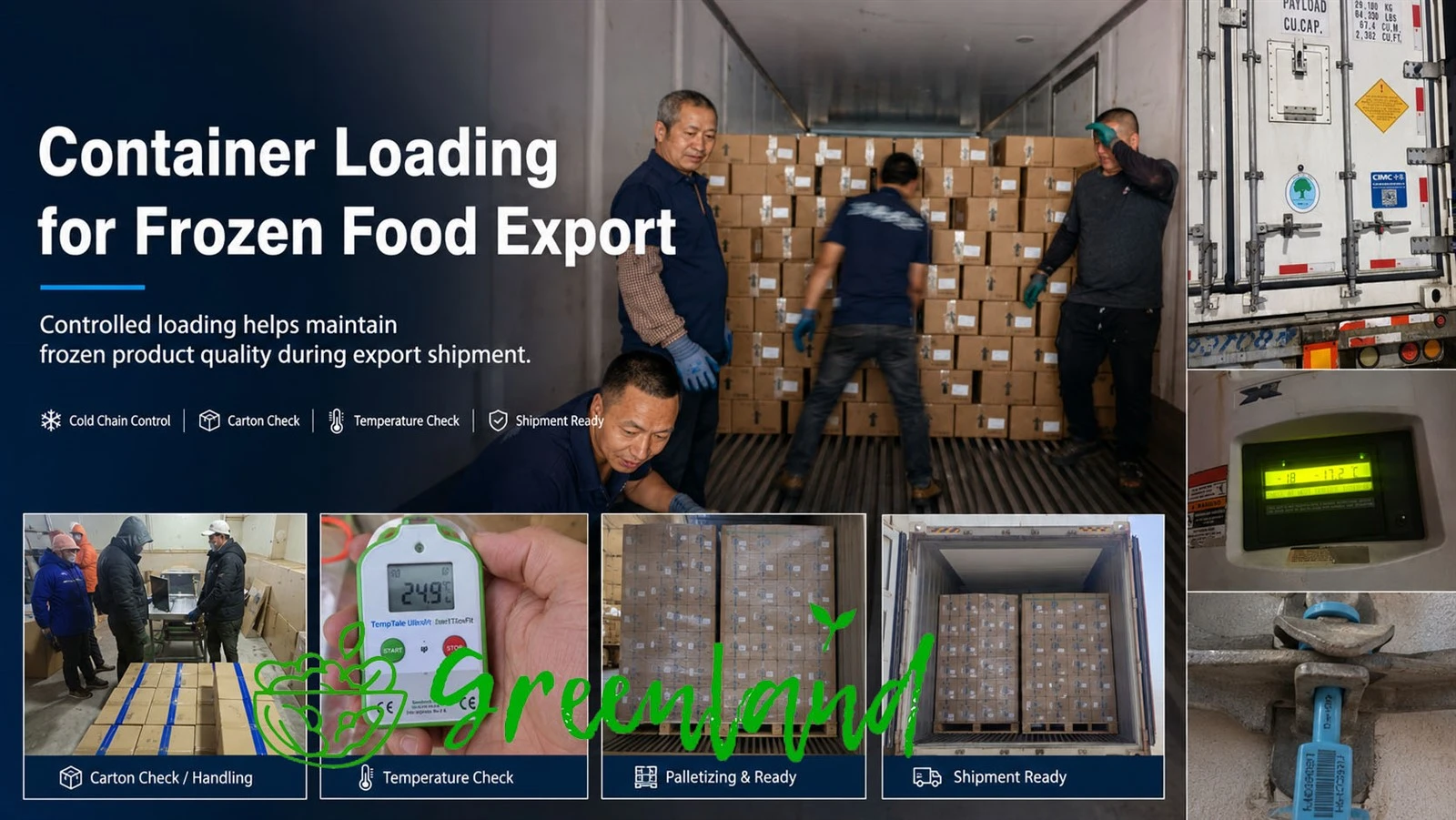
Loading File Container number, seal number, carton count, condition, loading photos and temperature check Shipment handover and cold-chain evidence

Logistics and Frozen Cold-Chain Control

We connect packing format, payload, pallet plan and destination-port document needs before loading. Product remains at -18°C or below in frozen storage and reefer transport, without planned thawing or refreezing.

GreenLand cold storage before frozen food export at minus 18 degrees Celsius

Cross-category cold-storage evidence supporting -18°C or below holding before shipment.

GreenLand reefer container loading and frozen shipment temperature checks

Cross-category loading evidence covering carton handling, container condition and frozen shipment temperature checks.

Payload planning
Use 22–25 MT as a 40-foot reefer reference; carton volume and pallets reduce the net payload.
Mixed container
Group compatible frozen SKUs under the same temperature condition and loading sequence.
Shipment file
Link container and seal numbers, carton count, loading photos, temperature check and export documents.

Why Source Frozen Pumpkin with GreenLand-food

We quote the processing route.
Unblanched, blanched, steamed and puree programs are not presented as the same product.
We write measurable limits.
Cut size, out-size, clumps, peel, blemishes, microbes and packing appear in the specification.
We connect lot and files.
The COA, inspection results, packing lot, cold-store record and shipment file follow the same traceability chain.
We plan the channel.
Bulk cartons, foodservice bags, retail private label, pallet patterns and mixed loading are built around the sales channel.

Frozen Pumpkin FAQ for Commercial Buyers

1. What does "freezing raw pumpkin" mean in a commercial order?

It means washed, peeled, seeded and cut pumpkin that is frozen without a blanching step. The product is not ready to eat and requires further heat treatment.

2. Is unblanched IQF pumpkin the same as blanched IQF pumpkin?

No. Unblanched product keeps a raw-style process route and uses the raw-style microbiological target. Blanched product includes an enzyme-inactivation step and uses the tighter heat-treated target.

3. Which frozen pumpkin sizes are available?

Dice are offered at 6×6, 10×10, 15×15 and 20×20 mm. Chunks use 20–40 or 30–60 mm, and slices use 7–10 or 10–20 mm thickness.

4. Which size works for ready meals?

Use 15×15 or 20×20 mm when the finished meal needs visible pieces. Use 10×10 mm when faster heating and more even distribution matter.

5. What are the reference Brix and pH values?

Diced pumpkin uses 6–8°Bx and pH 4.8–6.5 as the reference natural range. Puree programs use 8–14°Bx and pH 4.5–6.5.

6. What is the standard bulk packing?

The main option is 1×10 kg PE bag in an export carton. We also use 2×5 kg, 4×2.5 kg, 1×20 kg and retail-bag configurations.

7. What quantity should an IQF pumpkin RFQ use?

Use 10 MT for a 20-foot reefer or 22–25 MT for a 40-foot reefer as the planning reference. The offer states the actual MOQ for the chosen packing and mixed-load plan.

8. What lead time should the RFQ plan?

Use 15–45 days as the planning range. Plain bulk packing uses the shorter end; printed retail film and peak-season production use the longer end.

9. How long is frozen pumpkin stored?

Shelf life is 24 months from production when the unopened product remains at -18°C or below without thawing and refreezing.

10. What microbiological results appear on the COA?

The panel covers TPC, total coliforms, E. coli, yeast, mould, Salmonella and Listeria monocytogenes, with separate raw-style and blanched targets.

11. What pesticide and heavy-metal limits are used for EU orders?

The EU-oriented release uses lead ≤0.050 mg/kg and cadmium ≤0.020 mg/kg. Pesticides follow the active-substance MRL; 0.01 mg/kg is the general default where no specific EU MRL is set.

12. Can you supply private-label frozen pumpkin?

Yes. We prepare 400 g, 500 g, 1 lb, 1 kg and 2 lb options with artwork, nutrition panel, barcode, lot code, carton marks and pallet pattern.

13. Can frozen pumpkin ship in a mixed container?

Yes. Pumpkin can share a reefer with compatible frozen vegetables when the total reaches the container loading plan and every SKU uses the same cold-chain condition.

14. What is included in the pre-shipment inspection file?

The shipment file links the product lot, packing condition, carton count, container and seal numbers, loading photos, temperature check and agreed release documents.

Send a Complete Frozen Pumpkin RFQ

Include these details so we can return one specification-based offer instead of a generic price:

• Product form and process route• Cut size and acceptable tolerance• Target defect and micro limits• Bulk, foodservice or retail packing• Order quantity and annual volume• Destination port and market• Application and cooking process• COA, residue and certificate list• Private-label artwork requirement• Pallet or mixed-container plan

Hot Tags: freezing raw pumpkin, China freezing raw pumpkin manufacturers, suppliers, factory, frozen diced pumpkin, , frozen fresh pumpkin

Technical specification · reference schedule

Frozen Raw Pumpkin

We review the selected form, grade, process and packing against the technical schedule below. Published and TDS values are specification references for order review. External benchmarks apply only within their stated scope. Acceptance is governed by the signed SKU specification; the identified lot COA reports actual measured results.

Form: Raw/unblanched pumpkin pieces; cut selected by order Product category: Frozen Pumpkin

01 / Physical & Sensory

ParameterSpecification / referenceVerification & order basis
Botanical GroupCucurbita species; Miben and Ebisu/kabocha type are commercial cultivar references to name in an RFQ when variety mattersPublished referenceCheck raw-material identity and variety/source declaration against the ordered programme.
OriginFujian, China; the product specification and shipment file state the contracted origin and crop lotPublished referenceReconcile source declaration, intake lot and shipment documents.
GradeGrade A commercial frozen ingredient; tighter defect limits available as a premium contract gradePublished referenceConfirm method, representative sample and acceptance basis in the signed specification.
Dice / Cube Sizes6 × 6, 10 × 10, 15 × 15 and 20 × 20 mmPublished referenceMeasure a defined frozen sample with caliper or size gauge; report distribution and tolerance.
Chunk Sizes20–40 mm or 30–60 mmPublished referenceMeasure a defined frozen sample with caliper or size gauge; report distribution and tolerance.
Slice / Wedge SizesLength 20–40, 40–70 or 40–90 mm; thickness 7–10 or 10–20 mm; with or without skinPublished referenceMeasure a defined frozen sample with caliper or size gauge; report distribution and tolerance.
ColorNatural yellow, yellow-orange to deep orange, uniform for the agreed variety and maturity gradePublished referenceCompare with the approved sensory reference using the stated frozen/thawed/prepared condition.
AppearanceClean, sound, free-flowing frozen pieces; slight surface frost is acceptable; no permanent mass or visible foreign materialPublished referenceCompare with the approved sensory reference using the stated frozen/thawed/prepared condition.
Flavor and OdorCharacteristic pumpkin flavor and odor after cooking; no foreign flavor or odorPublished referenceCompare with the approved sensory reference using the stated frozen/thawed/prepared condition.
TextureFirm when frozen; tender after correct thermal processing; unblanched product requires further cookingPublished referenceCompare with the approved sensory reference using the stated frozen/thawed/prepared condition.
Plant-origin matter≤0.05% by weightPublished referenceConfirm method, representative sample and acceptance basis in the signed specification.
Size-grade inspectionUse the selected diameter, length, piece mass or count-per-weight grade; state the proportion permitted outside the range.Measure the named anatomical dimension; count and weigh the same representative sample.
Declared product formRaw/unblanched pumpkin pieces; cut selected by orderMatch approved sample, pack label and order form. Published page identity; approve selected grade before order.

02 / Physicochemical & Residue Controls

ParameterSpecification / referenceVerification & order basis
Natural Soluble SolidsTechnical planning benchmark: 6–8°Bx for diced pumpkin; 8–14°Bx for puree programs depending on variety and concentration routePublished referenceMeasure representative prepared sample with a temperature-compensated refractometer.
pHTechnical planning benchmark: 4.8–6.5 for diced pumpkin; 4.5–6.5 for puree programsPublished referenceUse calibrated pH meter or titration on the stated sample preparation.
Skin residue≤7% by weightPublished referenceUse a validated analytical method for this matrix; report sample basis, unit, preparation and lot result.
Mineral matter≤0.03% by weightPublished referenceUse a validated analytical method for this matrix; report sample basis, unit, preparation and lot result.
Pesticide residue scheduleNamed active ingredients and commodity-specific limits are selected for the destination market. EU sourceLink farm spray history, laboratory LOQ and batch result to the destination MRL. EU database is one market reference; apply the actual destination rule.
Lead, cadmium and other contaminantsApply the limit for the exact commodity and processed form in the destination market. EU sourceState analyte, preparation basis, method, LOQ and lot result. Do not transfer a fresh-commodity limit to a processed form without the required assessment.

03 / Microbiological Criteria

ParameterSpecification / referenceVerification & order basis
Total plate count - Unblanched / Raw-Style IQF≤500,000 CFU/gPublished referenceReport the named organism, analytical method, sample mass, sampling plan and lot result; use CFU/g for enumeration and a stated mass for detection. Programme: Unblanched / Raw-Style IQF.
Total plate count - Blanched IQF Target<100,000 CFU/gPublished referenceReport the named organism, analytical method, sample mass, sampling plan and lot result; use CFU/g for enumeration and a stated mass for detection. Programme: Blanched IQF Target.
Total coliforms - Unblanched / Raw-Style IQF≤1,000 CFU/gPublished referenceReport the named organism, analytical method, sample mass, sampling plan and lot result; use CFU/g for enumeration and a stated mass for detection. Programme: Unblanched / Raw-Style IQF.
Total coliforms - Blanched IQF Target<100 CFU/gPublished referenceReport the named organism, analytical method, sample mass, sampling plan and lot result; use CFU/g for enumeration and a stated mass for detection. Programme: Blanched IQF Target.
E. coli - Unblanched / Raw-Style IQF≤100 CFU/gPublished referenceReport the named organism, analytical method, sample mass, sampling plan and lot result; use CFU/g for enumeration and a stated mass for detection. Programme: Unblanched / Raw-Style IQF.
E. coli - Blanched IQF Target<10 CFU/gPublished referenceReport the named organism, analytical method, sample mass, sampling plan and lot result; use CFU/g for enumeration and a stated mass for detection. Programme: Blanched IQF Target.
Yeast - Unblanched / Raw-Style IQF≤1,000 CFU/gPublished referenceReport the named organism, analytical method, sample mass, sampling plan and lot result; use CFU/g for enumeration and a stated mass for detection. Programme: Unblanched / Raw-Style IQF.
Yeast - Blanched IQF Target<1,000 CFU/gPublished referenceReport the named organism, analytical method, sample mass, sampling plan and lot result; use CFU/g for enumeration and a stated mass for detection. Programme: Blanched IQF Target.
Mould - Unblanched / Raw-Style IQF≤1,000 CFU/gPublished referenceReport the named organism, analytical method, sample mass, sampling plan and lot result; use CFU/g for enumeration and a stated mass for detection. Programme: Unblanched / Raw-Style IQF.
Mould - Blanched IQF Target<1,000 CFU/gPublished referenceReport the named organism, analytical method, sample mass, sampling plan and lot result; use CFU/g for enumeration and a stated mass for detection. Programme: Blanched IQF Target.
Salmonella - Unblanched / Raw-Style IQFAbsent in 25 gPublished referenceReport the named organism, analytical method, sample mass, sampling plan and lot result; use CFU/g for enumeration and a stated mass for detection. Programme: Unblanched / Raw-Style IQF.
Salmonella - Blanched IQF TargetAbsent in 25 gPublished referenceReport the named organism, analytical method, sample mass, sampling plan and lot result; use CFU/g for enumeration and a stated mass for detection. Programme: Blanched IQF Target.
Listeria monocytogenes - Unblanched / Raw-Style IQFAbsent in 25 gPublished referenceReport the named organism, analytical method, sample mass, sampling plan and lot result; use CFU/g for enumeration and a stated mass for detection. Programme: Unblanched / Raw-Style IQF.
Listeria monocytogenes - Blanched IQF TargetAbsent in 25 gPublished referenceReport the named organism, analytical method, sample mass, sampling plan and lot result; use CFU/g for enumeration and a stated mass for detection. Programme: Blanched IQF Target.
Acceptance scheduleSelect the test panel and limits by intended use (ready-to-eat or further processing), product form and destination. EU sourceState organism, analytical method, sample mass and n/c plan; report actual lot results. A universal APC, coliform, Salmonella or Listeria limit is not assigned to every frozen product.

04 / Freezing & Cold Chain

ParameterSpecification / referenceVerification & order basis
Separation & loose-ice assessmentKeep inherent moisture, loose ice and permanently frozen clusters as separate inspection categories.Weigh separated loose ice and welded clusters against initial sample mass; distinguish natural paired pieces or blocks.
Product thermal centre−18°C or colder after freezing and thermal stabilization; maintain the agreed frozen distribution condition.External reference CodexProbe the thickest representative pack and retain storage/transport temperature records. Codex quick-frozen reference; selected product form and route must be frozen.
Frozen condition at dispatchHard frozen, correctly sealed and coded, without thaw/refreeze evidence or excessive loose ice. CodexCheck pack integrity, free-flow or block condition as declared, carton condition and loading temperature.

05 / Pack Size & Shelf Life

ParameterSpecification / referenceVerification & order basis
Bulk Packing1 × 10 kg, 2 × 5 kg, 4 × 2.5 kg or 1 × 20 kg food-grade PE bags in export cartonsPublished referenceCheck approved pack drawing, calibrated scale and production records.
Retail Packing20 × 500 g, 25 × 400 g, 10 × 1 kg, 1 lb or 2 lb bags in cartonsPublished referenceCheck approved pack drawing, calibrated scale and production records.
Shelf Life24 months from production when unopened and continuously stored at -18°C or belowPublished referenceVerify unopened-pack validation, declared storage condition and production/best-before coding.
Declared net contentsVerify each selected pack format against the artwork and applicable quantity-control rule. CodexCalibrated checkweigher or scale; defined sample and tare.
Shelf-life basisThe labelled period applies only to its validated pack and continuous stated storage condition. CodexReview stability study or approved shelf-life file and production-date code.

06 / Process Controls

ParameterSpecification / referenceVerification & order basis
ProcessingMain product: unblanched IQF pieces. Blanched IQF, steamed frozen and puree are separate RFQ routes and must appear as separate order lines.Published referenceCheck the approved product flow, line settings and identified production record; validate numerical critical limits within the site HACCP plan.
Peroxidase - Unblanched / Raw-Style IQFNot applicablePublished referenceCheck the approved product flow, line settings and identified production record; validate numerical critical limits within the site HACCP plan. Programme: Unblanched / Raw-Style IQF.
Peroxidase - Blanched IQF TargetNegative for a validated blanch routePublished referenceCheck the approved product flow, line settings and identified production record; validate numerical critical limits within the site HACCP plan. Programme: Blanched IQF Target.
Raw-material preparation checksState raw/blanched/steamed state and whether the product is pieces or puree.Verify the selected product flow and the relevant trimming, sorting and pretreatment record.
CCP designationUse the site-approved HACCP plan to identify true CCPs and their validated critical limits. CodexCheck hazard analysis, monitoring, deviation and corrective-action records. A quality-control step is not automatically a CCP.

07 / Ingredients, Additives & Allergens

ParameterSpecification / referenceVerification & order basis
Ingredient100% pumpkin; no added color, flavor or preservative in the standard productPublished referenceVerify approved formula, supplier declarations and line-specific allergen assessment.
Added glaze / coating declarationDeclare any intentionally added water glaze, syrup, oil or coating and the measurement basis; loose ice is assessed separately.Verify formula/addition records; agree a deglazing or coating test and net-content basis where applicable.
Additive useDeclare any colour-protection agent, acidulant or other additive by ingredient and maximum permitted use for the target market. NHC standardCheck approved formula, actual addition record and market-specific additive category. GB 2760-2024 applies to China; export rules are checked separately.
Allergen and cross-contact assessmentDeclare inherent allergens and assess shared-line cross-contact from the actual facility schedule. FDAReview line matrix, cleaning validation and buyer label approval. Do not claim a shared-line allergen or allergen-free status without facility evidence.

08 / Defects & Foreign Matter

ParameterSpecification / referenceVerification & order basis
10 mm In-Size Reference8–12 mm measured dimension bandPublished referenceMeasure a defined frozen sample with caliper or size gauge; report distribution and tolerance.
In-size band8–12 mmPublished referenceMeasure a defined frozen sample with caliper or size gauge; report distribution and tolerance.
Color defects≤10% by weightPublished referenceCompare with the approved sensory reference using the stated frozen/thawed/prepared condition.
Irregular dice≤25% by weightPublished referenceClassify on the defined sample by count or mass; record individual categories, denominator and any combined limit.
Permanent clumps≤15% by weightPublished referenceClassify on the defined sample by count or mass; record individual categories, denominator and any combined limit.
Pest/disease damage≤3 pieces per 500 gPublished referenceClassify on the defined sample by count or mass; record individual categories, denominator and any combined limit.
Foreign materialNone detectedPublished referenceInspect a defined representative sample; record count or mass basis and disposition.
Undersize below 10 mm≤20% by weightPublished referenceMeasure a defined frozen sample with caliper or size gauge; report distribution and tolerance.
Oversize above 30 mm≤10% by weightPublished referenceMeasure a defined frozen sample with caliper or size gauge; report distribution and tolerance.
Clumps over 5 joined units≤10% by weightPublished referenceClassify on the defined sample by count or mass; record individual categories, denominator and any combined limit.
Minor + major blemishes≤2% by weightPublished referenceClassify on the defined sample by count or mass; record individual categories, denominator and any combined limit.
Overripe pieces≤6% by weightPublished referenceClassify on the defined sample by count or mass; record individual categories, denominator and any combined limit.
Extraneous vegetable matter≤1 piece per 1,000 gPublished referenceClassify on the defined sample by count or mass; record individual categories, denominator and any combined limit.
Intrinsic defect classificationPeel, seed, fibrous cavity tissue, soft overripe material and dark spots.Record each defect class separately by count or mass; state sample size, denominator and combined-limit rules.
Hazardous foreign matterNo foreign matter detected in the defined inspection sample; reject and investigate any finding.External reference CodexDefine visual-inspection sample size and detector challenge in the signed quality schedule. "None detected" is a sampling statement, not an absolute guarantee of zero particles.

09 / Packaging Materials & Label

ParameterSpecification / referenceVerification & order basis
OEM / Private LabelBag weight, film, artwork, label language, barcode, nutrition panel, lot code, carton marks and pallet planPublished referenceApprove artwork and food-contact declaration for the destination market.
Food-contact packSpecify inner-contact material and obtain the applicable food-contact compliance declaration. NHC standardReview film structure, supplier DoC, migration evidence and actual intended conditions. GB 4806 series is China-specific; EU export also checks Regulations 1935/2004 and 10/2011.
Carton and seal integrityDefine carton stacking strength, bag seal and puncture resistance for the confirmed net weight and pallet plan. EU sourceInspect pack drawing, compression/seal test and shipment configuration.
Label verificationMatch product name, ingredient/allergen statement, net weight, lot/date, shelf life and storage instruction to the destination artwork. CodexApprove artwork against the signed specification and destination rules.

10 / Detection & Traceability

ParameterSpecification / referenceVerification & order basis
Foreign-body detectorValidate Fe, non-Fe and stainless-steel challenge pieces for the actual product, aperture, pack and line; record the proven sensitivity. CodexChallenge at defined start, changeover, interval and end points; retain rejection records. Do not copy generic detector sizes into a plant capability claim.
Lot traceabilityLink input source lot, processing run, packaging code, test records, frozen storage and shipment to one finished lot. CodexTrace one sample lot forward and backward in a recorded mock recall. Recall speed is stated only when the site has a validated target and record.
Order approval: Confirm the selected form and grade, ingredient formula, intended use, destination market, packing, sampling plan and test panel. The signed specification controls acceptance; the identified lot COA reports actual results.

Send Inquiry