


A Hotter Osmotic Bath Can Speed Water Loss Without Improving Selectivity
Oct 09, 2026
Leave a message

Research This Article & Topic with AI
Verify key claims, compare reliable sources, and explore GreenLand-food's practical frozen food knowledge.
Article details and research questions are prepared in the links. Sign-in or sending may be required.

Consider an illustrative apple processor planning a treatment before further drying or freezing. The developer asks GreenLand whether increasing bath temperature will shorten the step and also reduce sugar uptake relative to water removal. Those are two different questions. We would separate the untreated apple input specification from the buyer's treatment trial, and ask what finished composition the buyer can accept. Plain frozen apple and an osmotically treated ingredient should not become interchangeable descriptions.
The paper behind this question examined apparent mass diffusivities in fruit and vegetable tissues. Its reported temperature and concentration responses support a useful distinction: temperature can accelerate both transfers, while a concentration change can alter their relative response differently. This article uses that distinction to frame a development decision. The research does not supply a validated treatment recipe for our frozen apple or a shelf-life claim for the buyer's finished product.
Choose the transport objective before changing the bath
The first question is what the osmotic step is supposed to accomplish. A processor trying to remove some water before air drying may value a shorter downstream drying time. A processor making sweet apple pieces may welcome some solute uptake. A bakery developer who needs recognizably unsweetened fruit may find the same uptake unacceptable. The bath can be identical while the useful outcome changes with the application. Define the finished ingredient before discussing a hotter treatment.
Water loss means water leaving the tissue. Solute gain means material from the surrounding solution entering or remaining with the treated fruit, according to the measurement procedure. These quantities are often reported against an initial sample mass, but the calculation basis must be stated. Final sample weight alone cannot separate them. An apple piece can lose water and gain dissolved solids simultaneously, with a modest net weight change concealing substantial changes in both components.

Frosted peeled apple pieces in a close product view. Actual GreenLand product photo; confirm the offered specification. This is not treatment evidence.
Apparent diffusivity is also different from the amount transferred during a production run. It is a parameter estimated using a model and specified experimental conditions. A larger estimated water diffusivity does not directly identify the final water content at every contact time. Nor does a ratio of diffusivities automatically equal the ratio of cumulative water loss to solute gain. Keep the paper's transport parameters, your measured composition and your throughput estimate in their respective columns.
For the illustrative customer, the useful brief might be an apple ingredient that loses enough water to support the next step while keeping added sweetness within an agreed formulation allowance. That brief needs a measurable endpoint. It could specify final moisture alongside a limit on solid gain, with texture and apple flavour checked separately. We would leave numerical limits to the buyer's development and quality teams because the acceptable balance depends on the intended finished food.
The receiving state of the apple deserves equal attention. Freshly cut tissue and previously frozen tissue need not present the same transport structure. Thawing can change liquid release and the distribution of soluble material before the bath is even introduced. If the intended input is frozen apple, record whether it enters frozen, partially thawed or fully thawed, and whether released liquid remains with the sample. An experiment using fresh apple slices cannot silently become qualification of frozen apple cubes.
In our sourcing discussion, the details we can usefully align are the product form, cut and the lot information available for sampling. The buyer then tests that input in its own treatment route. We would not describe an untested apple lot as optimized for osmotic dehydration, or infer an added-sugar specification from the appearance of the pieces. The material identity and the transport objective together make the trial interpretable; neither one can substitute for the other.
An explicit objective also prevents an unhelpful optimization exercise. The fastest bath is not automatically the best bath if it leaves the fruit too sweet, too soft or difficult to portion. Conversely, the lowest solid gain is not automatically desirable if the application requires a sweetened inclusion. State the acceptable composition and handling behaviour first. That lets the team judge temperature as one process variable instead of treating speed as the entire definition of success.
Temperature can accelerate both transfers
Temperature affects the movement of water and solutes, and it can affect the tissue through which they move. In the original study, increasing temperature had a strong positive effect on the apparent diffusivities of both water and solute. The relative response did not support a general promise of improved water-over-solute selectivity. That is the central answer to the customer's question: faster transfer is plausible, but preferential water removal requires its own evidence.
Imagine two treatments compared at the same clock time. If the hotter treatment causes more water loss and more solute gain, its higher water loss alone does not resolve whether the ingredient is better for a low-sweetness formulation. The comparison has to include both outcomes. A team that reports only moisture reduction may select a condition whose effect on added solids becomes apparent later, when the treated apple is mixed into a filling or dessert base.
A comparison at the same final moisture asks a different question. The hotter treatment might reach that point sooner, but solute gain at that point still needs measuring. The shorter residence time and the faster solute transfer can act in opposing directions. Which effect dominates is an experimental result for the particular tissue and route. It is not something we would settle from the bath temperature or the water-loss curve alone.

Water leaving apple tissue and bath solute entering it are separate transfers. Arrows show direction, not rate.
Texture is another reason to observe the material during the temperature trial. Transport behaviour and structural change can occur together. A condition that improves the rate of one transfer may also alter the ability of pieces to survive draining, conveying or later heating. The application check should use the same handling sequence that matters to the buyer. A neatly cut apple cube in a beaker is not yet evidence that it will remain a usable inclusion after the full process.
The relevant temperature is the treatment environment actually experienced by the sample. Record how the bath is controlled, how loading affects it and how the fruit reaches the treatment condition. An initial setpoint written on a trial sheet is insufficient if a large cold load changes the bath temperature. This is particularly relevant when a frozen input is considered. The team's time definition should distinguish the planned contact interval from any preceding equilibration or thawing stage.
The original result is useful for selecting measurements, not for copying an operating point. We have not established a universal temperature threshold for apple damage or an optimum temperature for the buyer's line. Studies using different tissues, geometries or solutes can help explain why responses vary, but they do not remove the need to test the intended input. The procurement consequence is practical: request a representative sample and define the trial state before expecting a temperature recommendation.
When the developer reports a shorter cycle, we would ask how that cycle was measured. Was the comparison based on equal time, equal moisture or equal solids? Did the treated pieces also meet the sensory and handling requirements? Those questions make the throughput result commercially meaningful. They allow a hotter condition to be accepted when it earns its place, while avoiding a claim that faster water loss automatically protects the original apple composition.
Concentration can change the relative response differently
Bath concentration is not simply another way to produce the same temperature effect. In the reported study, increasing concentration raised the apparent water diffusivity while reducing the apparent solute diffusivity. The resulting relative response differed from the temperature response. This finding explains why a developer should consider temperature and concentration as separate factors when asking about selectivity. It does not mean that the strongest solution always gives the best treated apple.
The surrounding solution supplies the driving environment for exchange, but its physical properties also change with composition. Different solutes and mixtures create different practical treatments. A result from one sugar solution cannot be transferred unchanged to a polyol system or a formulated syrup. The qualification record should identify the solute, the concentration basis and the method used to verify it. A generic entry such as 'sweet bath' leaves too much uncertainty for a repeatable comparison.
The solution itself changes as the fruit and bath exchange material. Water entering the bath can dilute it; uptake and material released from the fruit can also affect its composition. Consequently, an initial concentration is only part of the trial description. The loading ratio, mixing arrangement and replenishment approach determine how close the sample remains to the intended environment. A small laboratory trial and a heavily loaded production vessel may depart from the initial condition in different ways.
A measured concentration expressed as soluble solids also needs interpretation. Fruit-derived soluble material can enter the solution, so a reading after use may not describe the original added solute alone. For a development trial, agree whether the concentration measurement is a process-control indicator or an analytical basis for calculating transfer. The same instrument reading should not be assigned more specificity than the method provides. This distinction matters when a label or formulation calculation depends on added solids.

The original study reported both apparent diffusivities increasing with temperature, but different directions with concentration. No effect magnitudes are shown.
Geometry can interact with the concentration trial. Thin slices and thick cubes have different distances from the surface to the centre, and the surface area available per unit mass differs. Keep each comparison internally consistent. If the buyer plans to use cubes, slice data can help frame questions but should not define the cube treatment endpoint. Changing the cut at the same time as the bath concentration makes it harder to identify the reason for the observed response.
For our illustrative customer, this creates a sensible second trial question: could an adjustment in concentration produce a more acceptable balance of water removal and solid uptake at the required endpoint? That question remains open until measured. We would encourage the buyer to compare it against the temperature change using the same material and reporting basis. The aim is to understand the competing responses, not to assume that concentration provides a guaranteed solution to sweetness control.
There may also be handling and formulation costs associated with a different solution. The buyer needs to assess its own mixing, draining and subsequent ingredient use, as well as the transfer result. Those practical considerations can narrow the useful concentration range even when the transport data appear favourable. An ingredient decision should therefore retain the final composition and application criteria established at the start, rather than replacing them with a single diffusivity ratio.
An apparent selectivity advantage should also be checked at the endpoint relevant to the buyer. Suppose a concentration trial is judged at a fixed time while the temperature trial is judged at a fixed final moisture. Their ratios are not directly competing answers to the same question. Recalculate or repeat the comparison on an aligned basis. The study's distinction between temperature and concentration responses is valuable precisely because it encourages a controlled comparison rather than a ranking built from mismatched endpoints.
| Material or comparison | Relevant outcome | Decision boundary |
|---|---|---|
| Equal contact time | Transfers at a fixed duration | Measure water loss and solute gain together |
| Equal final moisture | Composition and time at a matched endpoint | Shorter time does not prove lower solid gain |
| Finished application | Useful treated ingredient | Accept composition, texture and throughput together |
Compare both transfers under the intended route
A useful comparison begins with matched apple samples and a written material history. Record the cut, receiving condition, thawing treatment if applicable, starting mass and the composition measurements used in the calculations. Use representative sampling rather than selecting only the most intact pieces from one lot. When different incoming lots are involved, separate a lot comparison from a process-variable comparison. Otherwise, an apparent temperature effect may partly reflect a change in the fruit itself.
For each tested condition, collect the information needed to separate water loss from solid gain. Initial and final weights should be paired with appropriate moisture or dry-matter measurements, using the same basis throughout. The laboratory should state its analytical procedure and calculation definitions. Report the underlying values alongside calculated transfers so another reviewer can understand the result. Net mass loss is useful operational information, but it cannot by itself answer the customer's selectivity question.

Matched geometry matters: slices and cubes have different transport distances and should not silently share an endpoint.
Draining and surface-liquid handling are especially important. Syrup adhering to the pieces can contribute to the measured mass and solids without representing transport into the tissue. Decide how samples will be removed, drained and prepared for analysis, then apply the same procedure to every condition. If a rinse is part of the intended route, describe it and account for its effect. Inconsistent surface handling can make two otherwise comparable treatments appear more different than they are.
Time-series observations can help identify where the process delivers useful progress and where additional contact adds little value to the application. They can also show whether an endpoint selected from a single measurement is stable enough to reproduce. Choose the sampling frequency and number of replicates with the development team. The source paper's experimental design is evidence about its own system. It is not a mandatory sampling plan for this buyer's equipment or commercial decision.
The next step belongs in the comparison. If the pieces are dried, evaluate their behaviour during the intended drying route. If they are frozen after treatment, assess the resulting frozen ingredient and its handling after the planned use. If the material goes directly into a filling, examine the finished filling at the intended fruit loading. A favourable transfer balance in the bath is one intermediate result, and it can be undermined by an unsuitable downstream texture or flavour.
Keep the main comparisons readable. An equal-time comparison addresses what each treatment accomplishes during a fixed contact interval. An equal-moisture comparison addresses the composition and time needed to reach a matched water endpoint. A finished-application comparison addresses whether the resulting ingredient performs acceptably. These comparisons can all be useful, but they answer different questions. Label them explicitly rather than combining their results into an unspecified claim of greater efficiency.
For GreenLand sample discussions, we would use the intended apple form to keep the input side clear. The buyer should specify which cut and receiving state it wants represented in the trial. Treatment performance then remains attached to the tested lot, method and application. If the buyer subsequently changes geometry, input state or bath composition, the earlier comparison becomes supporting information rather than automatic approval of the new route.
Sampling the centre and surface can be informative where uneven composition is a concern, although the method must be chosen for the cut and analytical question. A bulk average can meet a target while pieces or regions differ in their response. This is particularly relevant when thick pieces are later used as visible inclusions. The team should decide whether a bulk endpoint is sufficient or whether uniformity needs a separate check, based on the finished application's tolerance for variation.

Geometry changes distance to the interior. The schematic is not to scale and does not specify a commercial cut.
Retain untreated reference material prepared under the same handling conditions. It helps the buyer interpret whether a sensory or textural change comes from the osmotic treatment, the thawing stage or subsequent processing. The reference should be evaluated at a comparable time and in the same finished application where possible. Comparing treated apple with an unrelated fresh reference would add another material-history difference to a trial that is supposed to explain the bath's effect.
Where the developer models the transfer curves, retain the fit assumptions and the observations used. An apparent diffusion parameter depends on the model as well as the measured response. A satisfactory fit does not automatically establish that the same parameter predicts a different cut or treatment range. Use the model to help interpret the tested system, and check its prediction against new observations when the development route changes materially.
Select the acceptable composition and throughput together
The decision should bring the two transfers back to the finished ingredient. A condition can be accepted when its water removal, added-solid contribution, texture and handling fit the buyer's intended use, and the associated contact time is operationally useful. A shorter step that creates an unacceptable formulation change is not an improvement for that application. Equally, a carefully controlled composition may have little commercial value if the route cannot meet the buyer's practical production needs.
Formulation teams need to understand what the treated apple contributes. Water reduction changes the balance of fruit material in a given ingredient weight, while uptake of bath solids changes the composition in another way. The finished food should be evaluated using the actual treated ingredient, with its measured composition. A developer should not maintain an untreated-apple addition rate and assume that the treated pieces bring the same water, sweetness and fruit contribution per kilogram.
The commercial description should also follow the process. If the buyer produces an osmotically treated apple ingredient from our frozen apple input, that downstream treatment needs its own specification and applicable declaration review. We would not rename the untreated input or imply that every frozen apple product has undergone such treatment. The buyer's quality and regulatory teams should establish the correct finished description for the relevant market, based on the actual formulation and process.
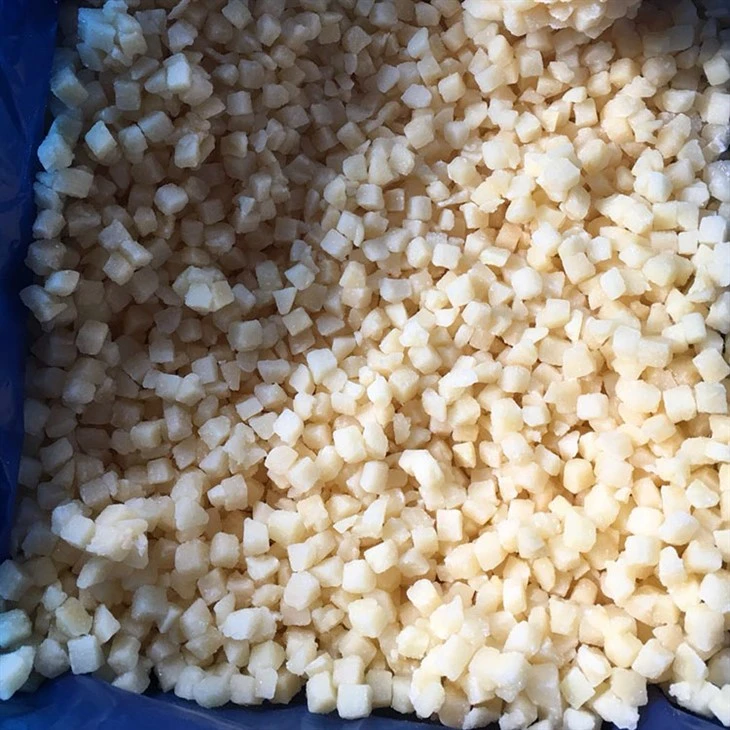
Frozen apple dice in a blue bulk liner. Actual GreenLand product photo; confirm the offered specification. This is not treatment evidence.
Operational evaluation extends beyond nominal contact time. The buyer should consider loading, unloading, draining, solution preparation and any downstream changes caused by the treatment. A shorter immersion period may not produce the same reduction in total cycle time. Conversely, a route that adds a treatment step could still be useful if it improves a subsequent operation sufficiently. Those are plant-specific questions to assess with a realistic process trial, not benefits established by the diffusion paper.
The illustrative developer can therefore receive a clear answer without an invented recipe. Raising temperature may shorten the time needed for a selected water-removal endpoint. It does not by itself demonstrate reduced sugar uptake relative to water loss. A concentration change deserves separate consideration because the original study reported a different relative transport response. Acceptance still depends on measurements from the intended apple, cut, input state and full application route.

Net weight change cannot separate water loss and solute gain. Measure mass and composition on a stated basis.
We would start a sourcing conversation with the untreated frozen apple requirement and the buyer's proposed application. The useful requests are a defined sample form, the relevant available specification and a trial brief that states how treatment success will be judged. If the buyer needs a pretreated ingredient, that is a distinct requirement to clarify before making any supply assumption. No osmotic pretreatment capability or validated treatment performance is established by this article.
The final approval record can be concise: identify the material, describe the tested route, report both transfers on a stated basis, and record the finished-application outcome. Include the selected endpoint and the reason it meets the buyer's composition and throughput needs. That record gives procurement a defensible basis for repeating the chosen input specification. It also preserves the most useful lesson from the research: rate and selectivity are related questions, but they are not the same result.
Related reading
Osmotic Dehydration Before Freezing: When Treated Fruit Is Not Plain IQF
Understand why a downstream treated ingredient needs a distinct composition and description.
How to Dry Apples and Other Fruit Slices: Preparation, Browning and Dryness
Connect the pretreatment trial with the actual drying and finished-quality objective.
Separate freezing preparation from the osmotic treatment being qualified.
Plan your frozen apple sourcing with GreenLand-food
GreenLand-food is a frozen food supplier and manufacturer in China. For factory-direct wholesale frozen apple sourcing, send us the required form, packing, quantity, destination and sample brief. We can discuss the offered product and available documentation so your team can qualify the actual input in its application.