


An Apple-Pectin Fat Replacer Can Soften Cookies While Reducing Spread
Oct 09, 2026
Leave a message

Research This Article & Topic with AI
Verify key claims, compare reliable sources, and explore GreenLand-food's practical frozen food knowledge.
Article details and research questions are prepared in the links. Sign-in or sending may be required.
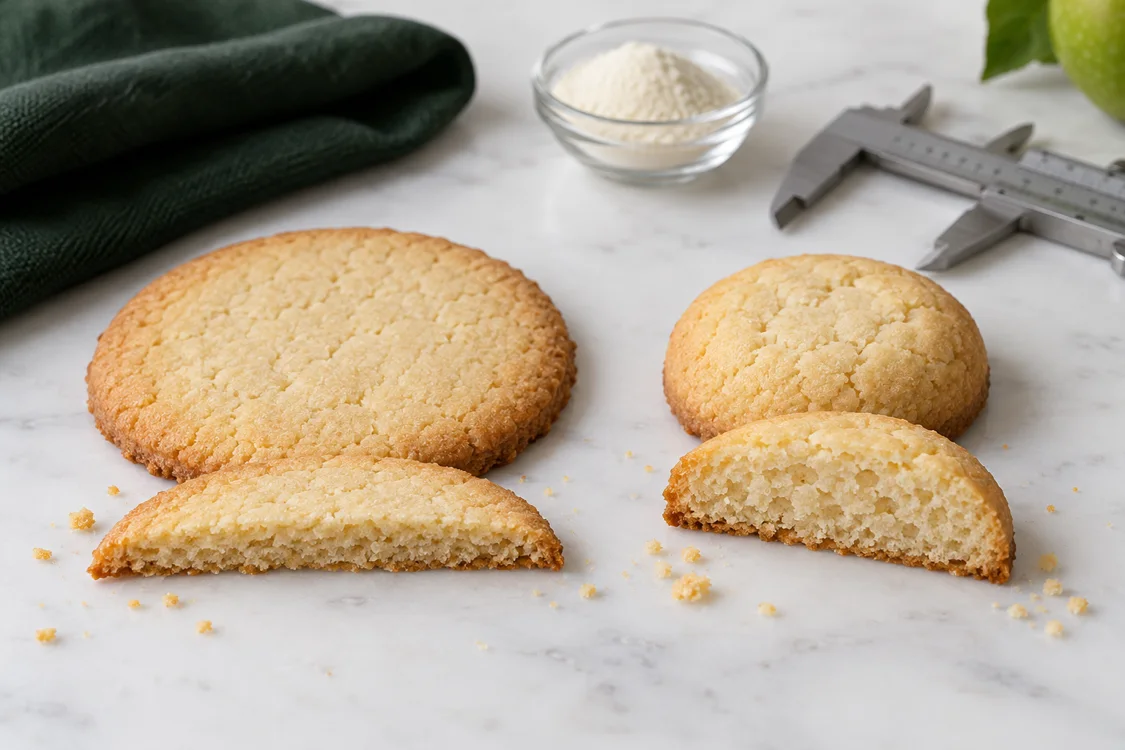
For an ingredient developer, that distinction changes the trial brief. A lower hardness result can justify further work, but a biscuit that misses its required diameter, stacking profile or filling coverage still needs attention. At GreenLand-food, we would first establish which apple ingredient the developer is using. Our frozen apple supply and the isolated derivative in the published study have different identities and require separate specifications.
Consider an illustrative enquiry: an apple ingredient developer asks us whether a coproduct-derived pectin trial remains useful when its softer cookie spreads too little. This is a reconstructed purchasing scenario, not a past customer case. A useful response starts with the derivative description, the basis of replacement and the two product targets. Those details allow the bakery to decide whether to continue development, change the intended cookie format or reject the candidate for that application.
Name the derivative and the replacement basis
The material studied by Min and colleagues was water-soluble pectin-enriched material, abbreviated PEM, isolated from apple pomace. That description identifies a prepared fraction. It does not describe whole apples, IQF apple dice, untreated wet pomace or every powder sold under the broad name apple fibre. The institutional record of the original study supplies the abstract and the DOI. The complete experimental protocol should be obtained and reviewed before anyone attempts to reproduce the study.
Begin a comparison by copying the exact ingredient identity from its specification into the trial record. Include the producer, product code, lot, supplied physical form and preparation history that the producer can substantiate. An internal nickname such as apple powder is too broad to connect a purchasing sample with a scientific result. If two reports use different descriptions, resolve the difference before comparing their response figures. Otherwise, a plausible product name can conceal a different ingredient.
Replacement also needs a denominator. The original cookie work describes replacing shortening on the basis of the shortening weight. That is a different calculation from replacing a share of the flour, adding a percentage of the total dough or substituting an equal volume of a hydrated material. A percentage without its denominator leaves the actual formulation uncertain. Keep the base recipe and the revised recipe in the same units, so the development team can see what was removed and what entered in its place.

Qualitative schematic: apple materials have distinct forms. Shapes explain the comparison; no numerical result or production setting is implied.
The supplied state matters to this arithmetic. A dry powder and a prepared aqueous dispersion may deliver different quantities of solids and water at the same weighed addition. Ask the ingredient supplier how the trial material was prepared and report the water contributed by that preparation. This does not establish a mechanism for the cookie result; it makes the comparison intelligible. The baker should be able to reconstruct the ingredients entering the mixer without guessing whether preparation water was included elsewhere in the formula.
| Material considered | Identity to establish | Comparison it can support |
|---|---|---|
| Isolated pectin-enriched material | Fraction, preparation and supplied solids basis | A defined derivative substitution trial |
| Dried apple pomace flour | Drying, milling and composition specification | A trial of that flour at its stated replacement basis |
| Frozen apple pieces | Cut, peel condition and intended handling | A trial of a fruit inclusion or fruit preparation |
These distinctions are supported by the wider literature. A separate apple pomace flour study substituted dried material for wheat flour. Its material preparation and ingredient exchange differed from the PEM shortening experiment. The two papers may help a developer identify questions, but their results cannot be combined as if they tested one product. Purchasing should maintain the same discipline when several suppliers submit samples with similar trade descriptions.
For the illustrative enquiry, we would ask the developer to send the ingredient specification and both trial formulas before discussing whether the outcome is promising. If the candidate is an isolated derivative, its supplier must confirm its commercial identity and suitability. If the intended order concerns frozen apple, we can clarify the available fruit form and order specification. The derivative discussed here is research context. It is not an offered GreenLand product established by this article.
Softness and spread changed together
The published PEM abstract reports a group of cookie responses: less spread diameter, greater moisture content, a more tender texture and a lighter surface. Those observations belong together. Reporting only tenderness would omit a change that can matter to production and presentation. Equally, a smaller cookie is not automatically defective. Its relevance depends on whether the revised geometry still fits the commercial brief. A cookie designed to hold a compact shape may have a different acceptance window from a thin sandwich biscuit.
Use the same cooled sampling condition when comparing geometry and texture in an application trial. Record when the cookies were removed from the oven, when they were measured and how they were held in between. These are proposed controls for the customer's investigation, not a reconstruction of the published method. They help prevent one batch being judged warm and another after a longer holding period. A result becomes more useful when the sample condition accompanies the measurement.
Diameter, thickness and spread ratio should be reported in the terms actually measured. A smaller diameter alone does not establish a particular change in the ratio of diameter to thickness. Where a laboratory reports a spread ratio, request its calculation and dimensions. Where it reports only diameter, retain that term. This precision prevents an application summary from adding a result that the available evidence did not report, and helps the bakery compare the finding with its own quality-control method.
Texture needs the same care. Instrumental hardness, a trained description of bite and consumer liking answer different questions. A lower force under a specified probe can support a statement about that instrumental measurement. It does not by itself establish that the cookie feels more pleasant, travels better or remains acceptable throughout the required storage period. The developer should connect the instrumental method with a sensory description that the product team recognizes, while retaining both records.

Qualitative schematic: diameter and bite are separate. Shapes explain the comparison; no numerical result or production setting is implied.
Imagine that the developer wants a soft cookie with a defined footprint for an individual tray. The trial's tenderness could move in the desired direction, while the reduced diameter leaves excessive empty space or changes the appearance next to the approved reference. The commercial result would remain unresolved. A different customer might welcome the compact shape. These are hypothetical acceptance situations, and they illustrate why a single favorable response should not become an overall improvement claim.
Moisture and surface color add further observations, but they do not settle the cause of the softness. Several formulation and processing variables may have changed together. The available abstract does not isolate a complete causal chain connecting every measured endpoint. Describe the observed association and then design the next question. For example, the bakery could investigate whether its selected candidate still meets both targets when handling and baking conditions are held to a defined comparison plan.
A concise trial conclusion might therefore read: the candidate met the agreed instrumental texture range but remained outside the required diameter range under the tested conditions. That wording identifies the result and its limitation without turning the sample into a universal success or failure. It gives purchasing a reason to keep the sample under development, and gives the baker a specific issue to investigate. It also prevents an early prototype from being treated as an approved commercial substitute.
Keep individual observations available behind the summary. If the mean diameter meets the target while many cookies fall outside it, a mean alone will hide the production problem. Record the sampling plan, number of pieces, variation and agreed acceptance rule. The scientific abstract is not a source for those factory limits. The bakery must define them from its product and process requirements, then use the same rule across the control and candidate samples.
Set shape and eating targets independently
The product brief should state the geometry target before the team sees the candidate's results. Diameter and thickness may affect piece count in a tray, stacking height, depositor pattern, sandwich assembly or the visible proportion of a topping. Which of those relationships matters depends on the cookie. Ask the production and packaging teams to identify the actual constraint. A drawing or approved physical reference often communicates that constraint more clearly than a request for good spread.
Set an eating target separately. Words such as soft, crisp, tender and crumbly are not interchangeable specifications. The team needs a shared description of the desired first bite and the way the cookie breaks down during eating. A soft cookie that sticks to the teeth can be a different product from a tender cookie that breaks cleanly. The application trial should record the relevant sensory observations instead of forcing them into one general texture score.
The two targets can then be reviewed on the same sample set. A candidate may meet both, meet one, or meet neither. This simple comparison helps the team decide what further work would be useful. If the shape passes but the bite fails, adjusting a packaging specification would not resolve the eating issue. If the bite passes but the shape fails, the team can evaluate whether process development or a different product format is commercially justified.
| Geometry against agreed target | Eating texture against agreed target | Meaning for development |
|---|---|---|
| Meets target | Meets target | Continue the remaining application and storage qualification |
| Misses target | Meets target | Investigate the shape issue before commercial approval |
| Meets target | Misses target | Investigate the eating response while retaining the geometry record |
| Misses target | Misses target | Reconsider the candidate or its intended application |

Qualitative schematic: shape must fit the product. Shapes explain the comparison; no numerical result or production setting is implied.
Moisture measurement can support this discussion when the method and basis are stated. A laboratory value for total moisture should not be substituted for a separate assessment of eating quality or shelf-life performance. Likewise, surface color should be judged under a repeatable viewing condition against a suitable reference. The study's lighter surface is an observed result, not a promise that every apple-derived ingredient will produce the same appearance in every cookie.
Consider a bakery that sells two formats: a filled sandwich cookie and a softer individually wrapped cookie. Both may use the same broad ingredient list, yet the geometry constraints differ. The sandwich version needs a reliable relationship between two shells and the filling. The individually wrapped version may allow more variation in diameter but have a tighter bite target. A successful result in one format should be recorded under that format, with the other still requiring its own decision.
Define the evaluation time as part of each target. A cookie can be approved at packing, after a specified distribution simulation or at a stated point in its intended shelf life, depending on the customer's qualification plan. Those decisions should be made by the responsible bakery team. This article supplies a way to frame the comparison; it does not establish a storage period or a universal acceptance threshold for reformulated cookies.
The purchase decision also has an economic dimension that should remain visible. Ask whether a narrower geometry window increases sorting, breakage, rework or packing difficulty in the intended operation. Use the customer's measured yield and process records when available. An ingredient price comparison is incomplete if the candidate changes the number of acceptable finished units. Any predicted saving should remain provisional until the bakery has a representative production trial rather than a single attractive laboratory sample.
Qualify the intended ingredient separately
A paper can justify testing a candidate; qualification concerns the actual commercial ingredient in the actual process. Obtain the supplier specification, composition information needed for the formulation, applicable food-use documentation and a representative sample. Confirm that the sample matches the proposed order grade. Where a derivative's preparation influences its functional behavior, request enough information to distinguish it from other available materials. A shared apple origin does not provide that equivalence.
Research on enzymatic processing of apple pomace illustrates why preparation deserves attention: treatment changed the measured properties of the material. That study does not establish the behavior of a candidate PEM in the customer's cookie, but it reinforces the need to retain the ingredient's processing identity. A purchasing substitution made only on the basis of a similar name can change the material being tested.
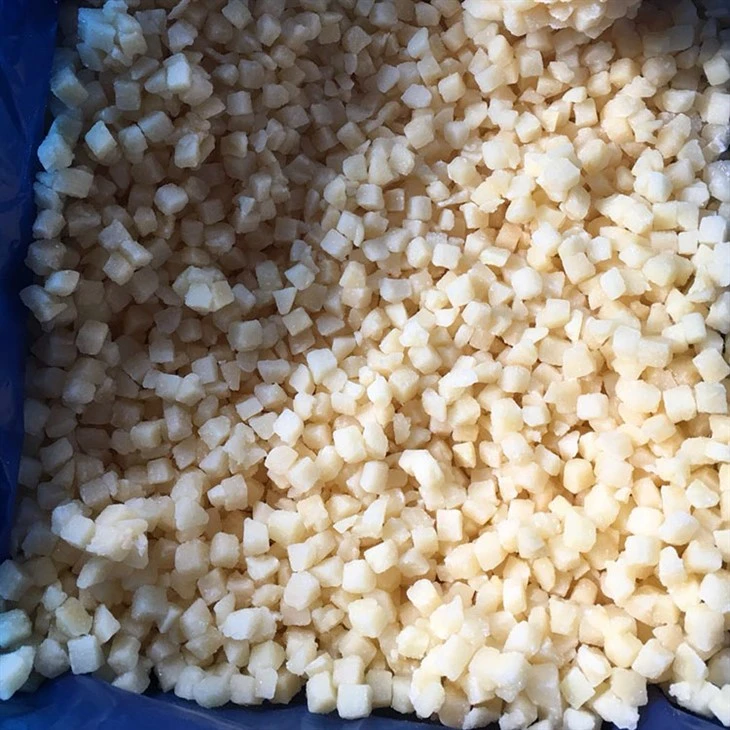
Peeled frozen apple dice with visible frost. GreenLand product photograph of the ingredient, not a sample from the cited experiment.
Plan the baking comparison so that the development question remains clear. Use the approved reference formula, the candidate formula and a record of deliberate changes. Keep the flour lot, shortening identity, mixing sequence, dough holding condition, piece mass and oven loading controlled where the trial design requires them. The bakery may need to adjust some factors during development, but each adjustment should have a stated purpose. Changing several conditions without recording them makes the outcome difficult to interpret.

Qualitative schematic: state the replacement denominator. Shapes explain the comparison; no numerical result or production setting is implied.
Do not import the maximum replacement level mentioned in a research abstract as a recommended recipe. The original study's tested range belongs to its own material and model system. A customer may have a different shortening, flour, sugar system, product shape, mixer, oven or packaging requirement. The development team should choose its trial range independently with its ingredient and process specialists. The appropriate decision is whether a specific candidate meets the defined application, not whether it copies a published percentage.
Photographs of the actual incoming fruit are useful when the discussion involves frozen apple supply. They show cut and peel condition that a powder or derivative specification cannot convey. They do not prove the behavior of a pectin-enriched fraction. If the application also includes apple pieces, keep their contribution separate in the trial record: identify the fruit addition, its preparation and any liquid retained or removed. Otherwise, a fruit-form change could be confused with the effect of the derivative substitution.
Sampling should follow the proposed order closely enough to make the next decision worthwhile. Agree the sample quantity, frozen transport arrangement where relevant, laboratory handling and the version of the specification accompanying the sample. Retain the lot identity through the trial. When results return to purchasing, include the actual formula and measurement conditions rather than a photograph and a simple pass or fail. This makes later discussions about repeat orders or a changed specification more productive.
Qualification can proceed in stages without pretending that an early stage proves everything. A bench bake can screen shape and bite. A representative production run can assess forming, oven consistency and packing behavior. A separate storage assessment can address the customer's intended distribution and holding conditions. These are examples of distinct questions the customer may need to answer. Their order and acceptance criteria depend on the business and must be independently established.
Keep supply and nutrition claims bounded
GreenLand-food's role in this discussion is to clarify the frozen apple form that is actually available and the specification relevant to the customer's process. Our product page covers fruit forms such as slices, dice and chunks, with order details confirmed against the enquiry. It does not establish that we supply isolated PEM, apple pomace coproducts or a finished fat-replacer system. A research paper cannot extend a supplier's product range, and the quotation should name only the material being offered.
For a frozen apple enquiry, send the intended application, preferred cut, peel requirement, size tolerance and expected condition after the customer's preparation step. Include the required packing, order quantity and destination. If the project compares two trial reports, supply the material identity and formula basis for each. We can then clarify the fruit specification and the information available for the proposed order, while the derivative supplier and bakery address the separately qualified functional ingredient.
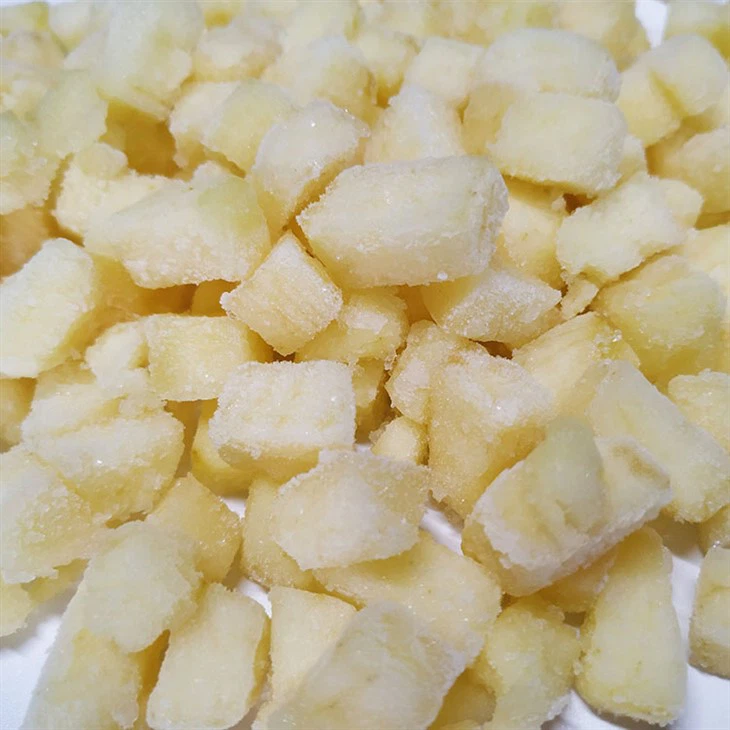
Peeled frozen apple pieces in a close product view. GreenLand product photograph of the ingredient, not a sample from the cited experiment.
The same boundary applies to nutrition language. A cookie experiment showing tenderness and spread does not establish a health benefit for the final commercial product. The amount of shortening removed, the composition of the replacement, the rest of the formula and the final product basis all matter to a nutrition calculation. Any label or claim needs an appropriate assessment of the actual finished food and its intended market. The application paper alone is insufficient support.

Qualitative schematic: frozen fruit and a soluble derivative. Shapes explain the comparison; no numerical result or production setting is implied.
Keep technical reports and sales descriptions aligned. If a trial establishes lower instrumental hardness under a stated test, use that precise statement in the development record. Avoid converting it into a broad better-for-you or healthier-cookie promise. If the commercial goal includes a nutrition claim, make it a separate workstream with the evidence and review it requires. That separation gives the formulation team room to assess performance without prematurely attaching a marketing conclusion to the result.
An enquiry may also involve lead time, sample continuity and repeatability. Ask whether the candidate ingredient grade will remain available during the proposed production period and whether a change in its specification would trigger a new trial. For frozen apple supply, we confirm availability and order arrangements against the requested form, packing and shipment plan. For a derivative, those assurances must come from its actual producer or supplier. Combining them in one assumption leaves an avoidable gap in the approval record.
The developer in our illustrative scenario can therefore make a useful next decision. Retain the tenderness result as evidence for that endpoint, state the unresolved spread requirement, and qualify the exact intended ingredient under a controlled bakery comparison. If the commercial order also needs frozen apple, discuss that fruit specification with us on its own terms. This gives both the bakery and purchasing a clear account of what the evidence supports and what still requires a result from the intended product.
Related reading
Review the behavior and specification of whole frozen apple ingredients.
Match an apple fruit form to the intended application before discussing a derivative.
Read how pectin grade and formulation conditions differ from a general apple ingredient name.
Source frozen apple with GreenLand-food
GreenLand-food manufactures frozen apple in China. We fill factory-direct wholesale orders for food manufacturers, importers and private-label programs.
Tell us how you'll use frozen apple and where you need delivery. We'll review the product form and specification with you, then confirm packing, quantity, private-label details and requested documents. Include the material and process comparison described above so we can clarify the appropriate frozen ingredient and order details.