


Are Soft Potatoes Still Good?
Sep 02, 2026
Leave a message
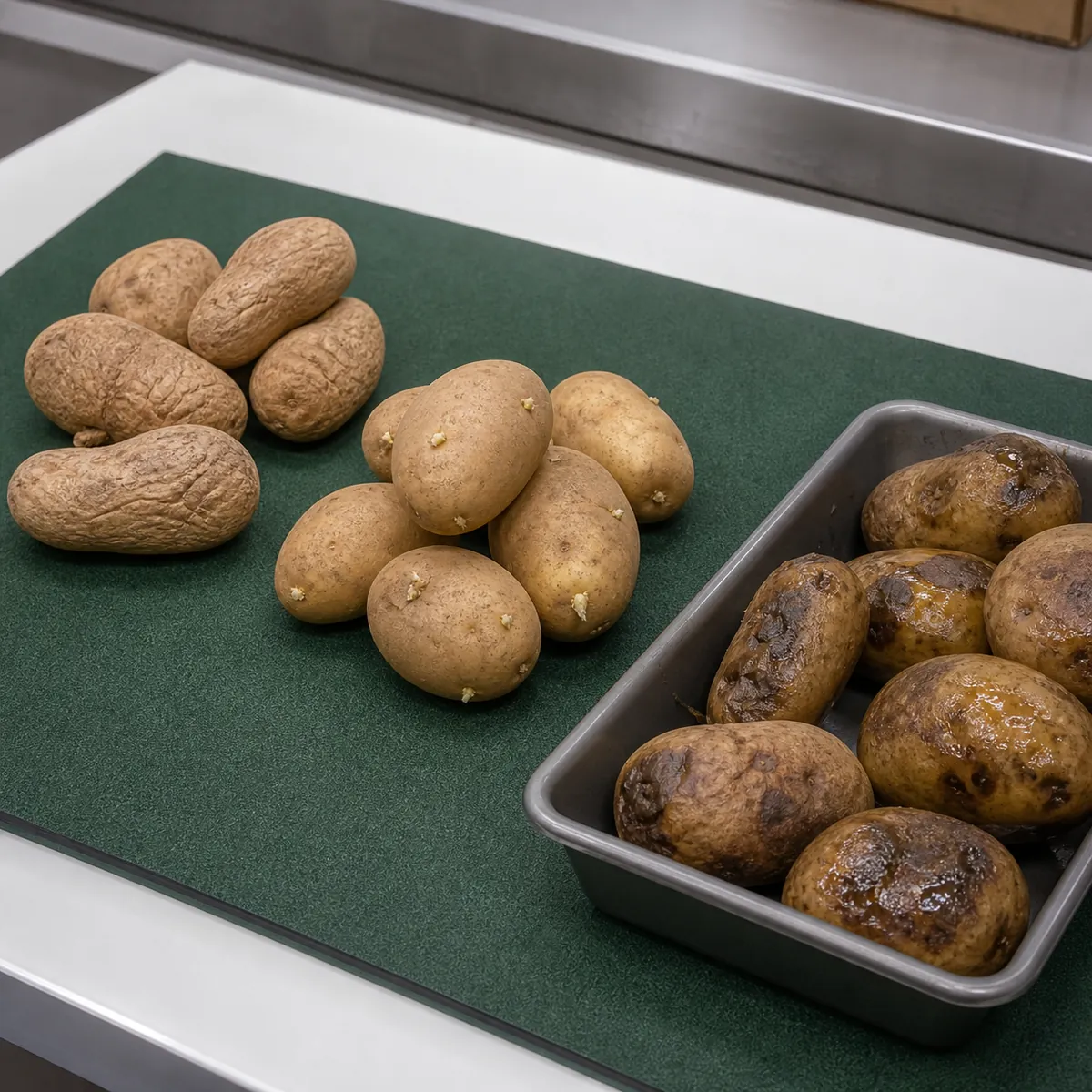
Slightly soft can be a quality problem; mushy or wet is a discard signal
Press gently and inspect the whole tuber. Dry wrinkling without odor, slime, mold, extensive sprouts or green flesh is mainly a sign of age and moisture loss; the potato may be usable in a cooked dish if the interior is sound. A collapsing texture, wet dark area, fermentation odor, mold or spreading internal discoloration indicates decay.
Do not use cooking as a rescue for heavily sprouted or deeply green potatoes. Green color signals light exposure and can accompany higher glycoalkaloids. Remove small sprouts and shallow green areas only when the remaining potato is firm and sound; reject heavily affected or bitter potatoes.
Key takeaways
Keep, trim or discard soft potatoes
| Condition | Likely meaning | Decision | Reason |
|---|---|---|---|
| Slightly soft, dry and wrinkled; no odor | Moisture loss and age | Use soon if the cut interior is sound | Quality and yield are reduced, but no decay sign is present. |
| Firm potato with a few tiny sprouts | Dormancy has ended | Remove sprouts completely and inspect | Use only when firm, not green beneath the skin and not bitter. |
| Small shallow green patch on a firm potato | Light exposure | Trim generously or reject under the program standard | Greening is a warning sign; deep or extensive green tissue should be discarded. |
| Very soft, wet, leaking or slimy | Active decay | Discard | Trimming cannot reliably rescue spreading soft rot. |
| Mold, sour odor or internal black/brown breakdown | Spoilage or disease | Discard and inspect adjacent stock | Cross-contamination and lot deterioration may be present. |

A practical potato inspection method
- Check the storage area. Look for heat, light, condensation, poor ventilation, damaged packs and nearby decayed tubers.
- Inspect without squeezing every potato hard. Use gentle, consistent pressure to identify firm, slightly yielding and collapsing samples.
- Separate dry shrivel from wet soft rot. Dry wrinkles suggest water loss; wet glossy tissue, leaks and slime suggest decay.
- Look for sprouts and green color. Record prevalence and severity rather than treating them as the same defect as softness.
- Smell the sample area. Earthy potato odor is normal; sour, fermented or rotten odor supports rejection.
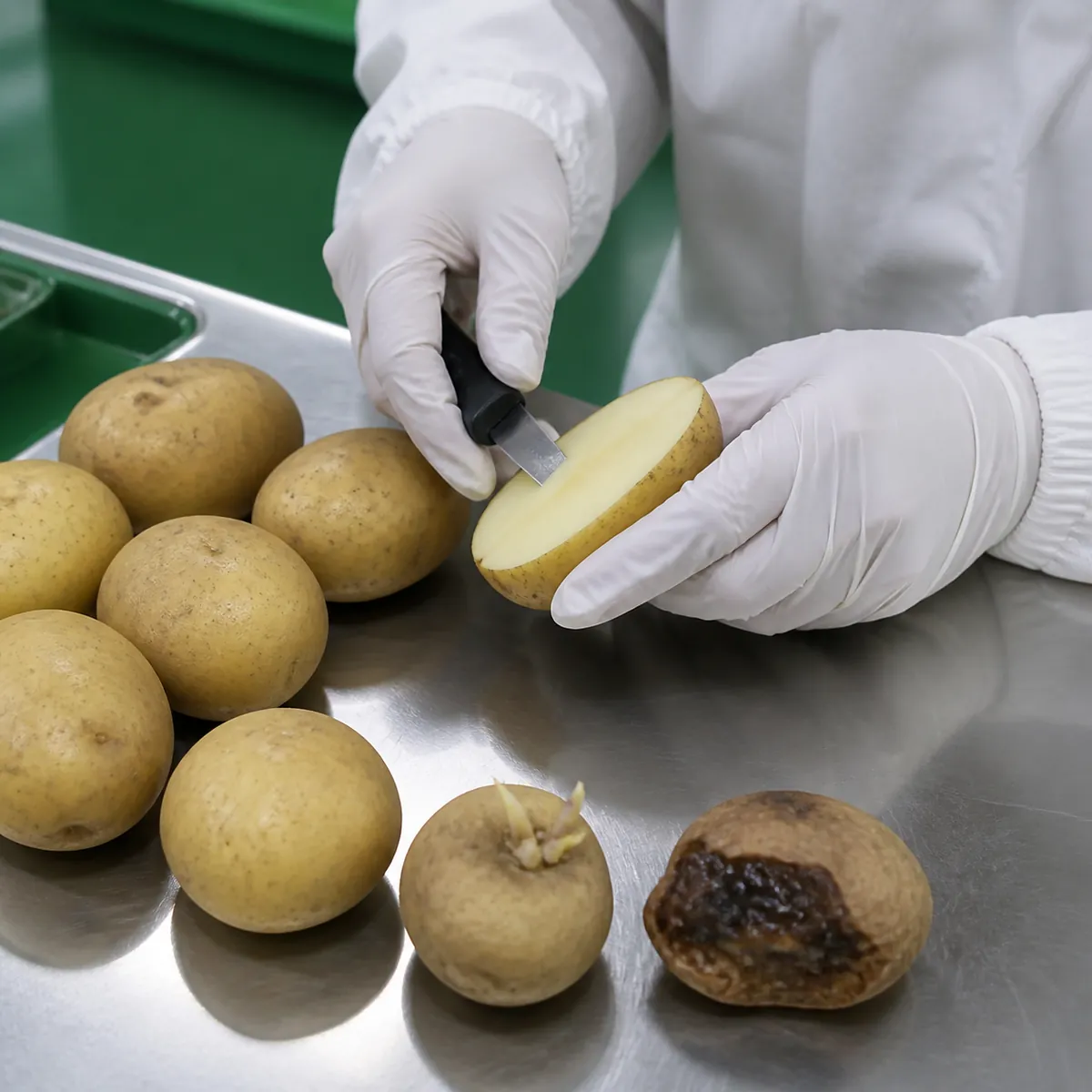
- Cut representative samples. Check whether a surface defect is shallow or whether internal discoloration and breakdown are spreading.
- Decide at lot level. Apply the agreed defect limits, sample plan and food-safety hold-not a casual keep-or-toss judgment.
- Correct storage. Keep accepted potatoes cool, dark, dry and ventilated under the program requirement, away from damaging light.
Why potatoes become soft
Potatoes lose water during storage, so the skin wrinkles and the tissue becomes less crisp. They also respire, use stored reserves and eventually break dormancy. Warmth speeds these changes, while light encourages greening.
A dehydrated potato may produce a smaller, less attractive cooked yield. It can be harder to peel cleanly and may darken or cook unevenly. Even when usable, it should not automatically meet a fresh-retail or premium foodservice specification.
Sprouts and green tissue are different from ordinary softness
Sprouts draw on the tuber's reserves and contain higher concentrations of naturally occurring glycoalkaloids. Green color itself is chlorophyll, but it signals light exposure under conditions that can also raise glycoalkaloids. A bitter taste is another warning sign.
Small sprouts on a firm potato can be removed under common household guidance, yet commercial programs may set stricter defect limits. Extensive sprouting, shriveling, deep greening or bitterness should lead to rejection rather than an attempt to peel away every concern.
Soft rot has a different appearance
Bacterial and fungal decay often create wet, sunken, dark, leaking or odorous tissue. Pressure may release liquid, and damage can extend well beyond the visible spot. Adjacent potatoes and packaging can become contaminated.
Do not wash a decayed lot and return it to stock. Segregate it, record photos and lot identity, evaluate surrounding packs and follow the receiving hold or disposal procedure. A dry pressure bruise or cut may be trimmable; spreading soft rot is not.
Receiving inspection protects yield and evidence
Sample across the pallet rather than only the top bag. Check outer cartons, inner liners, condensation, temperature, odor, sprouting, greening, pressure damage, dry shrivel and wet decay. Record the percentage and severity of each defect.
If the lot is disputed, keep representative evidence under controlled conditions and compare with the purchase specification. A vague complaint that potatoes were "soft" is less useful than a sample record separating dehydration, sprouts, greening, bruising and rot.
Troubleshooting the most common failures
| Problem | Likely cause | Next adjustment |
|---|---|---|
| Potatoes soften quickly after delivery | Warm, bright or poorly ventilated storage | Correct storage and review transit and receiving temperatures. |
| Only bottom bags are wet | Condensation, compression or pallet exposure | Hold the affected zone and inspect the pallet pattern. |
| High trim loss | Greening, sprouts, bruises or deep defects | Measure usable yield and compare with specification. |
| One rotten tuber in a bag | Localized decay may have spread moisture and microbes | Remove the bag, inspect neighbors and follow sanitation procedures. |
Turn receiving observations into a lot decision
Begin by writing the finished target in observable language. For fresh-potato receiving for distributors, caterers and processors, with frozen potato as a consistency alternative when yield is critical, the useful endpoint is a sound lot with acceptable firmness, defect prevalence and usable yield. That statement is more operational than a vague direction such as "cook until done" or "use good quality." It tells purchasing, kitchen and quality teams what the trial must demonstrate, while leaving room for equipment-specific timing.
Use a representative sample, not the most attractive handful. Pull material from several positions in the bag, case or lot and record clumps, free water, broken pieces, color and odor before preparation. If the article concerns a finished dish, record the ingredient batch and the pan or container depth as well. Small input differences often explain a large finished difference.
Measure the starting condition. Frozen ingredients should be hard frozen unless a controlled thaw is part of the method; fresh raw material should be at the defined receiving and storage condition; cooked food should have an accurate preparation time. An uncontrolled bench period creates a new process that cannot be compared fairly with the approved one.
Run the first trial at a deliberately manageable scale. Weigh the main ingredient, liquid, oil, sauce and seasoning. Record equipment model, vessel dimensions, load depth and actual settings. A reliable small trial produces a baseline; a casual large trial produces too many possible causes when wet decay, extensive sprouts, deep greening, bitter potatoes or unrecorded trim loss appears.
Observe the process rather than watching only the clock. Note the moment frost melts, water releases, sauce thickens, slices become tender, grit settles or the center warms-whichever signals apply. Those observations reveal why two batches with the same nominal minutes can finish differently.
Check the slowest or most difficult portion. It may be the thickest mushroom cap, the center of a casserole, the largest fry, a dense kettle zone or the bottom of a wash load. Edge color and surface heat can look satisfactory while the limiting point remains outside the target.
Scale in controlled steps. Increasing a batch changes heat recovery, evaporation, agitation, cooling and holding. Doubling ingredient weight does not automatically double time, nor does it preserve the same surface area. Establish a maximum load per pan, basket, tank or kettle and retest before exceeding it.
Record yield as well as appearance. Weigh input, prepared output, trim or drip loss and rejected material. Yield connects quality to cost and helps explain portion changes. A cheaper delivered product can cost more per acceptable serving when frost, defects, breakage or trim are high.
Include the real hold. Evaluate a sound lot with acceptable firmness, defect prevalence and usable yield immediately and again after the normal service, display, refrigeration or delivery interval. Steam migration, continued starch hydration, sauce absorption and moisture loss can change the result after the active cook or preparation step has ended.
Test the final application rather than approving an isolated ingredient only. A sample that works in a small skillet may behave differently in a soup, ready meal, buffet pan, retail pack or bakery formula. Include any chilling, freezing, thawing and reheating that the customer will actually use.
Define corrective actions before production. If the process trends toward wet decay, extensive sprouts, deep greening, bitter potatoes or unrecorded trim loss, staff need a bounded response: reduce load, hold the lot, adjust within an approved range, repeat a rinse, extend a controlled thaw, or reject the material. Improvised corrections should not silently become a new formula.
Receiving evidence protects both buyer and supplier. Record product temperature, packaging condition, lot code, photographs and representative defects before the material is dispersed. When the finished result changes, compare the affected lot against an approved reference under the same method.
Cold-chain and storage control continue after acceptance. Door openings, partial thawing, condensation, light exposure or poor ventilation can change the ingredient before it reaches the kitchen. A good purchase specification cannot compensate for uncontrolled local storage.
Compare supplier samples under identical conditions. Keep load, equipment, liquid, seasoning and endpoint constant. Score only attributes that matter to the application. Changing the recipe for every sample hides whether the input is suitable and makes commercial comparison unreliable.
Turn the approved result into a short working standard. Include input condition, batch weight, equipment, sequence, approximate check window, observable endpoint, hold and rejection triggers. Train staff to use the endpoint within that boundary rather than treating one minute as a substitute for judgment.
Review complaints with data. Separate product defects from handling, recipe and equipment causes. If wet decay, extensive sprouts, deep greening, bitter potatoes or unrecorded trim loss occurs, reconstruct the lot, input condition, load, settings and hold. The aim is not to assign blame quickly; it is to identify which control failed and stop the same failure from returning.
For private-label instructions, test realistic customer equipment and behavior. Give a usable range plus clear visual or texture cues. Avoid promising one exact result across every appliance, pan, serving size or storage history when the evidence supports only a controlled range.
Release commercial claims only after the evidence matches them. Words such as ready to eat, fully cooked, washed, quick-cook or freezer-stable carry process expectations. Put the declared status, preparation directions and supporting documents into one coherent specification.
Revisit the standard when crop, cut, formula, pack, factory, equipment or intended use changes. A result approved for fresh-potato receiving for distributors, caterers and processors, with frozen potato as a consistency alternative when yield is critical is not automatically transferable to another application. Change control keeps a once-valid method from becoming an assumption.
How we review a frozen potato enquiry
At GreenLand-food, we start with the intended use rather than a product name alone. For this program, the first technical points are firmness, dry shrivel, wet soft rot, sprout length and prevalence, green surface and depth. We match the sample review to fresh-potato receiving for distributors, caterers and processors, with frozen potato as a consistency alternative when yield is critical so the purchasing team can see whether the proposed format reaches a sound lot with acceptable firmness, defect prevalence and usable yield.
Send the destination market, required pack, annual or trial volume, preferred delivery window and whether the program is foodservice, industrial, retail or private label. MOQ, mixed loading, lead time and loading port depend on the selected item and order plan, so we confirm them during the quotation instead of inserting a universal figure into the article.
For sample approval, we recommend one written method and one score sheet. Keep load, equipment and endpoint constant; record yield, defects and the normal hold. If the result trends toward wet decay, extensive sprouts, deep greening, bitter potatoes or unrecorded trim loss, the record shows whether to adjust the application, tighten the specification or review another format.
Document needs also vary by market and customer. Share the requested product specification, certificate or audit support, ingredient and allergen declarations, origin wording, microbiological requirements and shipment documents at RFQ stage. We can then review which controlled copies apply to the proposed supply.
Specification and approval checks for frozen potato
1. firmness. Define what is acceptable, how it will be sampled and how it affects fresh-potato receiving for distributors, caterers and processors, with frozen potato as a consistency alternative when yield is critical. Check the attribute on the frozen or received product and again at the finished endpoint. Record the result against the approved reference, not an unwritten impression. If it contributes to wet decay, extensive sprouts, deep greening, bitter potatoes or unrecorded trim loss, set a hold, correction or rejection rule before ordering commercial volume.
2. dry shrivel. Define what is acceptable, how it will be sampled and how it affects fresh-potato receiving for distributors, caterers and processors, with frozen potato as a consistency alternative when yield is critical. Check the attribute on the frozen or received product and again at the finished endpoint. Record the result against the approved reference, not an unwritten impression. If it contributes to wet decay, extensive sprouts, deep greening, bitter potatoes or unrecorded trim loss, set a hold, correction or rejection rule before ordering commercial volume.
3. wet soft rot. Define what is acceptable, how it will be sampled and how it affects fresh-potato receiving for distributors, caterers and processors, with frozen potato as a consistency alternative when yield is critical. Check the attribute on the frozen or received product and again at the finished endpoint. Record the result against the approved reference, not an unwritten impression. If it contributes to wet decay, extensive sprouts, deep greening, bitter potatoes or unrecorded trim loss, set a hold, correction or rejection rule before ordering commercial volume.
4. sprout length and prevalence. Define what is acceptable, how it will be sampled and how it affects fresh-potato receiving for distributors, caterers and processors, with frozen potato as a consistency alternative when yield is critical. Check the attribute on the frozen or received product and again at the finished endpoint. Record the result against the approved reference, not an unwritten impression. If it contributes to wet decay, extensive sprouts, deep greening, bitter potatoes or unrecorded trim loss, set a hold, correction or rejection rule before ordering commercial volume.
5. green surface and depth. Define what is acceptable, how it will be sampled and how it affects fresh-potato receiving for distributors, caterers and processors, with frozen potato as a consistency alternative when yield is critical. Check the attribute on the frozen or received product and again at the finished endpoint. Record the result against the approved reference, not an unwritten impression. If it contributes to wet decay, extensive sprouts, deep greening, bitter potatoes or unrecorded trim loss, set a hold, correction or rejection rule before ordering commercial volume.
6. odor. Define what is acceptable, how it will be sampled and how it affects fresh-potato receiving for distributors, caterers and processors, with frozen potato as a consistency alternative when yield is critical. Check the attribute on the frozen or received product and again at the finished endpoint. Record the result against the approved reference, not an unwritten impression. If it contributes to wet decay, extensive sprouts, deep greening, bitter potatoes or unrecorded trim loss, set a hold, correction or rejection rule before ordering commercial volume.
For a closer explanation, see Black Spots in Potatoes: Bruising, Blackheart or Decay at Receiving?.
7. internal discoloration. Define what is acceptable, how it will be sampled and how it affects fresh-potato receiving for distributors, caterers and processors, with frozen potato as a consistency alternative when yield is critical. Check the attribute on the frozen or received product and again at the finished endpoint. Record the result against the approved reference, not an unwritten impression. If it contributes to wet decay, extensive sprouts, deep greening, bitter potatoes or unrecorded trim loss, set a hold, correction or rejection rule before ordering commercial volume.
8. pressure damage. Define what is acceptable, how it will be sampled and how it affects fresh-potato receiving for distributors, caterers and processors, with frozen potato as a consistency alternative when yield is critical. Check the attribute on the frozen or received product and again at the finished endpoint. Record the result against the approved reference, not an unwritten impression. If it contributes to wet decay, extensive sprouts, deep greening, bitter potatoes or unrecorded trim loss, set a hold, correction or rejection rule before ordering commercial volume.
9. pack ventilation. Define what is acceptable, how it will be sampled and how it affects fresh-potato receiving for distributors, caterers and processors, with frozen potato as a consistency alternative when yield is critical. Check the attribute on the frozen or received product and again at the finished endpoint. Record the result against the approved reference, not an unwritten impression. If it contributes to wet decay, extensive sprouts, deep greening, bitter potatoes or unrecorded trim loss, set a hold, correction or rejection rule before ordering commercial volume.
10. storage history. Define what is acceptable, how it will be sampled and how it affects fresh-potato receiving for distributors, caterers and processors, with frozen potato as a consistency alternative when yield is critical. Check the attribute on the frozen or received product and again at the finished endpoint. Record the result against the approved reference, not an unwritten impression. If it contributes to wet decay, extensive sprouts, deep greening, bitter potatoes or unrecorded trim loss, set a hold, correction or rejection rule before ordering commercial volume.

Safety references and scope
This article uses conservative handling language and should be applied with the product label and the rules for the reader's jurisdiction. Primary references consulted include Iowa State Extension potato guidance and Poison Control green potato guidance. The page is general guidance, not a substitute for a facility food-safety plan or individual medical advice.
Frequently asked questions
Can I cook a potato that is a little soft?
If it is only slightly soft and dry, with no odor, slime, mold, deep green tissue or heavy sprouts, cut it open and use it soon if sound.
When should a soft potato be thrown away?
Discard a potato that is mushy, wet, leaking, slimy, moldy, foul-smelling or extensively broken down inside.
Are sprouted potatoes safe?
A firm potato with very small sprouts may be usable after complete sprout removal and inspection. Discard heavily sprouted, shriveled, deeply green or bitter potatoes.
Can cooking destroy solanine in green potatoes?
Ordinary cooking should not be relied on to remove the concern. Reject deep or extensive greening and do not serve bitter potatoes.
Why are potatoes soft but not rotten?
They may have lost moisture during storage. Dry wrinkling reduces quality and yield even when no wet decay is present.
What should receiving staff record?
Record lot, temperature, packaging, firmness, shrivel, sprouts, green area, odor, wet decay, internal defects, sample size and disposition.
Review frozen potato for a controlled commercial program
GreenLand-food is a frozen potato supplier and manufacturer supporting factory-direct and wholesale programs. Share your intended application, specification, pack, market and expected volume so our team can review supply and sample requirements.