


Black Spots in Potatoes: Bruising, Blackheart or Decay at Receiving?
Sep 28, 2026
Leave a message

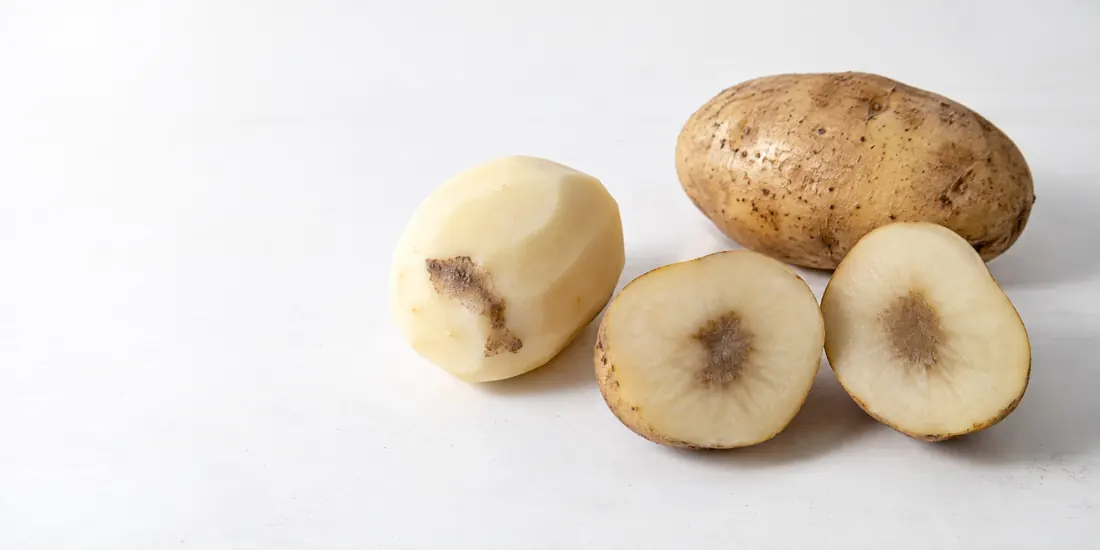
First locate the dark area
Begin with the intact skin. Is the dark mark loose soil that washes off, a flat stain, an attached speck or a sunken lesion? Is the skin broken or wet? A mark that remains on the surface may be a skin blemish or a disease sign, but it cannot be named from a distant photo. Cornell describes black dot disease as having tiny dark fungal structures on affected tubers, while UC Davis lists black scurf among potato quality defects. Those names are specific conditions, not synonyms for every black spot. If the surface condition matters to the contract, photograph it before washing or peeling, then ask a qualified crop or quality specialist to identify an uncertain lesion.
Next remove a thin, consistent layer of peel on a sample tuber. A dark patch just below apparently sound skin can be blackspot bruising. Colorado State Extension notes that this impact injury may be hard to detect in an intact potato because the skin need not show damage. Its darkness develops after mechanical stress and can become more visible after storage or peeling. Record the spot's depth and whether the tissue around it remains firm. A shallow patch in one potato is not proof of the same condition in every dark-looking tuber; compare several samples from different packages.
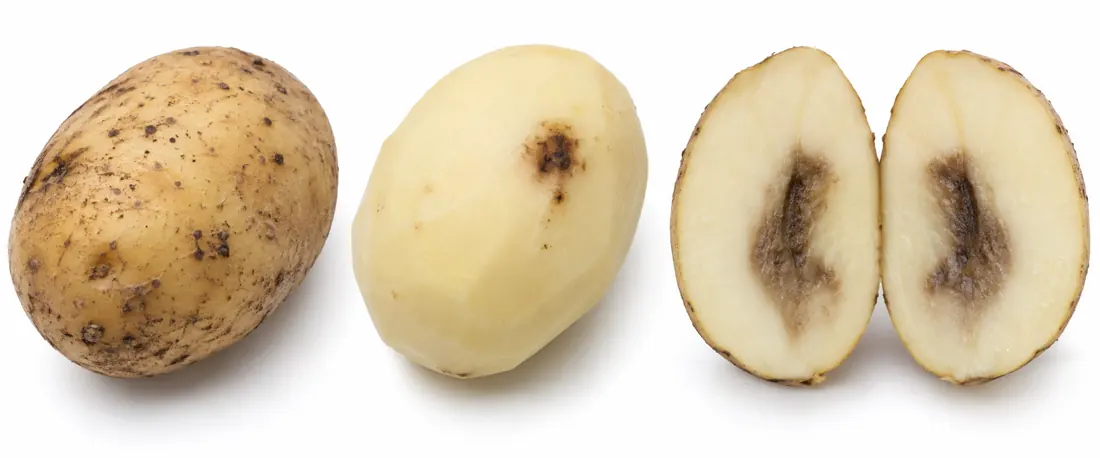
Inspect the skin, peel and center as separate observations.
Then cut through the center. A darkened central region with relatively pale outer flesh raises a different concern from a localized sub-skin spot. UC Davis describes blackheart in potatoes held where airflow is restricted and respiration is high: insufficient oxygen reaches the inner tissue, which turns brown and may progress toward black. Internal brown spot is another possible explanation for dry, corky sectors. A centered black area cannot be established as blackheart solely because it is dark. The position, texture, distribution across the lot and storage history all matter.
The time of first observation is useful evidence. Was the mark visible at unloading, after peeling, immediately after cutting, or only after the product was cooked? Fresh cut surfaces can darken by ordinary enzymatic reactions, and cooking can change the appearance of some defects. These later colors should not be merged into a raw-material incidence count without a consistent observation time. Photograph the potato before and after the relevant step, and include a reference tuber from the same lot. A finished frozen cube photographed without its raw record supports only a finished-product observation.
Location should guide the next check rather than end the investigation. A surface speck may lead to inspection of peel condition and adjacent tubers. A firm patch under the skin leads to handling and bruise review. A dark center leads to storage and aeration questions. Wet or foul tissue leads to a hold for decay assessment. The same shipment can contain more than one type of mark, so a receiving sheet should allow separate categories. Combining all dark findings into "black spots" makes later supplier feedback and contract acceptance almost impossible to interpret.

The real product photo shows a cut form, not a diagnosed black spot.
The frozen cut changes visibility. Small frozen potato cubes can show a dark piece in a mixed bag even when the original spot occupied only a small area of the tuber. Larger chunks may preserve enough tissue to show a pattern. The GreenLand product photo beside this discussion shows a real frozen form, not a potato diagnosed with bruising or blackheart. For a claim about a particular lot, a buyer needs that lot's raw sample, cut-face record and finished sample rather than an illustrative product photo.
Why bruising and blackheart are different hypotheses
Blackspot bruise begins with mechanical injury. Potatoes can be struck or compressed during digging, transfer, grading, packing or transport. Cells are damaged beneath the surface, and compounds in the tissue react to form a dark pigment. The mark may become visible hours after the impact rather than at the exact time of handling. Colorado State Extension describes the typical bruise as close to the vascular ring or beneath the skin, often without visible skin damage. The practical implication is that a clean exterior inspection cannot stand in for peeling or cutting when bruise tolerance is important.
Handling evidence strengthens or weakens the bruise hypothesis. Look for skinned areas, flattened contact points, broken tubers and a cluster of marks on the side that would strike a hard surface. Review transfer heights, cushioning, container fill, pallet pressure and transport events where records exist. North Dakota State potato extension explains that skinning and bruising can also increase later quality and disease concerns. A bruise finding therefore deserves more than a cosmetic note if the lot will be stored or processed over time. It may identify a preventable handling problem even when a small proportion of sound tubers can be accepted for a specific use.
Blackheart follows a different route. It is an internal physiological condition associated with insufficient oxygen reaching the center during unfavorable holding conditions. UC Davis describes higher respiration and restricted airflow as relevant to its development. The center can turn brown and later deeper black. Questions about pile depth, ventilation, temperature, holding duration and any interruption in airflow are more useful here than asking only whether a tuber fell from a conveyor. A receiving team cannot reconstruct the exact event from a cross-section, but it can record the pattern and request storage records before deciding the lot's fate.
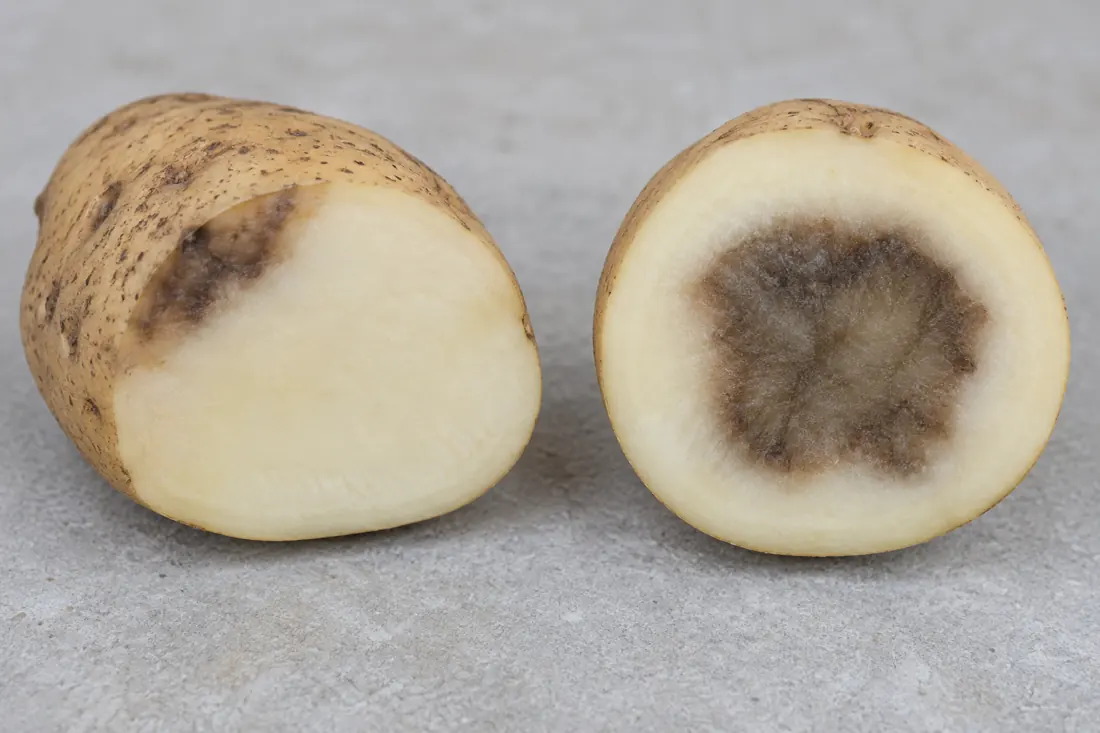
A handling bruise and central discoloration call for different evidence.
The outer ring of a blackheart-affected cut may initially look comparatively normal, which can make a single superficial trim misleading. Conversely, a localized bruise need not mean that the center is compromised. Cutting several tubers both lengthwise and crosswise helps reveal whether the dark tissue is central, peripheral or irregular. The description should reflect what is observed: "firm dark area beneath peel," "dark center with pale outer flesh," or "dry corky internal sector." Such language is more reliable than calling every case "blackheart" on a photo.
These hypotheses can overlap with other defects. UC Davis lists internal brown spot as dry, corky reddish-brown or black spots or sectors, associated with calcium uptake problems during growth. Its page also lists chilling injury, freezing injury, greening and various decay conditions. The commercial purpose of a first cut is to narrow the question, not to force a textbook label. If the proposed disposition depends on knowing the cause, a qualified specialist may need more evidence than a visual receiving check can provide.
Do not infer a safety conclusion from a likely mechanical bruise. The tissue and surrounding tubers still need their normal safety and quality controls. Blackheart is not a pathogen diagnosis by itself, yet dark damaged tissue may still be unsuitable for an appearance specification, and any softening or off-odor changes the decision. Cooking is also not a universal repair: it may alter color and kill some microbes under a validated process, but it does not make an unidentified lesion automatically acceptable or remove every hazard. A buyer should keep the observed condition, plausible cause and contracted disposition as separate fields in the record.
Keep decay out of a quality-only decision
A dark mark with firm, dry surrounding flesh is evaluated differently from a lesion that is wet, soft, expanding or malodorous. Decay organisms and secondary infection can enter through wounds, and a damaged potato can deteriorate during holding. UC Davis lists bacterial and fungal diseases as important sources of postharvest loss; North Dakota State notes that skinned and injured tubers need monitoring because pathogens may exploit the damage. A receiving team should therefore move any uncertain soft or wet case into its established hold and investigation process rather than discussing only how much discoloration can be trimmed away.
The inspection should capture tissue condition before destructive preparation obscures it. Record whether the peel is broken, whether liquid is present, whether the lesion is sunken or spreading, and whether an unusual smell comes from the affected tuber or the package. Photograph a freshly opened carton and a freshly cut representative specimen. Keep a separate note for firm discoloration that appears only after peeling. The two findings may require different routes even if the supplier complaint begins with the same words, "black spots."
Avoid diagnosing a named pathogen from appearance alone. Black dot, black scurf, soft rot and other potato conditions have their own characteristic signs and epidemiology. A commercial buyer may have enough evidence to hold a lot without proving the organism at the dock. If a diagnosis is needed for corrective action, consult the appropriate laboratory or qualified crop specialist and preserve the relevant sample under the site's procedure. A generic internet image of a diseased potato is not proof that the current pallet has the same disease.
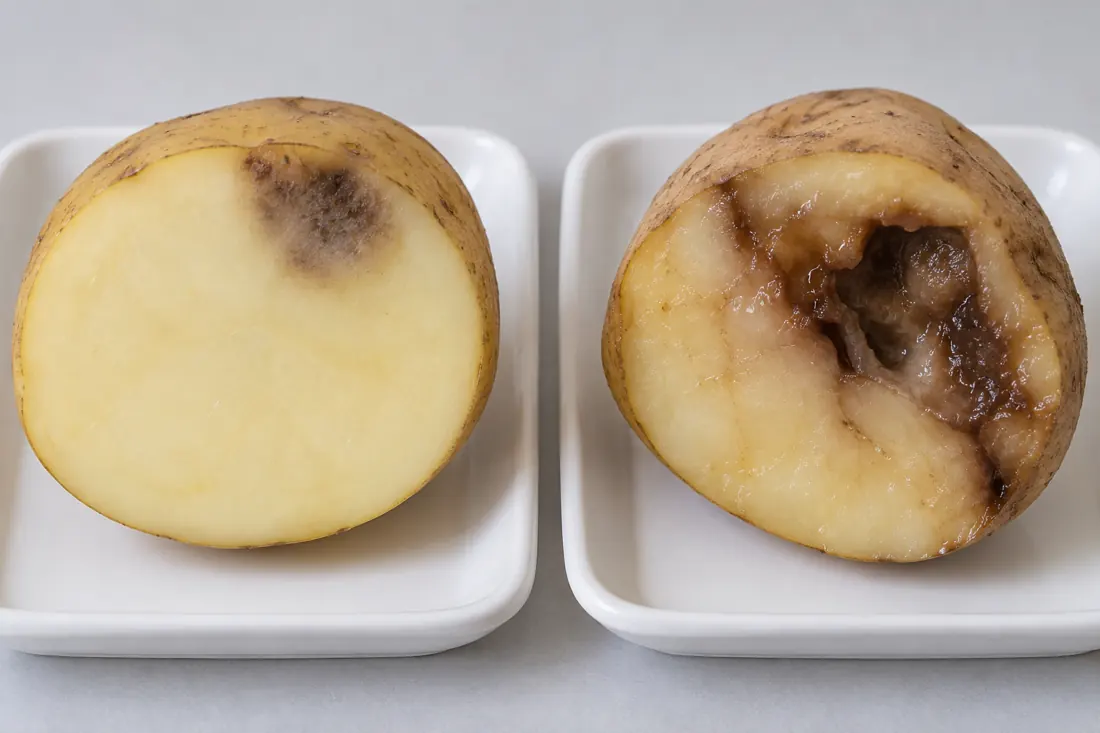
Wet broken tissue requires a hold and qualified assessment.
The user-facing question "Can I eat a potato with black spots?" often receives a short answer about cutting out a bruise. That answer is too broad for a processor receiving tonnes of raw material. A retail consumer examines one potato and may discard it; a processor has a contractual lot, a validated food safety system and a finished product sold to others. The Idaho Potato Commission's direct answer itself acknowledges that some dark spots could be early decay. Commercial acceptance therefore requires representative sampling and an explicit quality decision. It should not be phrased as "cook it and it is fine."
The intended process cannot erase uncertainty about decay. Peeling and trimming can remove an identified localized defect when the contract and food safety plan permit it, but that option must be evaluated against the actual lesion and the remaining sound tissue. Washing may clean soil and make surface marks easier to inspect; it does not establish that internal tissue is sound. Blanching or freezing may change the appearance of a potato cut. Neither should be used as a shortcut to release an unexplained soft, wet or off-smelling raw lot. A failed intake check should trigger the site's corrective action and traceability workflow.
Good separation also protects the supplier investigation. If the problem is a bruise, handling data may be most valuable. If blackheart is suspected, ventilation and storage data become central. If decay is suspected, lot segregation, sanitation, time and temperature records and qualified diagnosis may be needed. Mixing those tracks into one percentage of "dark potatoes" hides the action that could prevent recurrence. The buyer can ask for the source lot code and relevant records without claiming that GreenLand has already identified the cause in a hypothetical batch.
Sample beyond the first damaged potato
One tuber starts an investigation; it does not measure a shipment. Define the lot first by supplier code, harvest or packing date where available, pack style, container and arrival condition. Draw samples from several positions and packages according to the agreed plan, including both accessible and less accessible parts of the load. If cartons differ in date, size or appearance, do not average them into a single informal count before understanding whether they belong to the same acceptance lot. The buyer's approved specification should set any sample size and acceptance number. This article gives no universal defect limit.
For every sampled potato, note the observation stage. Check the intact skin, wash or brush if that is the normal inspection route, peel a consistent depth, then cut a centered cross-section. A second lengthwise cut may clarify how a dark region extends. Use the same lighting and camera distance when comparing samples. If marks appear after a wait, record the time since peeling or cutting. Retain both an affected and apparently unaffected sample from the same lot where the site's evidence procedure allows. A photo without a sample identifier and timestamp is hard to use in a dispute.
Count observations with a denominator. "Eight potatoes with sub-skin dark spots among 80 peeled and cut samples" is much more informative than "many potatoes are bad." Record central discoloration and signs of decay in separate columns. If one potato has multiple findings, the record should say so rather than counting it twice as two affected tubers without explanation. Describing both incidence and severity helps: a tiny firm point beneath the peel and a large dark core have different implications even if each counts as one potato.
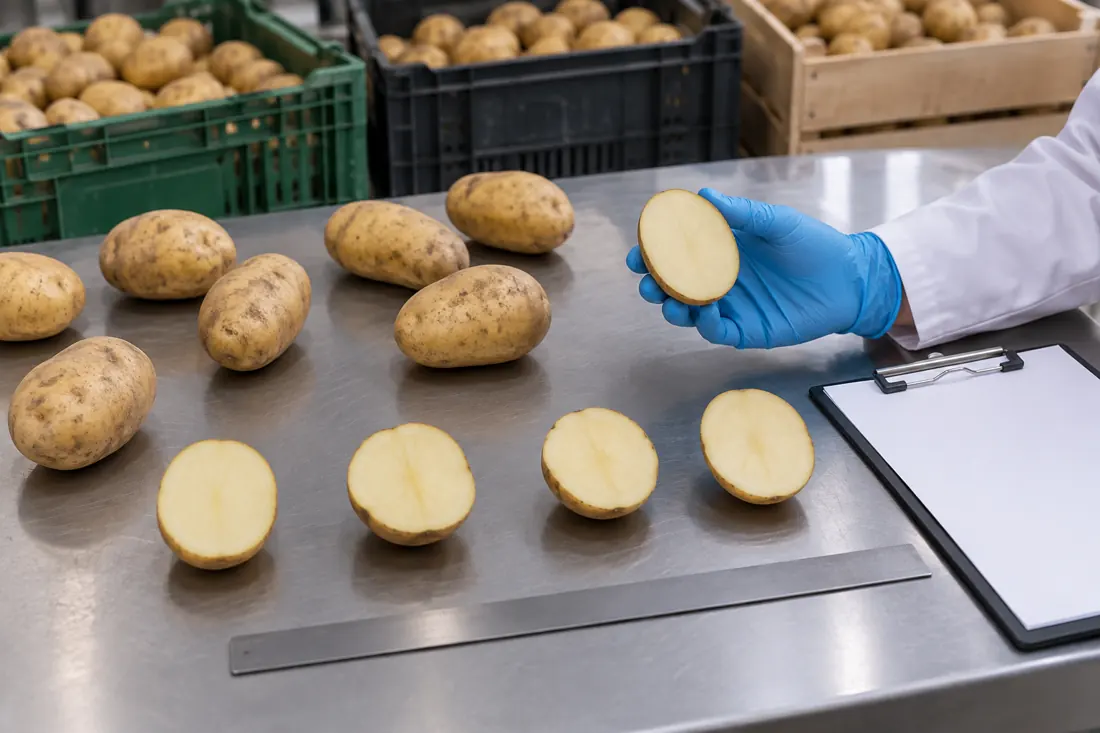
Sampling across packages supports a lot-level decision.
Location, evidence and handling can be summarized in a practical comparison:
| Observed location and condition | Plausible line of inquiry | Evidence to retain | Immediate route |
|---|---|---|---|
| Specks or dark marks on the skin | Soil, skin blemish or a specific surface disease | Photo before washing, surface condition and any broken skin | Compare with approved appearance reference; refer uncertain disease signs for diagnosis. |
| Firm dark patch just beneath peel | Handling-related blackspot bruise or another local injury | Consistent peeled depth, position on tuber and handling record | Count separately under the contracted bruise category. |
| Dark center with paler outer tissue | Blackheart or another internal disorder | Cross and lengthwise cuts, storage and airflow history | Hold for qualified quality and contract review. |
| Wet, soft, spreading or foul dark lesion | Decay or secondary infection | Segregated sample, package condition, time and temperature history | Quarantine under the site's food safety procedure. |
The rows are investigative routes, not diagnoses. An affected lot may require additional laboratory testing, customer approval or rejection under its actual contract. The table deliberately does not prescribe a number of potatoes to trim or a proportion that can be frozen. Such limits depend on the product grade, processor's control plan and destination market. If the current sample is too small or unrepresentative to estimate incidence, take the required additional sample rather than presenting the initial count as a shipment-wide rate.
Check the finished sample as well as the raw tuber. A peeled raw potato may reveal bruising that a whole-potato camera missed. A frozen bag may contain a dark cube that sorting failed to remove. Compare raw and finished findings with traceable lot codes to learn whether the dark appearance entered with the raw potato or arose later in processing, cooking or storage. That does not replace cause analysis, but it prevents a supplier and buyer from debating different points in the process under the same defect name.
Agree a defect description before ordering IQF cuts
The raw-potato standard and the finished frozen-cut standard answer related but different questions. Incoming potatoes need an acceptance rule for surface defects, bruising, internal discoloration and decay. Finished IQF pieces need a definition of objectionable dark pieces, size and cut tolerance, remaining peel if relevant, texture, packaging integrity and the intended application. A raw lot that meets a whole-tuber grade may still generate too many visibly dark dice after cutting. A finished bag that looks pale does not retrospectively prove there was no internal defect in raw fruit. Both checkpoints deserve their own record.
Start with the intended use. A pale diced potato in a clear retail pack exposes individual dark pieces. A seasoned foodservice mixture may present color differently, but it still requires sound raw materials and the agreed quality standard. Larger chunks expose more tissue on each face and may make central discoloration obvious. Mashing can hide isolated color in a blended mass, which is a reason to inspect raw material carefully rather than a reason to relax its safety control. Application changes appearance sensitivity; it does not make decay acceptable.
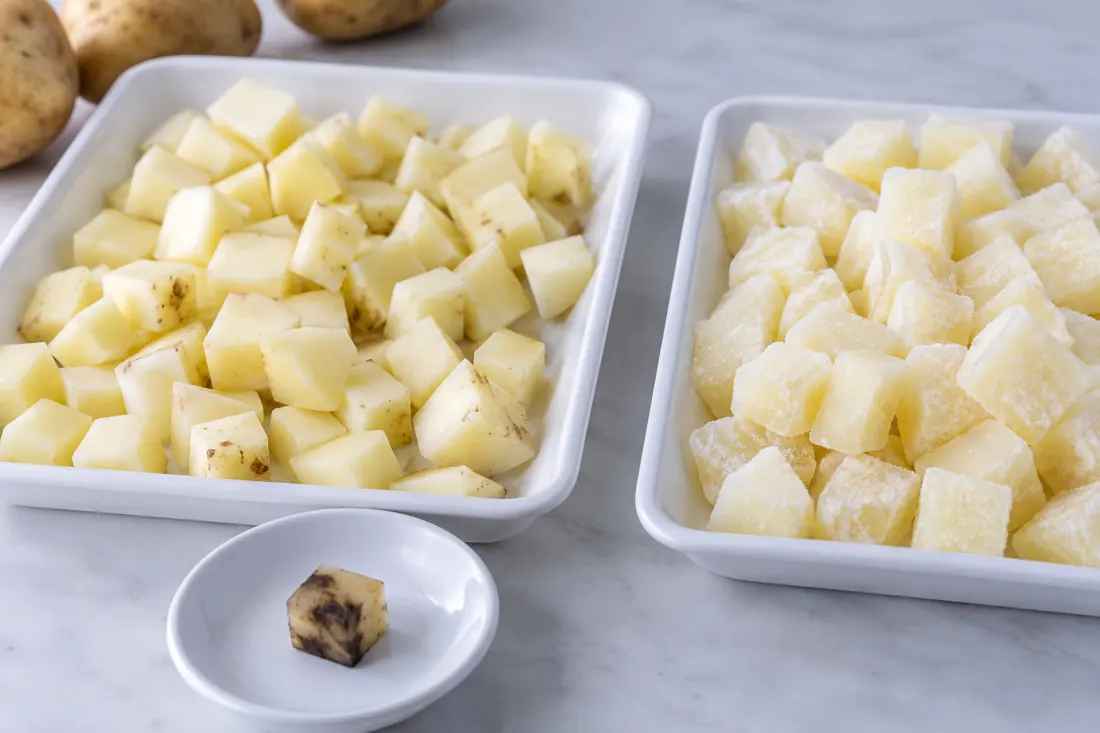
Raw acceptance and finished-cut appearance need separate criteria.
Describe defects in observable terms. Specify whether the customer counts a black area on a peel surface, a firm dark spot inside a cut, brown tissue at the center, or a soft decayed piece. State the viewing stage: raw, peeled, immediately cut, after freezing or after the customer's normal preparation. Reference photographs help if they are taken under consistent light and tied to the written description. An unqualified phrase such as "no black spots" invites disagreement because even normal handling and cooking can produce different dark appearances. The contract should also say how an ambiguous sample is escalated.
Document incidence with the sample size and the applicable method, rather than borrowing a threshold from an article about another variety or product. A supplier may inspect a defined number of raw tubers and a separate mass or number of finished pieces. The denominators are not interchangeable. If a buyer wants a stricter limit for retail visual quality than for an industrial ingredient, that difference should be explicit and still respect the same safety release criteria. Any proposed alternative use needs customer agreement and a representative process trial, not a quiet reclassification after a defect is found.
GreenLand-food's frozen potato range shows distinct product forms. The real product photographs in this section illustrate frozen dice and chunks, not a guarantee about a current batch's defect incidence. We can discuss the needed cut, specification, packing, volume, application and destination with a buyer, then confirm present availability and the quality evidence for that order. Are Soft Potatoes Still Good? expands on deterioration signs; this article keeps the focus on the location and cause of dark marks at receiving.

Small frozen cuts need their own appearance check.
A useful supplier report states what was actually seen: lot identity, number inspected, exact location of each mark, condition of surrounding tissue, photograph timing, storage or handling evidence, and the requested disposition. It can distinguish a firm sub-skin bruise from an unresolved dark center and from a suspected decayed tuber without pretending to prove a cause from sight alone. That level of detail lets purchasing, quality and production reach the same decision before potatoes are cut and frozen.
Source frozen potato with GreenLand-food
GreenLand-food is a professional frozen potato supplier and manufacturer in China, providing factory-direct wholesale supply for importers, food manufacturers, foodservice distributors and private-label programs.
Send the product form, specification, packing, quantity, application, destination, private-label needs and requested documents. We can confirm the current source and sample for your order.