


Chestnuts for Mont Blanc: From Unsweetened Kernels to Pipeable Vermicelli
Sep 28, 2026
Leave a message

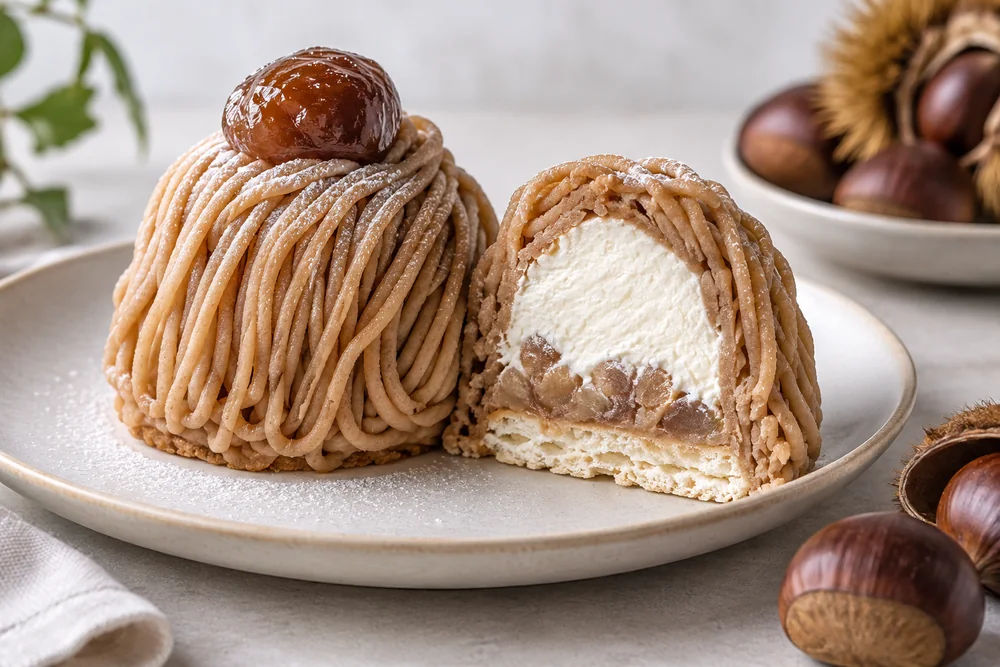
For a bakery or dessert manufacturer, the useful question is whether the offered kernels produce a repeatable chestnut base at the required cost and speed. Peel fragments, variable cooking, excess water and uneven pieces can all appear later as blocked nozzles or collapsed strands. The buying trial therefore has to extend beyond the frozen bag: cook or soften the kernels as specified, mill them, sweeten and adjust the mixture, pipe it, then judge the complete dessert at the intended service point.
This guide follows that chain. It draws on the familiar Mont Blanc architecture of base, cream and piped chestnut, while keeping supplier claims distinct from pastry results. Recipe examples can suggest a method; only a trial with the actual kernel lot, formula, nozzle and holding conditions can approve a commercial product.
Identify the chestnut input and its cooking history
Mont Blanc recipes often begin with sweetened chestnut purée or prepared chestnut cream. Those products already contain added ingredients and have a texture ready for mixing or piping. A frozen peeled chestnut is a different purchasing unit: the pastry team controls its cooking, milling, sweetness and final water balance. That control can be valuable when a bakery wants its own flavor or a private-label manufacturer needs a defined formula, but it also puts more process responsibility in the kitchen. The first quote should therefore specify the exact input, not simply "chestnut for Mont Blanc."
GreenLand-food's frozen chestnut product page identifies the category available for a sourcing discussion. Ask for the offered kernel form, peel-removal standard, size or grade, packing, ingredient statement, processing history and preparation instructions that apply to the proposed lot. The page photograph is evidence of a product type, not a promise that every kernel will have identical color or pass a fine piping tip. Request a representative sample and written specification before locking a dessert formula to the ingredient.

Peeled frozen chestnuts are the confirmed input, not ready-made sweetened paste.
Inspect a sample after opening and after the approved preparation step. Look for shell or pellicle residue, broken pieces, discolored material and an uneven ratio of large and small kernels. A large intact kernel may look attractive for garnish but provide no advantage when the entire batch will be milled. Conversely, a certain amount of broken material may be economical for purée if peel control and flavor remain acceptable. Define the defects that matter to the finished dessert, then distinguish them from harmless size variation. Visual grading alone is not an adequate piping test.
The prior heat treatment must be clear. Some frozen chestnut offerings may be blanched, cooked or otherwise prepared before freezing; others require substantial cooking before purée. Follow the specific supplier instructions and the operation's food-safety plan rather than borrowing a timing from a recipe that starts with another chestnut form. Record whether the sample entered the test frozen or thawed, what liquid was used, the cooking endpoint and any draining step. This history strongly affects the water that later has to be adjusted in the paste.
Set a cost sheet at the same time as the quality sheet. Track frozen input, unusable fragments or peel residue, cooked weight, drained weight and smooth base after milling. A lower price per kilogram can be misleading if more labor and screening are needed or if a high share of the sample is rejected. A trial batch should be large enough to expose normal pack variation, not just a handful of visually perfect kernels chosen from the top. Keep lot identification on every bowl and worksheet so the pastry result can be tied back to the quoted product.
Turn peeled kernels into a smooth unsweetened base
A smooth base begins with uniformly tender chestnuts. Hard centers remain as particles after milling, while over-watered kernels can make a thin purée that needs extended concentration. Prepare the sample according to its documented processing status, using enough controlled heat and liquid to soften it consistently. Then drain or retain cooking liquid deliberately. Measure both the liquid and the kernels so that the same procedure can be repeated. The kitchen should decide whether its desired flavor comes from water, milk, syrup or another component in the final formula; the raw ingredient trial should not hide that choice.
Work in stages. Break down the kernels with the equipment intended for production, then pass the mass through the screen or sieve suitable for the planned piping tip. Record the fraction held back. A visually smooth paste on a spatula can still contain particles large enough to block a multi-hole vermicelli disc. Screen loss may come from peel residue, hard pieces or simply a mesh finer than necessary; inspect the retained material before calling it a supplier defect. The goal is a controlled smoothness appropriate to the dessert, not an arbitrary claim that all purée must be perfectly uniform.
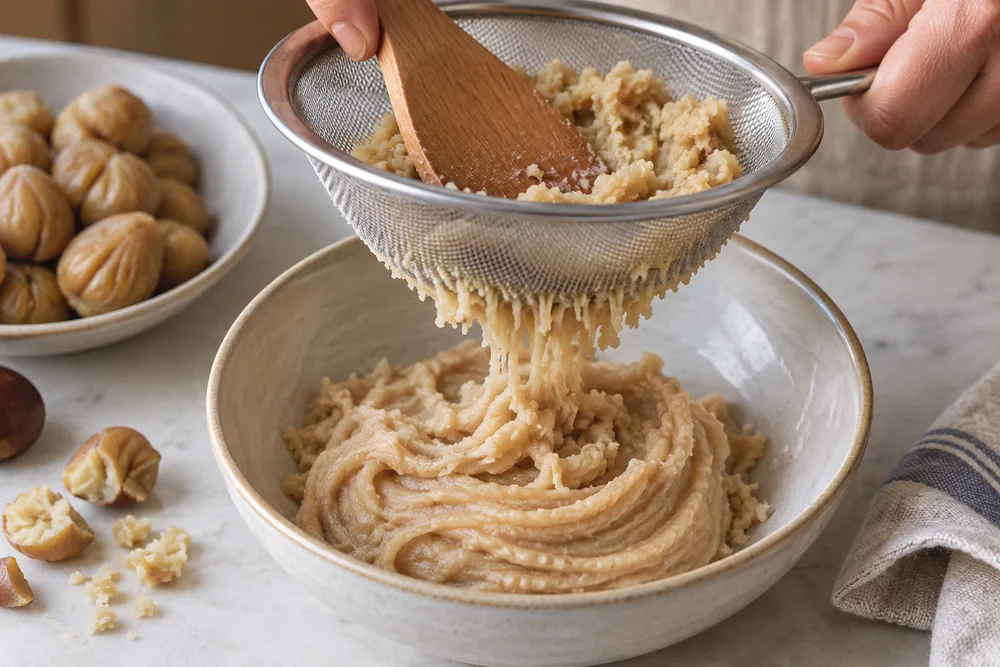
Cooked peeled chestnuts pressed through a fine sieve
Keep the first pass unsweetened, or at least document the additions separately. It gives the bakery a clearer view of the chestnut's own aroma, color and milling yield. Sugar, syrup or cream can soften an astringent note and change texture, but an ingredient that requires major correction may make the final dessert overly sweet or costly. Compare the unsweetened base to an approved reference under the same temperature and lighting. Chestnut color naturally varies; define a sensible acceptable range based on the finished product instead of assuming a single photograph is a binding color standard.
For continuous production, consider the work that a bench test can hide. A hand mill used on a kilogram may be practical for a boutique pastry counter and unsuitable for a larger line. A high-speed blender can entrain air and warm a paste; a coarse processor can leave particles. Trial the equipment and batch size intended for sale. Track time from cooked kernel to screened base, the temperature at each transfer and the amount stuck in the mill. Those factors affect both labor and consistency. Any food-safety cooling and storage limits for the prepared paste belong to the producer's approved controls.
An unsweetened base can also be diverted to other applications if the Mont Blanc trial does not use the whole batch. That flexibility should be planned, not used to excuse a poor pastry result. GreenLand-food's general chestnut application guide discusses broader uses; the present test is narrower. The required output here is a screened base that can become a stable, flavorful vermicelli layer. Record its net yield and sensory character before adjusting it so the ingredient supplier and pastry team can see which part of the chain needs attention.
Adjust sweetness and flow for the vermicelli nozzle
The characteristic Mont Blanc surface is made of narrow chestnut strands. Taste France's Mont Blanc example and the Institute of Culinary Education's discussion illustrate the traditional visual idea. The exact sweetening level, richness and piping tool vary by pastry style. For production, the question is more specific: does the chosen paste travel through the nozzle smoothly, leave clean separate strands and keep its mound after assembly and the planned hold?
Build a small formula matrix from the same screened chestnut base. Adjust sugar or syrup, fat and liquid in controlled steps, recording each addition as a percentage of the base weight. A paste that is too stiff requires excessive piping force and may break into rough pieces. A paste that is too loose flows easily but blurs into a heavy smooth coating or slides down the cream. Temperature matters too: the same formula can feel firmer after chilling and softer on a warm line. Record the paste temperature when assessing extrusion, then repeat at the intended production temperature.
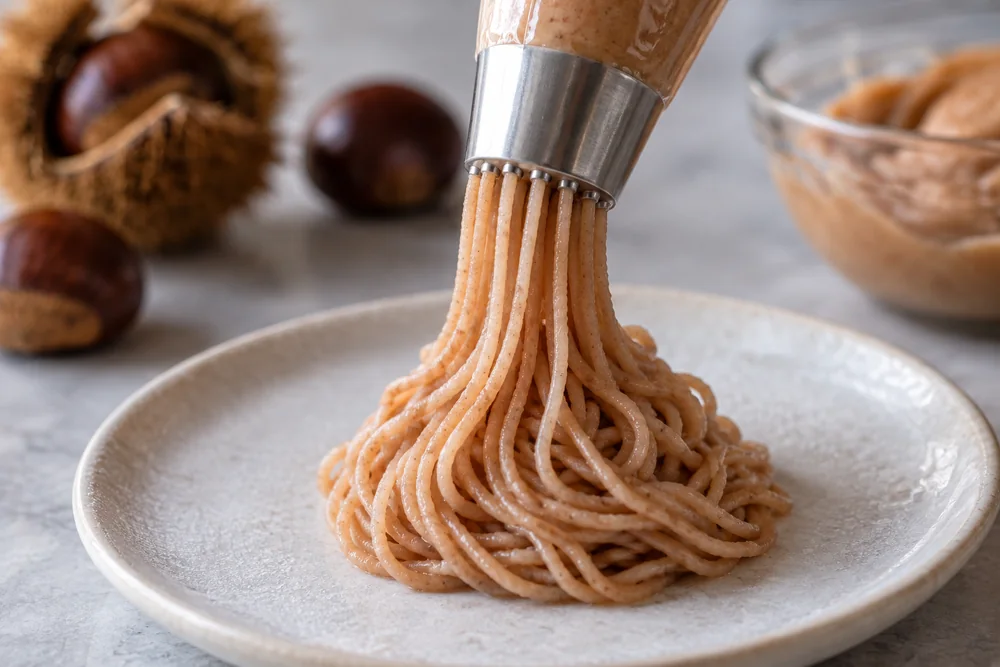
Chestnut cream extruded in fine strands from a Mont Blanc piping tip
Use the actual piping bag, machine or depositor and the intended disc. A single-hole star tip can make a decorative swirl even when fine vermicelli holes would clog. Pipe a defined mass onto a test plate, note pressure and interruptions, then measure the visual height and strand separation immediately. Cut across the mound after the hold to see whether the chestnut layer remains distinct from the cream. A continuous ribbon that appears neat for one minute may merge after a chilled display period. Conversely, a paste that holds perfectly may be so dense that it overwhelms the dessert when eaten.
Do not solve every clog by adding water. First check screen size, retained particles, kernel softening and paste temperature. More water may improve the immediate extrusion while increasing surface wetness or migration into the base. If a formula needs a thinner paste, adjust in small weighed steps and repeat the complete dessert test. The trial should reveal a workable process window rather than a single lucky sample. Define an acceptable amount of added liquid and a maximum screen residue only after testing, and state which party controls each stage.
Sweetness is a menu decision as well as a technical one. The center cream, meringue or pastry base may already add sugar. Taste the piped paste by itself and then in a complete bite. An aggressively sweet commercial chestnut cream might pipe beautifully yet make the assembled dessert cloying. Starting from unsweetened frozen kernels gives the producer control, but that benefit is real only when additions and process losses are measured. Include those additions in the finished-product cost rather than comparing raw kernel price directly with ready-made sweetened cream price.
Choose a base and cream architecture
Mont Blanc is a family of desserts rather than one fixed bill of materials. Many versions place whipped cream or Chantilly beneath the chestnut strands and set that assembly on meringue, sponge, tart shell or another base. Epicurious's version and Tannov's pastry discussion show different choices. A bakery should choose the architecture for its service channel before approving the chestnut paste, because the amount of cream and the moisture tolerance of the base change the meaning of "stable."
Meringue offers a light, crisp contrast, but it is sensitive to moisture during a long hold. A tart shell can add structure and a different eating texture, yet its filling and rim still need to survive cream and chestnut contact. Sponge or biscuit may accept some moisture while gradually losing definition. Make the same measured mound of cream and chestnut on each candidate base. Hold the complete desserts in the intended package and temperature, then cut them at the planned service point. The comparison needs a fresh control and the actual display or transport conditions, not only an attractive assembly photograph.
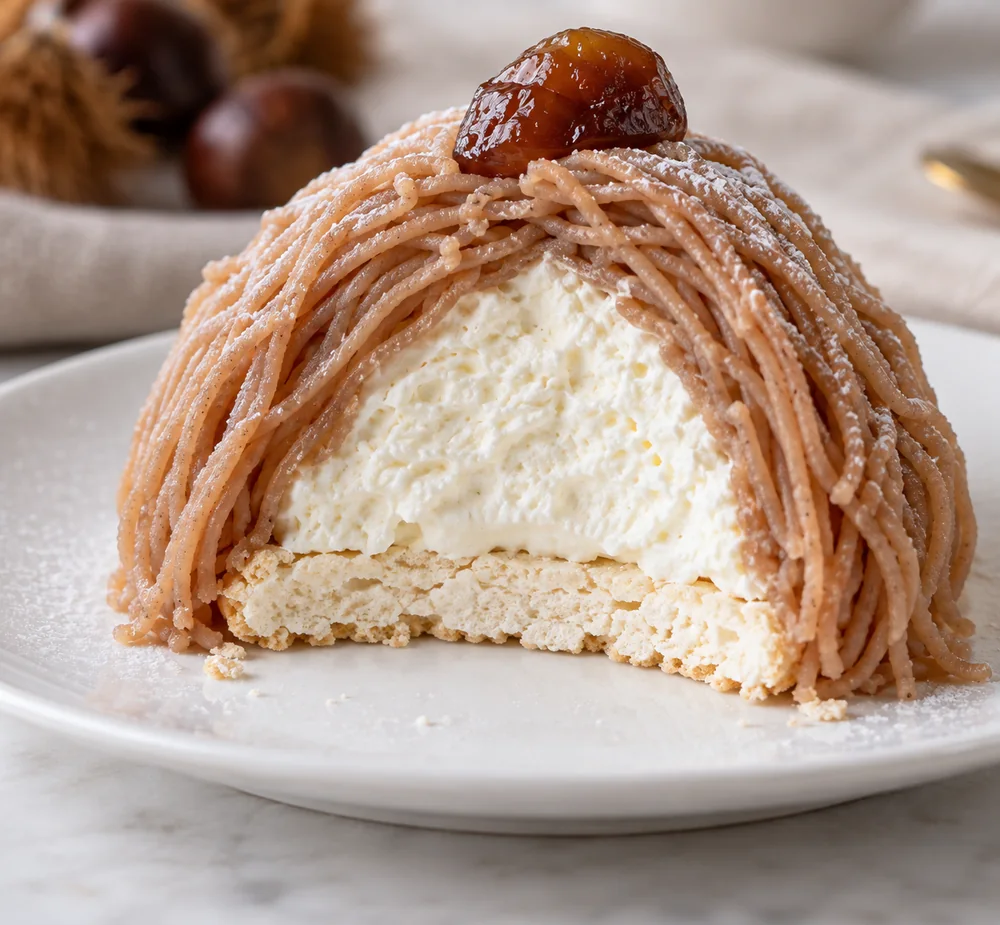
Cut Mont Blanc pastry showing meringue, cream and chestnut strands
The cream shape should support piping. An uneven dome forces one side of the chestnut layer to be thick and another thin. Define a cream weight and rough height, then have different operators assemble several units. Watch whether the chestnut strands grip the surface or slide. A softer cream may make a pleasant bite but provide weak support; a very firm cream can compress the base or make the dessert heavy. The choice interacts with nozzle flow: a paste that requires high pressure can displace a delicate cream core. Trial those elements together before scaling.
Check the moisture boundary at the base. If the pastry component softens, determine whether the cause is cream contact, chestnut paste, condensation in the package or thawing of a pre-frozen component. A barrier or an alternate assembly sequence may help, but each change affects flavor and labeling. Do not call the chestnut input unsuitable because the meringue failed after a long chilled hold. Equally, do not approve a chestnut paste that sheds liquid simply because a robust tart shell conceals the problem. Separate the failure modes with controlled comparisons.
The architecture also determines labor. A bakery that pipes à la minute can favor a more delicate structure than a distributor supplying fully assembled desserts. A central kitchen might prepare screened chestnut base ahead, then sweeten and pipe after transfer under approved controls. A retail program may require a unit that survives case loading and shopper handling. Document where each component is made, when it is combined and how long the finished dessert waits. That timeline is necessary to interpret every texture observation in the test.
Pipe and hold a complete dessert
The final trial is a service simulation. Assemble several Mont Blanc units from the same chestnut batch, cream and base, using the intended deposited weights. Record the paste temperature, nozzle, operator, assembly order and package. Assess one immediately, then assess others after the actual chilled display or transport intervals. Note strand definition, lean or collapse, surface drying, weeping, cream leakage and base texture. A single beautiful hero dessert may be possible even with a difficult ingredient; repeatability across the set is the useful commercial result.
Photograph the whole unit and a clean cutaway. The outside view captures visual height and pattern; the cutaway shows whether chestnut, cream and base retain distinct layers. Westgold's Mont Blanc recipe is another example of how a composed dessert depends on its components. For a buyer's acceptance sheet, add numerical weights and a simple visual grade. Define a reject example such as a blocked nozzle, smeared strands or visibly wet base. Avoid a vague requirement that the dessert should "look premium," which gives different operators no reproducible decision.
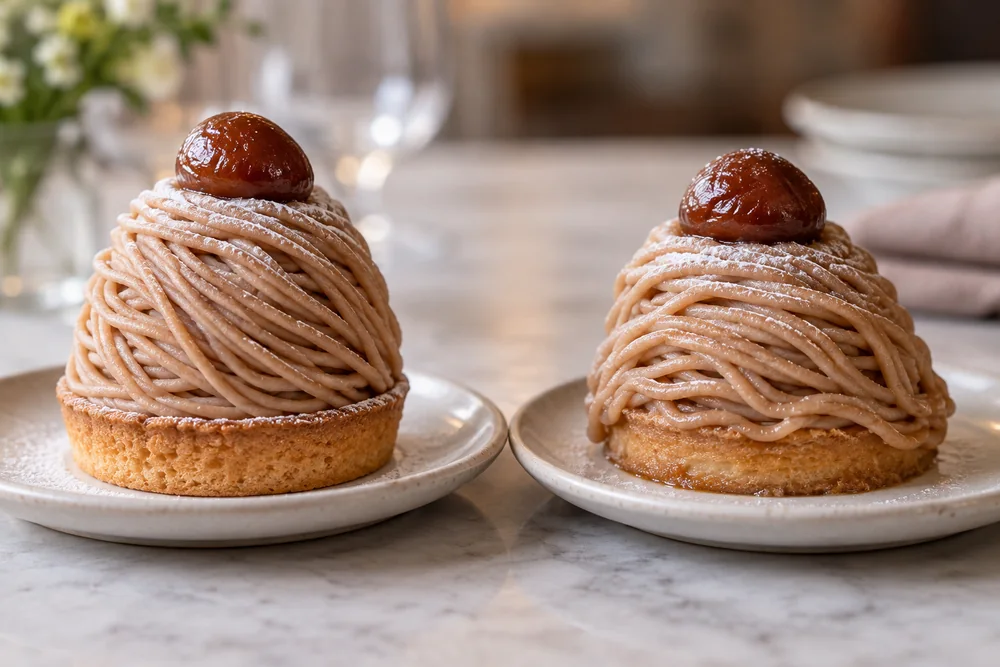
Mont Blanc pastries showing retained and slumped chestnut strands
If the product will be frozen after assembly, treat that as a separate project. A frozen peeled chestnut ingredient does not establish that whipped cream, meringue and piped chestnut will survive a finished-dessert freeze-thaw cycle. Run a trial of the completed formula, package and thaw method under the producer's food-safety controls. Compare it with a chilled, never-refrozen control at the same service temperature. Screen for lost strand definition, water migration and collapse. Do not present the frozen ingredient's storage instructions as the shelf life or handling instructions of the completed pastry.
For a take-away or delivery unit, examine the container clearance. A high chestnut mound may touch the lid or shift when the carton tilts. A cup that holds it tightly might deform the strands during removal. Trial a packed case and an individual consumer unit, including opening. If the dessert needs a garnish, test whether the garnish survives that handling or should be added at service. The packaging decision can affect the suitable piping height and therefore the amount of chestnut paste per unit; feed that result back into the formulation and cost sheet.
Keep production records connected. A quality complaint about flattened strands could stem from paste water, screen residue, warm filling, soft cream, an overloaded case or a longer hold than approved. Record the kernel lot, paste formula, equipment, cream batch, base batch, assembly time and service check. The aim is not paperwork for its own sake; it is the ability to correct the right stage. The supplier can support a consistent ingredient specification, while the dessert producer controls preparation, assembly and finished-product release.
Translate pastry performance into a kernel specification
After the trial, write the kernel purchase standard from observed needs. Include peeled status and acceptable residue, size or broken-piece allowance, color range, ingredient statement, processing status, pack, storage conditions, traceability and required export documents. Add the customer's test method for milling and screening, not just a statement that the kernels are "good for purée." State the equipment, preparation and screen used in that acceptance test so a future batch can be compared fairly. If whole-kernel appearance matters for a garnish as well as the paste, define those as separate graded uses.
Ask GreenLand-food for a quote against that standard and for a representative sample of the exact offered frozen chestnuts. The supplier can discuss factory-direct bulk supply and available packing arrangements; the buyer should confirm the details in the quotation and sample approval. Our frozen chestnut range can start the discussion, but a web page cannot replace written lot and product documents. Keep the agreed sample, photograph its appearance and retain its milled-paste and piped-dessert test records.

Pack presentation shows kernel integrity before cooking and milling.
Build the landed cost around accepted desserts. Begin with frozen chestnut price and usable milled yield, then include cooking or softening, screening labor, sugar, cream, base, assembly time, packaging and rejected units. A cheaper kernel that demands repeated milling or excessive sweetening may cost more per saleable Mont Blanc. A more uniform input may permit a wider process window and fewer nozzle interruptions. Evaluate the trade with the scale of the actual bakery; a small pastry shop and an automated line will value labor and equipment losses differently.
Trial the proposed commercial pack as well as the kernels. A bag size that suits the frozen warehouse may be awkward at the pastry station if only a small quantity is used per shift. Repeated opening and partial use need an approved handling procedure and clear lot identification. Larger users may prefer a case configuration that feeds a scheduled batch without excessive inner-pack waste. Confirm net weight, pallet and case marking, and the documents required by the receiving market. Those practical details should be settled before a recipe is scaled around a bench sample delivered in a temporary bag.
For a seasonal dessert, reserve capacity against realistic demand rather than assuming the freezer guarantees unlimited production flexibility. The prepared paste, cream and bases have their own schedules and control limits. A reliable chestnut supply helps only if the pastry operation can cook, mill and pipe at the required rate. A pilot production day can expose a bottleneck that a tasting panel cannot: slow screening, nozzle cleaning or insufficient cooling space. Feed those observations back into pack size, order frequency and the acceptable kernel grade.

A size measurement photograph supports kernel calibration for the trial.
Finally, establish change control. A shift in kernel size distribution, processing history or packing can alter cook time and paste moisture even when the item name is unchanged. Request notification of material changes and recheck the kernel-to-paste and paste-to-dessert stages if the offered specification changes. The quality promise should be specific: the approved chestnut input supports the buyer's tested smooth base and piping process. The finished pastry's appearance, hold and food safety remain the responsibility of the producer who controls the full recipe and service conditions.
Source Frozen Chestnut with GreenLand-food
GreenLand-food is a professional frozen chestnut supplier and manufacturer in China, providing factory-direct wholesale supply for importers, food manufacturers, foodservice distributors, and private-label programs.
Send the product form, specification, packing, quantity, application, destination, private-label needs, and requested documents. We can confirm the available format and a suitable sample for your planned process.