


What to Do with Chestnuts
Sep 09, 2026
Leave a message
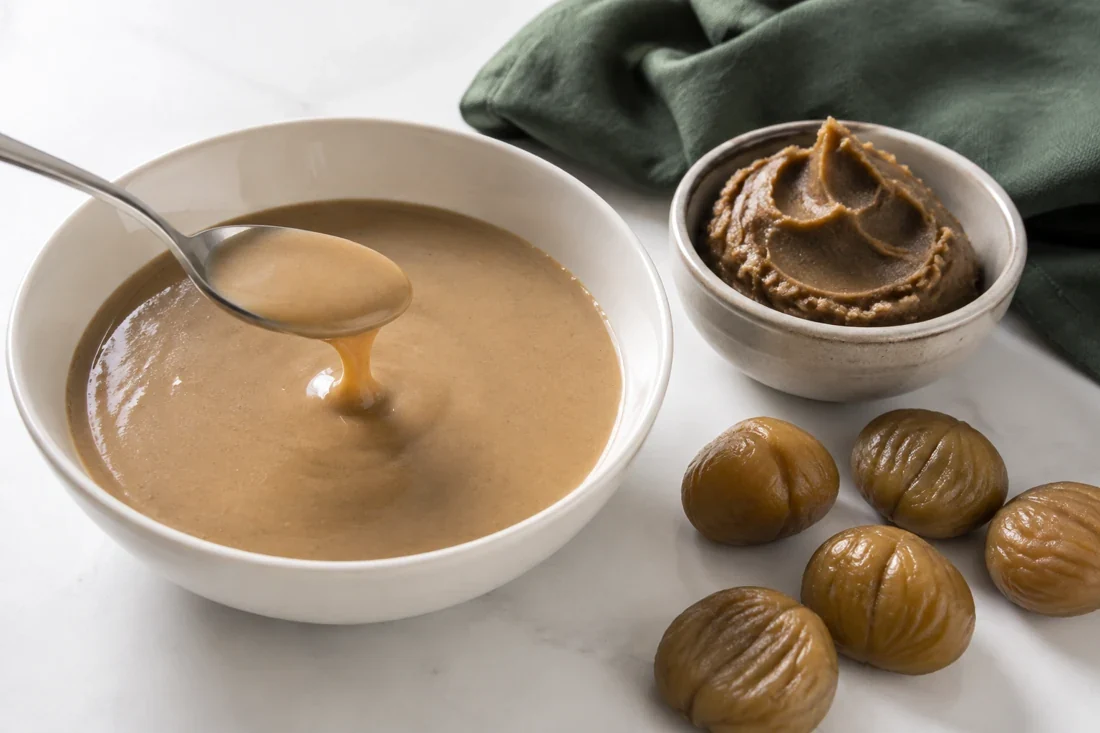
Whole kernels work well where their shape should remain visible; sound pieces are useful when the recipe involves chopping or blending. Before starting, check whether your chestnuts are raw, cooked, sweetened or supplied frozen for further preparation.
That product state matters as much as the recipe idea. A bag of raw peeled kernels cannot enter every dish at the same stage as cooked chestnuts, and a sweetened puree will change a savory sauce. The following applications explain what each form contributes and what to check before using it in a kitchen or a larger production run.
Start with the chestnut format your dish needs
Whole chestnuts give a dish a recognizable ingredient and a tender, substantial bite. They suit a plated side, a roast vegetable combination or a visible inclusion in a premium meal. The important question is whether they remain intact through the full preparation and service sequence. A kernel that looks attractive in a raw sample may break during mixing or a second heating stage, so evaluate the final portion as well as the starting material.
For preparation details, see How to Roast Chestnuts in the Oven.
Pieces and broken kernels can be useful in stuffing, chopped fillings and soups. Their smaller size distributes chestnut through a mixture and reduces the work of cutting whole kernels. "Broken" should describe an agreed product form, not permission to accept damaged or spoiled material. Soundness, skin-remnant limits and the size of the pieces still matter. If a filling needs an even texture, uncontrolled fines and large chunks should not be treated as interchangeable.
| Format | Useful role | Trial question |
|---|---|---|
| Whole kernels | Visible savory portions | Do kernels stay intact through the complete cook? |
| Pieces | Stuffing and mixed dishes | Is the bite distributed consistently? |
| Puree | Fillings, soup and sauces | What sweetness, composition and consistency are supplied? |
| Flour | Dry recipe formulation | How does it change hydration and the finished structure? |
Puree offers a more continuous texture. It can provide the main body of a cream, a filling or a soup, but its composition needs to be understood. A plain chestnut puree, a sweetened spread and a vanilla-flavored dessert cream can look similar in a tub. Their sugar, added liquid and flavorings affect what they contribute to a recipe. Read the ingredient list before deciding how much sweetener, seasoning or liquid to add.
Flour and dried chestnuts are additional ingredients with their own behavior. Chestnut flour can add flavor and solids to baked goods, while dried whole or broken chestnuts may need rehydration and cooking. Flour is not a direct replacement for a moist puree, nor does it reproduce the bite of a whole kernel. The FAO survey of chestnut processing illustrates how many distinct products can come from the same crop; each should be developed in the form actually purchased.

Whole peeled chestnut kernels with wrinkled surfaces. Whole kernels provide a different structure from chestnut puree or flour.
We supply frozen chestnuts with the offered form and preparation confirmed for the order. If the application is a smooth filling, say so before requesting a whole-kernel grade. If the dish needs visible whole chestnuts, state that appearance requirement. A supplier can review a clear application much more usefully than a request for the best chestnuts without any description of how they will be cooked or served.
For a first development trial, keep the ingredient plain enough to reveal its own flavor and texture. Compare the proposed form with the current recipe input, using the same finished portion. Record preparation time, usable quantity and any changes to liquid or seasoning. A format that reduces one task may add another, so assess the complete recipe rather than assuming that the most processed product is always the most convenient choice.
Make chestnut puree for sweet and savory dishes
Chestnut puree begins with thoroughly cooked, peeled chestnuts. The kernels need to be tender enough to break down smoothly, and the thin inner skins should be removed to the standard required by the dish. Blend with a measured amount of suitable liquid, adding it gradually until the texture fits the purpose. A spoonable dessert filling needs less fluidity than a soup base, even when the same cooked chestnuts are used.
For a savory puree, stock, milk or another recipe-appropriate liquid can help establish the texture. Season after you understand the sweetness and flavor of the chestnuts. A little salt, a complementary herb or another savory ingredient may provide balance, but the dish should still taste of its intended ingredients. If using a purchased stock or dairy ingredient, include it in the full ingredient and allergen review for the recipe.
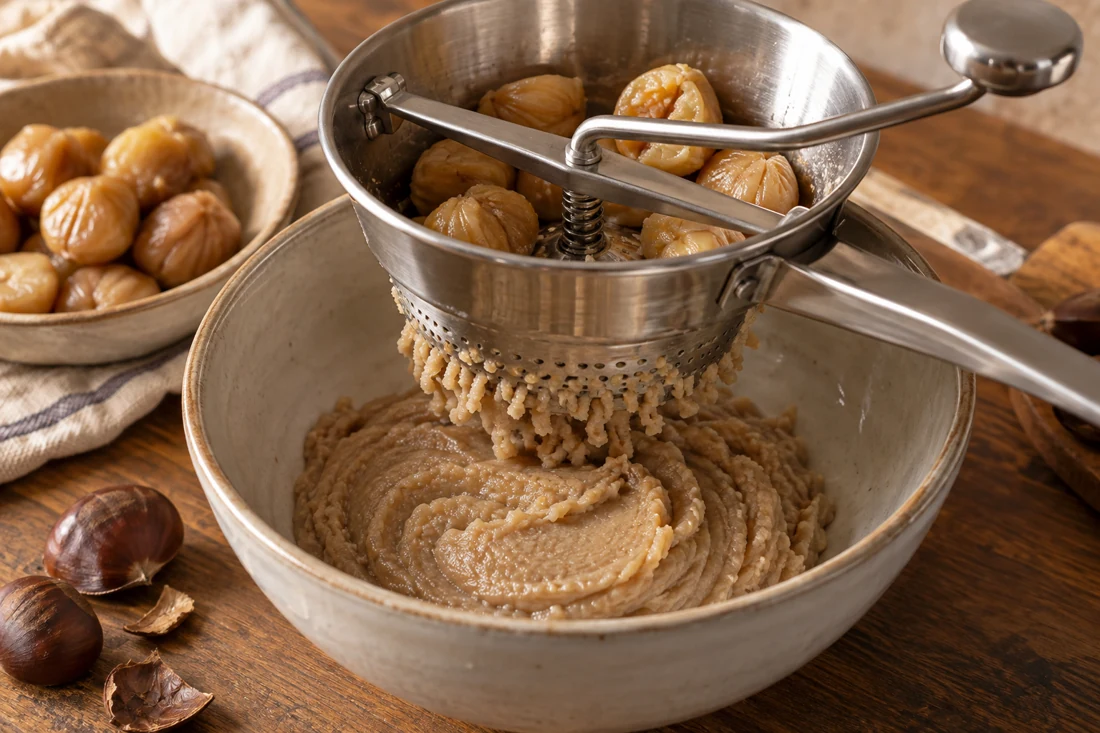
Cooked chestnut kernels can be milled into a smooth puree. Illustration.
- Confirm whether the input is raw, blanched or cooked and whether the puree will be sweet or savory.
- Cook as required for the product, then blend with measured recipe liquid.
- Adjust consistency and seasoning in a small trial, and test the puree in the finished application.
For a sweet puree, start by checking whether sugar is already present. Unsweetened kernels give the recipe developer control over sweetness, while a sweetened puree may simplify a specific confectionery process. Vanilla, chocolate and coffee can complement chestnut in desserts, but they should be adjusted around the actual supplied ingredient. A strongly flavored filling can conceal a weak chestnut contribution, so taste a plain sample before building the final flavor profile.
Texture needs checking after the puree reaches the temperature at which it will be used. A warm blend may flow easily, then become much firmer as it cools. A chilled filling may soften when baked. For piping, examine how the mixture passes through the chosen nozzle and whether the deposited shape holds. For spreading, look at drag and thickness on the intended pastry or cake surface. Those practical observations are more useful than describing the puree only as smooth.
If the mixture remains grainy, examine the cooked kernels before adding more liquid. A hard center will not necessarily become a pleasant puree simply because the blender runs longer. Residual skin can also affect the texture. A fine sieve may be useful for a very smooth application, but it introduces a yield and labor consideration. Record the amount retained and the finished quantity so that the recipe cost reflects the process actually used.
For batch production, define the puree at a reproducible stage: after cooking, after blending or after any concentration step. Use the same measurement point when comparing samples. A bakery should also test the filled and baked product after its normal cooling period. The puree's appearance in the mixing bowl is one observation; its behavior inside the finished product is the basis for approval.
Add chestnuts to stuffing and grain dishes
Chestnuts add soft, slightly sweet pieces to bread stuffing, rice, barley and other grain-based dishes. They can create a gentle contrast with herbs, onions, mushrooms or a savory stock. Cooked kernels are often convenient because the mixing stage can focus on distributing them and balancing moisture. If the chestnuts are supplied raw or only blanched, their required cooking stage must be included rather than assumed to happen during a brief final warming.
Choose the cut around the desired eating experience. Large pieces make the chestnut more obvious in each bite but can leave some portions with very little. Smaller pieces spread more evenly and may suit a portioned stuffing. Very fine material can contribute body while losing its identity as a separate ingredient. A sample trial should therefore examine both texture and distribution across several servings, not just the first spoonful from the mixing bowl.
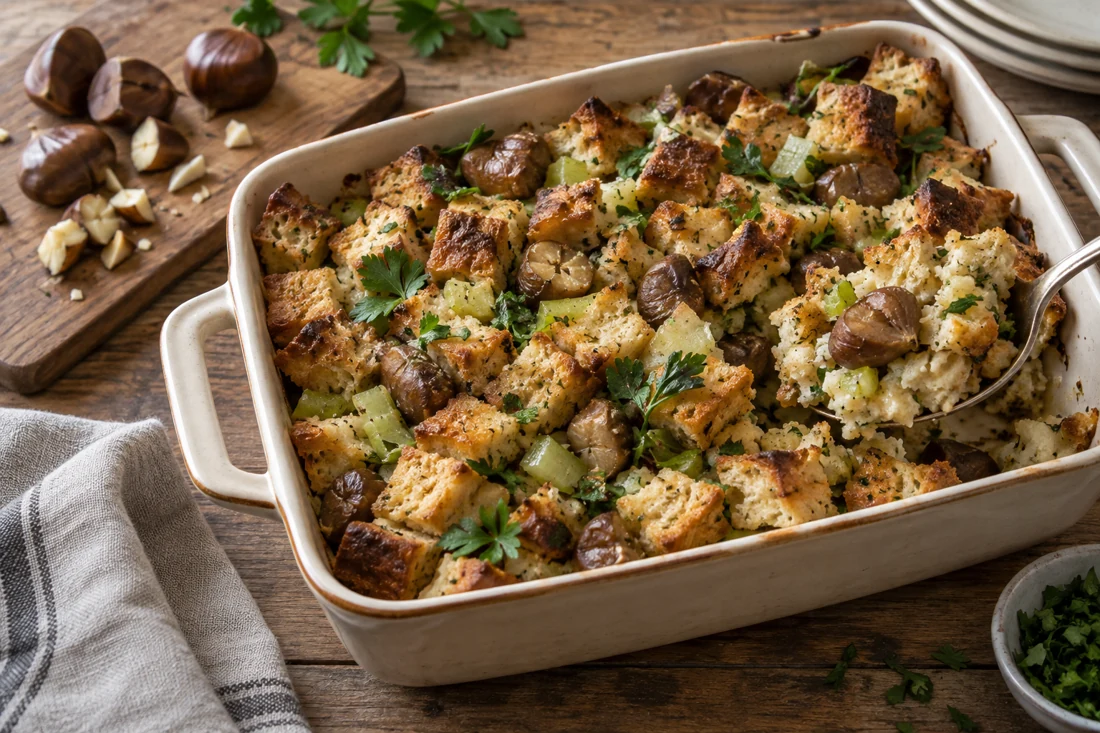
Chestnut pieces add a soft bite to bread and herb stuffing. Illustration.
The Chestnuts Australia recipe collection includes a range of stuffing and savory uses. It provides ideas for compatible applications without requiring chestnuts to be treated only as a roasted snack. When adapting an idea, retain the logic of the dish: the bread or grain needs the appropriate moisture, the chestnuts need the correct cooking state, and the finished mixture needs to be cooked and handled according to its complete formulation.
Add delicate cooked kernels at a stage that preserves the texture you want. Vigorous mixing can turn tender pieces into a much finer inclusion than the original cut suggests. If visible chunks are important, compare a gentle final fold with earlier addition during mixing. In a factory trial, reproduce the actual mixer and batch load where possible. A hand-folded development bowl can give an unrealistic picture of breakage on a production line.
Moisture should be measured against the full mixture. Bread dryness, grain absorption and the amount of stock all influence the result. Chestnut puree, whole kernels and thawed pieces may introduce different amounts of free liquid. Avoid replacing one form with another at the same weight and assuming that the stuffing will remain unchanged. Start with a small controlled trial, then adjust the liquid around the desired cooked consistency.
A stuffing cooked separately in a dish has different heating conditions from stuffing placed inside poultry or another assembled food. Follow the safety instructions for the complete recipe, including the required center temperature and handling. Chestnuts do not establish that process. For a manufacturer, ingredient approval should be followed by validation of the assembled product, with the actual portion size, packaging and consumer preparation route included.
Use chestnuts in cakes, pastry and bakery fillings
Chestnuts can appear in bakery products as pieces, puree, cream, flour or a visible topping. These forms serve different purposes. Pieces create a recognizable inclusion in a cake or bread; puree distributes chestnut throughout a filling; flour becomes part of the dry formulation. A whole glazed chestnut may be chosen for appearance. Decide which role matters before selecting a grade, because an attractive whole kernel can be an unnecessary cost when the next step is blending.
A filling needs more than a pleasant flavor in the bowl. It must work with the pastry, depositing equipment and baking cycle. Examine whether it releases moisture into the pastry, whether it stays in place during baking and whether it becomes too firm after cooling. A filling that performs well in a small tart may behave differently in a larger product with a deeper center. Test the actual shape and portion you intend to sell.
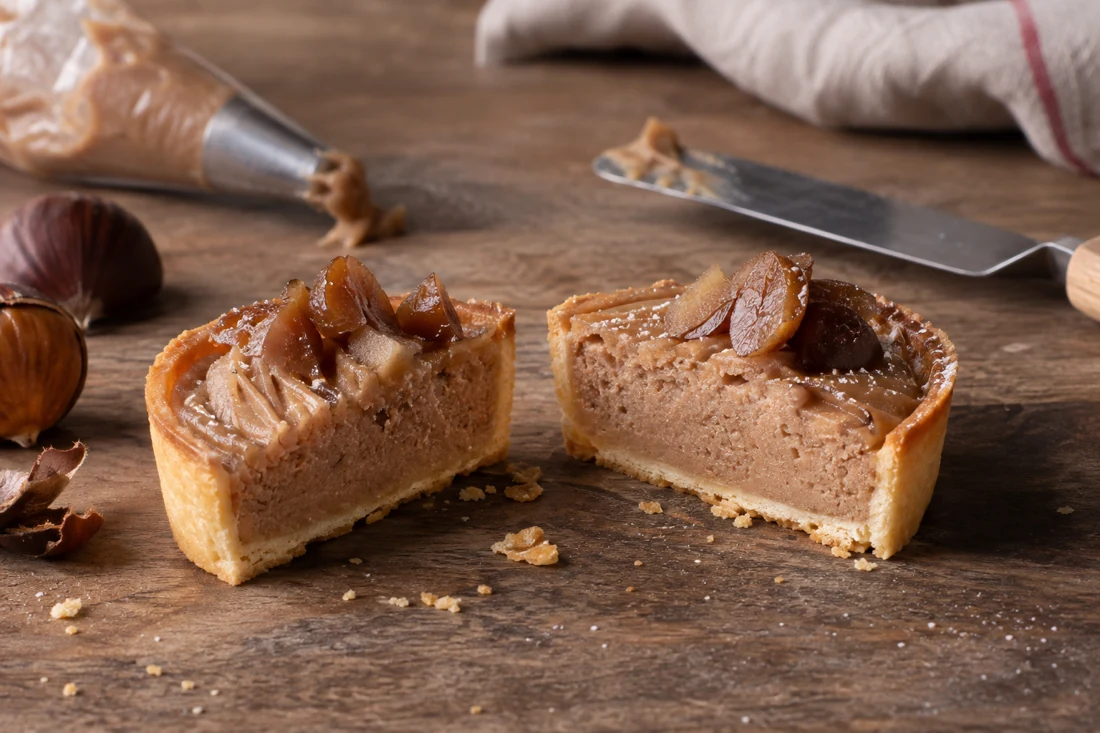
A tart cross-section shows how a chestnut filling holds its shape. Illustration.
Sugar deserves particular attention when changing suppliers or formats. A sweetened chestnut cream may already contain enough sugar for the dessert, while plain puree leaves that decision to the recipe. Added flavors can also affect the finished profile. Request the full ingredient declaration and compare it with the current approved input. Product names such as chestnut spread or chestnut paste are not sufficiently exact for an unchanged bakery formulation.
For a cake with pieces, choose an inclusion size that fits the slice and crumb. Very large pieces can make cutting uneven; small pieces may disappear visually. Observe how the chestnuts distribute during mixing and whether they settle before the batter sets. The appropriate adjustment may involve the inclusion form, the recipe or the mixing sequence. It should be based on a test of the finished cake rather than a guess from the raw ingredient photograph.
Chestnut flour needs its own development work because it does not supply the same structure as wheat flour. It can contribute a distinctive flavor, but replacing a large share of another flour changes the recipe. Avoid treating a suggestion for a small addition as proof that a one-for-one substitution will work. Any gluten-free or allergen-related claim must be established for the complete ingredient supply and production process, not inferred from the name of one component.
For a commercial bakery, assess the product at the end of its intended sale or service period as well as on the day it is made. Check moisture movement, filling firmness, visible pieces and flavor after the planned storage and reheating sequence. These observations help decide whether whole frozen kernels, pieces or a specified puree is the right input. They also give the supplier concrete feedback when a sample needs adjustment.
Build soups and sauces around chestnut texture
Chestnuts can give a soup a smooth, substantial body and a mild sweetness. Cooked peeled kernels can be simmered with the recipe's liquid and blended to the desired texture. A plain chestnut base leaves room for vegetables, mushrooms, herbs or dairy where appropriate. The amount of liquid should be adjusted around the actual kernels and the intended serving consistency, especially if the soup will stand before service.
The Chestnuts Australia recipe booklet demonstrates soup applications using cooked peeled chestnuts. Its recipes also show why consistency after standing matters. Rather than copying a recipe quantity into a larger process without review, begin with the intended proportion of chestnut and liquid, then observe the finished soup at service temperature. A soup that coats a spoon pleasantly when blended can become too thick during holding.
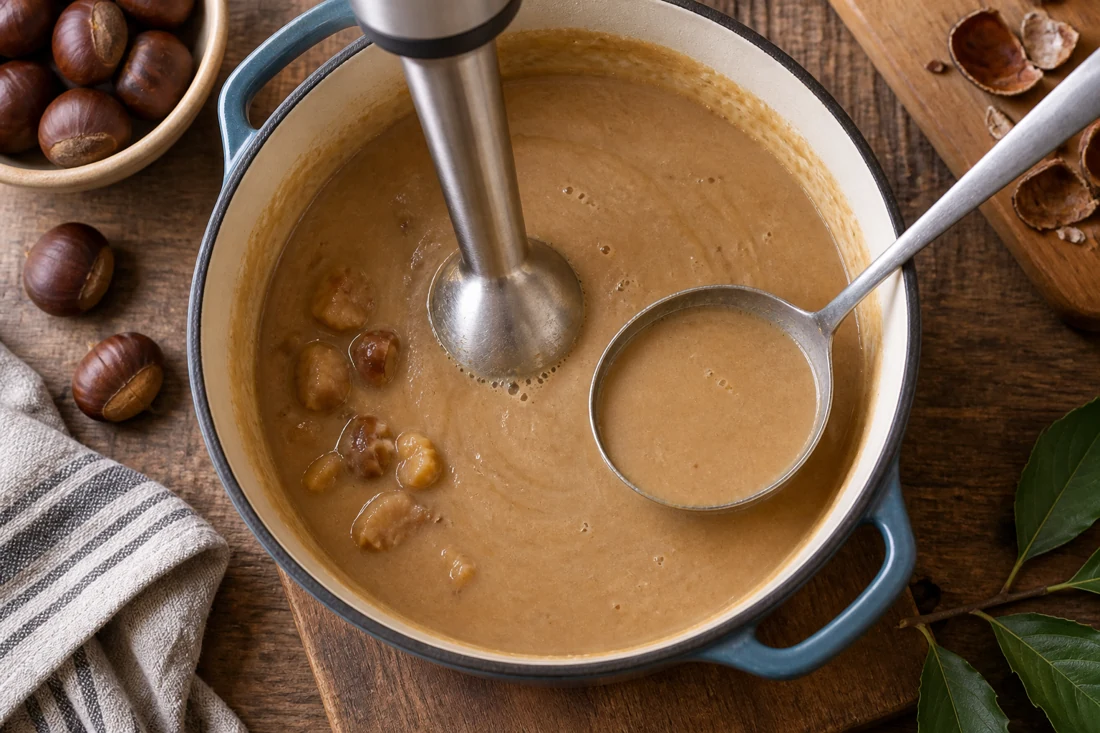
Blend softened chestnuts to develop the desired soup consistency. Illustration.
Choose whether the chestnuts should supply most of the body or simply contribute flavor. If the recipe also contains potatoes, beans, cream or another thickening ingredient, their combined effect needs balancing. Adding more chestnuts may make the soup denser without producing a proportionate improvement in flavor. A controlled trial can compare two inclusion levels while keeping the other ingredients constant and assessing the actual bowl served.
For a smooth sauce, check the texture against the food it accompanies. A thick puree that works under roasted vegetables may be too heavy for pasta. A sauce intended for pumping or depositing needs to move through the equipment without losing its intended consistency. Explain the final use to the ingredient supplier, but validate the sauce within your own formulation. A supplier's chestnut specification does not define the viscosity of every recipe made from it.
Skin remnants and undercooked centers become more apparent in a smooth soup than in some rustic dishes. Inspect the kernels and confirm their preparation before blending. If the recipe requires straining, include that step in the yield calculation. A small quantity of retained coarse material may be acceptable for development, but it should not be ignored when estimating how much finished soup a commercial batch will produce.
Cooling and reheating also belong in the trial. Divide large quantities and cool them using the operation's approved procedure. Reheat the complete soup safely, then reassess thickness and flavor. If additional liquid is normally added at service, document how much and when. That keeps the kitchen from making repeated unrecorded adjustments that gradually change the chestnut content and the eating quality from one batch to the next.
Keep whole kernels visible in savory dishes
Whole chestnuts work well when their shape and tender bite are part of the appeal. They can accompany roasted vegetables, appear in a braise or be served as part of a plated side. Their mild sweetness can balance earthy or savory ingredients. The most useful starting question is how much cooking the chestnuts still need and how long the rest of the dish will take to reach its intended texture.
If the kernels are already cooked, a long vigorous simmer may break them down more than the presentation requires. Adding them later may preserve their shape, provided the complete dish still receives the necessary heating. If they are raw, late addition may leave a hard center. Confirming the preparation state resolves that choice. A frozen peeled kernel should not be placed into either category without the product information.
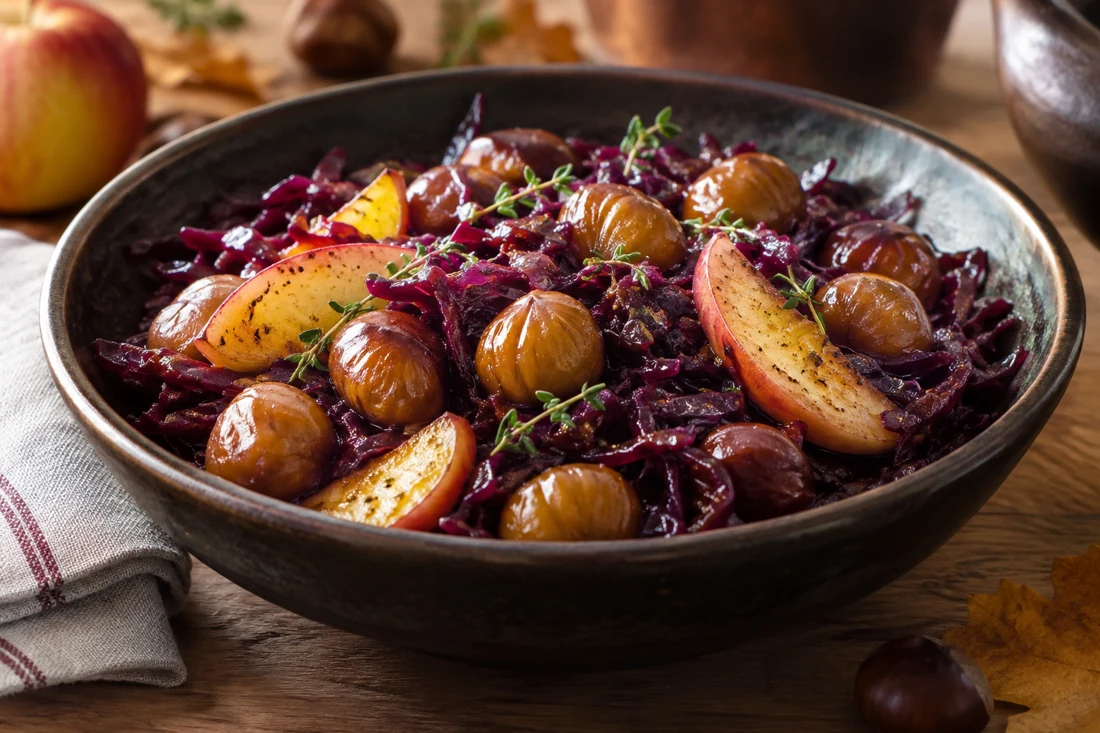
Whole chestnut kernels remain distinct in a savory cabbage and apple dish. Illustration.
Roasting fresh in-shell chestnuts can provide kernels for these dishes, but allow for scoring and peeling. The Kitchn's oven guide explains that preparation sequence, while the Italian Recipe Book method illustrates how time varies with the batch. Once the kernels are prepared, the application here is about their role in the finished savory dish rather than repeating the entire roasting method.
For a vegetable side, choose pieces that can be distributed evenly across portions. If a plate needs a certain number of whole kernels, evaluate how the chosen grade translates into that serving. A broad mix of sizes may create inconsistent portions even when the total weight is correct. The buying specification can then describe the form and tolerance that support the service requirement, instead of relying on an informal expectation of uniform appearance.
Seasoning should support the chestnuts without concealing their condition. A little browning, a complementary sauce or a measured herb addition can help integrate them into the dish. Heavy seasoning should not be used to disguise off odors or damaged kernels. Taste a plain cooked sample when assessing a new ingredient, then test it in the finished recipe. Those two observations answer different questions and are both useful.
For a ready meal, examine the portion after its intended reheating route. A whole kernel may hold together during assembly yet soften or break during reheating and handling. Check the interaction with the sauce and neighboring components, including any released moisture. The approval should describe the food the customer receives. A photograph taken immediately after careful hand-plating is not enough to establish how the product will perform through normal distribution and preparation.
Choose frozen chestnut inputs for repeatable production
A frozen chestnut ingredient can reduce preparation work and make it easier to plan usage beyond the fresh selling season. The practical benefit depends on the form supplied and how it fits the process. Whole kernels, pieces and other confirmed formats should be compared against the same finished application. The purchase should specify what the kitchen receives, including preparation state, rather than treating all peeled frozen chestnuts as one uniform input.
For harvest and seasonality details, see When Are Chestnuts in Season?.
Our frozen peeled chestnut product information provides a starting point for that discussion. We confirm the offered processing option, size or grade, packing and intended use with the order. Buyers should identify whether the chestnuts will be blended, chopped, baked into a filling or served whole. That helps us review the appropriate form without making the quotation more restrictive than the application needs.

Peeled chestnut kernels held in a hand. Confirm size and processing state before a production trial.
Request a sample that represents the proposed specification, and keep its identification with the trial results. Record the amount used, any preparation required, the finished yield and the observations that matter to the dish. For a visible inclusion, count or assess intact pieces after processing. For a puree, examine smoothness and consistency. For a bakery filling, test the baked product after cooling and the intended storage period.
Agree how defects and natural variation will be assessed. Skin remnants, broken kernels, fines, color and odor may all deserve limits, but the acceptable range depends on the application. The sampling method matters too: a handful selected for a photograph is different from a representative sample from a production lot. Clear acceptance criteria help the purchasing and quality teams apply the same decision when future shipments arrive.
Packing should support daily use and cold storage. Tell us the preferred pack size, expected quantity, destination and delivery period, together with private-label and document requirements. Keep frozen product under its specified conditions, and follow the agreed instructions after opening or thawing. Availability from frozen stock can support production planning, but the relevant crop, inventory and shipment details still need confirmation for the actual order.
Chestnuts offer several useful directions without requiring every dish to become a dessert or a holiday stuffing. A smooth soup needs different preparation from a visible whole-kernel side, and a bakery filling needs different controls from either. Choose the application first, identify the supplied product state, and test the finished food. That sequence turns a broad collection of recipe ideas into a chestnut ingredient your kitchen can use consistently.
Discuss frozen chestnut supply with GreenLand-food
GreenLand-food is a professional frozen chestnut supplier and manufacturer in China, providing factory-direct wholesale supply for importers, food manufacturers, foodservice distributors and private-label programs.
Tell us whether your recipe needs whole kernels or pieces, the processing state, pack size, order quantity and destination.