


Cranberry PAC Reports: A DMAC Total Is Not an A-Type Fingerprint
Oct 09, 2026
Leave a message

Research This Article & Topic with AI
Verify key claims, compare reliable sources, and explore GreenLand-food's practical frozen food knowledge.
Article details and research questions are prepared in the links. Sign-in or sending may be required.

Consider a buyer asking GreenLand-food to compare two reports marked "PAC." One gives a DMAC total; the other quantifies selected A-type compounds. We would first clarify whether the purchase requires a comparable total, evidence for those compounds, or both. Comparing the two headline numbers before answering that question could turn an ordinary difference in analytical scope into an unsupported ingredient claim.
For whole frozen cranberries, the sample matrix adds another issue. A method demonstrated for a dry extract or powder needs an appropriate scope for the fruit being supplied. The laboratory must explain preparation, extraction, calibration and the mass basis. Those details determine what the number represents and which comparisons it can support.
Separate a PAC amount from an identity claim
Proanthocyanidins are a family of compounds assembled from flavan-3-ol units. Their structures vary with unit composition, chain length and linkage arrangement. A-type and B-type describe linkage features; a PAC total does not communicate all those structural attributes. An ingredient can therefore have a measurable total response while the report leaves the distribution of particular structures unresolved.
The distinction matters when a purchase specification uses two different kinds of language. "Total PAC by the agreed DMAC method" describes an operational measurement. "Selected A-type compounds identified and quantified" describes a molecular requirement. The second statement needs evidence capable of addressing the named compounds. A supplier or laboratory should not silently convert the first statement into the second because both use the word PAC.
The original UPLC-MS/MS method study explicitly distinguishes these questions. Its comparison found that DMAC and butanol-HCl assays could not distinguish A-type from B-type PACs. The authors developed a more specific method for selected A-type dimers and trimers in cranberry dry extracts. That is a bounded analytical result: it supports the need for a suitable method when linkage identity matters, while leaving other molecules and sample matrices to their own validation.
An A-type calibration material does not change that scope. Using procyanidin A2 to turn an absorbance response into an equivalent amount does not prove that every responding compound in an unknown sample is A2 or shares its linkage pattern. Calibration describes the reference used for quantification. Identification describes what has been established about the sample. These should appear as separate fields when the purchase requires both.

PAC linkage and chain length are separate structural attributes. Schematic relationship, with no measured ingredient values. View full-size figure.
Nor does a missing identity measurement establish that an ingredient is adulterated. A report can simply be incomplete for the buyer's question. If the requested evidence is absent, the useful response is to define the additional analytical scope and the sampling basis. An authenticity allegation requires a defensible interpretation of appropriate evidence, including the method's limitations and alternative explanations for the observed composition.
For the hypothetical GreenLand request, the purchasing team could agree a total-PAC comparison for routine consistency while reserving a separate identity requirement for a claim that specifically names A-type compounds. The two requirements might use aliquots from one representative preparation, but their conclusions remain distinct. This keeps the laboratory brief focused and avoids paying for an elaborate structural study when the commercial decision only needs a matched total measurement.
The application also determines how much detail is justified. A whole-berry fruit preparation may be purchased primarily for fruit identity, taste, color and process performance. A technical development program may need an additional compound-specific comparison. Neither buyer should inherit a specification copied from a concentrated extract without checking whether its denominator, analyte scope and intended claim make sense for whole fruit.
Read the DMAC standard and extracted fraction
DMAC totals are method-dependent quantities. Read the calibration material alongside the result, including whether the laboratory uses a defined dimer or a characterized cranberry PAC reference. Two results both labelled milligrams of PAC can represent different equivalent responses if their reference materials differ. A numerical difference is then partly a difference in the analytical definition, rather than a straightforward change in ingredient composition.
The multi-laboratory cranberry powder validation used procyanidin A2 as a commercially available standard. It supported a defined total-PAC method within the studied scope and cautioned about comparisons across food types with different oligomer and polymer distributions. Buyers can use that finding to ask a precise question: does the laboratory's current procedure and calibration fit the actual cranberry matrix and the comparison being proposed?
Extraction creates another boundary. The liquid entering the assay is an extracted fraction of the prepared sample. Its relationship to whole fruit depends on the preparation and extraction procedure. A report should make clear whether the result concerns an extract itself or has been calculated back to a stated mass of original ingredient. Those are different denominators even when the analytical reaction is identical.
A fruit report also needs an explanation of which material entered the preparation. Whole berries contain skin, flesh and seeds. Selecting visually attractive berries, removing material before homogenization or testing only separated liquid changes the represented sample. The appropriate laboratory preparation should follow the purchasing question and sampling plan, rather than an undocumented choice made because one fraction is easier to handle.
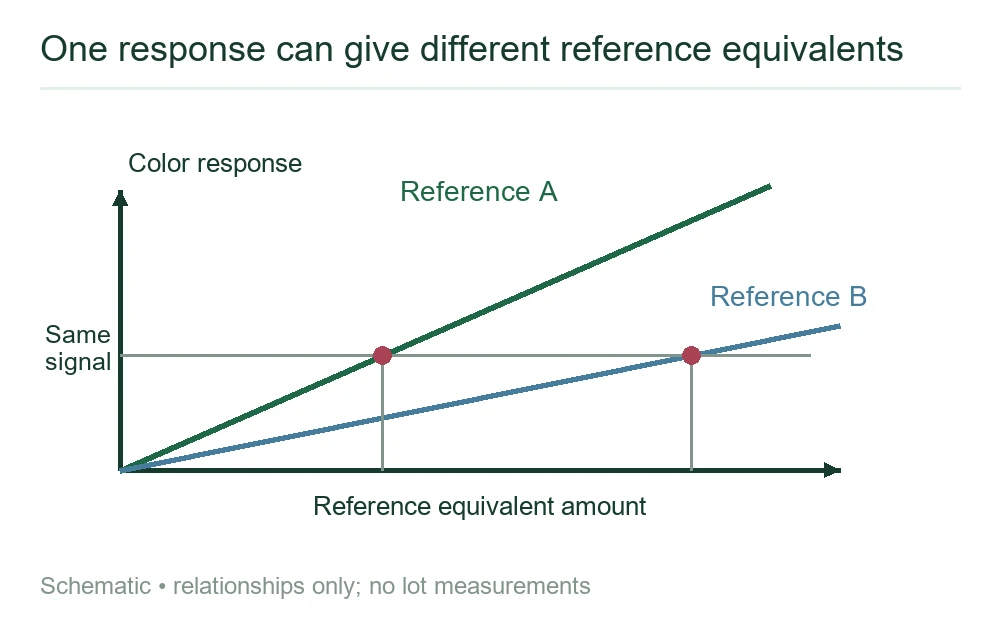
Calibration changes the conversion from absorbance to equivalent mass. Schematic relationship, with no measured ingredient values. View full-size figure.
Research on cranberry press-residue extraction provides a useful example of why fraction matters. The study optimized extraction and characterized purified fractions from processing residues. Its results concern those materials and procedures. They cannot be relabelled as the PAC content of an unspecified whole frozen-berry lot, even though all the materials originated from cranberries.
When comparing reports, follow the calculation back from the displayed unit to the original sample. The relevant information includes the sample mass, extraction volume, any subsequent dilution and the reporting basis. If the laboratory reports a dry-matter value, request the moisture determination used to calculate it. A wet-fruit value and a dry-matter value require a justified conversion before they can be placed in one numerical ranking.
The timing of the color response can also belong to the method definition. An original study on sweetened dried cranberries specified a kinetic measurement and an A2 calibration. This illustrates the need to identify the actual reading procedure. It supplies no universal storage claim for unsweetened IQF cranberries and no acceptance limit for a GreenLand shipment.

Whole frozen cranberry product form; appearance does not establish PAC amount or linkage identity.
For a routine procurement comparison, a concise method record is more useful than collecting unexplained certificates. Ask the laboratory to identify the method version, reference material, extracted fraction and final denominator. Then decide whether the two reports describe the same measurand closely enough for the intended decision. If they do not, preserve the original results and commission a defined matched comparison when its commercial value justifies the work.
An analytical trend should retain the same definition from one sampling date to the next. If a laboratory replaces its reference material or extraction procedure, mark that change before comparing new totals with the previous series. A higher value after the change might reflect a different equivalent response or extracted fraction. It should not be presented as demonstrated improvement in the berries without a suitable comparison that separates the method change from the ingredient change.
The control sample also needs a defined role. A retained ingredient portion may help compare preparations within a study, while a laboratory reference material supports analytical control in a different way. Neither automatically represents every pack in a delivery. State whether the evidence concerns a submitted sample, a defined lot sample or a broader monitoring program, and avoid extending the conclusion beyond the sampling design.
Targeted A-type analysis answers a narrower question
A targeted LC-MS/MS result can provide evidence about selected compounds that a bulk color response leaves unresolved. Chromatographic separation and compound-specific analytical criteria are used within a validated procedure to address the targets. The purchase request should name those targets or ask the laboratory to propose an appropriate scope, rather than assume that the phrase "A-type analysis" covers every PAC structure in the ingredient.
The distinction between a dimer, a trimer and a longer polymer is substantial. Chain length and structural complexity affect the available reference materials and the practical scope of an analysis. A method validated for selected dimers and trimers should be described that way. Its output is useful evidence for those molecules; it does not automatically characterize the complete polymer population or establish a universal structural fingerprint.
The 2018 targeted study also examined matrix effects and used standard addition in its validated approach. For a buyer, the practical implication is to ask how the laboratory demonstrates suitability for the submitted material. It would be premature to assume that using a sophisticated instrument alone makes an extract-based procedure reliable for a whole-fruit homogenate. Method performance belongs to the combination of analytes, preparation and matrix.
The laboratory should explain how it distinguishes the selected targets, which reference materials support the assignments and how quantification is performed. Request the reporting limits and the interpretation of results below those limits when they could affect acceptance. "Not quantified under this procedure" has a different meaning from a demonstrated absence. The report wording should preserve that distinction instead of compressing it into a binary present-or-absent claim.

A targeted chromatographic window covers selected molecules. Schematic relationship, with no measured ingredient values. View full-size figure.
Broader characterization is possible through methods designed for broader questions. A study of PAC polymerization and low-molecular-weight fractions combined fractionation with analytical characterization. Its approach shows why molecular distribution requires additional evidence beyond one total. The particular commercial extract findings in that paper should remain attributed to the study materials and should not become assumptions about a frozen cranberry supplier.
If a buyer only requires confirmation and quantification of defined A-type compounds, that narrower scope may be sufficient. If the buyer requires a wider authenticity assessment, the laboratory should explain what additional evidence addresses that requirement and where uncertainty remains. Expanding the claim without expanding the evidence creates a larger interpretation problem, even when the initial targeted result is analytically sound.
The following comparison separates the report endpoints that are most easily confused. It describes evidence scope, rather than ranking methods by sophistication. A valid total method may be the appropriate tool for one decision, while a targeted method is necessary for another. Neither is a substitute for a specification that clearly says what the buyer wants to establish.
| Report endpoint | Typical evidence | Suitable statement | Remaining boundary |
|---|---|---|---|
| DMAC total with a named standard | Calibrated color response from the defined extracted fraction | Comparable total response under the agreed method and basis | A/B linkage identity and complete molecular distribution remain unresolved |
| Targeted A-type dimers and trimers | Validated compound-specific results for the named targets | Identification or quantity of those targets within method scope | Untargeted oligomers and polymers are not automatically covered |
| Broader structural characterization | A specifically designed combination of separation and characterization | Conclusions explicitly supported by that study or validated procedure | Scope, matrix suitability and identification confidence still need definition |
When the targeted method reports several compounds separately, keep those individual results available even if the purchasing summary uses a sum. The sum has a defined membership: it includes only the targets and calculation specified by the method. Changing that membership changes the endpoint. A total of selected A-type dimers and trimers should therefore retain its qualifying name and should not be shortened to total cranberry PAC in a later spreadsheet.
Identification evidence and quantitative confidence may also have different limitations. The laboratory can explain which criteria support assigning a peak to a named target and which data support its quantity in the submitted matrix. Buyers should ask for a conclusion stated at the appropriate level. An instrument trace that resembles a reference is not, by itself, a purchasing interpretation of all the compounds in a complex food extract.
Whole frozen fruit needs its own applicable method scope
Whole frozen cranberries arrive as a food ingredient with a physical form and a lot history. A dry extract arrives with a different composition and concentration. A powder may contain a selected or processed fraction. These differences affect sample preparation and reporting. A laboratory should check the method's suitability for the material actually submitted, rather than rely solely on the ingredient name appearing in a previous validation.

Extraction samples a defined fraction of whole cranberry tissue. Schematic relationship, with no measured ingredient values. View full-size figure.
Start with an identifiable lot and an agreed sample. Record the product form, pack information, sampling locations and condition at dispatch. The laboratory needs enough representative material to prepare the intended sample. A photograph of whole berries can document appearance, but it cannot establish PAC content or structural identity. Those conclusions require the analytical evidence attached to the same material.
The GreenLand frozen cranberry range provides the commercial context for defining the offered ingredient. Before requesting a chemical comparison, confirm which product and form the order concerns. If the intended process uses whole berries, the sample should represent that input. If the buyer deliberately uses a separated fraction, the report should name the fraction and its relationship to the purchase.
Agree how thawing and any released liquid will be handled during laboratory preparation. A sample taken only from drained solids answers a different question from one prepared from the complete thawed contents. This is a sampling and denominator issue that should be resolved before analysis. The laboratory can then choose a procedure appropriate to the measurand, without an undocumented loss of material between the pack and the assay.
Moisture and concentration require similar care. A dry-basis PAC result can be useful for compositional comparison, while an as-received fruit basis may be easier to connect to recipe inclusion. Both should be clearly named. The buyer should resist describing one as the universally correct basis: the useful basis depends on the purchase claim, and conversions require valid information for the same sample.
Representative sampling and analytical replication address different sources of variation. Repeating a measurement from one extract assesses part of analytical precision. Preparing separate portions adds information about preparation variability. Sampling different packs or lot locations addresses ingredient representation. These operations should not all be described simply as "three tests," because they support different levels of confidence in the purchasing conclusion.
If two laboratories disagree, the next step should follow the source of the disagreement. The published GreenLand guide on retesting versus resampling explains that distinction in more detail. For this topic, first check whether the reports concern the same PAC endpoint and fraction. Retesting an unmatched method will not necessarily resolve a disagreement created by different definitions.

Whole frozen cranberry product form; appearance does not establish PAC amount or linkage identity.
Any requested assay availability also needs confirmation. We would clarify the submitted product, the laboratory scope and the supporting documents before agreeing to a testing arrangement. This avoids turning an educational discussion of an analytical method into an unverified promise that every GreenLand cranberry SKU carries a particular compound-specific report.
Make the acceptance claim explicit
A useful acceptance specification starts with the claim the purchase needs to support. If the requirement concerns a matched DMAC total, name the method, calibration, extraction and basis. If it concerns selected A-type compounds, identify the targets and the suitable method scope. Where both matter, retain separate fields and attach each acceptance statement to its own evidence.
The hypothetical buyer comparing two PAC reports can then make a coherent decision. A DMAC total may help compare a defined total response across suitably matched samples. A targeted report may establish quantities of selected A-type compounds. The purchasing team should decide which requirement belongs in the order, rather than pick the larger number and describe it as proof of ingredient equivalence.
Agree how limits will be interpreted before the laboratory reports the sample. The analytical method's reporting limits, measurement uncertainty where relevant and the chosen decision rule can affect borderline results. A result close to a limit should be interpreted under the agreed rule. Repeatedly testing until one value passes leaves the decision dependent on chance and obscures the original evidence.
Maintain a traceable link between the purchased lot, retained sample, laboratory preparation and report. The laboratory record should identify any deviation from the agreed procedure. If the product form or formulation changes, decide whether the existing validation and specification still apply. A new matrix can require a new suitability assessment even when the supplier and product family remain familiar.
Application approval should remain visible alongside chemical approval. A cranberry ingredient intended for a fruit filling, sauce or beverage also needs to meet the buyer's requirements for flavor, acidity, color and physical performance. Those properties can be tested through a controlled application trial. A PAC result does not replace that trial, and successful processing does not establish the molecular identity requested by a separate chemical specification.

Total response and targeted identity are independent acceptance coordinates. Schematic relationship, with no measured ingredient values. View full-size figure.
There is also no justified health ranking from the evidence described here. These analytical results establish a defined chemical response or selected compounds under a method. They do not, by themselves, establish a health effect, effective dose or clinical equivalence. If a business intends to make a particular consumer claim, that claim needs its own appropriate substantiation and market review.
For a GreenLand inquiry, send the intended use together with both reports and their preparation details. Include the DMAC calibration material, extracted fraction, targeted A-type compounds and whether each result refers to whole fruit, an extract or dry matter. We can then clarify the offered product and the information needed from the proposed laboratory, with the actual testing arrangement confirmed before it becomes an order commitment.
The resulting approval record should be precise enough for another person to read later without reconstructing the conversation. It should say which total-content comparison passed, which identity evidence was obtained and which application trial was approved. That record gives purchasing and quality teams a defensible basis for repeat orders while preserving the limits of the evidence.
A change-control agreement can keep those definitions useful after the first order. Identify which changes require notification or a new comparability review, such as product form, represented fraction, laboratory method or reference material. The agreement need not demand a full structural study for every shipment. It should connect the required evidence to the specific claim that would otherwise become uncertain when a change occurs.
Retain both original reports when a matched follow-up is commissioned. The new result can answer the revised common question, but it does not retrospectively turn the earlier endpoints into equivalent measurements. Recording why the follow-up was needed helps the next purchasing team interpret the history correctly. It also prevents an old extract-based value from returning as an unexplained whole-fruit specification during a later sourcing discussion.
Source Frozen Cranberries with GreenLand-food
GreenLand-food is a frozen cranberry supplier and manufacturer in China, providing factory-direct wholesale supply for importers, food manufacturers, foodservice distributors and private-label programs.
Tell us how you'll use frozen cranberry and where you need delivery. We'll review the product form and specification with you, then confirm packing, quantity, private-label details and requested documents. For a PAC comparison, include calibration, extracted fraction, targeted compounds and the reporting basis. We would confirm the offered product and any requested specialist testing arrangement before agreeing the supply scope.