


Edamame Trypsin-Inhibitor Loss: Leaching and Inactivation Are Different Results
Oct 09, 2026
Leave a message

Research This Article & Topic with AI
Verify key claims, compare reliable sources, and explore GreenLand-food's practical frozen food knowledge.
Article details and research questions are prepared in the links. Sign-in or sending may be required.

Name the inhibitor and sampled material
Trypsin inhibitor describes a functional activity: the material interferes with the action of trypsin under the assay conditions. A laboratory result should identify the method and basis used to assess that activity. It should also say which material was tested. A number reported for drained beans does not describe the cooking water, and a number reported for a liquid extract does not automatically describe the original food. The sampled fraction is essential to interpretation. Before discussing treatment success, establish whether the report concerns the bean tissue, recovered water, a combined system or a separately prepared laboratory material.
Edamame is immature vegetable soybean, supplied in commercially defined forms such as pods or shelled beans. Soybean flour is a different material with a different physical structure and preparation history. A result obtained from flour dispersed in liquid cannot be transferred directly to intact edamame, nor can an edamame observation settle the response of a flour treatment. The original paper discussed both materials, but its comparisons remain distinct. For a frozen ingredient inquiry, the actual offered product needs confirmation. The customer should not read every occurrence of 'soybean' in a study as a description of the same supplied food.
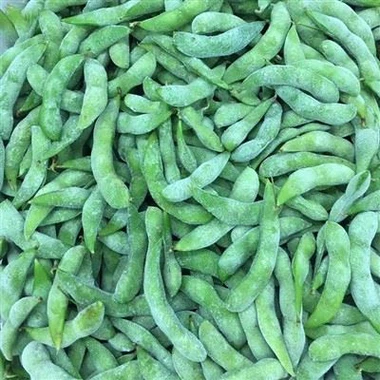
Actual GreenLand product photograph: the visible form does not establish the study endpoint or this lot's processing history.
The distinction between pods and edible beans also matters to the sample identity. A customer may purchase in-pod edamame for serving, while another uses shelled beans in a formulation. State whether the tissue was sampled before or after shelling and whether any other fraction was included. The preparation record should identify the actual form throughout the comparison. An assay performed on a laboratory extract can still answer a useful question if the sample and extraction are appropriate, but its result needs to be related to the food actually used. Product names alone do not establish that relation.

Bean tissue and water contain separately sampled activity symbols. Qualitative schematic; no measured values or production settings.
Imagine a formulation QA team asking GreenLand whether a solids result distinguishes inhibitor inactivation from transfer into the edamame's own cooking liquid. This is a hypothetical buyer scenario, not a past customer transaction or GreenLand test case. We would ask for the sampled fractions, method, reporting units, treatment history and recovery information. If the report contains only drained-bean activity, it can describe that fraction under the assay conditions. It cannot determine how much active material remains in the water or how much total recovered activity has changed. The question requires evidence that keeps those missing fractions visible.
Reporting basis adds another distinction. Activity per gram of sample, per gram of dry matter, per unit protein or per volume of extract can support different comparisons. Cooking can alter the sample's water content and recovered mass, so a concentration change may not match a change in total activity. The laboratory should explain how the denominator was determined and whether results can be compared directly. A percentage reduction is informative only when the starting reference and calculation are clear. Without that information, the buyer may mistake dilution, concentration or material transfer for a complete change in the inhibitor itself.
The food-safety meaning of the test remains separate. A direct inhibitor assay does not establish microbiological safety, ready-to-eat status, permission to reuse cooking water or conformity with every preparation requirement. Those questions belong to the independently validated product and customer process. The technical discussion can clarify the inhibitor evidence without offering a universal cooking schedule or nutritional guarantee. We would keep the actual form and intended preparation in the inquiry, and retain the agreed safety and release controls. A lower solids result is useful evidence for the solids question; its scope should not be expanded by assumption.
Loss from the bean is not necessarily inactivation
The original 2023 paper on soybean trypsin inhibitors and urease behavior investigated several treatments. In its accessible J-STAGE abstract, the authors report that edamame showed a gradual decrease in trypsin-inhibitor activity along with elution into boiling water. That observation establishes a relevant alternative to attributing all bean activity loss to heat destruction. It describes a change in location alongside the change measured in the beans. The article retains this bounded finding and does not supply a cooking recipe. The full original protocol is required before reproducing a condition or assigning a quantitative contribution to each route of loss.
Movement into water and inactivation are different events. If active material leaves the bean and enters water, the edible solid fraction may show lower activity even while some of that activity remains elsewhere in the system. If treatment reduces activity in the complete recovered system, the interpretation includes a change beyond simple relocation. Both effects can occur together. A solids-only report cannot separate their contributions because it does not measure every relevant destination. The appropriate comparison depends on what the team wants to know: the condition of the drained beans or the behavior of the whole material being retained.
A qualitative drawing can make the distinction visible without inventing experimental values. Activity symbols moving from a bean to a water vessel represent redistribution. Symbols that cease to represent activity would describe a different observation requiring direct evidence. The geometry is explanatory, not a measured mass balance or a molecular account of the original study. Its value is to show why a decrease in one location leaves an unanswered question about another. A buyer reviewing the drawing can identify the fraction missing from the report, then commission a suitable comparison rather than assume the missing result.

Activity symbols move from bean to water while total symbols remain visible. Qualitative schematic; no measured values or production settings.
The retained water can be relevant even when it is not intended for use. Measuring it may help explain the treatment response and distinguish transfer from inactivation. If the customer intends to discard water, the drained solid remains the relevant consumed fraction, but the mechanism claim still needs to be accurate. If the water will be retained in a soup or another recipe, both fractions can contribute to the finished food. Those are different application questions. The testing plan should reflect the intended use without implying that collecting a water sample approves the water for consumption or reuse.
Recovery information is necessary for a quantitative interpretation. The amount of water, recovered bean mass and sampling losses can affect the total represented by a concentration result. Material may also be present in other fractions, such as residues or incomplete recovery, depending on the actual process and test design. A laboratory should define the system boundary and explain whether a total-activity comparison is feasible with its method. Simply adding unlike concentration values would not provide a valid total. The calculation must preserve compatible units and account for the amount of material each assay result represents.
For the hypothetical QA team, the immediate decision is to change the wording of an unsupported conclusion. 'Lower activity in the drained bean fraction' is a narrower and more defensible statement than 'all inhibitor was destroyed' when only solids were tested. The team can then decide whether the intended use requires a broader recovery study. That decision has practical value: it identifies the next sample and method needed, while preserving the useful result already available. We would help clarify the supplied edamame form and trial identity, leaving the actual activity assessment and validation to qualified laboratories and the customer's responsible technical team.
A urease result is a separate endpoint
Urease activity and trypsin-inhibitor activity are separate endpoints. An assay of urease measures a different enzyme function from an assay of trypsin inhibition. A process may affect both, but similarity in their heat-related response must be demonstrated for the material and conditions where the proxy will be used. A familiar proxy can be convenient for process monitoring without answering every question directly. The buyer should ask what the relationship has been shown to support, over which range and under which method. A urease result alone cannot automatically establish the required inhibitor response in a different food or treatment.
The original paper provides a concrete boundary. Its separate soybean-flour work investigated treatment involving heated alcohol and pressure, and the accessible abstract reports different conditions associated with urease and trypsin-inhibitor inactivation. This article does not reproduce those conditions as a production recipe. It uses their inequality to show why the two endpoints should not be treated as interchangeable. The flour treatment differs from the edamame boiling observation in both material and process. Combining their results into one supposed edamame validation would discard precisely the distinctions that make the evidence useful.
A proxy relationship can fail when a process changes the relative responses. Material structure, extraction, composition and treatment can influence the measured activities. That does not mean a proxy is inherently useless. It means that the relationship must have a defined scope and appropriate evidence. For a routine monitoring program, qualified technical staff may establish which proxy supports which decision. For a new application or changed process, the relationship may need review against the direct endpoint. A purchasing document should say whether it reports direct inhibitor activity or a separate indicator, rather than calling either one a generic enzyme result.

Separate qualitative activity curves represent different assay endpoints. Qualitative schematic; no measured values or production settings.
The laboratory reporting method also matters. A qualitative proxy test cannot be read as a quantitative inhibitor reduction without a valid relationship and calculation. Likewise, a direct inhibitor result depends on suitable sample preparation and assay performance. The buyer should request enough method information to understand the evidence and its limits. If two reports use different denominators or extracts, their apparent disagreement may reflect incompatible methods. Resolving that issue requires a technical explanation or a matched comparison. It cannot be solved by choosing whichever result looks more favorable for the proposed ingredient release.
Other edamame research helps place these distinctions within a broader quality assessment. The opened original study of vegetable soybean boiling assessed inhibitor activity alongside texture, color and composition. Extension material discusses blanching in relation to several quality and microbiological observations from different studies. These sources show the range of questions that can matter, but they do not merge those endpoints into one certificate. A color result cannot replace inhibitor evidence, and an inhibitor result cannot replace the finished-food safety validation. Each observation should support the decision it was designed to answer under its actual tested conditions.
For GreenLand's sourcing discussion, we would ask which endpoint the customer specification actually requires and what report is being offered as evidence. If it requires trypsin-inhibitor activity in a particular fraction, the requested evidence should match that fraction and endpoint. If urease is being used for monitoring, the responsible team should establish the applicable relationship and retain its boundary. The original unequal conditions are a reason to ask for that support. They are not a claim that a customer's established proxy is wrong, nor a basis for an unverified treatment recommendation for frozen edamame.
Qualify the customer's actual fractions
A customer comparison should preserve the actual fraction that will reach the food. For a drained-bean application, define how the edible beans are recovered and sampled under the approved preparation. For a liquid-retaining application, identify the recovered water and any other retained material. The test plan can then decide whether to evaluate fractions separately, the finished food, or both. The appropriate design depends on the question and laboratory method. A formulation team's intended use should guide the sampling rather than allowing the easiest available specimen to stand for a different material in the final product.
Direct activity evidence needs an appropriate recovery basis. If the laboratory reports activity per volume of water, the recovered volume determines the total represented by that concentration. If it reports activity per mass of beans, the recovered mass plays the corresponding role. The values must use compatible definitions before a system comparison can be made. This is a principle for interpreting laboratory work, not a prescribed analytical protocol. Qualified laboratories should determine method suitability, uncertainty and recovery limitations. A buyer can still recognize that a report omitting recovered quantities cannot support every claim about total activity.

Actual GreenLand product photograph: the visible form does not establish the study endpoint or this lot's processing history.
Water changes during preparation can complicate the denominator. Evaporation, added water, draining and material left in equipment can affect the fraction represented by the sample. A concentration increase does not necessarily mean activity was newly created, and a concentration decrease does not necessarily mean the same fraction lost an equivalent total. Record the actual material amounts relevant to the approved comparison. When recovery is incomplete, the report should describe that limitation. An unexplained difference between initial and recovered totals cannot automatically be attributed to inactivation, especially when sampling or extraction could also influence the result.

Identical concentrations in different liquid volumes represent different totals. Qualitative schematic; no measured values or production settings.
The starting reference should be appropriate to the comparison. A raw edamame sample, a previously processed frozen product and a dry flour dispersion have different histories and may require different preparation for analysis. Identify which reference defines the reported reduction. If the customer is comparing offered frozen samples, those actual samples should be documented and tested in the relevant process. A literature value from another material can inform the question but cannot serve as the measured baseline of the current lot. Preserve the link between ingredient identity, treatment record and laboratory sample so the conclusion remains traceable.
The finished formulation may require direct evaluation beyond the separated fractions. A soup retains liquid that a drained serving discards, while a blended food redistributes the ingredients again. The fraction study can explain where activity moved, but the final-use question concerns the food actually prepared. Its safety, nutritional documentation and release requirements remain independently qualified. This article offers no permission to retain or reuse process water and no claim of a health benefit from a measured reduction. The food owner should determine the relevant specification and obtain evidence suitable for the actual recipe and destination requirements.
A useful inquiry includes the offered edamame form, intended application, the two reports or trials being compared, the sampled fractions and the basis of each result. Include the preparation and recovery records available to the laboratory. For supply planning, also identify packing, quantity, destination, private-label needs and requested documents. We would clarify the actual ingredient and help your purchasing team make the sample request precise. The aim is to avoid approving the wrong fraction or interpreting a solids result as a complete recovery result. That clarity makes both the technical review and the commercial specification easier to maintain.
Resolve intended use before any reuse or release
The intended use determines which remaining questions must be resolved before release. A drained bean and a food containing its cooking liquid do not present the same material to the customer. If the water will be retained, its suitability needs direct consideration within the independently validated food process. A solids activity result does not supply that approval. If the water will be discarded, the drained product still needs to meet all relevant preparation and release requirements. The activity comparison can explain one part of the process without changing the established food-safety controls or granting ready-to-eat status.
Confirm the actual offered frozen edamame form before arranging a trial. The product range can include different commercial forms, while the order specification defines which one is supplied and its preparation requirements. An in-pod product is not interchangeable with a shelled sample for every practical operation. The customer's equipment and handling may also differ from the published experiment. A responsible comparison starts from the offered ingredient and follows the approved customer sequence. The original paper supplies a reason to distinguish fractions and endpoints; it does not certify that a particular GreenLand lot follows the same quantitative response.
The commercial promise should be specific enough to verify. If a customer requires a defined inhibitor endpoint, the specification needs the sampled material, method or agreed evidence basis and the point of assessment. If the request instead concerns general preparation or supply, those requirements should be stated separately. We would confirm capability and documentation against the actual product and qualified production resources. This article does not claim that GreenLand supplies an alcohol-pressure-treated ingredient or a recovered edamame liquid SKU. Experimental treatments and ordinary frozen-product sourcing belong to different evidentiary and commercial scopes.

Bean-only and liquid-retaining dishes show different consumed fractions. Qualitative schematic; no measured values or production settings.
Keep approval records accessible for later comparisons. Identify the lot and retained samples, the approved preparation, fractions tested and the relevant laboratory reports. If the customer later changes water retention, draining, formulation or supplied form, review whether the original evidence still answers the new use question. A change that seems operationally minor can alter which material reaches the finished food or which denominator appears in a report. The quality team should know what its acceptance basis covers. Traceability allows a later discrepancy to be investigated without assuming that every result called 'soybean inhibitor' refers to the same material.
When evidence is incomplete, name the missing result precisely. A solids-only assay leaves the liquid question unanswered. A urease assay leaves the direct inhibitor question dependent on a demonstrated proxy relationship. A fraction study without suitable recovery information leaves a complete total-activity claim unresolved. These are useful boundaries for planning further work. They preserve the findings already available while preventing an unsupported conclusion. The responsible team can decide which additional tests the intended use warrants. No universal schedule or literature shortcut can supply the material-specific evidence that a release decision requires.
For the hypothetical QA team, our answer would be that lower bean activity can coexist with transfer of active inhibitor into the cooking water. To distinguish transfer from inactivation, define the sampled fractions and obtain appropriate direct activity and recovery evidence. Keep the separate urease and flour-treatment results within their own scope. When discussing frozen edamame with GreenLand-food, send the intended use and actual reports so we can clarify the supplied form and sample requirements. The final preparation, any retained liquid and the finished-food release should follow their independently validated process and documented acceptance criteria.
Continue reading about edamame
Distinguish young soybean forms, pods and shelled material.
Identify the intended serving method before approving the sampled fraction.
Connect drained bean identity to a finished puree application.
Source frozen edamame with GreenLand-food
GreenLand-food is a professional supplier and manufacturer of frozen edamame in China, providing factory-direct wholesale supply for importers, food manufacturers, foodservice distributors, and private-label programs.
Tell us what you're making and where you need delivery. We'll review the product form and specification with you, then confirm packing, quantity, private-label details and requested documents.