


Importing Frozen Vegetables from China into Egypt: Food Clearance and Buyer Guide
Oct 29, 2026
Leave a message

Reviewed 29 October 2026 · China-origin, blanched IQF broccoli · Cook before eating
To import frozen vegetables from China into Egypt, your Egyptian importer needs the appropriate business and food-import permissions, a defined product and approved document set, ocean ACI completion, and the applicable food and customs release. GreenLand-food prepares the product, factory, batch and shipping information for those steps. Your importer and authorised broker submit the Egyptian applications and return the accepted references; we use those references when coordinating the order and shipment.
Our example is China-grown and China-processed broccoli florets: one ingredient, blanched, individually quick frozen, industrial packing and intended to be cooked before eating. It is an order-planning example, not a declaration that every Chinese frozen vegetable has unrestricted access. A different species, recipe, processing route, retail presentation or ready-to-eat use needs its own assessment.
Start with the food and importer file below. For ACID fields, CargoX document transmission, bill matching and carrier validation, continue to our Egypt ACI, ACID, NAFEZA and CargoX guide. Keeping these tasks connected prevents a valid shipment reference from being mistaken for food clearance.
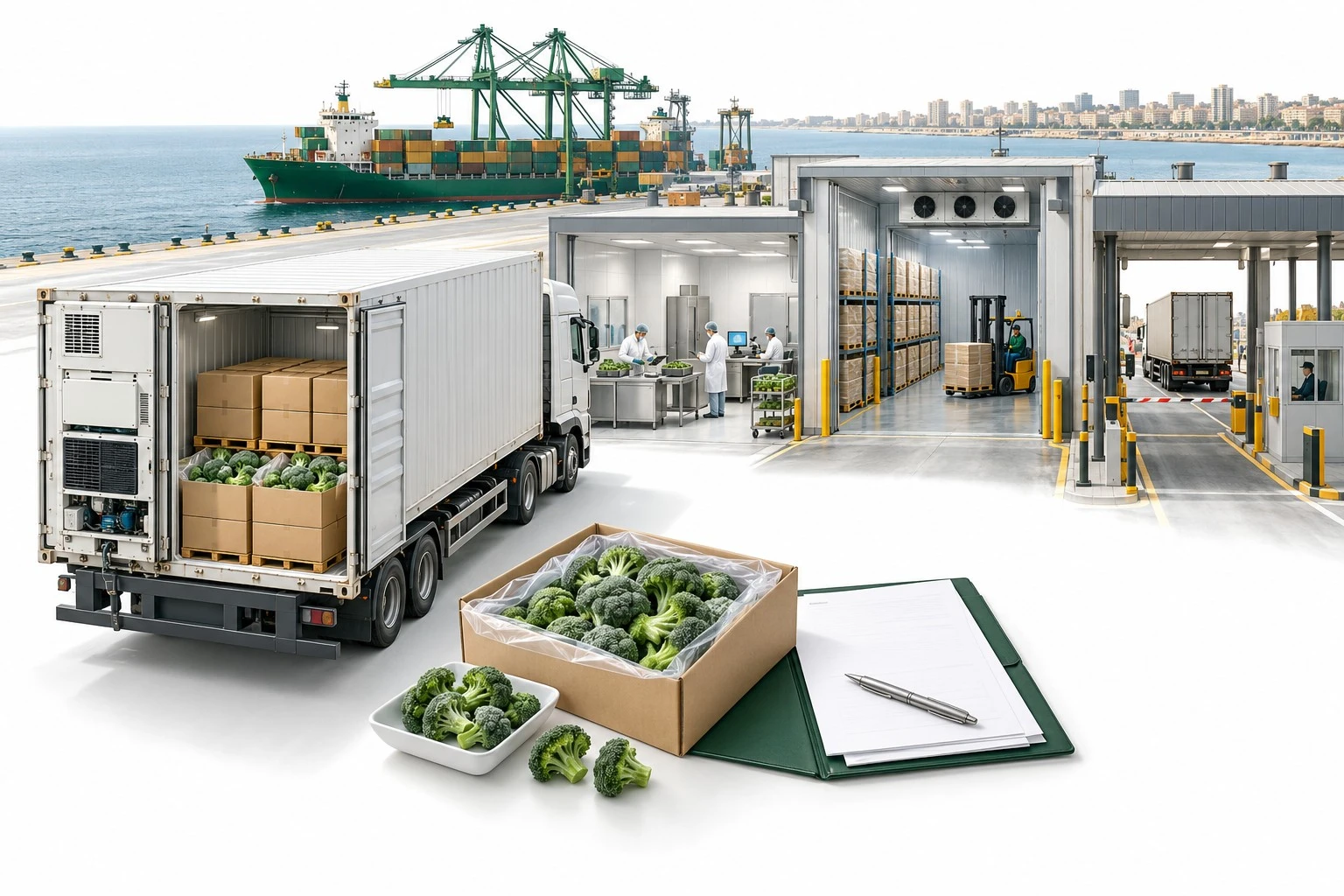
Illustration: food review, cold-chain custody and commercial delivery are separate parts of the Egyptian import order.
Establish the Egyptian food importer

Real GreenLand-food product photograph: define the food before matching the importer's permitted activity and shipment records.
Appoint the Egyptian legal entity that will import the broccoli and a broker authorised to act for it. Use that entity consistently on applications, the commercial invoice, packing list and customs declaration. The broker's software access cannot substitute for the importer's own permissions. Ask the importer to return its current business, customs and food-import evidence before reserving a sailing that depends on those permissions.
NFSA licence: prepare the importer file
Under NFSA Decision 6/2020, Articles 3–6, food importing requires NFSA licensing. A registered food manufacturer importing inputs for its own registered activity has a specific activity-limited treatment; industrial-size cartons do not make a trading importer eligible for that treatment. The application identifies the business and representative, tax and commercial registration, company constitution, food activities, Egyptian premises and contacts, customs number, previous-year importing activity and certified importer-register evidence. The published rules provide a three-year licence and review of a complete application within 30 working days; this is not a vessel-clearance guarantee.
Contact NFSA through its official registration and authority-contact service and hotline 19565, specifying that you need the food-importer licensing route under Decision 6/2020. The current establishment registration selector lists factories, storage and other establishment activities; it does not present a general importer-licence button. Do not choose "factory" simply to complete an account. Obtain the import-licensing desk's submission instructions and keep the application reference, any deficiency notice and issued licence or applicable registered-manufacturer confirmation.
We send the product identity, processing description and intended supply activity to support that enquiry. You supply the Egyptian corporate documents and nominate the person who can answer licensing questions. Record the licence's actual scope, expiry and renewal date from the issued document. Obtain the current official payment assessment before paying; historical fee tables are not a quotation for your application.
| Permission or account | Where your importer acts | What to keep |
| Commercial importer registration | GOEIC importer-register service; use the current checklist for the applicant's legal form and the competent service branch. | Importer card, activity/commodity coverage and validity. A manufacturer importing for its own production follows its applicable route. |
| Customs trader identity | Egyptian Customs registration rules; the broker checks the importer category and customs registration documents. | Active customs identifier and the documented broker authority. |
| NAFEZA and signing access | NAFEZA ACI service; the importer prepares the required verified company and electronic-signing access. | Verified account role and accepted shipment references, kept separately from the NFSA licence. |
A request for more information should name the missing item, its owner and the response date. For example, an expired importer card belongs with the importer and GOEIC; a mismatch in the Chinese factory's address belongs with us and the actual manufacturer. Do not solve an identity mismatch by putting an unrelated licensed company on a certificate.
Define the broccoli and approve its market file
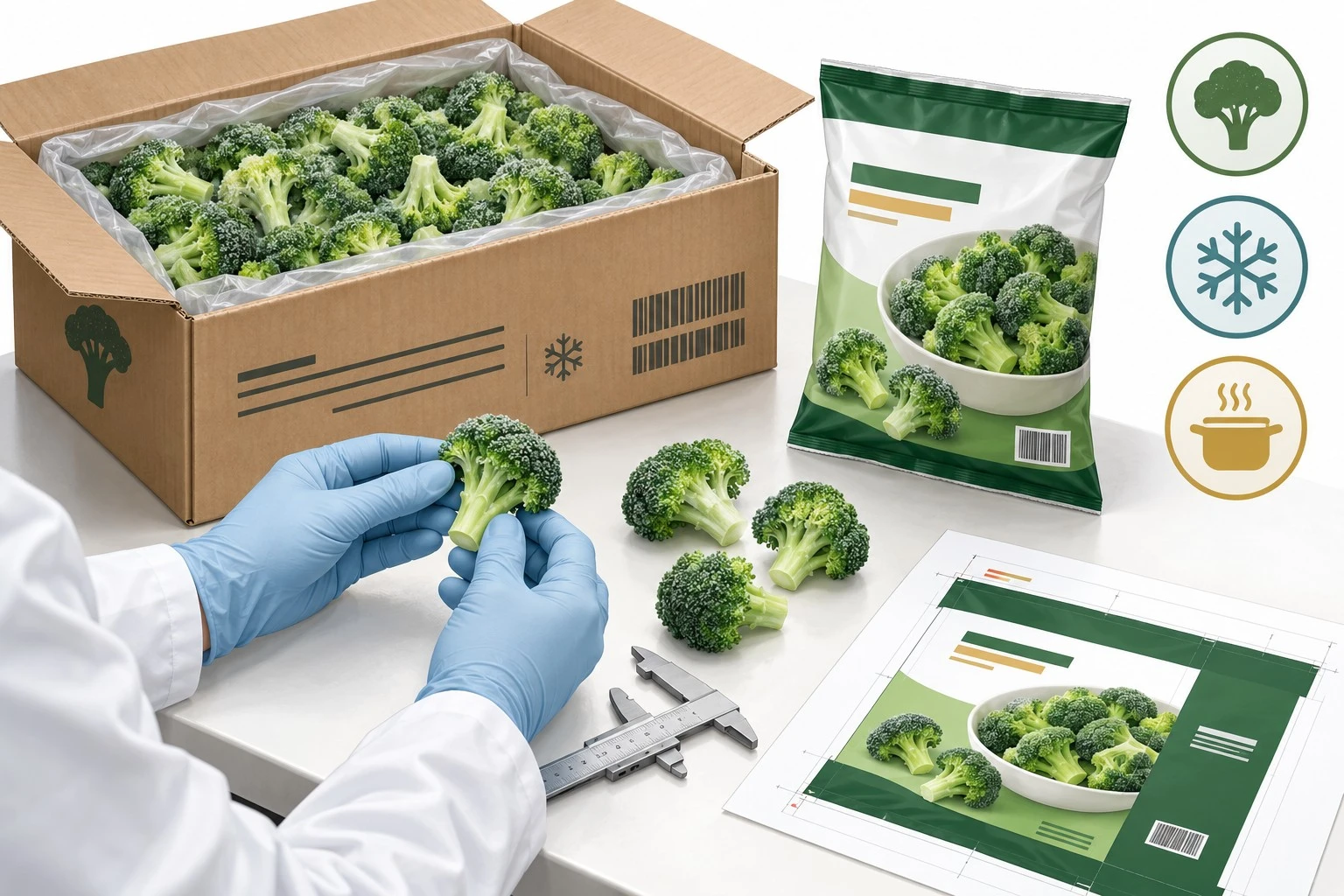
Illustration: industrial cartons and retail packs need a presentation-specific label review; the pictured artwork is illustrative.
Use one controlled product definition for the quotation, laboratory request, certificate request and Egyptian classification enquiry. Describe the species and food part, China origin, floret form, blanching, IQF freezing, ingredients, pack size, storage and cooking use. A generic description such as "frozen food" gives the importer too little information to establish the correct route.
| Order fact | Broccoli example | Why it matters |
| Identity and source | Brassica oleracea var. italica; florets; grown and processed in China. | Origin and food identity must agree across the import enquiry and documents. |
| Process and ingredients | Single-ingredient broccoli, blanched then IQF; actual flow chart supplied. | Freezing or blanching alone does not establish every regulatory exemption. |
| Use and presentation | Industrial packs; cook before eating; actual liner/carton weights agreed. | Retail labelling and ready-to-eat controls cannot be inferred from this example. |
| Classification | HS 0710 is the market-research heading; the broker selects and verifies the full Egyptian tariff line. | Record the applicable measures and tax treatment against the exact line, origin and product. |
| Contract quality | Floret size, stem allowance, loose pieces, colour, foreign matter and cooking performance. | Define units, sample state, sample size and the agreed acceptance decision; these are not automatically legal limits. |
Resolve food, plant and standards applicability before printing
Give the importer a process flow showing blanching and freezing, not just a frozen carton photograph. It should use that file to establish the food requirements with NFSA and the plant-health position with Egypt's Central Administration of Plant Quarantine (CAPQ). Ask specifically about China origin, the processed state, any import permission, and whether a phytosanitary certificate or particular declaration is required. Keep the permit or the recorded basis for non-application. Do not borrow the answer for fresh broccoli, dried vegetables or another country of origin.
For product standards, use the Egyptian Organization for Standardization and Quality (EOS) to identify the adopted edition and whether it is made mandatory for the transaction. A consultation listing or draft is not proof of an adopted requirement. Our release plan records each applicable Egyptian pesticide, contaminant and microbiological criterion with its food category, unit, sampling/method basis and date. It does not use an EU MRL or a laboratory's default limit as an Egyptian legal limit.
Your broker also checks whether the exact tariff line and presentation trigger GOEIC foreign-producer or trademark-owner registration under Decree 43/2016 and its amendments, using the official GOEIC decisions and registration-service directory. That is a separate question from the Egyptian importer's registry card. If the product is covered, we identify the actual producing site and prepare its requested corporate, product and certification file for the applicable registration route before shipment. Record the legal basis when the measure does not apply; neither "frozen" nor "industrial pack" is a substitute for that check.
Before printing, your importer approves the Arabic information and the actual industrial or retail presentation. The official US trade overview of Egyptian labelling identifies Arabic food information and items such as product, origin, producer/importer, ingredients, weight, dates and storage. We turn the approved requirements into a controlled artwork: exact wording, date format and location, lot code, net weight, storage and cooking instruction. The importer checks the current Egyptian text and presentation requirements. Photograph the printed front mark and production/date side against that approval; do not rely on a promise to repair the label after arrival.

Discuss an IQF broccoli order for Egypt
Review our broccoli florets for cooked meal components, foodservice sides or further manufacture. Send the required floret range, stem/loose-piece allowance, industrial pack, quantity, Egyptian port and cooking application. We compare the available product and proposed records with your approved specification.
View Frozen Broccoli Florets · Request Specifications & Quote
Prepare certificates and the food consignment dossier
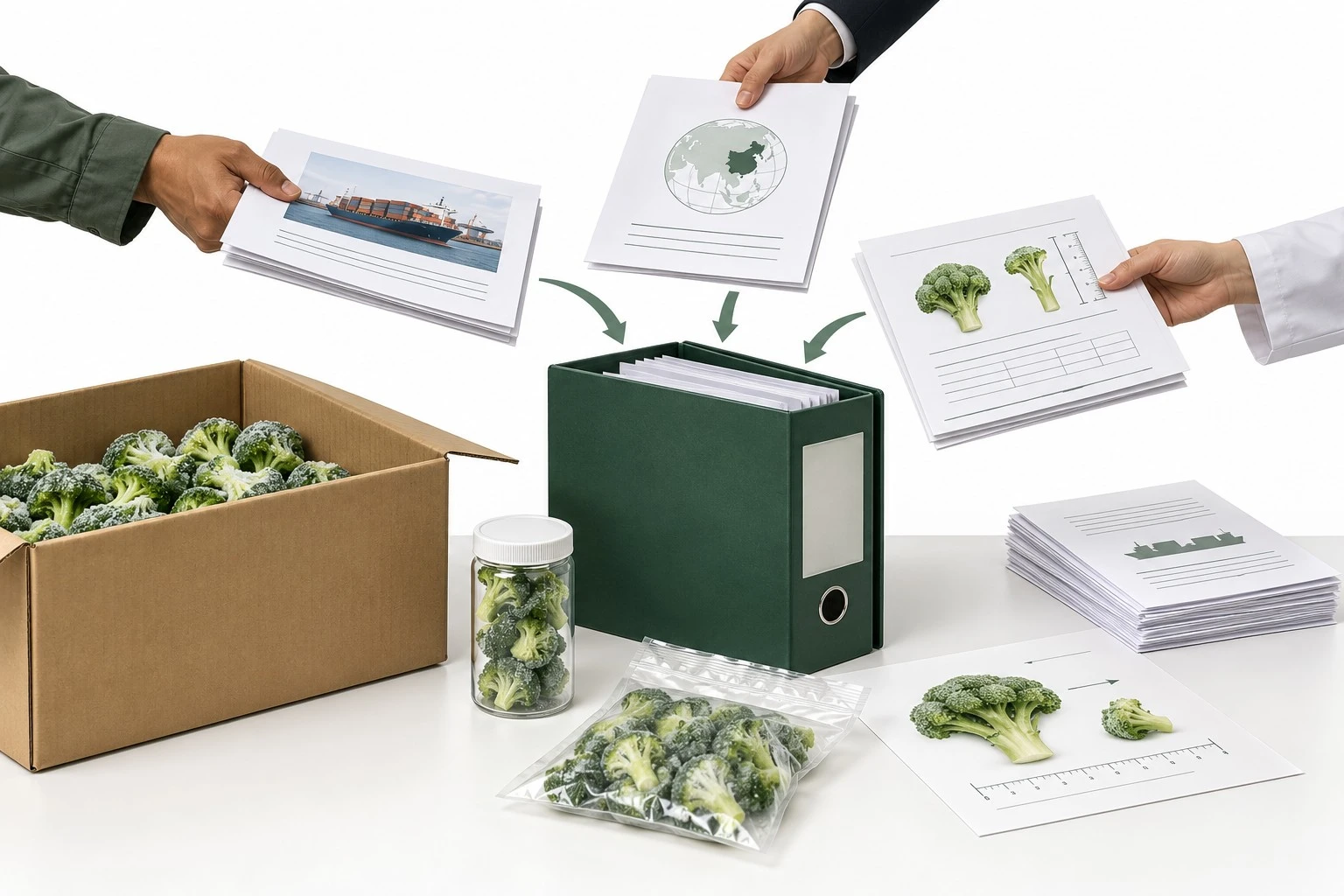
Illustration: the shipment dossier joins records from the supplier, importer, laboratory, issuer and carrier.
Build a document list while the order can still be changed. Your importer or broker should mark each item as required for this specific transaction, conditional on an identified measure, or requested by your customer. A long collection of unrelated certificates creates work without proving that the actual broccoli lot is acceptable. Our import-document guide provides the broader responsibility framework.
| Record | Prepared or obtained by | Order-level check |
| Invoice and packing list | GreenLand-food; importer checks its legal and customs details. | Actual goods, prices, currency, terms, carton/pallet counts, net/gross weights, origin and batch identity; reconcile ACID identifiers where required. |
| Product, factory and batch file | GreenLand-food with the actual production site. | Specification, ingredients, process, manufacturer address, lot/date code and shelf-life/storage basis match the ordered food. |
| Official food/health certificate, where required | Applicable Chinese competent authority, arranged with the responsible exporter/plant. | Importer confirms the accepted certificate type, issuer, wording, product coverage and any required authentication before application. |
| Plant permission/certificate, when applicable | Egyptian importer/CAPQ for the import condition; competent Chinese authority for the export certificate. | Use the recorded product-specific condition; do not substitute a private quality certificate. |
| Origin evidence | Responsible exporter and authorised origin-document issuer, as applicable. | Match the goods and actual origin; importer confirms the required format and authentication. No unverified preference is claimed. |
| COA and customer certification | Laboratory and relevant scheme/plant, coordinated with GreenLand-food. | Lot, sample, matrix, analytes, methods, LOQ and results; current factory/SKU/activity scope for certification. |
| Transport and destination records | Carrier/forwarder; importer and broker. | Bill, container, seal, itinerary, ACI receipts, declaration, food decisions and delivery records remain linked. |
An NFSA-recognised conformity-assessment route, when used and accepted for the actual consignment, is different from holding a general BRCGS, IFS or ISO certificate. The risk-control framework provides for conformity evidence; it does not make an arbitrary private inspection certificate universally compulsory. The importer must identify the accepted route and body before we order that service. A supplier's COA also does not replace an official sample or an NFSA decision.
For Halal, organic or private-label requests, record the actual legal or customer trigger and the accepted certification route. Check the manufacturer, address, products, activities, dates and mark permission. Do not treat a certificate held by a trading company or another plant as automatic coverage for the producing factory. Any formulation or processing-aid change returns to the ingredient and certification review before packing.
Our documentary handover includes a version list: document name, issuer, product/lot, version date, provider, reviewer, due event and returned acceptance reference. If an official certificate omits a required fact, the issuing authority controls its correction. We preserve the original and obtain the authorised replacement; we do not edit a government-issued PDF to make it look compliant. The importer confirms which originals, translations and authentication steps it needs while there is still time to obtain them.
Coordinate food pre-notification with ocean ACI

Illustration: ocean ACI preparation is tied to shipment; the NFSA food-notification window is tied to expected arrival. Confirm both accepted records.
Maintain two distinct preparation tracks: food-control notification and ocean cargo registration. Use the same product and importer identities in both, but record the separate submissions and accepted outcomes. An ACID number on an invoice is not, by itself, a food-import licence, an NFSA release or permission to sell the broccoli.
For the risk-based pre-border food notification, NFSA Decision 7/2020, Articles 9 and 14 specifies a window from three months before expected arrival to no less than 72 hours before arrival. The notification covers the importer, food and HS identity, processing/packing, containers, shipping/arrival details, entry point and relevant compliance evidence. The importer should confirm the current accepted NFSA filing channel and whether its integrated NAFEZA record satisfies that notification; keep the authority's accepted reference rather than assuming the systems are interchangeable. The linked English version is an unofficial translation; the Arabic text is the legal source.
Ocean ACI uses a separate pre-shipment sequence. NAFEZA's ACI explanation calls for preliminary shipment information at least 48 hours before shipment from the exporting country. Follow the current importer, exporter and carrier steps described in our ACI and CargoX operating guide, including verification, validation/lock, document transmission and bill identity. Carrier cut-offs and the earlier handover we agree with you are additional planning dates, not replacements for the legal event.
Work backwards from the right event
As an illustration, an expected Friday arrival at 16:00 makes Tuesday at 16:00 the point 72 hours earlier, using the same time basis. That calculation is not a recommendation to leave filing until the last minute. Record the port's local time and time zone, the accepted ETA and the actual submission time. Separately record the origin-shipment event and carrier cut-off used for ACI. If the vessel or ETA changes, the importer and filer decide which accepted records need amendment and return the updated acknowledgements.
Our sales and document teams prepare the preliminary product and factory facts, then reconcile them with actual production, packing and loading. Your importer confirms its identifiers, product measures and notification channel. The filer confirms acceptance or rejection messages. The forwarder/carrier confirms transport identifiers and its loading conditions. A missing response stays open in the handover list; sending an email is evidence of transmission to a contact, not evidence of government acceptance.
Clear the container through inspection and frozen storage
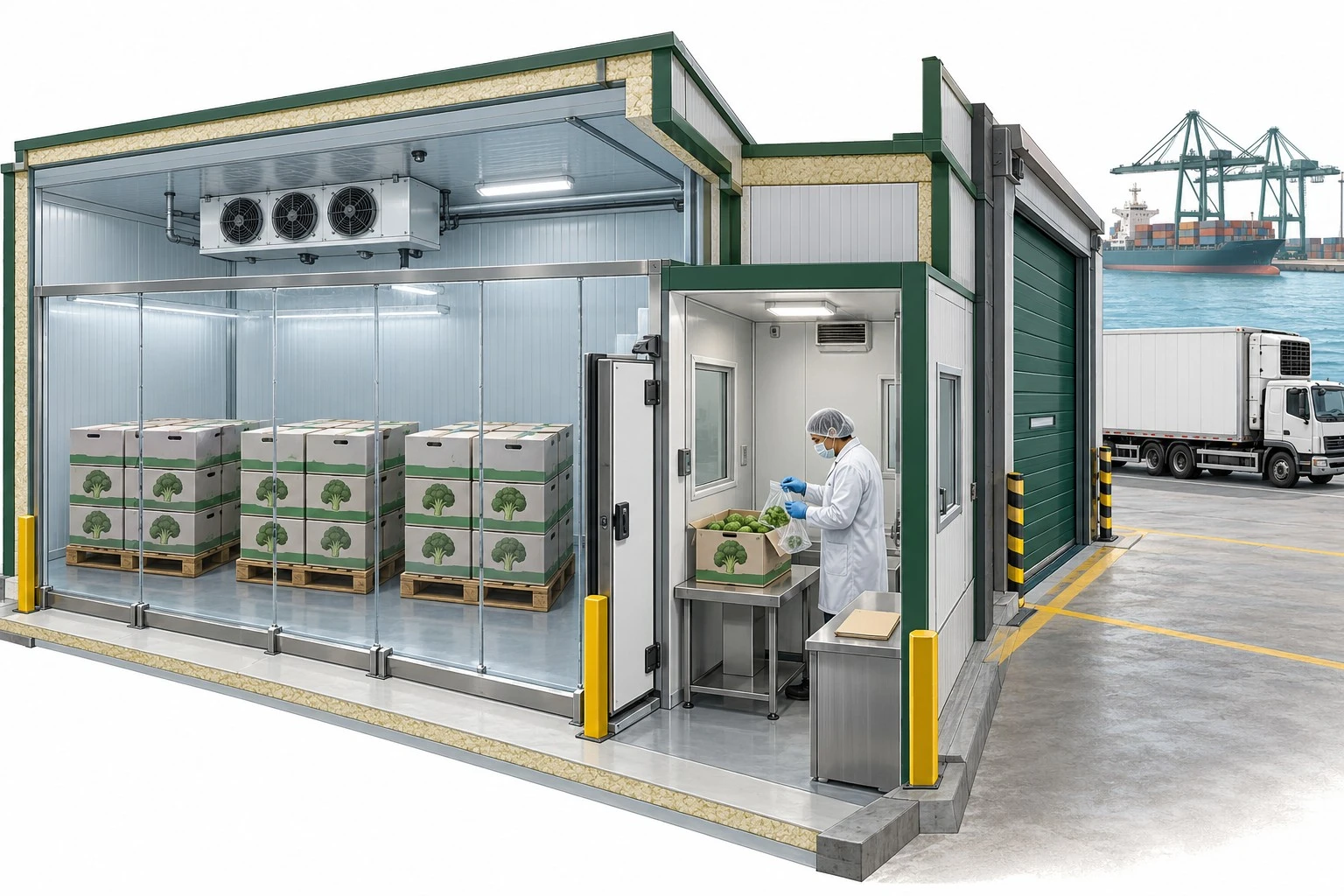
Illustration: authorised temporary movement to cold storage does not itself authorise sale or processing.
Before arrival, agree who will respond at the port, where a held reefer can remain powered, and which frozen store can receive it if the authority permits a transfer. Reserve the handling and delivery resources against the actual release conditions. A customs broker can coordinate these parties, but each authority and commercial operator still controls its own decision.
- Lodge and reconcile the declaration. The importer's authorised broker uses the current customs/NAFEZA route and the exact Egyptian tariff line, importer, invoice, packing, origin, shipment and valuation documents. Resolve a bill, quantity or container discrepancy against the underlying records before treating the declaration as ready.
- Obtain the food-control instruction. NFSA assigns its risk-based controls. Documentary review, identity/physical examination and sampling depend on that instruction; an importer should not choose its own channel on the strength of a private certificate. The broker returns the actual instruction and any request for additional evidence.
- Arrange frozen inspection and sampling. Ask the port/inspection parties for the required presentation, location and sample access. Record container and seal condition, opening time, carton/lot identity, sampled positions, sample quantities and official sample seals/references. An agreed door-access carton helps handling but does not determine the authority's sampling plan.
- Maintain custody under any hold. Decision 7/2020 distinguishes temporary from final food release: temporary release does not authorise Egyptian-market handling. Only move to a nominated cold store on the applicable written conditions. Record who holds the goods, the permitted movement, seal changes, quantities and the store receipt; do not sell or process a held lot.
- Complete food and any other applicable regulatory release. The importer obtains the NFSA decision and resolves CAPQ or other applicable conditions identified for this SKU. Keep the actual status and scope-whole consignment or identified part-alongside any laboratory result. A passing supplier COA is not the release decision.
- Complete customs and financial requirements. The broker settles the applicable declaration, valuation, tax and payment requirements and returns the customs release. Request itemised current assessments and paid receipts. Do not copy a duty rate, fee or bank form from a different tariff line or an old sample shipment.
- Obtain carrier and terminal delivery authority. The consignee resolves the agreed bill-of-lading release, delivery order, freight/local charges and terminal conditions with the relevant parties. Customs release alone does not make a carrier release or terminal gate pass appear. Confirm reefer power and truck booking while those approvals are being completed.
- Transfer and receive under the agreed frozen conditions. The carrier/store hands over to a suitable refrigerated vehicle. Record release references, collection time, container/seal or pallet identity, temperature information and delivery receipt. The importer links the received lots to its storage and subsequent sales/processing records only within the authorised disposition.
Your shipment status sheet should therefore have separate lines for NFSA food decision, any other applicable regulator, customs release, carrier delivery authority and terminal/store handover. Add the date, issuer and reference to each. If one line is unresolved, the team can contact its actual owner instead of repeatedly asking whether "clearance" is finished.
How GreenLand prepares and delivers the order

Real GreenLand-food product photograph: agree the measurement direction, sample state and acceptance method for floret size.
We translate the accepted Egyptian order requirements into a supplier-side control plan. The actions below describe how we organise the order with the nominated plant, laboratory and logistics parties; product-specific validated settings and actual records belong to that plant and batch. They are not a claim that one temperature, test panel or certificate makes every frozen vegetable suitable for Egypt.
From the field to a controlled frozen lot
Source and intake. Our purchasing and quality contacts define the growing source, harvest period and raw-material conditions. We request the relevant pesticide-use and traceability information and compare the proposed laboratory panel with the applicable Egyptian criteria and known source risks. Intake records identify the incoming lot, condition, visible damage, insects and foreign material. A change of source or producer returns to that review; it does not inherit approval simply because the food is still called broccoli.
Trimming, washing and blanching. The plant defines the floret cut, stem treatment, washing and sorting route. It establishes blanching and cooling settings against the actual floret distribution, equipment and process objective, with monitoring and corrective action. We compare colour, size and cooked texture against the approved sample and method. Blanching is not a universal sterilisation step; hygienic cooling, water control and prevention of later contamination remain part of the process review.
Testing and quality release. Before sampling, we agree the production lot, sample collection points and sample custody, then commission methods suited to the food and requested analytes. The reviewer checks the result, unit, LOQ, residue definition where relevant, method and legal/contractual basis. A missing pesticide from the laboratory panel stays a missing item; a "not detected" result above the required reporting capability cannot be relabelled as proof of compliance. Physical-size checks use the agreed frozen/thawed state and measurement direction, with defect counts or weights and their actual denominator.
Packing and lot reconciliation. We compare printed Arabic/other artwork with the importer-approved version, then reconcile finished quantity, net/gross weights, dates and lot codes with the packing list and certificate requests. Confirm the food-contact liner and carton performance required for the route. Any rejected or held production lot is excluded from the shipped quantity and the documents. The nominated quality decision-maker records the disposition before logistics receives a loading instruction.
The loading evidence you can receive
Our loading instruction calls for photographs of the empty container with its number visible; progress at about one-third and halfway; carton front marks and the production/date side; the completed load; doors half-closed and fully closed; and the fitted seal with its number. The load plan identifies the actual SKU/lot positions, declared samples and any inspection-access cartons agreed near the doors. Separate customer samples are positioned as agreed and remain in the quantity/document reconciliation. For palletised loads, the instruction includes at least five turns of stretch wrapping, subject to pallet stability, carton protection and the approved loading arrangement.
The same instruction requires the reefer to cool to −18°C before the loading-release photograph is taken. We record what the controller is showing and when the photograph was made. A controller display is not a measurement of the broccoli's core temperature: product-temperature verification, the loading environment, air passages and the agreed reefer operation must also be covered. The container is used to preserve an already-frozen load, not as a substitute for completing product freezing. This is our loading-control instruction, not a quoted universal Egyptian statutory limit.
Before handover, our document contact sends a shipment index tying the product definition and accepted artwork to the actual manufacturer, production lots, COA, invoice, packing list, container/seal, photographs and applicable official certificates. Your importer adds its licensing, notifications and destination decisions. You can request the agreed photo set and document index with the order; we define recipients and due events instead of promising that a photograph itself guarantees customs release.
Respond to a hold, change or arrival dispute
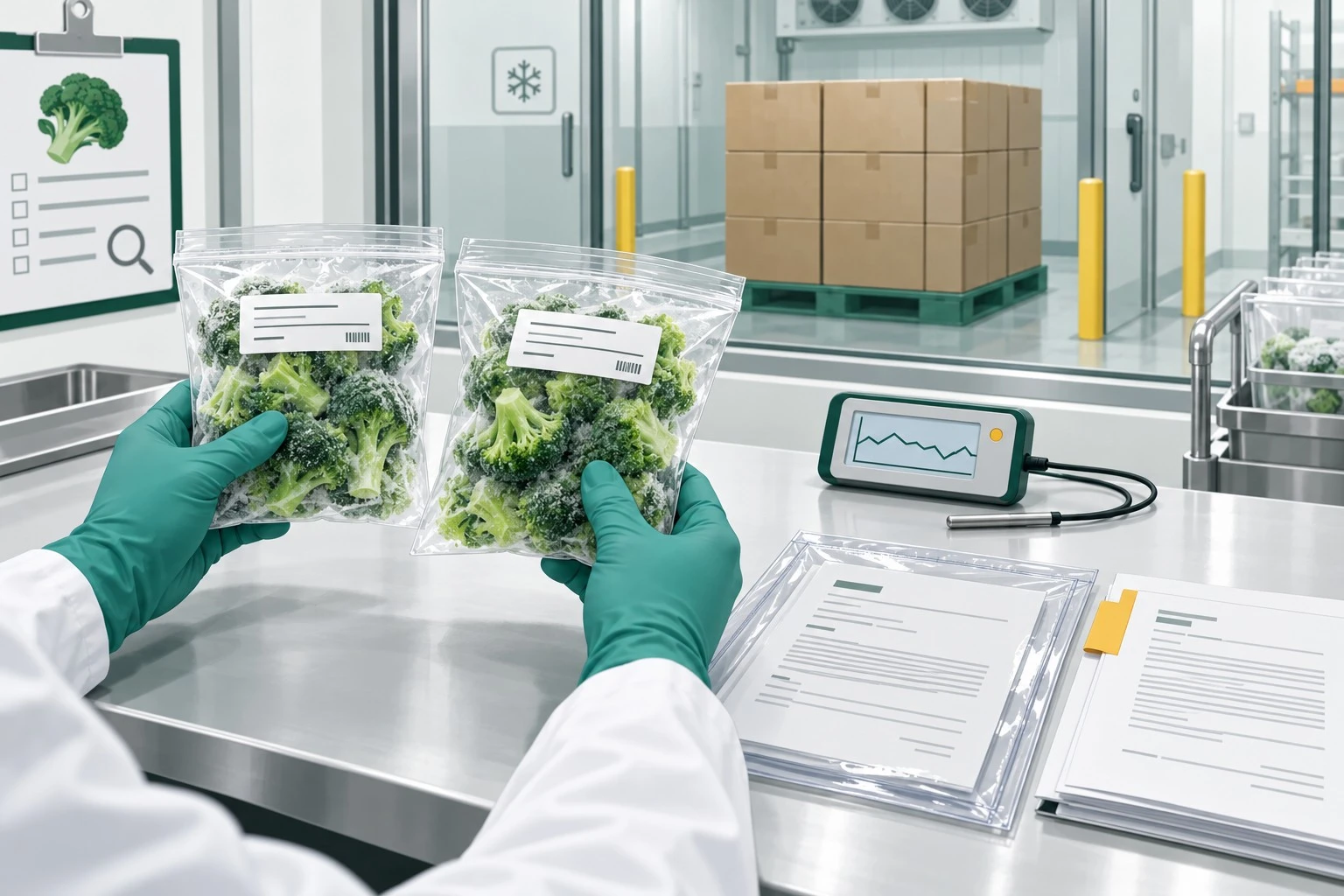
Illustration: retain the original result, identify the affected lot and compare controlled evidence before deciding its disposition.
A hold or discrepancy needs a controlled decision before the affected food is moved or used. Start with the official notice or the precise customer complaint. Record who issued it, the relevant declaration/ACID and container, the affected goods, the reason and any response deadline. The importer and broker own the local regulatory response; GreenLand-food and the actual producer supply the underlying product and batch evidence.
| Problem | Immediate action and responsible party | Decision evidence |
| Missing or inconsistent document | Importer/broker identifies the authority's exact request; we and the proper issuer provide the corrected record. | Original, reason for correction, replacement version and accepted response. Do not silently overwrite an official certificate. |
| Changed factory, formula, quantity or sailing | Stop reusing the previous facts; our team identifies affected lots/documents and the importer/filer checks required amendments. | Updated product/certification check, document comparison and platform/carrier acknowledgements. |
| Official sample fails or food is rejected | Keep the identified goods under the authority's hold. Importer seeks the stated review/grievance route and any permitted further testing. | Official sample/result, custody, permitted review and written disposition. A new private pass does not erase the first decision. |
| Seal, temperature or product-condition concern | Preserve the original seal and opening facts, logger data and photographs; agree controlled samples before general handling. | Timeline, recorder identity/location, affected positions, retained samples and comparison method. |
| Quality differs from approved sample | Compare the same lot/state and agreed size, defect, cooking or yield method with our quality contact. | Approved sample/specification, actual sample selection, calculation denominator, results and corrective action. |
For an official rejection, use the importer's notice to establish whether review, further examination, re-export or another supervised disposition is available. Follow the authority's written instruction and any time limit stated for the case. Keep the lot isolated and protect the cold chain while the decision is pending. We can arrange supporting records or permitted investigations with the responsible parties; we cannot replace an Egyptian authority's decision with our own release email.
For an arrival quality claim, compare evidence in order: container/seal and unloading records; the location and condition of affected cartons; the temperature recorder's identity and placement; the product's condition; and samples collected with recorded custody. Do not infer the broccoli's temperature solely from a controller photograph or infer thawing solely from one clump of ice. Use the same preparation and measurement conditions for arrival and retained samples. Where that comparison is not possible, state the limitation and agree the next investigation rather than manufacturing a precise loss calculation.
Close the investigation with the affected quantity, permitted disposition, commercial agreement where relevant, corrective action and a check for the next order. A raw-material issue returns to sourcing; a carton-marking mismatch returns to artwork/version control; a document delay returns to its provider and due event. Your next purchase then uses a revised requirement or handover step with an owner and evidence, rather than another general assurance that the supplier will be more careful.
Prepare your frozen broccoli order with GreenLand-food
GreenLand-food is a China-based frozen food supplier. For factory-direct wholesale orders, we identify the actual manufacturer, product, packing and shipment records with your team. Send your floret specification, application, quantity, pack, Egyptian port, target sailing and required documents. We will organise the product review, agreed sample, testing and export handover for your importer's approved route.