


Container Seal Checks and Resealing Records for Frozen Food Shipments
Oct 21, 2026
Leave a message
Reviewed 21 October 2026. Shipment requirements are checked for the actual product, route and filing date.
Define seal and custody fields before loading
Identify the exact container, booking or order reference, loading place, expected carrier handover, and person responsible for seal control. Keep a controlled record of seals received, issued, applied, removed, lost, or returned. The available seal number should be checked against that inventory before application. A loose seal lying on the desk is not shipment evidence, and a number typed into a packing list before doors close is only a planned value. The applied number is the one read from the physical seal after installation.
The ISO 17712 standard addresses freight-container mechanical seals and their classification and testing. A statement that a specific seal is compliant should be supported by the supplier's actual documentation for that seal, not by an article diagram or a similar-looking device. Some routes, customers, or security programs specify a particular seal class or placement. Confirm the booking and buyer requirement rather than assuming one type fits every movement. Record the maker or batch identifier if the local procedure requires it, but do not publish fictitious certificate numbers.
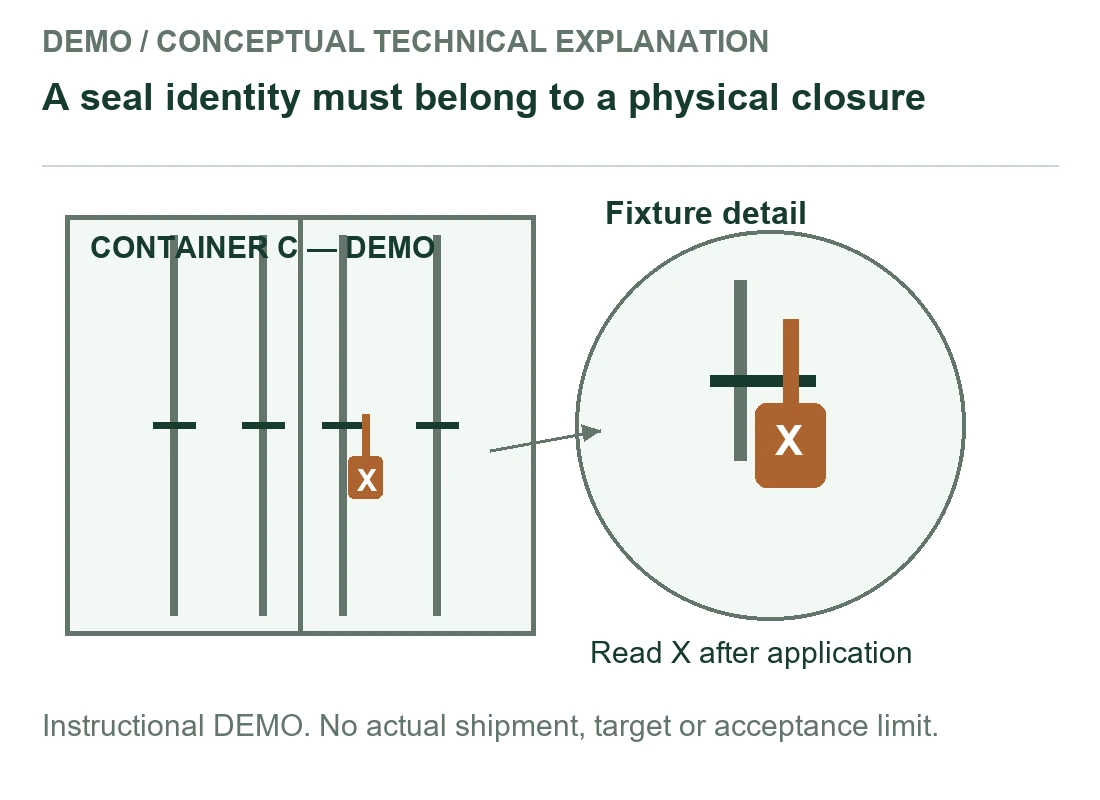
A seal identity must belong to a physical closure. Instructional DEMO; letters and event examples are placeholders, not actual custody proof. Swipe horizontally on a narrow screen to read all labels.
Plan where the seal will be applied and who will witness the operation. The locking bar or hasp must be intact, and the chosen point must make unauthorized opening evident under the applicable procedure. A numbered plastic tag used for an internal pallet is not interchangeable with a container door seal merely because both have serial numbers. The equipment inspection should already have addressed hinges, locking rods, cams, keepers, and gaskets. A seal cannot compensate for a damaged door or faulty locking mechanism.
Set up a record with separate fields for container number, seal number, installation time, installer, witness if required, place, closed-door image reference, and the document version updated after application. Keep an exception field for opening and replacement events. A single free-text cell headed "current seal" tends to erase history when a replacement is typed over the original. A two-row or event-based log allows a reviewer to follow the physical sequence from origin to receipt.
The seal identity belongs in a broader pre-load control. Compare the container number with the booking and measured load plan. Confirm product quantities, carton and lot marks, order-approved sample position, measured cargo temperature criteria, and the shipping-instruction and VGM cutoffs. IMO VGM guidance concerns the verified mass of the packed container; a seal number is not a weighing result. Getting these fields ready before final closure prevents an avoidable reopening just to correct a document that could have been reconciled while the doors were open.
Seal stock itself needs protection. Keep unused devices in a controlled place and issue them to a named person for a defined shipment. Record a broken or wasted seal rather than returning its number to the available list. If a driver arrives with an unrecorded pre-attached seal on a supposedly empty unit, the loading team should establish who applied it and why before removing it. The number may belong to an equipment transfer event, not to the cargo being loaded. This distinction avoids building a shipment custody story around a device that predates the shipment.
Verify the seal and closed doors at origin
Begin the closure record with the actual loaded state. The completed-load photograph should show the front face of cartons and any approved blocking or dunnage without inventing visibility into hidden pallets. The tally should identify quantities by SKU and lot; representative images should show carton fronts and production-date or lot marks. These records establish the observed cargo condition and traceability at loading. The final seal photograph links to them by container number and sequence, but does not itself reveal the contents.
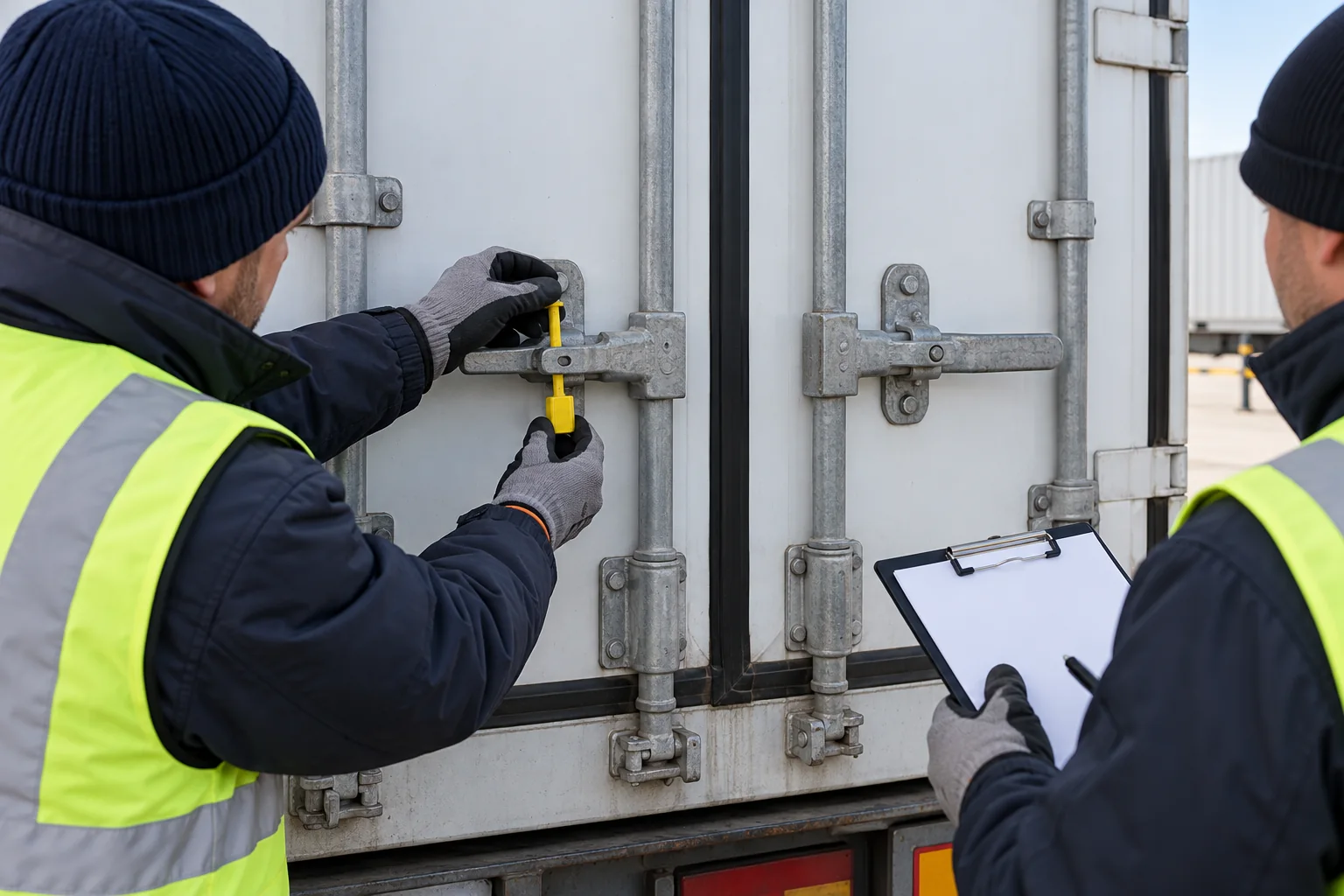
Close the doors fully in the correct order, engage the locking rods, and inspect their seated positions. A half-closed photograph is useful as a transitional stage only if the subsequent closed-door view shows both leaves and the readable container number. Then apply the assigned seal to the approved fixture. The installer should perform the local tug or retention check permitted by the seal procedure, and a second person should verify the serial where independent verification is required. Do not bend, cut, or reattach a seal simply to obtain a better photograph.
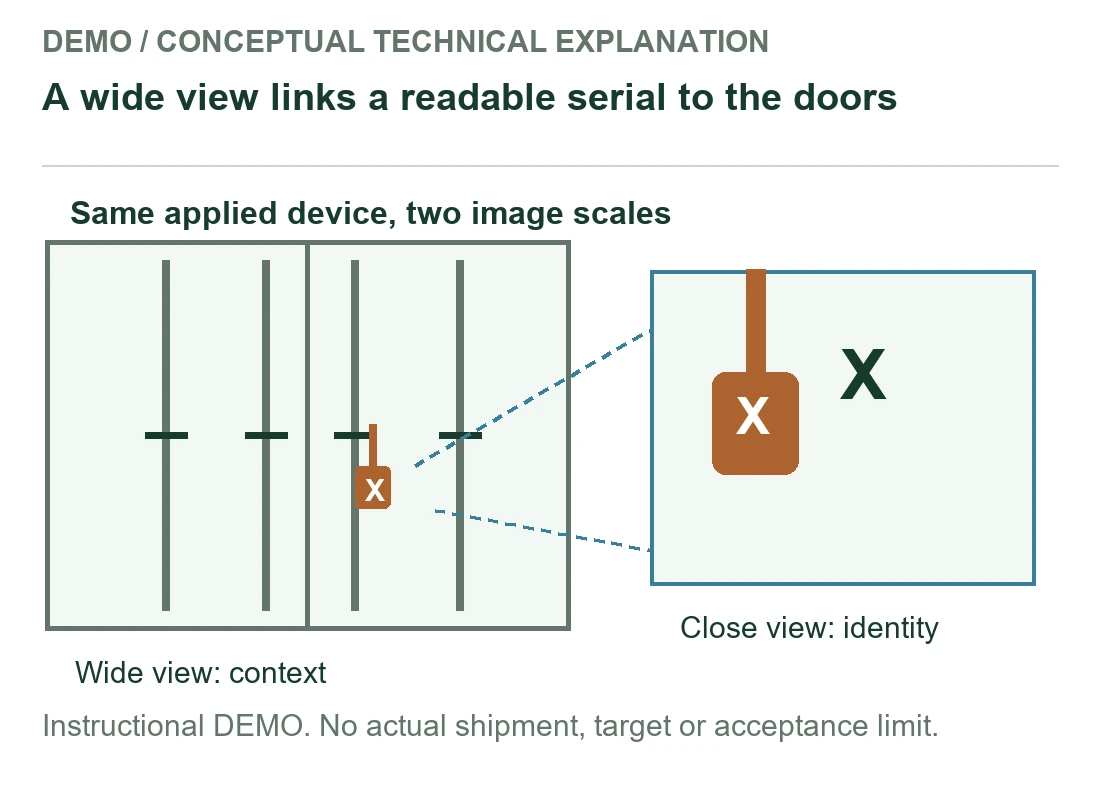
A wide view links a readable serial to the doors. Instructional DEMO; letters and event examples are placeholders, not actual custody proof. Swipe horizontally on a narrow screen to read all labels.
Confirm the actual frozen-food order
Share the product form, pack, quantity, destination, order-specific temperature criterion and evidence requirements. We can reconcile the loading and quality instructions with the selected product specification.
Review a genuine product example
Request Specifications & QuoteTake a close image in which the serial can be transcribed, plus a wider image showing the seal in relation to the container doors. The close image alone can be detached from context; the wide image alone often makes the digits unreadable. Record the digits in the log by reading the physical device, then compare them with the images. Pay particular attention to characters that can be confused, such as 0 and O, 1 and I, or 5 and S. If an image is blurred, retake it before the truck leaves rather than relying on a typed number alone.
The seal number must match any shipping instruction, packing record, transport instruction, or customer notice that includes it. The document owner should submit or update the final value through the approved carrier channel within the current cutoff. Maersk's Indonesia export page illustrates that deadlines and data channels are service-specific; the order's current booking is the operational source. If the seal is applied after a draft document was sent, record the correction and ensure the recipient has the final value.
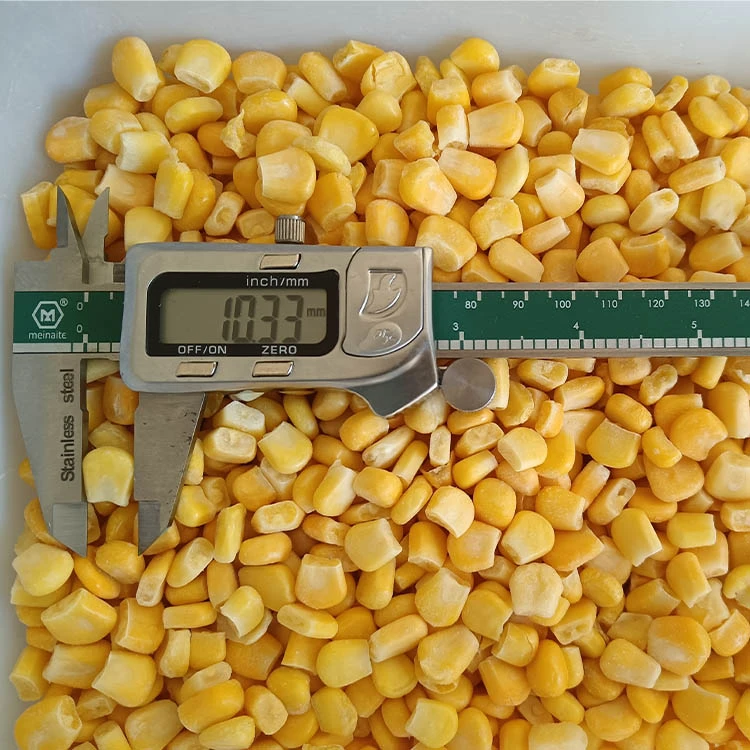
Original GreenLand product photograph; an example of a product form, not evidence from a particular loading or order. This image is not a loading photograph.
Document cargo temperature independently. The reefer setpoint is a command, supply and return air are controller readings at different places, and a product temperature is measured at an order-approved sample position. A closed, correctly sealed reefer can contain product outside specification; a good product reading does not prove that the seal was applied. We retain each fact with its time and source rather than writing one broad "shipment okay" statement.
Record each handover without implying contents are proved
At pickup, the handing and receiving parties should identify the container and observe the seal's presence, serial, and apparent condition according to their procedure. "Seal observed intact, number matched" is an observation at a time and place. It does not prove that every carton is present or that the reefer has continuously maintained product temperature. If the seal is obstructed or unreadable, record that limitation rather than marking it verified. Resolve the discrepancy while the unit is still at a place where both parties can inspect it.
Use an event sequence: origin application, carrier pickup, terminal intake if accessible, authorized inspection, onward release, and destination receipt. Not every operator will directly see every handover. Do not manufacture a continuous row of checks from an origin photo and destination observation. A carrier electronic milestone can establish a movement event, while a physical seal inspection requires a person or credible photo at that point. Keep the source of each event visible.
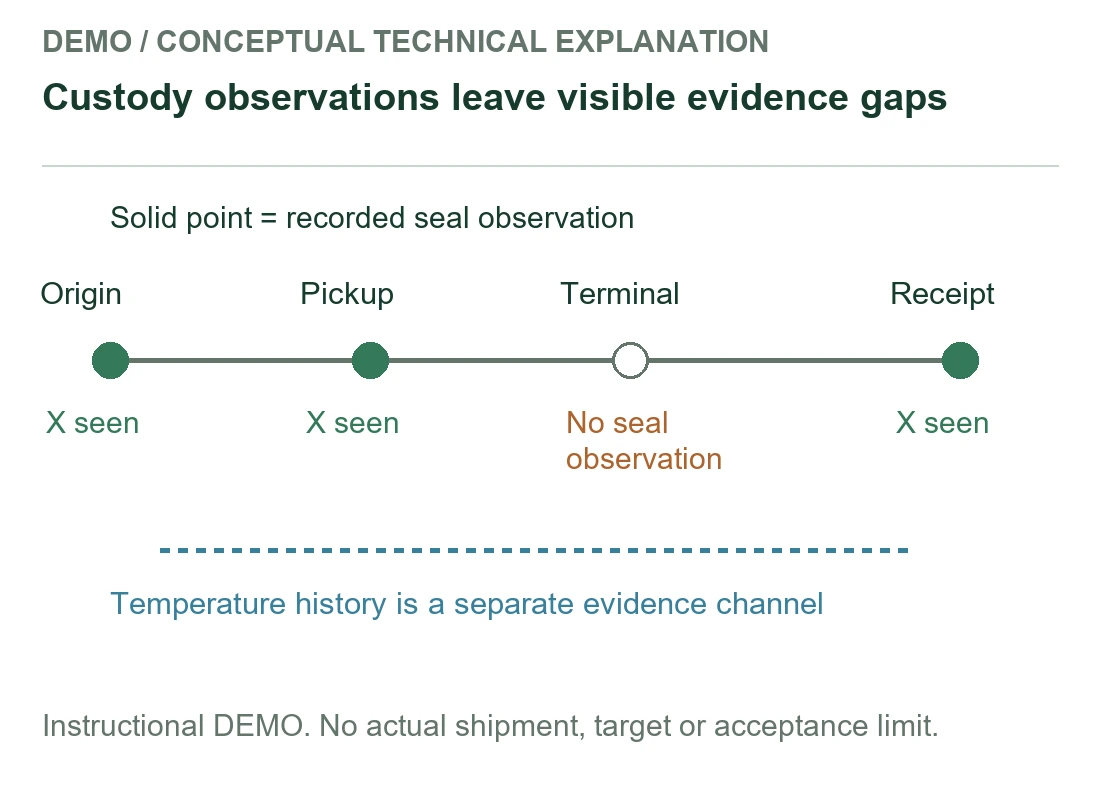
Custody observations leave visible evidence gaps. Instructional DEMO; letters and event examples are placeholders, not actual custody proof. Swipe horizontally on a narrow screen to read all labels.
An intact seal at destination is one useful custody signal, but it has limits. A poorly installed seal might be transferred or manipulated; a legitimate inspection may break it; a damaged door could compromise closure without the seal number changing. Conversely, a changed seal can result from a documented customs, security, or equipment event rather than cargo theft. Treat discrepancies as triggers for investigation, not instant conclusions. Preserve the found condition and consult the full transport and resealing record.
The cold-chain evidence runs beside, not inside, the seal log. If the equipment provides a downloadable temperature history, preserve the original time series and identify setpoint, supply and return air correctly. Door-opening events or power interruptions may need explanation. Product temperature at receipt should be measured under the buyer's agreed method when required. A seal continuity record cannot settle a temperature excursion, and an apparently normal air log cannot explain an unrecorded seal change.
Handover notes should be concise and factual. Record who saw the unit, where, when, which number, and whether there was an exception. Avoid "secure throughout voyage" unless there is actual evidence covering the interval and a defined meaning of secure. The discipline of small, precise statements makes a later claim easier to analyze than broad assurances that cannot be tested.
Time zones can matter when a shipment crosses ports. Record the local time and zone, or use a consistent timestamp convention, so an inspection event can be aligned with a reefer temperature history and terminal movement. A note marked simply "10:30" can appear to precede or follow an excursion depending on which location's clock it describes. Preserve source timestamps rather than silently converting them during a claim review.
Open only under authorized procedure
If authorities, carriers, terminals, or an agreed quality process require the doors to be opened, establish the reason and authority before cutting the seal where circumstances allow. Record the container number, location, time, requesting party, person cutting, old seal number, and condition of doors and seal as found. Photograph the intact old seal in context and close view before removal. Preserve the removed device if the applicable procedure calls for it. An emergency may change the order of actions; write what happened rather than backfilling a perfect-looking sequence.
Opening can expose frozen cargo to warm, humid air. Plan the examination to limit door-open time while meeting the inspection purpose. Record the observable cargo state, any cartons moved, damaged, sampled, or removed, and the revised count by SKU and lot. If a product temperature check is required, use the approved sample position and method, and record the actual measured value. Do not infer product condition from the controller setpoint or a momentary supply-air reading. The quality owner decides whether exposure or handling requires a hold.
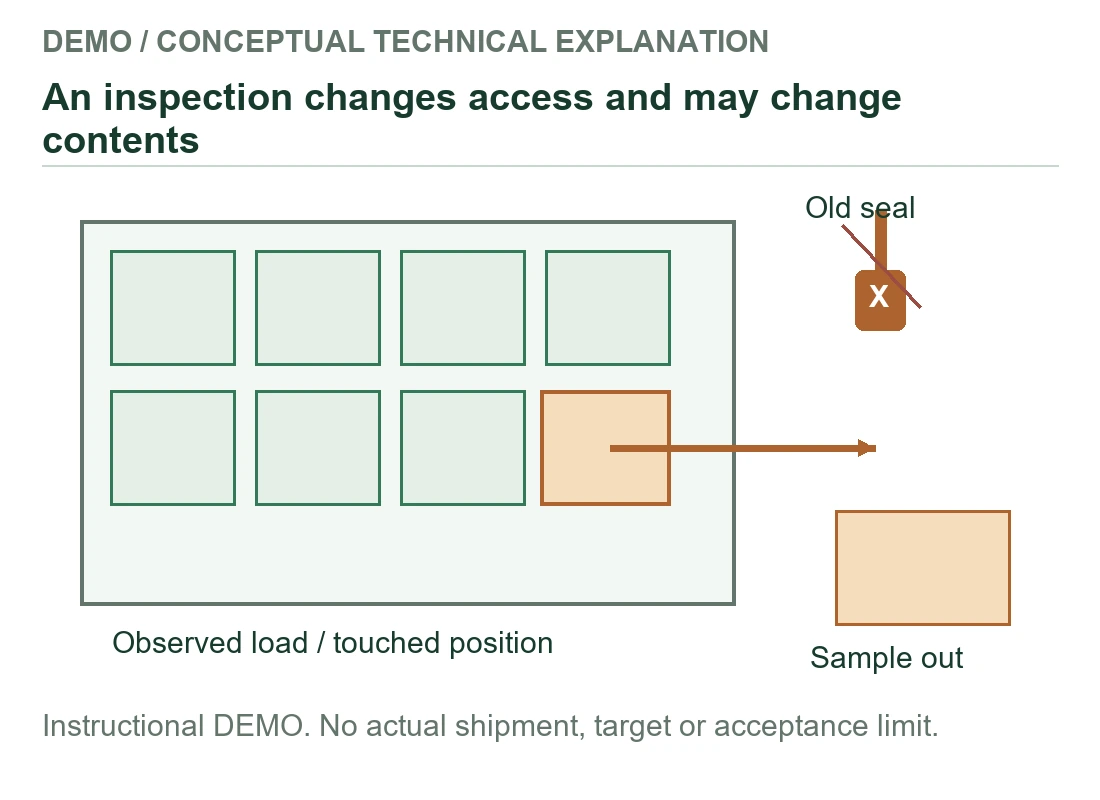
An inspection changes access and may change contents. Instructional DEMO; letters and event examples are placeholders, not actual custody proof. Swipe horizontally on a narrow screen to read all labels.
The inspection party may place its own seal or direct a new shipper seal. Follow the applicable authority and carrier process. A replacement number should be read after physical application and recorded as a new event. The old number remains in the record as "removed" or "broken for inspection," with the reason and time. A photo of the new seal without a record of why the original disappeared leaves an unexplained break in custody even if the replacement is genuine.
If a seal is accidentally broken during a routine yard activity, do not relabel the event as a formal inspection. Record the accident, who observed it, whether doors opened, what cargo checks were made, and who authorized resealing. If the doors were not opened, say so as an observation with the limits of that observation. The operational response may still require carrier and buyer notification. Do not decide it solely by whether a new seal can be found quickly.
If cargo is unloaded and reloaded, the loading evidence must be updated. A new seal cannot preserve an obsolete pallet map or original completed-load photograph as proof of the current contents. Take the necessary new tally and staged images, including representative lot marks and the final load face. The traceability record should show what left, what returned, and what remained outside the container.
Preserve old and new seal numbers through resealing
Write the reseal event as a transition, not an overwrite: original seal X applied at origin, X observed or removed at a named event, replacement seal Y applied at a stated location and time. Keep the physical container number constant through the event, or document a container swap separately. A two-number record lets the receiver understand why their observed seal differs from the original shipping instruction. If more than one replacement occurred, retain every event in order.
A DEMO exception record can be tested with three columns: event, observed number and authority. At origin, the operator records seal X after closed-door checks. At an authorized inspection, the inspector photographs X before cutting it, notes which pallets or samples were touched, and records the authority and time. After closure, the responsible party applies Y and records the new number. If the destination instruction still lists X, the receiving team needs a linked amendment or inspection notice explaining the X-to-Y transition before routine acceptance. If the inspection record lacks the cargo count after opening, do not treat the new seal as proof that contents remained identical; reconcile the tally separately. X and Y are placeholders, not real seal identifiers.
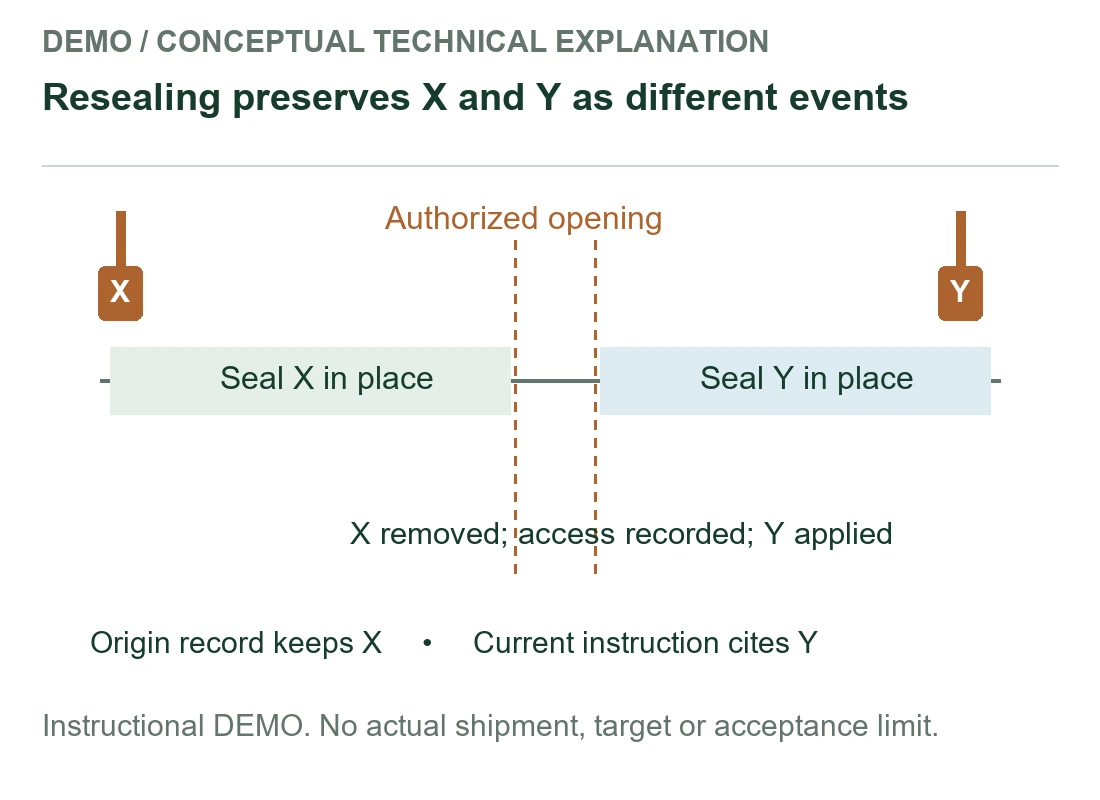
Resealing preserves X and Y as different events. Instructional DEMO; letters and event examples are placeholders, not actual custody proof. Swipe horizontally on a narrow screen to read all labels.
At replacement, inspect the doors and locking fixture before applying the new device. If the fixture is damaged or the doors cannot close correctly, placing a new seal does not solve the problem. Ask the equipment or carrier party for the appropriate remedy and record it. Confirm that the new seal meets the required type and is issued through the controlled inventory. Then record its full serial, installer, witness where required, photograph references, and retention check.
The new seal number should be communicated to the parties who use it for release or receipt. Depending on the route, that can include the carrier, forwarder, customs broker, buyer, warehouse, or insurer. Avoid sending a bare number with no old-number reference or explanation; a recipient might interpret it as a conflicting instruction. The update should identify container, original number, reason for change, authority, time and place, new number, and any cargo observations that affect receipt.
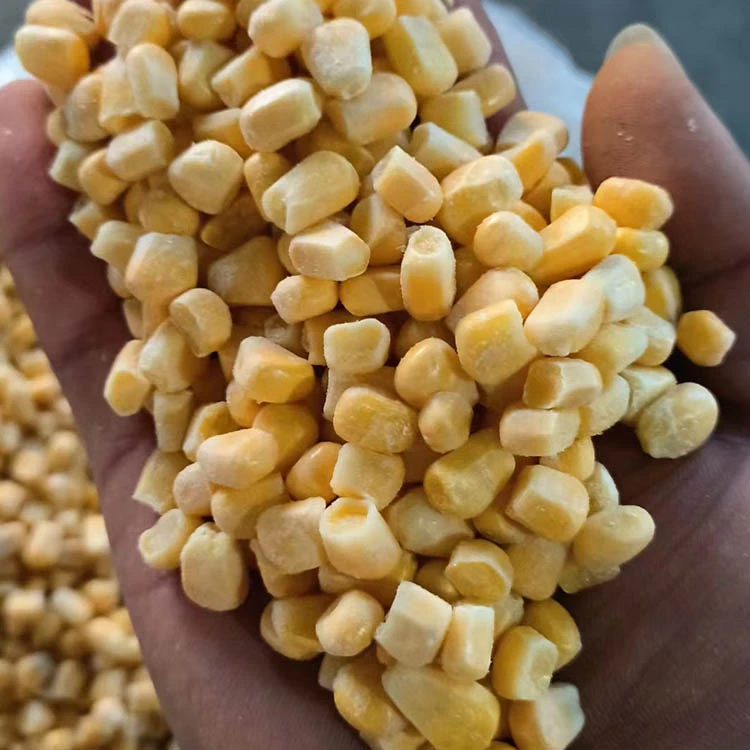
Original GreenLand product photograph; an example of a product form, not evidence from a particular loading or order. This image is not a loading photograph.
Preserve original files and a visible version trail. If a shipping instruction cannot be amended after a cutoff, keep evidence of the attempted correction and follow the carrier's accepted discrepancy process. Do not quietly edit a PDF copy and imply the carrier received it. Carrier local export instructions can change, so the booking-specific portal or contact should resolve the actual update channel. The key is that the receiving team has an authenticated explanation before they confront a different physical seal.
An illustrated example can show "X to Y" as a process. For a live shipment, use only the real seal photographs and issued records. A product photograph can show what a frozen-food form looks like; it does not establish that those particular packs traveled under a particular seal.
Reconcile documents and temperature evidence
After resealing, compare every record that carries the container or seal identity. The loading report, transport handover, shipping instruction, bill-of-lading data where applicable, inspection note, buyer notice, and destination receiving instruction may not all update automatically. Mark which document holds the origin seal, which holds the current seal, and which has an appended explanation. Do not force all records to show only the last number; the earlier number is part of the custody history.
If the container itself is replaced, the work is broader. Reinspect the empty replacement, verify its carrier PTI or equipment status, reconcile the new load, update the container number, recalculate the packed-container mass process if needed, and issue a new seal record. The IMO VGM framework applies to the actual packed container. Transferring cargo into another unit changes tare and may affect the verified gross mass, even when the carton count is unchanged. Current shipping-instruction and VGM cutoffs determine the urgency.
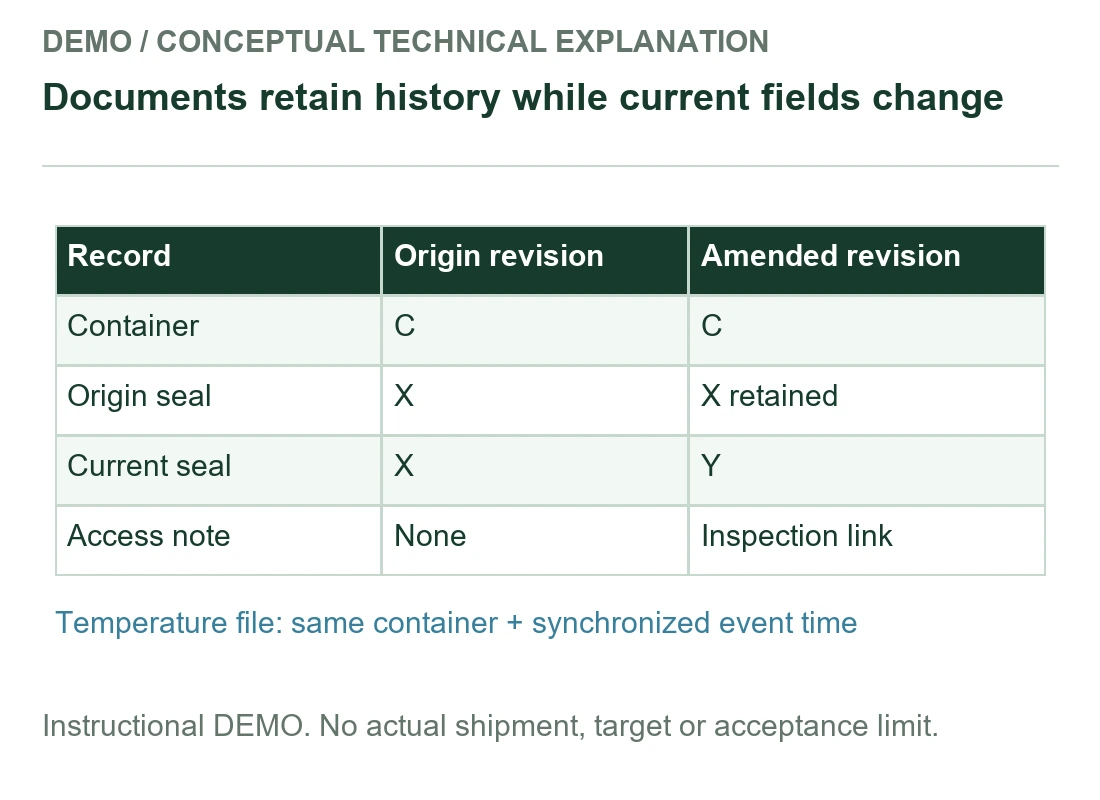
Documents retain history while current fields change. Instructional DEMO; letters and event examples are placeholders, not actual custody proof. Swipe horizontally on a narrow screen to read all labels.
Temperature evidence should cover the period around any opening. Preserve original reefer data, the time the doors were open, power status if known, and measured cargo temperature where the order requires it. Setpoint, supply air, return air, and product measurement stay in separate columns. A warm return-air spike during inspection is a signal to investigate in context, not automatic proof that the product failed. Likewise, a normal setpoint after closure cannot erase an earlier excursion. The authorized quality owner applies the order's numeric criteria and disposition process.
Check counts and samples too. An inspection may take a sample, reject a carton, or redistribute pallets. The final as-loaded or as-resealed tally should show those changes by SKU and lot. A retained sample outside the box needs its own custody and storage record; a sample placed back in the box needs an identified position. The buyer should be able to tell whether the final declared quantity includes it. A seal event is often the point where a small count difference first becomes visible.
At origin and after any opening, maintain the staged image sequence that the actual event permits: readable container number, carton front and date marks, partial and complete load, half-closed and closed doors, final seal. Do not reuse a pre-opening final-load image as if it shows a changed load. The photo index should make the before and after periods obvious.
Respond to a mismatched or missing seal at arrival
When the destination observer sees a different, missing, damaged, or unreadable seal, pause routine opening and document the condition before touching the doors. Capture the container number, wide door view, close view of the device or broken fixture, arrival time and location, and the people present. Compare the physical serial with the current written instruction and the full reseal chain, not only the original origin number. A properly documented replacement may explain the difference; an absent explanation remains an exception.
Notify the designated carrier, forwarder, buyer and quality contacts under the shipment procedure. Preserve the seal, packing, tally, loading photographs, transport milestones and reefer data. Avoid deciding cause from one picture. An unauthorized opening, a documented customs inspection that was not passed to the receiver, a transcription error, and a damaged seal after rough handling can produce similar first impressions. The investigation should identify which evidence supports each possibility and which remains unknown.
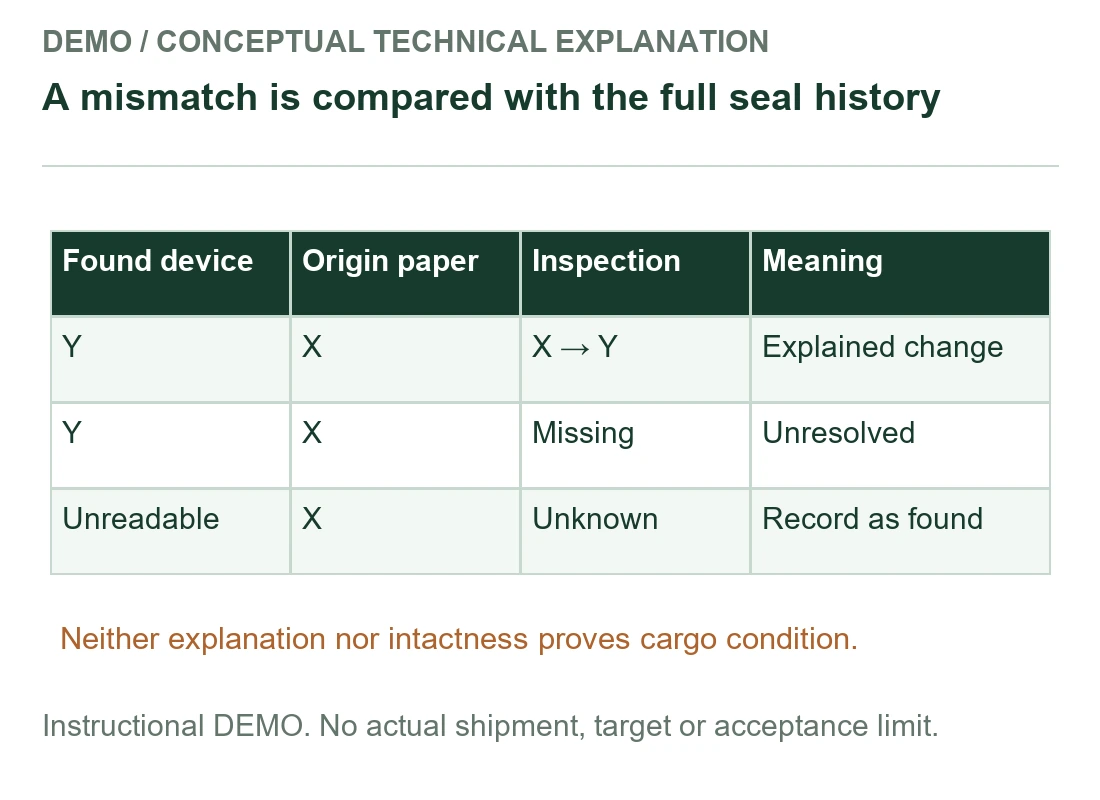
A mismatch is compared with the full seal history. Instructional DEMO; letters and event examples are placeholders, not actual custody proof. Swipe horizontally on a narrow screen to read all labels.
If the doors must be opened for safety or perishable-product protection before all parties respond, record that necessity, witnesses, time, and what was observed. Count by SKU and lot, note damaged or moved cartons, compare the visible door face with the origin load image, and follow the approved cargo-temperature sampling method. Keep the equipment readings separate from product measurements. The result may support a hold, survey, accepted receipt with reservation, or another disposition; the authorized parties decide under the order and contract.
An intact-looking replacement seal should not close the inquiry if there is no transition record. Conversely, a documented seal break does not by itself mean the food is unsafe or short. The seal chain tells us where custody evidence changed; product quality, quantity and cold-chain evidence answer different questions. The receiving report should state each conclusion at the level the evidence supports.
Close the case with a traceable event log: original number, every authorized or unexplained break, replacement number, condition at arrival, cargo observations, measured product results where required, and final disposition. If a record was wrong, correct it visibly with date and author instead of deleting the prior entry. That leaves buyers and operators with a useful account of what happened rather than a single final number that conceals the most important event.
Build your frozen food order with GreenLand-food
GreenLand-food is a professional frozen food supplier and manufacturer in China, providing factory-direct wholesale supply for importers, food manufacturers and foodservice programmes.
Send your product form, specification, packing, quantity, application, destination, private-label needs and requested documents. We will organise the product and order requirements with your purchasing and quality teams.