


Mixed Frozen-Produce Containers: SKU Positions, Lots and Shipment Samples
Oct 21, 2026
Leave a message

Reviewed 21 October 2026. Shipment requirements are checked for the actual product, route and filing date.
Choose the unit of traceability before the load
Start by deciding what the order actually distinguishes. "Mixed vegetables" may be one SKU with multiple production lots, or several SKU codes sharing a commercial description. A carton may carry a lot code, production date, expiry or best-before date, product name, net weight, customer label, and case number. A pallet label may summarize some of those fields. Write down the hierarchy explicitly: order line, SKU, lot, production date, pallet ID where used, and carton quantity. Do not merge lots because they share a date, or assume different pallet labels mean different lots.
Traceability granularity is a practical commitment. If every pallet is single-lot, the container map can identify each pallet and its zone. If pallets contain mixed lots, a pallet-level map is insufficient; the record must show layer or carton-group allocation. If cartons cannot be individually distinguished at the necessary level, the team should address that before loading rather than promise a later precise recall boundary. The FDA food traceability rule resources show why linked identifiers and event records matter, although legal applicability depends on product, market and party. Our loading map is an operational aid, not a claim that one generic form satisfies every jurisdiction.
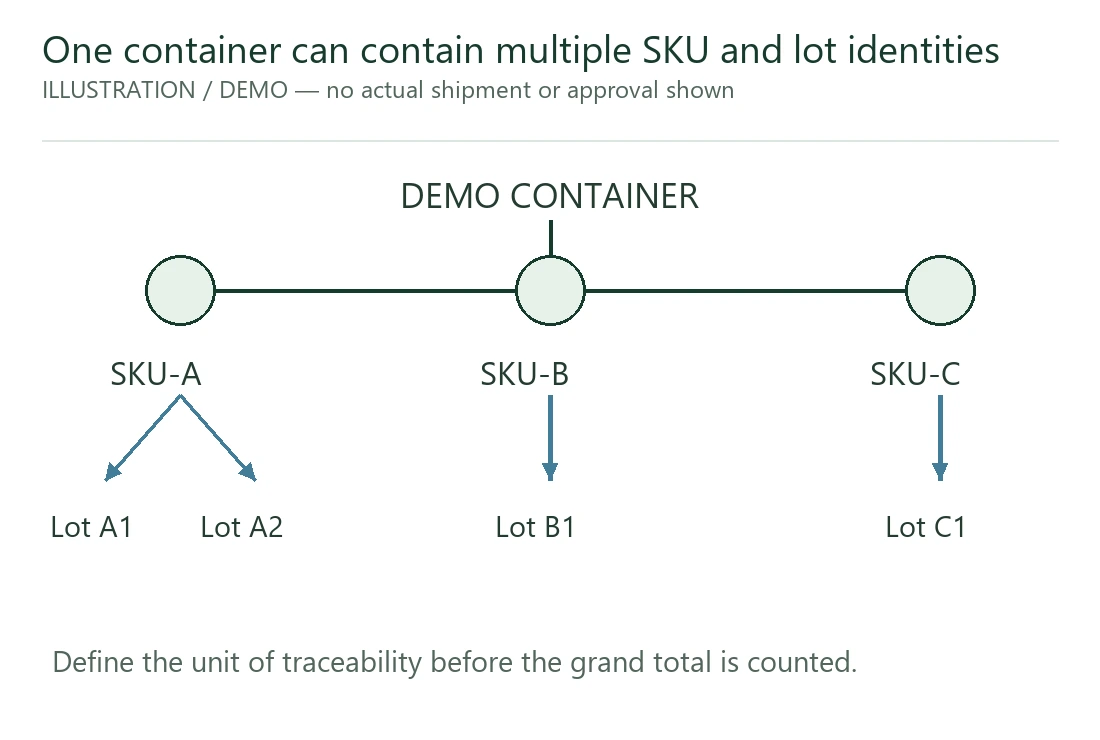
SKU and lot are distinct traceability levels within one container. Illustrative method / DEMO, not shipment evidence. Swipe horizontally on a narrow screen to read the full illustration.
Check the approved order and packing instruction against physical carton fronts. A design proof can be outdated; the cartons on the floor are the units to be shipped. Record exactly what a reader can see on a representative front and date/lot mark, and flag a mismatch before pallets disappear into the container. A code that is truncated by stretch wrap or printed on an inaccessible side is a retrieval problem even if it is technically present. Agree which face should remain visible at the door or in the staged photo sequence.
The traceability plan should also name the people and controls. One person reads or scans, another confirms the tally where the process requires independent checking, and an exception owner decides substitutions. A last-minute "equivalent" SKU is not just a count adjustment. It can change ingredient mix, cut size, allergen or label information, product specification, and the buyer's receiving plan. The substitution must be approved under the order process and reflected in the map, documents, and sample selection.
Before loading, compare planned cartons and pallets with the measured load plan. Carton dimensions, pallet pattern, and actual wrap method affect the number of positions. The internal requirement of at least five wrap turns does not guarantee stability by itself; verify film overlap, pallet-base capture, corners, and whether wrap obscures marks or the reefer air route. The map should describe physically achievable positions, not an abstract spreadsheet grid that ignores T-floor channels, load height, and door clearance.
Convert SKU and lot allocations into a spatial map
Give the container a simple coordinate system that remains readable after the doors close. We use machinery end to doors as the longitudinal direction, and left and right as viewed from the door opening. Number pallet rows or bays in that direction. Mark any partial pallet, loose carton zone, or dunnage position. State that the diagram is a planning and record tool; it is not a scaled engineering drawing. The actual equipment loading marks and carrier guidance govern clearance and air circulation.
Allocate each SKU and lot to a block before moving the first pallet. If an order contains IQF broccoli and mixed vegetables, keep their carton counts and lot identities separate even when the outside cases share a size. Mixed product forms can have different carton strength, density, and temperature behavior. The allocation should make the receiver's first opening predictable: what will be visible at the doors, where a particular SKU begins, and which lot follows it. If the buyer requires a particular unloading order, encode that in the approved plan rather than asking the forklift driver to improvise.
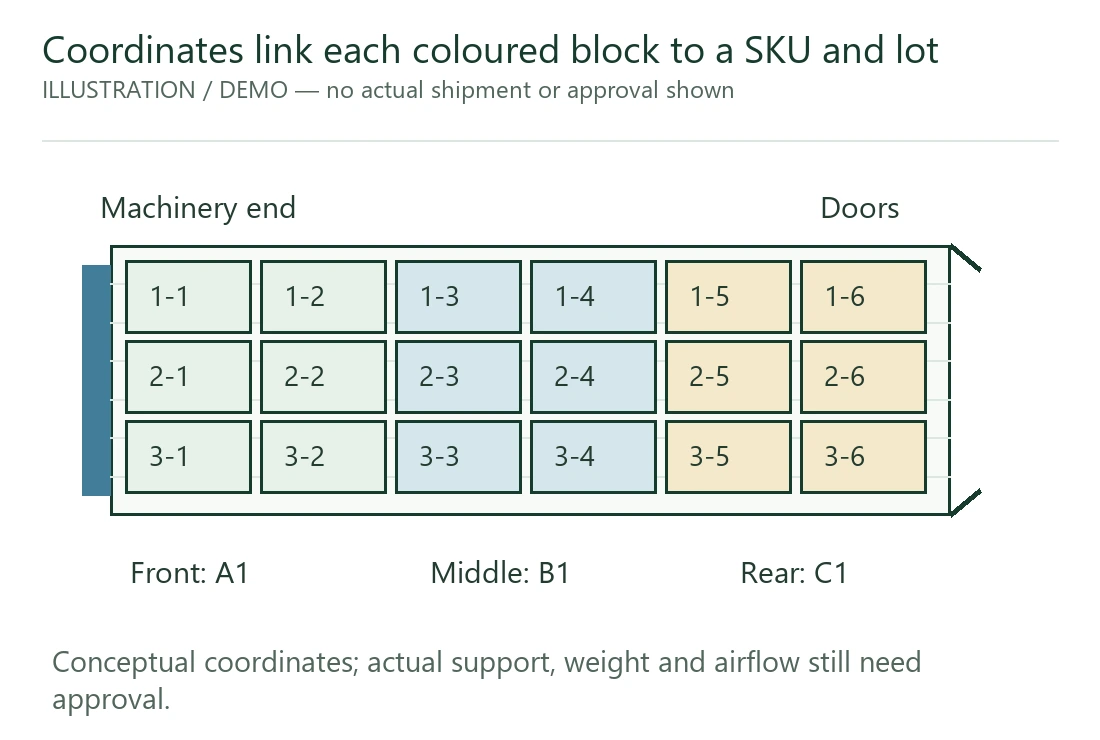
A coordinate map connects zones with product and lot identities. Illustrative method / DEMO, not shipment evidence. Swipe horizontally on a narrow screen to read the full illustration.
Confirm the actual frozen-food order
Share the product form, pack, quantity, destination, order-specific temperature criterion and evidence requirements. We can reconcile the loading and quality instructions with the selected product specification.
Review a genuine product example
Request Specifications & QuoteA DEMO plan might assign four pallet positions to broccoli lot B1, three to broccoli lot B2 and five to mixed-vegetable lot M1. A simple grand total of twelve pallets cannot reveal a wrong-lot substitution. If position 7 arrives with B1 rather than B2, the loader should stop that pallet, compare its carton date marks with the approved allocation, and either correct the staging error or obtain a documented substitution decision. The as-loaded map and tally then show the actual lot at position 7, and the representative mark photograph is indexed to that position. The receiving team can later hold the affected lot without assuming the entire mixed container has the same identity. These are illustrative codes and counts, not a GreenLand shipment.
Load order is not always the reverse of delivery priority. A front zone may be difficult to reach without moving door-side pallets, but airflow and stability may constrain which pallet can go where. Mark the planned order of entry and the final location separately. A pallet loaded first normally travels toward the machinery end; a replacement pallet loaded later may occupy a different zone than its original allocation. Every such change should be written on the as-loaded map immediately, not reconstructed from memory at the end of a long shift.

Original GreenLand product photograph; an example of a product form, not evidence from a particular loading or order. This image is not a loading photograph.
If the container uses slip sheets, floor-loaded cases, or mixed carton sizes, adapt the zone unit. A "pallet 6" field is meaningless when there is no pallet 6. Use defined rows, stacks, or other physical boundaries and ensure the observer can reliably distinguish them. The goal is an honest resolution level. A map that says "lot A in front half" can support a front-half hold; it cannot identify one particular carton after all units are unloaded and mixed in a warehouse.
Before release, reconcile the spatial plan with airflow. Do not block the T-floor with cartons, pallet overhang, loose wrap, or dunnage. Do not exceed the carrier's load-height mark. Keep the front bulkhead and return-air route open as designed. A visually tidy checkerboard of lots is not acceptable if it sacrifices refrigeration circulation or cargo security. The map should include the physical constraints that shaped the allocation so a later reviewer understands why the positions differ from a simple numerical sequence.
Tie carton front and date marks to the map
For each defined SKU and lot block, take a readable representative carton-front image and a close view of its production-date or lot mark. Record where the photographed carton was staged or loaded. A photo of a generic product case proves that a design existed in view, not that every case behind it carried the same mark. The map and tally supply the quantity link; the representative photograph verifies the observed mark. If a lot has two date codes, treat them as separate traceability entries even when the commercial SKU is unchanged.
Photograph the marks before stretch wrap, frost, or tight stacking makes them unreadable. Keep the original files with timestamps and a sequence index; a manually assembled collage can be useful for a buyer but should not replace originals. A readable image needs enough context to identify the carton face and enough resolution to transcribe the code. Avoid cropping away the product name while enlarging the date stamp, because the stamp then lacks a product association. If the mark is on a side panel, capture that panel and the front together or in an explicitly paired set.
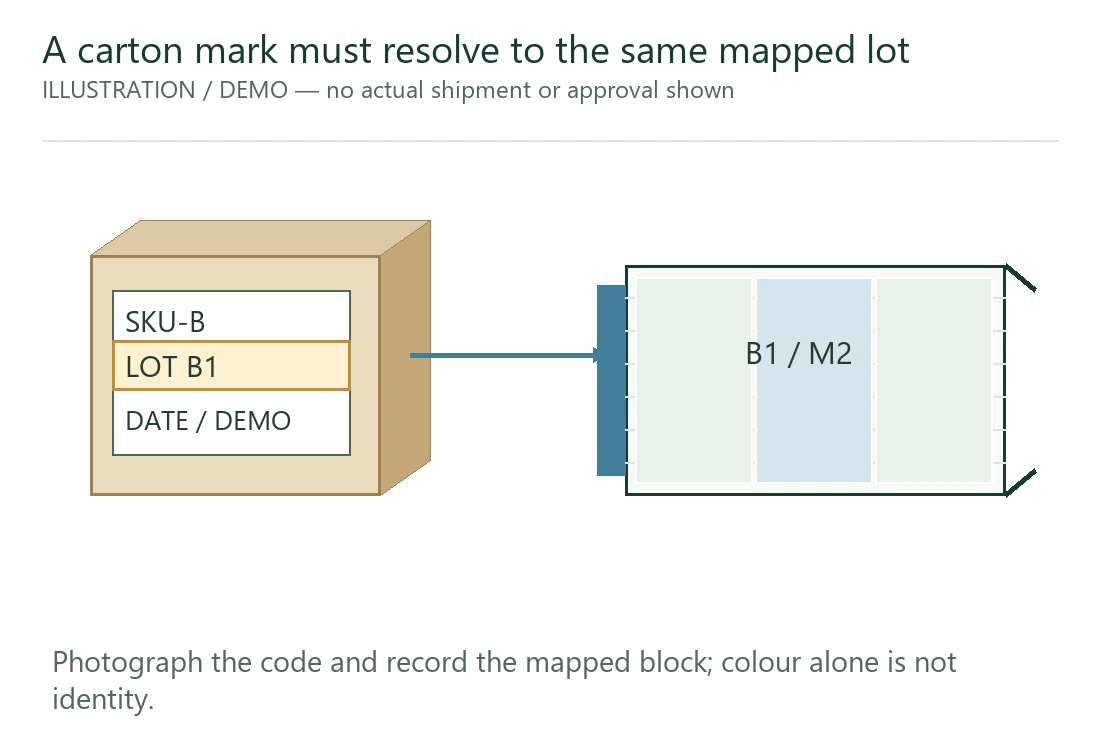
The photographed lot mark must resolve to the mapped position. Illustrative method / DEMO, not shipment evidence. Swipe horizontally on a narrow screen to read the full illustration.
The photo sequence should bridge the empty unit and completed load. Start with the empty reefer and readable container number, then show carton fronts and date marks, a front-facing view during partial loading, the complete load face, half-closed and closed doors, and the final readable seal number. The partial-load frame matters in a mixed container because it shows which blocks were inside before later pallets concealed them. Where an order requires a sample location image, photograph the chosen approved position. Do not insist on both a door and inner position as universal evidence; the sampling plan decides.
Printed codes can vary by line or shift. The tally should not silently normalize them into a cleaner-looking code. Transcribe what is actually marked, then use the production record to resolve an ambiguity. If a scanner or phone OCR is used, sample-check the decoded value against the physical carton, especially for characters such as O/0 and I/1. A perfectly formatted digital file with one wrong lot character is less useful than a hand-corrected record with a linked photograph.
If a buyer requests a particular photo format, define its evidentiary limits. A timestamp overlaid by a camera application is not necessarily a verified time source. A location tag may refer to the device rather than the exact container. We rely on the chain of identifiers: container number, staged carton marks, loading sequence, tally zones, operator, and final seal. Together they make the record reviewable without treating metadata as a substitute for visible content.
Control the approved sample location
Sampling answers a defined question, not a generic request for a photograph. The order or quality plan should specify whether the sample is for temperature, product quality, laboratory testing, retained comparison, or buyer inspection; which SKU and lot it represents; where it is taken; the number of units; and how the result is used. A single carton drawn from the door face cannot automatically represent several lots at the machinery end. A mixed container may require separate lot samples or a documented composite design, depending on the agreed purpose.
For a product-temperature reading, record the actual measured cargo temperature separately from the reefer setpoint, supply-air reading, and return-air reading. Those are four different observations. Include the instrument identity or calibration status, the sample carton and location, the method, time, and operator. The acceptance range comes from the confirmed order specification, not a convenient universal threshold. A controller setpoint at target does not prove the temperature of an IQF product sample, and one good sample does not prove that every carton in a mixed load is identical.
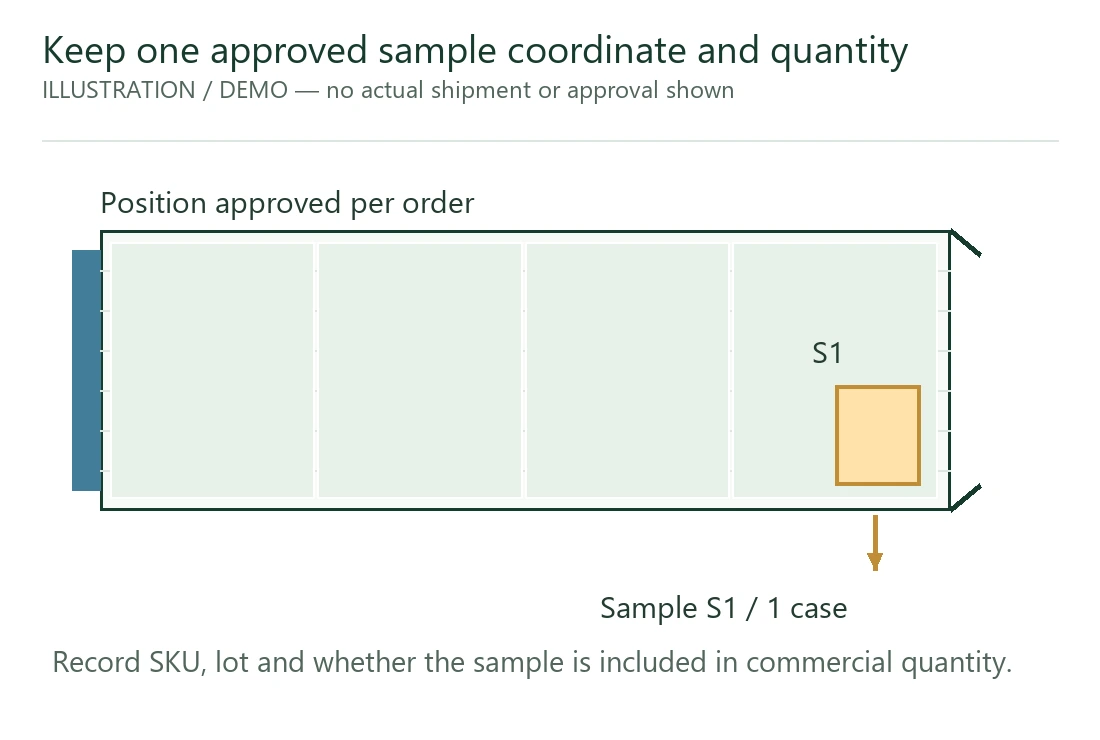
One per-order sample coordinate includes its quantity basis. Illustrative method / DEMO, not shipment evidence. Swipe horizontally on a narrow screen to read the full illustration.
Choose the sample position before loading so it can be accessed or retained without disrupting the map. Depending on the agreed method, that may be a designated carton on a specified pallet, a sample held outside the container under controlled conditions, or a defined position near the door. Each has a different custody path. If the plan calls for a shipment sample inside the box, identify the exact zone and take a photo showing how it can be retrieved. If the sample remains outside, record its storage condition and link it to the shipped lot without implying it traveled in the container.
Protect the product while sampling. Opening a carton, inserting a probe, or holding a unit on a warm dock can change the measured condition or packaging integrity. Use the approved technique and close or replace the carton as required. If the sampled carton is no longer saleable, remove it from the loaded tally and adjust the map. Do not let a sampled unit remain counted as shipped merely because it was originally allocated to a pallet.
The sample record should also describe what happens if a result is outside the order criterion. Hold the relevant SKU or lot, identify its planned and actual positions, verify the measurement and instrument, and let the authorized quality person decide disposition. Do not turn a favorable reefer display reading into a product release. That distinction is especially important in mixed loads where some products may have different approved handling or measurement methods.
Reconcile quantities while loading
Use a running tally by SKU and lot, not just a container grand total. The loading record should show planned cartons, actual cartons, pallet or zone position, and any cartons rejected or replaced at the dock. A total of 1,200 cases can be numerically correct while two 50-case lots are interchanged. The line-level tally is what catches that error. Update it when each pallet crosses the threshold, while the pallet label and carton marks are still visible.
At a pause or shift change, physically reconcile the pallets waiting outside with the map already inside. Record the last completed zone and the next planned zone. Do not rely on a driver's recollection of which mixed pallet was placed at the front. If a pallet is pulled back out, mark a removal event, then either re-enter it at a known location or record a substitute. The as-loaded record should describe the final cargo, not merely the sequence of intentions.
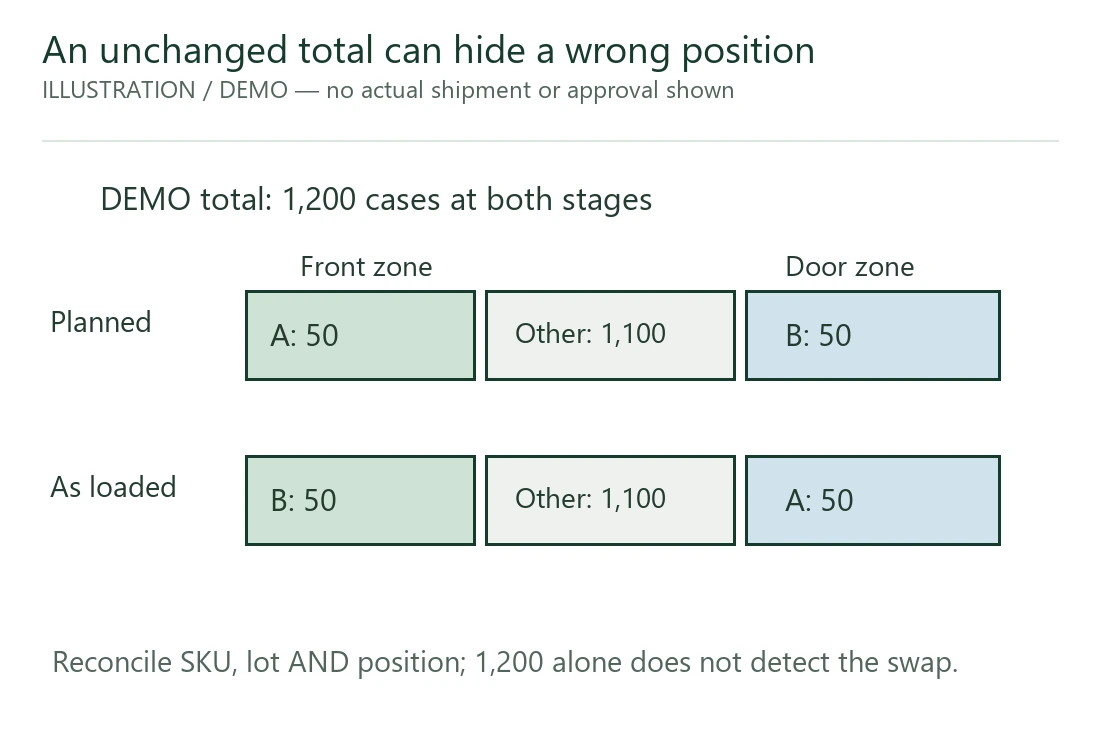
An unchanged grand total can hide a lot-position swap. Illustrative method / DEMO, not shipment evidence. Swipe horizontally on a narrow screen to read the full illustration.
Count discrepancies need a defined resolution path. Recount the affected SKU and lot, inspect the staging area, check whether a sample or damaged carton was removed, and compare the revised packing list. If the count cannot be reconciled before closure, hold closure and inform the document owner and buyer-facing team as required. A short shipment, overage, or wrong-lot substitution can change commercial documents and buyer import planning. It should not be hidden by a grand-total adjustment.
Measure the load actually built. Carton dimensions, pallet footprint, layer count, overhang, and total height should be checked against the approved plan and reefer markings. Record the wrap method, including at least five turns where that internal minimum applies, and verify the actual retention rather than counting film revolutions only. For floor-loaded cartons, confirm stack stability and count by zone. Neither a map nor a tally can compensate for an unsafe or airflow-blocking arrangement.

Original GreenLand product photograph; an example of a product form, not evidence from a particular loading or order. This image is not a loading photograph.
Before the doors close, compare the as-loaded map with the final photograph and the line-level tally. The visible door face should match the lot expected there. Check that the container number, carton quantity, seal-ready doors, and any dunnage notes are complete. VGM and shipping-instruction submission then use the actual packed unit and current carrier cutoff. The IMO VGM guidance addresses the verified mass obligation; a planned carton count is not a verified packed-container weight.
Preserve position evidence without making fake shipment proof
A useful position record combines a simple map, contemporaneous tally entries, and original photographs. Each has a limit. The map states location at a defined granularity. The tally states quantity and identity. The photos show selected visible surfaces and loading stages. None by itself proves every hidden carton. Put the evidence together and leave uncertainty visible. If a zone contains mixed lots because the original plan changed, draw that mixed zone instead of coloring it as a clean single-lot block for presentation.
Photograph the empty interior before loading, with a readable unit number; capture a representative carton front and date mark for each relevant SKU/lot; show the front-facing partial load while inner positions are still visible; then show the completed load, half-closed and closed doors, and the readable seal. A final sealed-door image is strong for closure identity and weak for inner positions. An inner-position image is strong for a visible lot at that moment and weak for the final sealed state. Their different roles are why the sequence matters.
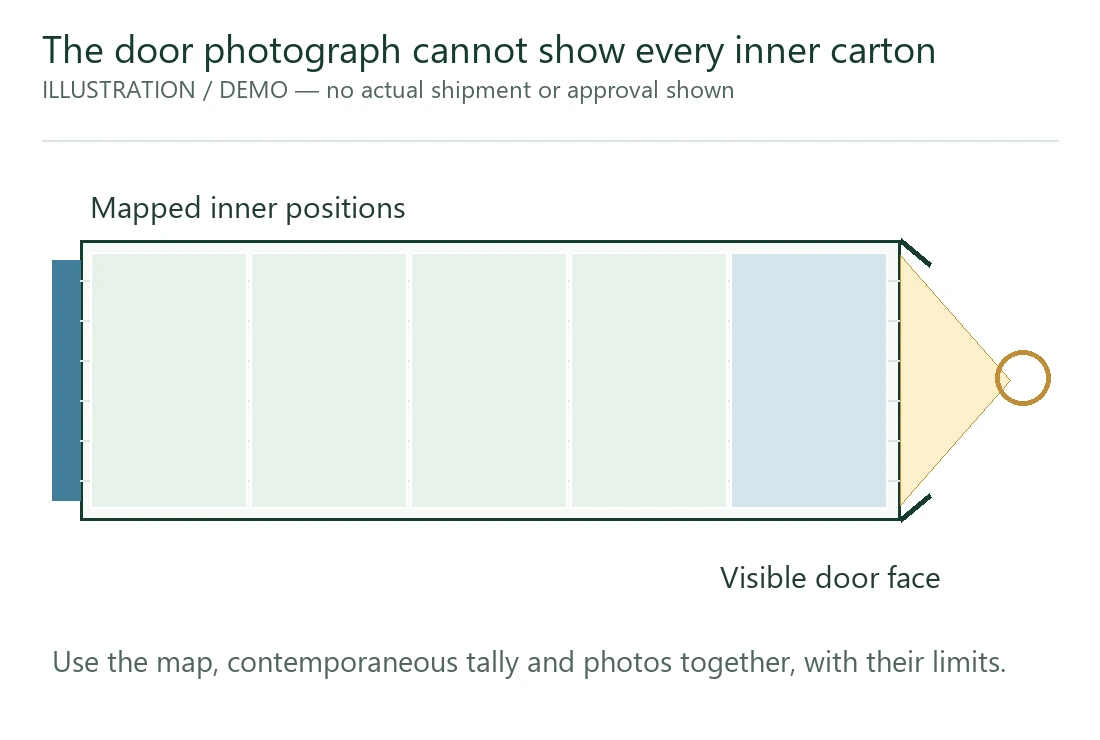
A door photograph has a limited field of view. Illustrative method / DEMO, not shipment evidence. Swipe horizontally on a narrow screen to read the full illustration.
Keep instructional illustrations clearly labeled as illustrations. A diagram can explain how to number zones and where to place a sample marker; it is not evidence that a particular order used those positions. Similarly, a genuine GreenLand product photo can show what a product form looks like without proving that photographed pack was in this container. An article should not display a fabricated loading record, sample certificate, or seal number. For actual shipments, only the order's real originals and approved records can establish those facts.
The records should remain usable after a buyer question. Name files with the unit and stage or maintain an index, retain originals, and link any annotated copies back to them. Store the map version approved before loading and the corrected as-loaded version. If an exception was approved verbally during loading, capture the written decision afterward with its timing and approver; do not erase the initial discrepancy. This history is part of the defensibility of the final map.
Check that public or customer-facing evidence does not disclose another buyer's order, identifiable staff without permission, or invented performance claims. The loading record can be detailed privately without every field appearing in marketing material. The practical standard remains the same: show what was observed, identify the actual unit and lots, and avoid a claim broader than the evidence.
Investigate a partial hold or arrival discrepancy
Suppose the receiver finds a carton with a mismatched date code in the door-side zone. The first response is to preserve the carton and the original loading records, not to assume the entire container is affected or that only one carton is. Compare the physical mark with the representative photos, tally line, pallet ID, and as-loaded map. Identify which units share that traceability code and which zones might contain them. If the map says the lot was at the machinery end, investigate whether a pallet moved during loading, the map was wrong, or a carton was misplaced within a mixed pallet.
Define the hold at the widest boundary the evidence currently supports. A clean single-lot pallet map may allow an initial pallet-level hold. A mixed zone with uncertain cartons may require the whole zone or larger lot to be held until counts and marks are checked. Do not call unaffected lots "proved clear" only because their color on a diagram is different. Check whether they share production time, packaging line, cold-store movement, or a disputed label run. The quality and customer decision depends on the nature of the discrepancy.
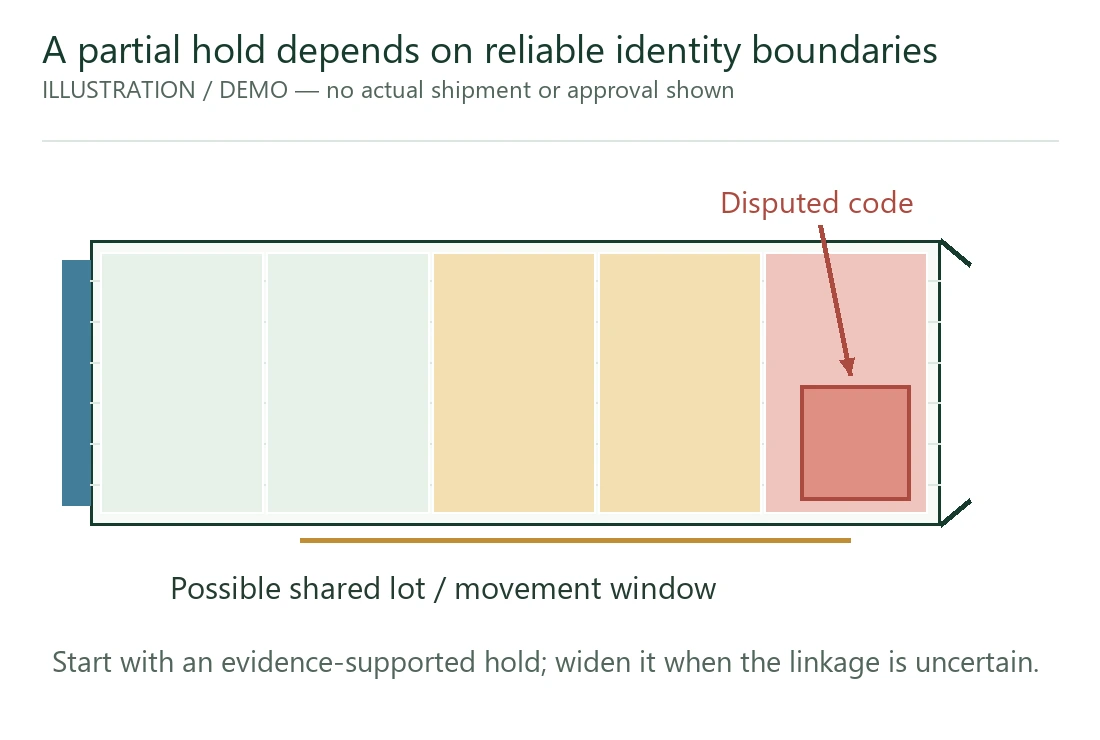
An initial hold boundary must follow the evidence and shared links. Illustrative method / DEMO, not shipment evidence. Swipe horizontally on a narrow screen to read the full illustration.
For a temperature concern, keep the logger time series, controller record, door events, and measured product samples distinct. A warm air spike at loading or discharge is not the same as product-core damage; a normal return-air series does not guarantee every carton remained within its criterion. Use the map to select representative affected positions for inspection, following the approved sampling plan and buyer agreement. Record the time and method of each measurement. A partial hold is only defensible if the position and lot boundaries are reliable enough for that decision.
The as-loaded map also helps with a short receipt. Reconcile container seal identity, pallets and carton counts at opening, then trace any missing quantity to a specific SKU and lot. The photo of the completed door face can support what was visible at origin, but it cannot prove all inner cartons were still present at destination. Receiving counts and custody records close that loop. If the seal is discrepant, preserve its number and condition before cutting it and follow the agreed exception process.
Close the investigation with a corrected record where needed. If the loading map was wrong, do not silently replace the original. Issue a dated correction that explains which evidence established the actual position and what uncertainty remains. The value of a mixed-load map is not that every line looks perfect; it is that a buyer can narrow a question to the right SKU, lot, and physical area without treating an attractive diagram as proof it never had.
Build your frozen food order with GreenLand-food
GreenLand-food is a professional frozen food supplier and manufacturer in China, providing factory-direct wholesale supply for importers, food manufacturers and foodservice programmes.
Send your product form, specification, packing, quantity, application, destination, private-label needs and requested documents. We will organise the product and order requirements with your purchasing and quality teams.