


From Loading Tally to Packing List: Frozen Food Shipment Data and VGM
Oct 21, 2026
Leave a message

Reviewed 21 October 2026. Shipment requirements are checked for the actual product, route and filing date.
Establish the approved order and document versions
Before loading, identify the approved order version, SKU descriptions, pack sizes, quantity tolerance, lot or production-date requirements, carton marks, destination, Incoterm, and any customer-specific document fields. Confirm who may approve a change. A salesperson's message about a possible substitute is not necessarily an amended purchase instruction. Use version numbers or dated approval references so the loading and document teams can distinguish current requirements from superseded drafts. If the buyer has a special sample or label requirement, include it in the load brief before cartons are staged.
The initial load plan should be measured rather than inferred from nominal case size. Use actual outer carton dimensions, pallet footprint, stack height, gross weights, dunnage, and the reefer's usable loading geometry. Check T-floor air channels, front bulkhead and return-air path, load-height marks, and door clearance. A spreadsheet can predict carton capacity, but the as-loaded record must reflect real pallets and any partial layer. Internal wrap guidance of at least five turns is a minimum to verify with the actual film method, overlap, base capture and stability; it does not replace a load-security check.
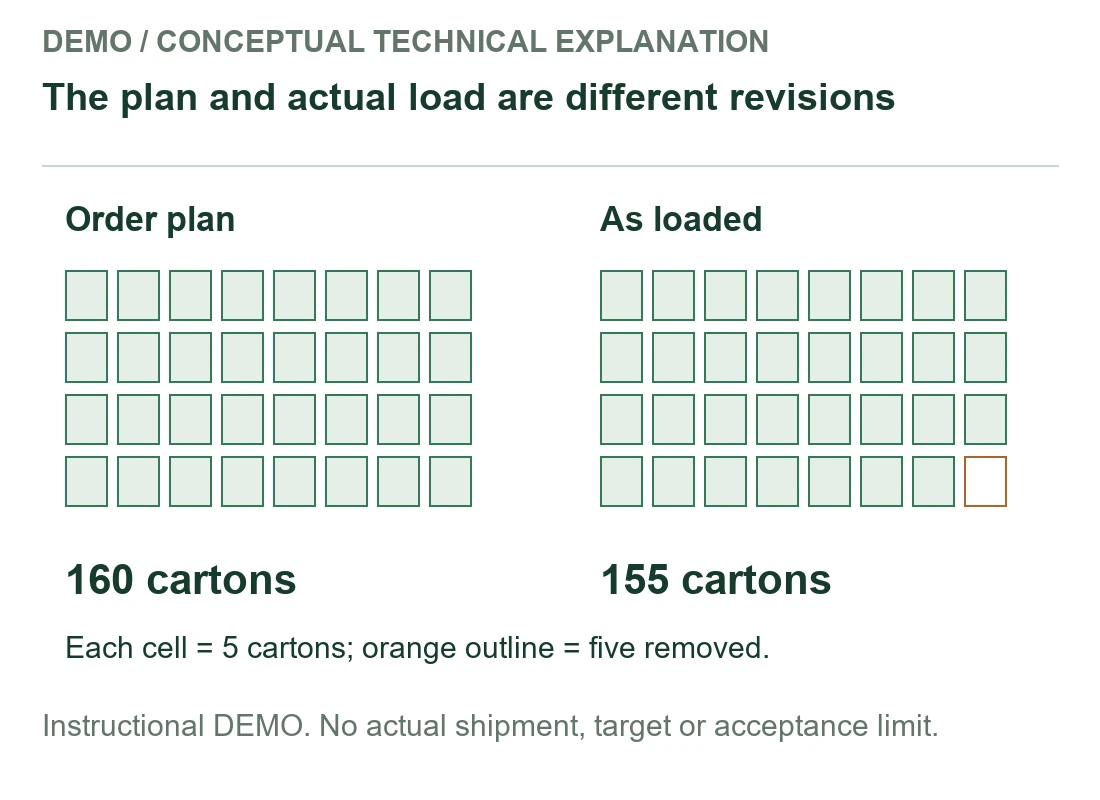
The plan and actual load are different revisions. Instructional DEMO; all numerical values are illustrative and are not order targets or limits. Swipe horizontally on a narrow screen to read all labels.
Assign a single source of truth for each field. The container number comes from the physically presented unit and booking reconciliation. The seal number comes from the seal applied after the doors close. Actual carton quantity and SKU/lot allocation come from the loading tally, not a sales forecast. Carton net and gross weight come from the approved pack specification and verified weighing process, subject to actual exceptions. VGM comes from an accepted weighing method for the packed container. A document preparer should know which person and record can authorize a change to any field.
Start the tally template with the approved rows, but keep planned and actual columns distinct. A prefilled actual column invites a later rubber stamp. Record the loader or checker, container number, start time, SKU, lot/date code, pallet or zone position, planned cartons, counted cartons, rejected or sampled cartons, and remarks. If a scan system is used, reconcile its events with the physical count; a scan can be missed, duplicated, or applied to a pallet that never enters the container.
Check current carrier deadlines early. Maersk's Indonesia export information is an example of location-specific instructions; the live booking or carrier portal supplies the actual shipping-instruction and VGM cutoff for this sailing. Note time zone and submission channel. A cutoff copied from another service is not a safe operating margin. If loading may run close to it, define who will stop, escalate, or seek an accepted amendment rather than hoping the final numbers match the draft.
Count actual cartons by SKU and lot at the door
Count the cartons that physically cross the threshold. For palletized cargo, verify the pallet label, carton fronts and lot or production-date marks against the row being tallied, then record the actual cartons on that pallet. A pallet label is useful, but it can be wrong or stale after rework. Where a mixed pallet is allowed, break its count down by each SKU and lot. If a carton is damaged or taken as a destructive sample, remove it from the shipment count unless it is replaced and actually loaded.
The container grand total is a final checksum, not the primary traceability record. Two lots can be swapped while the total stays unchanged. A case can be added to one SKU and missed in another. Keep separate rows for products whose descriptions, cuts, packs, or dates differ. A frozen broccoli carton and a mixed-vegetable carton may have similar dimensions but different buyer specifications and labels. Genuine product photographs can illustrate those forms in an article; for a live shipment, only readable carton-front and date-mark images from that loading event support the tally.
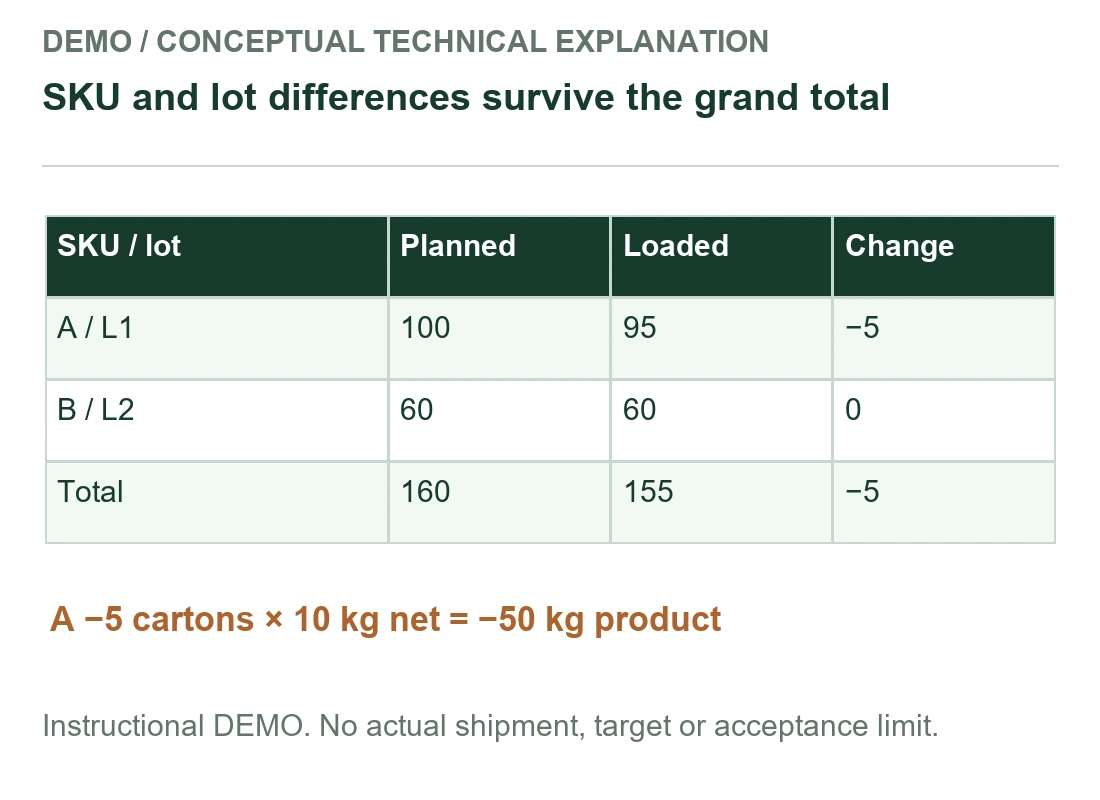
SKU and lot differences survive the grand total. Instructional DEMO; all numerical values are illustrative and are not order targets or limits. Swipe horizontally on a narrow screen to read all labels.
Confirm the actual frozen-food order
Share the product form, pack, quantity, destination, order-specific temperature criterion and evidence requirements. We can reconcile the loading and quality instructions with the selected product specification.
Review a genuine product example
Request Specifications & QuoteMap actual positions at a practical resolution. Record pallet row, left/right zone, or floor-loaded stack as applicable, from machinery end toward the doors. If a planned pallet is moved because of fit, stability or airflow, update the position at the time of movement. Do not reconstruct the map solely from a final door photograph. The FDA traceability resources illustrate the importance of linked identifiers and events, although applicability depends on product and market; our map supports order-specific investigation rather than claiming universal regulatory compliance.
Pause for reconciliation at defined points, such as each pallet row or shift change. Compare staged stock, tally entries and loaded positions. If a pallet is removed, enter a reversal and a new event if it returns. Preserve the original line and correction rather than overwriting it with a clean-looking final number. If the count differs from the order, ask whether the cause is a short pick, damaged carton, extra case, sample removal, incorrect pack quantity, or a substitution. Each cause has a different approval and document consequence.
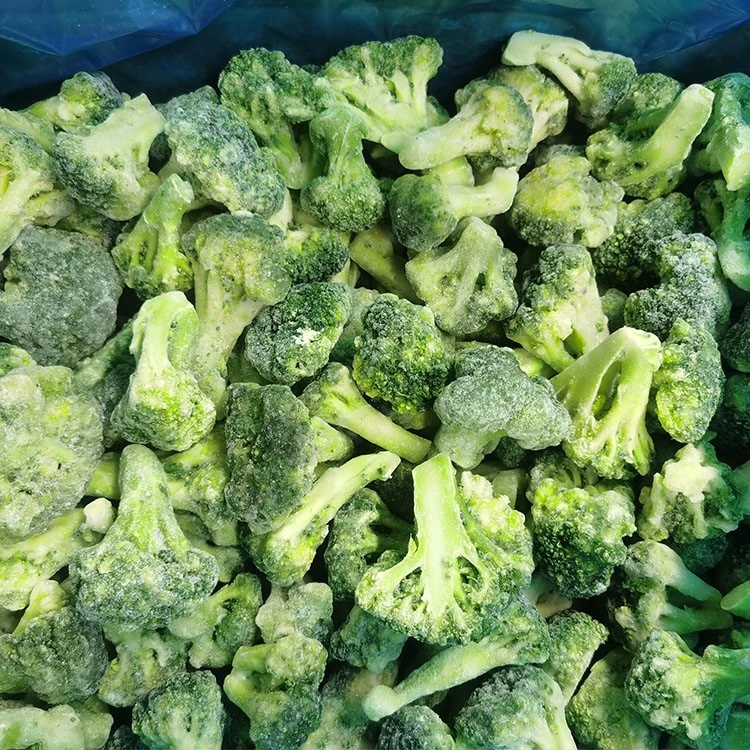
Original GreenLand product photograph; an example of a product form, not evidence from a particular loading or order. This image is not a loading photograph.
The photo sequence should support the count without pretending to replace it: readable empty container number and interior, carton fronts and date marks, a front-facing partial load, complete load face, half-closed and closed doors, and the final seal number. The approved sample position is chosen per order. A door sample and inner sample are not both mandatory for every shipment. Record measured product temperature from the approved sample separately from reefer setpoint, supply air and return air, with the order's actual numeric criterion.
Reconcile weights, packs and the packing list
After loading, sum actual cartons by SKU and lot, then calculate commercial net and gross values according to the agreed pack definition. Net product weight excludes packaging; gross carton weight includes the carton and any inner packaging under the specification. Pallet and dunnage masses may belong in shipping gross or packed-container mass calculations even when the buyer's commercial packing list shows carton gross separately. Label each figure so a reader can tell which components are included. "Gross weight" without a defined basis invites a discrepancy at customs, terminal, or destination.
Suppose an order specifies 10 kg net per carton and an approved gross carton mass. If five cartons are removed because of damage, the final net product total falls by 50 kg, but the gross change depends on the actual cartons and their packaging. The numbers in this example illustrate arithmetic only; the real shipment uses its approved pack and actual count. Do not force the declared gross to a round number merely because the booking forecast used one. Review any materially unexpected difference against count, pack size and weighing records.
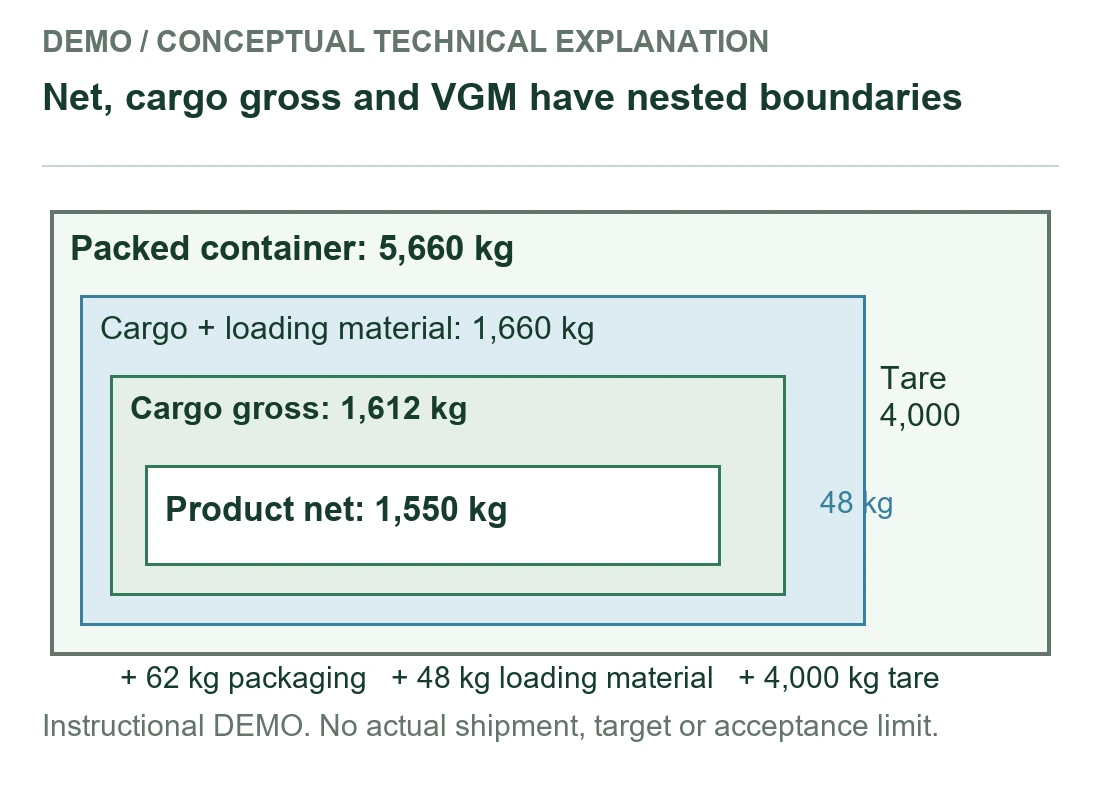
Net, cargo gross and VGM have nested boundaries. Instructional DEMO; all numerical values are illustrative and are not order targets or limits. Swipe horizontally on a narrow screen to read all labels. Areas show set inclusion, not mass or carton proportions.
Packing list lines should preserve the buyer's necessary detail: SKU or product name, pack description, cartons, net weight, gross weight, lot or production date where required, and pallet count if used. If several lots share a SKU, decide whether to show separate lines or an attached lot schedule according to the buyer and import requirements. A single combined line can be commercially acceptable in one context but inadequate for a traceability request in another. The attachment and main document should reconcile to the same totals.
Check container and seal numbers only after their physical events. The container number is confirmed before loading; the seal is recorded after closure. A draft packing list may leave the seal field blank. Do not fill it from a planned seal inventory entry. If the container changes because an empty-unit inspection fails, recalculate the applicable weight and identity fields for the replacement. If a seal changes after authorized inspection, retain both origin and current seal in the event log and update recipients under the carrier process.
The packing list should be reviewed against the final tally by someone who did not merely copy the same draft numbers into both. Compare line counts, totals, units, dates, and identifiers. A checksum can catch arithmetic errors; a physical record review catches wrong-lot or wrong-SKU errors that totals miss. Keep the approved final version and the underlying as-loaded evidence together so a later correction can be traced.
Prepare shipping instructions from controlled fields
Shipping instructions (SI) are a carrier-facing data submission, usually including parties, vessel or booking references, cargo description, package count, weight, container and seal identity, and bill-of-lading particulars. The precise field set and deadline depend on the carrier and service. Populate SI from the reconciled final packing list and booking, with the physical container and seal record as identity sources. Do not let an old booking draft override the tally if the real load changed.
Use a field map to show the origin of each important value. Package count traces to actual tally and final packing list. Product description traces to approved order and compliant document wording. Gross mass traces to the correct weighing or pack calculation according to that field's definition. Container and seal numbers trace to observed physical identifiers. Consignee and notify-party details trace to approved commercial instructions. A checker should be able to follow any field back to one authority rather than choosing between several emailed spreadsheets.
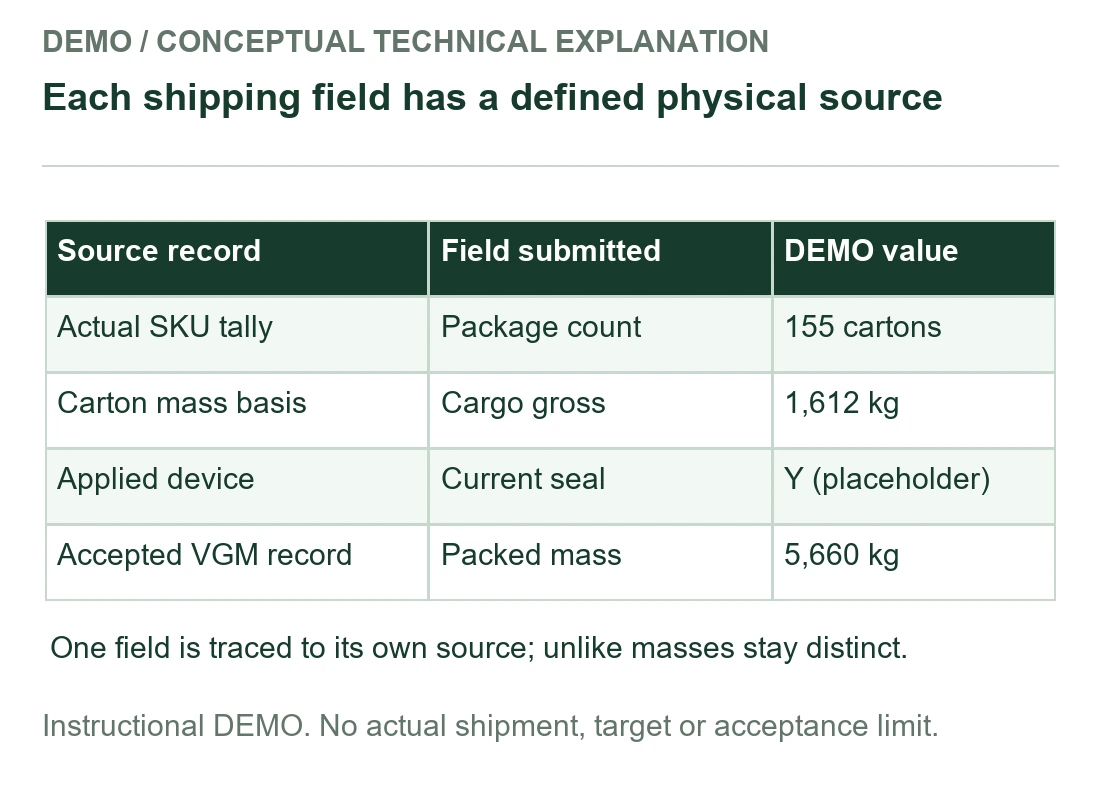
Each shipping field has a defined physical source. Instructional DEMO; all numerical values are illustrative and are not order targets or limits. Swipe horizontally on a narrow screen to read all labels.
Before submission, reconcile SI totals with the packing list and booking. A mismatch between cartons and packages may be legitimate if pallets are declared as transport packages under a specific carrier rule, but it must be understood, not accidental. Likewise, a customs description may differ in wording from a sales product name while still referring to the same goods. Review such differences explicitly. If a field is changed in the portal after a draft PDF is circulated, preserve the portal receipt or confirmation showing what the carrier actually accepted.
Time matters. The carrier may have distinct SI, VGM, gate-in and customs deadlines. Maersk's current local page must be checked for the specific booking and updated when the service changes. Record local time zone, cutoffs, who submitted, when, and acknowledgement. A document prepared before cutoff but not accepted by the carrier is not the same as a completed submission. If the website rejects a change, escalate through the accepted channel and retain the error and resolution.
Keep the loading team informed of any documentary constraint that could affect closure. An unresolved product description or weight discrepancy should be resolved before the seal is applied when possible. Once the unit leaves, a physical recheck becomes costly and can create a new seal event. The aim is an accurate, reviewable submission, not a rush to put every field into the portal first.
Determine VGM by the accepted method
Verified gross mass (VGM) is the mass of the packed container. The IMO MSC.1/Circ.1475 guidance describes two methods: weighing the packed container with suitable calibrated and certified equipment, or weighing all packages and cargo items plus pallets, dunnage and other securing material and adding the container tare, where the competent authority permits that method. The chosen process must meet the applicable national rules and carrier submission requirements. A forecast based on nominal cartons is not VGM.
Method 1 uses the actual sealed or otherwise packed unit and an accepted weighbridge or scale procedure. Record the container identity, weight result, equipment and calibration evidence as required, time, responsible shipper or representative, and any tractor or chassis deductions made by the approved method. The weigh ticket must correspond to the actual unit submitted to the carrier. A ticket for a rejected container cannot be carried over to a replacement simply because the cargo count is the same.
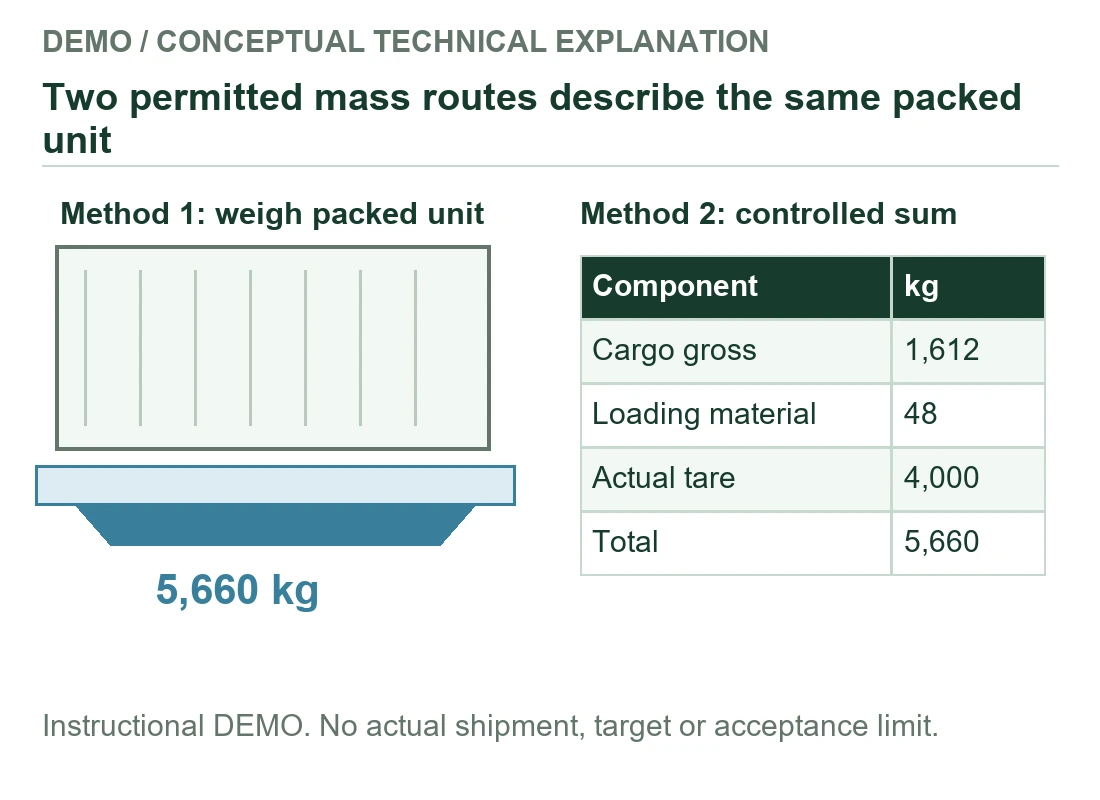
Two permitted mass routes describe the same packed unit. Instructional DEMO; all numerical values are illustrative and are not order targets or limits. Swipe horizontally on a narrow screen to read all labels.
Method 2 requires reliable constituent masses and the actual container tare. Add cargo and package weights, pallets, dunnage, bracing and other material inside the box, then tare. Use the permitted certification or control process. Do not omit wrap, pallets, or dunnage because they do not appear as commercial product on the packing list. Conversely, do not count a pallet twice by adding a "palletized gross" that already includes the pallet plus a separate pallet weight. Define every component in the calculation sheet.
The packing list gross and VGM need not be identical because they can include different components. The reconciliation should explain the bridge, not forcibly equalize the figures. Check the VGM result against container payload and road restrictions, and investigate unexpected differences. The shipper's authorized person submits the verified value through the carrier's accepted channel by the actual cutoff, retaining acknowledgement. IMO guidance does not provide a universal number of hours before departure for every port; use the current booking.

Original GreenLand product photograph; an example of a product form, not evidence from a particular loading or order. This image is not a loading photograph.
If cartons are added or removed after VGM, or the container changes, the verified result may no longer describe the packed unit. Follow the approved reweighing or recalculation and amendment procedure. A new seal after inspection does not necessarily change mass, but an inspection that removes samples or repacks cartons can. Record the physical event before deciding whether the VGM remains valid. The traceable calculation is as important as the final number.
Handle a late variance against the actual cutoff
A variance found near deadline needs an ordered response. Stop treating the draft as final; identify the changed SKU, lot, carton count, weight, container, or seal field; locate the physical evidence; and notify the authorized document owner. Check the current local SI and VGM cutoffs, portal status, and transport milestone. The decision may be to amend before cutoff, seek a carrier-accepted late correction, delay gate-in, or hold the unit. The right route depends on the carrier and booking, not on a generic article timetable.
Separate an arithmetic correction from a physical load correction. If the tally line was added incorrectly but the photographed and counted load is sound, revise the document with an audit trail. If a pallet was actually omitted, the container may need to reopen, with a controlled seal break, new tally, final-load photo and reseal. If a wrong lot entered the box, quality and the buyer may need to decide whether it can remain. A quick number change in SI cannot resolve a physical nonconformity.
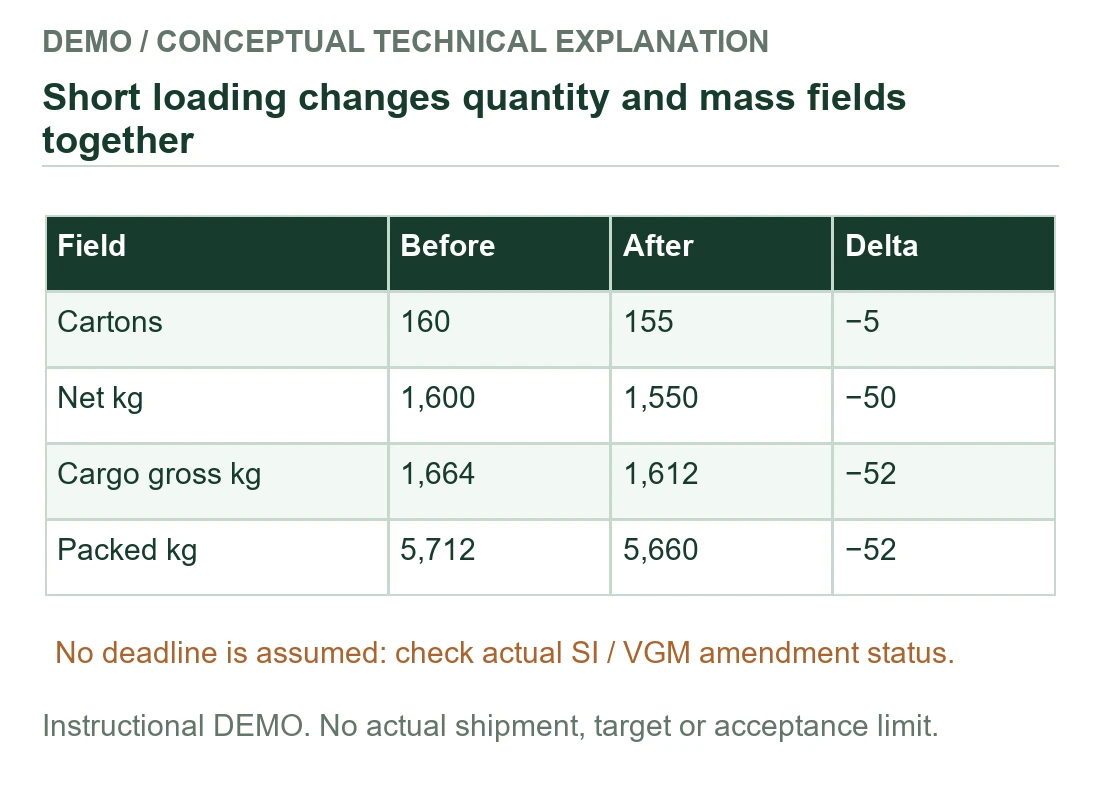
Short loading changes quantity and mass fields together. Instructional DEMO; all numerical values are illustrative and are not order targets or limits. Swipe horizontally on a narrow screen to read all labels.
The independent diagram DEMO makes the mass change visible. Five removed cartons contain 50 kg of product and 2 kg of packaging, so cargo gross mass falls by 52 kg, rather than by the 50 kg net figure. The remaining 155 cartons account for 1,550 kg net and 62 kg packaging. With the stated 48 kg of loading material and 4,000 kg container tare, the illustrative packed total is 5,660 kg. These are declared teaching inputs, not an actual VGM certificate. Recheck component quantities when the loading arrangement changes; do not assume that pallet or securing mass falls in proportion to carton count.
When the unit reopens, protect cargo condition. Record the old seal and authority for opening, duration of door exposure, any cartons moved or sampled, actual product-temperature measurements required by the order, new complete-load state and new seal. Keep reefer setpoint, supply and return readings separate from measured cargo temperature. An air reading at the moment of opening is not a substitute for the product release check. Revise the as-loaded map and quantity record before submitting corrected documents.
Communicate changes to every party relying on the previous version. The carrier may have accepted SI and VGM separately; a packing-list revision does not automatically update both. The buyer may have received an old packing list. The forwarder or customs broker may have filed a declaration. Send the corrected version with a clear revision identifier and a concise change description through the agreed channel. Retain the receipt or acknowledgement so the team knows which version was used.
If the cutoff has passed, do not backdate a correction or claim acceptance because an email was sent. Record the attempted submission, error, carrier response, and operational decision. A departure delay is inconvenient, but an unsupported document can create a larger arrival problem. The escalation should state the actual cargo and the deadline constraint so the responsible party can make a defensible choice.
Archive the final source-to-document reconciliation
The final file should let a reviewer move from the physical load to each declared document without guessing. Keep the approved order version, load plan, empty-unit and staged loading photos, carton-front and date-mark examples, order-approved product-temperature record, as-loaded tally, pallet or zone map, final packing list, SI submission receipt, VGM calculation or weigh ticket and acknowledgement, seal record, and exception decisions. Use an index that identifies the source and final revision of each item.
The archive should retain earlier versions when they explain a material change. A rejected empty container, moved pallet, adjusted count, authorized reseal or revised SI is not embarrassing noise to erase; it is the context that makes the final number credible. Mark obsolete versions clearly so they are not accidentally resent. Keep original photos and instrument files alongside annotated copies. An annotation can guide a reviewer, but the original provides the unmodified observation.
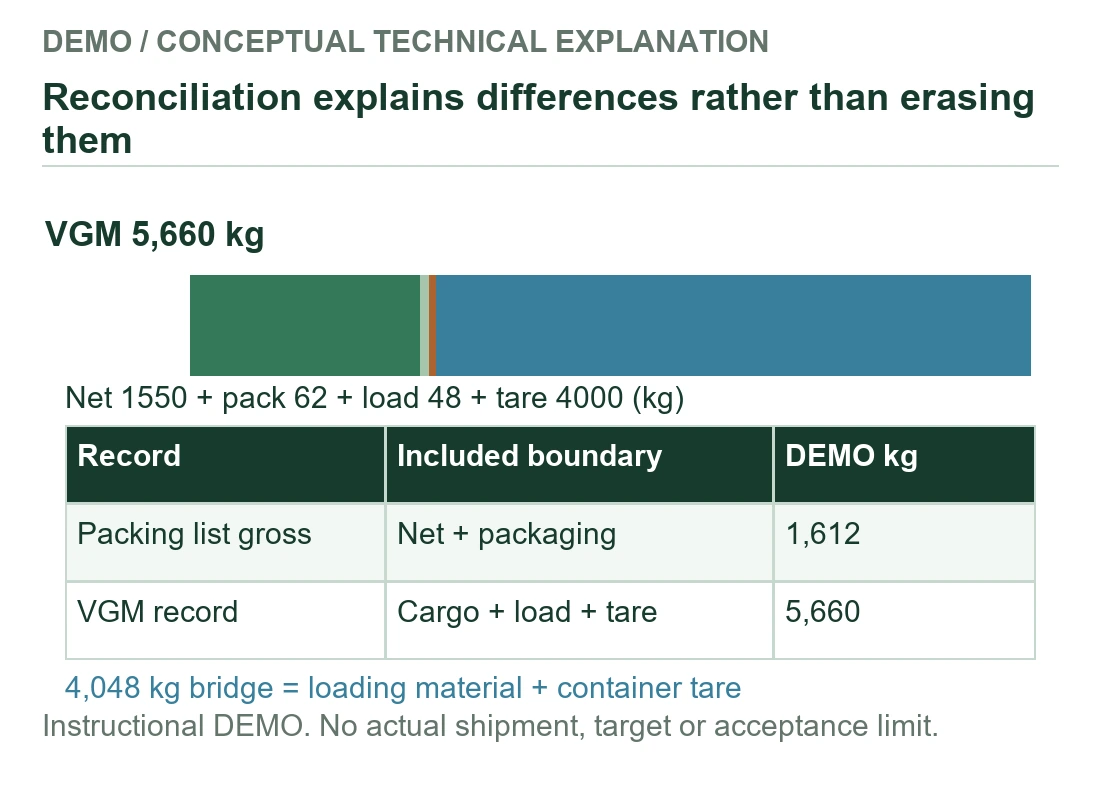
Reconciliation explains differences rather than erasing them. Instructional DEMO; all numerical values are illustrative and are not order targets or limits. Swipe horizontally on a narrow screen to read all labels.
Check cross-document invariants one final time: physical container number, final seal history, SKU and lot quantities, carton and pallet totals, weight definitions, buyer and consignee details, and the dates of carrier acceptance. A discrepancy may have a legitimate explanation, such as packing-list gross excluding container tare while VGM includes it. Write that explanation in the reconciliation rather than forcing the figures to match. The reviewer's task is to see a coherent chain, not identical numbers in unlike fields.
At destination, a claim or receiving discrepancy should begin with the same archive. The receiver's seal and count observation can be compared with the origin record. A logger trace can be compared with actual measured product values and door events. A wrong-lot question can be narrowed through carton marks and positions. The archive cannot prove hidden conditions it never observed, but it can show exactly what was loaded, what was declared, what changed, and who accepted each correction.
That is the practical value of the tally-to-document process. It turns a shipping paperwork task into a controlled statement about an identified container and an actual frozen-food load. The work takes minutes at the door and a disciplined reconciliation before cutoffs; it saves far more time than reconstructing a shipment from unmatched spreadsheets after the vessel sails.
Build your frozen food order with GreenLand-food
GreenLand-food is a professional frozen food supplier and manufacturer in China, providing factory-direct wholesale supply for importers, food manufacturers and foodservice programmes.
Send your product form, specification, packing, quantity, application, destination, private-label needs and requested documents. We will organise the product and order requirements with your purchasing and quality teams.