


Buying Frozen Edamame for Singapore: Whole-Pod Service or Seed Recovery
Oct 20, 2026
Leave a message

Key takeaways
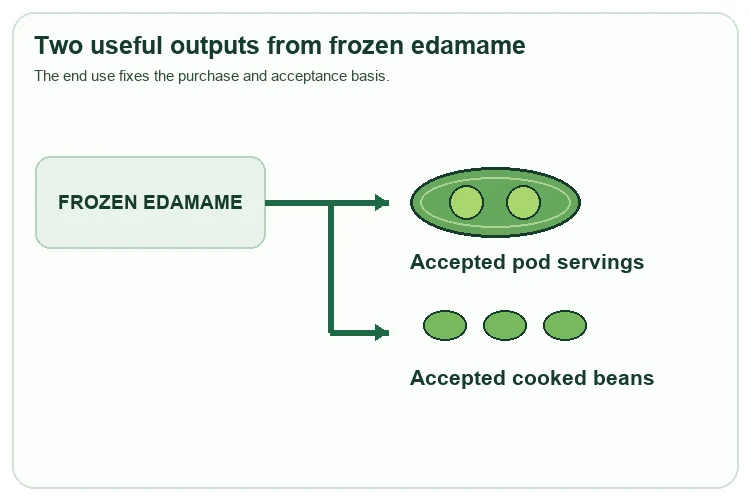
- Specify pod service in accepted servings, with an agreed empty-pod and defect count.
- Specify ingredient use in acceptable cooked, drained bean kilograms, after the buyer's real heating and dosing process.
- Keep purchase price, local labour and waste on the same output denominator; confirm the result on a production sample before locking the order.
Choose the service outcome before buying a form
The first conversation should describe the finished serving. In a restaurant, whole pods may be an intentional part of the experience: they are heated, perhaps seasoned, set in a bowl and shelled by the guest. The fibrous pod is discarded. Bean yield still matters because a flat or empty pod disappoints the customer, but the kitchen does not need to extract and dose every seed. A good quote for this use tells the buyer how many acceptable portions its frozen net weight can make under an agreed portion size and service method.
A central kitchen has another output. If edamame is mixed into a prepared rice meal, portioned into a grain bowl or blended into a filling, it needs edible beans at a predictable dose. Buying frozen in-pod stock means somebody must heat, shell, separate, inspect and dispose of pods. Buying already-shelled IQF beans moves shell removal upstream, though the factory still needs to define whether the beans retain their seed coats and whether the customer must cook them. Virginia Tech Extension describes frozen pods and frozen shelled beans as distinct commercial forms and notes the labour of shelling. That distinction should appear in the RFQ, pack description and sample label.

In-pod product view from the GreenLand gallery. The pictured ruler is a form reference, not an order grade.
We would create two SKU briefs even if one importer buys both. Route A says plain, blanched IQF in-pod edamame for heated appetizer service. Route B says plain, blanched IQF shelled edamame for a cooked meal ingredient. Each brief records the actual soybean identity, intended heating, ingredients, pack and carton configuration, source facility to be approved, and the destination. If a buyer requests salt or seasoning, that is an additional formulation decision and needs a revised ingredient and label review. "Shelled," "peeled" and "kernel" are not reliable synonyms across every catalogue; the agreed photographs and sample should show exactly which outer layers are present.
In-pod and shelled offers should be compared within their own commercial job before a final program decision. An attractive whole pod may justify a higher ingredient cost when guests value presentation. A slightly imperfect but intact shelled bean may work well in a cooked filling even though it would fail a premium snack appearance test. Conversely, an inexpensive pod carton may be a poor choice for industrial bean recovery if many pods are empty or the kitchen spends too much time extracting beans. The buyer should record that tradeoff in the use statement rather than asking the supplier for a single "best grade."
For a mixed distributor, separate item codes prevent accidental substitution. A restaurant customer should not receive shelled beans when its menu promises pods, and a ready-meal factory should not receive pods against a dosing specification. We can show the importer our frozen edamame product range while defining each quote against its actual customer. Product pages are starting points for form selection; the order specification and approved sample remain the purchase references.
Define an in-pod appetizer specification that counts empty pods
Pod count alone is a weak grade. A count of pieces per 500 g can be precise yet hide empty pods, single-bean pods, split seams or soft, yellow shells. Start with a frozen net-weight sample, state whether loose ice is included or removed, and count all pods in it. Then separate full two- and three-bean pods, one-bean pods, empty or nearly empty pods, broken pieces, discoloured pods and other agreed defects. A pod with a visible bulge should be cut or shelled during the trial so an attractive outline does not substitute for actual fill.

An empty-pod limit needs a counted sample and a stated denominator.
The purchase sheet needs a denominator for each limit. "Empty pods below 2%" is ambiguous until it says whether that is percentage of counted pods, frozen pod mass or cooked service portions. Define a minimum sample mass, carton positions and the number of production timepoints. Report the actual count and percentage by the chosen basis, with a photo standard for borderline cases. A 500 g sample drawn from one attractive display bag cannot represent a whole production run or a reefer shipment. We would ask the processing partner to keep a signed record of how the selected crop and line meet the customer's agreed grade.
Appearance and handling belong in the same specification. Record pod length range or pieces per net weight if those matter to the bowl, stem length, colour, insect or field damage, seam integrity, foreign material, loose frost and free-flowing condition. Agree which defects are visual rejections and which are commercially acceptable. A chef may accept a wider pod-length distribution in a heavily seasoned snack but still reject a high empty-pod rate. A retail buyer looking through a clear pouch may set a stricter visual range. These are negotiated product requirements, not universal edamame grade numbers.
The cooked sample should also be inspected. A frozen pod can look green, then turn dull or become stringy after the restaurant's boil, steam or microwave cycle. Record drained weight, pod integrity and bean tenderness at service. If the menu holds bowls for a period before pickup, inspect them at the actual hold point. If staff reheat small batches, include that stage. These observations protect the buyer from accepting an attractive frozen photograph that performs poorly in the real kitchen.
An empty-pod allowance is a commercial promise that must be possible to inspect on arrival. Agree how the receiving team will sample sealed cartons, whether a second inspection follows the kitchen cook, and how a disputed sample is retained. The supplier's release record and the buyer's receiving method should describe the same defect categories. We can prepare sample photographs and a count sheet, but the signed acceptance limit must be agreed with the buyer and confirmed for the actual crop and production lot.
Measure edible seed recovery on a controlled basis
For ingredient use, the useful question is how much acceptable bean mass reaches the recipe from one delivered kilogram. The pod itself is purchase weight for in-pod stock, yet it does not enter the dish. Seed recovery therefore needs a mass balance. Weigh frozen product as received; document loose ice and bag tare; heat by the agreed method; drain for a fixed period; separate beans; weigh pods and other rejects; then weigh only acceptable cooked beans. Record splits, hard beans, discolouration or stray pod material separately. The bean mass divided by the original frozen net mass is the observed acceptable recovery for that trial.

The accepted cooked bean mass is measured after heating, draining and sorting.
That calculation is different from a raw shell-out percentage. Heat can add or remove water, draining can change the mass, and the buyer may reject some beans after shelling. If a laboratory or supplier reports "edible yield," ask which stage it weighed and which pieces it accepted. A percentage measured on a raw field sample cannot be pasted onto a blanched frozen carton. Likewise, an edible-portion nutrition panel is a food-information basis, not a guaranteed extraction rate for a kitchen.
The same discipline applies to already-shelled beans. There is no outer pod in the purchased pack, but a finished yield can still fall through loose frost, cooking loss, splits, skins, colour sorting or a recipe's texture rejection. Weigh frozen shelled input, heat it as the customer will, drain and classify accepted beans. Note whether the beans are dosed hot, cooled, or exposed to a second cook inside the final meal. A shelled quote should state allowable broken beans and any pod fragments or foreign matter. "100% edible" would be an unsafe shorthand for an industrial acceptance calculation.
Run the routes as paired trials where possible. Take packages from the proposed production window, identify the lot, use the same scale calibration, and record operators and equipment. The pod route requires a shelling-time record in minutes per accepted bean kilogram. The shelled route requires a handling and dosing-time record. If the buyer plans to scale from a small test to a production kettle, repeat at a realistic load; crowded heating and a different drain screen can change both texture and water retention. Keep the first trial as design evidence and the production-scale trial as a release condition.
We would help the buyer express recovery as a range with an agreed acceptance statistic after real samples, not promise one universal ratio. Varieties, harvest maturity, pod-fill grade, blanching, freezing and the preparation method all change the result. A retained reference sample and a repeatable method make the next crop discussion more useful than an unsupported percentage in a quotation. The public usable-yield and cost worksheet T03 keeps the starting mass, accepted output and cost entries together with the agreed trial method.
Run heating, holding and reheating trials on both forms
The trial method should follow the actual service route. For whole-pod restaurant service, use the customer's batch size, water or steam equipment, starting frozen condition, seasoning stage and drain setup. Record the heating endpoint chosen by the kitchen's food-safety process, then observe pod colour, seam condition, bean tenderness and surface moisture at the point of service. A supplier's blanch step helps quality control; it does not establish that an arbitrary frozen SKU is ready to eat. The final cook instruction should reflect the actual formulation and process.

A matched kitchen trial records the actual service or dosing endpoint.
For shelled beans in a central kitchen, follow the recipe sequence. Some customers may add beans to a hot rice dish; others may cook them separately, chill the cooked ingredient under their validated process, then reheat in a finished meal. Each route has different exposure to water and heat. A bean that tastes good after one short preparation may soften, wrinkle or split after the full process. Record the bean's appearance and bite at the final consumer stage, not only immediately after the first kettle.
Holding and reheating deserve their own observations because they influence a Singapore foodservice buyer's usable output. For an appetizer, warm-held pods may dry at the seam and become less inviting. For a meal component, beans may lose colour or break when stirred and portioned. Make a small coded comparison between two candidate lots or forms under the same defined schedule. Photograph the same fixed sample position at the same timepoint, and weigh drained product with the same method. This is more useful than choosing the brightest unopened frozen bag.
The food-safety team must establish the time and temperature instruction for the actual SKU and channel. We would provide the actual processing description and available validation or COA records for review; the buyer's kitchen validates its preparation and service procedure. Do not derive a safe endpoint from a generic blog cooking time, and do not use a negative blanch-enzyme result to claim ready-to-eat status. If a customer wants a cold application, that changes the risk and instruction review and should be raised before a quote is finalised.
Record what failed as carefully as what passed. If the pod route gives excellent fill but poor colour after reheating, the buyer may change its batch plan or request another grade. If the shelled route preserves texture but has too many fragments for a visible grain bowl, it may still be suitable for a cooked filling only after the customer accepts that application and price. We can compare sample performance with the buyer in the customer trial and application worksheet T08; the signed trial record should remain attached to the chosen SKU and lot window.
Compare two quotation routes by accepted output
A supplier can quote both forms per frozen net kilogram, but a purchase committee needs a second calculation tied to use. Route A is an in-pod foodservice offer: divide delivered product spend by accepted cooked pod servings. Route B is a shelled IQF ingredient offer: divide delivered product spend by accepted cooked, drained bean kilograms. Add local shelling or dosing labour, energy, packaging and disposal on that same denominator. Then compare the alternatives that actually produce the same finished item. A pod appetizer and a bean ingredient are different menu products, so their per-serving and per-bean-kilogram numbers should not be placed in one ranking.
The following is a fictional arithmetic example, using Singapore dollars only as an illustrative unit. It is not a GreenLand quotation, tested lot, market price or promised yield. Suppose a restaurant receives 100 kg of in-pod product at SGD 4.00 per frozen kg, delivered to its freezer. Its defined serving uses 180 g frozen pods, and the trial finds 90% of theoretical portions acceptable after grading and preparation. One hundred kilograms could make about 555 theoretical portions; 90% yields 500 accepted portions. The product spend is SGD 400, or SGD 0.80 per accepted portion. If local preparation and disposal cost SGD 100 for this batch, the comparable operating cost becomes SGD 1.00 per accepted portion. The importer would substitute its own landed cost, actual accepted count and local labour rate.

A quote becomes comparable only after its useful output denominator is named.
Now suppose a central kitchen is comparing already-shelled IQF beans for a cooked meal. It receives 100 kg at a fictional delivered price of SGD 6.60 per frozen kg. Under its cook and drain method, 86 kg of acceptable beans reach dosing. Product cost is SGD 660 ÷ 86, or SGD 7.67 per accepted bean kg. Fictional handling and disposal of SGD 80 raise that to SGD 8.60 per accepted bean kg, rounded to cents. A pod offer at the fictional SGD 4.00/kg might seem cheaper, but if the same kitchen recovers 43 kg acceptable cooked beans and spends SGD 150 on shelling and disposal, its cost is (SGD 400 + SGD 150) ÷ 43, or SGD 12.79 per accepted bean kg. The comparison is valid only because both ingredient routes end at accepted cooked bean kg. It says nothing about which pod appetizer guests prefer.
| Decision basis | Whole-pod appetizer route | Shelled ingredient route |
|---|---|---|
| Bought unit | Frozen net pod kg | Frozen net shelled bean kg |
| Accepted output | Cooked pod servings meeting grade | Cooked, drained beans meeting recipe grade |
| Main loss or work | Empty/damaged pods, heating loss, service reject | Heat/drain change, splits, fragments, dosing work |
| Quote conversion | Landed spend ÷ accepted servings | Landed spend ÷ accepted bean kg |
| Order evidence | Pod count, fill and service trial | Bean integrity, cooked yield and process trial |
The quote sheet should name the Incoterm, currency, pack, net weight, destination freezer handover, order volume, validity window and what freight, local storage and inspection costs are included. Two quotations with different delivery points are not comparable until the importer normalises them. If the customer will buy 400 g pouches rather than bulk inner bags, packaging and label work also belong in the calculation. Ask the supplier to quote the two approved specifications separately and preserve a version number so a crop or pack change does not silently alter the basis.
Connect samples, production records and commercial terms
The sample request should be specific enough that production can repeat it. For the pod SKU, we would ask for the intended crop window, variety or approved equivalent, pod-size/number basis, filled-pod distribution, empty and damaged limits, plain ingredient statement, frozen pack and expected cooking route. For the shelled SKU, we would ask for bean size, whole-versus-split acceptance, skin condition, pod-material tolerance, free-flowing state and the exact recipe trial. In both cases the buyer should state monthly or shipment quantity, Singapore channel, artwork needs and the documents its importer will review. A sample with no production identity can start a discussion, but it cannot be the sole basis for a repeat-order promise.
We would put the selected sample beside a specification revision and retain a reference unit from the approved production. The processing partner's records need to connect farm or incoming material lots to washing, grading, blanching, cooling, freezing, sorting and coded packing. The actual line settings, monitoring and corrective actions should be reviewable by responsible QA; this article cannot certify them. A buyer may ask for a COA with named tests, sample matrix, method and lot. The required panel should follow the product, destination, risk and contract rather than a generic claim that every shipment has the same certificate.

Shelled-bean product view from the GreenLand gallery; the order sample and lot records decide the accepted grade.
An RFQ can separate three decision stages. First, sales confirms commercial feasibility and the exact physical form. Second, supplier QA and the buyer agree measurable limits and how representative samples will be drawn. Third, the customer runs the kitchen or factory trial and signs the accepted use. A later switch from in-pod to shelled, plain to seasoned, or one production facility to another goes back through the relevant review. Keeping the specimen, specification and price revision together prevents a pleasing trial of one form from being used to justify a different shipment.
Singapore compliance must remain attached to the actual order without overwhelming this format decision. For the defined blanched frozen edamame, the Singapore importer should check its SFA processed-food registration, exact product/HS and CA codes, soy declaration, cook-required wording and each consignment's approved TradeNet permit. SFA explains that freezing moves vegetables into the processed-food category. Its commercial import guidance requires a TradeNet application for each consignment and says that approval produces a Cargo Clearance Permit. A pending application is not a shipment release. The existing Singapore import guide goes through that route in detail. Here the procurement team should ensure that the import description says the same form and ingredient as the signed sample and packed carton.
Certificates need a similar identity check. If a buyer requests a food-safety scheme, organic or other claim, ask for the document's holder, actual site, activity, product scope, issuer and validity; then confirm whether it applies to this SKU and destination. Do not treat a sales brochure, a different partner's certificate or a photograph of a facility as proof of the current order. We can gather the agreed evidence before shipment, while the importer decides the local filing and any condition imposed on the actual consignment.
Choose the proposed form before requesting a production sample. Review our whole-pod product and shelled-bean product, then send the use, pack, volume and Singapore destination for a matched quote.
Receive and release the Singapore shipment by role
The production release and the Singapore arrival release are related but separate decisions. Supplier QA should compare the coded lot with the signed specification, approved reference sample, agreed test evidence, label and carton count before loading. Logistics should record the reefer set point, pre-cool status, pallet count, seal and available temperature data. The importer or declaring agent checks that the product description, quantity, manufacturer and arriving shipment match the approved TradeNet permit and follows any SFA condition. The receiving warehouse checks seal, cartons, frozen condition and lot codes before the kitchen or distributor puts stock into use.

A flagged lot is held until the responsible parties record a decision.
Hold rules should be written before a deviation occurs. If the carton label identifies shelled beans while the permit and order describe pods, isolate the goods and involve the importer and supplier QA. If a temperature logger, wet carton or large ice block suggests a break in cold handling, segregate affected pallets and preserve photographs and records. If the kitchen's accepted yield or pod-fill sample misses the agreed limit, retain the sample and report the counted basis. These events require a documented decision on correction, regrade, restricted use or rejection. Sales can coordinate communication; it should not independently release a questionable lot.
An SFA inspection or conditional permit message creates a regulatory hold that the warehouse must follow even if the food looks sound. A commercial dispute may require a separate customer hold while the importer checks legal release. The importer and its agent own declaration and local regulatory compliance; the supplier provides accurate product, lot and shipment information. The warehouse owns physical segregation and temperature records. The foodservice or factory customer owns its validated kitchen method and the actual serving acceptance. Putting these roles in a short handover sheet reduces the chance that one party assumes another has approved the load.
After first receipt, run the agreed arrival sample from the real lot under the same pod or bean trial method used to approve the order. Record accepted servings or bean kilograms, defects, cooking condition, temperature observations and lot code in one file. Compare the result with the approved sample and update the next purchase sheet if the crop or menu changes. That file gives GreenLand-food and the buyer a concrete basis for discussing a replacement, revised grade or repeat order. It also makes the next quote faster because the requested output is measurable.
The practical buying decision is therefore a pair of signed routes: presentation-grade pods with a measured serving result, and shelled beans with a measured acceptable ingredient result. We can coordinate both frozen forms, samples and shipment evidence. The buyer chooses the route that fits its menu or manufacturing line after a representative trial and an importer-reviewed Singapore entry plan.
Related reading
Read Singapore Import Guide for Blanched Frozen Edamame in Pods
Check processed-food classification, permit and soy-label responsibilities for the actual consignment.
Read Bulk Frozen Edamame Buying and Storage Guide
Review wider bulk packing, storage and handling choices after selecting a format.
Read How to Reheat Edamame Without Drying It Out
Build a reheat trial around colour, moisture and texture at the final service point.
Request a measured frozen edamame quote
GreenLand-food is a China-based frozen edamame supplier and manufacturer coordinating factory-direct wholesale supply. Send the pod or shelled form, grade, packing, expected quantity, kitchen application, Singapore destination, private-label needs and requested documents. We can align the sample and quotation with the accepted output you need.