


Added Water in Fruit Juice: Use a Water Reference, Not Only a Sugar Profile
Oct 09, 2026
Leave a message

Oxygen isotope measurements of juice water, interpreted against authentic material or an appropriate internal fraction such as pulp, address a different question from sugar-origin testing. The result is meaningful only after the laboratory establishes the actual juice form, the separated fractions and the water introduced legitimately during processing. A single Brix value or sugar chromatogram cannot substitute for that work.
The distinction is especially relevant when a customer buys frozen fruit and presses, blends or concentrates it later. GreenLand-food can specify the frozen apple ingredient and its lot history; a downstream beverage developer controls extraction, clarification, concentration and reconstitution. An isotope study on not-from-concentrate juice does not automatically validate a frozen apple lot or a concentrate recipe. We would start by defining where the customer's suspected dilution could occur, then choose a laboratory reference matched to that stage. The comparative study of fruit and vegetable juices found a relationship between juice-water oxygen isotopes and pulp in its studied not-from-concentrate samples. That is a promising analytical relationship, not a universal percentage of added water for all fruits and products.
Establish what water addition would mean
In an illustrative scenario, a beverage developer asks GreenLand what evidence could investigate dilution in a juice it makes from frozen fruit, without confusing added water with added sugar. This is an editorial reconstruction, not a past customer case or an allegation about a GreenLand supply lot. We would first identify the material and the point of concern. Is the customer checking a single-strength juice advertised as not from concentrate, a concentrate that will be reconstituted, a fruit drink whose recipe declares water, or a sample taken after its own mixing tank? The same analytical observation can have different commercial meaning in these four contexts.

Actual frozen fruit form shown on the corresponding GreenLand product page.
Water is a normal ingredient in some lawful products and processes. Reconstitution of a concentrate requires water; a beverage recipe may state water openly. The authenticity question is whether the water amount and product description match what was agreed and declared. Testing should not label a legitimate reconstitution step as adulteration merely because the oxygen isotope composition differs from fresh pressed juice. The customer should provide the formulation, concentration factor, expected final Brix, water source, process route and label claim before anyone interprets the measurement. That context sets the correct reference group.
In simple dilution, added water often lowers soluble solids and therefore °Brix. The FDA fruit-juice inspection guide notes that a sugar addition can mask this effect. A normal Brix thus cannot establish that no external water entered the juice. Nor does a low Brix prove undeclared dilution: fruit variety, maturity, extraction yield and legitimate recipe choices also matter. A sugar chromatogram adds detail about sucrose, glucose and fructose, but an apparently natural balance does not trace the origin of water molecules. The investigation should target the claimed alteration directly.
The customer needs a sampling map before ordering analysis. Retain incoming fruit or fruit preparation, pressed juice before addition, water used on the line, intermediate concentrate when applicable, and finished product from the same production window. Record sample date, vessel, temperature, storage and whether the vessel was sealed. Samples taken from different crops or unrelated production days can create variation that a laboratory may mistake for a meaningful comparison. If the only available sample is a finished beverage, the report should say so and limit the inference accordingly. The buyer may still learn something useful, but it cannot recreate missing process evidence from an isotope number alone.
GreenLand's frozen apple page describes dice and chunks for industrial use. Those fruit forms are a relevant supply starting point, yet the page is not a promise of a juice or concentrate SKU. For an order, we would confirm the exact cut, variety or maturity requirements where applicable, packing, quantity, destination, cold-chain conditions and documents. The beverage developer must then document its own pressing and water additions. Keeping those two scopes visible prevents a downstream water result from being attributed to the wrong stage.
Water and sugar signals answer different questions
Sugar-origin tests ask whether sugars came from the declared fruit or from another botanical source. Added-water tests ask whether the water fraction fits an authentic or declared process history. The same juice can raise both concerns, but one result does not answer the other. A sugar addition can conceal the Brix effect of dilution, and a carbon isotope test for cane sugar can be normal even if water was added without sugar. Conversely, an oxygen isotope result consistent with a reference water relationship does not establish that no foreign sugar or acid is present. The report should keep the analyte and claim in the same sentence.

One defined juice sample separates into water and dissolved-sugar targets; the water branch uses a matched pulp or authentic reference.
Fruit water becomes isotopically distinct from many environmental waters as the plant grows and evaporative processes affect its tissues. Oxygen isotope ratios are commonly written as δ18O. Water added after pressing may have a different signature and shift the measured juice-water value. That shift can support a dilution inference when the added water and authentic juice are sufficiently different and the process is understood. It is not self-interpreting: geographical water sources and fruit growing conditions vary. The classic AOAC isotopic analysis paper described differences between juice and water used for redilution, while also showing that fruit species do not all have identical water enrichment.
The original comparative work behind this topic examined whole juice and component-specific stable isotopes across fresh fruit and vegetable juices. In its not-from-concentrate material, the researchers reported a relationship between the oxygen isotope values of filtered juice water and pulp. Their idea was to use the pulp as a reference within or closely connected to the same fruit matrix, while measuring the water fraction that may have been diluted. That approach is different from looking only at a population range for juice water. An internal reference may help when geography and season cause authentic water values to vary, but its usefulness still depends on intact representative pulp and method validation for the fruit and process.
An internal pulp comparison also has limits. Clarification may remove the pulp; filtration may change which solids remain; adding pulp from a different source could distort the relationship; concentrate processing may alter the water fraction; and a fruit blend mixes reference populations. A processor cannot take a pulp–water relationship calibrated for one set of fresh juices and assume it applies to every frozen-fruit puree, reconstituted concentrate or mixed beverage. The lab needs to specify the product categories and preparation states in which its relationship was validated. Where no suitable pulp survives, it may recommend a different internal fraction, an external authentic reference set, or a conclusion limited to the available evidence.
Independent evidence helps. The Brazilian grape-juice study developed an oxygen isotope approach for exogenous water and explicitly examined temperature and evaporation effects. It does not provide an apple-juice threshold, but it illustrates why process conditions belong in the method qualification. A laboratory can compare the water signal with process records, the source-water signature, composition, concentration history and an authentic reference. Agreement among those lines is stronger than treating a sugar number as a water tracer.
For the beverage developer, we would ask which two reports or trial conditions it wants to compare, the sample basis for each and the actual downstream recipe. If one report measured sugar composition on concentrate and another measured water isotopes on a ready-to-drink beverage, the reports are not competing answers. They describe different fractions at different stages. The useful task is to draw the material flow, identify the disputed stage and select the fraction that can actually test that claim.
Define the fractions and their preparation
"Juice sample" is not a sufficient analytical description. A whole-juice measurement includes dissolved and suspended components; filtered juice water is a different fraction; isolated pulp represents insoluble fruit material; sugars and organic acids may be measured separately. The study that motivated this article considered multiple fractions because each carries different information. A buyer should ask the laboratory to list the fractions it prepared, how it separated them, what mass or volume was used, and which fraction supplied the reference. If the report gives only an isotope value without its fraction and preparation, it is hard to compare with another laboratory or with a published study.

Appearance can prompt investigation but cannot prove water origin.
Pulp is useful only if it belongs to the material whose water is under investigation. In a cloudy single-strength juice, retained pulp may be available for separation. In a clear filtered beverage, little representative insoluble material may remain. If a producer later adds pulp for texture, that pulp may come from a separate lot or product stream. An internal reference built on it might then answer a different sourcing question. Documenting the pulp's origin is therefore as important as measuring it. A qualified analyst should reject a reference that cannot reasonably be matched to the water fraction.
Concentrates require special care. Removing water changes the physical matrix, and reconstitution replaces water with a new source. A test designed to discriminate not-from-concentrate juice from a diluted concentrate cannot be used to condemn a correctly declared juice from concentrate. The Fera added-water testing page explicitly frames oxygen isotope analysis around claims such as "not from concentrate." That commercial framing is narrow and useful: the lab and buyer should define the claim first. If the product is a beverage made from concentrate, the question may instead be whether the declared concentration factor, water addition and final juice percentage agree with records and specification.
The Thermo Fisher application note demonstrates oxygen isotope measurement in fruit-juice water and comparison with other waters. It establishes that instruments can measure the signal; it does not establish a universal pass threshold for each fruit. Measurement precision, sample stability and reference design are different matters. A buyer should request laboratory uncertainty, replicate handling, control materials and the decision rule. If a measured shift is smaller than the method's uncertainty or lies within authentic variation, the correct output may be "not resolved by this test."

The reference must be linked to the same material and preparation.
Transport and storage can matter for a dispute sample. An unsealed container can lose or gain water, a thawed fruit preparation can separate into solids and liquid, and a subsample drawn only from the top may not represent the original pulp ratio. The custody record should say whether the sample was frozen, thawed, homogenized or filtered before aliquots were taken. It should also identify any added process water or rinsing step that could contact the sample. These are routine preparation details, yet they determine whether a pulp and water comparison is genuinely internal to the same material.
From our supply side, the proposed frozen fruit should be sampled against the agreed form and lot rather than an assumed juice yield. Frozen apple dice, for example, can be used in bakery or fruit preparations as well as beverage processing. If the customer's trial presses or mills them, the process creates a new derivative whose water and pulp fractions require its own documentation. We can supply lot and packing information for the frozen ingredient; the developer should retain trial conditions, fruit-to-water ratio, processing losses and any added sweetener. Those records will let the analytical team interpret the result at the correct boundary.
Check the reference relationship before classification
A reference population is more than a number copied from a paper. It represents botanical species, origin, season, maturity, process state and the way the laboratory prepared the sample. A grape-juice water value cannot automatically classify apple juice. A relationship measured in fresh not-from-concentrate samples may not hold after concentration, blending or addition of a separately sourced pulp. Before giving a dilution percentage, the laboratory should show that its reference material brackets the customer's actual matrix and that the suspected added water would create a distinguishable signal in that setting.
The original comparative study reported a strong relationship between pulp and juice-water oxygen isotope values for its studied materials. It is tempting to turn that correlation into a universal calculation. That would ignore the study's bounded sample set and the effect of product processing. A relationship can be statistically clear within a research population yet fail as a decision rule for a different crop, mixed fruit blend or reconstituted drink. The laboratory should describe its own validation set, any held-out verification samples, authentic spread, repeatability and how it treats results near the edge. If the reference is weak, additional authentic samples may be the most valuable next step.
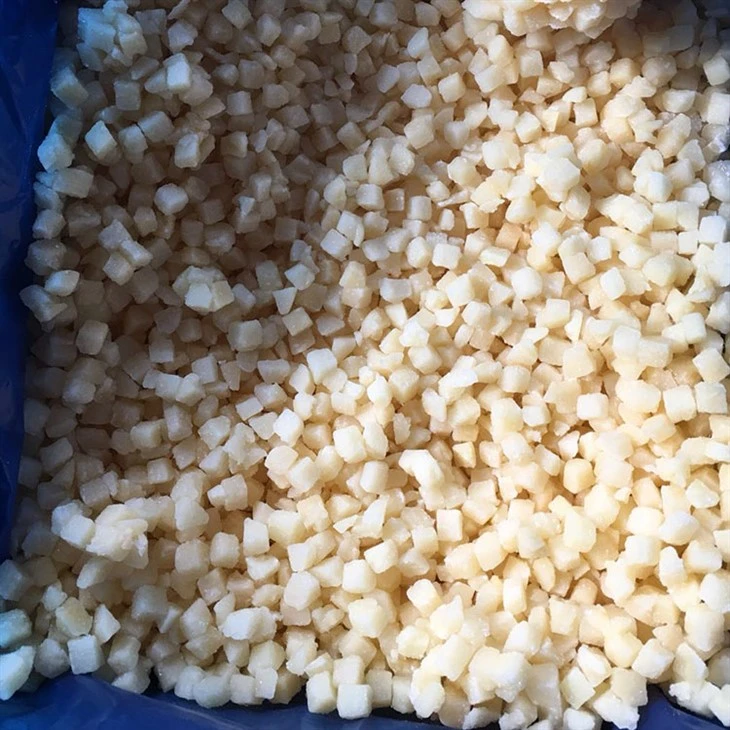
Actual frozen fruit form shown on the corresponding GreenLand product page.
The water used in a plant or recipe also deserves measurement when possible. Local drinking water, recovered condensate, process water and water carried in other ingredients can have different isotope signatures. If suspected added water happens to resemble authentic fruit water, the test may lack power to identify it. If the added water is markedly different, a shift can be more informative. A result should therefore state the assumed or measured added-water source and the detection capability under that scenario. A generic "water added" calculation without a source assumption can be misleading.
Historical and geographical variation matters. Fruit-water isotope values reflect growing conditions, including climatic and hydrological effects. A product sourced from multiple origins or seasons may have a broader authentic spread than one local trial. The Eurofins fruit-juice chapter discusses why an isolated isotope comparison can be circumvented or confused by other material choices. Its examples are a reminder to verify the particular scenario rather than give the isotope result a monopoly over the decision. Records, composition and other fractions can help distinguish plausible alternatives.

The illustrated relationship requires validation for the actual fruit and process.
We would ask the laboratory how it would report a result that falls between its clear authentic and clear diluted groups. An explicit inconclusive category protects both buyer and supplier. It may prompt a matched authentic control, a fresh sample from the same production run or a supplementary measurement. It should not become a casual "pass" because no threshold was crossed or a casual "fail" because the number looks unusual. The report's uncertainty and reference limits are part of the evidence the purchasing team needs to act fairly.
The same discipline applies when two reports disagree. One may use an external database of juice-water values, while the other compares water with pulp from the same sample. One may test an NFC juice; the other may test a reconstituted beverage. They may report values on different preparation bases or after different storage histories. The buyer should ask each lab to disclose its fraction, reference and product scope, then decide whether both results can legitimately be compared. The focus is a qualified dilution inference, not a contest between instruments.
Where a processor works with several frozen fruit origins, a small local pilot can reveal whether the proposed reference survives the real manufacturing route. The pilot should use authentic fruit lots from the intended origins, process them with the normal thawing, extraction and clarification settings, then retain paired water and pulp fractions. A qualified laboratory can evaluate the spread before any disputed lot is classified. This does not require the supplier to claim a new analytical capability; it is a customer validation exercise built around its own production conditions. If the pulp fraction disappears during clarification, the pilot will reveal that before a costly dispute. If seasonal spread is wider than expected, the decision rule can reflect that uncertainty or the customer can choose another method.
A second practical question is how to interpret an apparently normal result after deliberate recipe adjustment. A beverage with added water and added sugar might have an ordinary Brix, and its oxygen isotope value could still be inconclusive if the added water resembles fruit water. The correct conclusion is bounded: the tested method did not resolve that particular alteration under the observed source and matrix conditions. Recipe records, supplier declarations and retained pre-blend samples can still expose a discrepancy. Procurement should never force an analytical method to carry a claim it had no power to test. A report that plainly states this limitation can guide the next sample or control far better than an unqualified pass.
Report the supported dilution conclusion
A useful report states what was tested, which water addition it could detect and which possibilities remain unresolved. For example, a laboratory may find that the juice-water isotope value is inconsistent with a matched authentic reference under its validated conditions. That can support further investigation of external water. It does not alone prove who added water, when it was added or whether a declared reconstitution step was improper. Those commercial questions need formulation, process and custody records. Where the authentic reference or pulp fraction is inadequate, the report should say the evidence is insufficient to quantify dilution.
The claim on the finished product is a separate decision. A juice from concentrate can contain legitimate reconstitution water; a drink can declare water and sweetener. The buyer must compare the analytical evidence with the actual specification and destination-market labeling rules. A water-isotope measurement cannot write a legal product name, calculate the declared fruit percentage without its validated mass balance, or resolve every possible mixed-ingredient formula. The result can be one strong piece of the review when the tested claim and reference match.

Declared reconstitution changes the relevant authenticity claim.
For the illustrative beverage developer, we would request its intended product use, the two reports or trial conditions, and the basis for each result. We would ask whether the reports measured whole juice, filtered water, pulp or sugars; which material served as the authentic reference; and whether concentration or reconstitution occurred. The developer should include the water source, processing date, extraction and blending records, and any retained sample from before water could enter. GreenLand would independently confirm the actual offered frozen apple form, specification, packing, quantity and available lot documentation. We would not describe a downstream beverage test as a GreenLand juice SKU or an IQF apple isotope result.
If the concern remains after one result, the next action should repair the evidence gap. A fresh matched production sample may be better than repeated testing of a poorly documented bottle. A laboratory may recommend a different internal fraction if pulp is absent, or another authentic database if the first one does not represent the fruit source. A processor may need to reconcile its recipe and water meters. Each step should answer a named question. In that way, isotope analysis can help purchasing make a proportionate decision about dilution while sugar-origin testing, product identity and frozen-fruit qualification retain their own proper places.
For a development trial, preserve a sample chain that makes the water question testable. Identify the frozen apple lot, the fruit mass pressed, the point at which juice and pulp were separated, and a retained sample taken before any declared water addition. If the process later concentrates and reconstitutes the juice, record those volumes and stages separately from any suspected undeclared dilution. A paired pulp-and-water comparison can then be interpreted against a product form and preparation that the laboratory has qualified, rather than against a generic number borrowed from a different fruit or harvest. Ask the report to identify the tested fractions, reference population, uncertainty and the specific stage at which an additional-water inference is supported. If those records are unavailable, the responsible team may need a new representative trial instead of trying to reconstruct a percentage from one finished beverage. GreenLand can document the proposed frozen ingredient and lot identity; the beverage processor owns the extraction and formulation records. Together, those documents allow a buyer to assess the actual recipe and label claim without turning an isotope relationship observed in not-from-concentrate samples into a certificate for every reconstituted product.
Source Frozen Apple with GreenLand-food
GreenLand-food is a professional frozen apple supplier and manufacturer in China, providing factory-direct wholesale supply for importers, food manufacturers, foodservice distributors and private-label programs.
Send the product form, specification, packing, quantity, application, destination, private-label needs and requested documents so we can review the actual frozen ingredient offer for your project.