


Pineapple Juice Added-Sugar Screening Needs a CAM-Specific Method
Oct 09, 2026
Leave a message

Research This Article & Topic with AI
Verify key claims, compare reliable sources, and explore GreenLand-food's practical frozen food knowledge.
Article details and research questions are prepared in the links. Sign-in or sending may be required.

A conventional bulk carbon-isotope comparison can also be inconclusive for cane or maize additions because pineapple uses crassulacean acid metabolism, or CAM, and its sugar carbon values can overlap those C4 sources. A qualified laboratory can investigate the origin question with evidence selected for pineapple and for the suspected addition. Its conclusion must stay within the authentic reference population and product forms it has validated.
This distinction matters when a buyer starts with frozen pineapple and a downstream processor makes juice, puree or concentrate. GreenLand-food supplies frozen pineapple forms under a confirmed specification; we do not treat a study on commercial juice concentrates as a test result for an IQF lot. The processor's extraction, concentration, reconstitution and blending history belongs in the investigation. Our role is to establish the supplied fruit form and provenance, then help the customer ask the laboratory a question its method can answer. The original pineapple study offers a useful example of that disciplined approach, while its limited sample set prevents a universal pass/fail number.
Define the sugar-origin question
Imagine a juice developer asking GreenLand whether one conventional isotope result is enough to clear a pineapple-derived trial for added sugar. This is an illustrative purchasing question, not a report of a past GreenLand customer or an allegation about any supplied lot. We would first ask which material the developer actually tested. Was the sample a single-strength juice, a puree, a concentrate before reconstitution, or a beverage containing other ingredients? Was our proposed input frozen pineapple chunks, dices, or another confirmed form? A result from the finished beverage cannot automatically be assigned to the incoming fruit when the downstream formula includes other sugar sources.

Actual frozen fruit form shown on the corresponding GreenLand product page.
The commercial claim needs the same precision. A processor may be checking whether a product labelled as pineapple juice contains undeclared sugar. Another may be measuring the amount of sugar intentionally added to a drink. These are different questions even if the analytical work begins with the same vial. The FDA inspection guide explains why Brix alone can miss a combination of water and sugar: one change can offset the soluble-solids effect of the other. A satisfactory Brix therefore cannot close a sugar-origin inquiry. Conversely, a low Brix does not itself identify a cane or maize source; variety, maturity, dilution and processing must still be understood.
The laboratory brief should name the suspected source. Cane sucrose, maize-derived sweetener and beet sucrose do not present identical isotope questions. Pineapple's CAM signal particularly complicates the conventional carbon distinction from C4 cane and maize. Beet is a C3 plant and may be easier to separate by some carbon comparisons, as the pineapple study observed for its samples. That observation is useful for selecting a method, yet it is not a promise that every beet addition to every pineapple derivative is detectable at a chosen percentage. The type and amount of exogenous sugar, native sugar composition and sample preparation all influence interpretation.
It is also useful to separate a screening result from a defensible authenticity conclusion. A fast spectrum, a sugar-profile comparison or an unusual Brix-to-acid relationship may tell the QA team to investigate. Such screens can prioritize samples, but an atypical pattern has multiple possible causes. A well-founded conclusion identifies the target alteration, the relevant authentic comparison, the analytical uncertainty and the alternative explanations that remain. For a disputed commercial lot, buyers need to know whether the result is consistent with a specified sugar addition, merely atypical relative to a limited database, or unable to distinguish authentic variation from an addition.
At the fruit-supply boundary, we can document the agreed frozen pineapple form, variety where specified, maturity and Brix requirements, packing, lot identity and destination. The frozen product page describes chunks, dices, tidbits, slices and other cuts according to the order. A buyer should verify the precise offered format and documents for its order instead of assuming that a page list is a stock commitment. If the downstream customer wants a juice authentication trial, the sampling plan should show where the fruit lot ends and the customer's transformation begins. That trace makes the analytical result more useful than an isolated number.
Why pineapple differs from a simple C3 reference
Most textbook explanations start with the carbon isotope difference between C3 plants and C4 plants. For many fruit juices from C3 species, cane or maize additions can shift a carbon result away from the expected fruit reference. Pineapple is a poor candidate for applying that simplified example without checking the underlying physiology. Its CAM pathway can give sugar carbon values resembling C4 cane and maize in the measurement used by a routine bulk comparison. The 2021 pineapple study reports overlapping ranges for authentic pineapple sugars and cane sugar in its sample set. When two genuine source populations overlap, a value within the shared area cannot identify which source supplied all the sugar.

The shared region illustrates why one bulk carbon value may be inconclusive.
Overlap is not a laboratory defect. It is a limit on what one measurement can distinguish. If authentic pineapple and a cane addition both produce a plausible bulk carbon result, increasing the number of decimal places on the same measurement will not restore the missing source separation. A buyer who reads "within range" as "no cane added" has turned a reference interval into a stronger claim than it supports. The reverse error is possible too: a pineapple result outside a narrow historical range may reflect crop or origin variation rather than addition. The analyst needs a reference population that represents the real product and an independent signal capable of resolving the suspected source.
The original paper examined twenty authentic industrial samples that included single-strength juice, puree and concentrate from several producing countries, with uneven representation by country. The authors compared bulk carbon results with hydrogen isotope measurements on the carbon-bound, non-exchangeable hydrogen of sucrose. They described the work as a feasibility study and noted that natural hydrogen values varied among authentic pineapple samples. That detail matters because a statistical boundary derived from a small population is a research result, not a universal certificate for future harvests. We should not copy an experimental cutoff into a purchasing specification for every origin or freeze-thaw state.
There is also a chemical distinction between reading the total sugar pool and reading a chosen compound. Pineapple juice contains several sugars, and their proportions vary with fruit and process. The study selected sucrose for a repeatable compound-specific measurement, partly because it commonly generated the strongest analytical signal in its tested juices. A report must say whether it measured total sugars, isolated sucrose, ethanol derived from sugars, or another fraction. Results from those targets are not interchangeable even if each uses an isotope symbol in its name. The number must travel with its analyte, sample preparation and reference scale.
Other studies show why evidence can be layered without pretending every method solves the same question. A pineapple juice and concentrate study indexed by the US EPA compared carbon signatures among sugars and organic acids to investigate selected exogenous sugars or acids. That approach exploits relationships among components, while the CAM study sought a signal in the hydrogen of pineapple sucrose that could distinguish its samples from commercial cane sucrose. Spectral or sugar-composition screens can also reveal an unusual material, yet their target and validation determine whether they address cane, maize, beet, another fruit, acid adjustment or simple formulation difference. Selecting complementary evidence starts with the hypothesized change.
For a customer comparing two reports, we would ask what each laboratory called an authentic reference and whether both tested the same derivative state. A bulk carbon result on whole juice and a compound-specific result on isolated sucrose are not rival votes in a majority ballot. They answer related but different questions. If their interpretations disagree, the right next action is to inspect the reference and preparation, the sugar addition used to validate the method, and the uncertainty of each result. That is more informative than accepting whichever report sounds more decisive.
Choose complementary evidence for the suspected addition
The compound-specific hydrogen method in the pineapple research measured non-exchangeable hydrogen bound to sucrose carbon. That choice preserves an origin-related signal which a broad comparison can obscure. In the study, the authentic pineapple sucrose samples and tested commercial sugar sources showed useful separation in their average hydrogen signatures. The researchers also made a controlled cane-sugar mixing example. These findings support asking an experienced authenticity laboratory whether the method, or a validated successor, is suitable for the actual suspected addition. They do not establish that any laboratory can apply one published number to every pineapple juice, puree, concentrate or finished beverage.

Sample form and preparation must be recorded before isotope results are compared.
"Compound-specific" is an important phrase for procurement teams because it points to a defined chemical fraction. It does not mean the assay is automatically more accurate in all circumstances. Recovery during isolation, repeatability, matrix interference, isotope exchange control, calibration and source-reference coverage still matter. A processor should request the laboratory's validated scope for pineapple and the actual product state. The scope ought to say which added sugars were challenged, the range of additions evaluated and how the laboratory handles a sample whose result lies near a decision boundary. If the lab cannot provide that applicability statement, the report should be treated as exploratory evidence.
The fruit-juice authenticity review describes a wider toolbox, including component analysis, isotope measurements, spectroscopy and non-targeted profiles. Each tool contributes a different kind of signal. An FTIR pattern may flag a composition that differs from reference juices, for instance, but it does not independently prove that a particular sugar molecule came from cane. A sugar-profile result can reveal an unexpected balance of sucrose, glucose and fructose while leaving the botanical source unresolved. Isotope evidence can support a source inference within its validated source populations while saying little about processing performance. The report should name its target explicitly so that a buyer does not combine unlike "authenticity" scores as if they were one measurement.
A strong investigation may sequence tests rather than order every possible instrument at once. The buyer can start with identity, recipe and process records; retain a sealed reference sample; screen composition for inconsistencies; and then commission a source-sensitive method matched to the suspected sugar. The laboratory may recommend an additional component or orthogonal method if the first result is near the overlap zone. That sequence can save samples and avoid a premature accusation. It also lets the parties agree in advance how an inconclusive result will be reported, which is particularly important when the conclusion affects a release decision or a supplier dispute.
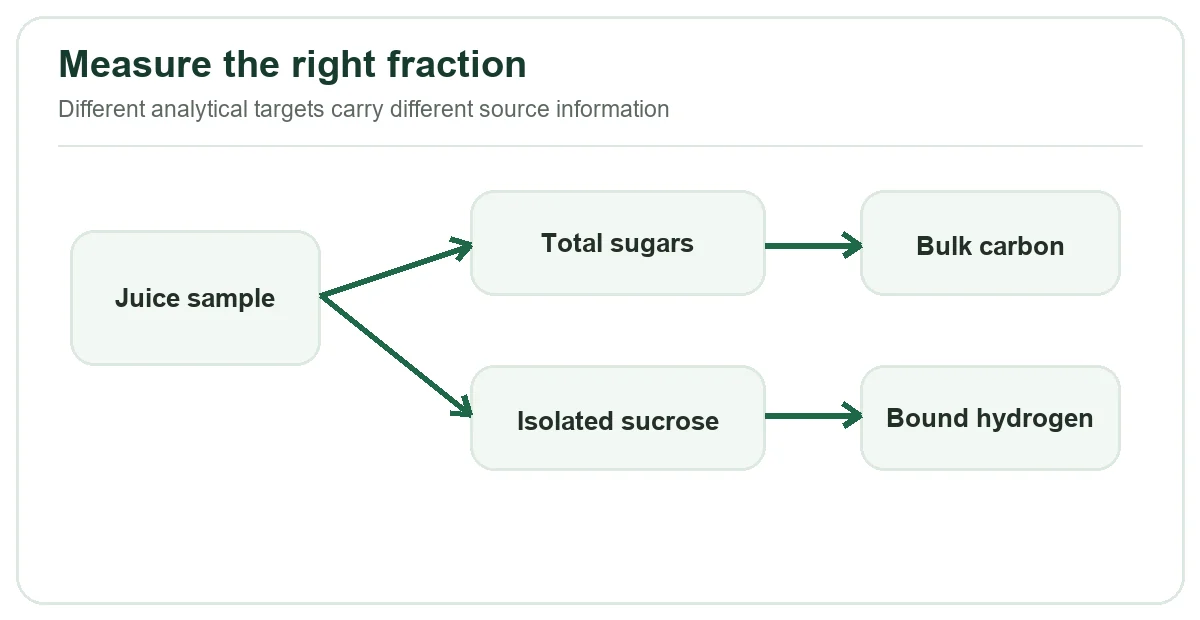
The target fraction determines what origin information the laboratory can interpret.
The sample's custody is part of the evidence. A concentrate opened and rediluted in an uncontrolled trial can no longer be compared casually with an unopened industrial sample. Water used for reconstitution, equipment cleaning, formulation sugars and carryover from another recipe should be documented. A lab needs enough sample to repeat an extraction, to test a retained reference and to evaluate uncertainty. If a customer asks us to help assess a pineapple input, we would ask for the intended application, exact supplied fruit form, two reports or trial conditions being compared, and the sample basis for each result. We can then distinguish the frozen-fruit specification from tests performed after the customer's own juice process.
An authenticity method should also be described in the language of support, not magic. The pineapple research proposed an approach that may identify selected additions under the studied conditions. It did not certify all global origins, all crop years or every syrup formulation. Nor did it measure an IQF GreenLand lot. If a laboratory uses a published paper as background, the analyst must still validate its own sample preparation, calibrators, uncertainty and decision rule for the intended commercial context. The purchasing team can ask for that validation summary without needing to reproduce the chemistry itself.
Qualify the reference population and preparation
An isotope value has meaning only beside an appropriate comparison. Pineapple grown in different climates can have different source-water and plant-fractionation histories, and the original study's authentic hydrogen results showed natural spread. The study's country counts were also unbalanced, with more samples from some origins than others. A buyer should therefore ask how a laboratory's authentic database covers the crop origins, production years and product forms relevant to the case. A narrow database may be useful for a narrow claim, but a global "pass" or "fail" cannot be inferred from it without checking representativeness.
The derivative state changes preparation. Single-strength juice, puree and concentrate do not arrive at the laboratory with the same water content or suspended solids. The pineapple study diluted its concentrate and puree samples to a specified Brix before isolating sugars. That procedure helped make those research samples comparable for the selected measurement. It is not an instruction for buyers to redilute their own disputed sample at an arbitrary ratio. The laboratory should explain how it brings different forms onto a comparable analytical basis and how it checks that preparation itself has not biased the target isotope fraction. A source report should preserve the original form as well as the prepared form.

Actual frozen fruit form shown on the corresponding GreenLand product page.
The choice of authentic comparison also depends on what was allegedly added. Cane sucrose, maize-derived syrups and beet sucrose can differ in both botanical pathway and commercial processing. A method validated using one commercial cane sucrose may not perform identically for a high-fructose syrup or a blend of sweeteners. If the suspected addition is an acid, flavor or another fruit juice, a sugar-origin test may be the wrong target altogether. Ask the analyst for the challenged materials and the detection range supported by its own validation. A generic "added sugar percentage" detached from source, matrix and uncertainty creates false confidence.
Sample handling can hide a problem or create one. Juice clarification removes insoluble material; concentration changes water content; fermentation converts sugars into other compounds; and reconstitution introduces water from another source. Those operations may be legitimate stages of the customer's process, but the tested fractions and process order must be recorded. A bulk juice result obtained before concentration cannot be assumed to describe a retail beverage after blending. The lab should say which fraction it isolated, whether the reported result is on a juice, concentrate or reconstituted basis, and whether the authentic reference experienced comparable preparation. The Eurofins fruit-juice chapter illustrates how different authenticity methods can answer different ingredient and processing questions.

An authentic comparison needs adequate origin and derivative coverage.
At GreenLand-food, we can make the incoming fruit side of that record concrete. For a frozen pineapple proposal we can confirm the expected cut, Brix range or target where agreed, natural color, core and eye tolerance, packing format, quantity, crop-origin plan, cold-chain expectation and requested documents. We should not imply that these ordinary supply checks authenticate a later juice's sugar origin. They establish what was bought and how the fruit was specified. A customer making a juice or concentrate must add its own extraction yield, any recipe ingredients, concentration and reconstitution records. The combined chain gives the laboratory a defensible sample story and tells purchasing where a corrective action, if needed, would belong.
Keep the purchasing conclusion narrower than the assay
The useful output of an authenticity investigation is a conclusion with boundaries. "The result is consistent with the validated pineapple reference and no selected added sugar was detected above this method's capability" is different from "all sugar is proven to be pineapple." "A selected cane addition is indicated" differs from a declaration that an upstream supplier intentionally adulterated the fruit. A borderline or overlapping result should be called inconclusive, with the source of uncertainty stated. The buyer may need additional samples or another method; it should not convert analytical ambiguity into a categorical supplier judgment.
The original pineapple study was not designed to supply a universal percentage cutoff for every lot. Its authentic set mixed juice, puree and concentrate, and natural origin effects remained a limitation. Even a validated laboratory cutoff must be read with its target, false-positive and false-negative behavior, and the confidence interval for the relevant source populations. If two reports use different fractions or references, comparing their raw isotope numbers is unlikely to resolve the dispute. Ask the laboratories to reconcile sample identity, preparation, measurement target and interpretation before treating their conclusions as contradictory.

The assay applies to the derivative sampled, with fruit-lot provenance documented separately.
Commercial identity needs independent review. A declaration such as juice, nectar or drink depends on the actual formulation and destination-market rules, not only on a laboratory signal. A processor that intentionally adds sugar may have a lawful product under an appropriate name and label. An authentic frozen pineapple ingredient can also be used in a beverage whose other ingredients change the final product's identity. The source and formulation documents should be reviewed with the analytical evidence; the assay cannot write the label or prove a product's legal status by itself.
For the illustrative juice developer, our response would be practical: send the intended product use; identify whether the input is frozen chunks, puree or another confirmed supply form; provide the two reports or trial conditions and the basis for each result; and explain why cane, maize or another addition is suspected. We would ask the lab to address pineapple's CAM overlap, identify a complementary source-sensitive target and qualify the authentic population and preparation for this particular derivative. On our side, we would confirm the lot specification, packing, quantity, destination and available traceability documents for the actual frozen fruit order. That gives the developer a decision it can defend and keeps the study's juice findings in their proper scope.
If the customer needs a routine monitoring plan after an investigation, the plan should follow the risk discovered. A consistent fruit supplier, controlled recipe and retained samples may allow targeted periodic checks; a changing blend or concentrate source may need a different frequency or method. The purchasing team should agree with its laboratory on what would trigger confirmation and what evidence is needed for release. The central question remains botanical sugar origin in the tested derivative. Brix, sugar composition, records and isotope analysis can support that question together, but none should be given a wider meaning than it earned.
A final laboratory statement should name the material to which it applies. If the retained sample was pressed juice from a development run, its conclusion belongs to that run and preparation; it is not automatically a statement about the incoming frozen pineapple lot, a later concentrate, or a finished drink with other ingredients. The file should connect sample IDs to the fruit lot, extraction date, any concentration or reconstitution step, and the recipe version. This lets the buyer see whether a change between the retained sample and the commercial product requires another comparison. Ask the laboratory to state which sugar sources and levels its selected methods could distinguish in the validated pineapple reference population, and which result remains inconclusive because of overlap or sample history. A finding consistent with authentic references has a defined analytical meaning; it is not an unlimited warranty about every possible addition. GreenLand can supply the frozen-fruit specification and lot documents that locate our part of the chain. The processor and qualified laboratory must connect those records to the derivative sample, while the buyer makes the commercial decision against its actual acceptance requirement.
Source Frozen Pineapple with GreenLand-food
GreenLand-food manufactures frozen pineapple in China. We fill factory-direct wholesale orders for importers, food manufacturers, foodservice distributors and private-label programs.
Send the product form, specification, packing, quantity, application, destination, private-label needs and requested documents so we can review the actual frozen ingredient offer for your project.