


How Long Can You Freeze Spinach?
May 18, 2026
Leave a message

Properly blanched, well-drained and well-packed spinach keeps its best household quality for about 10–12 months at 0°F / -18°C. It may remain safe longer if it stays continuously frozen, but color, aroma, texture and moisture performance can decline. Raw unblanched leaves should be used sooner. Commercial frozen spinach should follow the shelf-life statement, pack condition and cold-chain requirements for that exact product rather than a household rule.
The distinction between safety and quality matters. A bag can remain solidly frozen yet become too frosty, dull or watery for a premium filling or retail pack. A different lot can still look green but have an unknown temperature history. Time is only one part of the decision; preparation, packaging, storage temperature, temperature stability and final application decide what the date means.
Use 10–12 months as a best-quality reference for properly prepared home-frozen spinach. Do not use it as a discard deadline, a guarantee after temperature abuse or a commercial label claim. For purchased product, the approved specification and date code control.
The Short Answer: How Long Can You Freeze Spinach?
Utah State University Extension states that frozen spinach keeps best for about 10–12 months and provides a tested preparation method based on washing, two-minute blanching, rapid chilling, draining and airtight packing. That is a sensible household quality window for spinach prepared while fresh and held in a freezer that maintains 0°F / -18°C.
| Spinach condition | Time direction | What the time means | Main caution |
|---|---|---|---|
| Home-frozen, blanched spinach | About 10–12 months | Best-quality reference at 0°F / -18°C | Requires correct blanching, drainage and packing |
| Raw unblanched leaves | Use sooner | Short convenience hold, not the strongest long-storage method | Faster color, flavor and texture decline |
| Cooked spinach or a prepared dish | Follow the complete recipe guidance | Other ingredients and cooking history change the window | Do not apply the fresh-leaf window automatically |
| Commercial IQF, cubes, balls or blocks | Follow the approved product specification | Validated commercial shelf-life claim | Format, pack and storage conditions must match |
The full Utah State University spinach guide supports both the 10–12 month best-quality reference and the preparation method. It is more useful than copying a date from an unsourced storage chart because it defines how the spinach is handled before freezing.

Frozen appearance is one checkpoint; cooked color, aroma, moisture and yield complete the quality decision.
Safety Time and Best-Quality Time Are Different
USDA explains that food kept constantly at 0°F remains safe almost indefinitely and that recommended freezer periods concern quality. Freezing makes microorganisms inactive; it does not reliably destroy them or make an unsafe product safe. Once spinach thaws, microorganisms can become active again, so thawed product must be handled as perishable food.
That principle does not mean every old or damaged bag should be eaten. Spinach frozen after spoilage, contaminated after cooking or exposed to an uncontrolled thawing event is not rescued by a later return to the freezer. A stable current temperature also cannot prove that the product remained frozen throughout storage.
Use the USDA Freezing and Food Safety guidance for safety decisions. Use the spinach-specific 10–12 month reference for household quality planning. For commercial stock, use the product specification, production or packing code, warehouse records and deviation procedure.
Why Storage Answers Range From Three to Fourteen Months
Published storage guides do not give one consistent number. Some consumer pages recommend roughly three months for home-prepared spinach. Others give nine to fourteen months. Spinach-specific Extension guidance and several storage references cluster around ten to twelve months for best quality. The variation is not proof that frozen spinach has an unknowable life; it shows that the guides are describing different preparation methods, packs and quality expectations.
A loosely packed bag of raw leaves in a frequently opened refrigerator-freezer is not equivalent to blanched spinach in moisture-resistant packaging. A home portion is not equivalent to a commercially processed block with a defined moisture level. A manufacturer judging green color and drained yield uses a stricter performance threshold than a home cook blending spinach into soup.
| Variable | Longer-quality direction | Shorter-quality direction |
|---|---|---|
| Starting material | Fresh, tender, clean leaves | Yellowing, wilted or damaged leaves |
| Pretreatment | Tested blanching and rapid cooling | Raw freezing or weak enzyme control |
| Surface water | Well drained before packing | Wet product with excess ice formation |
| Packaging | Tight seal, low headspace, freezer-suitable barrier | Thin, open or repeatedly handled bag |
| Temperature | Stable at or below the specified limit | Cycling, partial thawing or warm loading |
| End use | Soup, sauce or blended application | Visible green filling with tight moisture limits |
Blanching Protects Long-Storage Quality
Freezing slows enzyme activity but does not stop it as effectively as blanching. For spinach and most other greens, the National Center for Home Food Preservation specifies a two-minute water blanch, followed by cooling, draining, packing and freezing. This brief heat treatment supports color and flavor stability during storage.
Under-blanching can be worse than expected because it may stimulate enzyme activity without completing the intended inactivation. Excessive blanching causes another problem: the leaves become soft, color can dull and more water must be removed. Follow the tested NCHFP method for freezing greens rather than improvising the time.
Our separate guide, Can You Freeze Spinach Leaves?, owns the detailed preparation topic. The storage-duration page only needs the principle: correctly blanched spinach has a stronger basis for a 10–12 month quality window than raw leaves placed directly into a household freezer.
Raw, Blanched and Cooked Spinach Do Not Share One Window
Raw leaves can be frozen for smoothies or cooked recipes, but they become fragile and release water after thawing. Without blanching, color and flavor are less stable during long storage. "Use sooner" is more honest than inventing a precise month limit for every raw-freezing method.
Blanched spinach fits the evidence-backed 10–12 month household quality reference when it is cooled, drained and packed correctly. It will still be soft after thawing because freezing disrupts leaf cells. The date cannot return it to fresh-salad texture.
Cooked spinach belongs to the finished dish. Oil, dairy, meat, grains, sauce and the cooking and cooling history can shorten or otherwise change the recommended freezer period. A cooked spinach filling should follow the validated recipe or food-safety plan, not the storage guidance for plain blanched leaves.
Lasagna, dip, quiche, dumpling filling and spinach sauce have their own formulation, cooling, packaging and reheating conditions. Use guidance for the finished product.
Commercial Frozen Spinach Shelf Life
Commercial shelf life is a product claim, not a category slogan. It should define the product, unopened pack, storage temperature, date basis and quality criteria. The clock may run from production, freezing or packing according to the specification. Buyers should confirm that basis instead of assuming the printed month and year use the same convention across suppliers.
The GCCA/WFLO spinach commodity storage guidance describes about one year at 0°F / -17.8°C as near the limit of market shelf life and notes that lower product temperatures can extend marketability. Current GreenLand-food spinach pages list 24 months at or below -18°C for specified commercial products. Those statements are not interchangeable: the approved item specification, packaging and supporting shelf-life basis control the order.
A purchasing team should request the shelf-life statement before comparing price. If one offer states 18 months and another states 24, ask how each claim was established, what pack it covers, which temperature it assumes and which color, flavor, moisture, microbiological and physical criteria must still pass at the end.
Product Format Changes the Storage Risk
Frozen spinach is sold as IQF chopped pieces, cut leaf, balls, cubes, tablets, bricks and pressed or BQF blocks. Format affects exposed surface area, portioning, freezing rate, package fill and how the buyer judges quality. A compact block may be efficient for a soup factory but inconvenient for a kitchen that uses 200 grams at a time. A loose IQF product offers dosing flexibility but exposes more individual surface area to air if the bag is repeatedly opened.
| Format | Storage-quality focus | Buyer acceptance check | Best operational fit |
|---|---|---|---|
| IQF chopped or cut leaf | Free flow, frost, cut visibility and dehydration | Separation, cut size and cooked moisture | Dosing into soups, sauces and ready meals |
| Balls, cubes or tablets | Unit weight, shape retention and surface frost | Count, weight range and thaw consistency | Retail and foodservice portion control |
| Pressed brick or BQF block | Pack seal, block integrity and moisture target | Net weight, drained yield and batch thawing | Large-batch factory processing |
| Puree or prepared base | Separation, oxidation and formula stability | Solids, color and post-thaw homogeneity | Sauce and formulated products |
GreenLand-food's frozen spinach range shows the available buying paths. The IQF chopped spinach page is the closer internal link for purchasing teams that need loose dosing, cut-size control and retail or foodservice packing.

Portioned cubes simplify dosing, but unit weight, frost and shape should remain within specification.
Packaging Often Decides Whether the Last Months Are Usable
Freezer burn is dehydration caused by air exposure. It is a quality defect, not proof of a food-safety hazard. Spinach is vulnerable because chopped leaves have a large exposed surface and a delicate structure. A weak seal, puncture, excessive headspace or a bag opened repeatedly can dry the product and transfer freezer odors.
Household packs should be freezer-suitable, tightly sealed and portioned so that the same bag does not warm and reopen many times. Commercial packaging needs a defined inner material, seal standard, net weight, carton strength and case mark. Retail film must also survive distribution and display without pinholes or seal creep.
Vacuum packaging may reduce headspace, but compression can change the presentation of cut leaves, and the packaging method must be suitable for the product and downstream handling. Packaging is not a substitute for temperature control. A perfect barrier cannot reverse damage caused by partial thawing.
Temperature Stability Matters More Than a Single Reading
A carton measuring -18°C at inspection does not prove that it stayed at or below the specified limit for the entire journey. Temperature cycling allows small ice crystals to melt and recrystallize into larger structures. Spinach may become more compact, frosty and wet after thawing even though it is frozen again by arrival.
For commercial shipments, review loading temperature, reefer set point, supply and return-air data where available, door-opening events, logger placement and unloading time. The exact evidence depends on the contract and shipment risk. The wider frozen vegetable cold-chain guide explains loading and transport controls without repeating them here.
If the shipment shows a deviation, quarantine the affected lots and preserve evidence. Do not simply return the cartons to the freezer and restart the shelf-life clock. Record measured temperature, carton location, package condition, frost pattern, lot code and logger trace before deciding whether to accept, test, downgrade or reject the stock.

Shelf-life claims assume the specified frozen condition continues through storage, loading, transport and receiving.
What Changes as Frozen Spinach Ages?
Quality does not collapse on one date. It changes gradually, and different attributes may reach their limits at different times. Color may become less vivid before flavor becomes unacceptable. IQF pieces may lose free flow while a pressed block remains intact. A filling manufacturer may reject extra drip that a soup producer can absorb into the formula.
| Observation | Likely quality meaning | Check before deciding |
|---|---|---|
| Fine surface frost | Normal minor moisture migration or early handling effect | Extent, package seal and free-flow condition |
| Heavy ice or fused pieces | Temperature cycling, wet packing or damaged seal | Temperature history and thawed water release |
| Pale, dry patches | Freezer burn and dehydration | Pack integrity, flavor and proportion affected |
| Dull or brown-green color | Raw-material, blanching, oxidation or long-storage issue | Cooked color against an approved reference |
| Excess drip after thawing | Cell damage, pressing difference or freeze-thaw exposure | Defined thawing and drained-yield test |
| Abnormal sour, rotten or moldy odor | Spoilage or mishandling concern | Do not taste; hold or discard under the applicable procedure |

A long-storage decision needs measured product condition, not a date or photo alone.
Is Spinach Still Good After One Year?
One year is near the end of the common household best-quality reference, not an automatic safety deadline. If the spinach was properly prepared, sealed and continuously held at 0°F / -18°C, it may still be usable. Evaluate the package, frost, color, aroma after controlled thawing and performance in the intended cooked application.
Do not use a sensory check to clear a known temperature-abuse event. Pathogens do not reliably announce themselves through smell or appearance. When the freezer has failed, USDA advises using ice crystals and measured temperature to guide refreezing decisions; food that has been above 40°F for more than two hours should be discarded.
For commercial inventory, "still edible" is not the acceptance standard. The lot must still meet the agreed specification. If its best-before or shelf-life date has passed, obtain written disposition from the responsible QA team. Extending a code requires a documented technical and legal basis, not a sales decision made because the cartons remain frozen.
Thawing and Refreezing Change the Remaining Quality
Each freeze-thaw cycle encourages more cell damage and water release. Spinach becomes softer, darker and less predictable in fillings. Refreezing may be safe after controlled refrigerator thawing, but it does not restore the original shelf-life position or quality.
Use direct-from-frozen cooking for soups, sauces and other wet applications when the product instruction allows it. For dips, pastry, dumpling or ravioli filling, thaw under refrigeration and measure drained or pressed yield. The article How Can You Thaw Frozen Food Safely? covers the general safety methods and commercial controls.
Portioning prevents repeated thawing. Small household packs, foodservice bags, cubes, balls and free-flowing IQF pieces let users remove only what they need. A large block suits a factory that uses the entire unit in one batch; it is inefficient when staff repeatedly soften and break the same block.
Use Near-End-of-Quality Spinach According to Performance
Spinach that remains safe and within the approved use decision may still serve a less appearance-sensitive application. Soup, sauce, curry and puree can tolerate softer leaf structure. Dumpling, pastry and pasta fillings can accept older product only if color, flavor and drained yield still meet the formula. A retail product promising bright, portionable IQF leaves may require stricter appearance.
Do not hide an off-flavor or spoilage concern with seasoning. Reassignment applies only to quality that remains acceptable for the alternative use. Record the decision in commercial operations so the lot, quantity, new application and approval remain traceable.
For detailed application choices, link to What to Do With Frozen Spinach. Keeping recipe coverage on that page prevents this storage guide from competing with the application intent.
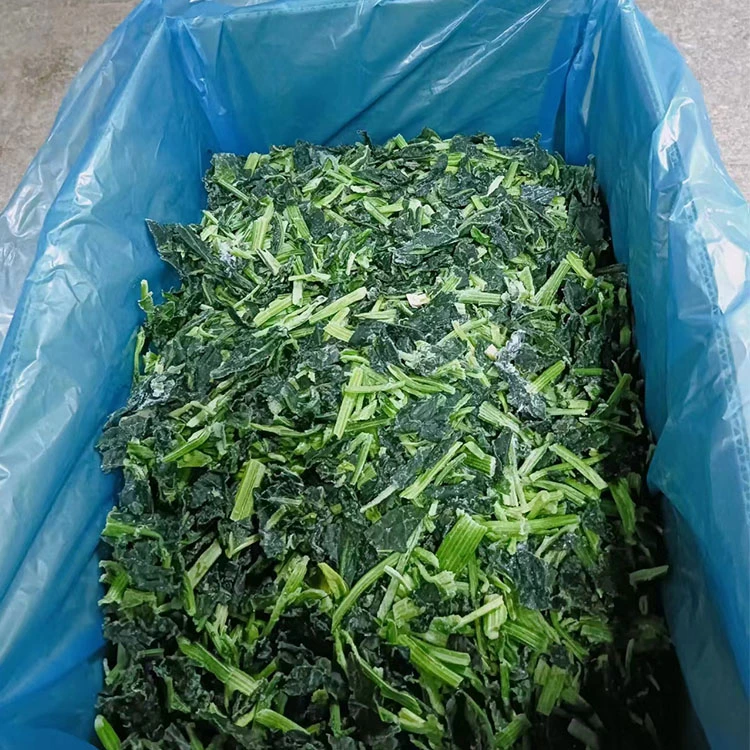
Bulk pack condition, liner integrity and moisture behavior affect the usable life of industrial spinach.
What a Commercial Shelf-Life Specification Should State
A buyer should be able to read the shelf-life conditions without guessing. Ask the supplier to identify the format, date basis, unopened pack, storage temperature and preparation state. The same document should connect the period to measurable quality and safety requirements.
- Product identity: IQF chopped spinach, cut leaf, ball, cube, tablet, brick, BQF block or another defined form.
- Date basis: production, freezing or packing date and the coding format printed on the case.
- Storage condition: maximum product or storage temperature, unopened original packaging and continuous frozen handling.
- Physical criteria: color, cut size, unit or block weight, free flow, frost, foreign matter and package integrity.
- Moisture criteria: total moisture where specified, thawed drip, drained yield or pressing condition.
- Sensory criteria: typical spinach aroma and flavor, without unacceptable off-odor or oxidation.
- Safety and documents: agreed microbiological limits, residue plan, COA or test reports, traceability and destination-market documents.
- After opening or thawing: a separate instruction; the original frozen shelf life no longer describes the opened product.
Shelf-life testing should use the commercial pack and include the attributes that matter to the application. A soup producer may prioritize cooked color and flavor. A filling factory needs drained yield and binding. A retail buyer needs appearance, portion separation, label clarity and consumer cooking performance.
Receiving, Stock Rotation and Near-Expiry Control
Record the remaining life at receipt rather than checking only the manufacture date. A product with 24 months total life but only three months remaining may be unsuitable for a long distribution program. Purchase terms can define minimum remaining shelf life, acceptable production window and documents required before loading.
At receiving, verify case codes, quantities, pack integrity, temperature and lot consistency. Photograph unusual frost or collapse before moving the product. Place accepted inventory into FEFO-first expired, first out-rotation rather than relying only on physical arrival order.
Near-expiry stock needs an action date earlier than the label date. Allow time for internal testing, production scheduling and finished-goods life. A factory should not use ingredient stock on its last day if the finished product then carries a longer shelf life that has not been supported by a formulation study.
How GreenLand-food Supports Frozen Spinach Programs
We supply frozen spinach in formats for foodservice, retail and processing programs. Before quotation, we ask whether the project needs IQF chopped spinach, cut leaf, cubes, balls or block-style material, because format changes portioning, packing and moisture behavior.
We help purchasing teams review cut size or unit weight, moisture or pressing target, packing, order quantity, destination market, application and required documents. Shelf life is confirmed on the applicable product specification. If a program requires a particular remaining life at arrival, include it in the RFQ and purchase agreement instead of treating it as an assumption.
Send the required format, cut or portion size, moisture target, application, pack size, quantity, destination market, target shelf life and minimum remaining life at arrival.
View IQF Chopped SpinachDownload Product CatalogSend an Inquiry
FAQ About Frozen Spinach Storage
How long can you freeze fresh spinach?
Properly blanched, drained, packed and continuously stored spinach keeps its best household quality for about 10–12 months at 0°F / -18°C.
Can spinach stay safe in the freezer for longer than one year?
USDA states that food held continuously at 0°F remains safe almost indefinitely, but quality declines. Freezing does not correct contamination or a previous temperature-abuse event.
Is frozen spinach good after two years?
A household pack is well beyond the common best-quality window. A commercial pack may carry a validated two-year claim, but only its specification, unopened packing and documented cold-chain conditions support that period.
Can raw spinach be frozen for 10–12 months?
Raw leaves will freeze, but blanching gives a stronger basis for long-storage color and flavor. Use raw-frozen leaves sooner and in cooked or blended applications.
Does freezer burn make spinach unsafe?
Freezer burn is mainly a dehydration and quality problem. It can produce pale, dry areas and weak flavor. A separate temperature-abuse or spoilage concern still requires a safety decision.
Why does long-stored spinach become watery?
Freezing damages leaf cells, and temperature cycling can enlarge ice crystals. After thawing, more water leaves the tissue. Measure drained yield when moisture affects a filling or formulation.
Can thawed spinach be refrozen?
Spinach thawed under safe refrigerated control may be refrozen, but texture and water release will worsen. Follow the operation's safety procedure and do not restart the original shelf-life period.
How long does commercial frozen spinach last?
Use the confirmed product specification. Commercial claims vary with format, processing, packaging, temperature and quality criteria; they should not be replaced by a general household range.
Does the best-before date guarantee quality after a power loss?
No. The date assumes the stated storage conditions. Use measured temperature, ice-crystal condition and the applicable deviation guidance after a freezer failure.
What should a frozen spinach RFQ include?
State format, cut or portion size, moisture target, pack, quantity, destination, application, preparation status, target shelf life, minimum remaining life and required documents.
This article provides general storage and procurement guidance. Household users should follow tested preservation and food-safety instructions. Commercial buyers should use the approved product specification, shelf-life validation, cold-chain records and destination-market requirements.