


How Much Does a Strawberry Weigh?
Sep 04, 2026
Leave a message
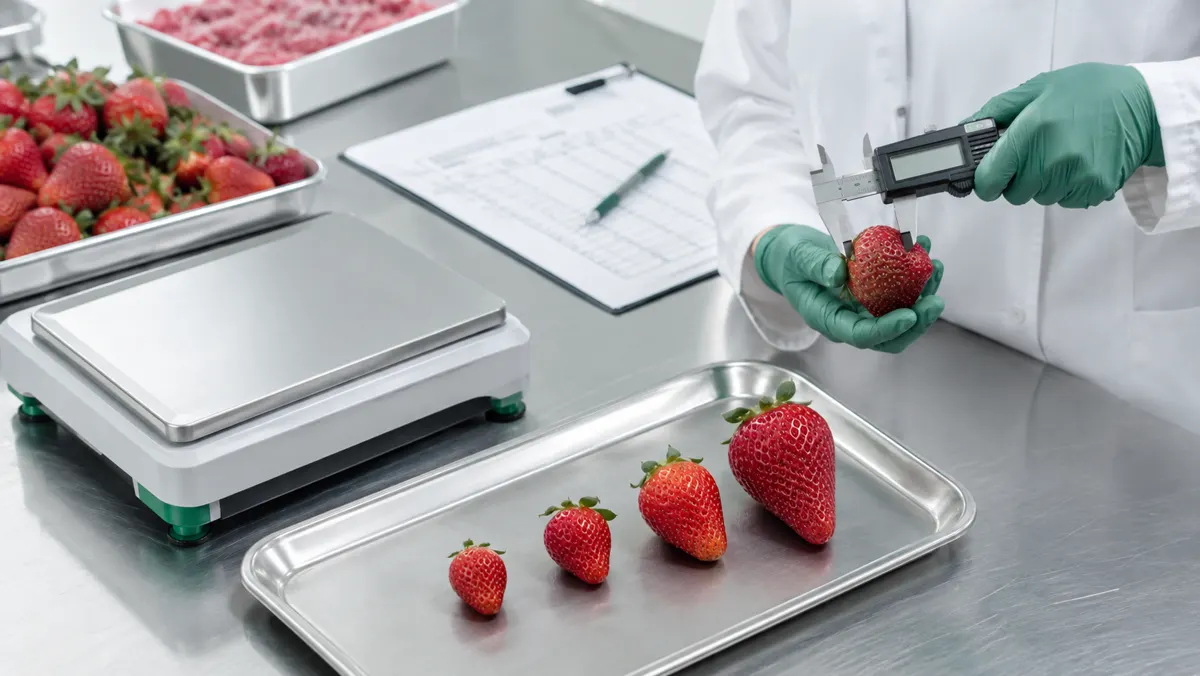
One strawberry commonly weighs about 7–27 grams, with roughly 12 grams a practical medium reference.
Strawberry weight varies with cultivar, diameter, length, shape, maturity and water content. Household conversion sources commonly estimate about 7 g for a small berry, 12 g for a medium berry, 18 g for a large berry and 27 g for a very large berry. For an IQF order, do not convert diameter directly into guaranteed piece weight. Weigh a representative sample and specify size grade, count distribution, net weight, broken tolerance and test method separately.
Small, Medium and Large Strawberry Weight References
A practical orientation range is about 7 g for a small strawberry, 12 g for a medium berry, 18 g for a large berry and 27 g for a very large berry. Different conversion sites use slightly different category boundaries, so the values should remain rounded. Keep that scope beside the relevant strawberry attribute so the purchasing team and the receiving team apply the same meaning.
At those averages, one kilogram contains roughly 143 small berries, 83 medium berries, 56 large berries or 37 very large berries. Real cartons contain a distribution, not four identical categories, and broken fruit changes the usable piece count. Natural and process variation remain possible, so confirm the working range on representative samples instead of relying on a single textbook number.
Whole-fruit volume conversions also vary. One reference gives about 144 g for a cup of whole average berries, 152 g for halves, 166 g for slices and 232 g for puree because smaller pieces remove air gaps. Translate that effect into the intended application, since strawberry that looks acceptable can still give a different yield, texture or flavor balance.
These figures help with recipe prototypes, serving estimates and line trials. They should not be copied into a supplier contract unless the buyer and supplier verify the same fruit, preparation and measuring method. For strawberry weight and count, write the acceptance method, tolerance and evidence type into the approval record before confirming the lot.
Why Two Strawberries with the Same Diameter Can Weigh Differently
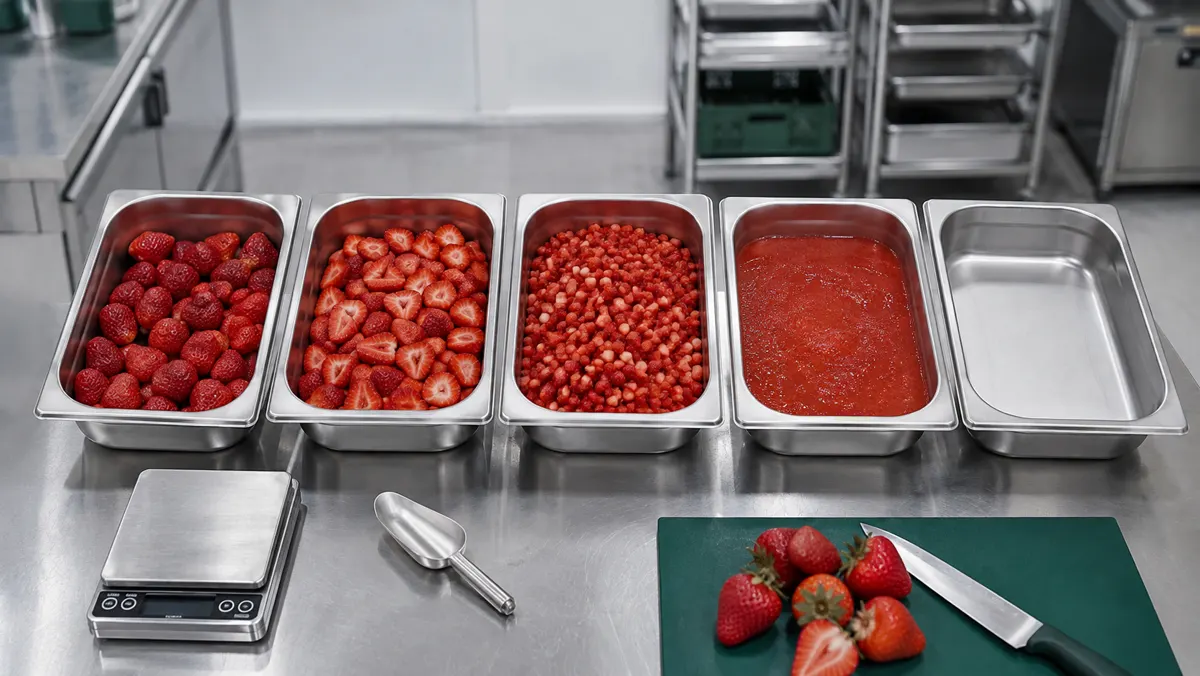
Commercial strawberry size is often expressed by maximum transverse diameter. Two berries can meet the same diameter band while differing in length, shoulder width, conical shape, internal cavity and density, so their mass is not automatically equal. Record the definition with the strawberry form being discussed; otherwise a correct general statement can become a poor buying assumption.
Cultivar affects fruit geometry and firmness. A long conical berry and a short broad berry may pass the same sizing screen but occupy different space in a retail pouch and deliver different piece counts per kilogram. Because fruit and process conditions vary, compare several representative units and keep the sample condition with any recorded result.
Maturity and moisture affect mass. Fruit can lose water after harvest, while surface ice or retained wash water can raise the gross measured weight of a frozen sample. The weighing protocol should state whether loose frost is removed. The application trial should use the proposed strawberry format and inclusion rate, not a convenient substitute with different physical behavior.
Hulling and trimming remove variable mass. A deep calyx cut reduces usable yield more than a shallow clean removal, while white shoulder or damaged tissue may require additional trimming before dicing or puree production. Keep photographs, measurements and documents tied to the same sample code; that prevents an attractive image from standing in for traceable evidence.
Diameter Grade Is Not a Unit-Weight Guarantee
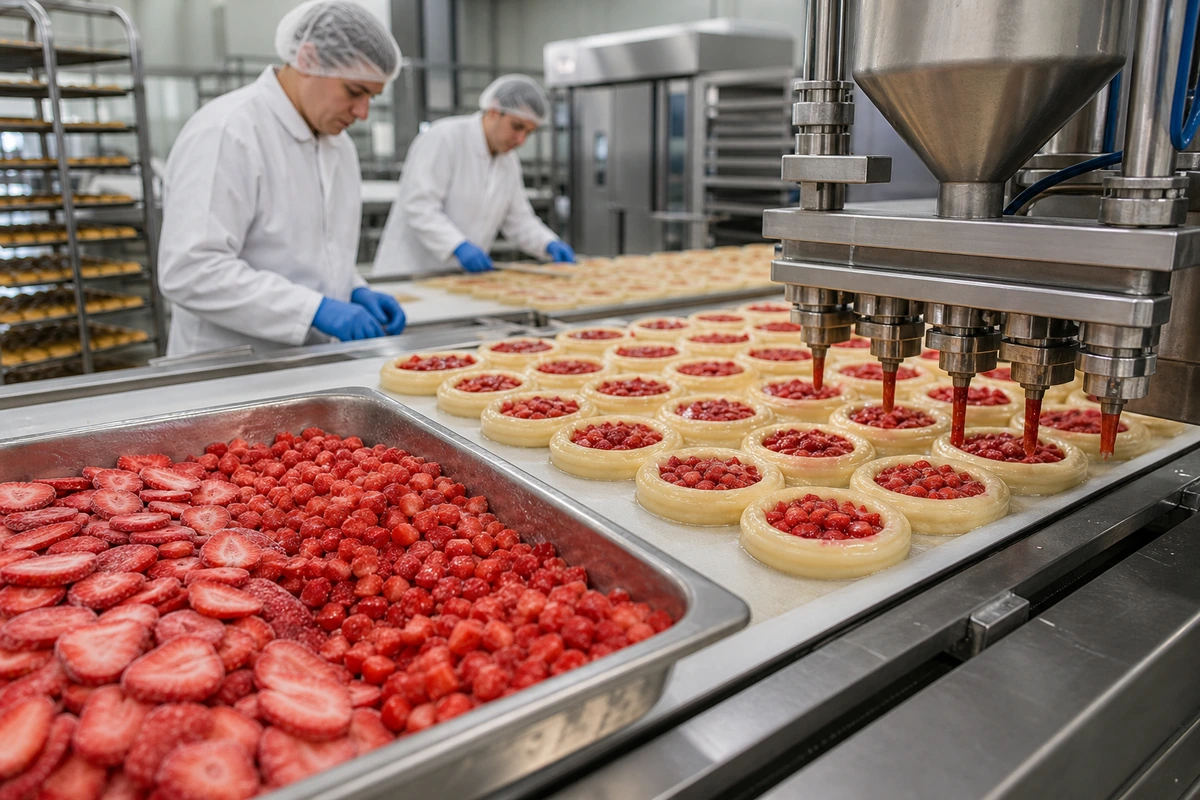
USDA grade standards use diameter within a wider quality framework. A diameter grade helps control visual size, but grade also considers defects and condition. It should not be read as an exact grams-per-berry promise. Link the term to the exact strawberry format in the quotation because whole fruit, cut fruit and puree may be judged differently.
IQF suppliers may quote ranges such as 15–25 mm, 25–35 mm, 35 mm up or uncalibrated. The declared percentage within size, measurement orientation and tolerance outside the band should be stated if sizing is critical. A useful planning range is not a lot guarantee; sampling method, product temperature and measurement basis still need to be stated.
A retail buyer may care about count distribution and pouch appearance as much as average diameter. A puree plant may accept uncalibrated fruit if Brix, color, defects and usable yield are controlled. The best grade depends on application. This point matters commercially when it changes portion control, thaw loss, screen retention, blending time or the finished product's appearance.
If a depositor or topping line needs a defined number of pieces per portion, approve both size and count data. A diameter-only specification can still deliver an unexpected number of berries per kilogram. If the point can affect release, name who checks it, when it is checked and what happens when the result falls outside the agreed range.
Whole, Sliced, Diced and Pureed Strawberry Weights
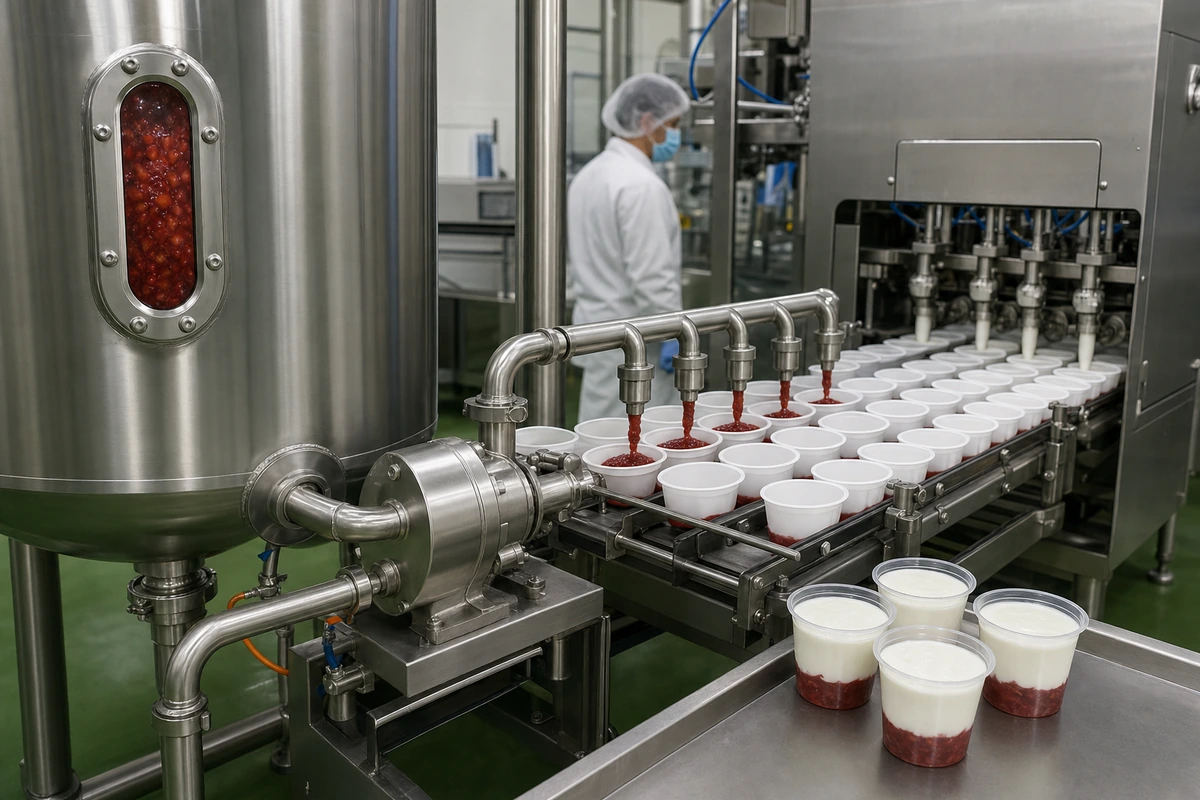
The same net mass occupies different volumes after cutting. Whole berries leave large air spaces; halves and slices settle more closely; dice fill gaps more efficiently; puree flows into nearly all available volume. That is why cup conversions rise as the structure becomes smaller. Put the stated basis into the strawberry specification wherever it changes how the lot will be sampled, compared or released.
Volume is especially sensitive to packing technique. Shaking a cup of dice, compressing slices or leveling thick puree can change the result without adding fruit. Commercial formulation should therefore use calibrated mass rather than cups. Use the figure as an early estimate, then replace it with sample data from the proposed origin, variety, grade and processing format.
Frozen and thawed weights can also be confused. The sealed net weight remains the commercial reference, while a drained thaw test measures retained fruit after released juice is separated under an agreed time and screen method. Ask the product-development team which outcome matters most, then test the strawberry against that outcome in the real recipe or process.
For bakery, yogurt and retail packs, piece count and visible size may drive portion quality. For beverages, jam and sauces, soluble solids, puree yield and screen loss may be more useful than the weight of one original berry. A practical control states the limit and the inspection method together, giving the supplier and buyer one reproducible basis for acceptance.

How to Measure Average Strawberry Weight
Define the lot and take samples from more than one carton, bag or pallet position. A handful from the top can overrepresent large intact berries, while fines and broken fruit may settle elsewhere during handling. Treat the definition as a boundary for the strawberry discussion, then convert the relevant part into a measurable purchase requirement.
Use a calibrated scale and state the condition: frozen, partly thawed or fully thawed; hulled or unhulled; surface frost retained or removed. Do not mix conditions within the sample. Where the observation is sensory, have the same approved method and product temperature used for both the control sample and the shipment check.
Count the selected whole berries, weigh them together and divide the net fruit mass by the count. A group weight reduces the influence of scale resolution. Report the minimum, maximum and distribution as well as the average. Connect the observation to usable yield and finished-product performance so the decision is based on more than the fruit's incoming appearance.
Repeat the test across batches if unit count affects costing or packaging. One approved sample cannot prove that a new crop, cultivar or size grade will produce the same average without change control. Where a batch claim is required, request the corresponding lot record or test result rather than extending a general article statement to every shipment.

From Fruit Weight to Yield and Portion Cost
Start with purchased net weight, then subtract rejected defects, calyx or peel-like plant material, trim, screen loss and process hold-up. The result is usable yield. Price per purchased kilogram can be misleading when two grades deliver different usable output. Use the explanation to align the strawberry brief before samples are requested, particularly when teams use the same word in different ways.
For whole IQF retail packs, estimate berries per pouch from the measured count distribution and check whether the appearance remains acceptable at both ends. A 500 g pouch of 12 g berries contains about 42 pieces only as a rough center point. Variation becomes easier to manage when the range, sample count and test condition are agreed before the commercial lot is packed.
For dice, calculate finished pieces from cut size, fines and breakage rather than original fruit count. Smaller dice increase surface area and can release more juice after thawing, which may affect formula water and visible fruit identity. A small difference can become material at production scale, especially when the strawberry is dosed by weight or must hold its identity after processing.
For puree, record the mass balance from raw frozen fruit through pulping and screening. Achene, coarse tissue and equipment retention can reduce yield. Compare cost per usable kilogram at the approved screen and Brix condition. Close the loop by carrying the agreed observation into the specification, control sample and pre-shipment record used for final approval.
How Strawberry Weight and Count Changes a Commercial Frozen-Fruit Decision
A correct factual answer is only the first layer for a commercial order. GreenLand-food supplies whole IQF berries, halves, slices, dice, brokens and puree for beverages, yogurt, bakery, jam, sauces, desserts, foodservice and retail frozen-fruit programs. The buyer still has to convert the article topic into a measurable requirement. Without that translation, two suppliers may answer the same question correctly while quoting products that behave differently in the buyer's line.
The practical comparison starts with variety, maturity, natural red color, Brix, size, calyx and stem tolerance, broken rate, defects, foreign material and thawing performance. Some of those points can be checked in a specification or COA; others need a retained sample, batch photograph, thaw test, screen test, cut measurement or sensory panel. We recommend stating the test method and tolerance instead of relying on adjectives such as premium, ripe, smooth or natural.
Format matters just as much as fruit identity. A whole IQF item is bought for piece definition and portioning. A puree is bought for flow, color, flavor and screen condition. Smaller pieces may improve dosing but increase exposed surface. The approval record should therefore name the exact form, not merely strawberry.
Packing and cold-chain details complete the decision. We review bulk cartons, foodservice bags, retail pouches and private-label packs against net weight, carton strength, label, pallet plan, storage statement and destination-market needs. An acceptable pre-shipment sample does not protect the order if temperature, seal integrity or loading practice changes before delivery.
A Repeatable Sample-to-Shipment Approval Process
Use one written comparison sheet for every candidate lot. Record the sample date, product code, crop or production reference, packing, frozen condition on arrival and the method used for each measurement. This prevents a sales sample, laboratory sample and shipped lot from being compared as if they were interchangeable.
Run the application test at the scale that reveals the risk. A visual tray review may be enough to reject serious foreign material or abnormal color, but it cannot predict a beverage screen, bakery bleed, dairy suspension or retail pouch display. Keep the test recipe, temperature, time and pass criteria stable across suppliers.
- Define the intended application and choose from whole IQF berries, halves, slices, dice, brokens and puree.
- Write measurable requirements for variety, maturity, natural red color, Brix, size, calyx and stem tolerance, broken rate, defects, foreign material and thawing performance.
- Confirm the sample identity, lot status and whether it represents current commercial supply.
- Test the fruit frozen, after controlled thawing and in the intended formula where relevant.
- Approve bulk cartons, foodservice bags, retail pouches and private-label packs with label, net weight, carton and pallet details.
- Match the final specification, COA, certificate scope, packing record and loading evidence to the shipment lot.
- Retain the approval result and change-control rule for repeat orders.
The sequence is deliberately simple. It gives purchasing, QA and product-development teams the same reference point, while leaving room for market-specific microbiology, residue, allergen, organic or non-GMO documentation. Not every document is required for every destination, so the buyer should name the governing standard rather than request an undifferentiated certificate bundle.
Before repeat production, define what triggers reapproval: a variety change, origin change, new crop, different facility, altered pack material, wider cut tolerance or revised test method. Small wording changes in a quotation can hide a meaningful technical change. A signed specification and documented sample decision make that change visible.
What to Put in the RFQ
| RFQ field | What to state | Why it matters |
|---|---|---|
| Product identity | whole IQF berries, halves, slices, dice, brokens and puree | Prevents a quotation for the wrong physical format. |
| Quality target | variety, maturity, natural red color, Brix, size, calyx and stem tolerance, broken rate, defects, foreign material and thawing performance | Turns broad quality language into an acceptance basis. |
| Application | beverages, yogurt, bakery, jam, sauces, desserts, foodservice and retail frozen-fruit programs | Lets the supplier review particle, texture, color and thaw behavior in context. |
| Packing | bulk cartons, foodservice bags, retail pouches and private-label packs | Connects net weight, handling, private label and loading plan. |
| Compliance | Destination market, required certificate scope, tests and shipment documents | Avoids treating one market's file set as universal. |
| Commercial plan | Trial quantity, annual forecast, delivery window, port and Incoterm | Separates sample availability from scalable repeat supply. |
Send the application before asking the supplier to recommend a form. The same fruit may need a visually intact whole piece for retail, a controlled dice for yogurt, a lower-cost broken grade for jam or a defined screen for beverage puree. A recommendation without the use case is mostly guesswork.
Request current evidence rather than generic marketing files. Useful evidence can include a representative frozen sample, product and packing photos, the draft specification, a batch COA, certificate copies with holder and scope, loading records and a change-control note. Availability depends on the order stage and agreed commercial terms.
For a broader product view, use the GreenLand-food frozen-food catalog. For product-specific forms and current order planning, review our frozen strawberry supply page and send the actual specification rather than only the article keyword.
How to Read the Numbers, Pictures and Supplier Claims
Every number in a fruit article has a scope. A weight can describe one fruit, a household cup, a drained sample or a sealed pack. A season can describe flowering, harvest, packing, shipment or arrival. A particle size can describe a screen opening rather than the particle that remains in a finished formula. When strawberry weight and count matters to a purchase, copy the definition and test condition beside the value.
Photographs also need context. Camera distance, white balance, frost, condensation and lighting can change apparent color and size. A photograph is strong evidence for gross product form, visible defects, packing condition and lot coding, but it cannot prove aroma, firmness, Brix, microbiology, residue compliance or a certificate's scope. Ask what the image shows and what it cannot show.
A certificate is evidence only within its named holder, facility, product or activity, validity period and standard. It should not be used as a universal quality badge. If the order depends on organic, non-GMO, food-safety or customer-program status, match the document to the operation producing or handling the shipment and record how the lot is connected to that operation.
A COA is likewise batch-specific. It can report selected analytical results, but it does not replace the full specification, sampling plan or sensory approval. Check the product code, lot, production date, laboratory or method, units and limits. A result without those identifiers is difficult to compare with the delivered goods.
Supplier language should be resolved into tolerances. Words such as sweet, ripe, smooth, firm, premium, seedless, clean or free-flowing can be useful summaries, but two teams may interpret them differently. For strawberry, pair the word with a number, reference sample, defect photograph, sensory scale or pass-fail application test wherever the commercial risk justifies it.
Sampling is the bridge between the specification and the physical product. Take enough increments to represent different cartons or pallet positions, keep the sample frozen until the defined test and record any thawing or preparation. If the lot is heterogeneous, an average alone can hide the very pieces that cause line stoppage or consumer complaints.
Scale-up adds another uncertainty. A hand-selected laboratory sample may show the intended result without representing a full production shift. Before a large private-label or industrial program, ask whether the sample is commercial stock, a pilot sample or a target reference, and define what happens if the production lot falls outside the approved range.
Finally, keep claims proportionate to evidence. This article provides a current technical framework and cites the sources used, but climate, regulation, varieties and market channels can change. Current supplier records, destination-market advice and the signed order specification should take priority when the shipment is approved.
Record disagreements instead of smoothing them away. If a sensory panel, certificate, laboratory result and production photograph point in different directions, pause the approval and identify which question each item actually answers. A clear exception note protects the buyer and supplier from turning an unresolved observation into a repeat-order precedent.
Continue the Product Review
For available formats and order discussions, review our Frozen Strawberry supply page. For related handling and use context, continue with Frozen Strawberries 101.
Frequently Asked Questions
How much does an average strawberry weigh?
About 12 g is a practical medium reference, but individual fruit commonly ranges from around 7 g for small berries to 27 g or more for very large berries.
How many strawberries are in one kilogram?
Roughly 37–143 across the broad 7–27 g reference range. Around 83 medium 12 g berries would make one kilogram, but real lots need counting.
How many strawberries are in 500 g?
Approximately 19 very large 27 g berries, 28 large 18 g berries, 42 medium 12 g berries or 71 small 7 g berries. Treat these as estimates.
Does one cup of strawberries always weigh the same?
No. Whole, halved, sliced, diced and pureed fruit leave different air spaces. Packing pressure and fruit size also change the mass in one cup.
For a closer explanation, see How Many Grams in a Cup of Strawberries?.
Does frozen strawberry weigh more than fresh?
The fruit itself does not gain meaningful dry matter through freezing, but retained water, frost, glaze or package ice can affect a measured sample. Use the agreed net-weight and test method.
Can strawberry diameter predict weight?
It can indicate a general tendency, but shape, length, cavity, density, maturity and water content prevent a reliable one-to-one conversion.
How should a buyer specify strawberry size?
State the diameter band, percentage within size, whole or cut form, broken tolerance, count requirement if needed, sampling plan and measurement condition.
How is usable strawberry yield calculated?
Divide accepted finished mass by the purchased input mass after documenting rejects, trim, drip, screening loss and equipment hold-up under the agreed process.
Source Frozen Strawberry with GreenLand-food
GreenLand-food is a professional Frozen Strawberry supplier and manufacturer in China, providing factory-direct wholesale supply for importers, food manufacturers, foodservice distributors, and private-label programs.
Send the product form, specification, packing, quantity, application, destination, private-label needs, and requested documents.