


How to Steam Sugar Snap Peas Without Losing Color and Crunch
Sep 23, 2026
Leave a message


Prepare Sugar Snap Peas for Even Steaming
Start by sorting the pods. Fresh sugar snap peas should be bright, reasonably crisp, and free from decay, heavy scarring, or excessive drying. Remove leaves and loose field material. Rinse under clean running water and drain well. Soaking for a long period is unnecessary and can fill damaged pods with water.
Trim the stem end and remove a tough string if the variety or maturity has developed one. Pulling from the stem along the seam often removes it in one strip. Some modern snap pea varieties have little noticeable string, so test a sample before committing labor to every pod. A string that remains tough after steaming is a maturity or preparation issue, not something extra cooking will reliably solve.
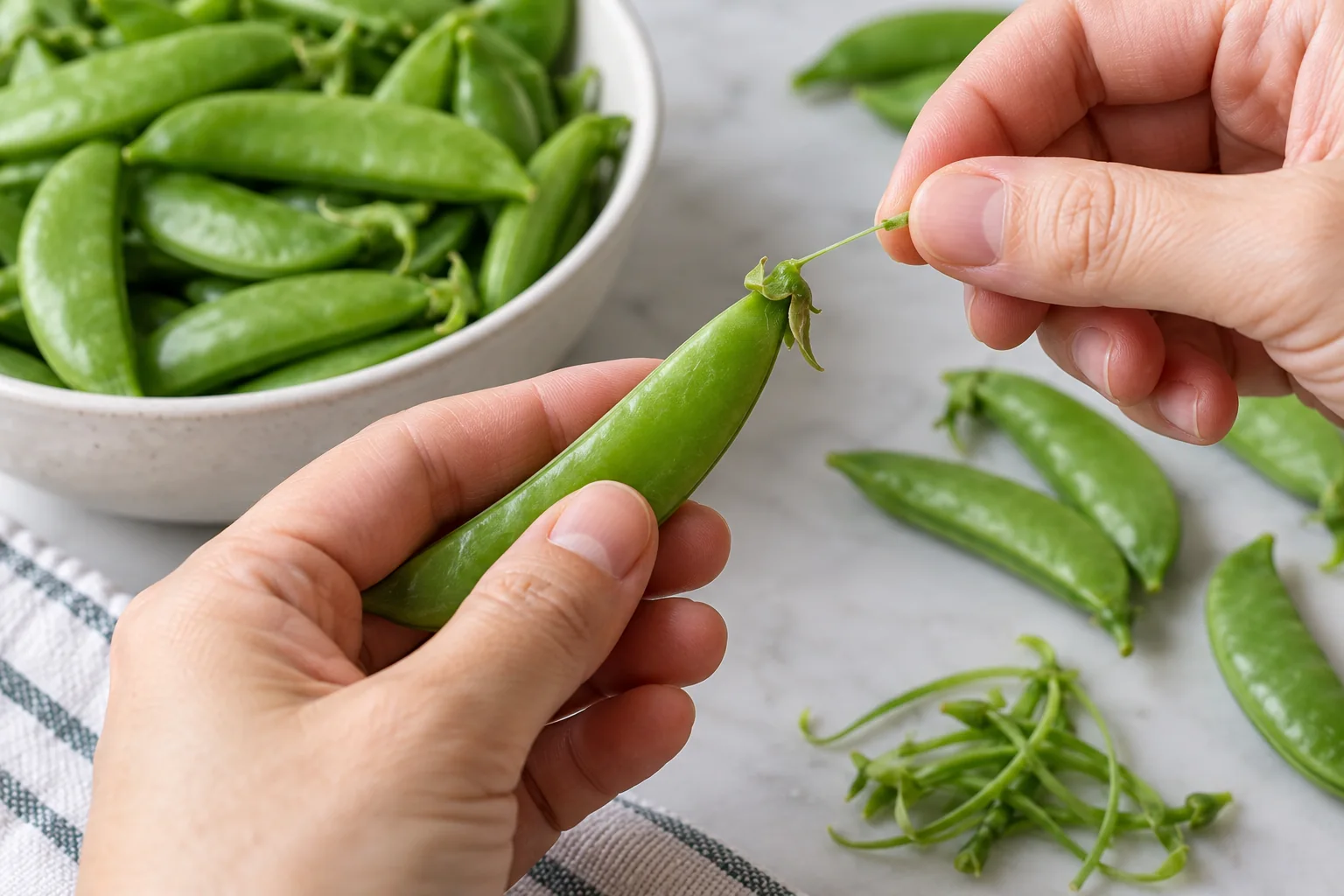
Close-up preparation sequence showing a hand snapping the stem end and pulling the string from a plump sugar snap pea, accurate pod anatomy, no face or text.
Keep pod sizes reasonably similar within a basket. Very small pods cook faster than large, full pods. If a lot has a wide distribution, grade it or expect a compromise between the smallest and largest pieces. For a foodservice specification, pod length, width, maturity, and string tolerance are more useful than the general phrase "good snap peas."
Frozen sugar snap peas are normally cleaned and blanched before freezing. They may arrive ready to cook, but the pack instructions and specification still control. Do not leave a bulk pack at room temperature while trimming other ingredients. Remove only the quantity needed for the next batch and return the remainder to proper frozen storage.
For individual quick-frozen pods, break up loose clumps gently without crushing. Large frozen blocks indicate that the product has fused or thawed and refrozen; investigate pack and temperature condition rather than forcing the block into the basket. Surface frost is expected to a degree, but heavy internal ice increases water load and can make timing less predictable.
The steamer itself should be ready before loading. Use a basket with enough open area for steam to move around the pods. Confirm that water will not touch the food at a normal simmer. Preheating prevents the first batch from spending a long time in warm, humid air before useful steam reaches it.
Sanitation and separation still matter for a vegetable that will be cooked. Use clean knives, boards, baskets, and pans, and keep prepared raw pods away from dirty cartons and floor-level handling. If the same steamer serves raw animal foods or allergen-containing dishes, follow the operation's cleaning and scheduling controls. Steaming for a few minutes is not a substitute for preventing cross-contamination before and after cooking.
For a planned chilled application, decide whether strings and stem ends will be more noticeable after refrigeration. A pod that seems acceptable while hot may feel tougher when cold. Run the trimming decision against the final salad or snack cup rather than only at the stove. This small test can save considerable labor when the supplied variety is genuinely tender, or prevent complaints when it is not.
Steam Fresh Snap Peas Until Bright and Crisp-Tender
Bring the water to a steady simmer or low boil, then load the drained fresh pods in a shallow, even layer. Cover promptly. Starting with active steam shortens the period in which the pods warm slowly and helps fix a repeatable reference point for the kitchen.
Check an initial small batch after roughly two minutes, then at short intervals. Depending on pod size, basket depth, equipment, and desired bite, fresh sugar snap peas often finish in about two to four minutes. Treat that range as a trial window, not a guarantee. A commercial cabinet steamer, combi oven, countertop pot, and perforated hotel pan recover heat at different rates.
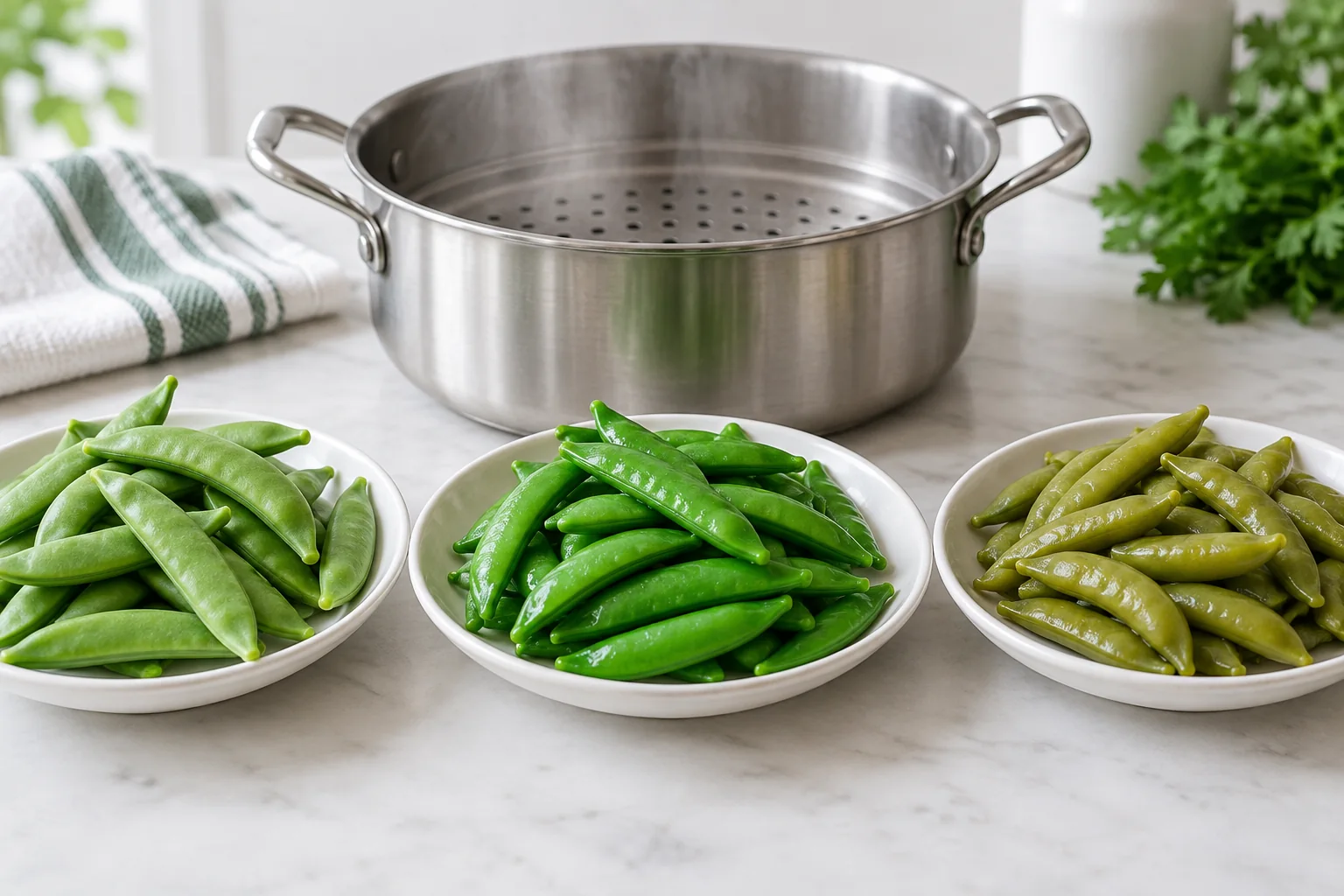
A three-stage steaming sequence with the same sugar snap peas before steaming, at bright crisp-tender doneness, and overcooked olive-soft condition, no labels or numbers.
The ideal pod becomes a brighter green and loses the raw, chalky impression while retaining a crisp bite. The peas inside should be warm and juicy, not mealy. Remove the basket as soon as that point is reached. Residual heat continues to soften the pods, especially when they remain piled together.
For immediate table service, drain briefly and season at once. For chilled salads or later reheating, cool rapidly according to the food-safety plan so cooking stops. A short ice-water chill can preserve color, but it introduces water that must be drained thoroughly. In production, a blast chiller or shallow-pan cooling method may be easier to control than an oversized ice bath.
The University of Alaska Fairbanks snap pea guidance provides practical handling and cooking context, while the University of Rhode Island preparation sheet reinforces the simple trim-and-cook approach. Their short consumer methods still need to be adapted to the actual quantity and equipment used in a commercial kitchen.
Record the finished batch, not only the timer. Note product weight, basket type, layer depth, starting water condition, cover position, check time, removal time, and result. This creates a useful baseline for staff and exposes why the same "three minutes" can produce different food on two stations.
Use Different Timing for Frozen Sugar Snap Peas
Frozen sugar snap peas have already received a blanching step during processing. Blanching inactivates enzymes and sets the product up for frozen storage, but it also begins cooking the tissue. The goal in the kitchen is mainly to heat the pod through while preserving the texture that remains, not to repeat a full fresh-vegetable cooking cycle.
Steam IQF pods from frozen unless the pack or recipe specifies another method. Thawing first releases moisture and makes the pods easier to overcook. Load a shallow layer into a fully preheated steamer and begin checking as soon as steam has recovered. The exact time may be similar to or slightly longer than a small fresh batch because the product starts below freezing, yet the safe quality window can be narrower because of the prior blanch.

Whole sugar snap pea pods showing plump rounded form.
Do not judge by surface ice alone. Frost melts quickly, while the center may still be cool. Open one representative pod and taste the peas and wall. The correct endpoint is evenly hot with a pleasant bite. If the outside is soft before the center is hot, reduce basket depth or improve steam circulation rather than extending the same overloaded cycle.
The GreenLand frozen sugar pea page and broader frozen snap pea category show commercial product formats for review. We confirm grade, pod size, blanch condition, pack, origin, destination documentation, and availability for a specific order. A buyer should run the cooking trial on the proposed lot because blanch intensity and maturity affect the final bite.
Frozen pods may show a darker green than very fresh pods, and a small amount of surface wrinkling after cooking can be normal. Excessive olive color, split seams, large ice crystals, or a waterlogged bite call for investigation. Possible causes include mature raw material, over-blanching, slow freezing, temperature abuse, overcooking, or prolonged hot holding.
Avoid thawing and refreezing unused portions. Repeated phase changes enlarge ice crystals, increase drip, and weaken the pod wall. In a foodservice kitchen, divide large packs only while the product remains safely frozen and use clean procedures that do not damage the package barrier. If the business needs many small releases, a smaller case or inner-bag configuration may be more economical than repeatedly opening one bulk liner.
A first trial should include at least three endpoints: slightly early, target, and slightly late. Photograph the color under consistent light and score bite while samples are still at service temperature. The acceptable window between early and late is operationally important. A product that tastes excellent at one exact second but collapses immediately may be harder to execute during a rush than a pod with a wider tolerance.
For recipe costing, weigh the frozen input and the drained cooked output. Ice and released water influence apparent yield. If the menu portion is based on cooked drained weight, a nominal bag weight is not enough to predict portions. Use several representative batches before setting the standard.
| Starting form | Main heating task | Best first trial | Common mistake |
|---|---|---|---|
| Fresh sugar snap peas | Cook raw pod walls and peas to crisp-tender | Small shallow load, checked after about two minutes | Extending time to soften a tough string |
| IQF frozen sugar snap peas | Heat a previously blanched pod through | Steam from frozen and check after steam recovers | Thawing on the counter, then cooking as if fresh |
| Chilled pre-steamed peas | Reheat without completing a second full cook | Short controlled reheat to the service endpoint | Adding the original steam time again |
The table is a starting logic, not a replacement for the product instructions or the site's food-safety plan. Equipment, pod size, maturity and batch depth still determine the real endpoint.
Read Color, Bend and Bite Instead of Trusting the Clock Alone
Time is a control, but sensory cues decide doneness. As chlorophyll-containing pods heat, their green often looks brighter before prolonged heat and acid push it toward dull olive. Remove the peas during that bright window. Kitchen lighting affects judgment, so evaluate under a neutral, consistent light when training staff.
Bend one pod gently. A raw pod can feel rigid and fibrous; a crisp-tender pod yields slightly and springs or snaps; an overcooked pod folds easily. This cue is especially useful when product size changes. It is not a substitute for tasting, but it helps a cook decide which pod to open.
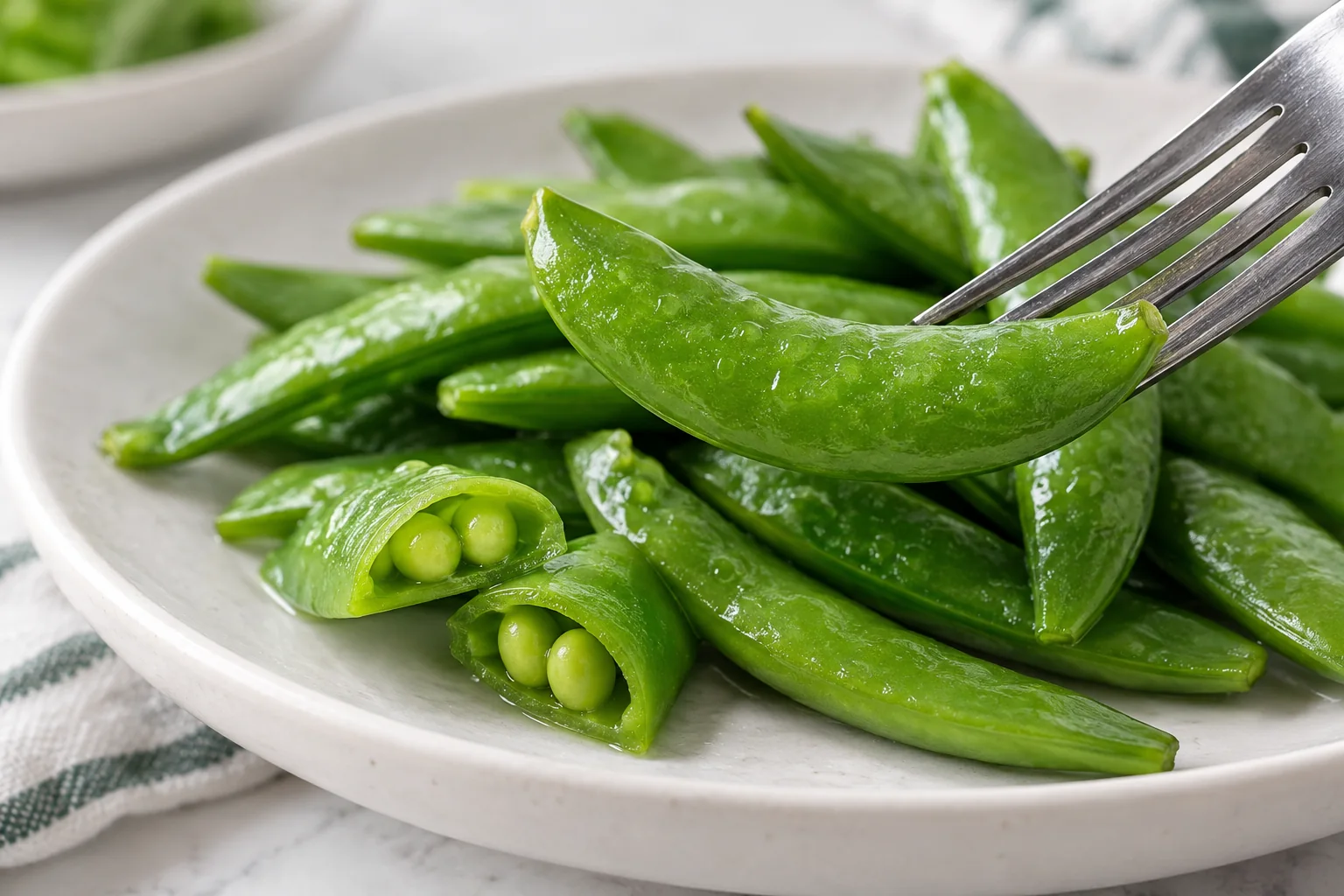
A doneness inspection close-up showing one steamed snap pea bending slightly, one cross-section with firm pod walls, and vivid green color under neutral light.
Cut or bite through the thickest part. The wall should be tender enough to chew without strings pulling, yet firm enough to make a clean break. The internal peas should be hot and sweet, not cold, chalky, or pasty. Taste without heavy seasoning during the trial so salt, fat, and acid do not mask texture problems.
Look at the seam and tips. Splitting can occur when mature pods, internal pressure, or rough handling meet heat. A few opened pods may be acceptable, while widespread splitting reduces visual quality and releases peas. If splitting rises, check maturity, freeze condition, loading, and steam intensity before assuming that a shorter clock alone will fix it.
Use the largest normal pod as the check piece, not the smallest. A batch can appear ready because thin pods are bright while the large pods remain cold. Conversely, waiting for an unusually oversized pod can sacrifice the whole basket. A tight incoming size specification narrows this conflict.
Create a reference plate or short training note showing underdone, target, and overdone samples from the actual product. Replace photographic references when lighting or product changes. This is more useful than telling staff to cook until "nice and green," and it gives supervisors a shared vocabulary for corrective action.
Do not use color as a food-safety measurement. It is a quality cue only. Safe handling, cooking, cooling, reheating, and holding must follow the validated procedure and local requirements for the complete dish. The distinction is important because a vivid green pod can still have been mishandled before cooking, while a safe product can lose color during an unnecessarily long hold.
For sensory scoring, use a short scale that staff can apply consistently: color, surface moisture, stringiness, pod-wall bite, internal-pea texture, sweetness, and off-flavor. A single "pass" hides the cause of failure. If color and flavor pass but stringiness fails, the answer may be maturity or trimming; if every attribute fails only in the center of a basket, loading and steam circulation are more likely.
Prevent Crowding, Condensation and Waterlogging
Steam transfers heat efficiently only when it can contact the food. A tightly packed mound creates cold pockets and slows recovery after the lid closes. The outer pods overcook while the center warms. Use a shallow layer, leave perforations open, and split a large quantity into repeated batches rather than compressing it into one basket.
Crowding also holds condensation. Water collects on pod surfaces and between layers, softening the exterior and diluting seasoning. Make sure the lid sheds condensation away from the food where the equipment design permits. Lift the basket promptly when finished and let free water drain before moving the peas to a service pan.

Frozen sugar snap pea pods with visible surface frost.
Water level matters. The boiling water should remain below the basket at the selected simmer. If bubbles splash into the pods, the method becomes partial boiling and the vegetables can absorb more water. Too little water is also a problem because the pot may run dry or steam output may collapse during consecutive batches. Mark a safe working level for the station.
Do not repeatedly lift the lid during a very short cook. Each opening releases heat and steam, making the next interval less predictable. Plan one early check for the trial, then refine the routine. In a commercial steamer with rapid recovery, follow the equipment instructions and verify the result with the same product load.
The receiving product contributes water as well. Poorly drained fresh peas carry wash water; frozen peas carry frost and may have thaw liquid if mishandled. These loads cool the chamber and increase condensation. Standardize draining and keep frozen product frozen until loading.
After steaming, avoid deep covered piles unless a short hot hold is specifically managed. Trapped steam continues cooking and turns the bottom layer wet. Shallow pans and small releases preserve quality better. If the operation must serve a large rush, increasing batch frequency is usually more successful than making one enormous early batch.
Equipment maintenance influences the result. Mineral scale, blocked perforations, worn door seals, and inaccurate controls change steam delivery. If timing suddenly drifts while the product and load remain the same, inspect the steamer before rewriting the recipe. Kitchens with more than one unit should qualify each unit; identical model names do not guarantee identical recovery after years of use.
Altitude can also affect open-pot steaming because water boils at a lower temperature as elevation rises. The difference may be small for a thin vegetable but becomes visible when a recipe is transferred between locations. Each site should confirm its own endpoint rather than enforcing a head-office minute value without a bite test.
Season After Steaming Without Softening the Pods
Season after steaming so the cook can see and control the pod itself. Salt added to the steaming water has little direct contact with food held above it and is mostly wasted. Tossing drained hot pods with a measured amount of salt distributes flavor more reliably. Oil or butter helps seasoning cling and adds gloss, but too much makes the pods heavy.
Acid brightens flavor but can dull green color during a hold. Add lemon juice, vinegar, or an acidic sauce close to service. If the dish must sit, test the actual time and concentration. A lightly acidic dressing served on the side may protect appearance better than coating a full pan in advance.
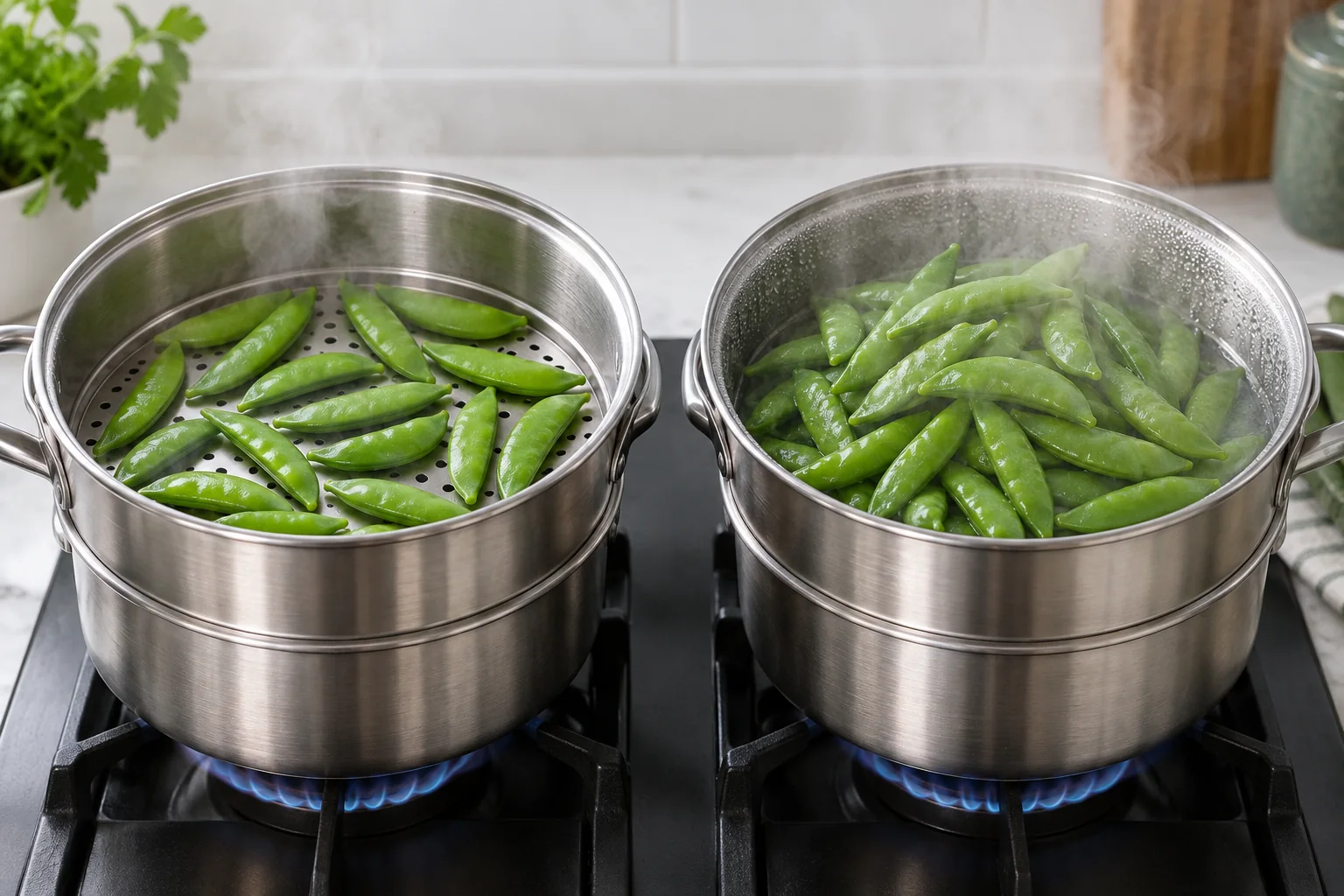
Two identical steam baskets comparing a shallow single layer with an overloaded mound producing condensation, clearly showing circulation differences without arrows or text.
Aromatics should suit the short cook. Lemon zest, toasted sesame, mild chili, black pepper, mint, dill, garlic oil, or a small amount of soy-based seasoning can work without burying the pea flavor. Raw minced garlic added to a large warm pan may taste harsh and uneven; infusing it in oil or cooking it separately gives more control.
Drain before adding fat. Water left in the pan prevents oil from coating evenly and creates a thin pool of diluted dressing. A perforated pan or colander helps, but do not shake so aggressively that hot pods split. Weighing the dressing against cooked drained weight improves consistency across batches.
If seasoning includes allergens such as dairy, sesame, soy, or nuts, manage utensils, pans, labeling, and cross-contact under the kitchen's allergen plan. The simplicity of steamed vegetables does not remove that responsibility. Plain unseasoned pods can be held separately for multiple menu uses when operations require flexibility.
Taste after one minute, when the seasoning has coated the hot surface, and again at service temperature. Salt and acid perception changes as food cools. A seasoning level that seems restrained at the pass may become strong in a chilled salad. Match the final check to how the customer will eat the product.
Plan Foodservice Batches and Short Hot Holds
For foodservice, calculate batch size from service rate and equipment recovery. A basket that holds three kilograms physically may deliver better quality at half that load. Measure how many acceptable portions a batch produces, how long the complete cycle takes, and how frequently staff can reload during peak service. Capacity is acceptable portions per hour, not basket volume.
Use a short, defined hot hold. Even at safe holding temperature, snap peas continue to soften and lose fresh aroma. Covering prevents surface drying but traps steam. A vented or loosely covered shallow pan may protect texture better, provided the operation's food-safety procedure is met. Never use quality advice to override local time and temperature requirements.
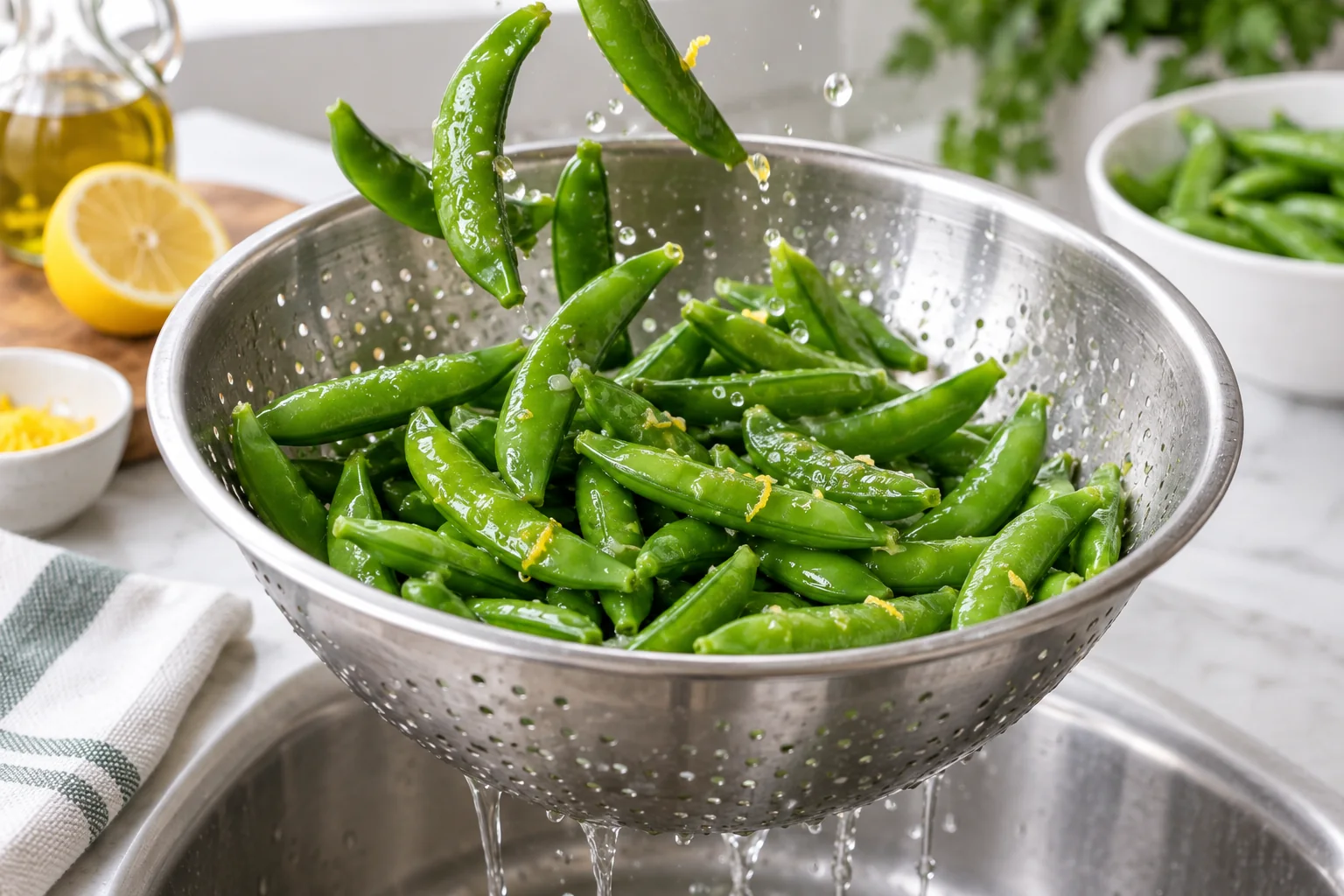
Steamed sugar snap peas being tossed after cooking with a light lemon-oil dressing while excess water drains away, preserving glossy crisp pods.
Separate cooking for immediate service from par-cooking for later finishing. If peas will be reheated, remove them earlier, cool rapidly, and validate the reheat so the final bite reaches the target. Recording only the first steam time ignores half of the heat load. Reheated frozen peas may need an especially light initial treatment because they were blanched before freezing.
Label batches with preparation time and use the oldest acceptable batch first. Do not mix a fresh crisp batch into an older soft pan; the average may pass a visual glance while giving customers inconsistent portions. Small pans make rotation easier and reveal waste honestly.
When selecting an ingredient, ask for pod size, maturity, string tolerance, blanch condition, defects, broken-pod limit, pack, storage, and current crop information. Confirm carton quantity, minimum order, loading port, destination documents, and sample availability. A cooking trial should use the same batch depth and service plan intended for the menu.
The repeatable method is straightforward: standardize preparation, use a shallow load over active steam, stop at bright crisp-tender, drain, season late, and serve in small batches. Fresh and frozen sugar snap peas can both work well, but they need separate tested timings. The pod's color, bend, and bite remain the best final evidence that the process is under control.
Source frozen sugar snap peas with GreenLand-food
GreenLand-food is a frozen-food supplier and manufacturer supporting factory-direct wholesale programs. We match the requested product form and coordinate the commercial details. Share the required pod size, grade, pack, destination and foodservice application. We will review frozen sugar snap pea supply for your menu or processing line.