


How to Tell If Shiitake Mushrooms Are Bad
Sep 23, 2026
Leave a message

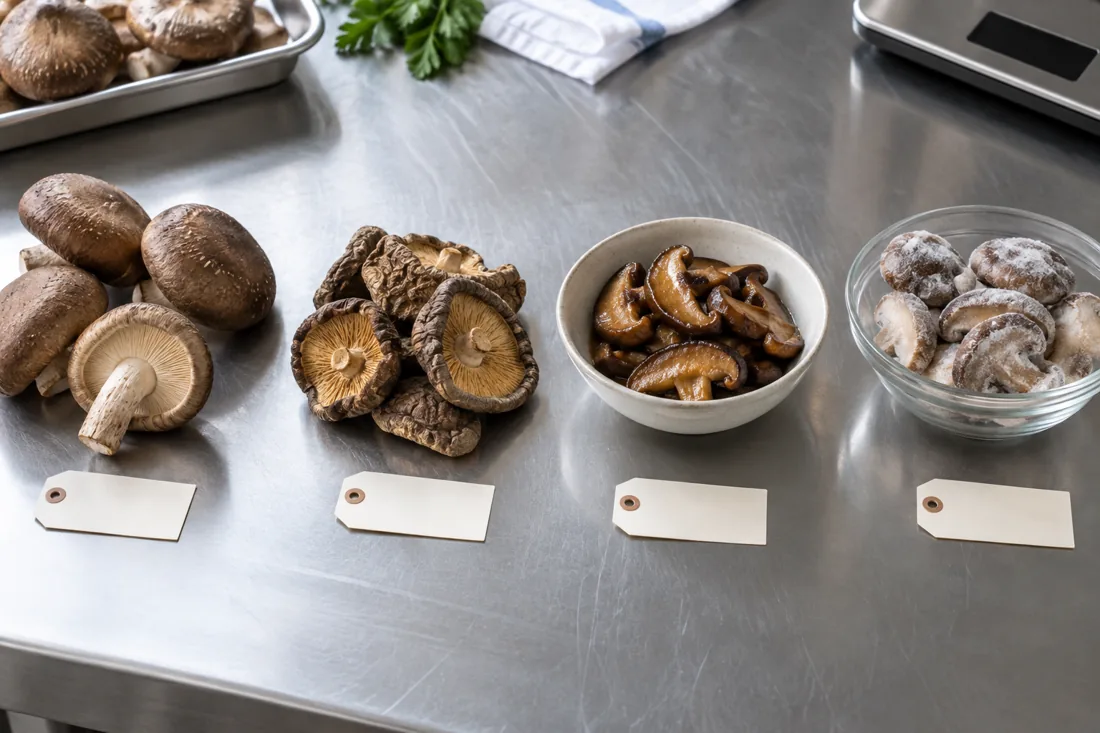
The right check depends on the product form. Fresh shiitake should not be judged like deliberately dried shiitake; soaked dried mushrooms are no longer a dry pantry product; cooked leftovers need time-and-temperature controls; and frozen mushrooms require a review of their cold-chain history as well as their appearance. A single photograph of a brown cap cannot answer all of those questions.
Use the package instructions and your knowledge of how the mushrooms were handled before making a decision. Do not taste a questionable mushroom as a safety test, and do not assume that washing or cooking can repair every problem. This guide separates useful quality observations from the situations in which the food should not be used.
Check fresh shiitake for moisture, slime, odour and mould
Fresh shiitake naturally vary in cap color, pattern and size. A brown cap with a pale crackled pattern is not automatically mold, and a firm fibrous stem can be normal. Begin by looking at the whole mushroom and the container rather than deciding from one color patch. Compare the condition with a sound fresh product of the same form, while remembering that visual comparison is only part of the assessment.
Inspect the cap, underside, stem base and the areas where mushrooms contact each other. Moisture and damage can be less obvious under a cap or at the bottom of a package. A surface that is markedly slimy, wet with deterioration or breaking down is a warning sign. A few droplets of condensation in a pack are not identical to decomposing tissue, but they should prompt a closer look at the product and storage conditions.
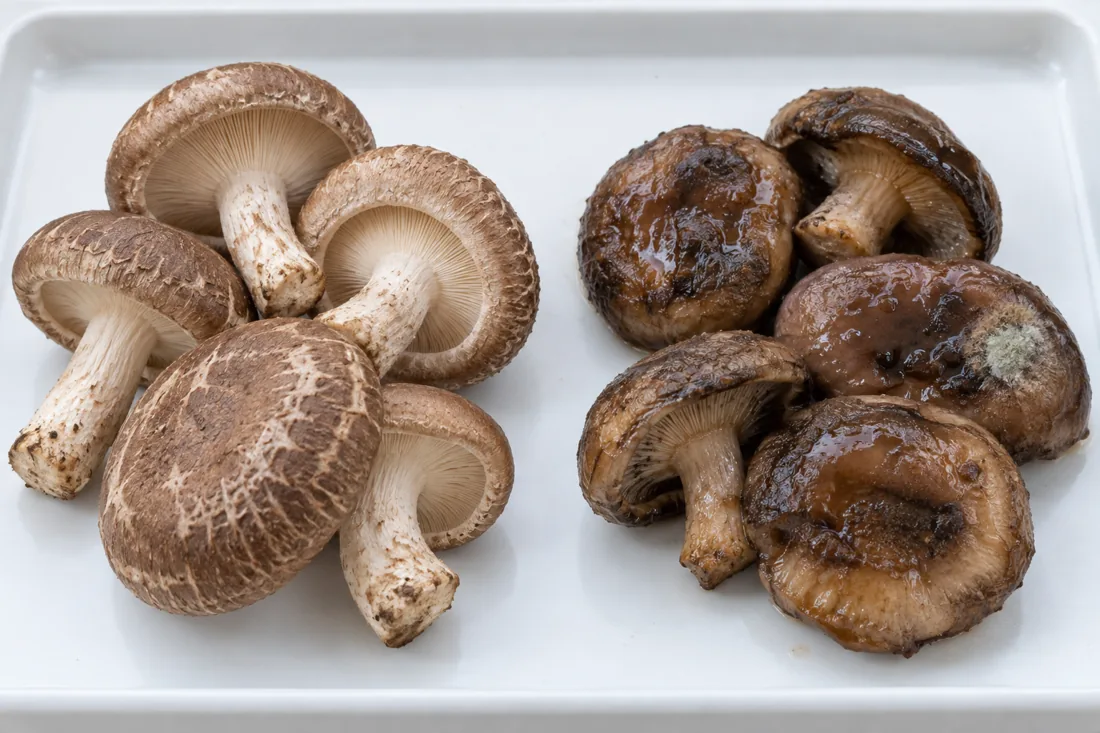
Illustrative fresh mushroom comparison with obvious deterioration on the right. Normal appearance on the left does not prove safety.
Odor can provide another warning. Shiitake have a characteristic mushroom aroma, while an unusual sour, fermented or putrid smell suggests that the product should not be used. Do not take repeated close inhalations of a visibly moldy product to characterize the smell. If the condition is clearly unacceptable, further sensory testing adds no useful reassurance.
Visible fuzzy growth, spreading mold-like patches or obvious decay should lead to discard or the appropriate commercial rejection procedure. Do not simply cut away a suspect area from a soft, high-moisture mushroom and assume the remainder is safe. Likewise, rinsing off slime does not restore a spoiled mushroom to its original condition. Cleaning suitable mushrooms and salvaging spoiled mushrooms are different activities.
Health Canada's mushroom handling advice recommends choosing firm fresh mushrooms, refrigerating them appropriately and using them promptly. It advises a paper bag for loose mushrooms and suitable original packaging for prepacked mushrooms. Avoid trapping fresh mushrooms in an improvised airtight container at room temperature. Follow the actual product label when it gives more specific instructions.
Handle the inspection cleanly. Keep mushrooms away from raw meat juices, wash hands and use clean utensils and surfaces. Do not move a questionable batch onto the board where you are preparing an acceptable batch without cleaning appropriately afterward. In a kitchen, separate the uncertain product so another person does not accidentally put it into a recipe while you are still deciding what to do.
Finally, look at the date and history. A mushroom with no obvious spoilage sign can still have been mishandled. If the product was left warm, exposed to contamination or stored beyond an applicable use-by instruction, a pleasant smell is not a reason to ignore those facts. Sensory inspection can identify some reasons to reject food; it cannot prove the absence of every hazard.
Separate normal ageing from spoilage
Shiitake lose quality as they age, but not every change has the same meaning. A slightly drier cap edge or some loss of firmness can indicate declining freshness. Pronounced slime, mold or an abnormal odor belongs in a different category. The useful distinction is between an observation about eating quality and evidence that the product should not be used.
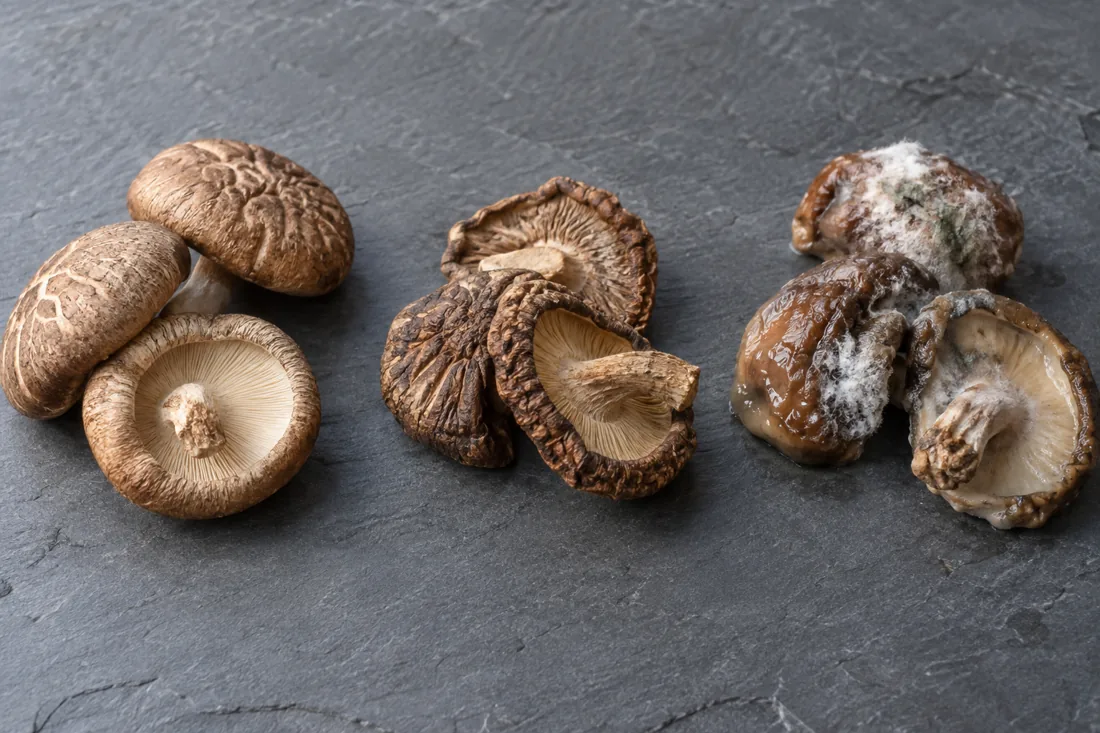
Illustrative fresh, withered and visibly moldy shiitake. Quality loss and spoilage warnings are different observations.
| Observation | What it can indicate | Appropriate response |
|---|---|---|
| Naturally brown cap with pale cracking | Normal appearance for some shiitake | Assess the whole product and its history; color pattern alone is not a discard test |
| Mild drying or shriveling | Moisture loss and reduced freshness | Check label, history and the absence of other warning signs; do not promise safety from dryness alone |
| Marked slime, decay or abnormal odor | Spoilage warning | Do not use; follow discard or rejection procedure |
| Visible mold-like growth | Unacceptable condition needing rejection | Do not trim and taste to test the rest |
| Normal appearance after unsafe storage | A history problem that may be invisible | Follow food-safety disposition guidance, not appearance alone |
| Dry pale areas on continuously frozen product | Possible freezer-related quality loss | Review the frozen history and specification separately from safety |
The University of Maryland and Virginia Tech shiitake reference discusses quality changes such as withering and oxidation during storage. That helps explain why a change in appearance is not a precise clock. Different harvest conditions, packaging and storage can make two mushrooms of the same purchase date look different.
Do not use a home "days since purchase" rule as if it were a laboratory test. Purchase date is not harvest date, and the temperature history before purchase may differ. A product's label and the supplier's instructions provide a more relevant framework. Within that framework, inspect condition and use sound product promptly rather than planning to keep it until the last possible day.
A dry edge also does not make the mushroom equivalent to a properly dried shelf-stable product. Accidental drying in the refrigerator is not a controlled dehydration process. Do not move partly dried fresh mushrooms into a pantry jar and assume they now have the storage life of commercially dried shiitake. The original product category and handling requirements remain relevant.
When a quality change is mild and the product remains suitable under its instructions and history, the intended dish may influence whether you want to use it. A less attractive but otherwise acceptable cap may not meet a premium whole-cap presentation standard even if it could suit a cooked chopped application. That is a quality decision, not permission to repurpose spoiled or mishandled food.
For a commercial team, record the specific observation rather than writing only "bad mushrooms." Note the percentage affected, location in the pack, odor, surface condition, date code and receiving temperature where applicable. Those details help distinguish a cosmetic specification failure from spoilage or a cold-chain issue and make the supplier investigation more useful.
Inspect dried shiitake for moisture uptake, pests and mould
Dried shiitake are intentionally shriveled and firm, so those features cannot be interpreted in the same way as on a fresh product. Start with the packaging and the dry-storage instructions. The pack should protect the mushrooms from moisture and contamination, and its condition should be consistent with the supplier's directions. A torn seal or evidence that the product became wet changes the assessment.
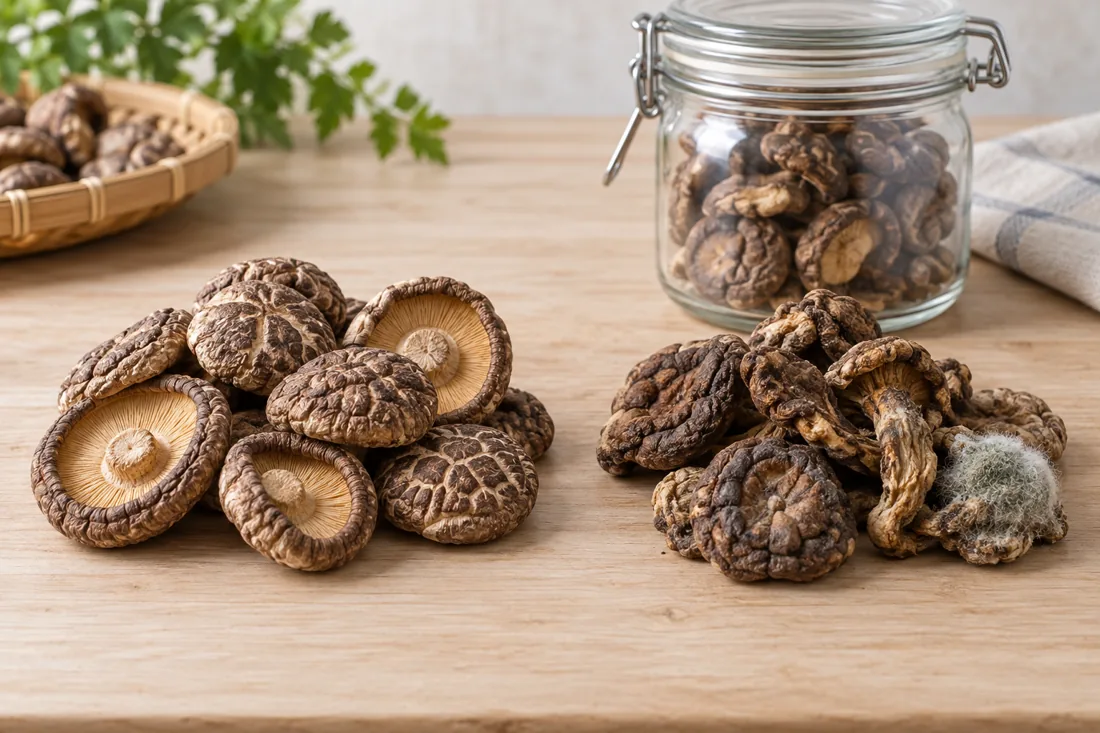
Illustrative dried shiitake inspection: keep dry product protected and reject moisture damage, pests or visible mold.
Look for unexpected dampness, sticky or softened areas, visible mold and pest activity. Insects, larvae, webbing or unusual debris are reasons to reject the affected product under the appropriate procedure. Do not assume that boiling later makes an infested or moldy dry product acceptable. A dry-food quality defect is not automatically harmless simply because the recipe includes a cooking step.
Distinguish the normal pale interior or surface pattern from unfamiliar growth, but do not try to diagnose uncertain mold species from a photograph. If a patch is questionable and you cannot establish that it is part of the normal product, seek the supplier's assessment or discard the product as appropriate. The purpose of a kitchen check is to make a prudent use decision, not to identify microorganisms by eye.
Smell should be consistent with the product, not musty or otherwise abnormal. Dried shiitake often have a stronger aroma than fresh mushrooms, so intensity alone is not the same as an off-odor. Compare with a known sound product if available, without tasting the dry mushroom as a safety test. A musty smell combined with moisture damage is a different situation from the expected concentrated mushroom aroma.
After opening, close the package or transfer the product to a suitable dry, clean container according to the instructions. Label it so the original lot and date remain available. Do not combine a new pack with an old uncertain batch in the same jar. That makes both traceability and quality assessment harder, especially if a problem appears later at the bottom of the container.
Keep the dry product away from steam and splashes during cooking. A jar repeatedly opened beside a boiling pot can be exposed to moisture even when the lid is replaced afterward. Use a clean, dry utensil to remove the required amount, then close and return the pack to its intended storage area. Small handling habits can matter more than an elaborate container.
If you need to evaluate a commercial dried shipment, check packaging integrity and the agreed moisture or other relevant specification through the supplier's documentation and testing program. A photograph may show an obvious wet patch or pest damage, but it cannot measure moisture content or establish microbiological compliance. Keep visual inspection and analytical evidence in their proper roles.
Once the dried mushrooms enter water, stop using the dry shelf-life logic. Rehydration creates a perishable prepared food with a new handling history. The unopened dry pack's best-before date does not authorize a long soak or several days of uncontrolled storage after hydration.
Treat soaked shiitake as a perishable refrigerated food
Soaking changes the mushroom from a dry stored ingredient into a high-moisture food. Plan the amount around what you will cook, use a clean container and follow the product's preparation instructions. The water, container and timing all become part of the history. A mushroom that started in a sound dry pack can still be mishandled during preparation.
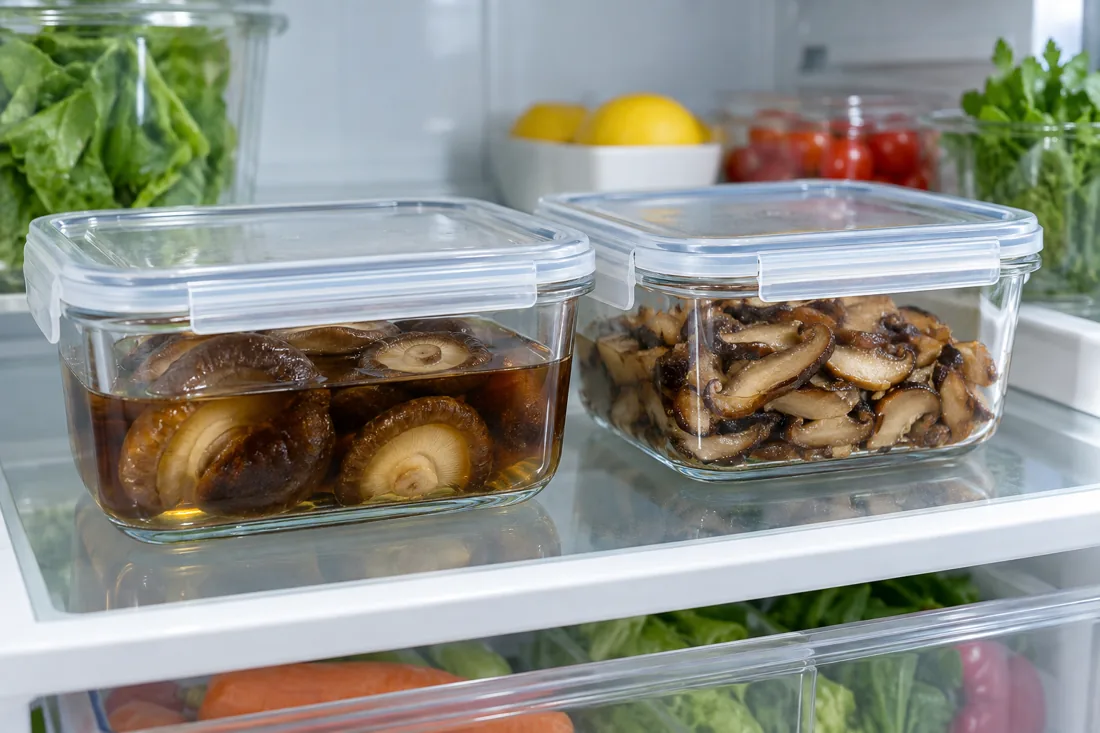
Illustrative refrigerator containers holding soaked and cooked shiitake. These two prepared states do not share an automatic storage limit.
The Hong Kong Centre for Food Safety's soaking guidance recommends keeping room-temperature soaking generally within two hours, using refrigeration for longer soaking and consuming rehydrated food promptly. Do not leave a bowl on the counter overnight and then assume that refrigeration in the morning makes the earlier period irrelevant.
Cover or otherwise protect the soaking container as appropriate, and keep it away from contamination. If the recipe requires a longer hydration period, plan refrigerator space from the start. Avoid putting a large bowl into an already crowded refrigerator without considering whether it can remain properly cold. In a commercial kitchen, record the soak start and follow the approved preparation limits.
- Check that the dry product and package are sound before soaking.
- Measure the amount needed and begin soaking with clean equipment under the product instructions.
- Control time and temperature, using refrigeration for a longer soak rather than an overnight countertop hold.
- After hydration, prepare and cook promptly as directed; keep any waiting period under the appropriate refrigerated controls.
- Discard or hold for qualified assessment if the soak history is unsafe or uncertain, regardless of normal appearance.
Changing the soaking water does not create a new start time. Rinsing the mushrooms after a prolonged warm soak also does not erase that exposure. These actions can be part of cleaning or a recipe, but they should not be presented as a way to restore a product's safety. Keep the original preparation history attached to the batch.
Some recipes use the soaking liquid for flavor. That is an intentional recipe choice with its own handling and cooking requirements, not a reason to save liquid from a questionable batch. Filter grit if the sound recipe calls for it, but remember that filtering is not a general microbial safety treatment. If the mushrooms or their history are unacceptable, do not rescue the liquid separately.
The refrigerator image in this section illustrates two different prepared states, soaked and cooked. Their containers may look similar, but the instructions are not interchangeable. An uncooked soaked mushroom does not automatically receive the same storage period as a properly cooked leftover. If you need a specific holding period for a prepared commercial ingredient, establish it through the operation's qualified food-safety process.
Cook shiitake according to the product instructions and a suitable recipe. Softening in water is not the same as cooking. Do not use tenderness after soaking as proof that a required heat treatment has already occurred, and do not expect cooking to be a universal cure for every prior handling failure.
Assess cooked shiitake by time, temperature and sensory change
For cooked shiitake, the first questions are when the dish was cooked, how it was cooled and how it has been stored. Smell and appearance remain useful rejection checks, but they do not replace that history. A glossy sauce can make a normal cooked mushroom look wet, while a dry-looking leftover can still have spent too long at an unsafe temperature.

GreenLand sliced frozen shiitake product photograph, not a cooked leftover. Confirm the required preparation before applying finished-dish storage rules.
USDA leftover guidance recommends refrigeration within two hours, or within one hour above 90°F, and generally using properly handled refrigerated leftovers within three to four days. Keep the refrigerator at 40°F or below. These are connected conditions; the day count does not apply independently of prompt cooling and correct storage.
Cool a large batch using an appropriate procedure and shallow containers rather than leaving a deep pot warm for hours. Protect the food from contamination and label it with the preparation information. If the dish contains meat, seafood, dairy or other ingredients, assess the entire dish. The mushrooms do not create a separate, longer storage period inside a mixed meal.
Look for changes that are unexpected for the recipe: an abnormal sour or putrid smell, mold, gas or obvious deterioration. Do not taste to decide whether a questionable leftover is acceptable. If the storage history already requires disposal, the absence of those signs does not reverse the decision. Similarly, a dish should not be kept simply because a strongly flavored sauce masks its odor.
Reheat properly handled leftovers according to authoritative guidance; USDA recommends 165°F. Stir and check appropriately so the whole portion is heated, particularly when microwaving. Reheating is not a reliable way to repair a spoiled dish or an unsafe cooling history. Repeatedly warming the full batch and returning it to the refrigerator also makes control more difficult than reheating a measured portion.
The real GreenLand sliced frozen shiitake photograph here is an ingredient-form reference, not a picture of an approved cooked leftover. That distinction matters in purchasing: "frozen sliced" does not by itself say whether a product is ready to eat or what cooking step it requires. Confirm the processing state and instructions before applying the finished-dish storage procedure.
For a restaurant or manufacturer, follow the relevant local requirements and validated food-safety system rather than using a household leftover range as a commercial shelf-life declaration. A sealed chilled mushroom meal needs its own technical assessment. Its pack, recipe, process and distribution conditions cannot be replaced by a generic article's storage advice.
Keep older and newer prepared batches identifiable. Mixing them in one container does not renew the older food's history. If you cannot establish which batch is present or when it was prepared, follow the appropriate disposition procedure. Good labels are often more useful than a last-minute attempt to judge safety from the cap color.
Judge frozen shiitake quality without confusing freezer damage with spoilage
Frozen shiitake need a frozen-product assessment. Start with the label, packaging integrity, lot information and temperature history. A commercially frozen mushroom may be whole, sliced or another form, and its processing state can differ between products. Follow its storage and cooking instructions instead of treating every frozen mushroom as a previously cooked household leftover.

Illustrative frozen quality comparison: loose frosted mushrooms and a heavily iced clump. The image cannot diagnose a shipment's time-temperature history.
Dry pale patches, surface dehydration and excessive ice can affect quality. Freezer-related dehydration may make texture less pleasant without being the same observation as visible mold on a fresh mushroom. However, a photograph cannot prove that the product remained continuously frozen. Review the history before deciding that an unusual appearance is merely cosmetic.
A large solid clump can have more than one explanation. Product may have been compressed in the bag, pieces may naturally adhere, or a temperature excursion may have contributed. Do not diagnose a thaw-refreeze event solely from one clump, and do not dismiss every clump as harmless either. Check the agreed free-flowing specification, packaging condition and available temperature records.
When opening a sample, examine several areas of the pack rather than only the exposed top layer. Record the proportion of broken pieces, the appearance of caps and stems, visible ice and any packaging damage. For a commercial inspection, use the agreed sampling method. One attractive handful or one damaged fragment does not necessarily represent the entire lot.
Cook a suitable sample according to the product instructions and assess the intended application. Frozen mushrooms can release liquid and soften during cooking; those changes are not automatically signs of spoilage. Compare the cooked texture, flavor and usable yield with the approved specification. A product can be safe yet fail the buyer's quality target, and that distinction should remain clear in the report.
If the product has thawed unexpectedly, do not decide its disposition from its current cold feel after it has been re-chilled. Time and temperature during the interruption matter. Follow current authoritative guidance and the operation's procedure, and seek the supplier's information where relevant. Do not invent a post-thaw refrigerator period from the frozen shelf-life statement.
The illustrative frozen comparison shows loose frosted mushrooms beside heavily iced clumped product. It communicates a reason to investigate quality and handling; it does not diagnose the history of an actual shipment. No image can establish that a particular frozen lot is pathogen-free, properly processed or suitable for uncooked use.
Keep remaining stock frozen as directed and minimize unnecessary handling. Portion only what the process needs, protect open packs and preserve lot identification. If your operation requires repeated small withdrawals, discuss an appropriate pack size rather than routinely warming a large bag until pieces can be separated.
Set receiving and complaint checks for commercial shiitake
At receiving, confirm that the delivered form matches the order: fresh, dried, frozen whole, frozen sliced or another preparation. Check the product name, pack size, lot code and storage instructions before beginning a sensory assessment. A correct-looking mushroom in the wrong processing state can still be unsuitable for the intended production line.

GreenLand whole frozen shiitake photograph: form and appearance support specification discussion, not lot-specific safety certification.
Use the agreed receiving procedure for temperature, package condition and sampling. Record actual observations rather than conclusions that the evidence cannot support. "Outer bag torn, ice concentrated at one corner, measured temperature recorded at receipt" is more useful than "the whole lot was refrozen" when the latter has not been established. Keep photographs and delivery information with the lot record.
Separate specification defects from safety concerns. Cap size, slice thickness, stem proportion and broken-piece level can determine whether the product fits a recipe. Mold, decay, contamination or an unacceptable handling history require a different response. Both can justify a rejection under the relevant terms, but the investigation and corrective action may be different.
For a complaint, provide the lot number, delivery date, quantity affected, package photographs and the conditions under which the issue was observed. If it appeared after cooking, include the preparation method, input weight, added liquid and holding sequence. That context helps distinguish a raw-material issue from a process mismatch without automatically blaming either side.
Do not continue using a questionable lot while waiting for an email response if your food-safety procedure calls for a hold. Keep it identified and separated, preserve relevant evidence appropriately and follow the disposition process. Retained samples and records should be handled under the operation's rules, not left at room temperature merely to make them available for a later photograph.
Our frozen shiitake mushroom range provides a starting point for discussing whole and sliced formats. We review the requested cut, packing, quantity, destination and cooking application, then confirm the offered product's specification and instructions. A product photograph supports form selection, not a guarantee of the condition of every delivered carton.
For repeat supply, keep an approved reference that includes more than appearance. Pair sample photographs with the product specification, preparation method and cooked acceptance criteria. That makes it possible to identify a real change without treating normal variation as a failure or overlooking a meaningful problem because the cap color looks familiar.
The most dependable decision combines form, history and condition. Reject obvious spoilage, treat uncertain handling seriously and do not use tasting as a safety test. At the same time, describe quality loss accurately: mild drying, broken slices and freezer dehydration are not interchangeable with mold or an unsafe prepared-food history. Clear distinctions make both kitchen decisions and supplier conversations better.
Source frozen shiitake mushroom with GreenLand-food
GreenLand-food is a professional frozen shiitake mushroom supplier and manufacturer in China, providing factory-direct wholesale supply for importers, food manufacturers, foodservice distributors, and private-label programs.
Send your required form and cut, pack size, expected quantity, application, destination, private-label needs and requested documents. We will review the available product and order-specific requirements.