


How to Use Frozen Ginger
May 20, 2026
Leave a message


Use the format-not the label-to choose the method
Whole frozen ginger can be grated directly into a hot pan, soup, sauce, marinade, or tea. Frozen slices can go straight into a broth or infusion. Free-flowing mince, dice, and small paste portions can usually be added to a hot process without thawing. A solid paste block or whole piece should be thawed only as far as the next operation requires, and always according to the product instructions and your food-safety plan.
Do not force a knife through a hard frozen root. Do not assume that one spoonful of one supplier's paste equals the same weight or flavor as another. When a formula matters, weigh the ingredient, run a pilot batch, and approve the result for aroma, heat, moisture, texture, and yield.
Choose root for flexible downstream prep, slices for infusion, mince or dice for visible distribution, and paste or puree for fast, even mixing.
Hot processes often accept ginger directly from frozen. Thaw for cutting, cold blending, precise weighing, or when a large block cannot disperse safely and evenly.
Paste, puree, mince, and slices differ in moisture, fiber, surface area, and added ingredients. A controlled trial is more reliable than a universal spoon conversion.
Keep the product at its specified frozen temperature, check packs and free-flowing condition on arrival, and prevent uncontrolled thaw-refreeze cycles.
Choose the frozen ginger form by the job it must do
The most reliable way to use frozen ginger is to start with the finished product. Are you trying to create a clean infusion, visible ginger pieces, fast flavor release, or a fully uniform sauce? That answer should determine the form you buy and the way you handle it. Changing form changes surface area, release rate, texture, and the amount of water introduced into the recipe.
A sauce developer who chooses slices will struggle to distribute flavor evenly. A tea producer who uses a fine puree may create more sediment than desired. A dumpling line that receives a soft, high-moisture paste may see a different filling yield from a line using controlled minced particles. The table below turns the product name into an application decision.
| Frozen ginger form | Best use method | Strong application fit | Check before use |
|---|---|---|---|
| Whole peeled pieces | Grate from frozen, or temper under control before cutting or grinding. | Foodservice prep, downstream slicing, grinding, broth, sauce, and flexible industrial processing. | Piece size, peel removal, fiber, color, surface frost, and tempering method. |
| Slices or strips | Add directly to hot liquid or a cooked dish; remove after infusion when a clean finish is needed. | Tea, broth, hot pot, braised products, marinades, meal kits, and visible recipe components. | Thickness, length, breakage, fiber direction, color, and slice count per serving. |
| Dice, mince, or grated ginger | Add from frozen to a hot base, or temper briefly for uniform mixing through a filling. | Stir-fries, dumplings, marinades, soup bases, ready meals, seasoning blends, and foodservice portions. | Particle distribution, clumping, free-flowing condition, moisture, fiber, and broken fines. |
| Paste or puree | Melt a small portion into a hot process, or thaw hygienically and weigh for a cold or precisely controlled batch. | Sauces, curry bases, dressings, marinades, beverages, soups, fillings, and industrial seasoning systems. | Ginger percentage, water, salt, acid, oil, stabilizer, sieve or particle standard, and microbial specification. |
| Portion block or cube | Use by declared unit weight in a hot recipe; thaw only when the block must be dispersed before heating. | Restaurant chains, meal kits, small-batch sauces, retail packs, and standardized kitchen recipes. | Unit weight tolerance, release from pack, formulation, portion count, and cooking instructions. |
For a first commercial trial, request the specification before the sample arrives. That lets your R&D or QA team record the right variables instead of judging "ginger strength" without knowing the form, moisture, or formulation behind it.
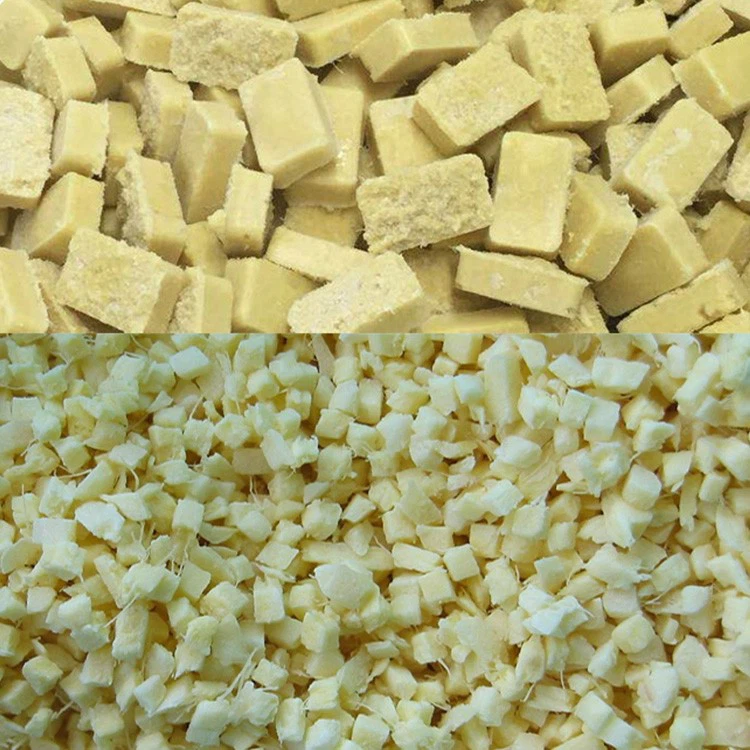
Blocks simplify portions; mince improves distribution
A frozen portion block is useful only when its unit weight and formulation are stable. A minced format is useful only when the particle range and free-flowing condition suit the mixer, filling, or recipe. The image shows why the two should not share one handling instruction.
If a block enters a short, low-temperature process, it may not disperse before filling. If fine mince enters a very hot dry pan too early, it can lose aroma or scorch. Use the physical form to decide addition point, mixing time, and whether controlled tempering is necessary.
A six-step method for using frozen ginger consistently
The sequence below works for a home pan, restaurant prep station, central kitchen, or factory trial. The scale changes; the logic does not. Keep the product frozen until the method is chosen, expose only the amount needed, and record what happens in the finished food.
- Identify the actual form and formulation. Read the pack or specification. Confirm whether the product is whole, sliced, diced, minced, grated, paste, puree, or a portion block. For paste and puree, check whether the ingredient list includes water, salt, acid, oil, or a stabilizer. Those details affect flavor, yield, and the point at which the ginger should enter the recipe.
- Choose direct-from-frozen or controlled thawing. Use direct addition for hot liquids, hot sauce bases, long-cook meals, or small free-flowing pieces that disperse quickly. Thaw in a controlled refrigerated process when you need knife work, cold blending, accurate weighing of a large block, or an even distribution before heating. Follow the supplier's instructions and your own food-safety plan.
- Portion without warming the balance. Remove only the amount required. Close the outer pack and return unused product to frozen storage promptly. In production, a staged small-bin system is usually easier to control than holding a full carton near the line. Record the lot number when traceability is required.
- Add at the right process point. Infusion slices can enter early with liquid. Mince or paste added to oil needs brief heat and movement so it releases aroma without burning. Paste used in a cold marinade should be completely dispersed before contact with the main ingredients. In fillings, break up clumps before the mixer reaches its final binding stage.
- Judge the finished application, not the raw spoonful. Ginger intensity changes with fat, acid, salt, sugar, cook time, particle size, and serving temperature. Compare pilot batches after the same heat treatment and hold time. For repeat production, weigh the ginger and record the addition rate instead of relying on a visual scoop.
- Close the loop with storage and QA records. Check whether the opened pack remained within the allowed handling window, whether any thawed balance can be used or refrozen under your approved procedure, and whether the finished result met aroma, texture, moisture, and yield targets. Update the recipe or purchase specification when a recurring difference is traced to form or lot condition.

Direct grating is efficient for a hot process; controlled thawing and weighing are better when a formula needs a repeatable addition rate.
How to use each form without losing control
Whole frozen ginger root
For small culinary quantities, a firm frozen piece can be grated directly into a pan, pot, sauce, or hot drink. The frozen structure often gives the grater a clean surface. Hold the piece securely, grate only what is needed, and return the unused portion to frozen storage before it softens. This method suits applications where ginger should disappear into the food rather than remain as a visible cut.
Whole peeled pieces also give factories flexibility because they can be ground, sliced, or pureed downstream. That flexibility requires a planned tempering step when mechanical cutting is involved. Never force a knife through a rock-hard piece. Define the permitted tempering temperature, time, batch size, and sanitation controls, then process the ginger before its surface warms beyond the approved condition.
Frozen ginger slices and strips
Slices are best when ginger needs to infuse rather than disappear. Add them directly to tea, broth, hot pot, braising liquid, soup base, or a cooked marinade. Add early for a longer, rounder extraction; add later for a brighter top note. If the final product should be free of ginger pieces, design a straining or removal step instead of switching to a puree that may change clarity or sediment.
For meal kits and prepared dishes, slice thickness and breakage matter. Thin slices release flavor faster and soften more; thick slices remain more visible. Ask for a tolerance that matches the eating experience and the portion-count target. A photograph of a perfect slice is not a specification-confirm thickness, length or diameter range, broken-piece allowance, and how the pack behaves after frozen transport.
Frozen minced, diced, or grated ginger
Fine pieces release aroma quickly and spread through stir-fries, fillings, sauces, marinades, and ready meals. Add free-flowing mince directly to a hot process when the mixer or pan can separate it quickly. In a dumpling or plant-protein filling, temper only enough to break up clumps, then distribute the ginger before final forming. The goal is uniform flavor without adding a pocket of meltwater.
Particle size affects both perception and processing. A coarse mince can provide visible ginger and a small bite; a fine mince behaves closer to paste. Check the percentage of fines, maximum piece size, fiber strands, and free-flowing condition. Those points determine whether the product passes through a dosing system, spreads through a filling, or settles unevenly in a sauce.
Frozen ginger paste or puree
Paste and puree are efficient when a sauce, curry base, marinade, soup, beverage, or prepared meal needs even flavor. Small frozen portions can melt into a hot process. Larger blocks should be thawed in a controlled cold environment when accurate weighing or pre-blending is necessary. Mix the thawed ingredient until uniform before taking a production sample; surface liquid and dense solids can otherwise create a misleading test.
Do not compare paste only by color or price per carton. Confirm ginger percentage, added water and ingredients, particle or sieve standard, aroma target, pungency method if one is used, microbial limits, and pack size. A lower-cost paste with more water may require a higher addition rate and may alter sauce viscosity, filling yield, or bake performance.
Frozen portion blocks and cubes
Portions are useful when kitchens or retail consumers need a repeatable unit and minimal contact with the remaining pack. Use the declared net weight per portion, not a visual assumption. Confirm how easily the cubes release, whether they remain separate, how quickly they disperse in the intended process, and whether the ingredient list changes the recipe's salt, acid, oil, or water balance. For a restaurant chain, validate the cube in the actual pan size and batch size used at store level.
Cook from frozen when heat will disperse it; thaw when control requires it
Direct-from-frozen use works well when the product is small enough to separate and the process supplies enough heat, liquid, and agitation. Examples include slices entering broth, mince entering a sauce kettle, a portion cube entering a hot pan, or grated whole ginger entering a stir-fry. It reduces handling and avoids an unnecessary warm step.
Controlled thawing is the better choice when a hard product must be cut, a solid block must be weighed precisely, a paste must blend into a cold dressing, or a filling must be uniform before cooking. Thaw in the refrigerator or under another validated procedure-not unattended on a warm worktop. The U.S. FDA recommends keeping freezers at 0°F (-18°C), and USDA FSIS guidance identifies refrigerator, cold-water, and microwave thawing as safe household routes; commercial plants should follow their validated program and supplier instructions.
Freezing does not make a contaminated ingredient sterile. The FDA notes that freezing stops bacterial growth but does not kill most bacteria. Treat thawed ginger as a perishable ingredient, protect it from cross-contamination, and define a time and temperature limit for staging and use.
Application matrix: use the form that fits the process

Fine ginger can distribute rapidly in a sauce process, but the addition point, particle size, and mixing time still determine aroma and uniformity.
| Application | Preferred form | How to use it | Approval focus |
|---|---|---|---|
| Stir-fry and foodservice pan | Grated, mince, dice, or portion block | Add briefly to hot oil or the sauce base; move it immediately and follow with other ingredients before it scorches. | Portion accuracy, release from pack, cook time, and aroma after service hold. |
| Soup, broth, hot pot, or braise | Slices for clean infusion; mince or paste for integrated flavor | Add slices early and remove if required; add paste after the liquid is moving so it disperses without sticking. | Clarity, sediment, extraction time, final aroma, and visible-piece tolerance. |
| Sauce, curry, or marinade | Paste, puree, fine mince, or grated ginger | Disperse in the aromatic base or pre-blend after controlled thawing; validate after the full heat and hold cycle. | Moisture, viscosity, particle visibility, separation, yield, and flavor balance. |
| Dumpling, bun, or prepared filling | Controlled mince or fine dice | Temper only enough to separate; distribute before final binding and forming. | Clumps, fiber, free water, filling yield, piece visibility, and cooked flavor uniformity. |
| Beverage, syrup, or tea base | Slices for infusion; puree or juice-style ingredient for fast extraction | Control extraction time and filtration; pre-disperse puree when the system is cold. | Sediment, pulp, color, heat level, aroma, filtration loss, and beverage stability. |
| Ready meal or meal kit | Slice, dice, mince, paste, or portion block according to eating experience | Place the ginger where it survives assembly, freezing, distribution, reheating, and final serving. | Reheat performance, sauce distribution, pack migration, portion consistency, and consumer instructions. |
For every application, evaluate the ginger after the complete process. A paste that smells strong when thawed may become muted after a long cook. A slice that looks correct in the frozen sample may break during mixing. A mince that disperses in a small pan may clump in a large kettle if it enters too quickly. Application approval should reproduce the real equipment, order of addition, batch size, heat profile, and hold time.
When frozen ginger is better-and when fresh still wins
Frozen ginger is not a lower-grade substitute by definition. It is often the practical choice when labor, waste, portioning, supply planning, and recipe consistency matter more than crisp raw texture. Fresh ginger remains the stronger choice when the customer must see a clean hand-cut garnish or experience a firm raw bite.
| Decision | Frozen ginger advantage | Fresh ginger advantage |
|---|---|---|
| Labor and waste | Prepared form reduces washing, peeling, trimming, and daily cutting. | Flexible on-site preparation when skilled labor and fast turnover are available. |
| Texture and appearance | Strong fit when ginger is cooked, blended, infused, or hidden in a formula. | Better for crisp garnish, raw julienne, pickling, or a premium visible slice. |
| Portioning | Predefined cuts or blocks can support repeat recipes and line dosing. | Flexible but dependent on local trim, operator method, and natural root variation. |
| Supply planning | Frozen inventory supports longer planning windows when the cold chain is reliable. | Useful for rapid local turnover and applications that reward peak fresh aroma. |
Do not decide from ingredient price alone. Compare usable yield, prep labor, waste, storage cost, dose rate, finished-product performance, and rejected batches. A frozen format may cost more per kilogram than raw root but cost less per finished serving-or the opposite-depending on water, trim, labor, and recipe intensity.
Whole pieces preserve downstream flexibility
Whole peeled frozen ginger can serve buyers that prefer to control grinding, slicing, or pureeing in their own process. The tradeoff is that the receiving specification must control piece condition, peel removal, color, fiber, and the tempering step before mechanical size reduction.
The close view also makes arrival inspection practical. Look for expected natural color, reasonable surface frost, intact pack condition, and the absence of obvious thaw-refreeze masses. Final acceptance still depends on the approved specification and sampling plan.

Commercial dosing: build the recipe around a pilot batch
There is no reliable universal conversion between a piece of fresh root, a spoon of frozen mince, and a spoon of ginger paste. Natural ginger varies, and commercial formats may differ in moisture, fiber, surface area, or added ingredients. Volume measures also introduce operator variation. For a repeatable formula, define the addition as a weight or percentage of the batch.
Start with the current approved ingredient or a conservative development dose. Keep the base formula, process, and hold time constant. Then compare at least three controlled points around the current target. The goal is not simply "more ginger." Evaluate aroma quality, heat, bitterness, fiber perception, sauce viscosity, filling yield, color, sediment, and flavor after the actual cook and storage cycle.
Record the ingredient
Supplier, item code, lot, form, formulation, frozen condition, thaw method, particle size, and measured addition weight.
Hold the process constant
Use the same batch size, equipment, addition point, mix speed, heat profile, cooking time, and sample temperature.
Approve the finished food
Judge the product after reheating, holding, freezing, or shelf-life conditions that represent how customers will receive it.
When a new lot arrives, a quick verification batch can reveal a shift before full-scale production. If the result changes, investigate moisture, particle distribution, fiber, aroma, cold-chain condition, or formulation before adjusting the recipe. Increasing the dose can hide one problem while creating another.
Fix the process problem before adding more ginger
Weak aroma
Check storage history, pack seal, time at ambient temperature, addition point, cook severity, and whether the comparison used the same ginger solids-not just the same spoon volume.
Watery sauce or filling
Review paste formulation, thaw drip, surface ice, and the recipe water balance. Confirm whether the ingredient was mixed before sampling and whether free water entered with a thawed block.
Uneven hot spots
Reduce clump size, change the addition point, pre-disperse paste when appropriate, or extend mixing before the product sets. Verify the particle distribution of the incoming lot.
Burnt or bitter note
Shorten direct contact with very hot oil, add other aromatics or liquid sooner, reduce exposed fine particles, and compare the result after the complete recipe rather than tasting scorched pan residue.
Wrong texture
Move from paste to mince when visible texture matters, from slices to paste when even distribution matters, or to fresh ginger when the product requires a crisp raw garnish.
Storage, receiving, and thawing controls for frozen ginger
For household storage, the FDA advises a freezer temperature of 0°F (-18°C). Commercial contracts often express frozen storage at -18°C or below, but the agreed product specification and transport plan remain controlling. Safety and quality are different questions: food kept properly frozen may remain safe, while aroma, color, texture, and package condition can still decline. Use the declared shelf life for the specific product rather than borrowing a generic number from another ginger format.
On arrival, do more than look for a cold carton. Confirm reefer or data records when required, outer-carton condition, inner-pack seals, product temperature under the agreed method, lot identity, label information, and whether IQF pieces remain reasonably free-flowing. A solid mass may indicate a block-format product by design, or it may signal temperature abuse; the specification and reference sample tell the difference.
| Check | Acceptable evidence | Buyer action if different |
|---|---|---|
| Pack integrity | Seals intact; no leakage, major puncture, open seam, or wet carton inconsistent with the specification. | Segregate affected units, photograph, record lot and pallet, and follow the claims or disposition procedure. |
| Frozen condition | Temperature and physical condition match the agreed receiving method; IQF items are not an unexplained solid mass. | Review temperature evidence and sample condition before release; do not judge only from carton air temperature. |
| Appearance and aroma | Color, frost level, fiber, and aroma align with the approved sample and tolerance. | Run the agreed inspection or application trial; avoid releasing a lot from appearance alone. |
| Traceability and documents | Item, lot, production date, net weight, packing list, certificate or report set, and destination documents match the order. | Hold the discrepancy for document review before production or onward sale. |
If thawing is required, use a controlled route and a clearly labeled container that prevents cross-contamination. Do not repeatedly move the same balance between freezer and room temperature. USDA FSIS notes that refrigerator-thawed food can be refrozen safely, although moisture loss may reduce quality; a commercial business should also follow its product specification, HACCP plan, customer agreement, and destination-market rules.

A prepared-meal application must keep ginger portioning and placement consistent through assembly, freezing, distribution, and final cooking.
Define the frozen ginger before comparing quotations
A useful RFQ describes what the ginger must do. Send the application, form, process, and acceptance needs first; the supplier can then confirm whether the available item fits or whether a sample and adjusted specification are required.
Product and sensory target
- Whole, slice, strip, dice, mince, grated, paste, puree, or portion block
- Peeled status, color, maturity, fiber, aroma, and heat target
- Cut or particle tolerance, fines, breakage, free-flowing or block condition
Formula and QA target
- Ginger percentage and any added water, salt, acid, oil, or stabilizer
- Microbiological, foreign-material, pesticide, and destination-market requirements
- Sampling plan, approval sample, COA or test report, and traceability needs
Commercial and logistics target
- Bulk, foodservice, retail, portion, private-label, carton, and pallet format
- Trial quantity, target annual volume, destination, delivery window, and loading plan
- Label language, shipment documents, cold-chain evidence, and arrival inspection method
MOQ, lead time, packing, supply period, and certificates depend on the selected item and market. Ask for a written quotation and specification instead of assuming one value applies to every frozen ginger format.
How we help match frozen ginger to the application
At GreenLand-food, we start with the way your team will use the ginger. We can discuss whole peeled pieces for downstream processing, frozen minced ginger and portion forms for distribution, or frozen ginger root for flexible preparation. The final offer should confirm the specification, packing, quantity, destination, and required documents.
We help purchasing and R&D teams compare the form against the real process: infusion, stir-fry, sauce, beverage, dumpling filling, ready meal, foodservice portioning, retail pack, or further processing. A sample trial can then focus on the variables that matter-particle size, moisture, fiber, flavor, thaw behavior, yield, and final product performance.
For broader planning, browse our frozen vegetable range. If your team is comparing storage history or fresh-versus-frozen performance, the related guides on frozen ginger quality and storage and frozen versus fresh ginger provide the next level of detail without repeating it here.
You can also download the GreenLand frozen food product catalog to review related vegetables, fruits, mushrooms, and packing possibilities before building a mixed inquiry.
FAQ about using frozen ginger
Do you need to thaw frozen ginger before using it?
Usually not for hot applications. Grated whole ginger, slices, free-flowing mince, and small paste portions can often go directly into a hot pan, soup, sauce, or broth. Thaw under control when you need safe cutting, accurate weighing, a cold blend, or uniform distribution before heating, and follow the product instructions and your food-safety plan.
Can you grate frozen ginger straight from the freezer?
Yes. A firm peeled frozen ginger piece can be grated directly into a cooked dish or hot drink. Hold it securely, grate only the amount needed, and return the unused piece to frozen storage promptly. Do not try to force a knife through a large, hard frozen root.
Can frozen ginger replace fresh ginger in commercial recipes?
It can replace fresh ginger in many cooked, blended, infused, or filled products, but it is not a universal one-to-one swap. Approve the frozen form by weight in a pilot batch and check moisture, particle size, ingredients, flavor, texture, and finished yield. Fresh ginger remains preferable when crisp raw texture or a clean hand-cut appearance is essential.
Can thawed frozen ginger be refrozen?
USDA FSIS states that food thawed safely in the refrigerator can be refrozen, although moisture loss may reduce quality. For commercial frozen ginger, also follow the supplier specification, your HACCP or food-safety plan, customer requirements, and destination-market rules. Avoid uncontrolled or repeated thaw-refreeze cycles.
Tell us how the ginger must perform
Send the required form, cut or particle size, formulation, packing, trial or annual quantity, application, destination, private-label needs, delivery window, and document list. We will help your purchasing team confirm the right frozen ginger item and the next sampling step.