


How to Wash Kale
Sep 02, 2026
Leave a message
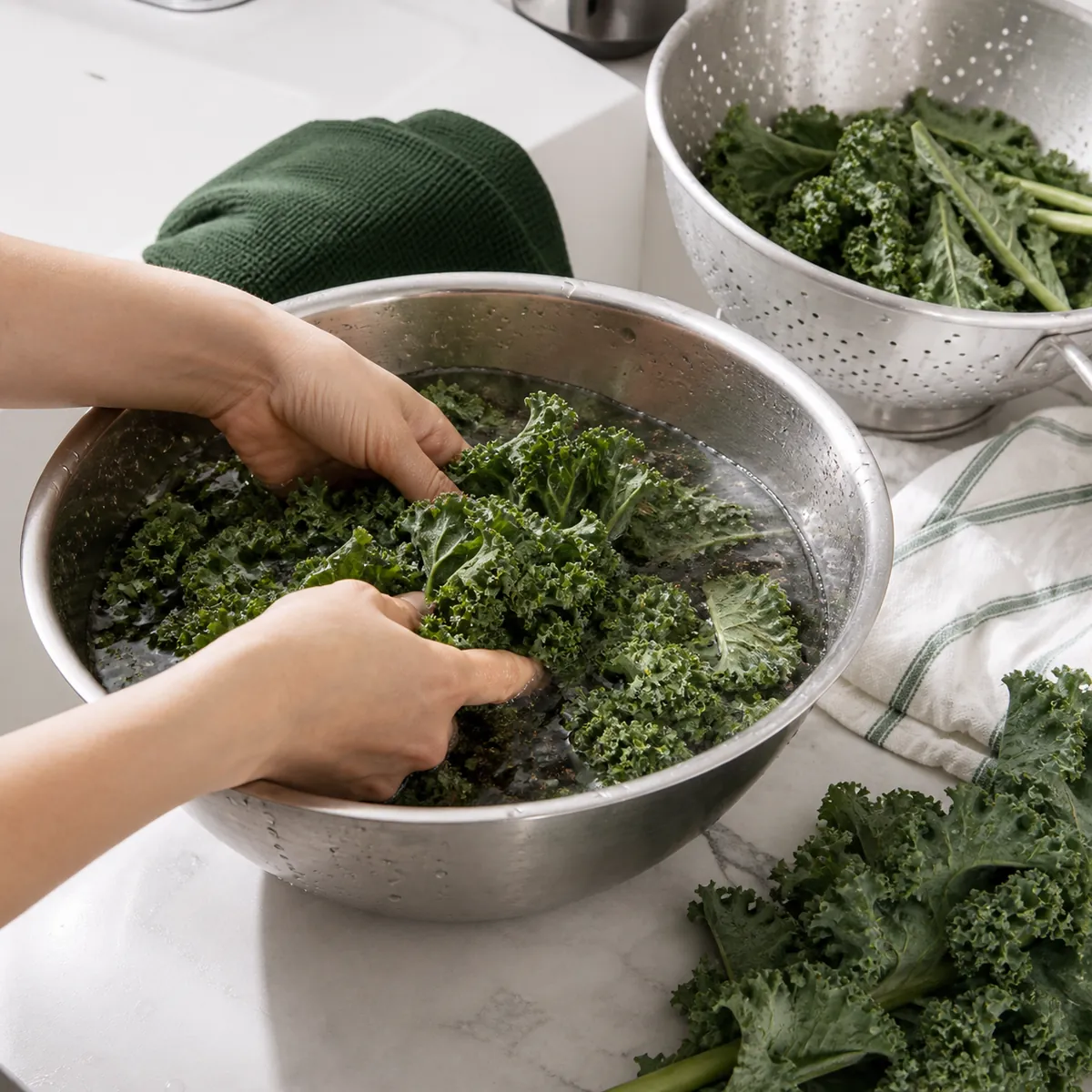
Open the leaves, move the grit into water, then lift the kale away from it
Kale holds soil around stems, ruffled edges and leaf folds. A quick rinse over an intact bunch often misses those areas. Work in manageable batches, keep the sink and tools clean, and change water whenever sediment or cloudiness is visible.
Washing reduces soil and surface microbes but does not sterilize produce. Keep washed kale separate from raw meat and dirty equipment. If a pack is labeled pre-washed or ready to eat, follow its instructions; unnecessary rewashing can reintroduce contamination from the kitchen.
Key takeaways
Household and large-batch kale washing
| Control | Household batch | Foodservice batch | Reason |
|---|---|---|---|
| Batch size | A few leaves in a bowl or clean sink | Defined kilograms per wash vessel | Overloading prevents agitation and inspection. |
| Water | Fresh potable running water and clean immersion water | Potable water under the facility program | Dirty water can spread contamination. |
| Agitation | Open curls and swish by hand | Gentle mechanical or manual movement | Releases grit without excessive bruising. |
| Water change | Whenever sediment remains | Defined by turbidity, soil load and procedure | Prevents dirt carryover. |
| Drying | Spinner or clean towels | Sanitary spinner, draining rack or controlled airflow | Reduces dilution and supports storage quality. |

How to wash kale thoroughly
- Prepare the station. Wash hands and clean the sink, bowl, colander, knife, board and drying equipment.
- Sort the bunch. Discard rotten leaves and cut away damaged areas. Keep soil-heavy leaves separate.
- Separate leaves and stems. Open the bunch and trim stems according to the recipe so hidden folds are accessible.
- Rinse under running water. Rub the leaf surfaces and stem junctions gently while water carries loose soil away.
- Agitate gritty kale in clean water. Swish a manageable batch, then pause so sand can settle.
- Lift kale into a clean vessel. Do not drain dirty water through the washed leaves. Empty, clean and refill when another wash is needed.
- Finish with a clean rinse. Use running potable water to remove remaining loose soil.
- Drain and dry. Spin, rack-drain or pat dry with clean material, then use promptly or refrigerate in a clean container.
Why kale traps more grit than a smooth leaf
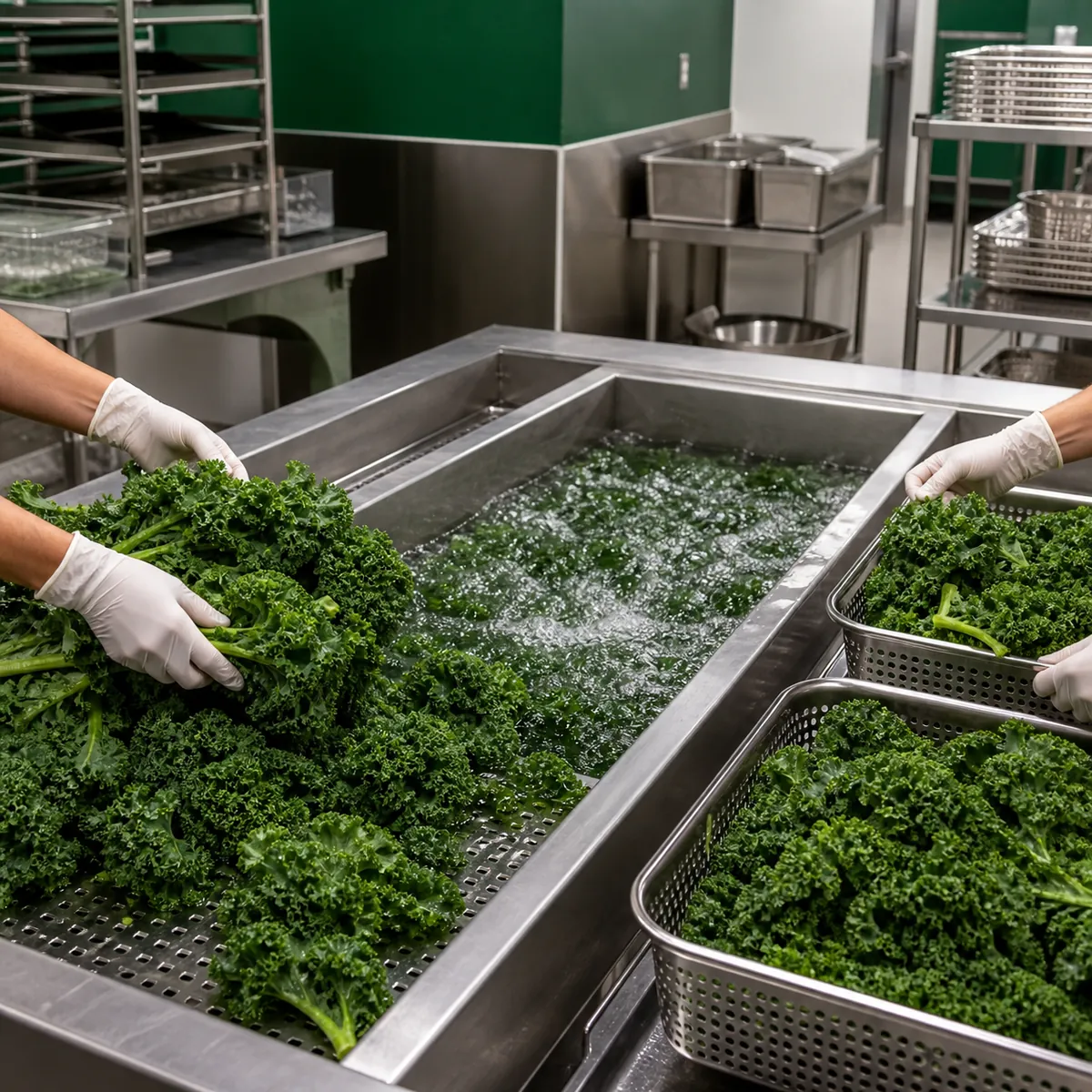
Curly kale creates pockets where field soil and fine sand lodge. Thick central ribs and leaf-stem junctions add protected surfaces. Rain splash and harvest conditions influence soil load, so one bunch can require more wash cycles than another.
Visual inspection under good light is still necessary after washing. Run fingers along folds and examine the bottom of the vessel. If grit remains, repeat with clean water rather than extending one increasingly dirty soak.
Washing is not the same as sanitizing
Plain running water removes dirt and can reduce surface bacteria, but it does not eliminate every pathogen. Household soap, detergent and bleach should not be applied to produce. They can leave residues and are not a substitute for clean handling.
Commercial facilities may use controlled wash-water systems under their food-safety plan. Concentration, water quality, organic load, contact time and verification must be managed by trained staff. Do not copy an industrial chemical procedure into a home kitchen.
Large batches need water-change discipline
When too much kale enters one tank, leaves form a mat and protect grit from movement. Soil load also consumes wash-water capacity. Define batch weight, vessel fill and agitation. Use a lift-out basket or perforated tote so debris stays behind.
Separate raw receiving, washing and clean-side draining. Moving a clean basket back onto a dirty pallet or using a hose that touched the floor cancels the earlier work. Include tools and worker flow in the procedure.
Fresh preparation is different from frozen kale processing
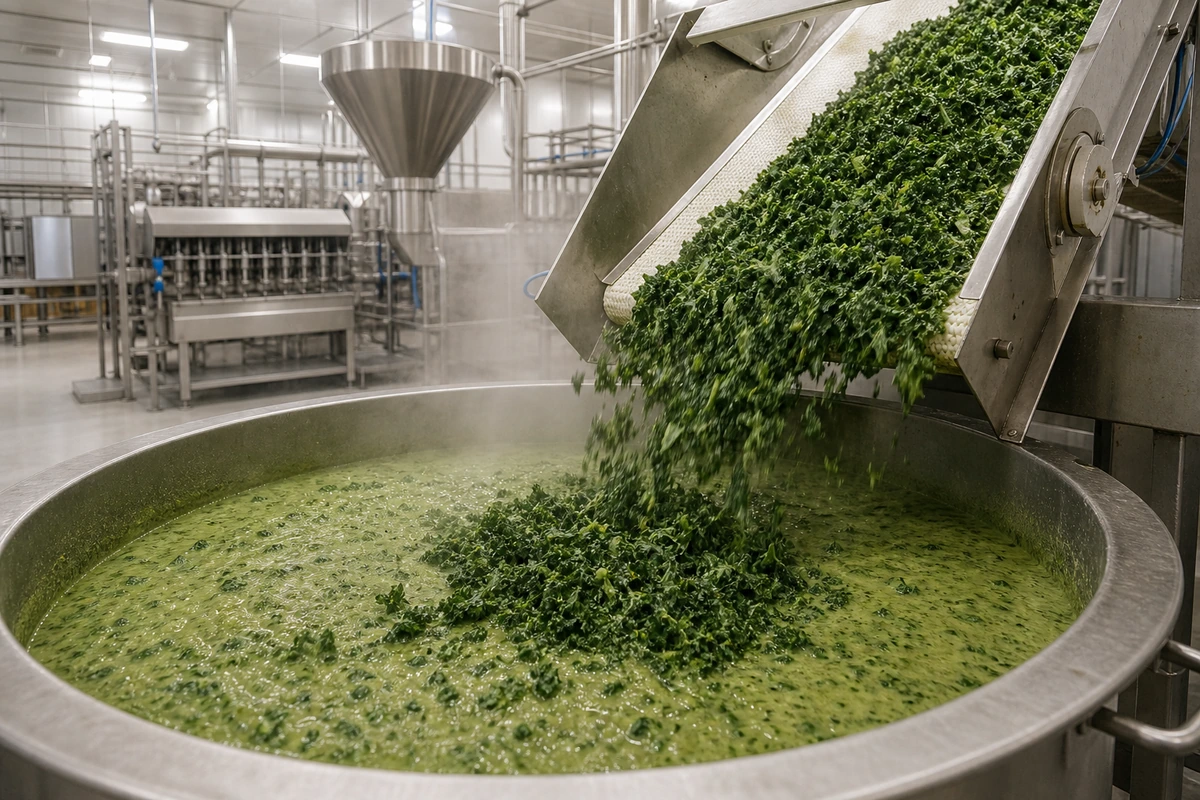
A fresh bunch is washed shortly before household or kitchen use. Commercial frozen kale is processed through supplier-controlled receiving, washing, cutting, blanching or other treatment where applicable, freezing and packing. The buyer should confirm the actual process instead of assuming every frozen product is ready to eat.
Kale storage before processing explains when to wash and how to avoid holding wet leaves before freezing.
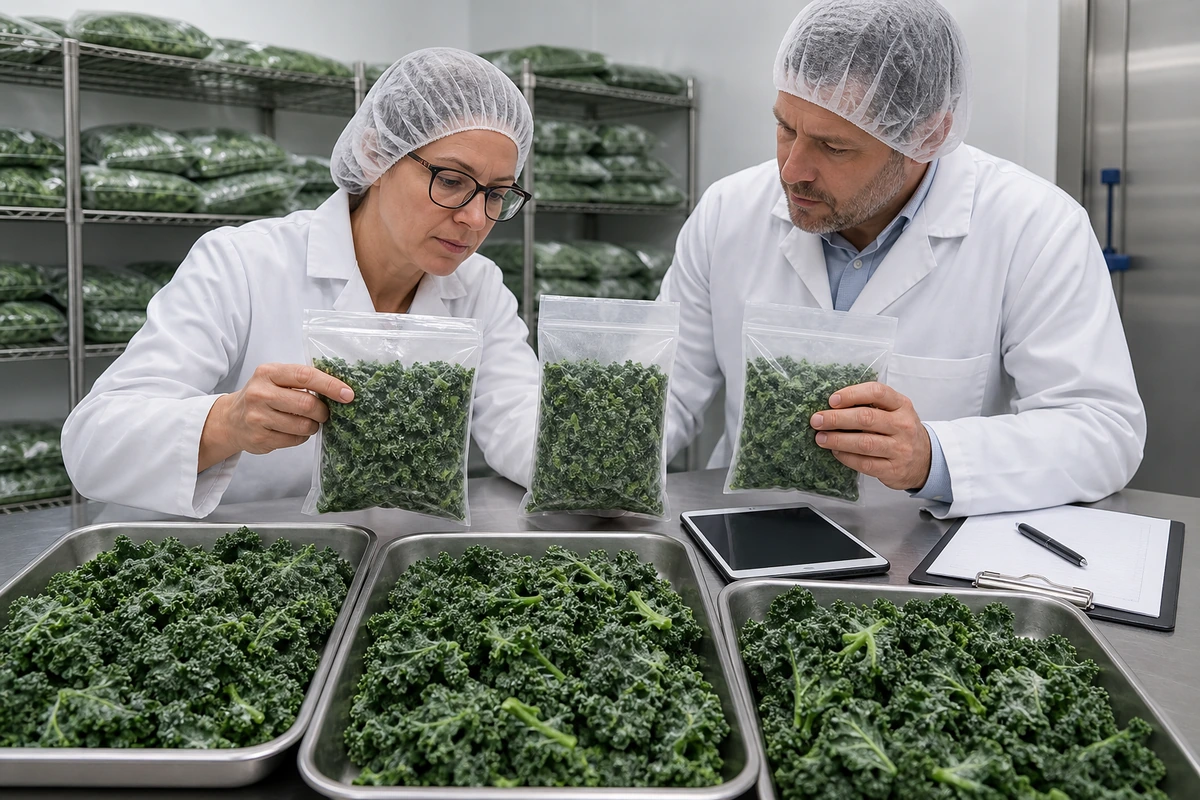
When using frozen chopped kale, follow the pack's cooking instructions and evaluate cut size, stem content, color, free-flow, frost and documents. Rewashing a frozen product is generally not the answer to a specification or process question.
Troubleshooting the most common failures
| Problem | Likely cause | Next adjustment |
|---|---|---|
| Grit after two washes | Batch too large or curls not opened | Reduce batch size, separate leaves and lift them from settled soil. |
| Kale wilts before use | Long warm soak or damaged leaves | Use cool potable water, gentle handling and prompt refrigeration. |
| Salad dressing becomes watery | Leaves were not dried | Spin or drain thoroughly before cutting and dressing. |
| Clean kale contacts dirty sink | Poor clean-side separation | Move it only to sanitized vessels and tools. |
Convert the wash method into a clean-side procedure
Begin by writing the finished target in observable language. For fresh kale prepared for salads and cooked dishes, plus commercially processed frozen chopped kale for foodservice and manufacturing, the useful endpoint is visibly clean grit-free leaves handled on a clean side, or a frozen product meeting its declared process and preparation status. That statement is more operational than a vague direction such as "cook until done" or "use good quality." It tells purchasing, kitchen and quality teams what the trial must demonstrate, while leaving room for equipment-specific timing.
Use a representative sample, not the most attractive handful. Pull material from several positions in the bag, case or lot and record clumps, free water, broken pieces, color and odor before preparation. If the article concerns a finished dish, record the ingredient batch and the pan or container depth as well. Small input differences often explain a large finished difference.
Measure the starting condition. Frozen ingredients should be hard frozen unless a controlled thaw is part of the method; fresh raw material should be at the defined receiving and storage condition; cooked food should have an accurate preparation time. An uncontrolled bench period creates a new process that cannot be compared fairly with the approved one.
Run the first trial at a deliberately manageable scale. Weigh the main ingredient, liquid, oil, sauce and seasoning. Record equipment model, vessel dimensions, load depth and actual settings. A reliable small trial produces a baseline; a casual large trial produces too many possible causes when residual sand, bruised leaves, cross-contamination or an incorrect ready-to-eat assumption appears.
Observe the process rather than watching only the clock. Note the moment frost melts, water releases, sauce thickens, slices become tender, grit settles or the center warms-whichever signals apply. Those observations reveal why two batches with the same nominal minutes can finish differently.
Check the slowest or most difficult portion. It may be the thickest mushroom cap, the center of a casserole, the largest fry, a dense kettle zone or the bottom of a wash load. Edge color and surface heat can look satisfactory while the limiting point remains outside the target.
Scale in controlled steps. Increasing a batch changes heat recovery, evaporation, agitation, cooling and holding. Doubling ingredient weight does not automatically double time, nor does it preserve the same surface area. Establish a maximum load per pan, basket, tank or kettle and retest before exceeding it.
Record yield as well as appearance. Weigh input, prepared output, trim or drip loss and rejected material. Yield connects quality to cost and helps explain portion changes. A cheaper delivered product can cost more per acceptable serving when frost, defects, breakage or trim are high.
Include the real hold. Evaluate visibly clean grit-free leaves handled on a clean side, or a frozen product meeting its declared process and preparation status immediately and again after the normal service, display, refrigeration or delivery interval. Steam migration, continued starch hydration, sauce absorption and moisture loss can change the result after the active cook or preparation step has ended.
Test the final application rather than approving an isolated ingredient only. A sample that works in a small skillet may behave differently in a soup, ready meal, buffet pan, retail pack or bakery formula. Include any chilling, freezing, thawing and reheating that the customer will actually use.
Define corrective actions before production. If the process trends toward residual sand, bruised leaves, cross-contamination or an incorrect ready-to-eat assumption, staff need a bounded response: reduce load, hold the lot, adjust within an approved range, repeat a rinse, extend a controlled thaw, or reject the material. Improvised corrections should not silently become a new formula.
Receiving evidence protects both buyer and supplier. Record product temperature, packaging condition, lot code, photographs and representative defects before the material is dispersed. When the finished result changes, compare the affected lot against an approved reference under the same method.
Cold-chain and storage control continue after acceptance. Door openings, partial thawing, condensation, light exposure or poor ventilation can change the ingredient before it reaches the kitchen. A good purchase specification cannot compensate for uncontrolled local storage.
Compare supplier samples under identical conditions. Keep load, equipment, liquid, seasoning and endpoint constant. Score only attributes that matter to the application. Changing the recipe for every sample hides whether the input is suitable and makes commercial comparison unreliable.
Turn the approved result into a short working standard. Include input condition, batch weight, equipment, sequence, approximate check window, observable endpoint, hold and rejection triggers. Train staff to use the endpoint within that boundary rather than treating one minute as a substitute for judgment.
Review complaints with data. Separate product defects from handling, recipe and equipment causes. If residual sand, bruised leaves, cross-contamination or an incorrect ready-to-eat assumption occurs, reconstruct the lot, input condition, load, settings and hold. The aim is not to assign blame quickly; it is to identify which control failed and stop the same failure from returning.
For private-label instructions, test realistic customer equipment and behavior. Give a usable range plus clear visual or texture cues. Avoid promising one exact result across every appliance, pan, serving size or storage history when the evidence supports only a controlled range.
Release commercial claims only after the evidence matches them. Words such as ready to eat, fully cooked, washed, quick-cook or freezer-stable carry process expectations. Put the declared status, preparation directions and supporting documents into one coherent specification.
Revisit the standard when crop, cut, formula, pack, factory, equipment or intended use changes. A result approved for fresh kale prepared for salads and cooked dishes, plus commercially processed frozen chopped kale for foodservice and manufacturing is not automatically transferable to another application. Change control keeps a once-valid method from becoming an assumption.
How we review a frozen kale enquiry
At GreenLand-food, we start with the intended use rather than a product name alone. For this program, the first technical points are incoming soil load, leaf variety and curl, stem proportion, wash-water quality, batch weight. We match the sample review to fresh kale prepared for salads and cooked dishes, plus commercially processed frozen chopped kale for foodservice and manufacturing so the purchasing team can see whether the proposed format reaches visibly clean grit-free leaves handled on a clean side, or a frozen product meeting its declared process and preparation status.
Send the destination market, required pack, annual or trial volume, preferred delivery window and whether the program is foodservice, industrial, retail or private label. MOQ, mixed loading, lead time and loading port depend on the selected item and order plan, so we confirm them during the quotation instead of inserting a universal figure into the article.
For sample approval, we recommend one written method and one score sheet. Keep load, equipment and endpoint constant; record yield, defects and the normal hold. If the result trends toward residual sand, bruised leaves, cross-contamination or an incorrect ready-to-eat assumption, the record shows whether to adjust the application, tighten the specification or review another format.
Document needs also vary by market and customer. Share the requested product specification, certificate or audit support, ingredient and allergen declarations, origin wording, microbiological requirements and shipment documents at RFQ stage. We can then review which controlled copies apply to the proposed supply.
Specification and approval checks for frozen kale
1. incoming soil load. Define what is acceptable, how it will be sampled and how it affects fresh kale prepared for salads and cooked dishes, plus commercially processed frozen chopped kale for foodservice and manufacturing. Check the attribute on the frozen or received product and again at the finished endpoint. Record the result against the approved reference, not an unwritten impression. If it contributes to residual sand, bruised leaves, cross-contamination or an incorrect ready-to-eat assumption, set a hold, correction or rejection rule before ordering commercial volume.
2. leaf variety and curl. Define what is acceptable, how it will be sampled and how it affects fresh kale prepared for salads and cooked dishes, plus commercially processed frozen chopped kale for foodservice and manufacturing. Check the attribute on the frozen or received product and again at the finished endpoint. Record the result against the approved reference, not an unwritten impression. If it contributes to residual sand, bruised leaves, cross-contamination or an incorrect ready-to-eat assumption, set a hold, correction or rejection rule before ordering commercial volume.
3. stem proportion. Define what is acceptable, how it will be sampled and how it affects fresh kale prepared for salads and cooked dishes, plus commercially processed frozen chopped kale for foodservice and manufacturing. Check the attribute on the frozen or received product and again at the finished endpoint. Record the result against the approved reference, not an unwritten impression. If it contributes to residual sand, bruised leaves, cross-contamination or an incorrect ready-to-eat assumption, set a hold, correction or rejection rule before ordering commercial volume.
4. wash-water quality. Define what is acceptable, how it will be sampled and how it affects fresh kale prepared for salads and cooked dishes, plus commercially processed frozen chopped kale for foodservice and manufacturing. Check the attribute on the frozen or received product and again at the finished endpoint. Record the result against the approved reference, not an unwritten impression. If it contributes to residual sand, bruised leaves, cross-contamination or an incorrect ready-to-eat assumption, set a hold, correction or rejection rule before ordering commercial volume.
5. batch weight. Define what is acceptable, how it will be sampled and how it affects fresh kale prepared for salads and cooked dishes, plus commercially processed frozen chopped kale for foodservice and manufacturing. Check the attribute on the frozen or received product and again at the finished endpoint. Record the result against the approved reference, not an unwritten impression. If it contributes to residual sand, bruised leaves, cross-contamination or an incorrect ready-to-eat assumption, set a hold, correction or rejection rule before ordering commercial volume.
6. water-change rule. Define what is acceptable, how it will be sampled and how it affects fresh kale prepared for salads and cooked dishes, plus commercially processed frozen chopped kale for foodservice and manufacturing. Check the attribute on the frozen or received product and again at the finished endpoint. Record the result against the approved reference, not an unwritten impression. If it contributes to residual sand, bruised leaves, cross-contamination or an incorrect ready-to-eat assumption, set a hold, correction or rejection rule before ordering commercial volume.
7. cut size. Define what is acceptable, how it will be sampled and how it affects fresh kale prepared for salads and cooked dishes, plus commercially processed frozen chopped kale for foodservice and manufacturing. Check the attribute on the frozen or received product and again at the finished endpoint. Record the result against the approved reference, not an unwritten impression. If it contributes to residual sand, bruised leaves, cross-contamination or an incorrect ready-to-eat assumption, set a hold, correction or rejection rule before ordering commercial volume.
8. blanching status. Define what is acceptable, how it will be sampled and how it affects fresh kale prepared for salads and cooked dishes, plus commercially processed frozen chopped kale for foodservice and manufacturing. Check the attribute on the frozen or received product and again at the finished endpoint. Record the result against the approved reference, not an unwritten impression. If it contributes to residual sand, bruised leaves, cross-contamination or an incorrect ready-to-eat assumption, set a hold, correction or rejection rule before ordering commercial volume.
9. microbiological criteria. Define what is acceptable, how it will be sampled and how it affects fresh kale prepared for salads and cooked dishes, plus commercially processed frozen chopped kale for foodservice and manufacturing. Check the attribute on the frozen or received product and again at the finished endpoint. Record the result against the approved reference, not an unwritten impression. If it contributes to residual sand, bruised leaves, cross-contamination or an incorrect ready-to-eat assumption, set a hold, correction or rejection rule before ordering commercial volume.
10. pack and cold chain. Define what is acceptable, how it will be sampled and how it affects fresh kale prepared for salads and cooked dishes, plus commercially processed frozen chopped kale for foodservice and manufacturing. Check the attribute on the frozen or received product and again at the finished endpoint. Record the result against the approved reference, not an unwritten impression. If it contributes to residual sand, bruised leaves, cross-contamination or an incorrect ready-to-eat assumption, set a hold, correction or rejection rule before ordering commercial volume.

Safety references and scope
This article uses conservative handling language and should be applied with the product label and the rules for the reader's jurisdiction. Primary references consulted include FDA selecting and serving produce safely. The page is general guidance, not a substitute for a facility food-safety plan or individual medical advice.
Frequently asked questions
Should kale be soaked in vinegar?
Plain potable running water is the standard household recommendation. Vinegar is not a substitute for clean handling and does not sterilize the leaves.
Can you wash kale with soap?
No. Do not use soap or household detergent on produce.
How many times should kale be rinsed?
Repeat with fresh water until the vessel shows no meaningful grit and the leaves pass visual and touch inspection.
Should kale be washed before cutting?
Separating leaves and trimming stems before or during washing exposes hidden soil. Final recipe cutting is often cleaner after washing and drying.
Does pre-washed kale need washing again?
Follow the label. Produce marked pre-washed or ready to eat can generally be used without rewashing; a dirty kitchen can recontaminate it.
Is frozen kale already washed?
Commercial frozen kale is processed under a supplier system, but buyers should confirm washing, cutting, blanching, microbiological criteria and cooking status in the specification.
Review frozen kale for a controlled commercial program
GreenLand-food is a frozen kale supplier and manufacturer supporting factory-direct and wholesale programs. Share your intended application, specification, pack, market and expected volume so our team can review supply and sample requirements.