


Is Taro Gluten-Free?
Sep 24, 2026
Leave a message


Why plain taro contains no gluten ingredient
Taro is the edible corm of a tropical plant, commonly Colocasia esculenta. Its starch is not a gluten-containing grain. When a plain taro corm is peeled and cooked without gluten-containing additions, the taro ingredient itself brings no wheat, barley or rye gluten to the dish. This basic distinction is useful because "taro" is also used as a flavor name on drinks, desserts and powders that may contain many other ingredients. The plant's status cannot be transferred automatically to a purple milk tea or filled pastry.
The US FDA's explanation of gluten and food labeling identifies gluten as naturally occurring in wheat, rye, barley and their crossbreeds. Plain fruits and vegetables can be naturally free of gluten, and a manufacturer does not have to place a voluntary gluten-free claim on every such food. For an ingredient buyer, that means "no gluten ingredient" and "eligible to carry a gluten-free claim in this market" are related but separate judgments. The first concerns what the food is; the second concerns the full formulation, handling and applicable regulation.

Close view of frozen peeled taro chunks.
Taro's appearance is not evidence of gluten status. Raw corms have a rough brown exterior and pale or speckled flesh; cooked taro can be cream, gray or purple-tinged depending on variety and preparation. Some intensely purple "taro" beverages rely on other flavorings or coloring. Neither white nor purple color proves which ingredients are present. Read the specification and ingredients, not the picture on a package. For a foodservice menu, ask the kitchen what went into the dish and whether it shares utensils or equipment with wheat-based preparations.
Plain taro also needs appropriate cooking before eating. Taro corms contain calcium oxalate crystals that can irritate when undercooked. This is a handling issue separate from gluten. Do not use "gluten-free" as shorthand for ready-to-eat, allergen-free or otherwise safe in every form. A raw taro cube can be naturally gluten-free and still require thorough cooking. The technical specification should say whether the delivered product is raw, blanched or fully cooked so the kitchen applies the correct next step.
For a buyer, the most concise answer is: plain taro is a naturally gluten-free ingredient; the exact frozen, dried or prepared product must be checked. If a claim matters to customers with celiac disease or a regulated label, document the process and label basis for that product. We can discuss the form and requested documents for frozen taro supply rather than assuming the botanical answer is the complete purchasing answer.
How taro form changes the label question
A fresh corm, plain frozen cubes, taro flour, instant drink powder and taro-flavored pastry have very different ingredient lists and process histories. The further taro moves from a single ingredient, the more the buyer must examine. A frozen bag labeled as plain taro pieces may contain only taro, while a beverage powder can include starches, milk ingredients, flavors, sweeteners, stabilizers or wheat-derived components. Even a taro flour made from a gluten-free corm can pick up gluten through shared milling or packing equipment. The word on the front of the pack is not a substitute for the ingredient statement and supplier declaration.
| Product form | Ingredient starting point | Questions before a gluten-free claim |
|---|---|---|
| Whole fresh taro | Single corm | Was it prepared with any coating, sauce or shared kitchen tools? |
| Plain peeled frozen taro | Often a single taro ingredient, but confirm | Are there added ingredients, shared-line controls and a documented claim basis? |
| Taro flour or starch | Taro-derived dry ingredient | What else is milled or packed on the line, and how is cross-contact controlled? |
| Taro drink mix or dessert base | Formulated product | What are all ingredients and sub-ingredients, and what does the finished-product label state? |
| Ready meal or bakery product with taro | Finished recipe | Do dough, sauce, topping, seasoning or kitchen practices introduce gluten? |
The table is a purchasing map, not a safety certificate. If a finished drink uses plain taro puree but a barley-based topping, the finished drink is not gluten-free by virtue of the puree. If a frozen taro ingredient is packed in a facility that handles wheat, the ingredient identity remains taro, but the buyer needs the supplier's cross-contact assessment before using it in a gluten-free line. The same logic applies to a restaurant that fries taro pieces in oil shared with breaded foods. Each stage can change the finished product's status.

Fresh taro, frozen cubes and a separate formulated powder.
Check whether the supplier means taro root, taro powder or taro flavor when using a short product name. "Taro powder" is particularly ambiguous. It can mean dried ground taro, a sweetened beverage mix or a flavored instant base. Request the complete ingredient list, not just a product photograph or marketing name. For B2B supply, ask whether a specification revision or ingredient change will be notified before shipment. A claim approved against last year's formulation can become inaccurate after a blend changes.
Taro's starchy texture also makes it useful in gluten-free formulation, but it is not automatically a one-for-one substitute for wheat flour. Wheat contributes gluten structure; taro contributes starch, moisture and flavor in a different way. A bakery needs recipe trials for texture and shelf life, and it still has to validate the finished product's gluten status. Choosing an ingredient for performance and choosing it for a claim are both important, but they use different evidence.
Where wheat, barley or rye can enter a taro product
Cross-contact means gluten can reach a taro product unintentionally during production or preparation. It can happen if wheat flour is weighed near open taro powder, if a shared conveyor or filling machine is cleaned inadequately, if a seasoning is added after a plain-taro step, or if a restaurant uses the same utensil for a wheat-containing sauce. These are examples of possible routes, not allegations about any particular supplier. The actual risk depends on the facility, process order, cleaning, equipment design and verification controls.
The FDA's gluten-free labeling Q&A explains that unavoidable gluten presence from cross-contact must meet the applicable definition when a US-regulated food bears a gluten-free claim. In the United States, the voluntary claim generally requires less than 20 parts per million of gluten, along with restrictions on intentionally used gluten-containing ingredients. Other destination markets may have different wording, thresholds or documentation expectations. A buyer should not import a US statement unchanged into every market; use the rules for the place where the finished product will be sold.
An ingredient specification should describe more than the absence of wheat in the recipe. Ask how the supplier evaluates shared equipment, incoming ingredients, rework, cleaning and changeovers. If the product is represented as suitable for a gluten-free program, request the evidence behind that representation: process controls, an appropriate supplier declaration and, when relevant, testing or certification. A single negative test result can be useful evidence but cannot by itself describe all future lots or every cross-contact route. The ongoing control program matters.
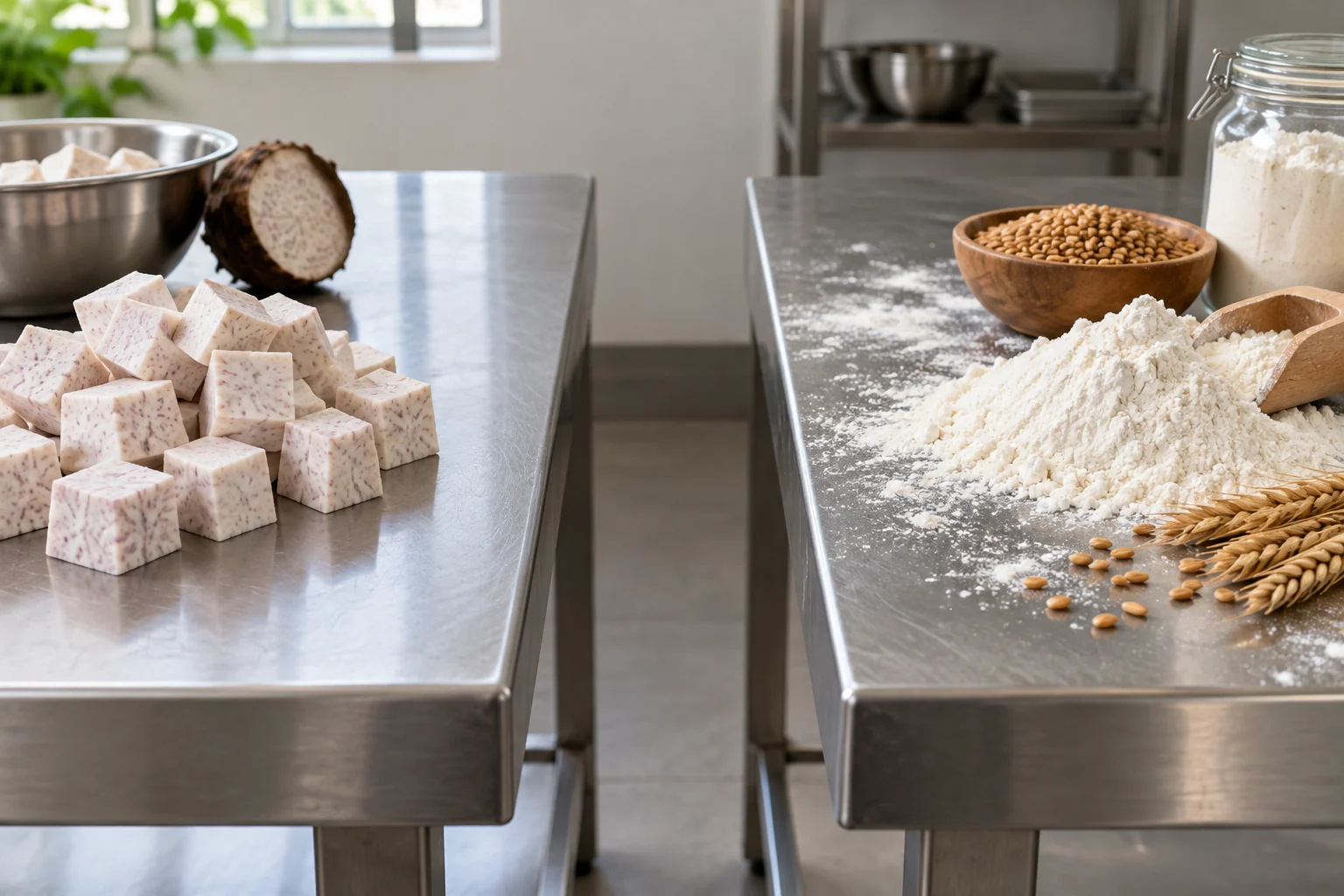
Separate taro and wheat work areas illustrating possible cross-contact.
At the kitchen level, review storage and preparation. A sealed bag of plain frozen taro can be handled safely as an ingredient, yet a worker can add it to a pot previously used for a barley soup without suitable cleaning. Shared fryers and preparation boards are common points to assess. Staff need clear instructions about what the menu claim covers and when they must say they cannot verify it. For customers who require strict avoidance, a confident but undocumented "taro is gluten-free" answer is inadequate.
Cross-contact is not visible. A clean-looking taro cube or a bright purple drink cannot establish the presence or absence of gluten. This is why claim review relies on formulation records and process controls rather than visual inspection alone. When a sourcing team changes a supplier, packer or cut format, it should reopen the cross-contact review even if the product name is unchanged.
Check the full recipe and finished-product claim
The status of a finished taro food comes from every ingredient and every process step. A taro dessert may use wheat-flour pastry. A savory taro dish may be thickened with wheat starch or flavored with a sauce containing wheat. A beverage may have a taro-flavored premix, toppings or a shared blender. The taro portion can be naturally gluten-free while the final food is not. Read the current ingredient declaration and ask about preparation, especially when the product is sold to a consumer who relies on the claim.
The FDA's gluten-free labeling guidance makes the claim a product-level responsibility for foods under its jurisdiction. A food that simply lacks a gluten-free logo is not automatically unsafe; some naturally gluten-free foods do not carry the voluntary claim. Conversely, a package should not display the claim merely because its headline ingredient is taro. The manufacturer needs the entire recipe and control system to support the wording. Retailers and foodservice operators should preserve the supplier's exact language rather than strengthening it in their own menus.
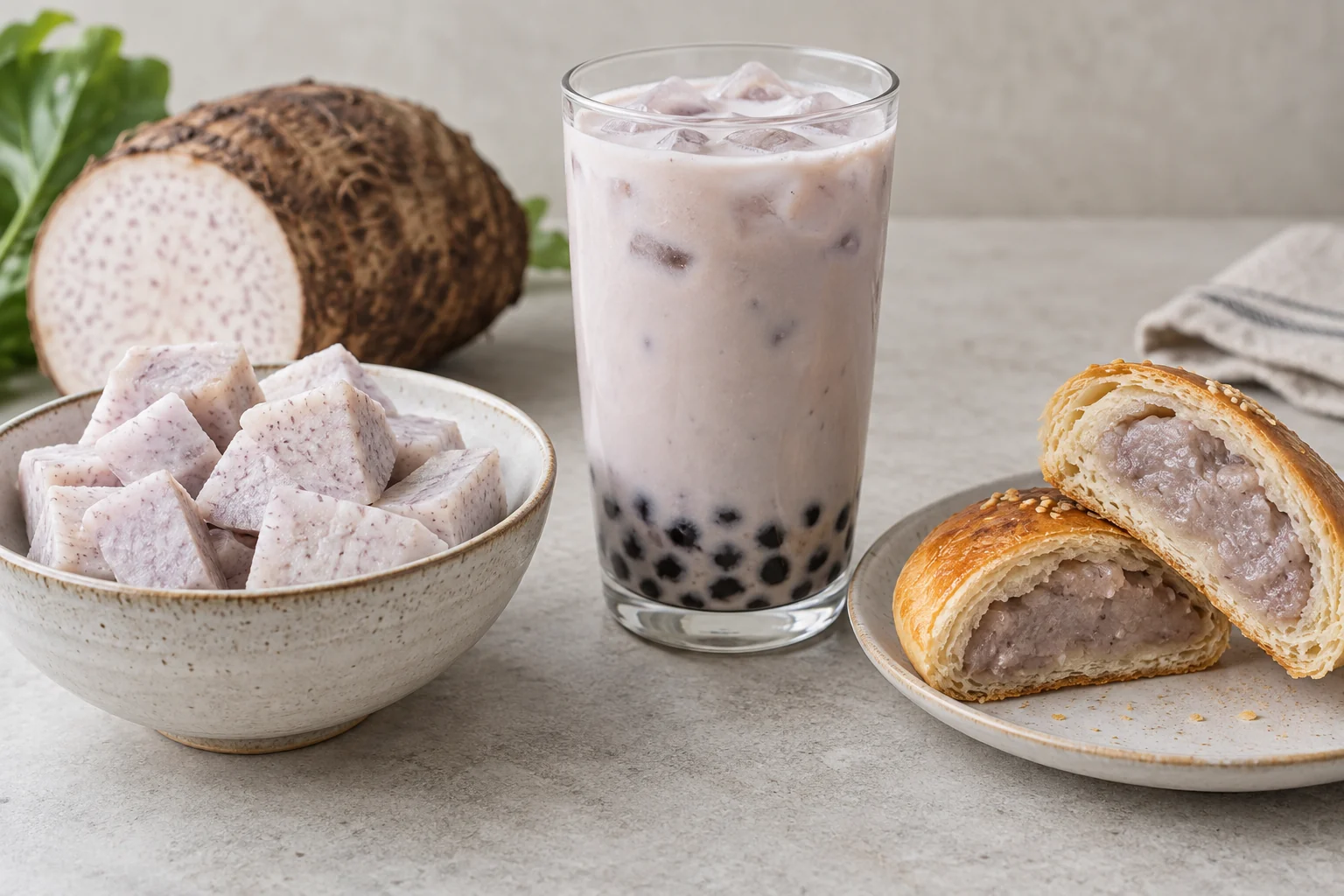
Plain taro beside a taro beverage and a filled pastry.
For a beverage, separate the plain taro base from the assembled drink. Ask whether the powder contains wheat, barley malt, a wheat-derived thickener or an undeclared sub-ingredient. Then review toppings, syrup and equipment. Tapioca pearls may be a separate ingredient, but their presence does not establish the mix's status. If staff cannot see the powder specification, the correct answer is that they need to verify it, not that all taro bubble tea is gluten-free.
For a bakery or prepared-food line, identify each formulation change point. A frozen taro cube may enter a pie filling that later goes into a wheat crust, or a gluten-free pastry may be handled beside conventional dough. A finished-product claim needs a controlled recipe, segregation or validated cleaning and an appropriate label review. The technical team should approve the claim before packaging is printed. A procurement manager can help by obtaining accurate ingredient documents and timely change notifications from suppliers.
The same caution applies to private-label goods. The brand owner may receive a product assembled from several suppliers. Keep a current bill of materials, ingredient specifications and supplier statements for each relevant component. If the taro is plain but the topping or seasoning changes, review the finished claim again. A clear record of why a claim was made is more valuable than a casual assumption attached to an ingredient's reputation.
What a plain frozen taro specification should say
Plain frozen taro can be a useful ingredient for food manufacturers and foodservice buyers because the corm is peeled and cut to a defined form. The product specification should identify the botanical or commercial name, ingredient statement, cut size, processing state, packing, frozen storage requirements, country of origin and lot coding. If a customer needs a gluten-free suitability statement, that should be an explicit item with a defined basis rather than an inference from the word "taro." Ask whether the supplier can provide the required evidence for the destination market and finished-food program.
"Frozen taro" can refer to cubes, chunks, slices or whole peeled pieces. The size affects cooking time and portioning; a small cube is not a direct substitute for a large chunk in a simmered dish. The specification should state whether the taro is raw, blanched or cooked. If it is raw or only partly processed, the buyer must cook it thoroughly before serving. If the product is sold as ready to heat, check the supplier's actual instruction and food-safety documentation. Gluten status does not answer cooking status.

Frozen peeled taro pieces in a blue crate.
Review the ingredient list carefully. Plain taro should not acquire a wheat ingredient simply because it is frozen, but a flavored, coated or seasoned frozen item can be different. If a supplier offers a "taro ball" or dessert piece, request the complete recipe: such products may include flour or starch blends. Ask which pack is being quoted and keep the product code on the purchase order. Names that sound similar can conceal different formulations, especially across private-label and foodservice ranges.
The package and frozen chain are also relevant. An intact pack protects the cut pieces from dehydration and handling damage. Check the lot on arrival for size consistency, excessive ice, discoloration and package integrity. Those checks say whether the ingredient matches the agreed quality, not whether it is gluten-free. A buyer making a claim needs both the quality check and the documented gluten assessment. Keep the two records distinct so a good-looking delivery does not become false evidence for a label claim.
GreenLand-food's frozen taro product range can be discussed at a specific cut and pack level. Tell us the application, target dimensions, monthly volume, cooking process and the declaration or documentation your market requires. We can confirm what is actually available and which documents apply to the offered product. We would not treat a general taro article as a certificate for a particular shipment.
Documents and controls to confirm before making a claim
For a B2B buyer, the evidence package begins with a current product specification and complete ingredient declaration. Add an allergen or gluten statement with its scope: does it describe an ingredient list, a shared-line assessment, a tested lot or a certified program? These are different statements. If a supplier presents a test report, note the tested matrix, method, detection limit, batch and date. If a certificate is offered, confirm the body, product coverage and validity. Do not place a logo or claim on a finished pack simply because a supplier sent a generic company certificate.
Ask about change control. A gluten-free program can be affected when an ingredient source, packing site, line, seasoning or rework policy changes. The buyer should know whether it will receive advance notice and whether the approved specification has a version number. A purchase order that names the exact product code and version helps prevent a similar but differently formulated item from arriving unnoticed. The same discipline matters when the product is repacked for private label.
Review the destination market's rules with the regulatory team. The US FDA's less-than-20-ppm definition is relevant to US-regulated foods carrying a gluten-free claim, but it should not be copied unexamined into EU, UK, Australian or other labels. Some buyers need a certification or customer-specific limit beyond the general legal requirement. Define the target before asking a supplier whether it can meet it. "Gluten-free" is a short phrase that can require a detailed technical agreement.

Plain frozen taro cubes beside an unmarked product specification.
For an importer, include the practical documents needed to release the shipment and support traceability: lot identification, packing details, country of origin and any agreed analysis or declaration. Keep the approval sample and specification linked to the product code. When a finished product is marketed as gluten-free, the brand owner's own handling and formulation records complete the evidence chain. The ingredient supplier cannot validate a sauce or pastry it has never seen.
The strongest purchasing question is specific: "Can you supply these plain frozen taro cubes under this product code, with an ingredient declaration and documented controls suitable for our intended claim and market?" It invites a verifiable answer. "Is taro gluten-free?" is the right question to start the article, but it is too broad to close a commercial approval.
If several factories or restaurant sites will handle the same ingredient, circulate one approved product specification and one claim decision to all of them. A local substitution made for cost or availability can undermine a central label review. Require staff to identify the exact product code on receipt and to raise any mismatch before use. This creates a practical handoff from the regulatory review to the people who actually open the cartons.
Keep safe cooking separate from gluten status
Taro should be cooked thoroughly according to the product's instructions. Raw or undercooked taro can irritate the mouth and throat because of calcium oxalate crystals; cooking reduces that issue. The exact preparation depends on cut size and whether the supplier has already blanched or cooked the pieces. A buyer should confirm processing state before using frozen taro in a beverage puree, soup, dessert or ready meal. A small cube may soften faster than a large chunk, but tenderness through the center is more useful than a fixed internet time for every format.
For home cooking, peel safely, handle the corm with clean equipment, and cook until the pieces are fully tender. For a production line, validate the heating and cooling process for the defined cut and recipe. A taro component in a chilled dessert may have to be cooked separately before mixing. A raw frozen cube is not ready-to-eat merely because the package came from a freezer. Likewise, a cooked cube does not become gluten-free if it is mixed with wheat-based ingredients afterward.

Taro cubes simmering until tender through the center.
Keep preparation instructions and label claims in different parts of the product file. The cooking instruction addresses the corm and food process. The gluten statement addresses ingredients and possible cross-contact. Both matter to the final customer, but one cannot be used to prove the other. A supplier can truthfully say "plain taro contains no gluten ingredient" while still requiring a buyer to check the process documentation before claiming the finished product is gluten-free.
When comparing suppliers, ask for a sample in the actual cut and processing state. Cook it by the proposed method, check texture, and record the result. Then review the ingredient and gluten documentation separately. This two-part trial avoids a common mistake: choosing a technically suitable gluten status but a texture that fails the recipe, or liking the texture while overlooking a formulated coating. The approved product should satisfy both performance and documentation needs.
If the customer has celiac disease or another reason to avoid gluten strictly, the final menu or label should communicate only what the business can substantiate. Staff can explain that plain taro is naturally gluten-free while checking the exact mix, sauce and shared preparation route. A precise answer protects trust better than a universal promise attached to the ingredient name.
Source frozen taro with GreenLand-food
GreenLand-food is a professional frozen taro supplier and manufacturer in China, providing factory-direct wholesale supply for importers, food manufacturers, foodservice distributors and private-label programs.
Send the target cut, quantity, application, destination and requested documents so we can confirm a relevant sample and current supply.