


How Long Do Chestnuts Last?
Sep 24, 2026
Leave a message


How long each chestnut form lasts
The word "chestnut" hides several different products. A newly harvested in-shell nut still contains substantial moisture and can sprout, dry out or develop decay. A peeled raw kernel has lost the shell's physical protection and is more exposed to handling, drying and contamination. A cooked chestnut is a ready-to-use food that should be cooled and refrigerated promptly. Frozen peeled chestnuts have a different clock again: storage temperature and packaging govern quality, while the supplier's validated shelf life and lot records govern commercial use. A buyer who asks only "how long do chestnuts last?" may receive a technically true answer for the wrong form.

Four chestnut forms compared at the same scale.
| Chestnut state | Practical home starting point | What changes the answer |
|---|---|---|
| Fresh in shell | Chill promptly. Chestnuts Australia suggests 2–3 days in a paper bag in the crisper, up to 10 days in an airtight container, and use within about three weeks of purchase for best freshness. | Initial condition, moisture, container, refrigerator temperature and handling before purchase. |
| Raw peeled | Treat as a highly perishable prepared ingredient; use promptly under refrigeration or freeze in a suitable pack. | Peel quality, exposed surface, whether the nuts were washed or blanched, and the agreed use date. |
| Cooked and peeled | Refrigerate in a closed container and use within about four days, following local food-safety guidance and the prepared recipe's requirements. | Cooling time, additions such as dairy or meat, refrigerator temperature and repeated handling. |
| Frozen peeled | Follow the pack's best-before date and storage instruction for quality; a home freezer and a controlled commercial cold chain are different systems. | Product treatment, seal, temperature continuity, ice, dehydration and intended use after thawing. |
The four-day cooked figure is supported by Chestnuts Australia and is consistent with the FoodSafety.gov guidance to use cooked leftovers within four days. It is a practical limit for home handling, not permission to ignore a more restrictive recipe, business food-safety plan or package instruction. FoodSafety.gov's cold storage chart also makes an important distinction: freezer time recommendations are principally quality guidance when food remains continuously at 0°F / −18°C or below. A thawed, warmed or poorly packed lot requires a different assessment.
Commercial fresh storage can last longer under tightly controlled conditions. UC Davis Postharvest describes up to four months for fresh chestnuts under specific near-freezing temperature, high humidity and controlled atmosphere conditions. That is a specialized system; it should not be copied into a refrigerator label for consumers or a buyer's ordinary warehouse. The key point is the condition and method behind each number. Ask for those before comparing two shelf-life claims.
Fresh in-shell chestnuts need prompt cooling
Put fresh in-shell chestnuts into a suitable cold environment promptly. They are not a dry pantry nut. The shell can give an impression of stability, but the kernel remains moisture-rich, and warm storage accelerates deterioration. At home, use a clean refrigerator container or bag according to the producer's instructions, avoid compressing or wetting the nuts, and check them regularly. In a commercial setting, define the temperature, humidity, ventilation and stock rotation that the product requires. A generic instruction to "store cool" is too vague for a long route or a receiving standard.
Start by selecting a sound lot. Chestnuts should feel heavy for their size and have firm, intact shells; a very light nut, rattle, split shell, visible mold or off odor warrants closer inspection or rejection. Chestnuts Australia's selection guidance emphasizes firmness, weight and undamaged shells. Cut several nuts from a representative sample where that fits the purchasing specification. An attractive shell does not prove the interior is sound. If the buyer plans to roast and sell whole nuts, the inspection should also reveal how easily they peel and how many usable kernels remain after preparation.

In-shell sweet chestnuts before peeling.
Moisture management is a balance. Letting chestnuts dry causes shrinkage and texture loss, while trapped liquid and unsuitable warmth encourage quality problems. That is why commercial postharvest advice discusses near-freezing temperature, high relative humidity and atmosphere together rather than one isolated number. UC Davis notes the role of temperature and atmosphere in limiting sprouting, mold and other deterioration. A supermarket crisper cannot reproduce controlled atmosphere storage, so do not infer a months-long home life from that research. Treat fresh retail nuts as a food to use soon.
For an importer, record the harvest or pack date where available, the departure and arrival dates, cold-chain evidence and arrival condition. Ask the supplier how it defines its stated shelf life: from harvest, packing or delivery? Those are not interchangeable. Check the outer carton and any inner pack for water damage, condensation or physical damage. If a lot arrives warm or with evidence of poor handling, investigate it under the receiving program rather than adding the remaining calendar days mechanically. The decision must be based on the actual lot and documented controls.
Fresh chestnuts are useful when the roasting or shell is part of the customer experience. Their shorter and more variable usable window is part of that choice. A kitchen using chestnut pieces only inside a filling may avoid unnecessary shell and peel work by choosing an approved peeled frozen form. This is a cost and process decision as well as a storage one: compare purchased weight with usable yield, labor and waste over the intended production schedule.
Peeled and cooked chestnuts have different clocks
Removing the shell and thin inner skin changes the handling of a chestnut. Raw peeled kernels can dry, discolor and pick up contamination more readily than intact in-shell nuts. There is no universal safe refrigerator period that applies to every peeled raw chestnut, because the starting material, wash or blanch step, packaging and hygiene vary. Use a documented procedure for a commercial product, follow its stated shelf life, and keep household peeled nuts chilled for prompt use. If the recipe is scheduled later, freezing in a suitable pack may be more practical than holding them in the refrigerator and hoping the texture remains unchanged.
Cooked peeled chestnuts are a clearer home case: cool them promptly in a shallow container, close the container once suitable, refrigerate, and plan to use them within about four days. FoodSafety.gov advises putting cooked leftovers into shallow containers for rapid cooling and using them within four days. Do not leave a large hot pile at room temperature while waiting for its center to cool. If chestnuts are mixed with cream, meat stock or another prepared food, assess the finished dish under the procedure for that dish; the presence of chestnuts does not extend the life of the other ingredients.
Avoid repeatedly opening and warming the same container. Portioning cooked chestnuts into the amounts a kitchen will use can reduce handling and speed cooling. Label the container with its preparation date, especially where several staff members work across shifts. Smell and appearance are useful reasons to discard food that has clearly deteriorated, but a normal appearance is not proof that a cooked leftover remains safe beyond its limit. Use time and temperature controls first, then a condition check.

Cooked peeled chestnuts cooling in a shallow covered container.
Freezing cooked peeled chestnuts can extend their usefulness, yet the outcome depends on the recipe. A frozen cooked kernel may hold well in a soup or stuffing but lose the exact firmness desired for a whole garnish. Freeze small, well-protected portions and trial the thawing or direct-cook method. Chestnuts Australia's foodservice guidance describes cooked peeled chestnuts frozen in small freezer bags for up to six months as a practical quality guide. A commercial packed frozen product may have a different validated date. Do not transfer one instruction to a different process or package without evidence.
For a production buyer, specify whether "peeled" means raw, blanched, cooked or roasted. The distinction drives both preparation and shelf-life interpretation. A cooked ready-to-eat chestnut in a pouch is not the same product as raw IQF peeled kernels. Verify the treatment, labeling, storage regime and intended further cooking before calculating stock rotation or using the product in a ready-to-eat recipe.
What freezing extends and what it cannot repair
Freezing extends the period in which a sound chestnut ingredient can remain useful. It slows changes that would be rapid in a refrigerator and allows peeled pieces to be packed for later production. The benefit is most visible when a kitchen needs a chestnut filling in spring or a manufacturer needs a repeatable ingredient across several delivery months. Freezing does not make an unsuitable raw material sound. A nut that is dry, moldy, badly peeled or off-flavored before processing will not improve in a freezer. Selection and preparation still set the starting quality.
Frozen time also has more than one meaning. A food held continuously at the required frozen temperature may remain safe longer than its preferred sensory life, while its color, flavor, surface moisture or whole-kernel rate may decline. A best-before date usually expresses the supplier's expected quality under stated conditions. It is not a promise that any abused carton remains acceptable until the printed day. Examine the offered lot and the remaining life needed for the buyer's own warehouse, distribution and recipe schedule.

GreenLand peeled frozen sweet chestnut kernels.
Packaging is part of the preservation method. A tight, intact seal helps protect peeled kernels from freezer dehydration and foreign odors. Smaller inner packs can reduce repeated warming or handling when a kitchen uses only a few kilograms at a time. Free-flowing IQF pieces make dosing easier; a solid block can force an operation to thaw more than it needs. The correct package depends on the batch size and how the product will be opened. Ask for the inner pack configuration before buying a full pallet.
Freezing can change texture too. A cooked chestnut that becomes softer after thawing may be excellent in puree but less convincing as a visible whole garnish. A raw peeled frozen kernel may need a different heating step from a cooked ready-to-use item. Test the form in the final recipe, including any cooling and reheating. If the recipe needs a defined bite, write that endpoint into the sample approval rather than assuming all frozen chestnuts share it.
Never use freezing as a remedy for a cooked leftover held too long or a fresh lot with uncertain storage history. The decision to freeze comes after the material has passed the relevant condition and safety checks. For a commercial program, record the lot, processing state, packing date, labeled life and storage conditions. Those facts explain what freezing has preserved and when the ingredient should be used.
Signs that chestnuts should be rejected
Visible mold, a sour or musty odor, soft wet areas, leakage or severe shriveling are reasons to stop and assess the lot. In-shell chestnuts may also show cracks, holes or a kernel that has pulled away from the shell. Peeled nuts can show unusual darkening, excessive dry patches, broken pieces, clumping or a surface coated with loose ice. No single visual cue gives a complete food-safety answer, but these cues are strong receiving signals. Document them and compare the lot with the approved specification before deciding whether it can be used.
The edible part deserves inspection. Cut a sample of in-shell nuts to look for internal damage and assess preparation yield. For frozen peeled kernels, thaw or cook a representative sample according to the intended process. A surface that seems fine while frozen may become mushy or split after heating. Record color, aroma, whole rate and bite. If the recipe hides the pieces inside a puree, the acceptable breakage may differ from a garnish application; odor, off flavor and compromised packaging still matter in either case.
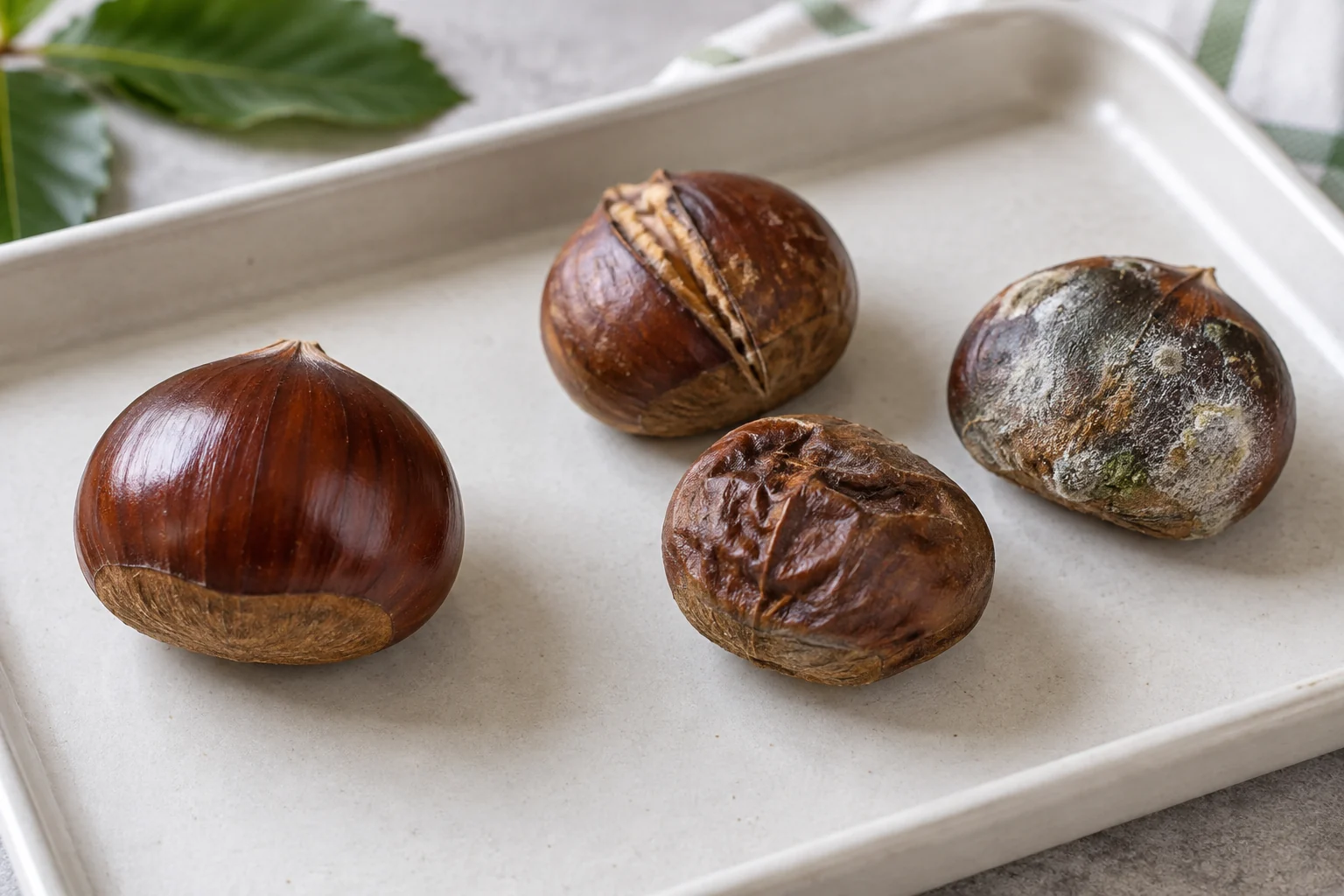
Sound chestnut beside cracked, shriveled and visibly moldy examples.
Avoid turning an illustrative spoilage photo into a safety threshold. The first visible moldy kernel is not the point at which a lot becomes unacceptable; the purchase agreement, risk assessment and relevant food-safety program govern the decision. Conversely, "no mold seen" cannot validate an unknown warm exposure or a damaged seal. This is why receiving checks combine supplier records, package integrity, transport condition and a sample inspection. Give staff a route to hold an uncertain lot while technical personnel evaluate it. An improvisation at the cooker is too late.
Quality loss can occur without obvious spoilage. A chestnut stored too dry may be chalky; a lot with high broken-piece content can alter portion appearance or require extra sorting. A frozen bag that has been handled roughly may contain acceptable food but no longer meet a premium whole-kernel grade. Such outcomes affect cost and customer experience even when the food-safety check passes. Specify them separately so that "safe" and "fit for this application" remain distinct receiving decisions.
When there is a concern, preserve the carton label, lot code, photos and a sample under appropriate conditions, then contact the supplier with the specific defect and quantity affected. An actionable report is more useful than "the chestnuts look old." It allows the parties to check the processing lot, cold-chain record and agreed tolerances and to choose replacement, credit or a permitted alternative use.
How commercial frozen shelf life is established
A commercial frozen chestnut's best-before date should come from the supplier's product, pack and validation, not from a generic internet chart. Processing state, moisture, package barrier, seal, piece size and frozen storage temperature all affect quality over time. A peeled IQF kernel in a sealed food-grade inner bag can behave differently from home-frozen cooked chestnuts in a partly filled box. Ask for the product specification and labeled storage instruction, confirm that the date is calculated from a clear starting point, and ensure the remaining life on arrival meets the contract.
Cold-chain continuity matters more than the printing of a distant expiry date. A stable frozen lot should arrive with intact packing and evidence of appropriate transport. Excessive frost, a solid block where free-flowing pieces were specified, wet cartons or damaged seals need investigation. Clumps do not by themselves prove a particular temperature abuse event; they can have several causes. They do indicate that the buyer should inspect the lot, check records and test whether it still meets the intended use. Never "reset" a best-before date after thawing and refreezing.
The FoodSafety.gov cold storage chart explains that freezer storage recommendations concern quality when food remains continuously frozen at 0°F / −18°C or lower. That distinction helps explain why a frozen product can be microbiologically stable for longer than its preferred eating quality. The practical commercial limit may be color, flavor, dehydration or the percentage of intact kernels. A buyer should judge the validated product date and quality standard, not treat "safe while frozen" as a reason to keep inventory indefinitely.

Sealed bag of peeled frozen chestnuts inside a carton.
GreenLand-food's frozen chestnut products are supplied as specific forms and packs. We would confirm the offered lot's label, available remaining shelf life, cut or whole rate, packing and frozen delivery conditions before promising it for a production run. If a customer needs a minimum remaining life at destination, include that term in the inquiry and purchase order. A date acceptable at origin may be insufficient after transit, customs and local distribution.
Use first-expiring stock first where the warehouse program requires it, but also maintain lot traceability. If several crop years or processing dates share one freezer, labels must be readable and picking rules clear. Sample retention or periodic sensory review can help a manufacturer detect quality drift before it enters the finished food. Those checks should be designed by the technical team for the actual ingredient; a generic six-month suggestion cannot stand in for a qualified supplier and a documented receiving program.
Receive and rotate chestnuts by product state
Decide the intended use before setting an acceptance limit. A whole chestnut visible on a premium plated dish needs a different breakage tolerance from diced chestnut in soup. A bakery may care most about predictable solids and sweetness in a filling. A distributor may need a certain remaining shelf life and pack format to serve multiple customers. Write those requirements into the specification and ask the supplier to confirm the particular lot. Otherwise a technically edible shipment can still cause line stoppages, rework and dissatisfied customers.
At receipt, check the shipment against the purchase order: product state, cut, treatment, pack size, lot code, best-before or use-by information, quantity and required documents. Examine carton and inner-pack integrity, then sample across the shipment rather than only the first accessible carton. For fresh in-shell nuts, inspect shell and a cut sample. For frozen peeled product, assess color, frost, clumping, whole rate and the condition after the intended cooking or thawing step. Record the temperature and delivery condition according to the buyer's program. A brief written record gives both sides a basis for resolving a discrepancy.
Compare useful yield, not just cost per gross kilogram. In-shell chestnuts lose weight to shells and the inner skin; a poor peel yield can erase a price advantage. Peeled frozen product usually reduces preparation labor, but broken-piece rate or unwanted size mix can also reduce the yield for a whole presentation. Run the comparison through the actual recipe and labor process. The cheapest carton may be expensive by the time a cook has removed damaged nuts and sorted enough intact pieces for service.
If the receiving team finds a concern, separate the affected lot and follow the hold-and-release procedure. Do not blend uncertain product into sound stock to make the visual defect less obvious. Provide the supplier with lot code, photos, number of cartons and the specific standard not met. Ask for a disposition that protects the production schedule. A pre-agreed substitute cut can sometimes rescue a blended recipe, but changing a visible ingredient without customer or technical approval can create a second problem.

Peeled chestnuts being checked for color and intact pieces on receipt.
For repeat programs, review the data after several shipments. Did freshness or broken-piece performance change near the end of a crop year? Was there a recurring pack defect or an avoidable over-order? Adjust contract quantity, delivery cadence or application split based on those observations. Shelf life is not a single printed number; it is a planned relationship among product state, storage, transport and the time the ingredient must perform in the finished food.
Common storage questions with practical answers
Can chestnuts be left on the counter? Fresh in-shell chestnuts should be chilled promptly rather than treated like dry pantry nuts. A short period during preparation is different from choosing room-temperature storage for days. Use the producer's handling advice and inspect any lot that has spent an unknown time warm. Cooked chestnuts should be cooled and refrigerated within the time limits of the applicable food-safety procedure.
Can a fresh chestnut be frozen in its shell? Home methods vary, but freezing peeled or prepared portions often makes later cooking and portioning easier. The best method depends on whether roasting in the shell or using peeled kernels is the goal. For a commercial recipe, purchase a clearly specified frozen form and trial it in the process instead of relying on an informal home method for a production quantity.
Does the printed best-before date prove quality after a warm delivery? No. The date assumes the labeled conditions were maintained. Check transport and package condition, hold a suspect lot, and investigate under the buyer's quality system. The supplier's date remains useful, but it is one piece of evidence rather than a substitute for receiving inspection.
How long after cooking can chestnuts be refrigerated? Plan on about four days in a closed container under proper refrigeration for plain cooked chestnuts, consistent with the cited Australian and US guidance. Mixed dishes can require a different limit. Label the preparation date and cool the food promptly in shallow portions rather than leaving a large mass warm.
Are dry or dark pieces always unsafe? Appearance alone cannot answer every safety question. Drying, darkening and breakage can make the ingredient unacceptable for a particular recipe, while visible mold, off odor or wet spoilage signals demand a more serious hold and assessment. Compare the lot with the agreed specification and food-safety program rather than taking a chance on a few apparently normal pieces.
What is the most useful question for a supplier? Ask: "For this exact product and lot, what is the processing state, pack date, labeled frozen life, remaining life on arrival, storage requirement and acceptable whole or broken rate?" Include the recipe and first production date. That answer can guide a purchasing decision. "Chestnuts last six months" without those conditions cannot.
Source frozen chestnuts with GreenLand-food
GreenLand-food is a professional frozen chestnuts supplier and manufacturer in China, providing factory-direct wholesale supply for importers, food manufacturers, foodservice distributors and private-label programs.
Send the target cut, quantity, application, destination and requested documents so we can confirm a relevant sample and current supply.