


ISPM 15 Wood Pallets and Packaging for Frozen Produce
Oct 20, 2026
Leave a message

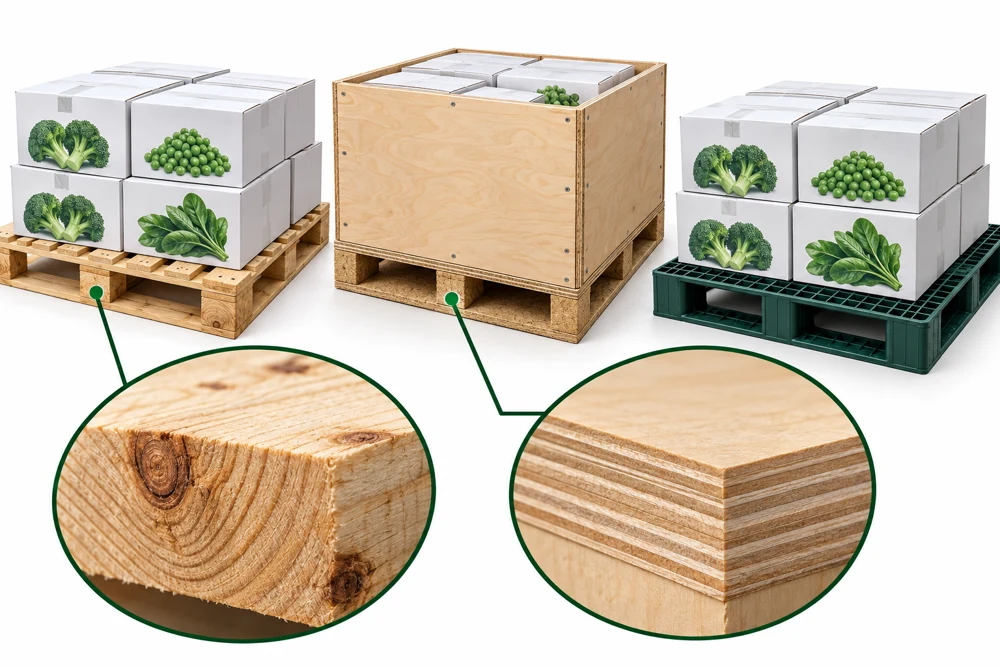
Reviewed 20 October 2026. Shipment requirements are checked for the actual product, route and filing date.
Identify every material that supports the reefer load
Start with the material, not the pallet color. ISPM 15 covers raw solid wood packaging used to support, protect or carry goods in international trade. Pallets, crates, skids, blocks, collars and loose dunnage can all be relevant. The IPPC standard text excludes certain processed wood that has been created using glue, heat or pressure and thin wood within its stated limits. A composite pallet can contain both processed panels and solid-wood stringers or blocks; inspect each component rather than assigning one rule to the whole unit from a top-board glance.
The standard's thin-wood exemption is for packaging made entirely from wood 6 mm or less in thickness; it also exempts packaging made wholly of the specified processed wood. Those words "entirely" and "wholly" matter when a processed panel is fixed to a thick raw-wood block. The buyer should identify every material in the finished unit, rather than infer an exemption from a supplier catalog's main material description. The IPPC section 2.1 exemptions are the reference for that distinction.
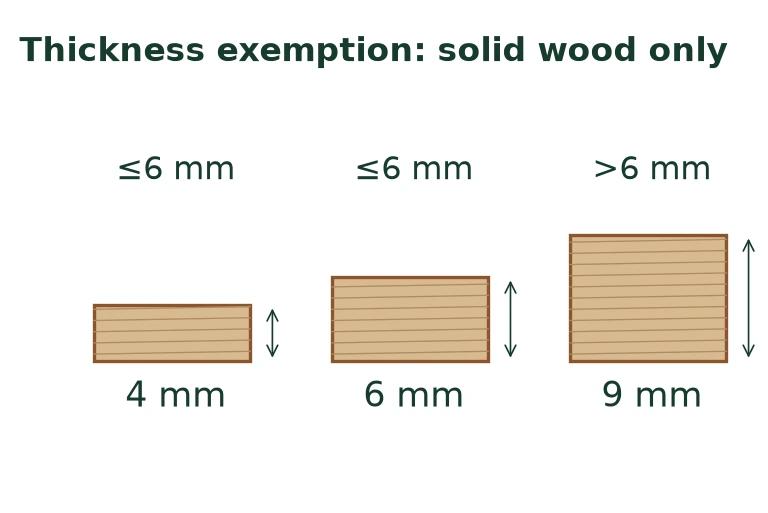
Schematic thickness comparison. The thin-wood exemption concerns packaging made entirely of wood 6 mm or less; processed-material rules are assessed separately.
Plywood, oriented strand board and pressboard are common processed-wood examples. Plastic and metal pallets are non-wood choices. The APHIS wood-packaging overview lists plywood or pressboard and plastic pallets among products outside its regulated WPM category. However, an exempt deck does not exempt a solid-wood runner attached underneath. Likewise, a plastic pallet can be strapped with untreated wood bracing inside a container. Make a loading-material inventory that names the actual construction and any loose dunnage, including temporary chocks introduced by a warehouse or freight provider.
The destination country applies its own import rules and may have bilateral or route-specific provisions. The APHIS export guidance lists countries that have stated ISPM 15 requirements and notes that the list is not exhaustive. It also describes a Canada–US exemption for certain wood packaging made from wood originating in those countries, with specified documentation. That provision should not be generalized to a China-origin reefer. The importer should confirm the latest destination and transit requirements and whether the actual packing material qualifies for any exemption. A supplier should not print "ISPM exempt" on every shipment just because one customer previously used plastic pallets.
For a frozen-produce quotation, ask the buyer whether it wants marked solid-wood pallets, plastic pallets or another approved design, and whether its warehouse has size, load-rating, hygiene or handling requirements. These commercial choices are separate from phytosanitary scope. A plastic pallet may avoid the ISPM 15 wood-mark requirement but still need an adequate load capacity and compatibility with racking, handling and the buyer's food-contact or sanitation policy. Solid wood may be suitable if sourced, treated and marked correctly. The order should specify the material and pallet count so a last-minute substitution cannot quietly alter the border evidence.
Map product lots to pallets. A reefer carrying IQF broccoli and frozen strawberries may use separate pallet ranges for each SKU and production lot. Record pallet identifiers, carton counts and container position where practical. The mark belongs to the wood packaging, while a lot label belongs to the food. They answer different traceability questions. A clean IPPC mark does not identify the broccoli batch, and a batch barcode does not certify the pallet treatment. Keep both readable after stretch wrapping or show the official mark from an accessible face before loading.
| Material / state | Decision before loading | Owner / evidence |
|---|---|---|
| Solid-wood pallets, blocks and dunnage | Apply destination ISPM15 rules; inspect authorised mark and pest condition. | Packer/quality: actual-unit check, provider trace and load map. |
| Packaging entirely wood≤6mm or wholly qualifying processed wood | Assess the complete construction, not just the face panel. | Purchasing: material specification, hidden runners/blocks check. |
| Plastic / metal pallet with added raw wood braces | Pallet material alone does not exempt separate wood dunnage. | Loading supervisor: all restraint materials and marks where applicable. |
| Repaired / rebuilt wood unit | Provider determines repair/remanufacture route and required treatment/marking. | Authorised provider: history and valid unit/component evidence; hold doubtful units. |
Check treatment, debarking and pest-free condition
ISPM 15 requires approved phytosanitary treatment of regulated wood packaging and application of the mark under a national plant protection organisation's oversight. The IPPC standard includes heat treatment (HT), dielectric heating (DH), methyl bromide fumigation (MB) and sulphuryl fluoride fumigation (SF) as approved code categories, with detailed schedules and conditions. A supplier should buy from an authorised producer or treatment provider and verify the applied mark. Painting "HT" on a pallet at the factory does not carry out the treatment.
For conventional heat-chamber HT, Annex 1 requires at least 56°C for 30 continuous minutes throughout the wood profile, including the core. The authorised treatment provider monitors or validates a schedule that meets that condition; a supplier's warehouse thermometer, kiln label or reefer temperature display cannot establish it. Other approved methods have their own parameters. Procurement should request an authorised marked pallet, then inspect its condition, rather than attempting to audit a treatment cycle from an unqualified shipping document.
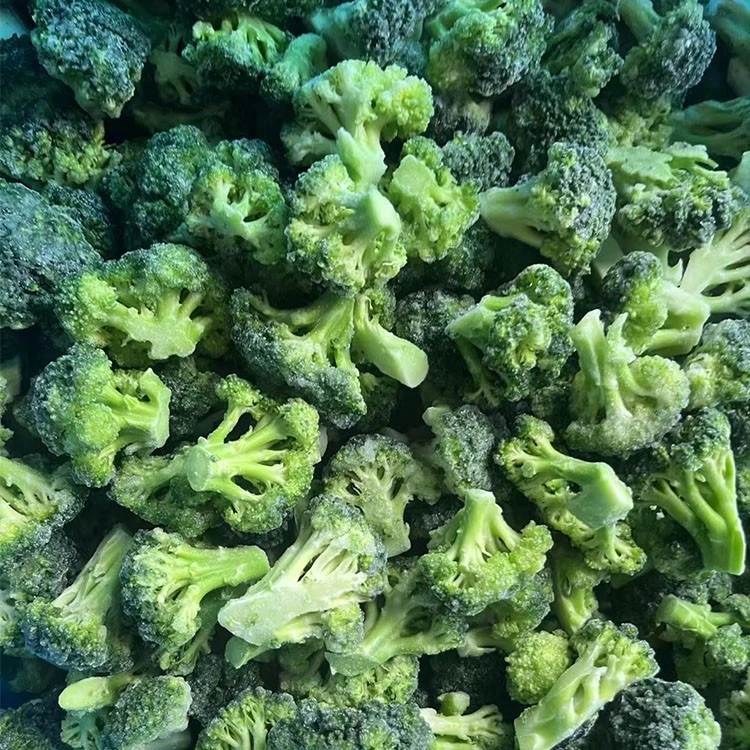
Frozen broccoli florets: identify the actual form, packing and intended use in the shipment file. Product photograph; not evidence of a filing result.
Frozen broccoli florets for your import programme
Tell us your destination, intended use, cut or grade, packing, quantity and preferred shipment window. We can coordinate the proposed source, sample specification and origin documents with your importer and appointed filing team. The actual lot, factory and required documents are agreed before dispatch.
View product and supply details
Request Specifications & QuoteDebarking is part of the standard, with specified tolerance for residual bark. It does not require a decorative perfectly smooth board. The pallet inspector should look for obvious bark patches, live insects, fresh bore dust, galleries, fungal or structural deterioration and suspicious replacement pieces. A pallet that bears a plausible old mark can still be stopped by visible pests or damage. APHIS import guidance tells US importers to ensure WPM is pest-free, debarked, treated and marked; non-compliant material can prevent entry. The destination authority makes the actual inspection decision.
Treatment choice is controlled by the certified provider and current country rules. Do not instruct an unapproved warehouse to fumigate pallets beside frozen food or assume a temperature setpoint in a reefer counts as heat treatment. The refrigeration system maintains product temperature; it cannot satisfy an ISPM 15 heat schedule for wood. If a buyer has a policy against methyl bromide, specify an acceptable treatment code in the pallet purchase and check the physical mark. Avoid a generic "fumigated pallet" statement that omits the recognised treatment, provider and traceability.
Cold storage introduces physical handling issues. Pallet feet can be damaged by forklifts, condensed moisture can make marks harder to read, and stretch wrap can obscure them. Inspect before and after the pallet is loaded with cartons, then arrange at least one readable marked face when the goods are staged. The check should not require unloading an entire reefer to locate a hidden stamp. Where a pallet is wrapped, photograph the mark before wrapping and identify the pallet in the photo. A photograph is supporting evidence; an inspector still judges the physical unit.
If live pests, fresh frass or unexplained holes are observed, isolate the pallet and protect the food from contamination. A clean stamp does not cancel an active finding. Ask the authorised pallet provider or quality lead for a replacement or treatment decision, and record which cartons moved to which new pallet. The importer or destination authority may require a specific response if the problem is discovered after arrival. A supplier should not scrape away evidence and re-mark the same unit. Document the observation and disposition so the buyer can understand what actually shipped.
Read the IPPC mark as a traceable certification
The IPPC Annex 2 mark specification requires the protected symbol, a two-letter country code, a producer or treatment-provider code, and an approved treatment code. The border and dividing line have prescribed form. The country code identifies the authority system supervising the mark; it does not necessarily state the origin of the frozen produce. The treatment code indicates the method applied to the wood; it is not a temperature instruction for the reefer or a claim about food quality.
The mark must be legible and durable enough to be recognised without a visual aid. The IPPC text describes placement and application, including marks on opposite vertical sides of a unit where practicable. A mark hidden under a pallet load, blurred by ink, cut by a repair or broken across separate pieces creates an avoidable inspection problem. Ask the pallet provider for examples of its approved mark and confirm the visible code corresponds to the provider or treatment site. A paper certificate can supplement procurement records but should not be used to excuse a missing or invalid mark where the destination requires a marked unit.
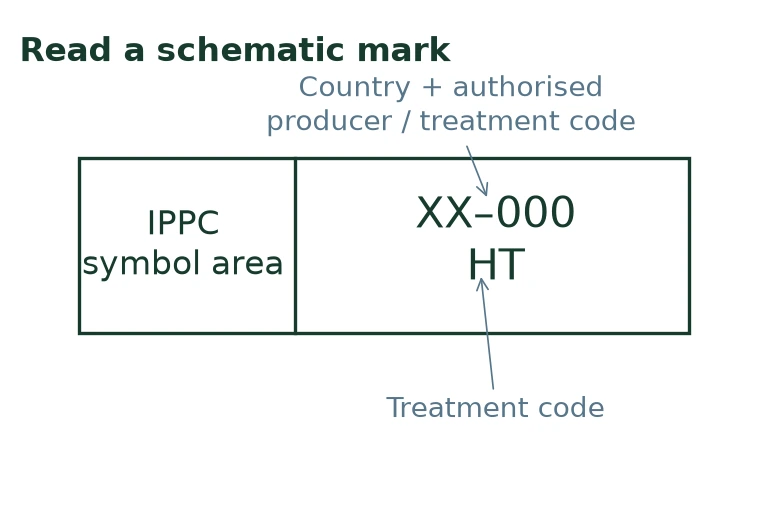
Schematic only: not a usable or authorised ISPM 15 mark. Inspect the actual legible mark and trace it through the authorised provider.
Check the actual pallet, not merely a sample from a shipment of pallets. At receiving, inspect a defined sample across the purchased stack for construction, marks and condition; before export loading, inspect every pallet selected for the container as the operational control. Photograph representative codes and any exception. If different suppliers or treatment lots are mixed, retain the link between their pallet codes and the units used. A buyer may ask for a pallet declaration or invoice; prepare it from observed material and procurement records rather than claiming that every pallet was individually treated in our factory.
Some pallets arrive with several marks after repair or reuse. Multiple marks are not automatically evidence of fraud; the standard has rules for repaired material. But a confusing cluster, partly obliterated code or new board without a readable authorised mark needs investigation. Consult the pallet provider and the destination's national plant protection organisation guidance. Do not choose whichever mark looks most favourable for the sales document. The IPPC implementation guide addresses mark application, reuse and repair in detail, while the formal standard decides the underlying requirement.
If a stamp appears counterfeit or the provider cannot establish authority, hold the pallet out of the export lot. A supplier declaration saying "ISPM 15 compliant" cannot validate a false mark. Replace the unit with an approved one and record the pallet change, affected cartons, lot mapping and new mark evidence. The cost of an authorised replacement before stuffing is usually far easier to control than a container held at destination; the exact financial outcome belongs to the shipment contract and authority decision. The operational priority is a truthful wood-packaging record.
Distinguish reuse, repair and remanufacture
An intact marked pallet can be reused without automatically repeating treatment as long as the unit remains compliant and its mark is valid. The IPPC explanatory document notes that compliant, unaltered wood packaging may move internationally through its service life without routine retreatment or remarking. Reuse does not excuse a live pest, unreadable mark or structural failure. The pre-load inspector checks condition on each shipment even if the supplier has used the same pallet pool for years.
Repair is different. The IPPC standard treats a unit as repaired when roughly one third or less of its components are replaced. Replacement solid-wood components must be appropriately treated and marked under the authorised system. The original mark may remain, and added components may need their own mark. National plant protection organisations may require a more controlled procedure where multiple marks make origin unclear. A factory carpenter should not attach an unmarked scrap board to a stamped pallet and assume the pallet's old mark covers the new wood. Buy repair work from an authorised source and keep the invoice or work record.
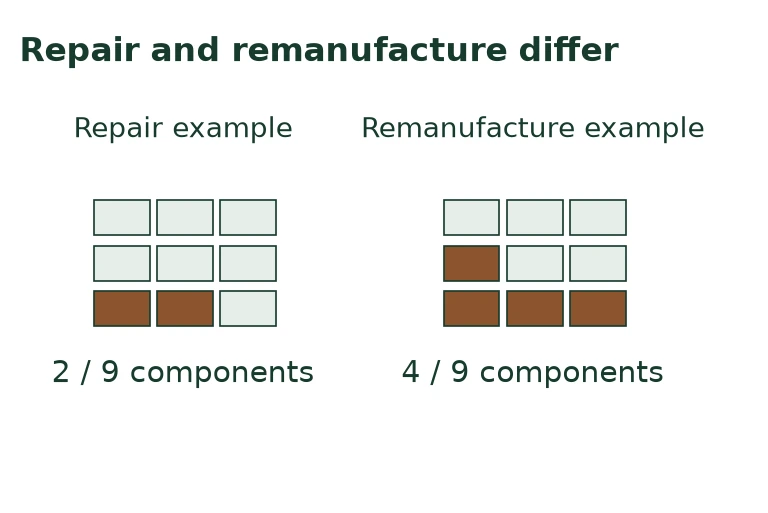
Illustrative component counts: the standard distinguishes up to approximately one third replaced from more than approximately one third. Follow its treatment and marking rules for the actual unit.
The threshold is intentionally approximate in the IPPC section 4.3.2–4.3.3 text. A buyer should not calculate 33.3% to justify a borderline repair in a mixed pallet with uncertain component history. The provider or responsible national authority determines whether the unit remains a repaired pallet or has become a remanufactured one. For export loading, a known compliant replacement is a safer operational choice when that history cannot be established. This leaves the formal judgment with the authorised programme.
Remanufacture applies when more than roughly one third of the wood components are replaced. The standard requires previous marks to be permanently obliterated and the rebuilt unit to be treated and newly marked under the responsible authority system. This is not a judgment based on whether the pallet still looks sturdy. A replacement of several deck boards and blocks can cross the threshold even if the base appears unchanged. Ask the provider to identify the repair category and treatment status; if it cannot, use a known compliant replacement for export.
The IPPC guidance also addresses uncertainty. If treatment history of components or origin of a repaired unit cannot be established, the national authority may require retreatment, destruction or prevention of its movement as compliant packaging. The supplier should not attempt to resolve uncertainty by over-stamping the unit. A mark is applied through an authorised treatment and marking programme. When a pallet is doubtful during loading, isolate it, move cartons to a verified unit and update the pallet-to-lot map. Record the decision before the reefer doors close.
Repair decisions should also protect food integrity. Move cartons with clean handling equipment in a suitable frozen environment; inspect packaging for punctures, moisture or contamination from the damaged wood. If a carton is damaged, quality determines whether it remains in the saleable lot. A replacement pallet solves the phytosanitary problem only if the product and packaging remain acceptable. The shipping record should show the new pallet number, carton count, seal and any time out of controlled temperature. Do not let a rushed pallet change erase the original lot identity.
Replace suspect wood and compare alternative materials
When a marked pallet fails inspection, the simplest controlled path is often replacement with a verified pallet from the approved stock. Quarantine the suspect unit so it cannot return to another export load. Confirm the replacement's material, mark and condition, then transfer cartons while maintaining traceability and temperature. Recount packages and gross weight if the pallet's tare differs materially. The container packing list and pallet schedule should describe what was actually loaded. A photograph of the old pallet's stamp does not describe the new pallet.
Plastic pallets can remove the regulated solid-wood question for the pallet itself, but the buyer should assess load rating, dimensions, slip resistance, racking, cleaning, sustainability and disposal. A plastic pallet can bend under a frozen load or fail a customer's mechanical specification. Processed-wood pallets or panels may also avoid ISPM 15 treatment for the processed components, yet attached solid wood still requires assessment. The destination importer's logistics team may prefer a certain pallet type because of warehouse equipment. Ask before production rather than making a one-sided substitution at origin.
Whole frozen strawberries: identify the actual form, packing and intended use in the shipment file. Product photograph; not evidence of a filing result.
Loose dunnage is easily overlooked. If a packer wedges the reefer load with raw wooden blocks or timber boards, those pieces may be regulated even when the pallets are plastic. Specify approved treated and marked wood dunnage or a suitable non-wood restraint. Inspect the container after loading for stray wooden braces. The treatment mark for loose dunnage needs to be visible and valid according to the standard's provisions; a pallet mark elsewhere in the container does not certify an unmarked board. The load-securing plan should also protect airflow and refrigeration, so the phytosanitary choice cannot compromise product temperature.
Destination-specific controls can be stricter in practice. CFIA's wood-packaging import page links its Canadian entry directive and advises importers to contact local offices for questions. APHIS US guidance describes US importer responsibility and non-entry for noncompliant WPM. A pallet accepted once by one border office is not a blanket permission for another country. The importer should tell the supplier its required pallet standard and any documentation wording before the pack is purchased.
An incident discovered after destination arrival belongs to the importer and authority process. The options may include treatment, replacement, re-export or destruction under the destination's direction. Do not promise that the container can be opened and pallets swapped without official supervision. The supplier can provide pallet procurement records, mark photos, packing list and lot map, then cooperate with the buyer's disposition and commercial claim. Preserve any official notice and exact affected unit codes; that evidence can identify whether a specific provider, repair practice or loading step caused the issue.
Run a pre-load check on frozen-produce pallets
Consider a proposed reefer containing IQF broccoli florets for a food manufacturer. The buyer specifies marked solid-wood export pallets, 10 kg cartons and a maximum pallet height. GreenLand-food's order coordinator confirms the product, packing, destination and pallet requirement with the buyer. The packer receives pallets from an approved provider and records its invoice and marks. Before cartons are stacked, staff inspect construction, debarking, visible treatment code, mark legibility and pest or damage signs. Failed units are tagged and removed from the export stack.
After freezing and packing, cartons are grouped by production lot and placed on inspected pallets. The pallet schedule records lot, carton range, count and position. Before stretch wrapping, an inspector photographs readable marks with pallet identifiers. After wrapping, the team checks that a mark can still be accessed where practical and that cartons are stable. The loading supervisor compares all pallet and carton totals with the commercial packing list. Loose wood bracing, if used, is separately inspected and recorded. The reefer is pre-cooled and operated to the agreed product temperature plan; pallet treatment records do not replace cold-chain evidence.
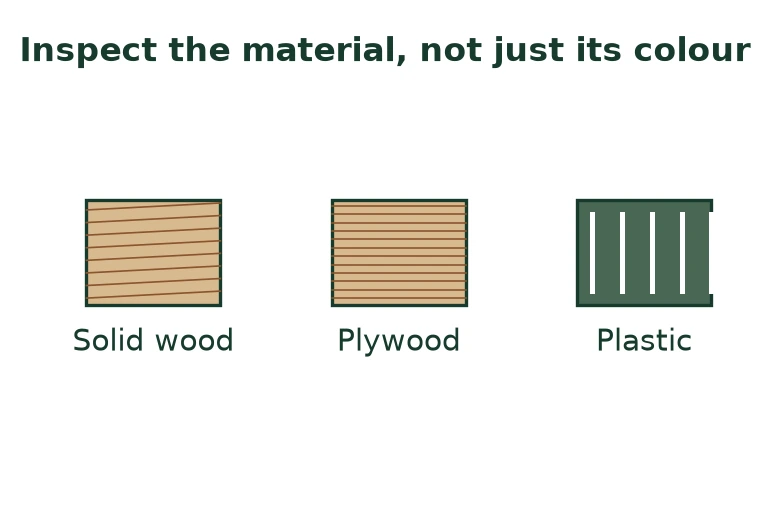
Assess the whole pallet or crate, including hidden battens and dunnage. A plywood face does not exempt separate solid-wood components.
During loading, a forklift splits a deck board on pallet P-07. Staff stop and move its cartons to a verified replacement pallet P-21 in a controlled area. Quality checks the cartons for puncture or contamination. The schedule is revised from P-07 to P-21, with a count and lot check, and a fresh mark photograph. P-07 is quarantined for the pallet provider. If the replacement uses plastic while the buyer specified wood, seek the buyer's approval before loading it; a technically exempt material can still violate the agreed warehouse specification. The final container and seal record identifies the actual pallets shipped.
The buyer receives a controlled pack: pallet material specification, provider identity and available mark evidence, final pallet list, commercial packing list, load and seal record, and any exception. These records support a border query but do not guarantee an authority's inspection outcome. If the destination importer needs a particular wood-packaging statement, it should approve truthful wording before the invoice is issued. GreenLand-food can prepare frozen vegetables, fruit and mushrooms for factory-direct wholesale supply as a China-based supplier and manufacturer; the quotation should name product form, pack, quantity, destination, pallet preference and required documents so the physical load matches the route.
Keep the pallet decision tied to the next order
The completed shipment file should show which pallet design was approved, which units were used, and whether any repair or replacement occurred. Link the provider purchase record and pre-load observations to the container and food lots. A random photograph of one stamp cannot support a statement about every pallet if the rest came from a different source. For repeat shipments, the order coordinator can use the same inspection form, but must check the actual stock and current destination rule. Pallet pools change through damage, repair and third-party handling.
Review exceptions by cause. An unreadable mark may reflect stamping quality, abrasion or careless wrapping. A raw replacement block reflects a repair-control failure. Live pests or frass call for isolation and provider investigation, not a better photograph. Missing dunnage marks point to a load-securing material overlooked by purchasing. Each cause belongs to a specific corrective action: approved-source replacement, revised receiving check, repair-provider qualification or clearer loading instruction. Record who closed it and which pallet or shipment was affected.
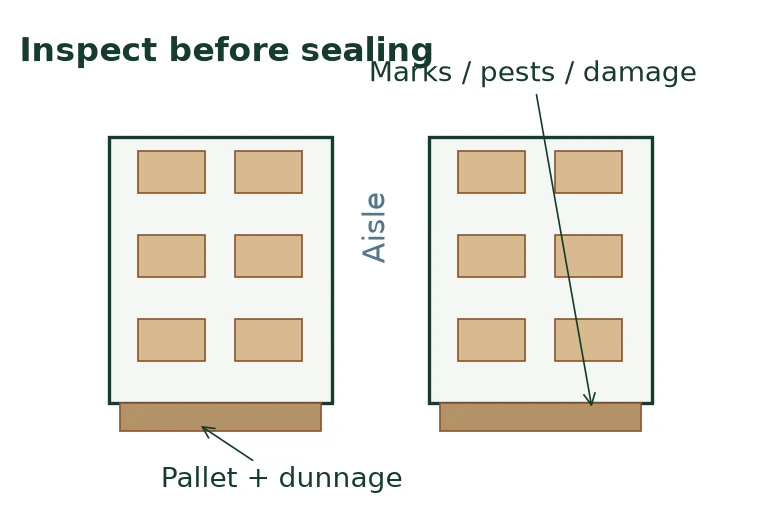
The pre-load check covers pallet, additional wood, visible marks, pests and damage. This drawing is not a validated container loading pattern.
The buyer can compare material options at quotation. Solid wood may suit its warehouse when sourced through a certified treatment programme and inspected carefully. Processed wood or plastic may simplify the ISPM 15 question for those components, while presenting different cost and handling decisions. The best option depends on the destination's rules, the customer's equipment, load weight, reefer airflow and sanitation needs. A contract should state the selected material, size and load requirements instead of using the vague phrase "export pallet." A late change should trigger both commercial approval and a fresh physical inspection.
Before the next container is sealed, ask three concrete questions: What material is under and around the cartons? Which solid-wood units and dunnage pieces carry valid marks and are free of pest signs? What evidence connects those units to the actual frozen-food load? Answering them does not replace the importer's country-specific legal assessment, but it gives the authorised importer a truthful, inspectable starting point. It also protects the frozen product from an avoidable pallet-related border delay while preserving food-lot and temperature controls.
- Agree actual pallet and restraint material with buyer and destination importer.
- Obtain regulated wood from an authorised source; inspect all export-selected units for marks, bark, pests and damage.
- Hold doubtful units, replace or route repair through the authorised provider, and update food-lot/pallet mapping.
- Recheck dunnage and actual loaded pallets before seal; importer follows any official destination disposition.
Use the existing order worksheets
Use T10 to assign each field or document to its provider, reviewer, due time and returned reference. T12 records changed source, product or transport facts; T11 preserves arrival evidence. Keep the legal deadline separate from the agreed earlier handover.
Build your frozen food order with GreenLand-food
GreenLand-food is a professional frozen food supplier and manufacturer in China, providing factory-direct wholesale supply for importers, food manufacturers and foodservice programmes.
Send your product form, specification, packing, quantity, application, destination, private-label needs and requested documents. We will organise the product and order requirements with your purchasing and quality teams.