


Kiwi in Gelatin Desserts: The Cultivar Exception
Oct 09, 2026
Leave a message

Research This Article & Topic with AI
Verify key claims, compare reliable sources, and explore GreenLand-food's practical frozen food knowledge.
Article details and research questions are prepared in the links. Sign-in or sending may be required.

In an illustrative sourcing discussion, a dessert developer asks GreenLand whether a kiwi ingredient must always be heated or excluded from its gelatin-based product. We would not answer from green or gold flesh color alone. We would clarify cultivar information, frozen form, treatment history and the proposed dessert, then help the buyer identify an input for its own application trial. Heating may be one route the developer evaluates, but a general ingredient warning is not evidence that every cultivar needs the same treatment. Equally, a published exception is not evidence that our current supplied lot has already passed the formula.
Identify the cultivar before the exclusion decision
The word kiwi can hide a material difference that matters to this decision. A purchasing specification may identify the fruit category and cut size while leaving the cultivar unspecified. That can be sufficient for some applications, but it is incomplete if a development decision depends on cultivar-related protease behavior. We would ask the buyer whether its proposed exclusion comes from an actual finished-dessert failure, an ingredient assay or a general rule encountered during recipe development. Those origins require different follow-up evidence.
Flesh color is not a reliable substitute for a documented cultivar. A photograph can show a green slice, seeds and a particular cut. It cannot establish the cultivar's identity or quantify activity against the developer's gelatin. Gold-colored kiwi should not be labeled universally inactive, and green-colored kiwi should not be dismissed as universally incompatible. The specific cultivar names in the research are material identifiers, not a new two-color classification for all fruit sold commercially.
At the sourcing stage, the buyer should distinguish information that is available from information it needs but has not yet confirmed. We can discuss the supplied frozen form and the identifying information available for a proposed lot. We should not promise a particular research cultivar merely because an article describes it. If documented cultivar identity is critical to the application, that requirement belongs in the inquiry before the buyer builds an approval around it. An unspecified material should remain unspecified in the conclusion.

Actual frozen kiwi dice from the corresponding product page; color does not establish cultivar.
Treatment history is another independent part of identity. Fresh untreated pieces, frozen pieces, thawed puree and a heat-treated preparation are different trial materials. "Frozen" does not mean "enzyme inactivated." A customer using a heated fruit preparation should confirm the relevant treatment history rather than infer it from the product name. Conversely, the presence of a cultivar exception in fresh-fruit research cannot be used to claim that an untested frozen ingredient will behave identically after the customer's handling route.
The form shown in a product photograph helps the developer plan the trial. Slices or pieces create localized contact with the gel; puree distributes fruit through a larger part of the mixture. A specified dice size is useful for portioning and presentation, but it does not determine the finished gel response on its own. The team still needs to know how much fruit enters the formula, how it is prepared and whether the liquid released during preparation is included.
We would also ask what the developer is trying to preserve by avoiding heating. It may want a particular fruit appearance, fresh-tasting character or a process with fewer preparation steps. These are legitimate development objectives, but they should be stated alongside gel performance. A solution that restores a firm gel while damaging the intended fruit presentation may fail the commercial brief. The supplier discussion should therefore identify the intended dessert, rather than treat enzyme control as the only goal.
For the illustrative GreenLand buyer, the first useful conclusion is narrower than "kiwi works" or "kiwi cannot work." It is that cultivar and treatment information must be considered before applying a categorical exclusion. If the proposed lot cannot be identified sufficiently, the developer can still test it as that specific supplied material. What it cannot do is borrow the behavior of a named cultivar and attach it to an unknown input. That distinction keeps the procurement conversation honest and the next trial interpretable.
The original gel experiment found exceptions
Nishiyama and colleagues' original gelatin-gelation study compared thirteen kiwifruit cultivars. Most showed extensive gelatin hydrolysis, while Kosui and Hort16A showed little or none in that experiment. Gelatin preparations with Kosui pieces or puree could set, although gel strength was affected. These findings establish a cultivar-specific exception to the blanket warning. They do not establish that every kiwi product, every gelatin formula or every frozen lot will set satisfactorily.
The distinction between setting and strength is central. A cup can hold a visible shape and still be too soft for portioning, transport or the eating texture the developer intends. A dessert that sets in a laboratory container may also release liquid or become difficult to remove from its mold. These possibilities should be assessed in the intended product; they are not all measured outcomes of the cited study. The research gives the developer a reason to investigate, rather than a finished commercial specification.
The study also prevents a misleading binary interpretation of enzyme behavior. "Little or none" under a particular experiment should not be translated into a universal claim of zero activity under every condition. It should certainly not become an allergy claim or a claim about digestion. The question in this article is the interaction between a defined fruit input and a gelatin dessert. Results from other substrates or biological endpoints are relevant only within their own scope.

Conceptual gel samples illustrate different setting outcomes, without assigning a cultivar result.
A comparison table can preserve what the paper actually allows us to say: most tested cultivars and the named exceptions differed in the reported gelatin response, while the Kosui preparations distinguished the ability to set from gel-strength behavior. It cannot be used as a commercial compatibility list for varieties not studied. The table also does not assign a heating requirement to current GreenLand material. That requirement would depend on the developer's actual ingredient and formula evidence.
The photographs of set and soft desserts are illustrative, not reproductions of the experiment. No cultivar label is attached to either cup, and no numerical loss of strength is claimed. Their purpose is to show why a developer should define the observable outcome it needs. A clean spoonful, a slice that stands and a dessert that remains suitable through holding are related but different observations. Without that distinction, a visually convincing trial photograph can conceal an incomplete acceptance decision.
A customer may ask whether the research justifies changing from its existing kiwi input to one of the named cultivars. That is a sourcing question as well as a development question. Availability, lot identification, form and continuity would need to be discussed, and the new material would still need testing. We would avoid suggesting that a named cultivar is automatically available from us or that changing the name on a specification completes qualification. Research can guide a candidate choice; supply confirmation and application evidence finish it.
For the illustrative developer, the exception opens a possible trial route. It does not require the team to abandon a heat-treated preparation that already meets its brief, nor does it establish that a less-treated route is better. The useful comparison is between feasible inputs under the intended formula and process. The developer should decide what improvement it is seeking and what performance would justify a change, rather than changing material simply because the published exception sounds promising.
An enzyme assay cannot replace the finished gel
An assay asks how an enzyme-containing material behaves against the substrate and conditions chosen for that assay. A finished-dessert test asks whether a complete food performs acceptably. Those are different questions. Gelatin source and concentration, fruit distribution, the liquid composition and the customer's preparation route all belong to the finished product. An assay can provide evidence for investigation, but it cannot account for the entire formula merely by reporting lower or higher protease activity.
This is especially important when an assay uses a protein other than the gelatin in the intended dessert. A published in vitro actinidin study reports substrate-dependent protein responses in a digestion model. That is not a gelatin-cup approval and should not be borrowed as one. Its relevance here is the limitation: an observed effect belongs to the substrate and system tested. This article makes no health or digestion claim for the buyer's dessert.
| Endpoint | Material examined | What it cannot replace |
|---|---|---|
| Enzyme assay | Defined kiwi material and laboratory substrate | Finished-dessert setting and texture |
| Gel test | Actual fruit, gelatin and formula | Cultivar identity or another fruit form |
| Holding assessment | Defined finished dessert under its holding conditions | An unrestricted storage or cultivar guarantee |
Even an assay against gelatin remains a model measurement unless its relationship to the finished formula has been demonstrated. The developer might use it to compare incoming candidates, monitor a known material or investigate an unexpected failure. Before it becomes a release criterion, the team should establish what a result means for the product it sells. A convenient numerical threshold without that relationship can reject a workable ingredient or accept one that fails in the actual dessert.

Branches from the same kiwi input separate the laboratory assay from finished-dessert endpoints.
The diagram shows these two evidence paths separately. One leads from the identified kiwi input to a laboratory substrate response; the other leads to prepared dessert and its eating and holding requirements. The paths can inform each other, but neither disappears into the other. The developer may use an assay to explain why a gel changed while relying on the finished gel for application acceptance. If the observations disagree, the disagreement should remain visible until the team understands its relevance.
A no-kiwi reference can help the team distinguish fruit-associated changes from a formula that is already too weak. Its composition and preparation need to be appropriate to the comparison the team intends. A casually prepared reference with different water or sugar content may create another confounding difference. The customer's developer should determine the controls suitable for its system. GreenLand can discuss the fruit input; the complete experimental formula and interpretation belong to the customer's application work.
A developer may also need to examine where a defect occurs. A soft region immediately around a fruit piece is a different observation from uniformly weak gel throughout the cup. The team can document the cut surface and eating response without assuming the cause from appearance alone. If it switches to puree, that local pattern may no longer be visible, so the observation method should fit the form. This makes the comparison more informative than assigning one overall firmness label to visibly different desserts.
Setting time is also not the only meaningful observation. The product may be consumed immediately, held in refrigerated distribution or used as a component in another dessert. The relevant hold can expose a performance question that is absent at the first inspection. The team should observe the stages needed for its commercial brief, including any handling that affects presentation. This is not an instruction to apply an arbitrary long test; it is a reason to connect the test to the actual sale.
Finally, changing the gelling system changes the question. A successful pectin preparation is not evidence that the original gelatin formula is compatible with the same kiwi input. The developer may legitimately choose another system, but it then needs a new formulation and appropriate assessment. Our article on pectin and gelatin in fruit desserts explains why substitution needs a new formula. It should not be used to sidestep an unresolved gelatin result.
For the illustrative buyer, the finished-gel trial is therefore the deciding application evidence. An assay may reduce uncertainty or support a materials comparison, but a favorable assay is not permission to skip the product. We would ask the team to retain the ingredient identity with both sets of results. That lets procurement understand whether an approval rests on actual dessert performance, a preliminary laboratory screen or a combination whose relationship has been established.
Test the intended frozen input and formula
The material tested should be the material the customer plans to buy and use. If development uses a fresh retail kiwi puree while purchasing will order frozen slices, the trial has not answered the frozen-slice question. The difference is not merely a packaging detail. Fruit form, preparation and inclusion of released liquid can change the contact between fruit and gel. The developer should make the transition explicit and test the proposed frozen input rather than assume equivalence.
Our frozen kiwi product range is the appropriate starting point for discussing form and supply. The photographs show actual product appearance and cut options, not a gelatin-performance certification. The team should agree which form it will evaluate and identify the sample lot. If a later order uses a materially different form, the previous result should be assessed for applicability. A product category page cannot provide that application decision on its own.

A distinct actual kiwi product view identifies physical form, with cultivar requiring documentation.
Preparation of frozen fruit needs a defined approach suitable for the customer's handling controls. Whether the fruit enters the formula partly frozen, after controlled thawing or after further processing should be recorded. The team should also decide how it handles thaw liquid. Draining one trial and incorporating all liquid in another changes more than enzyme exposure: it changes the formula balance. The point is to make those differences deliberate and interpretable, not to prescribe a universal thawing or draining method.
Pieces and puree deserve separate attention when both are possible. Pieces may create a visually attractive dessert with local fruit-gel interfaces; puree spreads the fruit through the mixture. The paired image makes that contact distribution visible without declaring a winner. A formula designed around pieces cannot be converted to puree by replacing the same nominal fruit weight and assuming identical behavior. The developer should evaluate the intended form at its intended loading and preparation sequence.
The gelatin itself needs a stable identity within the comparison. A change in source, grade or concentration can alter the product independently of the kiwi input. Sugar, acidity and total liquid also belong to the formula record. This article does not supply target values for them, because the correct settings depend on the dessert and the developer's system. A useful comparison holds the relevant formulation choices consistent while changing the factor under investigation, or clearly identifies a planned reformulation.
Product geometry and handling can affect what "acceptable" means. A spoonable cup, a cut portion and a molded insert require different performance. A dessert that is pleasant to eat with a spoon may not tolerate removal from a mold. The customer should define the format before deciding on a fruit route. If the first trial is only a small cup screen, its conclusion should remain a screen until the required commercial format has been assessed.

Piece and distributed-fruit contact illustrate different formula exposure patterns.
The developer should retain an agreed reference for the desired eating texture as well as a record of the trial. Without that reference, different assessors may use "soft" to describe either a pleasant spoonable dessert or a structural failure. The customer's team can define the distinction using its own suitable sensory approach. The important procurement consequence is that a supplier change should be assessed against the same intended product experience, rather than against a new expectation adopted after the replacement sample arrives.
The trial should preserve both successful and unsuccessful observations. A set gel that later softens, a firm gel with undesirable fruit texture, or a formulation that meets the eating brief but has poor presentation each points to a different development question. Reporting only the best-looking photograph makes those distinctions harder to recover. An honest record includes the material and formula context needed to understand the result, together with the hold stage and handling represented.
We would use those details to support the illustrative developer's sourcing decision. If the actual frozen input passes the intended formula, a cultivar-specific or lot-specific route may be worth pursuing within the documented scope. If it fails, the team can examine feasible changes such as treatment, fruit form or formulation. None is automatically preferred. The next step should address the observed failure while preserving the product characteristics the buyer set out to achieve.
Write a cultivar-specific application approval
An application approval should identify the kiwi material rather than use the category name alone when cultivar behavior is part of the justification. The record should state the available cultivar information, frozen form, lot identity and relevant treatment history. It should then connect that input to the formula, preparation, dessert format and hold conditions assessed. Where a fact remains unconfirmed, the conclusion should show that limitation instead of borrowing certainty from the literature.
A useful approval distinguishes setting from the other requirements. The dessert may set but fall short on firmness, liquid release, sliceability or fruit presentation. The customer should state which of those attributes it assessed and what acceptance means in its quality system. "Gel formed" is a meaningful observation; it is simply narrower than "commercial dessert approved." Clear wording protects the developer's work from being reused for a purpose it was never designed to support.
The approval also needs a change boundary. A different cultivar, fruit loading, cut, gelatin system or preparation may create a new question. The customer can decide whether the existing evidence remains applicable, but that decision needs enough information to compare the old and new conditions. A generic statement that kiwi is suitable provides little help. A bounded statement allows procurement and development to identify whether a proposed purchasing change is within the demonstrated scope.

The intersection identifies the tested material, form, formula and holding scope; it is not a blanket approval.
If the supplier cannot confirm cultivar identity, the customer should not describe the result as a cultivar-specific finding. It may instead qualify the particular identified sample and supplied material, with the appropriate limitation on future lots. That can still be valuable evidence. What matters is that the wording matches what is known. A missing cultivar field is not repaired by using a gold or green color description, and a favorable gel trial does not retrospectively establish an unknown variety.
Supply continuity matters when an ingredient characteristic is central to the dessert. The buyer should discuss which identifying requirements need to be maintained across orders and what information can be supplied. We would also clarify the desired frozen form, pack format and intended volume. These are procurement inputs for an ingredient discussion, not assurances that every future dessert has been validated. The customer's incoming-material and application controls should reflect the importance of the characteristic to its product.
The published exception should stay attached to its original study when the team explains its decision internally. It can justify considering a route that broad kitchen guidance would exclude. It cannot justify claiming that heating is never needed, that all low-activity cultivars behave alike or that frozen kiwi is compatible with every gelatin. Keeping the citation and the actual trial conclusion separate makes it clear which statement comes from research and which comes from the customer's own development.
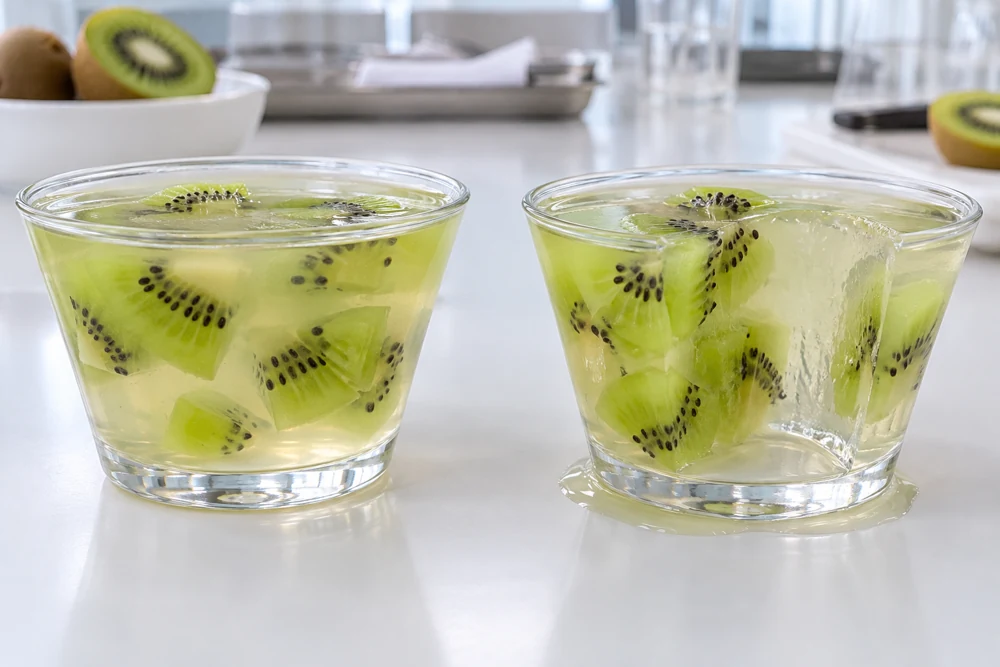
A dessert cup and released liquid illustrate a holding assessment without a time promise.
For the illustrative GreenLand buyer, the final decision may be to retain a heat-treated preparation, trial a sufficiently identified alternative, or use a different formulation. A valid outcome is the one that meets the intended product brief and is supported by evidence for the actual material. The commercial goal is not to prove a general warning wrong. It is to choose a reliable ingredient route while preserving the dessert's appearance, eating texture and feasible sourcing requirements.
Our response is therefore conditional in a useful way: kiwi need not be categorically excluded from gelatin desserts, but the exception must be qualified. Identify the material, keep assay evidence distinct from finished-gel performance, test the actual frozen input and document the scope of the result. That gives the buyer a concrete route to a decision without turning cultivar research into a promise about an untested GreenLand lot.
Source Frozen Kiwi with GreenLand-food
GreenLand-food manufactures frozen kiwi in China. We fill factory-direct wholesale orders for ingredient buyers and food manufacturers.
Tell us how you'll use frozen kiwi and where you need delivery. We'll review the product form and specification with you, then confirm packing, quantity, private-label details and requested documents. Send the intended product use, the two reports or trial conditions being compared, and the reporting basis for each result. Include material identity, preparation, sampling stage and the application endpoint.